

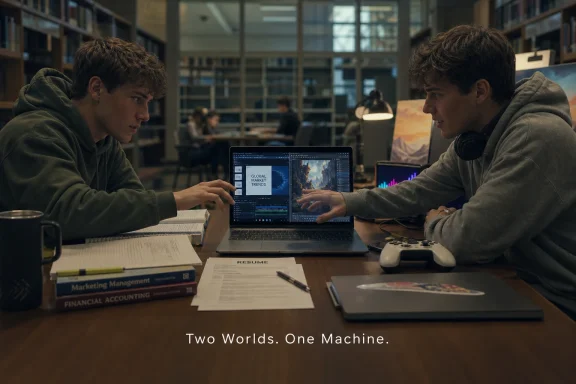
Microsoft’s Windows 11 “Doppelmode” campaign, launched in May 2026 with Droga5, is a student-focused ad built around 25 sets of identical twins in a college library to promote Windows 11 PCs and Microsoft’s U.S. College Offer. That sounds like a neat advertising gimmick until you look at what Microsoft is really trying to do. The company is not just selling laptops to students; it is trying to make Windows feel like the natural home for a life that no longer divides cleanly between work and play. “Two Worlds. One Machine.” is not subtle, but it is sharper than most back-to-school tech marketing because it admits the obvious: students already live in overlap.
The central idea of “Doppelmode” is simple enough to explain in one sentence: students have an academic self and a personal self, and both are fighting for the same screen. The ad literalizes that tension by placing a student and their double in the same quiet library, letting one side pull toward coursework, resumes, and presentations while the other side drags the room toward games, music, creative work, and interruption.
That is why the twin device works better than a conventional split-screen metaphor. Split screens are tidy. Twins are not. They can interrupt, mirror, compete, cooperate, and eventually sync, which is closer to the way students actually use PCs.
The library setting makes the whole thing land. A dorm room would have been too obvious, a campus quad too generic. A library is where students are supposed to perform focus, which makes it the perfect stage for showing the other half of their digital life creeping into view.
Microsoft’s point is not that distraction is virtuous. It is that the old advertising fantasy of a student as a perfectly disciplined productivity machine is false. College life now runs through the same device whether the task is a paper, a group chat, a job application, a stream, or a game.
This does not mean Microsoft is suddenly backing away from AI. Windows 11, Copilot, and Microsoft 365 are all part of a broader company strategy that treats AI as the next interface layer for everyday work. But the ad itself wisely avoids becoming another glowing abstraction about machine intelligence.
Instead, it feels physical. Bodies move through a real space. Laptops slide across tables. Controllers appear. Students react to people who are actually there. That gives the film a tactility that matters because the campaign is selling a human truth, not a benchmark.
There is also a useful tension here. Microsoft is pitching a modern, AI-adjacent computing environment through a piece of craft that deliberately looks handmade. That contrast helps the campaign avoid the synthetic sheen that has made so much recent tech advertising feel interchangeable.
“Doppelmode” solves that problem by refusing to explain everything Windows can do. It narrows the argument to one audience and one recognizable tension. A student needs a machine that can handle school without becoming a joyless appliance, and entertainment without becoming an unserious toy.
That is a more coherent pitch than a feature parade. Snap layouts, Microsoft 365, Copilot, Xbox Game Pass, phone integration, creative apps, and broad PC compatibility all support the argument, but none of them needs to dominate the ad. The product story is embedded in the behavior.
This is where the campaign shows discipline. It does not try to make Windows cool by pretending it is a lifestyle brand floating above the practical world. It makes Windows relevant by showing that practicality and pleasure already share the same machine.
That bundle is not decorative. It is the sales logic of the campaign made tangible. Microsoft 365 stands for coursework, resumes, presentations, collaboration, and storage. Xbox Game Pass Ultimate and the controller stand for downtime, games, and the student’s personal life after the assignment is submitted.
This matters because student laptop buying is rarely just a student decision. Parents may care about value and school readiness. Students may care about versatility, identity, and whether the device feels enjoyable after class. Retailers care about timing and conversion. Microsoft is trying to satisfy all three without sounding like it has three different messages.
The offer also reveals the competitive pressure underneath the creative polish. Microsoft knows that the student market is not automatically loyal to Windows. MacBooks remain culturally powerful on campus, Chromebooks compete on price and simplicity, and tablets have eaten into casual computing. A bundle worth real money is Microsoft’s way of turning Windows’ breadth into a purchase argument.
Students are ambitious and distracted. They are under pressure and looking for relief. They are trying to build resumes while managing friendships, finances, deadlines, family expectations, and the ambient noise of the internet. Their laptop is not a sacred study altar; it is the control panel for all of it.
That recognition gives the campaign its warmth. The playful double is not treated as a villain. The productive double is not treated as a bore. The film’s movement from disruption to choreography suggests coexistence rather than conquest.
That is a smart emotional position for Microsoft. A brand that tells students to eliminate their mess sounds like a lecturer. A brand that says it understands the mess sounds like a useful tool.
For students, that variety is not abstract. One buyer may need a cheap but serviceable laptop for essays and online classes. Another may need a machine that can handle engineering software. Another may want creative tools, gaming, and video editing. Another may simply want a device that does not force too many compromises.
Windows 11’s multitasking features, broad software compatibility, and gaming ecosystem all reinforce the “one machine” line. Not every Windows laptop will be equally good at every task, and Microsoft’s campaign should not be read as a promise that any qualifying PC magically becomes a premium gaming rig. But the platform argument is still clear: Windows is where more of those use cases can plausibly coexist.
That is the difference between metaphor and product truth. “Two Worlds. One Machine.” works because Windows really is designed to accommodate more than one identity at once.
If the ad had leaned into AI-generated doubles, it would have risked becoming a demonstration of synthetic cleverness rather than a story about students. By using real twins, choreography, and in-camera craft, the campaign makes the human behavior feel primary. The technology is present, but it does not swallow the scene.
That is a lesson Microsoft would do well to remember beyond advertising. AI features are most persuasive when they disappear into useful workflows. They are least persuasive when they announce themselves as the point of the experience.
In that sense, “Doppelmode” accidentally models a better AI-era product philosophy. The machine should help manage the user’s life, not demand that the user admire the machine.
That is why Microsoft’s bundle matters so much. The company is not merely saying Windows PCs are capable. It is saying the total package is harder to dismiss: a PC, productivity software, a gaming subscription, and a customizable controller. The message is value, but the deeper message is completeness.
There is a risk here. Bundles can feel generous, but they can also feel like compensation. If a student already wants a MacBook, a year of subscriptions may not change their mind. If a cheap Windows laptop feels compromised in build quality, display, battery life, or trackpad experience, no campaign can fully hide that.
But Microsoft does not need to win every student to make this campaign useful. It needs to make Windows feel like the rational and culturally acceptable choice for students who want flexibility. “Doppelmode” gives that flexibility a memorable shape.
It also does not try to make the student’s two modes perfectly balanced. That would be dishonest. Sometimes play interrupts work. Sometimes work crowds out leisure. Sometimes the same laptop is the source of both productivity and procrastination. The campaign’s choreography is idealized, but the underlying tension is real.
That is why the spot feels more observant than preachy. It gives Microsoft a way to talk to students without sounding like an institution. For a company whose brand can easily drift toward enterprise seriousness, that tonal shift is valuable.
Droga5’s contribution is not just the visual trick. It is the decision to let the trick carry the strategy. The best advertising ideas do not need a paragraph of explanation before they work. “Doppelmode” reads immediately, and then becomes more interesting the longer you sit with it.
For a student choosing a laptop, the emotional question is not “Which platform has the most comprehensive ecosystem strategy?” It is “Will this thing fit my life?” Microsoft’s campaign answers that question in a human-scale way.
That does not make the campaign immune to criticism. The Windows experience still depends heavily on the quality of the PC purchased, the configuration chosen, OEM software decisions, battery performance, and how well Microsoft keeps the operating system from feeling cluttered. A great ad cannot fix a bad first boot experience.
But it can clarify the promise. Windows 11 is not being sold here as the austere machine of productivity or the neon-lit machine of gaming. It is being sold as the machine of transition. That is a stronger and more honest position.
Source: ALM Corp Microsoft Windows 11 “Doppelmode” Campaign Explained: How Droga5 Framed One PC for Study, Gaming, and Student Life | ALM Corp
 Microsoft Turns Multitasking Into a Mirror Trick
The central idea of “Doppelmode” is simple enough to explain in one sentence: students have an academic self and a personal self, and both are fighting for the same screen. The ad literalizes that tension by placing a student and their double in the same quiet library, letting one side pull toward coursework, resumes, and presentations while the other side drags the room toward games, music, creative work, and interruption.That is why the twin device works better than a conventional split-screen metaphor. Split screens are tidy. Twins are not. They can interrupt, mirror, compete, cooperate, and eventually sync, which is closer to the way students actually use PCs.
The library setting makes the whole thing land. A dorm room would have been too obvious, a campus quad too generic. A library is where students are supposed to perform focus, which makes it the perfect stage for showing the other half of their digital life creeping into view.
Microsoft’s point is not that distraction is virtuous. It is that the old advertising fantasy of a student as a perfectly disciplined productivity machine is false. College life now runs through the same device whether the task is a paper, a group chat, a job application, a stream, or a game.
The Craft Choice Is Doing More Than Showing Off
The most repeated production fact about the campaign is also the most important one: the film reportedly used 25 sets of identical twins and was shot in camera rather than relying on AI-generated doubles. In an era when every tech company is desperate to attach itself to AI, that restraint is striking.This does not mean Microsoft is suddenly backing away from AI. Windows 11, Copilot, and Microsoft 365 are all part of a broader company strategy that treats AI as the next interface layer for everyday work. But the ad itself wisely avoids becoming another glowing abstraction about machine intelligence.
Instead, it feels physical. Bodies move through a real space. Laptops slide across tables. Controllers appear. Students react to people who are actually there. That gives the film a tactility that matters because the campaign is selling a human truth, not a benchmark.
There is also a useful tension here. Microsoft is pitching a modern, AI-adjacent computing environment through a piece of craft that deliberately looks handmade. That contrast helps the campaign avoid the synthetic sheen that has made so much recent tech advertising feel interchangeable.
Droga5 Finds a Cleaner Windows Story Than the Spec Sheet
Windows marketing has often had a structural problem: the platform is so broad that it can be hard to make it feel like one thing. Windows is enterprise infrastructure, a gaming platform, a student laptop OS, a developer workstation, a creative canvas, and the default PC environment for hundreds of millions of people. Breadth is an advantage in the market, but it can be a liability in storytelling.“Doppelmode” solves that problem by refusing to explain everything Windows can do. It narrows the argument to one audience and one recognizable tension. A student needs a machine that can handle school without becoming a joyless appliance, and entertainment without becoming an unserious toy.
That is a more coherent pitch than a feature parade. Snap layouts, Microsoft 365, Copilot, Xbox Game Pass, phone integration, creative apps, and broad PC compatibility all support the argument, but none of them needs to dominate the ad. The product story is embedded in the behavior.
This is where the campaign shows discipline. It does not try to make Windows cool by pretending it is a lifestyle brand floating above the practical world. It makes Windows relevant by showing that practicality and pleasure already share the same machine.
The Bundle Makes the Metaphor Commercially Useful
The Microsoft College Offer gives the campaign its hard retail edge. Eligible U.S. college students buying a qualifying Windows 11 PC can receive one year of Microsoft 365 Premium, one year of Xbox Game Pass Ultimate, and an Xbox Design Lab Wireless Controller, subject to the usual verification and promotional terms.That bundle is not decorative. It is the sales logic of the campaign made tangible. Microsoft 365 stands for coursework, resumes, presentations, collaboration, and storage. Xbox Game Pass Ultimate and the controller stand for downtime, games, and the student’s personal life after the assignment is submitted.
This matters because student laptop buying is rarely just a student decision. Parents may care about value and school readiness. Students may care about versatility, identity, and whether the device feels enjoyable after class. Retailers care about timing and conversion. Microsoft is trying to satisfy all three without sounding like it has three different messages.
The offer also reveals the competitive pressure underneath the creative polish. Microsoft knows that the student market is not automatically loyal to Windows. MacBooks remain culturally powerful on campus, Chromebooks compete on price and simplicity, and tablets have eaten into casual computing. A bundle worth real money is Microsoft’s way of turning Windows’ breadth into a purchase argument.
The Ad Works Because It Does Not Scold the Student
A lot of student advertising still carries a faintly moral tone. It tells young people to focus harder, plan better, optimize more, and become the polished future professional the brand imagines they should be. “Doppelmode” is more effective because it starts from a less flattering but more truthful premise.Students are ambitious and distracted. They are under pressure and looking for relief. They are trying to build resumes while managing friendships, finances, deadlines, family expectations, and the ambient noise of the internet. Their laptop is not a sacred study altar; it is the control panel for all of it.
That recognition gives the campaign its warmth. The playful double is not treated as a villain. The productive double is not treated as a bore. The film’s movement from disruption to choreography suggests coexistence rather than conquest.
That is a smart emotional position for Microsoft. A brand that tells students to eliminate their mess sounds like a lecturer. A brand that says it understands the mess sounds like a useful tool.
Windows 11 Gets Cast as the Platform of Overlap
The campaign’s best strategic move is that it frames Windows 11 as a mixed-use platform rather than a narrow productivity environment. That is where Windows has a legitimate claim. The operating system’s value has always come from its tolerance for variety: different hardware makers, different price bands, different input styles, different apps, different games, different workflows.For students, that variety is not abstract. One buyer may need a cheap but serviceable laptop for essays and online classes. Another may need a machine that can handle engineering software. Another may want creative tools, gaming, and video editing. Another may simply want a device that does not force too many compromises.
Windows 11’s multitasking features, broad software compatibility, and gaming ecosystem all reinforce the “one machine” line. Not every Windows laptop will be equally good at every task, and Microsoft’s campaign should not be read as a promise that any qualifying PC magically becomes a premium gaming rig. But the platform argument is still clear: Windows is where more of those use cases can plausibly coexist.
That is the difference between metaphor and product truth. “Two Worlds. One Machine.” works because Windows really is designed to accommodate more than one identity at once.
The No-AI Production Angle Quietly Helps Microsoft’s AI Story
One of the more interesting things about “Doppelmode” is that its practical execution may make Microsoft’s technology pitch more believable, not less. The company has spent the last several years attaching Copilot to nearly every corner of its software universe. That makes restraint valuable.If the ad had leaned into AI-generated doubles, it would have risked becoming a demonstration of synthetic cleverness rather than a story about students. By using real twins, choreography, and in-camera craft, the campaign makes the human behavior feel primary. The technology is present, but it does not swallow the scene.
That is a lesson Microsoft would do well to remember beyond advertising. AI features are most persuasive when they disappear into useful workflows. They are least persuasive when they announce themselves as the point of the experience.
In that sense, “Doppelmode” accidentally models a better AI-era product philosophy. The machine should help manage the user’s life, not demand that the user admire the machine.
The Campus PC Fight Is Really a Fight Over Sufficiency
The student laptop market is not just a battle over specs. It is a battle over whether one purchase feels sufficient. Families and students are asking whether a machine can last several years, run the required tools, support entertainment, stay secure, travel easily, and justify its price.That is why Microsoft’s bundle matters so much. The company is not merely saying Windows PCs are capable. It is saying the total package is harder to dismiss: a PC, productivity software, a gaming subscription, and a customizable controller. The message is value, but the deeper message is completeness.
There is a risk here. Bundles can feel generous, but they can also feel like compensation. If a student already wants a MacBook, a year of subscriptions may not change their mind. If a cheap Windows laptop feels compromised in build quality, display, battery life, or trackpad experience, no campaign can fully hide that.
But Microsoft does not need to win every student to make this campaign useful. It needs to make Windows feel like the rational and culturally acceptable choice for students who want flexibility. “Doppelmode” gives that flexibility a memorable shape.
A Better Student Campaign Because It Knows What Not to Say
The ad avoids several traps that often weaken tech marketing. It does not reduce students to clichés of backpacks, dorm posters, and inspirational voiceovers. It does not turn Windows into a dry checklist. It does not pretend gaming is a guilty secret. It does not over-explain AI.It also does not try to make the student’s two modes perfectly balanced. That would be dishonest. Sometimes play interrupts work. Sometimes work crowds out leisure. Sometimes the same laptop is the source of both productivity and procrastination. The campaign’s choreography is idealized, but the underlying tension is real.
That is why the spot feels more observant than preachy. It gives Microsoft a way to talk to students without sounding like an institution. For a company whose brand can easily drift toward enterprise seriousness, that tonal shift is valuable.
Droga5’s contribution is not just the visual trick. It is the decision to let the trick carry the strategy. The best advertising ideas do not need a paragraph of explanation before they work. “Doppelmode” reads immediately, and then becomes more interesting the longer you sit with it.
The Windows Brand Needed a Human-Scale Argument
Windows is too often discussed at the level of servicing, telemetry, hardware requirements, security baselines, AI roadmaps, and enterprise deployment. Those things matter enormously to WindowsForum readers, especially administrators and power users. But consumer relevance works differently.For a student choosing a laptop, the emotional question is not “Which platform has the most comprehensive ecosystem strategy?” It is “Will this thing fit my life?” Microsoft’s campaign answers that question in a human-scale way.
That does not make the campaign immune to criticism. The Windows experience still depends heavily on the quality of the PC purchased, the configuration chosen, OEM software decisions, battery performance, and how well Microsoft keeps the operating system from feeling cluttered. A great ad cannot fix a bad first boot experience.
But it can clarify the promise. Windows 11 is not being sold here as the austere machine of productivity or the neon-lit machine of gaming. It is being sold as the machine of transition. That is a stronger and more honest position.
The Twins Make Microsoft’s Student Pitch Harder to Ignore
The most concrete lesson from “Doppelmode” is that Microsoft has found a way to make Windows’ breadth feel like a benefit rather than a blur. The campaign is not important because it is cute. It is important because it translates a platform advantage into a student reality.- Microsoft’s “Doppelmode” campaign uses identical twins to dramatize how students move between academic and personal lives on the same PC.
- The practical, in-camera production gives the ad a human quality that stands out in an AI-heavy technology marketing cycle.
- The Microsoft College Offer makes the campaign more than a metaphor by bundling Microsoft 365 Premium, Xbox Game Pass Ultimate, and a customizable Xbox controller with qualifying Windows 11 PC purchases for eligible U.S. students.
- The campaign’s strongest strategic line is that Windows 11 can be positioned as a mixed-use platform rather than merely a school machine or gaming device.
- The biggest limitation is that the promise depends on the quality of the specific Windows PC a student buys, not just on the Windows brand itself.
Source: ALM Corp Microsoft Windows 11 “Doppelmode” Campaign Explained: How Droga5 Framed One PC for Study, Gaming, and Student Life | ALM Corp
