

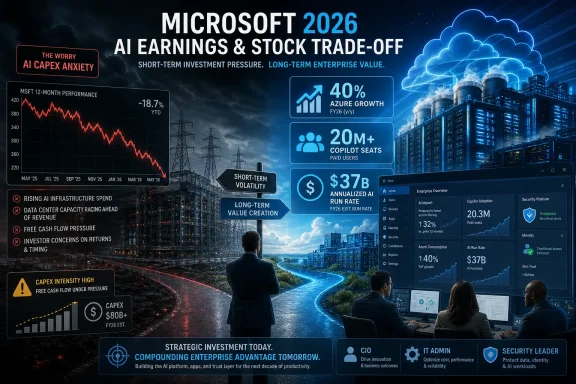
Microsoft entered the second half of 2026 with its stock roughly 20 percent below where it began the year, even after reporting fiscal third-quarter revenue of $82.9 billion, 40 percent Azure growth, and an AI business running above a $37 billion annualized revenue pace. That is the heart of the trade: Wall Street is treating Microsoft like a company whose AI spending has become a liability, while the operating data still looks like a company turning that spending into revenue. As MarketBeat argued in its July 5 analysis, the bearish story is no longer about whether Microsoft can grow; it is about whether investors still trust the price of that growth. For Windows users, enterprise admins, and anyone watching the platform economy, this is not just a stock chart story — it is a referendum on whether Microsoft’s AI-era Windows-and-cloud stack is becoming more valuable or merely more expensive.
The easy explanation for Microsoft’s bruising first half is that investors lost patience with Big Tech’s AI bill. The better explanation is that Microsoft became the cleanest test case for whether AI infrastructure spending can mature into a durable software-and-cloud profit engine. Unlike a chipmaker selling into the boom, Microsoft is trying to absorb the cost, resell the capability, and bundle the result into products customers already use.
That is why the selloff matters. A stock can fall because the business is deteriorating, or because expectations have detached from the timing of the payoff. Microsoft’s recent numbers point more toward the second case than the first. Fiscal third-quarter revenue rose 18 percent year over year, operating income rose 20 percent, and diluted earnings per share reached $4.27, according to Microsoft’s own earnings release.
The market, however, has not rewarded the company as though it solved the AI monetization problem. It has punished the company as though it merely proved AI is expensive. That distinction is the central tension for the second half of 2026.
MarketBeat’s argument is that Microsoft now looks like the most attractive Big Tech rebound trade because its valuation has compressed while its fundamentals have accelerated. That is a defensible case. But it is also incomplete unless we acknowledge why investors became skeptical in the first place.
For years, Microsoft enjoyed the best of both worlds. It was valued like a high-margin software platform, while Azure gave it the growth profile of a cloud infrastructure provider. AI has complicated that model. The company now needs enormous physical investment — data centers, networking, accelerators, power, cooling, storage, and memory — to defend the software margins investors love.
That does not make Microsoft a bad business. It makes Microsoft a more capital-intensive business than many shareholders were trained to expect. The question is whether those investments create a moat or merely an arms race.
The strongest evidence for the moat argument is Azure’s acceleration. Microsoft reported Azure and other cloud services revenue growth of 40 percent in fiscal Q3 2026, driven by demand across the platform. In a normal software cycle, that number would be the entire story. In the AI cycle, investors immediately ask what it cost to produce.
That is the new Microsoft bargain. The company is still selling software, subscriptions, identity, security, developer tools, databases, and cloud services. But underneath that familiar revenue engine is a data-center buildout that looks increasingly like national-scale infrastructure.
The sharper critique now is not that AI revenue is imaginary. It is that the revenue may not be profitable enough, soon enough, to justify the spending required to sustain it. That is a much more serious argument.
Microsoft’s fiscal Q3 capital expenditures, including finance leases, reached $31.9 billion, up sharply from the prior year, while free cash flow fell. For a company that built its reputation on producing oceans of cash, the direction of free cash flow matters. Investors are not wrong to notice when the machine becomes hungrier.
But the bearish case can also overreach. Microsoft is not a speculative AI application company waiting for product-market fit. It has enterprise distribution, cloud demand, Windows endpoints, GitHub, Office, Teams, Dynamics, security products, and a developer ecosystem that gives it many places to monetize AI features. The spending risk is real, but so is the revenue surface area.
That is what makes Microsoft different from a pure AI infrastructure bet. It does not need every dollar of AI investment to show up in one product line. It can monetize AI through Azure consumption, Copilot seats, GitHub usage, security automation, database services, and higher retention across Microsoft 365.
In the demo phase, AI products win attention by producing surprising moments. In the enterprise phase, they win budgets by saving time, reducing tool sprawl, improving compliance, or making workers less dependent on specialized interfaces. Microsoft’s advantage is that it can insert Copilot into the work graph that already exists inside Microsoft 365.
That does not guarantee happy customers. Many IT departments are still wrestling with licensing costs, permission hygiene, data governance, prompt quality, hallucination risk, and unclear productivity measurement. Copilot’s seat count answers the adoption question only partially. It does not settle the return-on-investment debate.
Still, a paid-seat base above 20 million changes the frame. Copilot is no longer just a strategic promise used to justify a premium multiple. It is becoming a commercial product with renewal cycles, usage patterns, deployment lessons, and upsell potential.
For WindowsForum readers, this is where the stock story intersects with daily IT reality. The more Microsoft succeeds with Copilot, the more AI becomes embedded in the administrative, productivity, and security surfaces of Windows-based organizations. That makes Microsoft’s AI trade less abstract than Nvidia’s chip cycle or an AI startup’s model release.
That doorway matters more in the AI era, not less. AI features are only as useful as their access to context, identity, files, applications, policies, and workflows. Windows endpoints, Entra identity, Microsoft 365 data, Defender telemetry, and Intune management form a distribution and governance layer that most competitors cannot easily replicate.
This is why Microsoft can survive skepticism about any single AI feature. If one Copilot workflow disappoints, another may still create value inside Teams, Outlook, Excel, PowerPoint, Visual Studio Code, GitHub, Defender, or Azure. The company’s strength is not that every AI product will be a hit. It is that Microsoft has more enterprise surfaces on which AI can become useful.
The risk is that this same breadth can feel coercive. Admins already know the pattern: a new capability arrives wrapped in licensing complexity, dashboard sprawl, policy questions, and security reviews. Microsoft’s AI expansion will be judged not only by investors but by the people who must deploy, govern, explain, and troubleshoot it.
That is where the company’s stock multiple meets its reputation. If Microsoft makes AI feel like a productivity layer, the valuation can recover. If it makes AI feel like another expensive licensing maze, the recovery becomes harder.
Microsoft’s More Personal Computing segment has been dealing with weak Xbox hardware revenue, and gaming coverage from outlets such as Windows Central, Tom’s Hardware, and TechSpot has tracked the worsening console economics. MarketBeat highlighted memory costs as one of the newest concerns facing Microsoft, particularly because gaming hardware is exposed to component inflation.
This is the irony of Microsoft’s position. The company is one of the giants driving demand for AI infrastructure, yet parts of its own consumer hardware ecosystem can be squeezed by the same supply dynamics. AI demand lifts Azure, but it can also raise the cost of building boxes that sit under televisions.
The financial importance of Xbox hardware should not be exaggerated. Microsoft’s future is not going to be decided by console unit margins alone. But Xbox reveals a broader truth: AI is not a clean software upgrade layered on top of the existing economy. It is a physical supply-chain event that touches memory, storage, power, land, cooling, networking, and semiconductors.
That matters for investors because it complicates the simple “AI revenue goes up” story. Some AI-driven costs show up in obvious places, like data-center capex. Others show up indirectly, in hardware margins, product pricing, and delayed upgrade cycles.
MarketBeat points to a forward price-to-earnings ratio near 23 times, below Microsoft’s longer-term average and far below some AI favorites. That comparison is not perfect, because Nvidia and Palantir have different growth profiles and investor bases. But it captures the trade setup: Microsoft is being priced with more skepticism even as its AI and cloud numbers remain strong.
The stock’s drop from its 52-week high near $555 to a June low around $349 created a rare technical reset for a company of this quality. A drawdown of that scale forces a different kind of investor conversation. Momentum traders see damage; value-oriented growth investors see a chance to buy a compounder after multiple compression.
The chart alone should not drive the thesis. Technical rebounds can fail, and a move above a round number like $400 is not a business model. Still, when a stock stabilizes after a large drawdown while the underlying company continues to grow revenue and earnings, the setup becomes interesting.
The risk is that investors are early. A stock can be fundamentally attractive and still spend months frustrating buyers if the market remains focused on capex, free cash flow, or AI saturation. Microsoft’s second-half trade is therefore not a simple bet on good earnings. It is a bet that the market’s attention rotates from spending fear back to revenue quality.
Enterprise AI adoption is not a single switch. It is a sequence of approvals. Legal teams ask where the data goes. Security teams ask what the model can see. Finance teams ask whether a Copilot license replaces labor, reduces software spend, or simply adds another line item. Admins ask how to keep permissions from turning into accidental data exposure.
Microsoft has an advantage because those conversations often happen inside accounts where it already has trust, contracts, identity systems, and compliance documentation. It also has a disadvantage because customers know Microsoft’s licensing habits too well. The company’s ability to bundle can accelerate adoption, but it can also intensify suspicion.
That is why the 20 million paid Copilot seats should be read as a beginning, not a verdict. The next question is renewal quality. Are customers expanding deployments after pilots? Are users engaging regularly? Are organizations willing to pay for more advanced agents, connectors, and consumption-based services?
If the answer is yes, Microsoft’s AI spending starts to look like the foundation of the next enterprise platform cycle. If the answer is no, the company risks owning a very expensive infrastructure layer for products that customers treat as optional enhancements.
Investors like clarity. The OpenAI relationship is powerful, but it is not simple. Microsoft is a partner, investor, infrastructure provider, product distributor, and, in some areas, a company that must preserve optionality across models. The rise of open-source and alternative commercial models has made the landscape more competitive than it looked during the first wave of ChatGPT enthusiasm.
That competition is not necessarily bad for Microsoft. If customers want model choice, Azure can sell the platform that hosts, governs, and connects those models. If enterprises want Microsoft-controlled experiences, Copilot can provide the packaged layer. If developers want tools, GitHub and Azure AI services remain natural entry points.
But the “SaaSpocalypse” narrative MarketBeat references reflects a real anxiety: that AI agents and open models could weaken traditional software pricing. If AI makes it easier to automate workflows across applications, then incumbent software vendors may have to prove that their suites remain indispensable. Microsoft is better positioned than most incumbents, but it is not immune.
The second half of 2026 will test whether Microsoft can keep AI as an attachment to its ecosystem rather than a solvent that dissolves software margins. That is a subtle but crucial distinction.
That balance is the appeal. Microsoft has cloud growth, enterprise AI distribution, productivity software, security, developer tools, gaming, LinkedIn, Windows, and a shareholder-return program. It is exposed to AI upside without being solely dependent on one layer of the stack.
It is also exposed to nearly every criticism of the AI boom. It spends heavily on data centers. It must justify AI licensing. It faces component inflation. It must compete with open models. It must persuade customers that Copilot is worth paying for at scale. It must keep regulators, enterprise buyers, developers, gamers, and shareholders from concluding that the company is trying to tax too many workflows at once.
That is why Microsoft’s setup is attractive but not effortless. The stock’s weakness has created a better entry point, but the company still needs to show that its AI investment cycle produces expanding cash flow, not just expanding revenue.
The best trade is often the one where sentiment has overshot the actual deterioration. Microsoft looks like a candidate for that category. The business has not cracked; the market’s patience has.
 Microsoft’s Selloff Is Really a Trial of the AI Supercycle
The easy explanation for Microsoft’s bruising first half is that investors lost patience with Big Tech’s AI bill. The better explanation is that Microsoft became the cleanest test case for whether AI infrastructure spending can mature into a durable software-and-cloud profit engine. Unlike a chipmaker selling into the boom, Microsoft is trying to absorb the cost, resell the capability, and bundle the result into products customers already use.That is why the selloff matters. A stock can fall because the business is deteriorating, or because expectations have detached from the timing of the payoff. Microsoft’s recent numbers point more toward the second case than the first. Fiscal third-quarter revenue rose 18 percent year over year, operating income rose 20 percent, and diluted earnings per share reached $4.27, according to Microsoft’s own earnings release.
The market, however, has not rewarded the company as though it solved the AI monetization problem. It has punished the company as though it merely proved AI is expensive. That distinction is the central tension for the second half of 2026.
MarketBeat’s argument is that Microsoft now looks like the most attractive Big Tech rebound trade because its valuation has compressed while its fundamentals have accelerated. That is a defensible case. But it is also incomplete unless we acknowledge why investors became skeptical in the first place.
The Cloud Giant Is Spending Like a Utility and Selling Like a Software Company
Microsoft’s capital expenditure story has become the bull case and the bear case at the same time. On the earnings call, Microsoft said it expected roughly $190 billion in calendar-year 2026 capital expenditures, including a sizable impact from higher component pricing. That number is large enough to change how investors think about the company.For years, Microsoft enjoyed the best of both worlds. It was valued like a high-margin software platform, while Azure gave it the growth profile of a cloud infrastructure provider. AI has complicated that model. The company now needs enormous physical investment — data centers, networking, accelerators, power, cooling, storage, and memory — to defend the software margins investors love.
That does not make Microsoft a bad business. It makes Microsoft a more capital-intensive business than many shareholders were trained to expect. The question is whether those investments create a moat or merely an arms race.
The strongest evidence for the moat argument is Azure’s acceleration. Microsoft reported Azure and other cloud services revenue growth of 40 percent in fiscal Q3 2026, driven by demand across the platform. In a normal software cycle, that number would be the entire story. In the AI cycle, investors immediately ask what it cost to produce.
That is the new Microsoft bargain. The company is still selling software, subscriptions, identity, security, developer tools, databases, and cloud services. But underneath that familiar revenue engine is a data-center buildout that looks increasingly like national-scale infrastructure.
The Bear Case Has Graduated From “AI Hype” to “AI Margin Math”
A year ago, the bearish critique of Microsoft’s AI push often sounded too simple: Copilot was overhyped, customers were experimenting rather than committing, and OpenAI-linked enthusiasm had inflated the stock. That critique is harder to sustain after Microsoft disclosed more than 20 million paid Microsoft 365 Copilot seats and an AI annualized revenue run rate above $37 billion.The sharper critique now is not that AI revenue is imaginary. It is that the revenue may not be profitable enough, soon enough, to justify the spending required to sustain it. That is a much more serious argument.
Microsoft’s fiscal Q3 capital expenditures, including finance leases, reached $31.9 billion, up sharply from the prior year, while free cash flow fell. For a company that built its reputation on producing oceans of cash, the direction of free cash flow matters. Investors are not wrong to notice when the machine becomes hungrier.
But the bearish case can also overreach. Microsoft is not a speculative AI application company waiting for product-market fit. It has enterprise distribution, cloud demand, Windows endpoints, GitHub, Office, Teams, Dynamics, security products, and a developer ecosystem that gives it many places to monetize AI features. The spending risk is real, but so is the revenue surface area.
That is what makes Microsoft different from a pure AI infrastructure bet. It does not need every dollar of AI investment to show up in one product line. It can monetize AI through Azure consumption, Copilot seats, GitHub usage, security automation, database services, and higher retention across Microsoft 365.
Copilot Has Crossed the Line From Demo to Line Item
The most important Copilot number is not that Microsoft has more than 20 million paid seats. It is that Copilot is now large enough to be judged by enterprise software standards rather than keynote standards. That is a less glamorous phase, but a more meaningful one.In the demo phase, AI products win attention by producing surprising moments. In the enterprise phase, they win budgets by saving time, reducing tool sprawl, improving compliance, or making workers less dependent on specialized interfaces. Microsoft’s advantage is that it can insert Copilot into the work graph that already exists inside Microsoft 365.
That does not guarantee happy customers. Many IT departments are still wrestling with licensing costs, permission hygiene, data governance, prompt quality, hallucination risk, and unclear productivity measurement. Copilot’s seat count answers the adoption question only partially. It does not settle the return-on-investment debate.
Still, a paid-seat base above 20 million changes the frame. Copilot is no longer just a strategic promise used to justify a premium multiple. It is becoming a commercial product with renewal cycles, usage patterns, deployment lessons, and upsell potential.
For WindowsForum readers, this is where the stock story intersects with daily IT reality. The more Microsoft succeeds with Copilot, the more AI becomes embedded in the administrative, productivity, and security surfaces of Windows-based organizations. That makes Microsoft’s AI trade less abstract than Nvidia’s chip cycle or an AI startup’s model release.
Windows Is No Longer the Growth Engine, but It Still Controls the Doorway
Microsoft’s stock is not primarily a Windows trade anymore. Azure, Microsoft 365, AI services, and enterprise cloud workloads carry the growth narrative. Yet Windows remains strategically important because it gives Microsoft a privileged doorway into enterprise computing.That doorway matters more in the AI era, not less. AI features are only as useful as their access to context, identity, files, applications, policies, and workflows. Windows endpoints, Entra identity, Microsoft 365 data, Defender telemetry, and Intune management form a distribution and governance layer that most competitors cannot easily replicate.
This is why Microsoft can survive skepticism about any single AI feature. If one Copilot workflow disappoints, another may still create value inside Teams, Outlook, Excel, PowerPoint, Visual Studio Code, GitHub, Defender, or Azure. The company’s strength is not that every AI product will be a hit. It is that Microsoft has more enterprise surfaces on which AI can become useful.
The risk is that this same breadth can feel coercive. Admins already know the pattern: a new capability arrives wrapped in licensing complexity, dashboard sprawl, policy questions, and security reviews. Microsoft’s AI expansion will be judged not only by investors but by the people who must deploy, govern, explain, and troubleshoot it.
That is where the company’s stock multiple meets its reputation. If Microsoft makes AI feel like a productivity layer, the valuation can recover. If it makes AI feel like another expensive licensing maze, the recovery becomes harder.
Xbox Is the Warning Label on the AI Infrastructure Boom
The Xbox business is not large enough to define Microsoft’s valuation, but it is a useful warning label for the broader technology economy. Rising memory and storage costs are not just an inconvenience for console margins. They show how the AI infrastructure boom can pressure adjacent hardware businesses inside the same company.Microsoft’s More Personal Computing segment has been dealing with weak Xbox hardware revenue, and gaming coverage from outlets such as Windows Central, Tom’s Hardware, and TechSpot has tracked the worsening console economics. MarketBeat highlighted memory costs as one of the newest concerns facing Microsoft, particularly because gaming hardware is exposed to component inflation.
This is the irony of Microsoft’s position. The company is one of the giants driving demand for AI infrastructure, yet parts of its own consumer hardware ecosystem can be squeezed by the same supply dynamics. AI demand lifts Azure, but it can also raise the cost of building boxes that sit under televisions.
The financial importance of Xbox hardware should not be exaggerated. Microsoft’s future is not going to be decided by console unit margins alone. But Xbox reveals a broader truth: AI is not a clean software upgrade layered on top of the existing economy. It is a physical supply-chain event that touches memory, storage, power, land, cooling, networking, and semiconductors.
That matters for investors because it complicates the simple “AI revenue goes up” story. Some AI-driven costs show up in obvious places, like data-center capex. Others show up indirectly, in hardware margins, product pricing, and delayed upgrade cycles.
The Valuation Reset Is What Makes the Trade Plausible
Microsoft is not cheap in the way a distressed industrial stock is cheap. It is still a nearly $3 trillion company by recent market values, with a premium business mix and premium expectations. But the relevant question is not whether Microsoft is cheap in absolute terms. It is whether Microsoft is cheap relative to its durability, growth, and AI monetization evidence.MarketBeat points to a forward price-to-earnings ratio near 23 times, below Microsoft’s longer-term average and far below some AI favorites. That comparison is not perfect, because Nvidia and Palantir have different growth profiles and investor bases. But it captures the trade setup: Microsoft is being priced with more skepticism even as its AI and cloud numbers remain strong.
The stock’s drop from its 52-week high near $555 to a June low around $349 created a rare technical reset for a company of this quality. A drawdown of that scale forces a different kind of investor conversation. Momentum traders see damage; value-oriented growth investors see a chance to buy a compounder after multiple compression.
The chart alone should not drive the thesis. Technical rebounds can fail, and a move above a round number like $400 is not a business model. Still, when a stock stabilizes after a large drawdown while the underlying company continues to grow revenue and earnings, the setup becomes interesting.
The risk is that investors are early. A stock can be fundamentally attractive and still spend months frustrating buyers if the market remains focused on capex, free cash flow, or AI saturation. Microsoft’s second-half trade is therefore not a simple bet on good earnings. It is a bet that the market’s attention rotates from spending fear back to revenue quality.
Enterprise IT Will Decide Whether the AI Premium Is Earned
The most important voters in Microsoft’s second-half story are not day traders staring at RSI readings. They are CIOs, procurement teams, security leaders, developers, and administrators deciding whether Microsoft’s AI products deserve budget.Enterprise AI adoption is not a single switch. It is a sequence of approvals. Legal teams ask where the data goes. Security teams ask what the model can see. Finance teams ask whether a Copilot license replaces labor, reduces software spend, or simply adds another line item. Admins ask how to keep permissions from turning into accidental data exposure.
Microsoft has an advantage because those conversations often happen inside accounts where it already has trust, contracts, identity systems, and compliance documentation. It also has a disadvantage because customers know Microsoft’s licensing habits too well. The company’s ability to bundle can accelerate adoption, but it can also intensify suspicion.
That is why the 20 million paid Copilot seats should be read as a beginning, not a verdict. The next question is renewal quality. Are customers expanding deployments after pilots? Are users engaging regularly? Are organizations willing to pay for more advanced agents, connectors, and consumption-based services?
If the answer is yes, Microsoft’s AI spending starts to look like the foundation of the next enterprise platform cycle. If the answer is no, the company risks owning a very expensive infrastructure layer for products that customers treat as optional enhancements.
The OpenAI Relationship Is Still a Strategic Asset and a Valuation Overhang
Microsoft’s OpenAI partnership remains one of the defining strategic moves of the AI era. It gave Microsoft early access to frontier-model momentum, allowed it to infuse AI into products quickly, and helped Azure become a central platform for AI workloads. But the relationship also adds complexity to the investment case.Investors like clarity. The OpenAI relationship is powerful, but it is not simple. Microsoft is a partner, investor, infrastructure provider, product distributor, and, in some areas, a company that must preserve optionality across models. The rise of open-source and alternative commercial models has made the landscape more competitive than it looked during the first wave of ChatGPT enthusiasm.
That competition is not necessarily bad for Microsoft. If customers want model choice, Azure can sell the platform that hosts, governs, and connects those models. If enterprises want Microsoft-controlled experiences, Copilot can provide the packaged layer. If developers want tools, GitHub and Azure AI services remain natural entry points.
But the “SaaSpocalypse” narrative MarketBeat references reflects a real anxiety: that AI agents and open models could weaken traditional software pricing. If AI makes it easier to automate workflows across applications, then incumbent software vendors may have to prove that their suites remain indispensable. Microsoft is better positioned than most incumbents, but it is not immune.
The second half of 2026 will test whether Microsoft can keep AI as an attachment to its ecosystem rather than a solvent that dissolves software margins. That is a subtle but crucial distinction.
The Best Big Tech Trade Is Not Necessarily the Cleanest Big Tech Story
Calling Microsoft the best Big Tech trade for the second half of 2026 does not mean it has the cleanest narrative. Nvidia has the clearer AI picks-and-shovels story. Apple has the cleaner consumer-brand story. Alphabet has the search-and-AI anxiety story. Amazon has the cloud-and-retail-margin story. Microsoft has a messier but potentially more balanced setup.That balance is the appeal. Microsoft has cloud growth, enterprise AI distribution, productivity software, security, developer tools, gaming, LinkedIn, Windows, and a shareholder-return program. It is exposed to AI upside without being solely dependent on one layer of the stack.
It is also exposed to nearly every criticism of the AI boom. It spends heavily on data centers. It must justify AI licensing. It faces component inflation. It must compete with open models. It must persuade customers that Copilot is worth paying for at scale. It must keep regulators, enterprise buyers, developers, gamers, and shareholders from concluding that the company is trying to tax too many workflows at once.
That is why Microsoft’s setup is attractive but not effortless. The stock’s weakness has created a better entry point, but the company still needs to show that its AI investment cycle produces expanding cash flow, not just expanding revenue.
The best trade is often the one where sentiment has overshot the actual deterioration. Microsoft looks like a candidate for that category. The business has not cracked; the market’s patience has.
Redmond’s Rebound Case Comes Down to a Few Hard Tests
The second-half Microsoft trade is not about believing every AI promise. It is about watching whether a handful of measurable signals keep moving in the right direction. The stock can recover if investors decide the company is absorbing near-term pain to secure long-term platform control.- Microsoft’s fiscal Q3 results showed a company still growing at a pace that does not match the stock’s first-half punishment.
- Azure’s 40 percent growth makes the AI infrastructure spend easier to defend, but only if capacity additions keep translating into high-quality cloud revenue.
- Copilot’s paid-seat base has become large enough that renewals, usage, and expansion now matter more than launch hype.
- Free cash flow pressure is the bear case investors should take seriously, because AI capex is no longer a rounding error.
- Xbox’s hardware weakness is not central to Microsoft’s valuation, but it illustrates how AI-driven component demand can create costs elsewhere in the business.
- A sustained move back above key technical levels would matter less as chart magic than as evidence that institutional investors are willing to re-rate Microsoft’s growth again.
References
- Primary source: MarketBeat
Published: 2026-07-05T14:08:12.202416
Loading…
www.marketbeat.com - Official source: microsoft.com
FY26 Q3 - Press Releases - Investor Relations - Microsoft
FY26 Q3 - Press Releases - Investor Relations - Microsoftwww.microsoft.com
- Related coverage: techspot.com
Loading…
www.techspot.com - Related coverage: tikr.com
Microsoft Stock Hits $82.9B Revenue as Azure Grows 40% in Q3 FY2026 | TIKR.com
Microsoft’s AI business hit $37B in annualized revenue this quarter. The bigger question is whether $190B in CapEx converts fast enough. www.tikr.com
- Related coverage: awesomeagents.ai
Microsoft AI Revenue Hits $37B as Copilot Tops 20M Seats | Awesome Agents
Microsoft's Q3 FY2026 earnings show its AI business running at $37 billion annually - up 123 percent - while Copilot enterprise seats hit 20 million, demolishing the low-adoption narrative.awesomeagents.ai - Related coverage: gamesradar.com
Loading…
www.gamesradar.com
- Related coverage: pcgamer.com
Loading…
www.pcgamer.com - Related coverage: windowscentral.com
"The crisis is the right term": Xbox strategy chief says memory shortages will impact next-gen and Project Helix, but Microsoft will work to adapt | Windows Central
Xbox's Matthew Ball says Microsoft is "working very hard to rethink everything that we can about Helix."www.windowscentral.com
