

AMD’s comment last week that its custom silicon is “progressing well to support a launch in 2027” has reset the public timeline for Microsoft’s next-generation Xbox — but industry reporting since has been unequivocal: supplier readiness is not the same thing as a locked-in release date, and 2027 should be understood as a best-case scenario rather than a stamped schedule. What changed is that a chipmaker publicly framed a window; what didn’t change is the long list of interdependent software, supply-chain, and product-design variables Microsoft still needs to resolve before it pushes a new Xbox into stores.
Microsoft confirmed in 2025 that it is working with AMD on the company’s next Xbox generation as part of a multi-year silicon partnership. Since then, a steady stream of leaks, executive comments, and OEM collaborations has shaped the narrative: the next console will blur the lines between console and PC, ship with significantly higher-end hardware than current Xbox models, run a Windows-based environment optimized for living-room use, and — depending on which rumor you read — arrive sometime in the late 2020s.
The immediate catalyst for renewed attention was an AMD earnings call in early February where the company’s CEO noted that its semi-custom SoC work for Microsoft is “progressing well to support a launch in 2027.” That phrasing is precise: it communicates AMD’s engineering readiness while leaving the commercial decision — and the full feature set and final timing — in Microsoft’s control. Follow-up reporting from outlets close to Microsoft’s hardware teams added context, describing Microsoft insiders as “taken a little off-guard” by the public timing and characterizing 2027 as a best-case outcome given outstanding software and productization tasks.
This is not an incremental update. It’s an architectural shift that recasts Xbox as both a living-room console and a managed Windows gaming PC, with the vendor providing a curated console path while offering an escape hatch into full Windows for power users.
Crucially, these price estimates remain unverified until Microsoft announces MSRP. They reflect component-cost pressures, tariff volatility, and the premium feature set Microsoft is reportedly targeting.
That potential change would be a major consumer-facing policy shift and could reshape Game Pass economics. Microsoft’s cost calculus will need to weigh subscription revenue, online services, and the strategic value of lowering barriers to play.
That hands-on OEM feedback loop is important. It lets Microsoft test UX assumptions, track how Windows behaves in a baked-in environment, and iterate on system-level features without shipping end-user hardware under the Xbox brand prematurely.
AMD’s recent remark that its semi-custom SoC work is “progressing well to support a launch in 2027” is an important indicator of supplier progress, but it is precisely that: a supplier readiness marker. Multiple independent reports and sourcing inside Microsoft underline that 2027 is the optimistic timeline. Microsoft’s internal commitment appears to hinge on Windows-level polish, price strategy, and the resolution of supply-chain pressures.
If Microsoft executes, the reward is market differentiation: a device potentially unmatched in content breadth, with deep cross-play and PC compatibility baked in. If Microsoft missteps, risks include market confusion, pricing pushback, and a protracted transition that leaves the Xbox installed base waiting — and developers wondering when (or whether) to prioritize the new platform.
For players and industry watchers, the sensible stance is cautious optimism. The engineering milestones are real, the intent is clear, and the prototype learnings from OEM handhelds are meaningful. But the coming 12–24 months will be decisive: we’ll learn whether this effort becomes a thoughtful redefinition of console hardware or a high-priced experiment that proves the complexity of making Windows feel like a polished living-room console.
In short: the next Xbox’s technical foundation is visibly under construction, AMD is ahead on the silicon timeline, and Microsoft’s design vision is public. The question now is timing and trade-offs — and whether Microsoft will prioritize an audacious, premium-first hardware debut next year or take the time required to align software, price, and supply into a launch that can meet player expectations.
Source: nme.com Next-gen Xbox will launch in 2027 as a “best case scenario”
 Background
Microsoft confirmed in 2025 that it is working with AMD on the company’s next Xbox generation as part of a multi-year silicon partnership. Since then, a steady stream of leaks, executive comments, and OEM collaborations has shaped the narrative: the next console will blur the lines between console and PC, ship with significantly higher-end hardware than current Xbox models, run a Windows-based environment optimized for living-room use, and — depending on which rumor you read — arrive sometime in the late 2020s.The immediate catalyst for renewed attention was an AMD earnings call in early February where the company’s CEO noted that its semi-custom SoC work for Microsoft is “progressing well to support a launch in 2027.” That phrasing is precise: it communicates AMD’s engineering readiness while leaving the commercial decision — and the full feature set and final timing — in Microsoft’s control. Follow-up reporting from outlets close to Microsoft’s hardware teams added context, describing Microsoft insiders as “taken a little off-guard” by the public timing and characterizing 2027 as a best-case outcome given outstanding software and productization tasks.
Why AMD’s comment matters — and why it doesn’t settle the calendar
What AMD said, exactly
AMD’s leadership described its semi-custom work as tracking toward the capability to support a 2027 launch. From a supplier standpoint, that’s significant: console launches are tightly coordinated with the silicon vendor’s tape-outs, validation cycles, and developer kits. When a chipmaker says it’s on track, it usually means engineering milestones like mask tape-out, early silicon samples, and yield ramp are proceeding.What the statement does not mean
A chipmaker’s timeline does not equate to a consumer launch date. Microsoft must still finalize system design, price-position the product, integrate cooling and memory subsystems, harden the OS experience for TV/console use, and secure global supply lines — all while balancing broader business considerations like Game Pass strategy and release windows for major first-party titles. Any one of those steps can shift the shipment calendar.The “best-case scenario” framing
Multiple reports from journalists with sources inside Microsoft caution that 2027 is effectively the optimistic scenario — a landing strip — not a runway that Microsoft has committed to publicly. The company appears to be prioritizing a polished user experience above hitting a fixed calendar target, and that suggests the next Xbox will ship only when Microsoft believes the software — notably a Windows-derived UI and TV-optimized Xbox shell — meets the console expectations players expect out of the box.What Microsoft appears to be building: a Windows-first console ecosystem
The console-as-PC hybrid
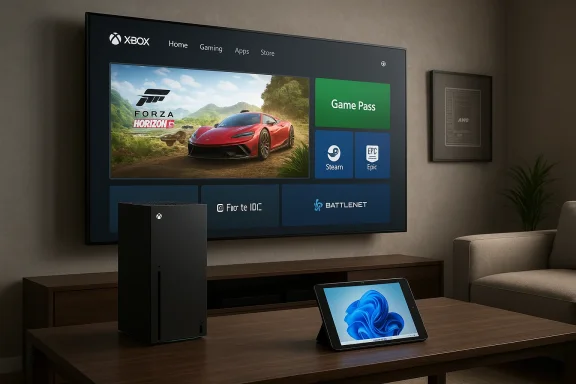
Insiders describe the next platform as a Windows-based device with a console-first interface layered on top. That means the default out-of-box experience would be familiar to Xbox users, but with the option to access a full Windows 11 environment for other applications and PC storefronts. The practical implication: a single machine might deliver both native Xbox titles and the broader Windows game ecosystem — Steam, Epic, Battle.net, GOG — with fewer of the current platform boundaries.This is not an incremental update. It’s an architectural shift that recasts Xbox as both a living-room console and a managed Windows gaming PC, with the vendor providing a curated console path while offering an escape hatch into full Windows for power users.
Why the Windows layer matters
Windows already represents the dominant install base for PC gaming. Treating Windows as the base OS gives Microsoft a path to vastly expand its content catalog for a living-room device while simultaneously offering developers the familiar Windows toolchain. The trade-off is complexity: console-grade seamlessness on top of Windows demands deep engineering to remove desktop friction, manage drivers and anti-cheat across storefronts, and guarantee a robust, secure multiplayer experience without confusing end users.What this means for exclusives and storefronts
A Windows-first Xbox could leave the door open to non-Xbox storefronts on the native platform. Theoretically, that makes the next Xbox the most content-rich device ever: native Xbox titles plus an open gateway to PC storefronts. But contractual realities, developer relationships, and anti-cheat/DRM concerns will shape how quickly and completely that vision becomes reality.Hardware expectations: silicon, memory, thermals, and price
The silicon picture
AMD’s confirmation that a semi-custom SoC is in development aligns with longstanding practice: AMD has supplied console APUs for Microsoft for generations. Reports name internal silicon codenames and suggest next-gen AMD IP — but those architectural details are speculative until Microsoft or AMD releases official specs. The key takeaway is that Microsoft is co-engineering the chip with AMD to target next-level performance and AI capabilities.Memory, cooling, and the “premium” angle
Multiple industry insiders and Microsoft executives have indicated this will be a premium device. Delivering PC-grade performance in a living-room form factor pushes toward higher DRAM capacity, faster memory types, and more aggressive cooling. Those components materially affect BOM (bill of materials) cost and thermal design.- Higher memory capacity — especially using high-bandwidth memory variants — raises component costs and can strain supply.
- More powerful GPUs and NPUs (neural processing units) increase thermal density, requiring larger heat sinks, better airflow, or liquid/heat-pipe designs.
- Implementing premium cooling inside a TV-optimized shell while keeping acoustics acceptable is a costly engineering challenge.
Price expectations and market positioning
Industry chatter has ranged widely, with speculative price points appearing between roughly $1,000 and $1,500 for a top-tier model. Microsoft’s leadership has described the platform as “very premium” and “high-end,” which does not preclude the company offering multiple SKUs or OEM variations to cover different price tiers. Expect a first-party flagship priced above current consoles, accompanied by potential lower-cost or OEM-built variants to reach cost-sensitive buyers.Crucially, these price estimates remain unverified until Microsoft announces MSRP. They reflect component-cost pressures, tariff volatility, and the premium feature set Microsoft is reportedly targeting.
Software, services, and the multiplayer/paywall question
The multiplayer paywall debate
One of the potential platform changes being discussed is the removal of a multiplayer paywall on native titles. The logic: if the device can run games from multiple PC storefronts that don’t charge a separate multiplayer fee, Microsoft may be inclined to harmonize policies across native and PC games to reduce user confusion and friction.That potential change would be a major consumer-facing policy shift and could reshape Game Pass economics. Microsoft’s cost calculus will need to weigh subscription revenue, online services, and the strategic value of lowering barriers to play.
AI features and visual upgrades
Microsoft has signaled that AI-driven enhancements — from auto super-resolution to frame generation and highlight-generation NPUs — will be part of the visual and user-experience roadmap. Implementing these features consistently across native and PC titles requires both silicon support and developer toolsets.Backward compatibility and developer workflows
Microsoft is promising full backward compatibility for current and legacy Xbox titles, and that is central to easing the transition for the install base. For developers, the promise of a fixed target spec (a “console in essence but with a TV-friendly shell”) aims to preserve many of the optimization benefits consoles provide while expanding the pool of potential hardware targets.OEM partnerships, the ROG Xbox Ally testbed, and hardware diversification
The ROG Xbox Ally lessons
Microsoft’s collaboration with OEMs like ASUS on the ROG Xbox Ally handhelds appears to have been treated as a learning exercise. Those devices run Windows and demonstrate the console-first UI approach in a handheld form factor. Microsoft reportedly prioritized the ally program to gather data about Windows in a console-like device before committing to a full home-console rollout.That hands-on OEM feedback loop is important. It lets Microsoft test UX assumptions, track how Windows behaves in a baked-in environment, and iterate on system-level features without shipping end-user hardware under the Xbox brand prematurely.
OEM-built consoles and a portfolio strategy
Expect Microsoft to pursue a portfolio approach: Microsoft may ship a first-party baseline console while allowing OEMs to build higher-end or lower-cost variants around the same reference architecture. That model mirrors Surface’s approach in PC hardware and offers Microsoft flexibility to pursue niche price/performance points without fragmenting the core platform too severely.Timeline realities: why 2027 is optimistic
Software readiness is the gating factor
Multiple reporting threads point to Windows 11 optimization as the gating factor. The Xbox teams and Windows teams are working closer than ever, but delivering a polished, controller-first Windows experience at console scale is a non-trivial engineering project that affects onboarding, performance overhead, driver support, and security. Microsoft has indicated that user experience quality — not an arbitrary calendar milestone — is the non-negotiable.Supply-chain and macro risks
Memory supply issues, geopolitical tariff changes, and the broader volatility in semiconductor and component markets remain real. Higher memory pricing or constrained yields for specific DRAM types could push cost targets up or force SKU rebalancing. Microsoft will be watching these factors closely before committing to volume production.The calendar and major-first-party launches
Microsoft’s launch window will also be influenced by the roadmap for major first-party titles it wants to coincide with hardware availability. Releasing hardware without a compelling flagship slate can handicap early sales. Microsoft may choose to time hardware announcements and initial availability around key game releases or a strategic holiday season, which can introduce real-world marketing scheduling constraints.Market implications and risks
For consumers
- Price friction: A premium-first strategy risks pricing out a large segment of console buyers. Microsoft will need to balance a flagship price point with lower-cost alternatives or multi-year software support for the existing install base.
- Complexity vs. simplicity: Merging Windows flexibility with a console-grade UX risks confusing customers who expect plug-and-play simplicity. Microsoft must ensure the console experience is reliably easy for less technical users.
- Interoperability headaches: Running third-party storefronts natively introduces variability in anti-cheat, mod support, and multiplayer compatibility that could impact experience consistency.
For developers
- Opportunity: A Windows-base means developers can target a huge potential install base with consistent hardware specs while still leveraging Windows toolchains.
- Burden: Developers will face new certification permutations and must ensure compatibility with console UI and controller paradigms while also potentially handling multiple storefronts and anti-cheat integrations.
For Microsoft’s business model
- Game Pass and services revenue: How Game Pass adapts to an ecosystem where users can also access other storefronts from the same box will be critical. Microsoft must make the value proposition of Game Pass compelling enough to counter decentralized storefront competition.
- Hardware economics: If the first-party flagship sits at a high price, Microsoft may accept lower hardware margins in pursuit of attached services revenue; that requires long-term confidence in lifetime value per user.
What to watch next (a practical checklist)
- Official Microsoft communication about schedule and SKUs — any precise dates or SKUs from Microsoft are decisive.
- AMD’s further disclosures — chip production milestones and sampling windows will indicate supplier confidence.
- Windows updates and the “TV-optimized” UX roadmap — incremental OS patches that improve full-screen controller UX will show engineering progress.
- Game Pass policy changes — watch whether Microsoft signals changes to multiplayer paywalls or subscription features.
- OEM rollouts — if partners like ASUS, Razer, or others announce console-style devices, that will signal Microsoft’s broader strategy and product segmentation.
- Pricing signals from retailer listings or leaked BOM estimates — these can crystallize expectations about consumer affordability.
Final analysis: bold gamble, plausible execution, and a cautionary tail
Microsoft’s next-generation Xbox concept is bold: by leaning into Windows as the base platform, it aims to collapse the distinction between console and PC while preserving a console-like UX for mainstream players. That ambition offers real consumer upside — a single living-room device that can run native Xbox titles alongside the vast PC catalog — but it also multiplies engineering, business, and ecosystem challenges.AMD’s recent remark that its semi-custom SoC work is “progressing well to support a launch in 2027” is an important indicator of supplier progress, but it is precisely that: a supplier readiness marker. Multiple independent reports and sourcing inside Microsoft underline that 2027 is the optimistic timeline. Microsoft’s internal commitment appears to hinge on Windows-level polish, price strategy, and the resolution of supply-chain pressures.
If Microsoft executes, the reward is market differentiation: a device potentially unmatched in content breadth, with deep cross-play and PC compatibility baked in. If Microsoft missteps, risks include market confusion, pricing pushback, and a protracted transition that leaves the Xbox installed base waiting — and developers wondering when (or whether) to prioritize the new platform.
For players and industry watchers, the sensible stance is cautious optimism. The engineering milestones are real, the intent is clear, and the prototype learnings from OEM handhelds are meaningful. But the coming 12–24 months will be decisive: we’ll learn whether this effort becomes a thoughtful redefinition of console hardware or a high-priced experiment that proves the complexity of making Windows feel like a polished living-room console.
In short: the next Xbox’s technical foundation is visibly under construction, AMD is ahead on the silicon timeline, and Microsoft’s design vision is public. The question now is timing and trade-offs — and whether Microsoft will prioritize an audacious, premium-first hardware debut next year or take the time required to align software, price, and supply into a launch that can meet player expectations.
Source: nme.com Next-gen Xbox will launch in 2027 as a “best case scenario”
