Navigate Forward: AI-Ready Business Central Migration for NAV Users (June 17, 2026)

Western Computer and Microsoft will host “Navigate Forward: Business Central & The AI Advantage” at Microsoft’s Downers Grove, Illinois office on Wednesday, June 17, 2026, beginning at noon, for manufacturing, distribution, finance, operations, and IT leaders evaluating Dynamics 365 Business Central and AI-enabled ERP modernization. The announcement is a partner event notice, but the timing makes it more than a calendar item. It lands at the point where Microsoft’s old NAV installed base is being pushed by support deadlines, cloud economics, and a suddenly unavoidable AI sales pitch. For many midmarket firms, the real question is no longer whether ERP will move toward the cloud; it is whether that move can be made without turning a working business system into an expensive science project.

Team of business professionals reviewing cloud and AI analytics on holographic screens outside an office.Microsoft’s ERP Pitch Has Become an AI Pitch​

For years, the migration argument around Dynamics NAV was familiar: the software was aging, customizations were hard to maintain, and Business Central offered a cleaner path into Microsoft’s cloud stack. That argument still exists, but it now arrives wrapped in a much larger claim. Microsoft is no longer selling Business Central merely as the successor to NAV; it is positioning Business Central as the operating layer for AI-assisted finance, supply chain, manufacturing, and reporting.
That shift matters because ERP systems are where corporate aspiration usually meets operational reality. A manufacturer can experiment with generative AI in marketing or customer support with limited blast radius. It cannot casually experiment with the ledger, inventory availability, vendor payments, production scheduling, or sales order fulfillment.
Western Computer’s Downers Grove event is aimed exactly at that tension. The agenda promises Business Central and Copilot demonstrations, migration guidance for NAV users, modernization strategies for manufacturers and distributors, and discussion of automation, reporting, and AI readiness. In other words, it is not just a product showcase; it is an attempt to translate Microsoft’s broad AI narrative into the grimier language of warehouse turns, month-end close, purchase orders, shop-floor constraints, and executive dashboards.
That translation is where partners like Western Computer matter. Microsoft can build the platform, but most midmarket ERP decisions are won or lost in partner-led discovery, data cleanup, customization analysis, user training, and go-live support. A live event at a Microsoft office, with both Microsoft and partner experts in the room, is designed to reduce the sense that “AI ERP” is just another licensing bundle looking for a problem.

NAV’s Long Goodbye Is Finally Becoming a Planning Problem​

Dynamics NAV occupies a strange place in Microsoft’s business applications history. It is old enough to be considered legacy, but it remains entrenched enough that many organizations still trust it more than the cloud services meant to replace it. That is not irrational. NAV implementations often contain years of industry-specific process knowledge, custom code, reporting logic, and informal workarounds that never made it into documentation.
The problem is that the support clock keeps moving. Dynamics NAV 2018, the final NAV release, left mainstream support in January 2023 and is scheduled to reach the end of extended support in January 2028. Earlier NAV versions are already further down the lifecycle road. For companies still running NAV 2015, NAV 2016, NAV 2017, or NAV 2018, the migration window is no longer comfortably distant.
The catch is that ERP migration is not a weekend upgrade. Moving from NAV to Business Central may involve rewriting or retiring customizations, converting older C/AL logic into AL extensions, rationalizing reporting, revisiting integrations, and deciding how much of the old process should survive. A business that waits until 2027 to begin serious planning may discover that the support deadline is the least of its problems.
That is why the event’s focus on NAV end-of-support is more significant than the marketing copy suggests. Microsoft and its partners are trying to pull customers forward before urgency curdles into panic. ERP customers do not want to be told they are obsolete; they want a credible path that preserves business continuity while reducing technical debt.

Business Central Is the Successor, but Not a Clone​

Business Central’s appeal is that it gives Microsoft a modern, cloud-managed successor to NAV while keeping enough functional continuity to make the move plausible. It covers finance, purchasing, sales, inventory, warehouse operations, manufacturing, projects, service management, and reporting. It integrates with Microsoft 365, Power BI, Power Platform, Dataverse, and the wider Dynamics ecosystem.
But the move should not be mistaken for a simple rename. Business Central online is governed by Microsoft’s release cadence and cloud architecture. Extensions replace many older customization patterns. Administration, security, integration, and reporting assumptions change. The system is designed for continuous improvement, but that means customers must become comfortable with continuous change.
For IT leaders, that can be both relief and threat. Relief comes from shedding aging infrastructure, old client dependencies, fragile custom code, and local upgrade projects that consume months. The threat comes from giving up some of the control that made on-premises NAV feel safe: frozen versions, local modifications, and slower change windows.
Manufacturing and distribution firms are especially sensitive to this trade-off. Their ERP systems often connect to barcode systems, EDI, shipping platforms, warehouse hardware, quality processes, production planning tools, and third-party industry add-ons. A cloud ERP migration is therefore not just a finance project or a CIO project. It is an operating-model decision.

Copilot Turns ERP Modernization Into a Data Quality Test​

The most important part of Microsoft’s AI push in Business Central is not the chatbot itself. It is the implication that ERP data must become cleaner, more connected, and more intelligible if companies want useful AI outcomes. Copilot can summarize, suggest, reconcile, draft, analyze, and guide only to the extent that the underlying system is configured and governed well enough to support those actions.
That is the uncomfortable truth behind the phrase AI readiness. Many companies want to ask AI systems strategic questions, but their ERP environment may still contain duplicate vendors, inconsistent item descriptions, undocumented custom fields, manual journal workarounds, aging reports, and integrations held together by institutional memory. AI does not magically fix that. In some cases, it simply makes bad data easier to act on at higher speed.
Business Central’s 2026 release wave has made Microsoft’s direction clear. The product is moving toward more embedded AI, more autonomous agents, and deeper use of Copilot in everyday ERP work. Microsoft has described investments around agents, payables automation, expense management, item insights, reporting, governance, Power Platform integration, and model-context connectivity for developers and makers.
That direction is compelling, but it also changes the modernization conversation. A NAV-to-Business Central migration cannot be judged only by whether old screens and reports can be replicated. The better question is whether the new environment creates a trustworthy operational data layer that can support automation without losing auditability.

The Partner Event Format Is Doing Strategic Work​

There is a reason this event is not just a webinar. Microsoft’s business applications strategy increasingly depends on partners who can turn platform features into industry-specific adoption. Manufacturing and distribution customers rarely buy ERP from a feature matrix alone. They buy confidence that someone understands inventory valuation, production variances, landed cost, demand planning, substitutions, vendor lead times, warehouse exceptions, and the political economy of replacing spreadsheet rituals.
Western Computer is leaning into that role. The company describes itself as a Microsoft Dynamics partner with more than 35 years of experience across ERP, CRM, BI, cloud, and AI solutions, with particular emphasis on manufacturing and distribution. Its announcement also points to Microsoft Inner Circle status and repeated G2 customer satisfaction recognition in Microsoft consulting services.
Those badges are not the story by themselves. The story is that ERP modernization now requires both product knowledge and change-management credibility. Customers need to know not just what Microsoft has shipped, but how a migration unfolds, what can be automated safely, which customizations should be preserved, and which should be killed with ceremony.
The quote from Western Computer CEO Kristen Sage gets at the buyer anxiety. Companies have AI on the roadmap, she argues, but are stuck on where to start, what it will cost, and how long it will take. That is the right framing because it shifts the AI conversation from wonder to implementation math.

The Cloud Is the Easy Part Until It Touches the Factory Floor​

Microsoft’s preferred answer to NAV aging is Business Central online, and for many organizations that will be the rational endpoint. Cloud ERP reduces the burden of infrastructure maintenance, keeps customers closer to Microsoft’s latest features, and makes integration with Microsoft 365, Power Platform, and Copilot more natural. It also fits the subscription economics Microsoft has spent years building across its commercial portfolio.
But manufacturing and distribution are not cloud-adoption fairy tales. The more operationally embedded the ERP system, the more complicated the migration. A distributor with complex pricing, rebate structures, EDI flows, and warehouse automation cannot simply “move to SaaS” without testing the edges. A manufacturer with routings, bills of material, quality holds, subcontracting, serial tracking, and shop-floor dependencies must validate that the new system reflects how work actually moves.
That is where many modernization programs get into trouble. Executives approve the migration as a technology refresh. The business experiences it as a forced redesign of daily work. Users who were promised efficiency encounter changed screens, changed approvals, changed reports, and changed responsibility boundaries.
The better migration story is more honest. Business Central is not just a place to host old NAV logic in a newer container. It is an opportunity to simplify process debt, retire brittle customizations, and build better reporting and automation. But every simplification has an owner, and every retired workaround was probably compensating for a real operational need.

AI Raises the Stakes for Governance​

Copilot in ERP is appealing because it promises to reduce friction in routine work. Users can get help with analysis, generate text, reconcile accounts, surface insights, and potentially rely on agents for more structured business processes. For overburdened finance and operations teams, that sounds less like a gimmick and more like overdue relief.
Yet ERP AI is not the same as drafting an email. If an AI assistant suggests the wrong vendor match, summarizes inventory incorrectly, misreads an exception, or accelerates an approval that should have been reviewed, the cost is not merely embarrassing. It can become a financial-control issue, a customer-service issue, or a compliance issue.
That is why administrators should treat AI adoption as a governance project before they treat it as a productivity project. Permissions, data access, audit trails, approval workflows, retention policies, and exception handling all become more important when software begins making suggestions inside core systems of record. The old ERP rule still applies: automation should make the right process faster, not make a messy process harder to see.
Microsoft’s pitch includes security, compliance, and responsible AI language, and those commitments matter. But implementation choices still belong to customers and partners. The practical question is not whether Copilot is safe in the abstract. It is whether a specific organization’s configuration, data model, permission design, and process controls are mature enough to use it responsibly.

The Microsoft Stack Is Becoming the ERP Argument​

Business Central’s strongest selling point may not be any single ERP feature. It is Microsoft’s stack gravity. A company already standardized on Microsoft 365, Teams, Excel, Power BI, Azure, Entra ID, Power Automate, and Power Apps has a strong incentive to keep ERP inside that orbit.
That is especially true for midmarket companies with lean IT teams. The promise of fewer vendors, common identity, familiar productivity tools, shared reporting surfaces, and low-code automation is attractive. If Business Central can become the operational core while Power Platform handles workflows and Power BI handles analytics, Microsoft can present a coherent modernization path that competitors struggle to match.
But stack gravity can also become lock-in by another name. Once ERP, reporting, workflow, identity, collaboration, and AI all flow through Microsoft services, the cost of leaving rises. Customers may accept that trade-off, but they should understand it. The choice is not merely between NAV and Business Central; it is between a heavily customized legacy estate and a more standardized Microsoft cloud operating model.
For many organizations, the latter will be the better choice. The older estate may be familiar, but it is often expensive to maintain, difficult to secure, and dependent on a shrinking pool of specialized knowledge. Still, the decision deserves clear-eyed analysis rather than AI-era inevitability.

ERP Buyers Need Demos That Show Failure Modes​

Live demos are useful, but only if they move beyond the polished happy path. A Copilot demo that summarizes clean data in a pristine tenant is not enough. Prospective customers should ask what happens when vendor records conflict, when item data is inconsistent, when a custom process breaks a standard flow, or when an approval requires human judgment rather than pattern recognition.
This is not cynicism. It is how serious ERP buyers evaluate risk. They should want to see how Business Central handles exceptions, how Copilot explains its suggestions, where human approval remains mandatory, how audit trails are preserved, and how administrators can limit feature exposure while users build confidence.
The same applies to migration strategy. A credible partner should be able to discuss phased rollout, data migration, testing, reporting replacement, integration mapping, user adoption, and post-go-live support. It should also be willing to say when a customization is too expensive to preserve or when a process should change rather than be rebuilt exactly as before.
That is where an onsite event has potential value. The hallway conversations may matter as much as the sessions. Buyers can compare concerns, ask uncomfortable questions, and listen for whether the answers sound like implementation experience or brochure language.

Downers Grove Is a Local Event With a National Subtext​

The location gives the announcement a regional flavor, but the underlying issue is national and, really, global. Across the Microsoft customer base, old Dynamics installations remain embedded in companies that are big enough to need serious ERP but not always big enough to absorb enterprise-scale transformation pain. That is precisely the market Business Central is built to capture.
Chicago’s manufacturing and distribution ecosystem makes the Downers Grove venue sensible. The Midwest still has deep concentrations of industrial, logistics, wholesale, and supply-chain businesses. Many of these companies are exactly the kind of organizations that adopted NAV because it was flexible, partner-friendly, and adaptable to midmarket needs.
Those same strengths can make migration harder. The more successfully NAV was tailored to the business, the more careful the Business Central transition must be. A generic cloud migration playbook will not do. The work is in deciding what the business has outgrown, what it still depends on, and what Microsoft’s newer platform can now handle natively.
The national subtext is that Microsoft’s partner ecosystem is being mobilized to convert legacy ERP customers before the end-of-support cliff gets too close. Events like this are part education, part sales motion, and part risk management. Microsoft does not want NAV customers drifting to competitors because the migration story felt too vague or too late.

The Real Competition Is Inertia​

Business Central competes with other ERP platforms, of course, but the most stubborn competitor is inertia. If NAV still closes the books, ships orders, supports purchasing, and keeps the warehouse moving, executives may hesitate to fund a disruptive migration. The old system’s flaws become tolerable because they are known.
That tolerance has limits. Aging ERP tends to accumulate hidden costs: unsupported components, difficult reporting, manual reconciliations, brittle integrations, security exposure, and dependence on a small group of employees or consultants who understand the custom environment. These costs rarely arrive as one dramatic invoice. They seep into operations as delay, fragility, and missed opportunity.
AI changes the inertia equation because it widens the gap between systems that can participate in the next phase of automation and systems that cannot. A company does not need to believe every Copilot promise to recognize that modern ERP data will become more valuable when connected to workflow, analytics, and AI services. The danger for NAV holdouts is not only losing support. It is being stuck with a system that cannot easily join the next operational model.
Still, fear is a poor migration strategy. Companies should not move because a deadline or a demo scared them. They should move because they have a staged plan, a realistic budget, executive sponsorship, cleaned-up data, and a clear understanding of which business outcomes matter.

What the Downers Grove Agenda Really Signals​

The most useful way to read Western Computer’s announcement is not as an isolated event notice, but as a snapshot of where Microsoft’s ERP ecosystem is headed. The NAV migration story, the Business Central cloud story, and the Copilot AI story are converging into one sales and implementation motion.
That convergence creates opportunity for customers that have been waiting for a more mature Business Central platform. Microsoft’s release waves have continued to add functionality, governance improvements, reporting enhancements, developer capabilities, and AI features. For some NAV customers, the case for waiting is getting weaker.
It also creates pressure. Once Microsoft and its partners frame modernization around AI advantage, organizations may feel compelled to accelerate without doing the preparatory work that ERP projects demand. The phrase “AI advantage” can be useful if it forces a serious conversation about data and process. It becomes dangerous if it turns migration into a branding exercise.
The companies that benefit most will likely be the ones that treat AI as an outcome of modernization, not its starting point. Clean data, simplified process, secure access, reliable integrations, and trusted reporting come first. Copilot and agents become more valuable after the foundation is in place.

The Practical Reading for NAV Shops Heading to Downers Grove​

For attendees, the event should be approached less like a product launch and more like a working session for strategic due diligence. The strongest questions will be specific: which NAV versions are in scope, what customizations exist, what integrations are business-critical, what reports executives actually use, and where manual processes create measurable cost.
The value of a session like this is not that it can answer every migration question in an afternoon. It is that it can help leaders separate three conversations that often get tangled together: the support lifecycle problem, the cloud ERP architecture problem, and the AI adoption problem. They are related, but they are not identical.
The organizations that leave with a better inventory of their risks will have gained something real. The organizations that leave merely impressed by demos may still be at the beginning. ERP modernization rewards disciplined skepticism.

The AI Advantage Belongs to the Prepared, Not the Enthusiastic​

The Downers Grove event is a signpost for a broader shift in Microsoft’s business applications strategy. Business Central is now being sold not just as the next stop after NAV, but as the place where midmarket ERP, Microsoft 365 productivity, Power Platform automation, and Copilot-era AI are supposed to meet.
  • Dynamics NAV customers should treat January 2028 as a planning deadline, not a distant support footnote.
  • Business Central migration should include process redesign, data cleanup, reporting strategy, and integration mapping rather than a narrow technical upgrade plan.
  • Copilot demonstrations should be judged by how they handle exceptions, permissions, auditability, and messy operational data.
  • Manufacturing and distribution firms should involve operations leaders early because ERP modernization will change daily work outside the IT department.
  • Microsoft partners will be decisive in whether the AI-enabled ERP pitch becomes a practical roadmap or another cloud transformation slogan.
Western Computer and Microsoft are selling a forward path, and for many NAV-era businesses the path is probably necessary. But the organizations most likely to gain an AI advantage will be those that resist treating AI as a shortcut. The future of ERP is moving toward cloud services, embedded assistants, and increasingly autonomous workflows; the winners will be the companies that modernize deliberately enough to trust the automation when it finally arrives.

References​

  1. Primary source: Weekly Voice
    Published: 2026-06-09T15:44:10.446865
  2. Related coverage: windowscentral.com
  3. Official source: learn.microsoft.com
  4. Related coverage: randgroup.com
  5. Related coverage: iesgp.com
  6. Related coverage: dynamicssmartz.com
  1. Related coverage: softwareconnect.com
  2. Related coverage: techradar.com
  3. Related coverage: tipsa.net
  4. Related coverage: navins.eu
  5. Related coverage: yesdynamic.com
 

Western Computer and Microsoft will host “Navigate Forward: Business Central & The AI Advantage” on Wednesday, June 17, 2026, at Microsoft’s Downers Grove, Illinois office, targeting manufacturing, distribution, finance, operations, and IT leaders evaluating Dynamics 365 Business Central, Copilot, and ERP modernization. The event is a local partner roadshow, but the timing makes it more than another lunch-and-learn. Microsoft’s old Dynamics NAV customer base is running into support deadlines, cloud pressure, and AI expectations at the same time. That collision is turning ERP migration from a back-office cleanup project into a boardroom decision about how much operational intelligence companies want to hand to Microsoft’s cloud.

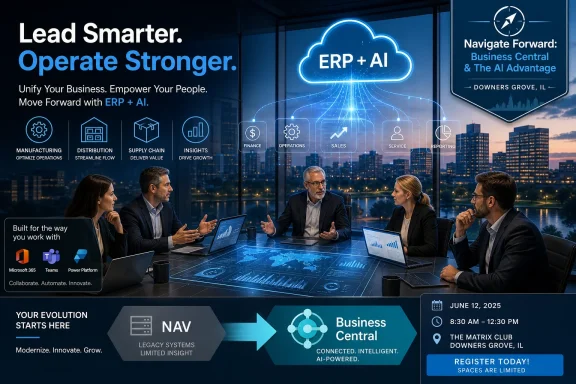
A futuristic business tech ad shows executives meeting under an “ERP + AI” cloud over a city skyline.The ERP Migration Pitch Has Become an AI Pitch​

For years, the case for moving from Dynamics NAV to Dynamics 365 Business Central was mostly architectural. NAV was familiar, heavily customized, and deeply embedded in mid-market finance and operations, but it belonged to an older software era. Business Central promised a cloud-first successor with better update cadence, Microsoft 365 integration, Power Platform hooks, and less dependence on brittle local infrastructure.
That argument was rational, but not always urgent. Many manufacturers and distributors had tuned NAV around quoting, inventory, warehouse, purchasing, production, and finance workflows that did not break just because Microsoft renamed the future. If the system still closed the books and shipped product, the upgrade could wait.
AI changes the sales motion. Western Computer’s event description makes that explicit: the promise is no longer merely that Business Central is newer than NAV, but that it is the operating layer through which Microsoft Copilot, automation, reporting, and future AI agents can reach business data. ERP is being repositioned as the context engine for AI, not just the database of record.
That is a clever pivot, because most companies do not lack AI curiosity. They lack a credible starting point. The pitch from Microsoft partners is increasingly that ERP modernization supplies that starting point, because AI without clean operational data is mostly a demo.

NAV’s Long Goodbye Is Finally Becoming Operationally Awkward​

Dynamics NAV has always had one major advantage over its successor: customers already own the pain. Years of customizations, reports, integrations, and department-specific workarounds are sunk costs. Replacing that fabric with Business Central means reopening decisions many companies thought they had settled a decade ago.
But the support calendar is narrowing. Older NAV versions have already aged out, NAV 2016 reached the end of extended support in 2026, NAV 2017 and NAV 2018 are also moving toward their final support dates, and Microsoft’s product investment has long since shifted to Business Central. That does not mean every NAV deployment stops working the morning support ends. It means the risk profile changes.
Unsupported ERP is not like running an old media player. It touches tax, audit, customer commitments, vendor payments, warehouse execution, and sometimes regulated data. The longer a company stays put, the more it depends on partner heroics, internal tribal knowledge, and increasingly narrow compatibility windows for surrounding systems.
This is where the Downers Grove event fits into a larger Microsoft pattern. The company and its partners are not simply saying “upgrade because support is ending.” They are saying “upgrade because the next layer of business automation will assume you already moved.” The calendar creates pressure, but AI creates aspiration.

Business Central Is Microsoft’s Mid-Market Cloud Wedge​

Business Central occupies a strategic middle ground in Microsoft’s business applications portfolio. It is not the sprawling enterprise footprint of Dynamics 365 Finance and Supply Chain Management, but it is more than accounting software. For many small and mid-sized organizations, especially manufacturers and distributors, it is the place where financial truth, inventory reality, and customer commitments meet.
That makes it valuable real estate for Microsoft. A company that runs Business Central is more likely to use Microsoft 365, Power BI, Power Automate, Teams, Entra ID, Azure services, and Copilot experiences. ERP modernization becomes a multiplier for the rest of the Microsoft stack.
The event’s focus on manufacturers and distributors is not accidental. These sectors often have complicated operational data but limited tolerance for massive, multi-year ERP transformations. They need forecasting, purchasing discipline, margin visibility, inventory accuracy, and faster reporting, but they also have shop-floor realities that punish vague digital-transformation language.
Business Central’s appeal is that it can be sold as both pragmatic and strategic. It modernizes an old NAV estate while giving executives a plausible AI story: automate invoice matching, improve analysis, summarize records, generate product descriptions, streamline reporting, and connect workflows across Microsoft tools. The result is less a single product sale than a platform migration.

Copilot Raises the Bar for Data Hygiene​

Microsoft’s Copilot story depends on a deceptively simple premise: put AI where people already work. In Business Central, that means surfacing assistance inside ERP tasks rather than making users export data, ask questions elsewhere, and paste answers back into the system. The more useful version of AI is not a chatbot floating outside the business process; it is an assistant with permissioned access to the data and workflow in front of the user.
But that also exposes the uncomfortable part of AI adoption. Copilot is only as useful as the data model, process discipline, and access controls beneath it. A manufacturer with inconsistent item masters, stale vendor records, custom fields nobody understands, and security roles inherited from three controllers ago should not expect a magical productivity dividend on day one.
This is why events like Western Computer’s matter for IT leaders. The useful conversation is not “Does Copilot work?” It is “What must be true inside our ERP environment before Copilot is safe, accurate, and worth paying attention to?” That answer usually involves governance, cleanup, role design, integration review, and user training — the unglamorous work that vendors rarely put on the hero slide.
There is also a trust issue. Finance and operations teams are used to deterministic systems: a posted invoice is posted, a quantity is on hand or it is not, a ledger entry has an audit trail. Generative AI introduces suggestion, summarization, and probability into environments built around accountability. That is not a reason to reject it, but it is a reason to deploy it with boundaries.

The Partner Channel Is Where Microsoft’s AI Strategy Gets Real​

Microsoft can publish roadmaps, demo Copilot, and describe Business Central as an AI-powered application. But most NAV-to-Business Central migrations will not be executed by Microsoft employees. They will be shaped by partners that understand old customizations, industry-specific process gaps, licensing tradeoffs, and the politics of getting finance, operations, and IT to agree on a cutover plan.
Western Computer is leaning into that role. The company’s announcement emphasizes its manufacturing and distribution specialization, its long history in Microsoft business applications, and its status inside the Microsoft partner ecosystem. That is not just credential-stacking; in ERP, partner quality often determines whether the platform’s theoretical advantages survive contact with the business.
The partner channel also has a commercial incentive to frame AI as the modernization accelerant. A customer asking “Should we upgrade NAV?” may defer the project. A customer asking “How do we make our ERP ready for AI?” has already accepted that standing still is not a neutral option.
Still, customers should be clear-eyed. Partner-led events are part education, part pipeline generation. The most valuable attendees will be those who arrive with hard questions about custom code, data migration, licensing, integrations, reporting parity, downtime, change management, and what Copilot features are actually available for their deployment model.

The Cloud Question Is Not Just About Hosting​

For some NAV customers, “cloud ERP” sounds like an infrastructure decision: move from servers in a closet or data center to Microsoft’s cloud. That framing understates the shift. Business Central online changes the update model, customization model, integration posture, security assumptions, and feature eligibility.
Microsoft’s most ambitious Business Central AI features are tied to the online service. That matters because some organizations still prefer on-premises deployments for control, latency, regulatory comfort, or integration complexity. They may be able to modernize within the Business Central family without fully embracing SaaS, but they should not assume the AI roadmap will treat every deployment model equally.
This is the quiet leverage behind Microsoft’s AI push. The company does not have to force every customer into the cloud by removing all alternatives overnight. It can make the cloud version the place where the most interesting features show up first, work best, and receive the most investment.
For IT administrators, that shifts the risk calculation. Staying on-prem may reduce one category of dependency while increasing another: slower access to new capabilities, more responsibility for infrastructure, and a growing gap between what the vendor markets and what the deployment can consume. Cloud adoption is not automatically correct, but it must be evaluated against the actual roadmap, not nostalgia for server ownership.

Manufacturing and Distribution Need Less AI Theater​

The event’s target audience is telling. Manufacturers and distributors are fertile ground for AI claims because their operations generate mountains of structured and semi-structured data: purchase orders, sales orders, bills of material, inventory movements, invoices, forecasts, exceptions, and customer correspondence. But they are also sectors where bad automation creates immediate consequences.
An AI-assisted suggestion that saves five minutes in a marketing workflow is one thing. A bad purchasing recommendation, misread invoice, flawed substitute item suggestion, or misleading inventory summary can ripple into production delays and customer misses. In operational businesses, AI must earn trust by reducing exception work without hiding the logic of the exception.
That is why Business Central’s most credible AI uses are initially narrow. Bank reconciliation assistance, record summaries, list analysis, invoice matching, sales line suggestions, and document automation are not science fiction. They are practical attempts to reduce the manual drag around existing business processes.
The danger is executive overreach. A CEO may hear “AI-powered ERP” and imagine autonomous planning. A controller may hear it and worry about audit risk. A warehouse manager may hear it and expect another tool that fails to understand real constraints. The useful middle ground is to begin where human review remains central and the productivity gain is measurable.

Reporting Is the Sleeper Issue​

ERP modernization is often sold through workflows, but reporting is where many projects live or die. Companies running NAV frequently have years of custom reports, Excel models, SQL queries, Power BI datasets, and informal month-end rituals built around the old environment. If those outputs disappear or change without explanation, users will declare the migration a failure even if the new system is technically healthier.
The AI angle makes reporting even more important. Copilot-style analysis depends on users trusting the underlying numbers. If Business Central becomes the new source of truth but historical reporting is fragmented, decision-makers will hesitate to rely on AI-generated summaries or natural-language analysis.
This is where finance leaders should push beyond the demo. A live demo can show how Copilot analyzes a list or summarizes a record. It cannot prove that the company’s peculiar margin calculations, rebate structures, item categories, or production variances will survive migration intact. That proof requires discovery work.
Microsoft’s broader platform can help here. Power BI, Dataverse, Power Automate, and Business Central APIs can create a more coherent reporting and automation layer than many NAV-era environments ever had. But only if the modernization project treats reporting as a first-class deliverable, not a cleanup task after go-live.

The Cost Question Is Really a Scope Question​

Western Computer’s CEO Kristen Sage framed the common AI questions as where to start, what it will cost, and how long it will take. Those are the right questions, but the third one often answers the first two. ERP modernization is expensive when scope is vague, customizations are poorly understood, and every department uses the migration as a chance to rebuild its wish list.
NAV customers should begin with a ruthless inventory of what they have. Which customizations are essential? Which reports are used? Which integrations still matter? Which workarounds exist only because NAV could not do something Business Central now handles differently? Which processes should be standardized rather than migrated?
AI readiness adds another layer to that assessment. If a company wants Copilot to assist with reporting, documents, approvals, and operational questions, it must examine permissions, master data, process consistency, and exception handling. In other words, the AI project starts before anyone turns on an AI feature.
That may frustrate executives looking for a fast win, but it is also an opportunity. A disciplined Business Central migration can retire technical debt that has quietly taxed the organization for years. If the company merely recreates the old NAV environment in a new place, it may get cloud hosting without cloud leverage.

Microsoft’s Advantage Is Integration, Not Novelty​

None of the individual ideas around AI-assisted ERP are unique to Microsoft. Every major enterprise software vendor is attaching AI assistants, agents, summarization, and automation to its application suite. The market has moved too quickly for novelty to remain a durable advantage.
Microsoft’s advantage is distribution and integration. Business Central sits next to Outlook, Excel, Teams, SharePoint, Power BI, Power Automate, Entra ID, and the broader Dynamics 365 portfolio. If Copilot can move across those surfaces with appropriate permissions and context, Microsoft can offer a version of AI that feels less like another application and more like an overlay on the workday.
That is the dream. The risk is that customers end up with overlapping Copilots, licensing confusion, uneven feature maturity, and a new dependency on Microsoft’s release cadence. IT leaders have seen this movie before: integration convenience becomes platform lock-in when architectural choices are made one small concession at a time.
The practical answer is not to reject the ecosystem. For many WindowsForum readers, Microsoft standardization is already reality. The answer is to document where the organization benefits from tight integration and where it needs escape hatches, clean APIs, independent backups, and clear data ownership.

The Local Office Event Still Has a Place in a Cloud Market​

It may seem quaint that a cloud ERP and AI event is being held onsite in Downers Grove. But for ERP buyers, geography still matters. These are not impulse purchases made after a webinar; they are trust-heavy projects that affect payroll, orders, inventory, vendors, customers, and financial close.
An in-person event gives Microsoft and Western Computer a chance to make the migration feel concrete. Attendees can ask how a manufacturer with aging NAV customizations should sequence an upgrade, how Copilot fits into a realistic deployment timeline, and how the partner has handled messy data and operational complexity elsewhere. That kind of conversation rarely happens in a polished product video.
It also signals that Microsoft’s AI strategy is moving down-market and into regional business communities. The company’s biggest AI announcements may arrive from global conferences, but adoption will depend on local credibility. A mid-market manufacturer in Illinois may care less about keynote rhetoric than whether someone can look at its process map and say, “Here is the least risky path.”
That is the underappreciated function of the Microsoft partner ecosystem. It translates platform ambition into migration plans, training sessions, configuration decisions, and uncomfortable scope meetings. AI may be the headline, but implementation remains stubbornly human.

The Real Test Is After the Demo​

The Downers Grove agenda promises guidance for NAV customers, Business Central and Copilot demonstrations, modernization strategies, discussions around automation and reporting, and networking with Microsoft and Western Computer leadership. That is a sensible package. It also compresses a complex organizational decision into an afternoon.
The real test begins when attendees return to their companies. A good event should leave them with a sharper map of the problem, not merely a warmer feeling about the Microsoft stack. The next step should be an internal readiness assessment that includes finance, operations, IT, security, and at least one skeptical power user who understands how work actually gets done.
Organizations should also resist treating AI as a separate executive initiative bolted onto ERP. The more sustainable approach is to identify high-friction processes where Business Central modernization and AI assistance reinforce each other. Invoice processing, reconciliation, order entry, inventory analysis, and reporting are better starting points than vague mandates to “use AI.”
That realism matters because failed AI adoption will not always look like catastrophe. Sometimes it will look like indifference: users ignoring suggestions, reverting to Excel, distrusting summaries, and quietly maintaining shadow processes. For Microsoft and its partners, adoption will be measured not by how many features are available, but by how many become boringly useful.

Downers Grove Is a Small Stop on a Much Larger Roadmap​

The concrete facts are simple, but the implications are larger than a single event announcement.
  • Western Computer and Microsoft are using the June 17, 2026, Downers Grove event to target organizations that are simultaneously evaluating ERP modernization and AI readiness.
  • Dynamics NAV customers face a shrinking support horizon, which makes migration planning less optional even when the old system still functions.
  • Business Central’s strongest modernization pitch is its connection to Microsoft 365, Power Platform, Power BI, Copilot, and Microsoft’s broader cloud ecosystem.
  • Copilot in ERP should be judged by specific workflow gains, not by generalized AI enthusiasm.
  • Manufacturers and distributors should treat data quality, reporting continuity, permissions, and change management as core AI-readiness requirements.
  • The most successful migrations will avoid cloning every NAV-era customization and instead use the project to reduce technical debt.
The deeper point is that Microsoft’s ERP story has entered a new phase. Business Central is no longer being positioned only as the cloud successor to NAV; it is being positioned as the place where mid-market companies prepare their operational data for AI-mediated work. That is a stronger pitch, but also a higher bar. If Microsoft and partners like Western Computer can turn Copilot from demo sparkle into dependable process relief, events like this will look like early waypoints in a real modernization cycle. If not, customers will remember that the old ERP system, for all its age, at least knew how the business ran.

References​

  1. Primary source: StreetInsider
    Published: Tue, 09 Jun 2026 15:30:56 GMT
  2. Official source: learn.microsoft.com
  3. Related coverage: prnewswire.com
  4. Related coverage: randgroup.com
  5. Related coverage: simplydynamics.com
  6. Related coverage: iesgp.com
  1. Related coverage: bc4.com
  2. Related coverage: advantage.co.uk
  3. Related coverage: clonepartner.com
  4. Related coverage: forvismazars.us
  5. Related coverage: navins.eu
  6. Related coverage: tipsa.net
  7. Related coverage: mercuriusit.com
 

Western Computer and Microsoft will host “Navigate Forward: Business Central & The AI Advantage” at Microsoft’s Downers Grove, Illinois office on Wednesday, June 17, 2026, with the event aimed at manufacturing, distribution, finance, operations, and IT leaders evaluating Dynamics 365 Business Central and AI-enabled ERP modernization. The announcement is a local event notice, but the bigger story is Microsoft’s continuing effort to turn old ERP migration anxiety into a Copilot-era sales motion. For companies still running Dynamics NAV, the calendar is no longer a background concern. It is becoming the forcing function.

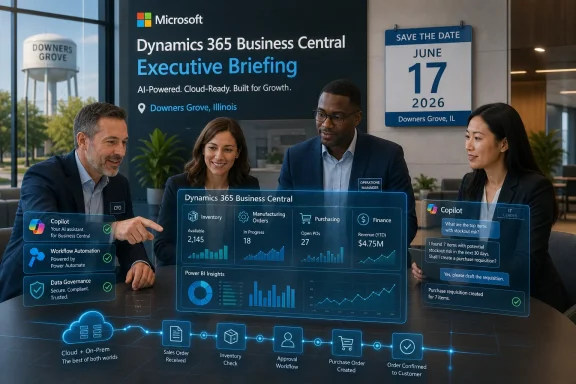
Business team presenting Microsoft Dynamics 365 Business Central executive briefing with holographic analytics.Microsoft Turns ERP Migration Into an AI Conversation​

The pitch around Business Central used to be clean enough: move from legacy Dynamics NAV to a cloud ERP platform, reduce infrastructure headaches, and get onto Microsoft’s faster update cadence. That was already a substantial argument for mid-market manufacturers and distributors, many of which have spent years treating NAV as the dependable back office system nobody wanted to disturb.
Now Microsoft and its partners are changing the language. The event Western Computer is promoting is not just about migration, support deadlines, or cloud hosting. It is about AI advantage, Copilot, automation, reporting, and readiness. That shift matters because it reframes ERP modernization from a defensive IT project into an offensive business project.
This is exactly where Microsoft wants the conversation to go. Business Central is no longer being sold merely as the successor to NAV; it is being positioned as the ERP layer inside a larger Microsoft cloud fabric that includes Microsoft 365, Power Platform, Power BI, Dataverse, Azure AI, and Copilot. For a CFO or operations executive, that makes the migration pitch more attractive. For a CIO, it also makes the decision more complicated.
The danger is that AI branding can make a hard ERP project sound easier than it is. Moving a manufacturer or distributor from a deeply customized NAV environment into Business Central is not a weekend upgrade. It is a data, process, integration, security, licensing, and change-management project wearing the friendlier clothes of modernization.

Dynamics NAV Is Becoming the System Nobody Wants to Explain to the Board​

Dynamics NAV has had a long and unusually sticky life. Its appeal was never glamour; it was flexibility. Partners could customize it heavily, businesses could shape it around real operational quirks, and many organizations built years of process muscle memory into NAV screens, reports, add-ons, and integrations.
That same flexibility is now the liability. A 12-year-old NAV deployment can contain a company’s institutional knowledge, but it can also contain unsupported code, brittle integrations, undocumented workarounds, and security assumptions from another era. The system may still work, but “it still works” is not the same as “it is still a good platform for the next decade.”
Microsoft’s lifecycle clock has made that distinction harder to ignore. Older NAV versions have already fallen out of support, and the last NAV generation is moving toward the end of extended support. That does not mean NAV instances suddenly stop running. It means the risk shifts from the vendor to the customer.
For regulated industries, security-conscious boards, and companies under cyber-insurance scrutiny, that distinction matters. Unsupported ERP does not merely create a technical exposure; it creates an uncomfortable governance question. If the system holding financials, inventory, purchasing, and customer operations is no longer in the vendor’s mainstream future, who owns the risk when something breaks?
Western Computer’s event appears designed to meet that unease head-on. The attendee list it targets — finance, operations, IT leaders, and executives — is telling. This is not a developer workshop. It is a room for the people who must justify why a stable-but-aging ERP environment should be disturbed before a deadline, audit, acquisition, or incident forces the issue.

Business Central Is Microsoft’s Cloud ERP Beachhead for the Mid-Market​

Business Central occupies a specific place in Microsoft’s enterprise software strategy. It is not Dynamics 365 Finance, the larger ERP platform aimed at more complex enterprise scenarios. It is Microsoft’s cloud-first ERP for small and mid-sized organizations that need financials, supply chain, project operations, manufacturing, service management, and reporting without adopting the full weight of a Tier 1 ERP program.
That makes it particularly important for manufacturers and distributors. These companies often have complex operational needs but limited appetite for a sprawling transformation project. They need inventory visibility, purchasing discipline, warehouse processes, margin reporting, production planning, and integration with sales and service systems. They also need those capabilities to be maintainable by a lean IT staff.
The Business Central proposition is that the ERP system becomes less isolated. Microsoft 365 handles collaboration. Power BI handles analytics. Power Automate handles workflow. Power Apps handles lightweight extensions. Copilot increasingly becomes the user-facing AI layer. In theory, this is the “one Microsoft cloud” story that partners have been assembling for years.
In practice, the value depends on implementation quality. A poorly designed Business Central migration can reproduce all the old NAV pain in a shinier interface. A thoughtful migration can simplify processes, retire customizations, standardize reporting, and give users a system that is easier to extend without turning every improvement into a bespoke coding exercise.
That is why partner-led events like this matter more than the press-release format suggests. Microsoft can describe the platform. Partners usually have to explain the ugly middle: what happens to old custom objects, industry-specific workflows, EDI connections, warehouse scanners, reporting packs, third-party tax tools, and the unofficial spreadsheet empire that surrounds every ERP system.

Copilot Gives the ERP Sales Pitch a New Shine, but Not a Free Pass​

Microsoft has spent the last several years attaching Copilot to nearly every major product line. In Business Central, the AI story has centered on assistance inside business workflows: summarizing records, helping with content generation, supporting analysis, improving search-like experiences, and eventually enabling more agentic automation across sales and purchasing scenarios.
That sounds useful because ERP systems are full of friction. Users hunt for the right page, reconcile exceptions, interpret reports, type repetitive descriptions, chase approvals, and manually connect information from invoices, purchase orders, customer records, and inventory movements. If AI can reduce even a modest share of that work, the productivity argument becomes real.
But ERP is also where AI hype collides with operational accountability. A hallucinated paragraph in a marketing draft is annoying. A mistaken purchasing recommendation, inventory adjustment, customer credit interpretation, or financial summary can be expensive. The closer Copilot gets to operational decisions, the more governance matters.
This is where “AI readiness” becomes more than a fashionable phrase. Companies need clean data, role-based access controls, well-defined approval paths, auditability, and a clear view of which actions AI can suggest versus which actions it can execute. They also need employees who understand that Copilot is an interface and assistant, not an oracle.
The strongest version of the Business Central AI argument is not that Copilot magically transforms ERP. It is that cloud ERP creates the conditions under which AI can be introduced more safely, updated more frequently, and governed more consistently. That is a more sober pitch, but it is also the one IT leaders should be listening for.

The Real Migration Decision Is About Process Debt​

Every ERP migration eventually discovers the same uncomfortable truth: the software is not the only legacy asset. The company’s processes are legacy assets too. Some are valuable. Some are accidental. Some exist only because the old system could not do something cleanly in 2013, and nobody revisited the workaround.
Manufacturers and distributors are especially vulnerable to this kind of process debt. A custom report becomes a departmental ritual. A warehouse exception becomes a permanent manual step. A pricing override becomes a shadow policy. A spreadsheet created for one urgent month-end close becomes part of the operating model.
Moving to Business Central forces those choices into daylight. Should the company rebuild every customization, or should it adapt to standard functionality? Should it carry years of transactional history into the new environment, or retain it for reference elsewhere? Should it modernize reporting during the ERP migration, or wait until after go-live? Should it clean master data before the move, during the move, or never, which is the option many organizations accidentally choose?
These are not merely technical decisions. They are political decisions disguised as project scope. The finance team wants continuity. Operations wants minimal disruption. IT wants supportability. Executives want transformation without operational risk. The partner’s job is often to make the trade-offs explicit before the project becomes a budgetary hostage situation.
That is why a live event with demos and real-world scenarios can be useful, provided it does not collapse into theater. A polished Copilot demo can show what the future might look like. A candid migration discussion should show what must be fixed before that future is credible.

Downers Grove Is Local, but the Strategy Is National​

The choice of Microsoft’s Downers Grove office gives the event a regional flavor, but the underlying pattern is much broader. Microsoft’s partner ecosystem has always been central to Dynamics, and that is even more true in the Business Central market. Mid-market ERP buyers rarely purchase an abstract platform; they buy an implementation relationship.
Western Computer’s positioning fits that model. The company is emphasizing its long history with manufacturing and distribution, its Microsoft partnership status, and its experience across Dynamics 365, Power Platform, data, and AI solutions. That is the language buyers expect, but it is also a reminder that Business Central projects are not purely software transactions.
For Microsoft, partners perform a crucial translation function. Redmond can speak in release waves, Copilot capabilities, cloud architecture, and product roadmaps. A partner has to speak in cycle counts, backorders, month-end close, supplier lead times, production constraints, EDI failures, customer-specific pricing, and the fact that one person in accounting knows how the rebate report actually works.
That translation is especially important now that Microsoft is pushing AI into the ERP conversation. AI adoption in business applications will not be won by feature announcements alone. It will be won or lost in operational trust. Users need to see where it saves time, where it stays out of the way, and where human approval remains mandatory.
The event’s framing around “where do we start, what will it cost, and how long will it take” is therefore the right one. Those are the questions customers actually ask. The less comfortable follow-up is whether companies are willing to simplify processes, retire custom work, and invest in data quality before asking AI to accelerate anything.

The Cloud Promise Comes With a Control Trade-Off​

Business Central’s cloud model offers obvious advantages. Customers get a platform that Microsoft continues to update, a tighter fit with Microsoft 365 and Power Platform, and a path to newer AI capabilities without waiting for a major on-premises upgrade cycle. For organizations tired of managing aging infrastructure, this is a compelling shift.
But the cloud also changes the control model. Updates arrive on Microsoft’s cadence. Extensions need to be managed with future compatibility in mind. Integrations must be designed for a service-oriented world rather than a local-server comfort zone. Administrators who once controlled every layer of the environment now share responsibility with Microsoft and the partner ecosystem.
That trade-off is not inherently bad. In many cases, it is exactly the point. The old model gave companies control, but it also gave them the freedom to accumulate technical debt indefinitely. The cloud model narrows some choices while expanding others, particularly around analytics, automation, and AI services.
The difficulty is that organizations often want cloud benefits without cloud discipline. They want continuous innovation but also permanent customization. They want standardization but also every historical exception. They want AI-driven reporting but do not want to confront inconsistent item records, customer hierarchies, or warehouse data.
Business Central can support a modern operating model, but it cannot impose one by itself. The migration is the opening move. The harder work is deciding which parts of the old business should be preserved and which parts should finally be allowed to die.

AI Readiness Starts With the Boring Work Microsoft Cannot Demo​

The most useful sentence in the announcement may be the one about companies being stuck on where to start, what AI will cost, and how long it will take. That is the honest center of the market right now. Many executives are convinced they need an AI strategy; far fewer have mapped that strategy to ERP data, user permissions, process controls, and measurable business outcomes.
ERP is a sensible place to start because it contains high-value business data. It is also a dangerous place to start because that data is often messy, sensitive, and operationally consequential. AI layered onto bad data does not produce transformation. It produces faster confusion.
For Business Central customers, readiness should begin with fundamentals. Are items, vendors, customers, dimensions, posting groups, and units of measure clean enough to support reliable analysis? Are permissions aligned with job roles? Are workflows documented? Are reports trusted? Are integrations monitored? Are exceptions handled consistently?
These questions are boring in the way foundations are boring. Nobody applauds the concrete under a building. But without it, every impressive AI demo becomes a staged performance rather than a repeatable business capability.
Microsoft’s challenge is that Copilot branding creates expectations faster than most organizations can modernize their data estate. Partner events can help narrow that gap if they are willing to tell customers that AI adoption begins with governance, cleanup, and process clarity. That message is less glamorous than “agentic ERP,” but it is more likely to survive contact with month-end close.

Manufacturing and Distribution Will Judge AI by Exceptions, Not Slogans​

Manufacturers and distributors do not live in ideal workflows. They live in exceptions. A supplier misses a shipment. A customer changes an order. A production run consumes more material than expected. A substitute item needs approval. A warehouse count does not match the system. A margin report reveals a pricing problem after the invoice has already gone out.
This is where ERP value is tested, and it is where AI will be judged. A Copilot feature that helps users navigate routine tasks is welcome. An AI assistant that helps identify anomalies, summarize operational context, or accelerate exception handling could be more valuable. But only if the underlying controls are strong enough to keep suggestions from becoming unreviewed decisions.
Distribution, in particular, has an appetite for better reporting and automation because margins can be thin and operational delays compound quickly. Manufacturing has a similar need, but with additional complexity around production orders, capacity, materials, quality, and scheduling. In both worlds, ERP modernization is not an abstract IT upgrade. It is a bet on how accurately the company can see and steer its own operations.
Business Central’s appeal is that it gives these organizations a modern Microsoft-aligned platform without requiring them to become giant-enterprise ERP shops. The risk is that companies underestimate how much business redesign is required to get the promised value. If the old process is inefficient, moving it to the cloud only makes the inefficiency more accessible.
The best AI use cases will probably begin small: better summaries, faster lookups, assisted analysis, draft communications, anomaly surfacing, and workflow suggestions. The larger promise — autonomous or semi-autonomous business agents — will require more maturity. In ERP, autonomy without trust is not innovation. It is a control failure with better branding.

The Partner Pitch Now Carries More Responsibility​

Western Computer’s event is a marketing exercise, but it sits in a serious moment for the Dynamics ecosystem. Customers are being asked to make decisions that affect core business operations for years. They are also being asked to evaluate AI capabilities whose practical value varies widely by process, data quality, licensing, and user adoption.
That puts more responsibility on partners, not less. A good partner should be able to say when Business Central is a fit, when it needs extensions, when another Dynamics product may be more appropriate, and when a customer’s appetite for customization is about to undermine the project. The most valuable advice in ERP is often the advice that prevents a customer from recreating its old mess.
Microsoft’s ecosystem incentives are not always perfectly aligned with that candor. Cloud migrations, Copilot adoption, Power Platform expansion, and data projects all create opportunity. Customers should welcome partner expertise while remembering that modernization programs require skeptical internal ownership.
The strongest buyers will arrive at events like this with hard questions. Which NAV customizations should be retired rather than rebuilt? How are integrations handled? What happens to historical data? Which Copilot features are available today in Business Central, and which are roadmap promises? How does licensing change the cost model? What security and audit controls govern AI-assisted workflows?
Those questions do not weaken the case for Business Central. They make the case more realistic. ERP modernization succeeds when enthusiasm is paired with discipline.

The ERP Upgrade Is Becoming the AI Governance Test​

There is a temptation to treat AI governance as a separate corporate initiative, something handled by legal, security, or a center of excellence. ERP modernization exposes why that separation will not hold. The moment AI enters financial, inventory, purchasing, and operational workflows, governance becomes part of the application design.
That means role-based access is AI policy. Data retention is AI policy. Approval routing is AI policy. Reporting lineage is AI policy. Integration monitoring is AI policy. The controls that once sounded like back-office hygiene now determine whether AI assistance can be trusted in the systems that run the business.
Business Central’s integration with the broader Microsoft stack could make governance easier for organizations already standardized on Microsoft identity, compliance, and productivity tools. It could also create false confidence if companies assume that being inside one ecosystem automatically solves policy design. It does not.
The move from NAV to Business Central is therefore not just a product migration. It is a rehearsal for how mid-market companies will absorb AI into everyday operations. The winners will not be the companies with the flashiest demos. They will be the ones that know which processes are stable enough to automate and which still need human judgment.

The Downers Grove Pitch Puts a Deadline on Comfortable Delay​

The practical message for NAV customers is that waiting has a cost even when nothing visibly breaks. Every year on an aging ERP system can increase the distance between current operations and Microsoft’s investment path. It can also make the eventual migration harder, because customizations deepen, integrations age, and the people who understand the original design move on.
The practical message for Business Central evaluators is that AI should not be treated as an add-on prize at the end of the project. If Copilot and automation are part of the business case, then data quality, permissions, reporting, and process design need to be part of the migration plan from the start. AI readiness cannot be retrofitted cheaply after go-live.
The practical message for Microsoft is subtler. The company has to prove that Copilot in ERP is not just another branding layer. Users will tolerate AI assistance if it saves time, respects permissions, explains itself well enough, and stays inside business controls. They will reject it if it becomes a novelty pane that adds uncertainty to already stressful workflows.
For partners, the opportunity is large but unforgiving. Manufacturers and distributors are pragmatic buyers. They do not need metaphors about the future of work as much as they need fewer late shipments, cleaner inventory, faster closes, better margin visibility, and systems that can survive staff turnover.

What the June 17 Room Will Really Be Selling​

The event’s stated agenda is Business Central, Copilot, modernization, automation, reporting, and AI readiness. The implied agenda is confidence. Western Computer and Microsoft are trying to convince a room of operational decision-makers that now is the time to move from a familiar legacy ERP world into a cloud platform that will change more often, integrate more broadly, and increasingly expose AI inside business workflows.
That is a reasonable argument, but it is not a small one. The companies most likely to benefit will be those that approach the move as a business redesign program, not a technical port. They will inventory customizations, challenge old processes, clean master data, and set boundaries around AI-assisted work before users are asked to trust it.
A few concrete points should survive the demos:
  • The June 17 event is aimed at leaders who are evaluating Business Central as both a NAV successor and a foundation for AI-enabled ERP.
  • Dynamics NAV customers should treat support timelines as a governance issue, not merely an IT maintenance detail.
  • Copilot’s value in ERP will depend less on branding than on clean data, clear permissions, reliable workflows, and auditable decisions.
  • Manufacturers and distributors should evaluate Business Central around exception handling, reporting, integrations, and operational continuity.
  • A successful migration should retire unnecessary customization rather than blindly recreate every legacy behavior.
  • AI readiness should be designed into the ERP program from the beginning, not added after the cloud migration is complete.
The Downers Grove event is a local stop on a much larger Microsoft campaign: move the installed base, modernize the partner channel, and make AI feel inseparable from the next ERP decision. That campaign will probably work, but not because every company suddenly wants an AI-branded finance system. It will work if Microsoft and its partners can show that Business Central is not just the place NAV customers go before support runs out, but the platform where mid-market operations become clean enough, connected enough, and governed enough for the next wave of automation to matter.

References​

  1. Primary source: The Malaysian Reserve
    Published: 2026-06-09T16:50:10.578402
  2. Related coverage: windowscentral.com
  3. Official source: microsoft.com
  4. Related coverage: prnewswire.com
  5. Official source: learn.microsoft.com
  6. Related coverage: randgroup.com
  1. Official source: blogs.microsoft.com
  2. Related coverage: iesgp.com
  3. Official source: news.microsoft.com
  4. Related coverage: bc4.com
  5. Official source: test.playready.microsoft.com
  6. Related coverage: techradar.com
  7. Related coverage: forvismazars.us
  8. Related coverage: tipsa.net
  9. Related coverage: navins.eu
 

Western Computer and Microsoft will host “Navigate Forward: Business Central & The AI Advantage” on Wednesday, June 17, 2026, at Microsoft’s Downers Grove, Illinois office for manufacturing, distribution, finance, operations, and IT leaders evaluating Dynamics 365 Business Central and AI-driven ERP modernization. The event is a partner roadshow, but the timing says more than the venue does. Microsoft’s mid-market ERP story is no longer just about replacing Dynamics NAV with a cloud product; it is about using that migration moment to make Copilot, automation, and data readiness unavoidable parts of the same conversation.
That is the real pitch behind this announcement. Western Computer is not merely inviting customers to see demos. It is trying to catch companies at the exact point where technical debt, aging ERP deployments, and executive curiosity about AI all collide.

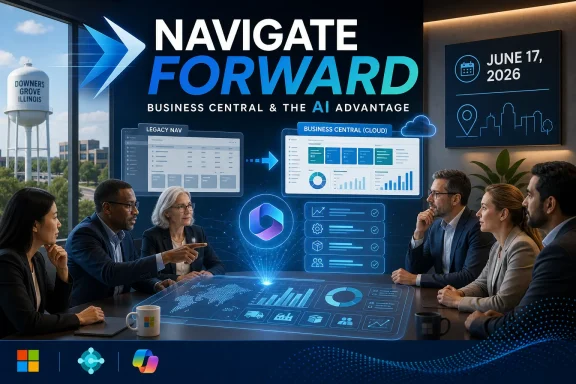
Business team discusses cloud/AI integration on a “Navigate Forward” dashboard display dated June 17, 2026.The ERP Migration Conversation Has Been Rewritten Around AI​

For years, the move from Dynamics NAV to Dynamics 365 Business Central could be framed as a familiar enterprise software upgrade: get off an older system, move to the cloud, reduce local maintenance, modernize reporting, and standardize integrations. That case still exists, but it has become too modest for Microsoft’s current platform strategy. In 2026, the stronger sales argument is that an ERP system stuck in a legacy posture is also an AI system that cannot be meaningfully activated.
That is why an event about Business Central now carries “The AI Advantage” in its name. Microsoft and its partners understand that many organizations are not ready to buy “AI” in the abstract. They are, however, willing to talk about better forecasting, faster month-end close, cleaner purchasing workflows, improved inventory visibility, automated document handling, and fewer spreadsheet-based workarounds.
The shift is subtle but important. AI is being smuggled into the boardroom through the operational pain points that ERP buyers already understand. A manufacturer may not care about agentic AI as a concept, but it may care deeply about whether a purchasing team can surface exceptions before stockouts ripple through production.
That makes Business Central a convenient vessel for Microsoft’s AI ambitions. Unlike a generic chatbot, ERP AI can be attached to transactions, approvals, vendors, customers, financial dimensions, and operational events. The promise is not merely that Copilot can summarize something; it is that Copilot can sit closer to the business process itself.

Dynamics NAV Is the Ghost at the Table​

The announcement’s reference to Dynamics NAV end-of-support planning is not a throwaway line. NAV remains one of Microsoft’s most consequential business application legacies, especially among mid-market manufacturers and distributors that customized it heavily and then kept it running because it worked well enough. That “well enough” is now the problem.
The last major NAV generation, Dynamics NAV 2018, is in its extended-support era, with final extended support scheduled to end in January 2028. For older NAV versions, the clock has already run out. That gives partners a clear migration deadline, but it also creates a familiar customer objection: if the system still posts invoices, manages inventory, and supports operations, why disrupt it?
The answer Microsoft and Western Computer are presenting is not simply “because support ends.” Support deadlines are useful for risk committees, but they rarely inspire transformation budgets by themselves. The stronger argument is that a legacy NAV estate limits what the business can do next, especially when executives are asking for AI-enabled reporting, workflow automation, modern integrations, and cloud governance.
NAV’s greatest strength was also its trap. It was flexible, adaptable, and often deeply tailored to the business. Over years, that flexibility produced bespoke environments where business logic lived in custom code, tribal knowledge, add-ons, and partner-maintained extensions. Moving that world to Business Central is not a weekend upgrade; it is an exercise in deciding which customizations still represent competitive advantage and which ones are fossilized process debt.
That is where events like this become more than marketing. The hard part for many organizations is not believing that Business Central is Microsoft’s future. The hard part is mapping the path from a working NAV system to a cloud ERP model without breaking the workflows that keep orders shipping and plants running.

Microsoft Wants Business Central to Be the Mid-Market AI Control Plane​

Microsoft’s 2026 release wave for Dynamics 365 Business Central continues the company’s broader push to make ERP more intelligent, more automated, and more connected to the rest of the Microsoft cloud. The language in Microsoft’s release planning is familiar by now: Copilot, agents, extensibility, automation, and deeper integration across Microsoft 365 and Power Platform. The strategy is not subtle. Microsoft wants Business Central to become the operational system of record that AI can act upon.
That matters because mid-market ERP has historically been a stubborn category. Companies do not replace ERP systems because a vendor has a fashionable keynote. They replace them when the cost of standing still becomes more obvious than the cost of change. Microsoft is trying to change that calculation by tying ERP modernization to AI readiness.
If Business Central is connected to Microsoft 365, Power BI, Power Automate, Dataverse, and Copilot Studio, then the ERP migration becomes a platform decision rather than an accounting-system decision. That is exactly the kind of framing Microsoft prefers. The more a customer’s finance, operations, collaboration, reporting, and automation layers run through Microsoft services, the more persuasive the Microsoft cloud story becomes.
There is a practical side to that strategy. Many mid-market companies already live in Microsoft 365, use Teams for collaboration, rely on Excel for analysis, and have at least some Power BI footprint. Business Central’s appeal is that it can make those familiar tools feel less like disconnected productivity software and more like part of a single operating environment.
But there is also a lock-in story here, even if vendors prefer not to say it out loud. Once ERP data, workflows, user identities, automation, reporting, and AI assistants are braided together across Microsoft’s cloud, leaving becomes more complicated. For customers, the question is not whether that integration is useful. It is whether the productivity gains justify concentrating even more operational gravity inside one vendor’s ecosystem.

Copilot Demos Are Easy; Operational Trust Is Hard​

The event agenda promises Business Central and Microsoft Copilot demonstrations, and those demos will almost certainly be the most visually compelling part of the day. A good Copilot demo can make ERP look less like a maze of forms and more like a conversational business assistant. It can summarize records, generate drafts, suggest actions, and reduce the intimidation factor for users who do not live inside ERP screens all day.
But demos are also where enterprise AI can become misleading. The distance between “Copilot produced a useful suggestion in a controlled scenario” and “Copilot reliably improves a business process under real production constraints” is larger than many sales decks admit. ERP is not a note-taking app. Mistakes can affect purchasing, inventory, revenue recognition, compliance, customer commitments, and audit trails.
That is why the more interesting part of Western Computer’s event is not the existence of Copilot, but the promised discussion around AI readiness. Readiness is the unglamorous work: data quality, process standardization, security roles, governance, integration architecture, change management, and a clear understanding of where automation should stop and human approval should begin.
Manufacturers and distributors are especially sensitive to this. A bad AI-generated email is embarrassing. A bad recommendation tied to inventory availability, vendor lead times, production scheduling, or financial posting can be expensive. The companies most likely to benefit from ERP AI are also the ones that need the strongest guardrails.
The right question for attendees is not “What can Copilot do?” It is “Which parts of our business are clean, standardized, and governed enough for Copilot to touch?” That is a less exciting question, but it is the one that separates a useful deployment from a novelty.

The Manufacturing and Distribution Angle Is the Point​

Western Computer’s focus on manufacturing and distribution is not incidental. These sectors sit at the intersection of operational complexity and mid-market pragmatism. They often run lean teams, depend on accurate inventory and costing, and carry years of process variation that accumulated through growth, acquisitions, customer demands, and supplier constraints.
For those companies, ERP modernization is rarely about chasing the newest user interface. It is about whether the system can support the way the business now operates. A distributor may need better demand visibility across warehouses. A manufacturer may need stronger production planning, quality tracking, lot traceability, or integration with shop-floor systems. A finance team may need faster close cycles and cleaner reporting without exporting half the business into Excel.
AI can help with some of that, but only if the underlying ERP foundation is coherent. Copilot cannot magically repair a poorly maintained item master, inconsistent dimensions, duplicate vendors, or undocumented custom processes. If anything, AI makes those problems more visible because automation depends on the quality of the data and logic underneath it.
This is where partners earn or lose trust. Microsoft can describe the platform vision, but a partner like Western Computer has to translate that vision into migration sequencing, extension strategy, training, and operational design. The difference between a successful Business Central project and a painful one often lies in those implementation decisions, not in the product brochure.
That is also why onsite events still exist in a cloud-first world. ERP buyers want to look experts in the eye and ask uncomfortable questions. They want to know what breaks, what takes longer than expected, what customizations should be retired, and what the budget looks like after the optimistic slide deck ends.

Business Central Is Becoming a Test of Microsoft’s “One Cloud” Promise​

Business Central occupies an interesting place in Microsoft’s portfolio. It is not as sprawling as Dynamics 365 Finance and Supply Chain Management, but it is more operationally central than a productivity app. For many mid-market businesses, it is the place where Microsoft’s promise of an integrated cloud either becomes real or collapses into another stack of subscriptions.
The ideal version of the story is compelling. A user works in Outlook or Teams, surfaces customer or vendor context from Business Central, analyzes performance in Power BI, automates approvals through Power Automate, and uses Copilot to summarize, suggest, or generate next steps. The ERP system becomes less isolated, and the business spends less time reconciling data across disconnected tools.
The less ideal version is also familiar. Licensing becomes confusing. Integrations require more work than expected. Custom extensions complicate upgrades. Users resist process changes. AI features arrive faster than governance models. The organization discovers that cloud ERP is not a destination but a treadmill of continuous updates, release waves, and administrative decisions.
Microsoft’s release-wave cadence is both a strength and a source of fatigue. Customers get regular improvements rather than decade-long upgrade cliffs. But IT teams must also absorb a steady rhythm of change, test extensions, manage user expectations, and decide which features to enable. In ERP, change is not just a technical event; it is a business event.
That makes partner guidance essential, but it also means customers should enter modernization projects with eyes open. Business Central is not a magic escape from ERP complexity. It changes the shape of that complexity, moving it from server rooms and version upgrades toward cloud governance, extension management, security configuration, data architecture, and business-process discipline.

The AI Pitch Raises the Bar for Data Governance​

The most dangerous sentence in enterprise technology is still some version of “We’ll fix the data later.” In an AI-enabled ERP environment, that sentence becomes even more dangerous. Copilot and agents do not reduce the need for data governance; they increase the penalty for neglecting it.
ERP data is full of nuance. A customer record may be technically complete but commercially misleading. A vendor may appear active but be avoided by purchasing because of quality issues. Inventory may be accurate in aggregate but wrong by location or lot. A financial dimension may exist for reporting reasons that only one controller understands.
AI systems can surface patterns and accelerate workflows, but they do not automatically understand the political and historical sediment inside an ERP database. Without governance, they may confidently expose ambiguity that humans previously managed through experience. That is not a reason to reject AI. It is a reason to treat AI as a forcing function for cleanup.
For companies moving from NAV to Business Central, this is an opportunity. Migration projects already require decisions about master data, chart of accounts design, dimensions, integrations, security roles, and reporting models. Adding AI readiness to that work can make the project more valuable, provided it does not become a vague slogan pasted onto the plan.
The practical test is whether the organization can identify a few high-value AI use cases and then work backward to the data, controls, and process changes required to support them. “We want AI in ERP” is not a strategy. “We want to reduce manual purchase-order follow-up by surfacing supplier exceptions and drafting recommended actions for review” is much closer to one.

The Partner Event Is Also a Signal About the Channel​

Microsoft’s business applications ecosystem depends heavily on partners, and this event is a reminder that the channel remains central to how Microsoft reaches mid-market customers. Business Central is not usually bought the way a consumer downloads an app or an enterprise adds another Microsoft 365 license. It is evaluated, scoped, implemented, customized, trained, and supported.
Western Computer’s credentials in the announcement are therefore part of the message. The company points to decades of experience, Microsoft partner status, Inner Circle recognition, G2 customer satisfaction positioning, and industry specialization. That is not just résumé padding. In ERP, buyers are not only choosing software; they are choosing the team that will interpret the software for their business.
The rise of AI makes that partner role more complicated. A traditional ERP implementation could focus on configuration, migration, reports, integrations, and training. Modern projects increasingly need to address automation design, AI governance, data strategy, user adoption, and security boundaries across multiple Microsoft services. The partner must speak both operations and platform architecture.
This creates opportunity for the best partners and risk for customers who treat all implementers as interchangeable. A weak implementation can turn a promising cloud ERP system into a long-running source of resentment. A strong implementation can help a company simplify processes, retire unnecessary customizations, and build a foundation for gradual automation rather than chaotic experimentation.
The June 17 event is therefore partly a sales motion and partly a credibility exercise. Western Computer and Microsoft are telling prospects: this is not merely a product shift; it is a business-process and AI-readiness shift, and you should not attempt it as a generic software upgrade.

The Calendar Is Forcing Decisions That Strategy Committees Delayed​

Many organizations have spent the last two years discussing AI without making operational commitments. That hesitation is understandable. AI pricing, governance, reliability, security, and return on investment have all been moving targets. But the ERP calendar is less forgiving.
For NAV customers, support timelines turn indecision into risk. Even if a company does not view January 2028 as an immediate crisis, ERP modernization projects can take significant planning time, especially where customizations, integrations, data cleanup, and user retraining are involved. Waiting until the final year compresses decisions that should be made deliberately.
That is why Western Computer’s event lands at a useful moment. Mid-2026 is late enough for Copilot and Business Central AI features to feel more concrete than speculative, but early enough for NAV customers to plan before the deadline becomes a scramble. The companies that begin with assessment now will have more room to decide what to migrate, what to redesign, and what to abandon.
The more disciplined organizations will resist the temptation to turn modernization into a like-for-like cloud replica of their old NAV environment. That is often the fastest way to carry old problems into a new platform. The better path is more uncomfortable: challenge customizations, simplify workflows, standardize where possible, and treat exceptions as business decisions rather than sacred inheritance.
That is easier said than done. ERP systems encode power structures as much as processes. Departments defend reports, screens, approvals, and workarounds because they represent years of adaptation. Successful modernization requires executive backing not because the software is hard to install, but because changing the business is hard to govern.

AI Will Not Save a Bad ERP Project​

The strongest criticism of the current enterprise AI boom is that vendors sometimes imply intelligence can compensate for poor systems. In ERP, the opposite is true. AI magnifies the quality of the implementation beneath it.
A well-designed Business Central environment can give Copilot useful context and safe boundaries. A messy one can produce confusion at higher speed. That distinction should matter to every CIO, CFO, and operations leader attending the Downers Grove event.
There is a temptation to judge AI features by their most impressive demo moment. A user asks a question in natural language, receives a summary, drafts a response, or generates a suggested action. It looks like a leap forward, and in some cases it is. But the more durable value comes when AI reduces repetitive friction in a governed process that the organization already understands.
That means companies should start with boring use cases. Automating pieces of vendor communications, explaining variances, summarizing overdue receivables, drafting collection notes, identifying anomalies, or helping users navigate business data may not sound revolutionary. But these are the kinds of improvements that can build trust.
The grander vision of agents operating across ERP, productivity apps, and workflow tools will require that trust. Enterprises will not hand operational authority to AI systems all at once. They will expand permissions gradually, after proving that the system is accurate, auditable, secure, and useful.

The Downers Grove Event Shows Where Microsoft’s Business Apps Story Is Going​

The significance of this event is not that a Microsoft partner is hosting a regional ERP session. Those happen all the time. The significance is that the framing neatly captures Microsoft’s current business applications strategy: use cloud migration as the entry point, use Copilot as the accelerant, and use the broader Microsoft ecosystem as the reason to standardize.
For WindowsForum readers, the story is also a reminder that Microsoft’s AI strategy is not confined to Windows 11, Microsoft 365, or developer tools. The company is pushing AI into the operational software that runs businesses. That may be less visible than a Copilot button in a consumer app, but it may prove more consequential.
ERP modernization is where Microsoft’s AI claims meet business reality. If Copilot can help reduce manual work inside finance and operations, the value is tangible. If it merely adds another layer of licensing and user confusion, customers will notice quickly.
That is why events like this are worth watching even if you are not in the Chicago area or not shopping for ERP software. They show how Microsoft and its partners are translating the AI era into practical buying motions. The pitch is no longer “move to the cloud someday.” It is “move to the cloud because the next layer of automation assumes you already did.”

The Real Test Comes After the Downers Grove Demo​

The most useful reading of Western Computer’s announcement is not as a one-day event notice, but as a snapshot of the ERP market’s next phase. The cloud migration argument has matured. The AI argument is now being attached to specific operational systems. The burden is shifting from vendor promise to customer preparation.
Companies considering Business Central should treat the event as a starting point for due diligence, not as a destination. The right outcome is not excitement about Copilot alone. It is a clearer view of which processes should move, which should change, which data needs cleanup, and which AI scenarios are mature enough to justify investment.
The concrete lessons are straightforward:
  • Organizations still running Dynamics NAV should treat support timelines as planning deadlines, not last-minute migration triggers.
  • Business Central modernization should be scoped as a process redesign effort, not a like-for-like technical conversion.
  • Copilot value depends on clean data, sensible permissions, clear workflows, and human review points.
  • Manufacturers and distributors should prioritize AI use cases tied to measurable operational friction, not abstract productivity claims.
  • Partner selection matters more as ERP projects expand into Power Platform, Microsoft 365, data architecture, and AI governance.
  • The safest AI roadmap begins with narrow, auditable scenarios before expanding toward more autonomous agents.
The companies that gain the most from Microsoft’s ERP-and-AI push will not be the ones dazzled by the newest demo. They will be the ones that use the migration pressure to make harder decisions about process, data, governance, and platform strategy. Business Central may be the product on the agenda in Downers Grove, but the larger question is whether mid-market firms are ready to turn years of operational improvisation into systems that AI can actually help run.

References​

  1. Primary source: The AI Journal
    Published: 2026-06-09T16:50:07.555497
  2. Related coverage: windowscentral.com
  3. Official source: learn.microsoft.com
  4. Related coverage: prnewswire.com
  5. Related coverage: randgroup.com
  6. Related coverage: iesgp.com
  1. Related coverage: bc4.com
  2. Related coverage: softwareconnect.com
  3. Related coverage: thetestmart.com
  4. Related coverage: techradar.com
  5. Related coverage: navins.eu
  6. Related coverage: dynamicsconsult.com
  7. Related coverage: dynamicscon.com
 

Back
Top