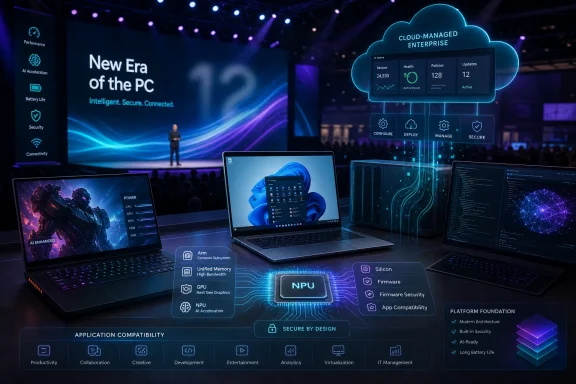
Microsoft signaled on May 29, 2026, that Build 2026 and the adjacent Computex week will not bring a Windows 12 preview, with Windows chief Pavan Davuluri instead pointing developers toward new Windows tooling and possible PC hardware announcements. The message is less a denial than a course correction. Microsoft is trying to make the next Windows story about devices, AI workloads, and Windows 11 repair work rather than another version-number reset.
That is a harder story to sell, but probably the more consequential one. Windows 12 would be easy theater: a new logo, a new Start menu argument, a new compatibility panic, and a new round of enterprise deferrals. What Microsoft appears to be preparing instead is messier and more strategic: keep the Windows 11 brand, rebuild confidence in the platform, and use the coming PC silicon wave to make “the next Windows” arrive without changing the name on the box.
The pre-Build rumor cycle practically writes itself every year, and in 2026 it had unusually fertile ground. Windows 11 is nearing its fifth birthday, the AI PC push is maturing, Arm laptops are no longer a science project, and Microsoft is sharing the calendar with Computex, the hardware industry’s annual stage for silicon bravado. If there were ever a week to tease Windows 12, this looked like it.
Davuluri’s post did the opposite. “Something new is coming for developers,” he wrote, while explicitly undercutting the operating-system speculation with the line that it was “not a new OS version.” That is unusually direct for a company that often lets ambiguity do its marketing work until the keynote lights come up.
The official Windows account then added another layer of intrigue by echoing a “new era of PC” teaser tied to coordinates in Taipei. Those coordinates point the conversation away from Redmond’s versioning department and toward the Computex stage, where Nvidia, Microsoft, and PC partners are expected to have something to say about the future of Windows hardware.
The point is not that Windows 12 is dead. Microsoft has rarely treated Windows branding as a sacred calendar commitment. The point is that the company wants the next public Windows moment to be interpreted through hardware and developer capability, not through a clean operating-system break.
But a new major version would not automatically fix any of that. It might even make the trust problem worse.
Enterprises do not see a new Windows version as a celebration. They see application validation, driver testing, deployment rings, help desk scripts, security baselines, procurement exceptions, and months of user education. For sysadmins who only recently finished wrestling Windows 10 estates toward Windows 11, a Windows 12 preview in mid-2026 would look less like innovation and more like a second invoice for the same migration.
Consumers are not much easier to impress. The average PC buyer does not care whether a better taskbar arrives under Windows 11 26H2 or Windows 12. They care whether the machine wakes quickly, updates cleanly, plays their games, runs their peripherals, avoids nagging them, and does not turn routine tasks into a tour of Microsoft’s commercial priorities.
That is why Microsoft’s quieter message matters. The company appears to understand that the next credibility test for Windows is not whether it can ship a new shell. It is whether Windows 11 can become less annoying, more responsive, and more coherent before Microsoft asks users to trust it with another generational leap.
A movable taskbar is a small example with large symbolic weight. Microsoft removed or constrained several long-standing customization behaviors in the Windows 11 transition, often in the name of modernization. For a company that serves everyone from gamers to accountants to kiosk operators, that kind of simplification can quickly look like arrogance.
The same is true of Start menu customization. The Start menu has become a recurring battlefield because it sits at the intersection of user habit, Microsoft promotion, enterprise policy, and search monetization. Improving it is not just a UI tweak; it is a signal about whether Microsoft thinks the Windows desktop belongs primarily to the user or to the company’s engagement funnel.
Windows Update is even more important. If Microsoft can make updates smaller, less disruptive, more predictable, and easier to administer, it will do more for Windows satisfaction than a new wallpaper pack ever could. The operating system’s reputation is shaped in the minutes when users are blocked from working, not in the seconds when they admire a launch animation.
The developer story in 2026 is not likely to be “install this new Windows preview.” It is more likely to be “build applications that can take advantage of local models, NPUs, GPUs, Arm chips, cloud fallbacks, and Microsoft’s AI tooling without caring too much which PC architecture is underneath.” That is a more complicated pitch, but it is also where the platform fight has moved.
Windows developers now face a hardware landscape that is fracturing in useful and uncomfortable ways. Intel and AMD remain central. Qualcomm made Windows on Arm commercially credible with Snapdragon X. Nvidia appears poised to enter the client PC conversation more aggressively. Microsoft has to make that diversity look like opportunity rather than fragmentation.
That means APIs, runtime layers, packaging, drivers, app compatibility, developer documentation, and performance guidance matter more than a version banner. If Windows is going to become a credible AI client platform, developers need predictable ways to target heterogeneous silicon. They need to know when to use the NPU, when to use the GPU, when to fall back to the CPU, and when the cloud is still the right answer.
A Windows 12 preview would generate headlines. A better developer stack for local AI and cross-architecture Windows apps could generate applications people actually use.
The likely center of gravity is not merely another Surface refresh. Microsoft already introduced new Surface for Business systems in May with Intel Core Ultra Series 3 processors, and it has confirmed more Surface hardware with Snapdragon X2 chips later in the year. That alone would be enough to keep the Surface faithful busy, but the coordinated hints from Microsoft and Nvidia suggest a broader platform play.
Nvidia’s long-rumored move into Windows client CPUs would be a major development if it arrives in earnest. Nvidia already owns the mindshare around GPUs, AI acceleration, and developer tooling in the datacenter. A Windows PC platform that combines Arm CPU cores with Nvidia graphics and AI capabilities would immediately put pressure on Intel, AMD, and Qualcomm to sharpen their own stories.
For Microsoft, the upside is obvious. Apple’s Mac transition proved that tight coordination between operating system, silicon, and developer tools can reshape expectations around battery life, performance per watt, and media workloads. Microsoft cannot vertically integrate the Windows ecosystem in the same way, but it can cultivate a competitive silicon field that makes Windows laptops feel less like variations on the same x86 theme.
The risk is also obvious. Windows has lived through Arm false starts before. Windows RT damaged confidence. Early Windows on Arm devices were compromised by performance gaps and app compatibility caveats. Even the more recent Copilot+ PC wave had to fight the perception that headline AI features were arriving faster than the everyday reasons to buy the machines.
Nvidia entering the category would change the psychology. It would make Windows on Arm look less like a Qualcomm lane and more like an ecosystem transition. Developers would have more reason to test native Arm builds. OEMs would have more leverage and variety. Microsoft would have another partner with enormous influence in AI software stacks.
Nvidia would not be entering a quiet market. Intel is trying to make its Core Ultra roadmap synonymous with AI PCs. AMD has credible CPU and integrated graphics offerings. Qualcomm is pressing battery life and Arm efficiency. Apple remains the benchmark Microsoft and its partners do not like to name too often but cannot ignore.
A Windows PC with Nvidia silicon would therefore have to be more than a logo exercise. If the machines are merely expensive curiosities with uneven compatibility, the market will shrug. If they deliver strong battery life, serious graphics performance, credible local AI acceleration, and a smooth app experience, they could reset expectations for premium Windows laptops.
That is the real “new era” test. The PC industry has overused the phrase for decades. Users will believe it only if the new machines behave differently in the hand, in the bag, and under load.
Many Windows users still experience AI as something bolted onto the shell rather than something that improves the machine. Recall, the most controversial of Microsoft’s AI features, became a privacy and security flashpoint before it became a reason to buy hardware. Copilot integration has at times felt more like a distribution strategy than a productivity revolution.
That does not mean the AI PC concept is empty. Local transcription, image generation, semantic search, accessibility features, developer assistants, gaming enhancements, creative workflows, and enterprise automation all have plausible on-device use cases. The issue is that Microsoft must make those use cases feel dependable, governable, and optional enough for real-world environments.
For administrators, the question is not whether a laptop has an NPU. It is whether that NPU introduces new data paths, new policy requirements, new update dependencies, and new support calls. If Microsoft wants AI PCs to penetrate managed fleets, it must give IT departments controls that are as mature as the marketing is enthusiastic.
This is where Build matters. Developers and admins need the plumbing beneath the Copilot+ slogan. They need APIs, documentation, management hooks, privacy boundaries, performance tools, and clear deployment models. Without that, AI PCs remain a retail shelf category rather than a platform shift.
That does not mean enterprises are satisfied with Windows 11. Many are not. They want fewer surprises, better controls over consumer-facing features, more predictable servicing, and a clearer separation between business productivity and Microsoft’s promotional ambitions. But those are governance problems, not necessarily Windows 12 problems.
A major version change can sometimes create useful forcing functions. It gives security teams a moment to reset baselines, procurement teams a reason to refresh hardware, and executives a simple story about modernization. But Windows 11 already served that role, and many organizations are still digesting it.
The more practical enterprise path is incremental improvement. Make Windows 11 more manageable. Reduce reboot pain. Improve update transparency. Keep expanding driver and app compatibility across silicon architectures. Make AI features controllable by policy from day one rather than after the backlash.
In other words, Microsoft’s best enterprise argument is not “trust us, Windows 12 is better.” It is “the Windows 11 estate you are building now will continue to improve, and the new hardware you buy will unlock capabilities without requiring another operating-system migration.”
A new version sounds like a chance to impose discipline. It suggests Microsoft might finally finish modernizing the shell, rationalize Control Panel leftovers, simplify privacy controls, and stop treating the desktop as an experiment in cross-selling. That desire is legitimate.
The problem is that Microsoft does not need a new brand to do those things. It needs product restraint. Windows 11 can be made more coherent if Microsoft chooses coherence over engagement metrics. It can become faster if performance work is prioritized over decorative AI integrations. It can become more trustworthy if defaults are designed for user agency rather than funnel optimization.
A Windows 12 launch without that discipline would simply move the clutter into a new box. Enthusiasts know this, which is why the Windows 12 fantasy often contains contradictory demands: be radically new, but do not break anything; be cleaner, but bring back every removed option; be AI-ready, but stop pushing AI; be modern, but preserve Win32’s glorious chaos.
Microsoft’s challenge is to satisfy enough of that sentiment without pretending there is a magical reset button.
That makes “Windows 12” a fuzzier concept than it appears. Microsoft could ship a dramatically redesigned Windows 11 update and users would experience it as a new OS in all but name. It could also ship Windows 12 with modest visual changes and users would experience it as Windows 11 with a different sticker.
This ambiguity cuts both ways. It allows Microsoft to improve the platform without triggering a full migration panic. It also lets the company blur accountability, pushing meaningful changes through channels users do not always understand or control.
For IT pros, the label matters less than the servicing commitments. How long is the release supported? Which features can be deferred? Which components update outside the normal patch cadence? Which AI features are enabled by default? Which telemetry and cloud dependencies are introduced? Which hardware requirements are enforced?
Those are the questions that determine operational risk. Whether the answer is called Windows 11, Windows 12, or something else is secondary.
The scarce resource is patience.
Users have endured years of upgrade prompts, account nudges, Teams integrations, Copilot experiments, browser defaults, Start menu revisions, and AI branding exercises. Administrators have endured shifting baselines, inconsistent policy timing, and the need to explain to executives why a feature announced onstage is not necessarily safe or ready for the fleet.
Microsoft’s advantage is that Windows remains the default environment for enormous swaths of business, gaming, engineering, education, and public-sector computing. Its disadvantage is that default status can breed resentment. People may keep using Windows because they must, but that does not mean they are eager to absorb every new initiative Microsoft attaches to it.
This is why the Windows 12 denial is strategically useful. It lowers the temperature. It tells users not to expect another forced narrative next week. It gives Microsoft room to argue that the real work is happening inside Windows 11 and across the PC ecosystem.
But lowering expectations only works if the follow-through is real. If Build and Computex deliver only another round of vague AI demos and aspirational hardware slogans, the absence of Windows 12 will feel like a dodge. If they deliver practical developer tools, credible devices, and visible Windows quality improvements, the version-number restraint will look smart.
That transition will be uneven. Some users will benefit quickly, especially those buying premium laptops or building apps around new AI and media workloads. Others will see little difference beyond more branding. Enterprises will move cautiously, waiting for hardware maturity, driver stability, policy coverage, and proof that local AI features can be governed.
Microsoft will keep the Windows 12 option in reserve. It may eventually need the brand to mark a support boundary, a major shell redesign, a new security baseline, or a hardware requirement shift. But the company appears unwilling to spend that card merely because the calendar looks convenient.
That restraint is notable. Microsoft has not always resisted the urge to make the Windows story bigger than the product reality. If it is now choosing to underpromise on versioning and overinvest in the platform beneath it, that is a healthier instinct.
That means the most important announcements may not be the loudest ones. A new Arm-based Nvidia PC would be fascinating, but its success depends on app compatibility, thermals, battery life, drivers, pricing, and OEM execution. A new Surface model might photograph well, but its relevance depends on whether it advances the Windows experience beyond another premium chassis.
Developer tooling could matter more than both. If Microsoft gives developers clean ways to target local AI acceleration across diverse hardware, Build 2026 could be remembered as a platform moment even without Windows 12. If it fails, the hardware ecosystem risks becoming a collection of impressive chips waiting for software that knows what to do with them.
For WindowsForum readers, that is the practical lens. Do not ask only whether Microsoft announces a new PC. Ask whether the PC makes Windows better. Do not ask only whether Microsoft mentions AI. Ask whether the feature can be disabled, managed, audited, and explained. Do not ask only whether Windows 12 is missing. Ask whether Windows 11 is finally being treated as a product that deserves refinement rather than a billboard that happens to boot.
That is a harder story to sell, but probably the more consequential one. Windows 12 would be easy theater: a new logo, a new Start menu argument, a new compatibility panic, and a new round of enterprise deferrals. What Microsoft appears to be preparing instead is messier and more strategic: keep the Windows 11 brand, rebuild confidence in the platform, and use the coming PC silicon wave to make “the next Windows” arrive without changing the name on the box.
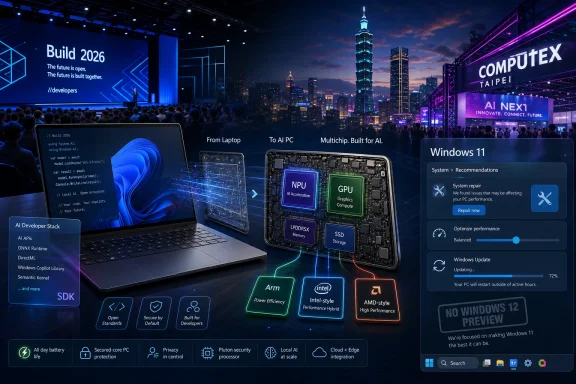 Microsoft Takes the Windows 12 Bait Off the Hook
The pre-Build rumor cycle practically writes itself every year, and in 2026 it had unusually fertile ground. Windows 11 is nearing its fifth birthday, the AI PC push is maturing, Arm laptops are no longer a science project, and Microsoft is sharing the calendar with Computex, the hardware industry’s annual stage for silicon bravado. If there were ever a week to tease Windows 12, this looked like it.Davuluri’s post did the opposite. “Something new is coming for developers,” he wrote, while explicitly undercutting the operating-system speculation with the line that it was “not a new OS version.” That is unusually direct for a company that often lets ambiguity do its marketing work until the keynote lights come up.
The official Windows account then added another layer of intrigue by echoing a “new era of PC” teaser tied to coordinates in Taipei. Those coordinates point the conversation away from Redmond’s versioning department and toward the Computex stage, where Nvidia, Microsoft, and PC partners are expected to have something to say about the future of Windows hardware.
The point is not that Windows 12 is dead. Microsoft has rarely treated Windows branding as a sacred calendar commitment. The point is that the company wants the next public Windows moment to be interpreted through hardware and developer capability, not through a clean operating-system break.
A New Version Number Would Not Solve the Old Windows Problem
The temptation to ask for Windows 12 is understandable. Windows 11 has never fully escaped the sense that it was an imposed upgrade rather than a beloved one. Its hardware requirements were stricter, its interface changes were uneven, its advertising and account nudges irritated power users, and its AI features often arrived before users understood why they needed them.But a new major version would not automatically fix any of that. It might even make the trust problem worse.
Enterprises do not see a new Windows version as a celebration. They see application validation, driver testing, deployment rings, help desk scripts, security baselines, procurement exceptions, and months of user education. For sysadmins who only recently finished wrestling Windows 10 estates toward Windows 11, a Windows 12 preview in mid-2026 would look less like innovation and more like a second invoice for the same migration.
Consumers are not much easier to impress. The average PC buyer does not care whether a better taskbar arrives under Windows 11 26H2 or Windows 12. They care whether the machine wakes quickly, updates cleanly, plays their games, runs their peripherals, avoids nagging them, and does not turn routine tasks into a tour of Microsoft’s commercial priorities.
That is why Microsoft’s quieter message matters. The company appears to understand that the next credibility test for Windows is not whether it can ship a new shell. It is whether Windows 11 can become less annoying, more responsive, and more coherent before Microsoft asks users to trust it with another generational leap.
Windows 11 Is Becoming the Construction Site for Windows 12’s Ideas
The irony is that many features people would have expected in Windows 12 are already being framed as Windows 11 repair work. Microsoft has been talking more openly about performance, quality, taskbar flexibility, Start menu customization, and changes to the update experience. These are not glamorous keynote beats, but they are exactly the areas where Windows users have been asking Microsoft to stop chasing novelty and start sanding down the daily friction.A movable taskbar is a small example with large symbolic weight. Microsoft removed or constrained several long-standing customization behaviors in the Windows 11 transition, often in the name of modernization. For a company that serves everyone from gamers to accountants to kiosk operators, that kind of simplification can quickly look like arrogance.
The same is true of Start menu customization. The Start menu has become a recurring battlefield because it sits at the intersection of user habit, Microsoft promotion, enterprise policy, and search monetization. Improving it is not just a UI tweak; it is a signal about whether Microsoft thinks the Windows desktop belongs primarily to the user or to the company’s engagement funnel.
Windows Update is even more important. If Microsoft can make updates smaller, less disruptive, more predictable, and easier to administer, it will do more for Windows satisfaction than a new wallpaper pack ever could. The operating system’s reputation is shaped in the minutes when users are blocked from working, not in the seconds when they admire a launch animation.
Build Is a Developer Conference, and Microsoft Is Finally Acting Like It
The public often treats Build as a consumer launch event because Windows news occasionally breaks there. Microsoft, however, has been nudging Build back toward its original center of gravity: developers, platform APIs, tools, cloud services, and increasingly AI infrastructure. In that context, Davuluri’s “not a new OS version” line is not a disappointment. It is a redirect.The developer story in 2026 is not likely to be “install this new Windows preview.” It is more likely to be “build applications that can take advantage of local models, NPUs, GPUs, Arm chips, cloud fallbacks, and Microsoft’s AI tooling without caring too much which PC architecture is underneath.” That is a more complicated pitch, but it is also where the platform fight has moved.
Windows developers now face a hardware landscape that is fracturing in useful and uncomfortable ways. Intel and AMD remain central. Qualcomm made Windows on Arm commercially credible with Snapdragon X. Nvidia appears poised to enter the client PC conversation more aggressively. Microsoft has to make that diversity look like opportunity rather than fragmentation.
That means APIs, runtime layers, packaging, drivers, app compatibility, developer documentation, and performance guidance matter more than a version banner. If Windows is going to become a credible AI client platform, developers need predictable ways to target heterogeneous silicon. They need to know when to use the NPU, when to use the GPU, when to fall back to the CPU, and when the cloud is still the right answer.
A Windows 12 preview would generate headlines. A better developer stack for local AI and cross-architecture Windows apps could generate applications people actually use.
The Hardware Tease Points to a Bigger Fight Than Surface
The “new era of PC” teaser is classic industry stagecraft, but the timing is not accidental. Computex is where chip companies and OEMs try to define the next purchasing cycle. Microsoft’s presence in that conversation says the Windows story is now inseparable from the silicon story.The likely center of gravity is not merely another Surface refresh. Microsoft already introduced new Surface for Business systems in May with Intel Core Ultra Series 3 processors, and it has confirmed more Surface hardware with Snapdragon X2 chips later in the year. That alone would be enough to keep the Surface faithful busy, but the coordinated hints from Microsoft and Nvidia suggest a broader platform play.
Nvidia’s long-rumored move into Windows client CPUs would be a major development if it arrives in earnest. Nvidia already owns the mindshare around GPUs, AI acceleration, and developer tooling in the datacenter. A Windows PC platform that combines Arm CPU cores with Nvidia graphics and AI capabilities would immediately put pressure on Intel, AMD, and Qualcomm to sharpen their own stories.
For Microsoft, the upside is obvious. Apple’s Mac transition proved that tight coordination between operating system, silicon, and developer tools can reshape expectations around battery life, performance per watt, and media workloads. Microsoft cannot vertically integrate the Windows ecosystem in the same way, but it can cultivate a competitive silicon field that makes Windows laptops feel less like variations on the same x86 theme.
The risk is also obvious. Windows has lived through Arm false starts before. Windows RT damaged confidence. Early Windows on Arm devices were compromised by performance gaps and app compatibility caveats. Even the more recent Copilot+ PC wave had to fight the perception that headline AI features were arriving faster than the everyday reasons to buy the machines.
Nvidia Could Make Windows on Arm Feel Less Like a Qualcomm Experiment
Qualcomm deserves credit for making Windows on Arm feel viable in a way earlier efforts did not. The Snapdragon X generation changed the tone of the conversation from “Can this run my apps?” to “Is this good enough for my workload?” That is progress, but it also leaves Microsoft dependent on a single visible champion for the Arm side of its PC ambitions.Nvidia entering the category would change the psychology. It would make Windows on Arm look less like a Qualcomm lane and more like an ecosystem transition. Developers would have more reason to test native Arm builds. OEMs would have more leverage and variety. Microsoft would have another partner with enormous influence in AI software stacks.
Nvidia would not be entering a quiet market. Intel is trying to make its Core Ultra roadmap synonymous with AI PCs. AMD has credible CPU and integrated graphics offerings. Qualcomm is pressing battery life and Arm efficiency. Apple remains the benchmark Microsoft and its partners do not like to name too often but cannot ignore.
A Windows PC with Nvidia silicon would therefore have to be more than a logo exercise. If the machines are merely expensive curiosities with uneven compatibility, the market will shrug. If they deliver strong battery life, serious graphics performance, credible local AI acceleration, and a smooth app experience, they could reset expectations for premium Windows laptops.
That is the real “new era” test. The PC industry has overused the phrase for decades. Users will believe it only if the new machines behave differently in the hand, in the bag, and under load.
Copilot+ Was the Opening Bid, Not the Destination
Microsoft’s Copilot+ PC branding was an attempt to define the AI PC before the term became meaningless. It established a hardware baseline around local AI acceleration and gave OEMs a badge to sell. The problem is that badges are easy to print and hard to justify.Many Windows users still experience AI as something bolted onto the shell rather than something that improves the machine. Recall, the most controversial of Microsoft’s AI features, became a privacy and security flashpoint before it became a reason to buy hardware. Copilot integration has at times felt more like a distribution strategy than a productivity revolution.
That does not mean the AI PC concept is empty. Local transcription, image generation, semantic search, accessibility features, developer assistants, gaming enhancements, creative workflows, and enterprise automation all have plausible on-device use cases. The issue is that Microsoft must make those use cases feel dependable, governable, and optional enough for real-world environments.
For administrators, the question is not whether a laptop has an NPU. It is whether that NPU introduces new data paths, new policy requirements, new update dependencies, and new support calls. If Microsoft wants AI PCs to penetrate managed fleets, it must give IT departments controls that are as mature as the marketing is enthusiastic.
This is where Build matters. Developers and admins need the plumbing beneath the Copilot+ slogan. They need APIs, documentation, management hooks, privacy boundaries, performance tools, and clear deployment models. Without that, AI PCs remain a retail shelf category rather than a platform shift.
The Enterprise Case for Staying on Windows 11 Is Stronger Than the Consumer One
Consumers may feel disappointed if Windows 12 does not appear. Enterprise IT will mostly feel relief. A stable Windows 11 roadmap gives organizations time to consolidate after the Windows 10 end-of-support crunch and evaluate new hardware on business merits rather than branding pressure.That does not mean enterprises are satisfied with Windows 11. Many are not. They want fewer surprises, better controls over consumer-facing features, more predictable servicing, and a clearer separation between business productivity and Microsoft’s promotional ambitions. But those are governance problems, not necessarily Windows 12 problems.
A major version change can sometimes create useful forcing functions. It gives security teams a moment to reset baselines, procurement teams a reason to refresh hardware, and executives a simple story about modernization. But Windows 11 already served that role, and many organizations are still digesting it.
The more practical enterprise path is incremental improvement. Make Windows 11 more manageable. Reduce reboot pain. Improve update transparency. Keep expanding driver and app compatibility across silicon architectures. Make AI features controllable by policy from day one rather than after the backlash.
In other words, Microsoft’s best enterprise argument is not “trust us, Windows 12 is better.” It is “the Windows 11 estate you are building now will continue to improve, and the new hardware you buy will unlock capabilities without requiring another operating-system migration.”
Enthusiasts Want a Clean Break Because Windows Feels Cluttered
The enthusiasm for Windows 12 is not just version-number fetishism. It reflects a real desire for Microsoft to make a clean break from the clutter that has accumulated in Windows 11. Enthusiasts look at the current OS and see competing design languages, half-migrated settings, promotional surfaces, legacy dialogs, web-powered panels, and inconsistent performance.A new version sounds like a chance to impose discipline. It suggests Microsoft might finally finish modernizing the shell, rationalize Control Panel leftovers, simplify privacy controls, and stop treating the desktop as an experiment in cross-selling. That desire is legitimate.
The problem is that Microsoft does not need a new brand to do those things. It needs product restraint. Windows 11 can be made more coherent if Microsoft chooses coherence over engagement metrics. It can become faster if performance work is prioritized over decorative AI integrations. It can become more trustworthy if defaults are designed for user agency rather than funnel optimization.
A Windows 12 launch without that discipline would simply move the clutter into a new box. Enthusiasts know this, which is why the Windows 12 fantasy often contains contradictory demands: be radically new, but do not break anything; be cleaner, but bring back every removed option; be AI-ready, but stop pushing AI; be modern, but preserve Win32’s glorious chaos.
Microsoft’s challenge is to satisfy enough of that sentiment without pretending there is a magical reset button.
The Version Number Is Becoming Less Important Than the Servicing Model
Windows is no longer developed like the boxed software era that shaped so much of its mythology. Features arrive through annual updates, cumulative updates, Microsoft Store components, web services, Edge dependencies, and staged rollouts. The operating system is less a single artifact than a constantly shifting bundle of code and cloud-connected experiences.That makes “Windows 12” a fuzzier concept than it appears. Microsoft could ship a dramatically redesigned Windows 11 update and users would experience it as a new OS in all but name. It could also ship Windows 12 with modest visual changes and users would experience it as Windows 11 with a different sticker.
This ambiguity cuts both ways. It allows Microsoft to improve the platform without triggering a full migration panic. It also lets the company blur accountability, pushing meaningful changes through channels users do not always understand or control.
For IT pros, the label matters less than the servicing commitments. How long is the release supported? Which features can be deferred? Which components update outside the normal patch cadence? Which AI features are enabled by default? Which telemetry and cloud dependencies are introduced? Which hardware requirements are enforced?
Those are the questions that determine operational risk. Whether the answer is called Windows 11, Windows 12, or something else is secondary.
Microsoft’s Real Competitor Is User Patience
The PC market in 2026 is not short of technical ambition. Silicon vendors are promising more TOPS, better battery life, faster GPUs, and richer local AI. Microsoft is promising a more intelligent Windows experience. OEMs are promising thinner, lighter, longer-lasting machines that can run workloads once reserved for workstations or cloud services.The scarce resource is patience.
Users have endured years of upgrade prompts, account nudges, Teams integrations, Copilot experiments, browser defaults, Start menu revisions, and AI branding exercises. Administrators have endured shifting baselines, inconsistent policy timing, and the need to explain to executives why a feature announced onstage is not necessarily safe or ready for the fleet.
Microsoft’s advantage is that Windows remains the default environment for enormous swaths of business, gaming, engineering, education, and public-sector computing. Its disadvantage is that default status can breed resentment. People may keep using Windows because they must, but that does not mean they are eager to absorb every new initiative Microsoft attaches to it.
This is why the Windows 12 denial is strategically useful. It lowers the temperature. It tells users not to expect another forced narrative next week. It gives Microsoft room to argue that the real work is happening inside Windows 11 and across the PC ecosystem.
But lowering expectations only works if the follow-through is real. If Build and Computex deliver only another round of vague AI demos and aspirational hardware slogans, the absence of Windows 12 will feel like a dodge. If they deliver practical developer tools, credible devices, and visible Windows quality improvements, the version-number restraint will look smart.
The Next Windows Moment Will Arrive in Pieces
The most likely future is not a single dramatic unveiling. It is a rolling transition. New Surface devices arrive in stages. OEMs bring Intel, AMD, Qualcomm, and possibly Nvidia systems to market. Developers get more APIs for local AI and hardware acceleration. Windows 11 continues to absorb features that might once have been saved for a major release.That transition will be uneven. Some users will benefit quickly, especially those buying premium laptops or building apps around new AI and media workloads. Others will see little difference beyond more branding. Enterprises will move cautiously, waiting for hardware maturity, driver stability, policy coverage, and proof that local AI features can be governed.
Microsoft will keep the Windows 12 option in reserve. It may eventually need the brand to mark a support boundary, a major shell redesign, a new security baseline, or a hardware requirement shift. But the company appears unwilling to spend that card merely because the calendar looks convenient.
That restraint is notable. Microsoft has not always resisted the urge to make the Windows story bigger than the product reality. If it is now choosing to underpromise on versioning and overinvest in the platform beneath it, that is a healthier instinct.
The Week Ahead Is About Silicon, Developers, and Trust
The cleanest way to understand the coming announcements is to separate the spectacle from the substance. The spectacle is the “new era of PC” language, the Taipei coordinates, the Nvidia intrigue, and the inevitable keynote demos. The substance is whether Microsoft can make Windows a better host for the next generation of hardware without making users feel like beta testers for a marketing department.That means the most important announcements may not be the loudest ones. A new Arm-based Nvidia PC would be fascinating, but its success depends on app compatibility, thermals, battery life, drivers, pricing, and OEM execution. A new Surface model might photograph well, but its relevance depends on whether it advances the Windows experience beyond another premium chassis.
Developer tooling could matter more than both. If Microsoft gives developers clean ways to target local AI acceleration across diverse hardware, Build 2026 could be remembered as a platform moment even without Windows 12. If it fails, the hardware ecosystem risks becoming a collection of impressive chips waiting for software that knows what to do with them.
For WindowsForum readers, that is the practical lens. Do not ask only whether Microsoft announces a new PC. Ask whether the PC makes Windows better. Do not ask only whether Microsoft mentions AI. Ask whether the feature can be disabled, managed, audited, and explained. Do not ask only whether Windows 12 is missing. Ask whether Windows 11 is finally being treated as a product that deserves refinement rather than a billboard that happens to boot.
The Windows 12 Non-Launch Still Leaves Plenty to Watch
Microsoft’s message narrows the rumor field, but it does not make the week boring. It clarifies where serious attention should go.- Microsoft has effectively told users not to expect a Windows 12 preview at Build 2026, shifting the focus toward developer features and PC hardware.
- The coordinated “new era of PC” teaser points toward Computex and suggests that Windows hardware announcements, possibly involving Nvidia, may carry the biggest news value.
- Windows 11 is likely to keep absorbing features that enthusiasts might have expected from a future Windows 12, including interface flexibility, update improvements, and performance work.
- Enterprises should treat the absence of a new OS version as a chance to stabilize Windows 11 deployments rather than as proof that no major platform changes are coming.
- Developers should watch for local AI, Arm, GPU, and NPU tooling because Microsoft’s real platform bet is increasingly about heterogeneous Windows hardware.
- The credibility test is whether Microsoft can translate AI PC marketing into controllable, useful, and well-managed experiences for ordinary users and IT departments.
References
- Primary source: root-nation.com
Published: Sun, 31 May 2026 08:39:52 GMT

Microsoft reveals the cards on Windows 12 - Root-Nation.com
Microsoft has denied rumors about the release of Win12 at Build 2026. The company will focus on updating Win11 and announcing a new software.
root-nation.com
- Related coverage: axios.com
Microsoft, Dell to debut Nvidia-powered laptops
The chips will appear in Microsoft Surface computers and PCs from other manufacturers.www.axios.com
- Related coverage: tomshardware.com
Nvidia and Microsoft tease "a new era of PC" ahead of Computex 2026 — coordinated social media posts could indicate that rumored N1X laptops will be Windows on Arm systems | Tom's Hardware
An Nvidia-powered Arm PC running Windows could inspire new local AI experiences beyond Copilot+.www.tomshardware.com - Related coverage: techradar.com
10 products that launched at Microsoft Build — and what happened to them | TechRadar
From Windows 8 to Copilot, here’s everything that was born at Buildwww.techradar.com - Related coverage: windowscentral.com
"A new era of PC": Microsoft and NVIDIA tease major announcement experts predict to be the fabled N1X chip | Windows Central
Microsoft and NVIDIA just hinted at major announcements at Computex and Build 2026.www.windowscentral.com - Official source: developer.microsoft.com
Before You Build: A Microsoft Build Preview | Microsoft Reactor
Learn new skills, meet new peers, and find career mentorship. Virtual events are running around the clock so join us anytime, anywhere!developer.microsoft.com
- Official source: learn.microsoft.com
Visual Studio 2026 - Microsoft Lifecycle | Microsoft Learn
Visual Studio 2026 follows the Modern Lifecycle Policy.learn.microsoft.com - Official source: news.microsoft.com
Microsoft Build 2026
 news.microsoft.com
- Official source: blogs.windows.com
CES 2026: Showcasing new Windows 11 PC innovations across the ecosystem
CES has always been where the future of technology steps onto the global stage and the proving ground for the next era of innovation. This year at CES, it was clear: AI has moved from concept to mainstream, and the Windows ecosystem is advancing theblogs.windows.com - Related coverage: tomsguide.com
Microsoft Build 2026 preview — all the big announcements to expect | Tom's Guide
Microsoft Build 2026 should be a showcase for the company's latest and upcoming AI efforts. Here are some of the big announcements we expect to see.www.tomsguide.com - Related coverage: portaltela.com
Microsoft e Nvidia anunciam nova era para PCs em anúncio misterioso
Microsoft e Nvidia sugerem parceria com promessa de “nova era para PCs”, a ser revelada durante a Computex 2026, em Taipei, entre 2 e 5 de junho. A fala de...www.portaltela.com - Official source: cdn.techcommunity.microsoft.com
- Official source: info.microsoft.com
- Related coverage: gadgets360.com
Microsoft Surface for Business (2026) Series Launched With Up to Intel Core Ultra X7 Processor: Price, Specifications | Technology News
Microsoft Surface for Business (2026) series has been launched as the latest addition to the US-based tech giant's Surface lineup.www.gadgets360.com - Related coverage: itpro.com
Microsoft reveals Surface Pro and Surface Laptop for Business with Intel Core Ultra 3 series processors | IT Pro
New 13in Pro and Laptop claim big performance improvements and vast AI capabilitieswww.itpro.com - Related coverage: techrepublic.com
Microsoft Launches New Surface AI PCs for Business Buyers
Microsoft launched new Surface for Business PCs with Intel Core Ultra Series 3 chips, AI features, 5G options, and enterprise security tools.www.techrepublic.com
- Related coverage: theregister.com
Microsoft refreshes Surface for Business lineup, starts AI PC upsell at $1,499
Latest hardware adds Intel’s newest AI-focused processors as Redmond continues pushing enterprises toward Copilot+ PCswww.theregister.com - Related coverage: hardware.slashdot.org
Microsoft Launches Surface Pro 12, Surface Laptop 8 With Intel Chips - Slashdot
Microsoft is launching three new Intel-powered Surface devices for businesses: the Surface Pro 12, Surface Laptop 8, and a smaller 13-inch Surface Laptop model. These new machines come equipped with newer Intel chips, a few business-focused upgrades, and notably higher starting prices. "The...hardware.slashdot.org - Related coverage: gigazine.net
New Intel CPU-powered business devices, 'Surface Laptop for Business' and 'Surface Pro for Business,' are now available, along with an optional 'Privacy Screen' feature that applies a one-tap privacy filter. - GIGAZINE
On May 19, 2026, Microsoft announced new products equipped with the Intel Core Ultra Series 3 processor: the Surface Pro for Business (13-inch) , Surface Laptop for Business (13.8-inch and 15-inch) , and Surface Laptop for Business (13-inch) . All are designed for business use and are said to...gigazine.net - Related coverage: pcgamer.com
Microsoft plans to launch a cheaper 8 GB Surface laptop later this year which won't meet the requirements of a Copilot+ PC | PC Gamer
How far we have fallen.www.pcgamer.com - Official source: microsoft.com
- Related coverage: download.intel.com
Surface Book 3 with 10th Gen Intel Core processor
Surface Book 3 with 10th Gen Intel Core processors is a portable powerhouse that provides the performance you need to tackle any task. (Credit: Microsoft)download.intel.com