

Novo Nordisk entered mid-June 2026 with its oral Wegovy expansion gathering regulatory and prescription momentum, Medicare coverage for eligible obesity patients due to begin on July 1, and a newly disclosed clinical-trial data breach weighing on an already battered share price. The investment argument is no longer a simple story about GLP-1 dominance. It is a test of whether operational progress can outrun competition, pricing pressure, and a cybersecurity event that hits exactly where drugmakers are supposed to be most trusted: patient data. For investors, the stock’s fall has made Novo Nordisk look cheaper, but not automatically safer.
The strange thing about Novo Nordisk’s current position is that the company can look both wounded and strategically advantaged at the same time. Its shares have been punished hard, its guidance has disappointed, and the market has stopped treating GLP-1 leadership as a permanent entitlement. Yet the business is not stalled; in several important areas, it is doing exactly what bulls said it needed to do.
The oral Wegovy story matters because it changes the shape of obesity treatment. Injectable GLP-1 drugs turned Novo Nordisk and Eli Lilly into two of the most important pharmaceutical companies in the world, but injections were always going to limit adoption for some patients. A pill lowers psychological friction, widens physician comfort, and gives payers a different kind of product to slot into formularies.
That is why the reported early prescription data is so important. If millions of prescriptions are being written within months, and a large share of users are new to GLP-1 therapy, oral Wegovy is not merely shifting patients from one Novo product to another. It is expanding the addressable market, which is the difference between a franchise defending itself and a franchise opening another front.
The market, however, is not paying Novo Nordisk for that optionality yet. A 46 percent slide from the 52-week high tells us investors are not debating whether obesity drugs are valuable; they are debating who captures the value, at what price, and under what regulatory constraints.
The reported exposure of clinical-trial patient information is different from a generic corporate intrusion. Clinical trials depend on trust from patients, investigators, hospitals, regulators, and ethics boards. When trial participation data and health-related information are involved, the reputational damage can be larger than the immediate operational disruption.
Novo Nordisk’s response appears to have followed the expected crisis script: isolate affected systems, continue core operations, notify affected individuals, cooperate with authorities, and investigate the scope. That may limit the damage if the intrusion was contained quickly. The problem for investors is that the market dislikes open-ended liabilities, and cyber incidents are almost always open-ended in their early stages.
There are three questions management now has to answer without sounding complacent. What data was taken? How many people were affected? And did the attackers gain access to systems that could compromise trial integrity, not merely trial privacy? The distinction matters because a privacy breach is costly; a trial-integrity concern would be strategically more serious.
For now, the more plausible interpretation is that this is a sentiment headwind rather than a thesis-ending event. But sentiment matters when a stock is already under pressure. In a market that has lost patience with Novo Nordisk, even manageable bad news can keep buyers on the sidelines.
The pill’s early traction suggests that convenience still has enormous commercial value in GLP-1 therapy. Patients who resist injections may be willing to try a tablet. Primary-care doctors who hesitate to initiate injectable obesity treatment may feel more comfortable discussing a pill. Employers and insurers may see oral therapy as easier to distribute, monitor, and scale.
The catch is that oral semaglutide is not a frictionless product. Novo’s tablet formulation has administration requirements that are less convenient than Lilly’s Foundayo, which can be taken without the same food and water restrictions. In a consumerized obesity market, dosing rituals matter.
Still, the market often overstates convenience and understates familiarity. Wegovy is a known brand with enormous cultural recognition. Physicians understand semaglutide. Patients have heard of it. Novo has manufacturing, distribution, and market-access experience that newer oral competitors cannot instantly replicate.
The launch therefore gives Novo a credible route back into the growth conversation. But credibility is not proof. The proof will come when prescription data shows whether oral Wegovy sustains early demand, whether new patients stay on therapy, and whether reimbursement converts interest into durable paid volume.
This does not mean every Medicare beneficiary will suddenly receive Wegovy. Eligibility criteria, physician participation, supply availability, plan mechanics, and administrative friction will all shape uptake. But the symbolism is powerful. Obesity treatment is moving from a discretionary consumer-health category toward a reimbursed chronic-disease infrastructure.
That is good for Novo Nordisk if the company can supply the market and defend share. Medicare coverage can normalize prescribing, draw older patients into treatment, and create data that policymakers will use when debating permanent coverage. It may also pressure commercial plans to revisit their own exclusions if the federal program demonstrates measurable outcomes.
The risk is that public reimbursement rarely arrives without pricing consequences. Medicare access may expand volume while compressing economics. Novo Nordisk’s 2026 guidance already points to revenue and profit declines on a currency-adjusted basis, which is one reason investors remain skeptical despite the product momentum.
The market’s question is brutally practical: will volume outrun price? If Medicare creates a wave of new prescriptions but at lower realized net prices, the top-line benefit could be less dramatic than bulls expect. If volume accelerates and adherence remains strong, the bridge program could become the event that resets Novo’s narrative.
Lilly’s convenience advantage is real. A once-daily pill without food or water restrictions is easier to explain, easier to remember, and easier to integrate into daily life. In chronic medicines, small behavioral advantages can become large commercial advantages over time.
Novo’s answer is efficacy, brand, and launch scale. The reported comparison between oral Wegovy’s 16.6 percent weight loss and Foundayo’s 12.4 percent gives Novo a clean message: inconvenience may be tolerable if the result is stronger. In obesity treatment, patients and doctors often weigh efficacy heavily, especially when side effects and discontinuation risks are already part of the conversation.
But efficacy comparisons across products are never as simple as investor decks make them sound. Trial populations differ, adherence varies, dosing protocols matter, and real-world persistence often looks messier than clinical results. The company that wins may not be the one with the best headline number, but the one with the best combination of access, tolerability, convenience, physician confidence, and supply.
That is why early Foundayo uptake should not be overread. A slow first few weeks does not prove weak demand any more than a strong launch proves permanent dominance. Lilly has shown with Mounjaro and Zepbound that it knows how to scale GLP-1 franchises. Novo Nordisk would be foolish to treat the early gap as a moat.
The REIMAGINE phase 3 data in type 2 diabetes patients gives Novo something meaningful: a combination therapy that met primary endpoints and reduced both blood sugar and body weight. That reinforces the company’s scientific depth beyond semaglutide alone. It also supports a broader cardiometabolic strategy in which diabetes, obesity, cardiovascular risk, and metabolic health are treated as overlapping markets rather than isolated indications.
The blemish is the head-to-head weight-loss comparison with Lilly’s Zepbound. A 23 percent result would have been spectacular in an earlier era of obesity drugs, but the benchmark has moved. When Lilly posts 25.5 percent in the same competitive conversation, Novo’s strong result becomes a slight disappointment.
That is the paradox of the GLP-1 boom. The drugs are so effective that investors have become numb to numbers that would once have transformed a company. Novo Nordisk is not being punished because its pipeline is weak in absolute terms. It is being punished because Lilly has reset expectations.
The FDA decision expected in the fourth quarter of 2026 will matter, but approval alone may not be enough. Investors will want labeling clarity, comparative positioning, manufacturing confidence, and payer appetite. In a category this valuable, being good is not sufficient; the market wants a reason to believe Novo can be best, or at least indispensable.
The bear case has become clearer over the past year. Pricing pressure is no longer theoretical. Competition is no longer distant. Oral GLP-1s may expand the market, but they may also accelerate price comparison and payer bargaining. Medicare access may validate obesity treatment, but it may also bring government-shaped economics.
Novo’s own 2026 guidance has done little to calm those worries. A projected decline in revenue and profit on a currency-adjusted basis is not what investors expect from a company sitting at the center of one of the largest pharmaceutical markets in modern history. It implies that the transition from explosive scarcity-driven growth to normalized, competitive scale is already underway.
Buybacks can help per-share math, but they cannot solve a narrative problem. Repurchasing stock while investors question the durability of the franchise may signal confidence, but it does not answer whether Novo is losing pricing power or market share. The market wants operating proof, not capital-allocation reassurance.
That proof will likely arrive in prescription curves, payer updates, supply commentary, and competitive launch data. If oral Wegovy keeps expanding the category and Medicare uptake is strong, the current price may look overly pessimistic. If volume disappoints or discounts deepen, the stock may be cheap for a reason.
That makes cybersecurity a core operational risk. It is especially true for companies like Novo Nordisk, whose future depends on scaling chronic therapies to massive populations. More patients mean more data. More digital access programs mean more attack surfaces. More trial complexity means more sensitive information moving across vendors, sites, and internal systems.
For WindowsForum readers, the lesson is familiar from enterprise IT: the breach itself is only the visible failure. The harder questions involve segmentation, identity management, third-party access, logging, incident response, backup resilience, and governance. A company can say its business continues normally and still face months of forensic and regulatory scrutiny.
Pharma also operates under a harsher trust model than many industries. A retailer losing customer records is serious; a drugmaker losing trial-related health data touches informed consent, medical privacy, and confidence in research institutions. That is why Novo’s breach deserves attention even if it does not derail the commercial story.
The best-case outcome for Novo is that the incident remains contained, notifications proceed cleanly, regulators do not find systemic failures, and trial operations remain untouched. The worst-case outcome is not merely a fine. It is a credibility wound at a moment when Novo needs physicians, patients, payers, and investors to believe it can execute flawlessly.
That makes the stock unusually event-driven. Investors who buy now are effectively betting that bad news is already priced in and that volume catalysts will become visible soon. Investors who sell are betting that the market has not yet fully accounted for price erosion, regulatory risk, and Lilly’s competitive pressure.
Neither position is irrational. The bullish case has real substance: oral Wegovy is expanding access, UK approval adds international momentum, EU approval appears likely after the positive European opinion, Medicare could unlock a large patient pool, and CagriSema keeps Novo in the next-generation race. The bearish case also has teeth: guidance is weak, pricing pressure is real, Lilly is formidable, the cyber incident adds uncertainty, and the stock’s old premium depended on cleaner execution than Novo can currently claim.
The correct framing is not whether Novo Nordisk is suddenly broken. It is whether the company is still mispriced for leadership in a market that is becoming larger, more competitive, and more politically managed all at once. That is a harder question than the old GLP-1 bull story, but it is also a more useful one.
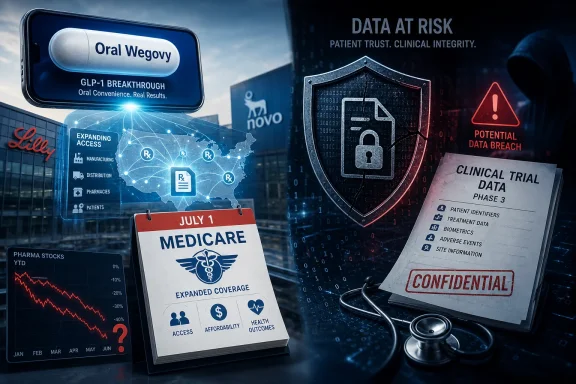 Novo Nordisk’s Week Captured the Whole GLP-1 Trade in Miniature
The strange thing about Novo Nordisk’s current position is that the company can look both wounded and strategically advantaged at the same time. Its shares have been punished hard, its guidance has disappointed, and the market has stopped treating GLP-1 leadership as a permanent entitlement. Yet the business is not stalled; in several important areas, it is doing exactly what bulls said it needed to do.The oral Wegovy story matters because it changes the shape of obesity treatment. Injectable GLP-1 drugs turned Novo Nordisk and Eli Lilly into two of the most important pharmaceutical companies in the world, but injections were always going to limit adoption for some patients. A pill lowers psychological friction, widens physician comfort, and gives payers a different kind of product to slot into formularies.
That is why the reported early prescription data is so important. If millions of prescriptions are being written within months, and a large share of users are new to GLP-1 therapy, oral Wegovy is not merely shifting patients from one Novo product to another. It is expanding the addressable market, which is the difference between a franchise defending itself and a franchise opening another front.
The market, however, is not paying Novo Nordisk for that optionality yet. A 46 percent slide from the 52-week high tells us investors are not debating whether obesity drugs are valuable; they are debating who captures the value, at what price, and under what regulatory constraints.
The Breach Is Not the Biggest Financial Variable, but It Hits a Sensitive Nerve
The newly disclosed cybersecurity incident is unlikely to be the single factor that determines Novo Nordisk’s long-term valuation. Pharmaceutical companies are valued on revenue durability, pipeline strength, pricing power, and trial outcomes more than on one IT event. But that does not make the breach incidental.The reported exposure of clinical-trial patient information is different from a generic corporate intrusion. Clinical trials depend on trust from patients, investigators, hospitals, regulators, and ethics boards. When trial participation data and health-related information are involved, the reputational damage can be larger than the immediate operational disruption.
Novo Nordisk’s response appears to have followed the expected crisis script: isolate affected systems, continue core operations, notify affected individuals, cooperate with authorities, and investigate the scope. That may limit the damage if the intrusion was contained quickly. The problem for investors is that the market dislikes open-ended liabilities, and cyber incidents are almost always open-ended in their early stages.
There are three questions management now has to answer without sounding complacent. What data was taken? How many people were affected? And did the attackers gain access to systems that could compromise trial integrity, not merely trial privacy? The distinction matters because a privacy breach is costly; a trial-integrity concern would be strategically more serious.
For now, the more plausible interpretation is that this is a sentiment headwind rather than a thesis-ending event. But sentiment matters when a stock is already under pressure. In a market that has lost patience with Novo Nordisk, even manageable bad news can keep buyers on the sidelines.
Oral Wegovy Is Novo’s Best Argument That Growth Is Not Over
Novo Nordisk’s strongest rebuttal to the bear case is not a buyback, a conference presentation, or a defensive comment from management. It is prescription volume. The oral Wegovy launch gives the company something investors can measure in near real time, and that makes it unusually important over the next two quarters.The pill’s early traction suggests that convenience still has enormous commercial value in GLP-1 therapy. Patients who resist injections may be willing to try a tablet. Primary-care doctors who hesitate to initiate injectable obesity treatment may feel more comfortable discussing a pill. Employers and insurers may see oral therapy as easier to distribute, monitor, and scale.
The catch is that oral semaglutide is not a frictionless product. Novo’s tablet formulation has administration requirements that are less convenient than Lilly’s Foundayo, which can be taken without the same food and water restrictions. In a consumerized obesity market, dosing rituals matter.
Still, the market often overstates convenience and understates familiarity. Wegovy is a known brand with enormous cultural recognition. Physicians understand semaglutide. Patients have heard of it. Novo has manufacturing, distribution, and market-access experience that newer oral competitors cannot instantly replicate.
The launch therefore gives Novo a credible route back into the growth conversation. But credibility is not proof. The proof will come when prescription data shows whether oral Wegovy sustains early demand, whether new patients stay on therapy, and whether reimbursement converts interest into durable paid volume.
Medicare Turns the Obesity Market From Consumer Demand Into Policy Infrastructure
The July 1 start of the Medicare GLP-1 Bridge may be the most important near-term catalyst in the entire story. Until now, the U.S. obesity-drug market has been constrained by a brutal mismatch: high patient demand, high list prices, uneven insurance coverage, and political discomfort with broad public reimbursement. A $50 monthly access point for eligible Medicare beneficiaries changes that equation.This does not mean every Medicare beneficiary will suddenly receive Wegovy. Eligibility criteria, physician participation, supply availability, plan mechanics, and administrative friction will all shape uptake. But the symbolism is powerful. Obesity treatment is moving from a discretionary consumer-health category toward a reimbursed chronic-disease infrastructure.
That is good for Novo Nordisk if the company can supply the market and defend share. Medicare coverage can normalize prescribing, draw older patients into treatment, and create data that policymakers will use when debating permanent coverage. It may also pressure commercial plans to revisit their own exclusions if the federal program demonstrates measurable outcomes.
The risk is that public reimbursement rarely arrives without pricing consequences. Medicare access may expand volume while compressing economics. Novo Nordisk’s 2026 guidance already points to revenue and profit declines on a currency-adjusted basis, which is one reason investors remain skeptical despite the product momentum.
The market’s question is brutally practical: will volume outrun price? If Medicare creates a wave of new prescriptions but at lower realized net prices, the top-line benefit could be less dramatic than bulls expect. If volume accelerates and adherence remains strong, the bridge program could become the event that resets Novo’s narrative.
Lilly Has Made This a Two-Company Knife Fight
Eli Lilly is no longer just a rival with a strong injectable competitor. It is now a rival with an oral GLP-1 product that attacks one of Novo’s most important expansion paths. Foundayo’s approval in April 2026 sharpened the competitive question from “Can Novo grow the pill market?” to “Can Novo keep the pill market once Lilly is fully mobilized?”Lilly’s convenience advantage is real. A once-daily pill without food or water restrictions is easier to explain, easier to remember, and easier to integrate into daily life. In chronic medicines, small behavioral advantages can become large commercial advantages over time.
Novo’s answer is efficacy, brand, and launch scale. The reported comparison between oral Wegovy’s 16.6 percent weight loss and Foundayo’s 12.4 percent gives Novo a clean message: inconvenience may be tolerable if the result is stronger. In obesity treatment, patients and doctors often weigh efficacy heavily, especially when side effects and discontinuation risks are already part of the conversation.
But efficacy comparisons across products are never as simple as investor decks make them sound. Trial populations differ, adherence varies, dosing protocols matter, and real-world persistence often looks messier than clinical results. The company that wins may not be the one with the best headline number, but the one with the best combination of access, tolerability, convenience, physician confidence, and supply.
That is why early Foundayo uptake should not be overread. A slow first few weeks does not prove weak demand any more than a strong launch proves permanent dominance. Lilly has shown with Mounjaro and Zepbound that it knows how to scale GLP-1 franchises. Novo Nordisk would be foolish to treat the early gap as a moat.
CagriSema Keeps the Pipeline Relevant, Even When It Misses the Perfect Narrative
Novo Nordisk needs more than Wegovy to regain the market’s full confidence. The company’s next-stage obesity and diabetes pipeline has to show that Novo can still innovate inside a category it helped define. CagriSema is central to that argument.The REIMAGINE phase 3 data in type 2 diabetes patients gives Novo something meaningful: a combination therapy that met primary endpoints and reduced both blood sugar and body weight. That reinforces the company’s scientific depth beyond semaglutide alone. It also supports a broader cardiometabolic strategy in which diabetes, obesity, cardiovascular risk, and metabolic health are treated as overlapping markets rather than isolated indications.
The blemish is the head-to-head weight-loss comparison with Lilly’s Zepbound. A 23 percent result would have been spectacular in an earlier era of obesity drugs, but the benchmark has moved. When Lilly posts 25.5 percent in the same competitive conversation, Novo’s strong result becomes a slight disappointment.
That is the paradox of the GLP-1 boom. The drugs are so effective that investors have become numb to numbers that would once have transformed a company. Novo Nordisk is not being punished because its pipeline is weak in absolute terms. It is being punished because Lilly has reset expectations.
The FDA decision expected in the fourth quarter of 2026 will matter, but approval alone may not be enough. Investors will want labeling clarity, comparative positioning, manufacturing confidence, and payer appetite. In a category this valuable, being good is not sufficient; the market wants a reason to believe Novo can be best, or at least indispensable.
The Share Price Is Cheap Only If the Old Growth Assumptions Survive
A stock down nearly half from its high will always attract bargain hunters. The danger is that investors confuse a lower price with a lower risk. Novo Nordisk’s valuation reset reflects real uncertainty, not merely market mood.The bear case has become clearer over the past year. Pricing pressure is no longer theoretical. Competition is no longer distant. Oral GLP-1s may expand the market, but they may also accelerate price comparison and payer bargaining. Medicare access may validate obesity treatment, but it may also bring government-shaped economics.
Novo’s own 2026 guidance has done little to calm those worries. A projected decline in revenue and profit on a currency-adjusted basis is not what investors expect from a company sitting at the center of one of the largest pharmaceutical markets in modern history. It implies that the transition from explosive scarcity-driven growth to normalized, competitive scale is already underway.
Buybacks can help per-share math, but they cannot solve a narrative problem. Repurchasing stock while investors question the durability of the franchise may signal confidence, but it does not answer whether Novo is losing pricing power or market share. The market wants operating proof, not capital-allocation reassurance.
That proof will likely arrive in prescription curves, payer updates, supply commentary, and competitive launch data. If oral Wegovy keeps expanding the category and Medicare uptake is strong, the current price may look overly pessimistic. If volume disappoints or discounts deepen, the stock may be cheap for a reason.
Cybersecurity Is Now Part of Pharma’s Investment Case
The Novo Nordisk breach also points to a broader change in how investors should think about pharmaceutical companies. Drugmakers are no longer just laboratories, manufacturers, and sales organizations. They are data custodians operating clinical platforms, patient-support systems, digital trial infrastructure, supply-chain networks, and increasingly sophisticated reimbursement operations.That makes cybersecurity a core operational risk. It is especially true for companies like Novo Nordisk, whose future depends on scaling chronic therapies to massive populations. More patients mean more data. More digital access programs mean more attack surfaces. More trial complexity means more sensitive information moving across vendors, sites, and internal systems.
For WindowsForum readers, the lesson is familiar from enterprise IT: the breach itself is only the visible failure. The harder questions involve segmentation, identity management, third-party access, logging, incident response, backup resilience, and governance. A company can say its business continues normally and still face months of forensic and regulatory scrutiny.
Pharma also operates under a harsher trust model than many industries. A retailer losing customer records is serious; a drugmaker losing trial-related health data touches informed consent, medical privacy, and confidence in research institutions. That is why Novo’s breach deserves attention even if it does not derail the commercial story.
The best-case outcome for Novo is that the incident remains contained, notifications proceed cleanly, regulators do not find systemic failures, and trial operations remain untouched. The worst-case outcome is not merely a fine. It is a credibility wound at a moment when Novo needs physicians, patients, payers, and investors to believe it can execute flawlessly.
The Market Is Waiting for July’s Receipts
Novo Nordisk’s next phase will not be decided by a single press release. It will be decided by a sequence of receipts. Medicare begins July 1. Oral Wegovy prescription trends will become harder to dismiss. Lilly’s Foundayo launch will move from curiosity to competitive signal. The cyber investigation will either narrow or widen.That makes the stock unusually event-driven. Investors who buy now are effectively betting that bad news is already priced in and that volume catalysts will become visible soon. Investors who sell are betting that the market has not yet fully accounted for price erosion, regulatory risk, and Lilly’s competitive pressure.
Neither position is irrational. The bullish case has real substance: oral Wegovy is expanding access, UK approval adds international momentum, EU approval appears likely after the positive European opinion, Medicare could unlock a large patient pool, and CagriSema keeps Novo in the next-generation race. The bearish case also has teeth: guidance is weak, pricing pressure is real, Lilly is formidable, the cyber incident adds uncertainty, and the stock’s old premium depended on cleaner execution than Novo can currently claim.
The correct framing is not whether Novo Nordisk is suddenly broken. It is whether the company is still mispriced for leadership in a market that is becoming larger, more competitive, and more politically managed all at once. That is a harder question than the old GLP-1 bull story, but it is also a more useful one.
The July Test Will Separate Signal From Stock-Market Noise
The next few months will tell investors more than the past few weeks did. The recent selloff, cyber disclosure, UK approval, prescription claims, and Medicare countdown are all signals, but they are not equal signals. Some describe sentiment; others describe demand.- Novo Nordisk’s cyber incident is a serious trust and regulatory issue, but the investment damage depends on the final scope of exposed data and whether trial integrity was affected.
- Oral Wegovy’s early prescription momentum is the strongest evidence that Novo can expand the GLP-1 market rather than merely defend injectable Wegovy.
- Medicare’s July 1 access program could create a major volume catalyst, but it may also reinforce the pricing pressure already embedded in Novo’s cautious 2026 guidance.
- Eli Lilly’s Foundayo gives patients a more convenient oral option, while Novo is leaning on stronger reported efficacy, brand familiarity, and launch scale.
- CagriSema remains strategically important, but Lilly’s Zepbound has raised the bar for what investors consider a category-leading obesity result.
- At roughly €38, Novo Nordisk may offer upside if execution improves, but the shares still carry unresolved risks around competition, reimbursement, cybersecurity, and margin durability.
References
- Primary source: AD HOC NEWS
Published: 2026-06-14T01:50:09.014063
Novo Nordisk's Cyber Incident Clouds Pill Progress as Medicare Catalyst Nears
Novo Nordisk faces a data breach and stock slump, but its oral Wegovy pill, UK approval, and looming Medicare expansion signal strong operational momentum.www.ad-hoc-news.de - Related coverage: lilly.gcs-web.com
FDA approves Lilly's Foundayo™ (orforglipron), the only GLP-1 pill for weight loss that can be taken any time of day without food or water restrictions | Eli Lilly and Company
The Investor Relations website contains information about Eli Lilly and Company's business for stockholders, potential investors, and financial analysts.lilly.gcs-web.com - Related coverage: glp1watchdog.com
FDA Approves Foundayo: The GLP-1 Pill You Take With Food (April 2026) | GLP1 Watchdog
Eli Lilly's oral weight loss pill got the fastest FDA approval since 2002 on April 1, 2026. Here's how Foundayo compares to oral Wegovy at $149/month. glp1watchdog.com
- Related coverage: cms.gov
Medicare GLP-1 Bridge | CMS
Centers for Medicare & Medicaid Services (CMS) announced the Better Approaches to Lifestyle and Nutrition for Comprehensive hEalth (BALANCE) Model and a separate short-term demonstration (now called the “Medicare GLP-1 Bridge”)www.cms.gov
- Related coverage: globenewswire.com
Novo Nordisk: Wegovy® pill (semaglutide tablets) becomes
Novo Nordisk's Wegovy® pill has been approved in the UK as an adjunct to a reduced-calorie diet and increased physical activity for adults ...www.globenewswire.com - Related coverage: peptidemark.com
Medicare GLP-1 Bridge: $50/Month Drugs July 2026 | PeptideMark
Medicare will cover Wegovy, Zepbound, and Foundayo for $50/month starting July 1 2026. Eligibility, enrollment, and what it means.www.peptidemark.com
