

NTT DATA has signed a definitive agreement in May 2026 to acquire WinWire, a Santa Clara-based Microsoft cloud and AI consultancy, adding more than 1,000 Azure engineers and Microsoft specialists to its global enterprise AI services business. The deal is not just another services roll-up. It is a bet that the next phase of generative AI will be won less by demos than by the armies of engineers who can wire agents, data, governance, security, and legacy applications into production. For Microsoft customers, it is also another sign that Azure’s AI ecosystem is becoming a battlefield for implementation scale.
The popular story of enterprise AI has been dominated by models, chips, copilots, and boardroom promises. The less glamorous reality is that most large companies are still wrestling with data readiness, security boundaries, workflow redesign, cost controls, and the uncomfortable question of who owns the business process once an AI agent starts acting inside it.
That is the layer NTT DATA is targeting with WinWire. WinWire is not a model lab and is not trying to compete with Microsoft, OpenAI, Anthropic, or Google DeepMind. Its value sits closer to the enterprise plumbing: Azure AI services, Microsoft Fabric, cloud-native engineering, application modernization, and the implementation patterns needed to turn agentic AI from a conference phrase into something that survives procurement, compliance, and Monday morning operations.
The acquisition also reflects a shift in what customers are buying. In 2023 and 2024, many enterprises wanted a generative AI pilot. By 2026, the more serious buyers want production workflows, measurable automation, managed risk, and integrations with the systems they already run. That requires consultants who understand Microsoft’s stack deeply enough to make it boring, repeatable, and supportable.
NTT DATA already had Microsoft scale, including a global Microsoft Cloud business unit operating across dozens of countries and tens of thousands of Microsoft certifications. WinWire gives it a sharper specialist edge in the exact part of the market where demand is rising fastest: Azure-based AI transformation with industry-specific delivery muscle.
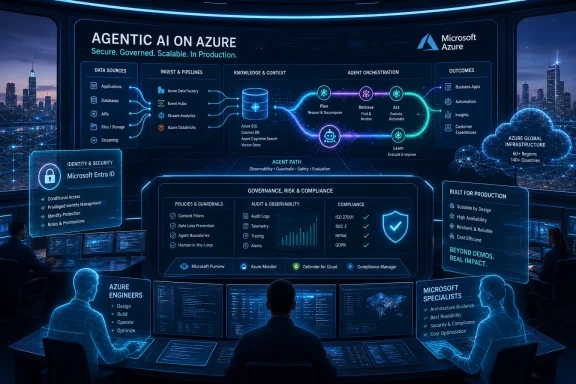
That is why services firms are suddenly treating agentic AI as a delivery discipline rather than a feature. The hard part is not making a demo agent book a meeting or summarize a document. The hard part is deciding what the agent is allowed to do, how it authenticates, what data it can see, how its actions are logged, when a human must approve a decision, and how the whole system behaves when a downstream API fails.
WinWire’s “Agentic AI @ Scale” positioning is designed for that practical middle ground. The pitch is not simply that AI can automate tasks, but that enterprises need frameworks, accelerators, governance models, and engineering teams capable of deploying autonomous or semi-autonomous systems safely across large environments.
For WindowsForum readers, this is where the story moves from corporate M&A into the daily life of IT. Agentic AI is going to land in the same places administrators already manage: Microsoft Entra ID, Azure subscriptions, Microsoft 365 tenants, data platforms, endpoint controls, audit logs, security operations, and compliance processes. The vendors may sell transformation; IT will inherit the blast radius.
That creates enormous opportunity for systems integrators. Microsoft can provide the platform, but it cannot personally redesign every insurer’s claims process, every hospital network’s data pipeline, every manufacturer’s supply chain workflow, or every software vendor’s SaaS modernization roadmap. That is where partners such as NTT DATA, Accenture, Capgemini, Cognizant, Kyndryl, TCS, and now WinWire’s expanded team compete.
The acquisition therefore strengthens NTT DATA’s position not merely as a Microsoft reseller or migration partner, but as a production AI integrator. That distinction matters. A cloud migration partner helps move workloads. An AI transformation partner must understand data quality, business process, application architecture, regulatory exposure, cost modeling, security operations, and user adoption at the same time.
Microsoft also benefits from this kind of consolidation. The more skilled partners it has pushing customers toward Azure AI services, the easier it becomes for Microsoft to convert platform ambition into consumption revenue. In cloud economics, implementation capacity is not a side issue. It is often the bottleneck between a customer’s AI strategy and actual Azure spend.
A large business does not usually fail at AI because it cannot find a language model. It fails because its data estate is fragmented, its access controls are inconsistent, its legacy applications lack clean APIs, its compliance team distrusts opaque automation, and its executives want productivity gains without accepting process change. A model cannot fix that by itself.
That is why more than 1,000 Azure engineers and Microsoft specialists are the headline asset in this deal. NTT DATA is buying delivery capacity, Microsoft credibility, and a team with repeatable patterns in industries that have high demand and high friction. WinWire’s focus on healthcare, life sciences, software companies, and digital platforms is particularly relevant because those sectors often have both the budget for AI and the governance problems that make implementation difficult.
This is also why financial terms being undisclosed does not make the transaction unimportant. The market is not just pricing revenue; it is pricing scarce skills, partner status, customer relationships, and accelerators that can shorten the path from pilot to production. In enterprise services, speed and trust can be as valuable as intellectual property.
That means IT teams will increasingly be asked to support systems they did not fully design. A business unit may hire a partner to build an agentic workflow on Azure. The workflow may rely on Microsoft Graph, Fabric, SharePoint, Teams, Dynamics, internal APIs, and privileged connectors. When something breaks, leaks, over-automates, or produces a bad decision, the ticket will not go to the keynote speaker. It will go to IT.
The acquisition hints at the future shape of these projects. They will not be isolated AI experiments run by innovation labs. They will be bundled transformations involving data modernization, app modernization, cloud migration, security controls, and managed services. That makes them more useful, but also harder to govern.
The practical consequence is that administrators need to get involved earlier. Waiting until an AI agent is ready for production is too late to ask about role-based access, auditability, retention, data residency, service principals, conditional access, or incident response. In the agentic era, governance is architecture.
This consolidation is not only about growth. It is also defensive. If enterprises begin spending more of their transformation budgets on AI-native projects, traditional systems integrators cannot afford to be seen as yesterday’s migration shops. They need agentic AI practices, Microsoft specializations, industry accelerators, and delivery teams that can talk convincingly to both CIOs and business executives.
The risk is that “AI transformation” becomes a packaging exercise. Every services firm now has frameworks, maturity models, accelerators, and responsible AI language. Buyers will need to distinguish between partners that can demonstrate production outcomes and partners that merely updated their slide decks.
WinWire gives NTT DATA a stronger answer to that buyer skepticism. Its Microsoft partnership history, awards, Azure specialization, and agentic AI messaging give NTT DATA more than a generic AI story. The challenge will be integrating WinWire without diluting the specialist culture that made it valuable.
For customers already committed to Azure, the deal could be positive. More scale inside NTT DATA’s Microsoft practice may mean broader geographic reach, deeper benches for complex projects, and more ability to combine cloud modernization with AI deployment. It could also make NTT DATA a more credible option for multinational enterprises that want a single partner across strategy, engineering, and managed operations.
But there is a trade-off. As the services market consolidates, customers may face fewer independent boutique specialists and more large-platform-aligned integrators. That can improve accountability for global programs, but it can also make projects feel more standardized, more vendor-led, and more tightly coupled to one cloud ecosystem.
For Windows-heavy enterprises, the strategic question is no longer whether Microsoft will be part of the AI stack. It almost certainly will be. The question is how much of the organization’s automation, data governance, workflow orchestration, and application modernization should be designed around Microsoft’s version of the AI future.
The best version of the deal is straightforward. WinWire keeps its Microsoft specialist identity while gaining NTT DATA’s global reach, larger accounts, managed services backbone, and cross-industry scale. NTT DATA gets a sharper Azure AI engine. Microsoft gets another stronger partner capable of turning AI demand into deployable systems.
The weaker version is equally familiar. A nimble specialist disappears into a large services organization, key talent leaves, accelerators become marketing artifacts, and customers discover that “scale” sometimes means more process rather than better outcomes. That is not a prediction, but it is the integration risk that shadows almost every acquisition of a high-skill consultancy.
The stakes are higher because agentic AI projects are unusually sensitive to execution quality. A delayed migration is annoying. A poorly governed autonomous workflow can create compliance, security, financial, or reputational damage. Enterprise buyers will not judge this deal by press-release ambition; they will judge it by whether production AI systems become safer, faster, and easier to operate.
For NTT DATA, WinWire is a capability purchase aimed at the messy middle of AI adoption. For Microsoft, it reinforces the importance of a partner ecosystem that can make Azure AI consumable at enterprise scale. For customers, it is another sign that choosing an AI platform increasingly means choosing an implementation ecosystem around it.
The concrete lessons are already visible:
Source: citybiz NTT DATA to Acquire Microsoft AI Specialist WinWire in Push Toward Enterprise-Scale AI Deployment
 NTT DATA Is Buying the Part of AI That Enterprises Actually Need
The popular story of enterprise AI has been dominated by models, chips, copilots, and boardroom promises. The less glamorous reality is that most large companies are still wrestling with data readiness, security boundaries, workflow redesign, cost controls, and the uncomfortable question of who owns the business process once an AI agent starts acting inside it.That is the layer NTT DATA is targeting with WinWire. WinWire is not a model lab and is not trying to compete with Microsoft, OpenAI, Anthropic, or Google DeepMind. Its value sits closer to the enterprise plumbing: Azure AI services, Microsoft Fabric, cloud-native engineering, application modernization, and the implementation patterns needed to turn agentic AI from a conference phrase into something that survives procurement, compliance, and Monday morning operations.
The acquisition also reflects a shift in what customers are buying. In 2023 and 2024, many enterprises wanted a generative AI pilot. By 2026, the more serious buyers want production workflows, measurable automation, managed risk, and integrations with the systems they already run. That requires consultants who understand Microsoft’s stack deeply enough to make it boring, repeatable, and supportable.
NTT DATA already had Microsoft scale, including a global Microsoft Cloud business unit operating across dozens of countries and tens of thousands of Microsoft certifications. WinWire gives it a sharper specialist edge in the exact part of the market where demand is rising fastest: Azure-based AI transformation with industry-specific delivery muscle.
The Deal Shows How “Agentic AI” Is Moving From Slideware to Services Contracts
Agentic AI has become one of the industry’s most overused terms, but the basic idea matters. Instead of a chatbot that waits for prompts, an agentic system can plan, call tools, coordinate steps, and act across business workflows with varying degrees of human supervision. In a Microsoft environment, that can mean Azure AI Foundry, Copilot Studio, Microsoft Fabric, Power Platform, enterprise data stores, identity systems, and application APIs all working together.That is why services firms are suddenly treating agentic AI as a delivery discipline rather than a feature. The hard part is not making a demo agent book a meeting or summarize a document. The hard part is deciding what the agent is allowed to do, how it authenticates, what data it can see, how its actions are logged, when a human must approve a decision, and how the whole system behaves when a downstream API fails.
WinWire’s “Agentic AI @ Scale” positioning is designed for that practical middle ground. The pitch is not simply that AI can automate tasks, but that enterprises need frameworks, accelerators, governance models, and engineering teams capable of deploying autonomous or semi-autonomous systems safely across large environments.
For WindowsForum readers, this is where the story moves from corporate M&A into the daily life of IT. Agentic AI is going to land in the same places administrators already manage: Microsoft Entra ID, Azure subscriptions, Microsoft 365 tenants, data platforms, endpoint controls, audit logs, security operations, and compliance processes. The vendors may sell transformation; IT will inherit the blast radius.
Microsoft’s AI Stack Is Becoming a Services Economy
Microsoft has spent the last several years turning Azure into the preferred landing zone for enterprise generative AI. Azure OpenAI Service, Microsoft Fabric, Copilot, Defender, Purview, Power Platform, and Azure AI Foundry are not just products; together they form a gravity well. Once an enterprise standardizes on Microsoft identity, data governance, productivity software, and cloud infrastructure, AI implementation naturally pulls more work into the same ecosystem.That creates enormous opportunity for systems integrators. Microsoft can provide the platform, but it cannot personally redesign every insurer’s claims process, every hospital network’s data pipeline, every manufacturer’s supply chain workflow, or every software vendor’s SaaS modernization roadmap. That is where partners such as NTT DATA, Accenture, Capgemini, Cognizant, Kyndryl, TCS, and now WinWire’s expanded team compete.
The acquisition therefore strengthens NTT DATA’s position not merely as a Microsoft reseller or migration partner, but as a production AI integrator. That distinction matters. A cloud migration partner helps move workloads. An AI transformation partner must understand data quality, business process, application architecture, regulatory exposure, cost modeling, security operations, and user adoption at the same time.
Microsoft also benefits from this kind of consolidation. The more skilled partners it has pushing customers toward Azure AI services, the easier it becomes for Microsoft to convert platform ambition into consumption revenue. In cloud economics, implementation capacity is not a side issue. It is often the bottleneck between a customer’s AI strategy and actual Azure spend.
The Unspoken Scarcity Is Not Models, But Skilled Implementers
The industry talks as though AI scarcity is mostly about GPUs and frontier models. Those are real constraints, but enterprise AI has another shortage: people who can make AI systems work inside messy, regulated, customized corporate environments.A large business does not usually fail at AI because it cannot find a language model. It fails because its data estate is fragmented, its access controls are inconsistent, its legacy applications lack clean APIs, its compliance team distrusts opaque automation, and its executives want productivity gains without accepting process change. A model cannot fix that by itself.
That is why more than 1,000 Azure engineers and Microsoft specialists are the headline asset in this deal. NTT DATA is buying delivery capacity, Microsoft credibility, and a team with repeatable patterns in industries that have high demand and high friction. WinWire’s focus on healthcare, life sciences, software companies, and digital platforms is particularly relevant because those sectors often have both the budget for AI and the governance problems that make implementation difficult.
This is also why financial terms being undisclosed does not make the transaction unimportant. The market is not just pricing revenue; it is pricing scarce skills, partner status, customer relationships, and accelerators that can shorten the path from pilot to production. In enterprise services, speed and trust can be as valuable as intellectual property.
The Windows and Azure Admin’s Job Is About to Get More Political
For administrators, AI transformation often arrives wearing friendly branding. It promises copilots, automation, workflow orchestration, and lower support burden. But once deployed, it becomes a new operational layer that touches identity, permissions, data classification, endpoint security, logging, and change management.That means IT teams will increasingly be asked to support systems they did not fully design. A business unit may hire a partner to build an agentic workflow on Azure. The workflow may rely on Microsoft Graph, Fabric, SharePoint, Teams, Dynamics, internal APIs, and privileged connectors. When something breaks, leaks, over-automates, or produces a bad decision, the ticket will not go to the keynote speaker. It will go to IT.
The acquisition hints at the future shape of these projects. They will not be isolated AI experiments run by innovation labs. They will be bundled transformations involving data modernization, app modernization, cloud migration, security controls, and managed services. That makes them more useful, but also harder to govern.
The practical consequence is that administrators need to get involved earlier. Waiting until an AI agent is ready for production is too late to ask about role-based access, auditability, retention, data residency, service principals, conditional access, or incident response. In the agentic era, governance is architecture.
Consolidation Is the Services Industry’s Answer to AI Anxiety
NTT DATA’s move fits a broader pattern across the consulting and IT services market. Large providers are racing to acquire specialist firms because the demand curve for AI implementation is rising faster than internal training programs can comfortably satisfy. Buying a company like WinWire accelerates capability, customer access, and credibility in one transaction.This consolidation is not only about growth. It is also defensive. If enterprises begin spending more of their transformation budgets on AI-native projects, traditional systems integrators cannot afford to be seen as yesterday’s migration shops. They need agentic AI practices, Microsoft specializations, industry accelerators, and delivery teams that can talk convincingly to both CIOs and business executives.
The risk is that “AI transformation” becomes a packaging exercise. Every services firm now has frameworks, maturity models, accelerators, and responsible AI language. Buyers will need to distinguish between partners that can demonstrate production outcomes and partners that merely updated their slide decks.
WinWire gives NTT DATA a stronger answer to that buyer skepticism. Its Microsoft partnership history, awards, Azure specialization, and agentic AI messaging give NTT DATA more than a generic AI story. The challenge will be integrating WinWire without diluting the specialist culture that made it valuable.
Microsoft Customers Should Read the Deal as a Signal, Not a One-Off
The most important part of the acquisition may be what it says about Microsoft’s enterprise AI channel. Microsoft has built a platform broad enough that few customers can adopt it deeply without help. That gives partner ecosystems enormous power over how AI is actually implemented.For customers already committed to Azure, the deal could be positive. More scale inside NTT DATA’s Microsoft practice may mean broader geographic reach, deeper benches for complex projects, and more ability to combine cloud modernization with AI deployment. It could also make NTT DATA a more credible option for multinational enterprises that want a single partner across strategy, engineering, and managed operations.
But there is a trade-off. As the services market consolidates, customers may face fewer independent boutique specialists and more large-platform-aligned integrators. That can improve accountability for global programs, but it can also make projects feel more standardized, more vendor-led, and more tightly coupled to one cloud ecosystem.
For Windows-heavy enterprises, the strategic question is no longer whether Microsoft will be part of the AI stack. It almost certainly will be. The question is how much of the organization’s automation, data governance, workflow orchestration, and application modernization should be designed around Microsoft’s version of the AI future.
The Real Test Comes After the Acquisition Closes
NTT DATA still has to close the transaction, complete regulatory and customary approvals, and integrate WinWire’s people, customers, and delivery methods. That last step is often where services acquisitions either create leverage or lose momentum.The best version of the deal is straightforward. WinWire keeps its Microsoft specialist identity while gaining NTT DATA’s global reach, larger accounts, managed services backbone, and cross-industry scale. NTT DATA gets a sharper Azure AI engine. Microsoft gets another stronger partner capable of turning AI demand into deployable systems.
The weaker version is equally familiar. A nimble specialist disappears into a large services organization, key talent leaves, accelerators become marketing artifacts, and customers discover that “scale” sometimes means more process rather than better outcomes. That is not a prediction, but it is the integration risk that shadows almost every acquisition of a high-skill consultancy.
The stakes are higher because agentic AI projects are unusually sensitive to execution quality. A delayed migration is annoying. A poorly governed autonomous workflow can create compliance, security, financial, or reputational damage. Enterprise buyers will not judge this deal by press-release ambition; they will judge it by whether production AI systems become safer, faster, and easier to operate.
The Azure AI Land Grab Is Now an Operations Story
The acquisition gives enterprise IT a useful reminder: the AI race is not only being fought in model benchmarks and cloud capex. It is being fought in statements of work, identity designs, data pipelines, compliance reviews, and the human labor needed to make automation trustworthy.For NTT DATA, WinWire is a capability purchase aimed at the messy middle of AI adoption. For Microsoft, it reinforces the importance of a partner ecosystem that can make Azure AI consumable at enterprise scale. For customers, it is another sign that choosing an AI platform increasingly means choosing an implementation ecosystem around it.
The concrete lessons are already visible:
- Enterprises are moving from AI pilots toward production deployments that require stronger governance, data engineering, and operational support.
- Microsoft’s AI stack is creating a large services opportunity around Azure AI, Microsoft Fabric, Copilot, and cloud-native modernization.
- NTT DATA is using acquisition to expand scarce Azure and AI implementation talent rather than relying only on organic hiring.
- Agentic AI will put new pressure on identity, permissions, logging, compliance, and incident response practices inside Microsoft environments.
- Customers should evaluate AI partners by production evidence, governance depth, and operational handoff plans, not by the language of accelerators alone.
Source: citybiz NTT DATA to Acquire Microsoft AI Specialist WinWire in Push Toward Enterprise-Scale AI Deployment
