

NTT DATA signed a definitive agreement in May 2026 to acquire Santa Clara-based WinWire, a Microsoft-focused cloud and AI consultancy with delivery centers in India and more than 1,000 Azure engineers and AI specialists. The deal is less about buying another systems integrator than about buying scarce implementation muscle for the next phase of enterprise AI. Microsoft has built the platform vocabulary around Fabric, Foundry, Copilot, Azure, and agents; customers now need someone to turn that vocabulary into working, governed systems. NTT DATA is betting that the winner in enterprise AI services will not be the firm with the loudest demo, but the one with enough certified people to industrialize it.
The consumer AI boom taught the market to look for spectacle: a chatbot answering in seconds, an image model conjuring a scene, a coding assistant filling in a function. Enterprise AI has a different rhythm. The hard part is usually not getting a model to produce an answer; it is wiring the model into identity, data governance, audit trails, application workflows, and change-controlled production systems.
That is why WinWire is a more interesting target than its size alone might suggest. NTT DATA is not acquiring a model lab or a glamorous AI startup with a moonshot pitch. It is acquiring a Microsoft partner whose advertised strengths sit squarely in the practical layer: Azure AI, data engineering, Microsoft Fabric, cloud-native applications, and agentic AI.
That combination tells us where the market is going. The first wave of generative AI spending often funded experiments, pilots, proofs of concept, internal hackathons, and executive showcases. The next wave is about turning those experiments into durable enterprise architecture, and that requires a lot of implementation capacity.
NTT DATA’s pitch is blunt: clients are moving from experimentation to enterprise-wide deployment, and the services industry has to scale accordingly. In other words, the AI story has shifted from “Can this work?” to “Can this be secured, governed, maintained, measured, and rolled out across 40 business units without embarrassing the CIO?”
But platform breadth creates its own problem. The more Microsoft offers, the harder it becomes for enterprise customers to know where one product ends and the operating model begins. Fabric, Foundry, Copilot Studio, Power Platform, Purview, Defender, Entra, GitHub, and Azure infrastructure all sound powerful in isolation. In production, they have to behave as one system.
That is where firms like NTT DATA see margin. Microsoft can sell the cloud substrate and provide reference architectures, but a global insurer, bank, manufacturer, hospital network, or retailer still needs someone to map business processes, clean data estates, rationalize applications, build agent workflows, train users, and operate the environment after launch.
The WinWire deal should be read against that backdrop. NTT DATA already had a deep Microsoft relationship, including a global Microsoft Cloud business unit operating across more than 50 countries and supported by tens of thousands of Microsoft certifications. WinWire adds a more specialized layer on top: Microsoft-native engineering talent with an emphasis on AI and modern data platforms.
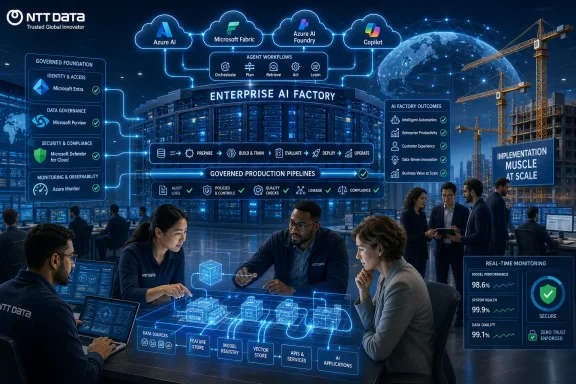
This is the services-industry equivalent of adding more cranes to a construction site. The blueprints may come from Redmond, but someone still has to pour concrete, inspect the wiring, and keep the building from failing its first safety review.
A customer-service summarizer can be useful even if it sits beside the main workflow. An agent that updates a customer record, opens a ticket, triggers a refund, queries a data warehouse, or drafts a regulated communication is different. It touches systems of record. It introduces questions about permissions, logging, rollback, human approval, hallucination, and liability.
That is why Microsoft partners with serious data and application engineering practices are suddenly more valuable. The bottleneck is not whether an LLM can call an API. The bottleneck is whether the organization has defined which APIs it may call, under whose identity, with what data, at what confidence threshold, and with what audit evidence afterward.
WinWire’s positioning around agentic AI, Azure, Fabric, and cloud-native development fits precisely into this gap. NTT DATA gets more people who can translate “we want agents” into the unglamorous checklist of enterprise readiness: data access models, event flows, application modernization, monitoring, security review, and managed service handoff.
The market is beginning to learn that an agent is not a product category so much as an architectural pattern. That makes services firms more relevant, not less. Every enterprise wants the productivity story; very few want to own the integration mess alone.
Certifications are not magic. Any sysadmin who has inherited a beautifully certified disaster knows that paper credentials do not guarantee production judgment. But at scale, certification depth does indicate something useful: the organization has invested in a structured partner practice, knows the vendor ecosystem, and can staff projects without treating every deployment as a one-off adventure.
For NTT DATA, the acquisition expands capacity in exactly the areas customers are now struggling to staff internally. Microsoft Fabric requires data architecture and governance skills. Azure AI and Foundry require model operations, evaluation, prompt and tool design, security, and developer discipline. Cloud-native modernization requires the patient refactoring of old estates that were never designed for AI-era workflows.
That is a difficult hiring market for enterprises. Many companies do not want to maintain large permanent teams for every platform specialty, especially when Microsoft’s AI stack keeps evolving. A global integrator can amortize that expertise across clients, geographies, and industries.
The result is a classic services consolidation move. NTT DATA is not only buying revenue or customer relationships. It is buying delivery elasticity, and in enterprise AI, delivery elasticity is becoming a form of competitive advantage.
That partner economy is now being reorganized around AI credibility. A Microsoft partner that can say it has built actual agentic workflows, Fabric data estates, and Azure AI applications is more attractive than a generic cloud migration shop. The old cloud-consulting categories are being compressed into one question: can this partner help a customer make AI operational without blowing up compliance, cost, or trust?
WinWire’s Microsoft credentials matter in that context. The company has promoted a long Microsoft partnership, multiple Microsoft awards, Azure and data specializations, marketplace offerings, and participation in Microsoft’s Agentic Partner Alliance. Those badges do not prove every project will succeed, but they do explain why NTT DATA would view WinWire as strategically useful rather than merely additive.
There is also a defensive angle. Large global integrators cannot afford to be seen as late to the Microsoft AI wave. Accenture, Capgemini, Cognizant, Deloitte, IBM, Infosys, Tata Consultancy Services, Wipro, and others are all telling versions of the same story: AI transformation requires industry knowledge, cloud platforms, data modernization, and managed operations. NTT DATA’s acquisition is a way to put more substance behind its version of that pitch.
The Microsoft ecosystem rewards scale, specialization, and co-selling readiness. WinWire gives NTT DATA more of all three.
Fabric promises a more unified analytics and data platform, but unification is not the same thing as simplicity. Enterprises still have legacy warehouses, lakehouses, SaaS sprawl, regional compliance requirements, custom pipelines, departmental Power BI workspaces, and shadow data processes. Before an AI agent can use enterprise data responsibly, someone has to decide what the trusted data sources are and how access should work.
Azure AI Foundry, meanwhile, addresses a different layer of the problem: building and managing AI applications. That includes model selection, evaluation, safety controls, orchestration, and deployment. But again, a platform does not eliminate the work. It concentrates the work into new design decisions.
This is why the NTT DATA-WinWire deal should be interesting to WindowsForum readers who live in the real world of enterprise IT. AI is increasingly being sold through glossy platform narratives, but it lands in environments full of hybrid identity, network constraints, security baselines, budget controls, procurement processes, and users who simply want the thing to work on Monday morning.
The integrator’s role is to absorb that mess. Done well, it makes AI adoption less chaotic. Done poorly, it turns every pilot into another dependency hairball. NTT DATA is betting that WinWire helps it do more of the former.
The next pressure point is measurable value. A company that spent 2023 and 2024 proving generative AI could help knowledge workers now needs to show what happens to cycle times, operating cost, customer experience, software delivery, risk review, or revenue. That requires systems tied to business process, not isolated AI toys.
This is where NTT DATA’s global scale matters. A multinational client does not want a clever prototype in one region if it cannot be replicated under different regulatory regimes, languages, operating models, and data residency rules. Global systems integrators exist because enterprise standardization is difficult, political, and expensive.
WinWire’s India delivery centers also fit the economics of the model. Enterprise AI services will require a mix of high-end architecture, industry consulting, platform engineering, application development, testing, support, and managed operations. The firms that can blend onshore advisory with offshore engineering will be able to price and staff these programs more aggressively than boutique consultancies.
That does not guarantee success. But it does explain the industrial logic. AI at scale is not a workshop; it is a program portfolio.
Microsoft’s enterprise stack gives partners many of the building blocks: Entra for identity, Purview for governance and compliance, Defender for security signals, Azure Policy for control, and Fabric and Foundry for data and AI workflows. The challenge is making these pieces enforce policy across real deployments rather than existing as separate dashboards.
For regulated industries, this is where AI programs slow down. It is one thing to let employees ask a model to summarize a public document. It is another to let an AI system inspect patient records, analyze claims data, recommend financial actions, or generate communications that could carry legal consequences. The security architecture has to match the business risk.
NTT DATA’s customer base includes large enterprises and regulated clients, which makes the governance side of the acquisition more important than the marketing language suggests. If WinWire’s specialists can help package AI use cases with security and compliance patterns, NTT DATA gets a stronger story for cautious buyers.
That will matter because the next AI backlash inside enterprises may not come from model quality. It may come from uncontrolled data access, unclear accountability, unexpected cloud bills, or agents doing exactly what they were technically permitted to do but never organizationally authorized to do.
NTT DATA will need to preserve what made WinWire valuable while folding it into a much larger organization. That is easier said than done. Boutique and mid-sized specialists often win because they are focused, fast, and close to technical execution. Large integrators win because they have reach, procurement access, and operational scale. Combining those strengths without smothering the smaller firm is the actual management test.
There is also the question of differentiation. Every major services company now claims expertise in AI, Microsoft Cloud, agentic systems, data modernization, and secure transformation. Customers will quickly learn to discount the language unless it is backed by repeatable offerings, reference architectures, industry-specific proof, and credible post-deployment support.
NTT DATA’s advantage may be that it is not trying to invent the whole story from scratch. It already had a Microsoft cloud unit, a global certification base, and a broader AI transformation strategy. WinWire plugs into an existing direction rather than forcing a pivot.
Still, acquisitions do not automatically create capability. They create the possibility of capability. The difference is execution.
A Windows environment is no longer just endpoints, Active Directory or Entra ID, Microsoft 365, Intune, Defender, SQL Server, PowerShell, and Azure infrastructure. Increasingly, it includes data estates feeding Fabric, agents built in Foundry or Copilot Studio, workflow automation through Power Platform, and security policies that must account for AI-mediated access. The boundaries are blurring.
That will change what IT teams are asked to support. Someone will need to understand why an agent cannot access a dataset, why a Fabric pipeline failed, why an AI workflow is producing inconsistent answers, why a Copilot extension is exposing the wrong content, or why a model evaluation changed after a deployment update. These problems will not stay neatly inside a data science team.
The services firms see this coming. That is why they are buying specialists, launching AI practices, and tightening vendor alliances. They expect enterprises to need help because the skills map is shifting faster than internal operating models.
For IT pros, the lesson is not to chase every AI buzzword. It is to understand how identity, data governance, automation, security, and application modernization now converge around AI deployment. The people who can bridge those domains will be harder to replace than the people who merely know how to prompt a model.
That requires repeatable methods. It requires templates for common use cases, patterns for approval workflows, cost controls for model consumption, evaluation pipelines, incident processes, and managed services that know what AI failure looks like. A failed AI system may not crash in the familiar sense. It may quietly degrade, produce plausible nonsense, retrieve stale data, or automate a flawed business rule.
NTT DATA’s scale gives it an opportunity to turn those lessons into reusable offerings. WinWire’s Microsoft-specific talent gives it more credibility in the tooling layer. If the combined organization can convert project experience into standardized delivery models, the acquisition could matter beyond the added headcount.
That is the services-industry race now. The firms that treat every AI deployment as bespoke consulting will struggle to scale profitably. The firms that industrialize patterns without ignoring customer-specific risk will have the advantage.
Microsoft also benefits from this. The more partners can make Fabric, Foundry, Azure AI, and Copilot-related deployments successful, the more durable Microsoft’s platform position becomes. Cloud platforms are sticky not merely because of APIs, but because entire service ecosystems grow around them.
NTT DATA’s acquisition of WinWire is a bet that those questions will define the next several years of enterprise technology spending. If the deal closes and integration goes well, NTT DATA will have more Microsoft-native capacity at exactly the moment customers are discovering that AI transformation is not a product they can simply switch on. The future of enterprise AI will be built in the plumbing, and the companies that can make that plumbing reliable are the ones most likely to turn today’s platform excitement into tomorrow’s operating reality.
Source: Pulse 2.0 NTT DATA To Acquire WinWire To Scale AI Adoption And Microsoft Cloud Transformation
 NTT DATA Buys the Boring Part of AI That Actually Matters
The consumer AI boom taught the market to look for spectacle: a chatbot answering in seconds, an image model conjuring a scene, a coding assistant filling in a function. Enterprise AI has a different rhythm. The hard part is usually not getting a model to produce an answer; it is wiring the model into identity, data governance, audit trails, application workflows, and change-controlled production systems.That is why WinWire is a more interesting target than its size alone might suggest. NTT DATA is not acquiring a model lab or a glamorous AI startup with a moonshot pitch. It is acquiring a Microsoft partner whose advertised strengths sit squarely in the practical layer: Azure AI, data engineering, Microsoft Fabric, cloud-native applications, and agentic AI.
That combination tells us where the market is going. The first wave of generative AI spending often funded experiments, pilots, proofs of concept, internal hackathons, and executive showcases. The next wave is about turning those experiments into durable enterprise architecture, and that requires a lot of implementation capacity.
NTT DATA’s pitch is blunt: clients are moving from experimentation to enterprise-wide deployment, and the services industry has to scale accordingly. In other words, the AI story has shifted from “Can this work?” to “Can this be secured, governed, maintained, measured, and rolled out across 40 business units without embarrassing the CIO?”
Microsoft’s AI Stack Has Become a Services Gold Rush
Microsoft has spent the last several years positioning Azure as the natural enterprise home for AI. Azure OpenAI Service gave cautious companies a more familiar route into large language models. Microsoft Fabric gave the company a unified data-platform story. Azure AI Foundry, now increasingly framed as part of Microsoft’s broader agent-building stack, gave developers and enterprise teams a place to assemble, test, evaluate, and manage AI applications.But platform breadth creates its own problem. The more Microsoft offers, the harder it becomes for enterprise customers to know where one product ends and the operating model begins. Fabric, Foundry, Copilot Studio, Power Platform, Purview, Defender, Entra, GitHub, and Azure infrastructure all sound powerful in isolation. In production, they have to behave as one system.
That is where firms like NTT DATA see margin. Microsoft can sell the cloud substrate and provide reference architectures, but a global insurer, bank, manufacturer, hospital network, or retailer still needs someone to map business processes, clean data estates, rationalize applications, build agent workflows, train users, and operate the environment after launch.
The WinWire deal should be read against that backdrop. NTT DATA already had a deep Microsoft relationship, including a global Microsoft Cloud business unit operating across more than 50 countries and supported by tens of thousands of Microsoft certifications. WinWire adds a more specialized layer on top: Microsoft-native engineering talent with an emphasis on AI and modern data platforms.
This is the services-industry equivalent of adding more cranes to a construction site. The blueprints may come from Redmond, but someone still has to pour concrete, inspect the wiring, and keep the building from failing its first safety review.
Agentic AI Moves From Buzzword to Delivery Constraint
The phrase agentic AI is already suffering from overuse, but the underlying idea is important enough that the jargon cannot simply be dismissed. In enterprise terms, agentic AI describes systems that can plan, call tools, execute multi-step workflows, and operate with some degree of autonomy under policy constraints. That is a much bigger governance challenge than deploying a chatbot that summarizes documents.A customer-service summarizer can be useful even if it sits beside the main workflow. An agent that updates a customer record, opens a ticket, triggers a refund, queries a data warehouse, or drafts a regulated communication is different. It touches systems of record. It introduces questions about permissions, logging, rollback, human approval, hallucination, and liability.
That is why Microsoft partners with serious data and application engineering practices are suddenly more valuable. The bottleneck is not whether an LLM can call an API. The bottleneck is whether the organization has defined which APIs it may call, under whose identity, with what data, at what confidence threshold, and with what audit evidence afterward.
WinWire’s positioning around agentic AI, Azure, Fabric, and cloud-native development fits precisely into this gap. NTT DATA gets more people who can translate “we want agents” into the unglamorous checklist of enterprise readiness: data access models, event flows, application modernization, monitoring, security review, and managed service handoff.
The market is beginning to learn that an agent is not a product category so much as an architectural pattern. That makes services firms more relevant, not less. Every enterprise wants the productivity story; very few want to own the integration mess alone.
The Talent Grab Is the Strategy
The most concrete number in the announcement is not the purchase price, which was not disclosed. It is the addition of more than 1,000 Azure engineers and AI specialists. In a market where every major consultancy claims to have an AI practice, headcount with platform-specific delivery experience is one of the few signals that matters.Certifications are not magic. Any sysadmin who has inherited a beautifully certified disaster knows that paper credentials do not guarantee production judgment. But at scale, certification depth does indicate something useful: the organization has invested in a structured partner practice, knows the vendor ecosystem, and can staff projects without treating every deployment as a one-off adventure.
For NTT DATA, the acquisition expands capacity in exactly the areas customers are now struggling to staff internally. Microsoft Fabric requires data architecture and governance skills. Azure AI and Foundry require model operations, evaluation, prompt and tool design, security, and developer discipline. Cloud-native modernization requires the patient refactoring of old estates that were never designed for AI-era workflows.
That is a difficult hiring market for enterprises. Many companies do not want to maintain large permanent teams for every platform specialty, especially when Microsoft’s AI stack keeps evolving. A global integrator can amortize that expertise across clients, geographies, and industries.
The result is a classic services consolidation move. NTT DATA is not only buying revenue or customer relationships. It is buying delivery elasticity, and in enterprise AI, delivery elasticity is becoming a form of competitive advantage.
The Deal Also Says Something About Microsoft’s Partner Economy
Microsoft’s enterprise strategy has always depended on partners, but AI makes that dependence more visible. The company can push Copilot into productivity software, Foundry into developer workflows, and Fabric into analytics modernization, but adoption at major enterprises still runs through integrators, managed service providers, independent software vendors, and advisory firms.That partner economy is now being reorganized around AI credibility. A Microsoft partner that can say it has built actual agentic workflows, Fabric data estates, and Azure AI applications is more attractive than a generic cloud migration shop. The old cloud-consulting categories are being compressed into one question: can this partner help a customer make AI operational without blowing up compliance, cost, or trust?
WinWire’s Microsoft credentials matter in that context. The company has promoted a long Microsoft partnership, multiple Microsoft awards, Azure and data specializations, marketplace offerings, and participation in Microsoft’s Agentic Partner Alliance. Those badges do not prove every project will succeed, but they do explain why NTT DATA would view WinWire as strategically useful rather than merely additive.
There is also a defensive angle. Large global integrators cannot afford to be seen as late to the Microsoft AI wave. Accenture, Capgemini, Cognizant, Deloitte, IBM, Infosys, Tata Consultancy Services, Wipro, and others are all telling versions of the same story: AI transformation requires industry knowledge, cloud platforms, data modernization, and managed operations. NTT DATA’s acquisition is a way to put more substance behind its version of that pitch.
The Microsoft ecosystem rewards scale, specialization, and co-selling readiness. WinWire gives NTT DATA more of all three.
The Fabric-and-Foundry Era Needs Integrators More Than Evangelists
Microsoft Fabric is an especially important piece of the story because AI deployments tend to expose the ugliness of enterprise data estates. A company can tolerate messy data when dashboards are late or analysts spend extra time reconciling numbers. It is much harder to tolerate that mess when an AI system is expected to reason over the data, automate decisions, or recommend actions.Fabric promises a more unified analytics and data platform, but unification is not the same thing as simplicity. Enterprises still have legacy warehouses, lakehouses, SaaS sprawl, regional compliance requirements, custom pipelines, departmental Power BI workspaces, and shadow data processes. Before an AI agent can use enterprise data responsibly, someone has to decide what the trusted data sources are and how access should work.
Azure AI Foundry, meanwhile, addresses a different layer of the problem: building and managing AI applications. That includes model selection, evaluation, safety controls, orchestration, and deployment. But again, a platform does not eliminate the work. It concentrates the work into new design decisions.
This is why the NTT DATA-WinWire deal should be interesting to WindowsForum readers who live in the real world of enterprise IT. AI is increasingly being sold through glossy platform narratives, but it lands in environments full of hybrid identity, network constraints, security baselines, budget controls, procurement processes, and users who simply want the thing to work on Monday morning.
The integrator’s role is to absorb that mess. Done well, it makes AI adoption less chaotic. Done poorly, it turns every pilot into another dependency hairball. NTT DATA is betting that WinWire helps it do more of the former.
Enterprise Buyers Are Asking for Production, Not Theater
The announcement’s repeated emphasis on moving from experimentation to production is not accidental. It reflects a broader fatigue in corporate AI programs. Executives have seen enough demos. Boards have asked enough questions. Employees have experimented with enough copilots, chat windows, and internal sandboxes to know that the technology is real, but not self-implementing.The next pressure point is measurable value. A company that spent 2023 and 2024 proving generative AI could help knowledge workers now needs to show what happens to cycle times, operating cost, customer experience, software delivery, risk review, or revenue. That requires systems tied to business process, not isolated AI toys.
This is where NTT DATA’s global scale matters. A multinational client does not want a clever prototype in one region if it cannot be replicated under different regulatory regimes, languages, operating models, and data residency rules. Global systems integrators exist because enterprise standardization is difficult, political, and expensive.
WinWire’s India delivery centers also fit the economics of the model. Enterprise AI services will require a mix of high-end architecture, industry consulting, platform engineering, application development, testing, support, and managed operations. The firms that can blend onshore advisory with offshore engineering will be able to price and staff these programs more aggressively than boutique consultancies.
That does not guarantee success. But it does explain the industrial logic. AI at scale is not a workshop; it is a program portfolio.
Security Is the Subtext, Even When It Is Not the Headline
The announcement frames the deal in terms of AI adoption and Microsoft cloud transformation, but security sits underneath every serious deployment. The more capable AI systems become, the more closely they must be bound to identity, access control, data classification, monitoring, and incident response. An autonomous or semi-autonomous agent with excessive permissions is not a productivity tool. It is a risk multiplier.Microsoft’s enterprise stack gives partners many of the building blocks: Entra for identity, Purview for governance and compliance, Defender for security signals, Azure Policy for control, and Fabric and Foundry for data and AI workflows. The challenge is making these pieces enforce policy across real deployments rather than existing as separate dashboards.
For regulated industries, this is where AI programs slow down. It is one thing to let employees ask a model to summarize a public document. It is another to let an AI system inspect patient records, analyze claims data, recommend financial actions, or generate communications that could carry legal consequences. The security architecture has to match the business risk.
NTT DATA’s customer base includes large enterprises and regulated clients, which makes the governance side of the acquisition more important than the marketing language suggests. If WinWire’s specialists can help package AI use cases with security and compliance patterns, NTT DATA gets a stronger story for cautious buyers.
That will matter because the next AI backlash inside enterprises may not come from model quality. It may come from uncontrolled data access, unclear accountability, unexpected cloud bills, or agents doing exactly what they were technically permitted to do but never organizationally authorized to do.
This Is Consolidation, Not a Victory Lap
The acquisition is still subject to customary closing conditions and regulatory approvals, so it is not yet an integrated operating reality. Even after closing, the hard work will be cultural and commercial. Services acquisitions often look clean in press releases and become messy in practice when sales incentives, delivery methods, account ownership, pricing models, and regional leadership structures collide.NTT DATA will need to preserve what made WinWire valuable while folding it into a much larger organization. That is easier said than done. Boutique and mid-sized specialists often win because they are focused, fast, and close to technical execution. Large integrators win because they have reach, procurement access, and operational scale. Combining those strengths without smothering the smaller firm is the actual management test.
There is also the question of differentiation. Every major services company now claims expertise in AI, Microsoft Cloud, agentic systems, data modernization, and secure transformation. Customers will quickly learn to discount the language unless it is backed by repeatable offerings, reference architectures, industry-specific proof, and credible post-deployment support.
NTT DATA’s advantage may be that it is not trying to invent the whole story from scratch. It already had a Microsoft cloud unit, a global certification base, and a broader AI transformation strategy. WinWire plugs into an existing direction rather than forcing a pivot.
Still, acquisitions do not automatically create capability. They create the possibility of capability. The difference is execution.
Windows Shops Should Read This as a Signal, Not Just Deal News
For Windows administrators, enterprise architects, and Microsoft-focused developers, the acquisition is another sign that Microsoft’s AI ecosystem is moving from optional experimentation into mainstream enterprise planning. The practical implication is that AI skills are becoming adjacent to the traditional Microsoft stack rather than separate from it.A Windows environment is no longer just endpoints, Active Directory or Entra ID, Microsoft 365, Intune, Defender, SQL Server, PowerShell, and Azure infrastructure. Increasingly, it includes data estates feeding Fabric, agents built in Foundry or Copilot Studio, workflow automation through Power Platform, and security policies that must account for AI-mediated access. The boundaries are blurring.
That will change what IT teams are asked to support. Someone will need to understand why an agent cannot access a dataset, why a Fabric pipeline failed, why an AI workflow is producing inconsistent answers, why a Copilot extension is exposing the wrong content, or why a model evaluation changed after a deployment update. These problems will not stay neatly inside a data science team.
The services firms see this coming. That is why they are buying specialists, launching AI practices, and tightening vendor alliances. They expect enterprises to need help because the skills map is shifting faster than internal operating models.
For IT pros, the lesson is not to chase every AI buzzword. It is to understand how identity, data governance, automation, security, and application modernization now converge around AI deployment. The people who can bridge those domains will be harder to replace than the people who merely know how to prompt a model.
The Real Prize Is Repeatable AI Operations
The most important word in this deal may be operationalize. It is a clunky enterprise verb, but it captures the industry’s current problem. Companies do not just want AI applications; they want AI applications that can be deployed, monitored, improved, secured, and supported like the rest of the business technology estate.That requires repeatable methods. It requires templates for common use cases, patterns for approval workflows, cost controls for model consumption, evaluation pipelines, incident processes, and managed services that know what AI failure looks like. A failed AI system may not crash in the familiar sense. It may quietly degrade, produce plausible nonsense, retrieve stale data, or automate a flawed business rule.
NTT DATA’s scale gives it an opportunity to turn those lessons into reusable offerings. WinWire’s Microsoft-specific talent gives it more credibility in the tooling layer. If the combined organization can convert project experience into standardized delivery models, the acquisition could matter beyond the added headcount.
That is the services-industry race now. The firms that treat every AI deployment as bespoke consulting will struggle to scale profitably. The firms that industrialize patterns without ignoring customer-specific risk will have the advantage.
Microsoft also benefits from this. The more partners can make Fabric, Foundry, Azure AI, and Copilot-related deployments successful, the more durable Microsoft’s platform position becomes. Cloud platforms are sticky not merely because of APIs, but because entire service ecosystems grow around them.
The WinWire Deal Draws the Map for Microsoft-Centric AI Work
The immediate facts are straightforward, but the implications are broader. NTT DATA is adding WinWire’s Microsoft-focused AI and Azure talent to a global services organization already trying to make Microsoft Cloud one of its enterprise transformation pillars.- NTT DATA has signed a definitive agreement to acquire WinWire, with the transaction still pending customary closing conditions and regulatory approvals.
- The deal adds more than 1,000 Azure engineers and AI specialists to NTT DATA’s Microsoft cloud and AI delivery bench.
- WinWire brings expertise in agentic AI, Azure AI, Microsoft Fabric, data engineering, and cloud-native application development.
- The acquisition strengthens NTT DATA’s push to help enterprises move AI projects from pilots into governed production deployments.
- For Microsoft-focused IT teams, the deal is another signal that AI work is becoming part of mainstream cloud, identity, data, security, and application operations.
NTT DATA’s acquisition of WinWire is a bet that those questions will define the next several years of enterprise technology spending. If the deal closes and integration goes well, NTT DATA will have more Microsoft-native capacity at exactly the moment customers are discovering that AI transformation is not a product they can simply switch on. The future of enterprise AI will be built in the plumbing, and the companies that can make that plumbing reliable are the ones most likely to turn today’s platform excitement into tomorrow’s operating reality.
Source: Pulse 2.0 NTT DATA To Acquire WinWire To Scale AI Adoption And Microsoft Cloud Transformation
