

World models are becoming the next contested label in AI, describing systems meant to learn how environments change over time rather than simply predict the next token, pixel, or frame. An AOL analysis published July 15 argues that the approach could matter most in areas such as weather, climate, biology, and industrial simulation, where useful answers depend on modeling physical dynamics rather than producing fluent descriptions.
The premise is straightforward: large language models infer patterns from language, while a world model is intended to build an internal representation of a system and simulate likely future states. That distinction is far less clean in practice. Video generators, robotics simulators, 3D scene models, and AI weather models are all now being marketed under the same umbrella, even though they use very different architectures and training data.
The most vocal advocate is Yann LeCun, Meta’s former chief AI scientist, who left the company at the end of 2025 to establish Advanced Machine Intelligence Labs. As reported by the Associated Press, LeCun’s new work is aimed at systems that can understand the physical world, retain persistent memory, reason, and plan actions—capabilities he has long argued cannot emerge from language prediction alone.
Other major players are taking adjacent paths. Google DeepMind’s weather research, NVIDIA’s Earth-2 simulation stack, and Fei-Fei Li’s World Labs all focus on models that handle spatial or physical relationships. World Labs raised $1 billion in February to pursue what it calls spatial intelligence, according to Reuters coverage carried by Channel NewsAsia.
That funding does not prove a unified technical breakthrough. “World model” remains an industry catch-all, and some researchers dispute whether generated video alone demonstrates a durable understanding of objects, causality, or physics.
These systems do not replace conventional numerical weather prediction, particularly for rare and extreme events. But they can generate forecasts much faster and at lower compute cost, which makes large ensembles and localized forecasts more practical.
The larger ambition is to combine observed data with known physical constraints, letting AI learn parts of complex systems that remain hard to express in equations. That could eventually help with coupled climate processes, supply chains, robotic operations, drug discovery, and digital twins.
Organizations using NVIDIA workstations, Windows-based engineering software, or hybrid HPC environments should expect more AI-assisted simulation workflows and increasing demand for accelerated compute. Administrators do not need to deploy anything yet, but the term is worth tracking because vendors are likely to attach it to the next generation of robotics, visualization, weather, and industrial AI products.
The premise is straightforward: large language models infer patterns from language, while a world model is intended to build an internal representation of a system and simulate likely future states. That distinction is far less clean in practice. Video generators, robotics simulators, 3D scene models, and AI weather models are all now being marketed under the same umbrella, even though they use very different architectures and training data.
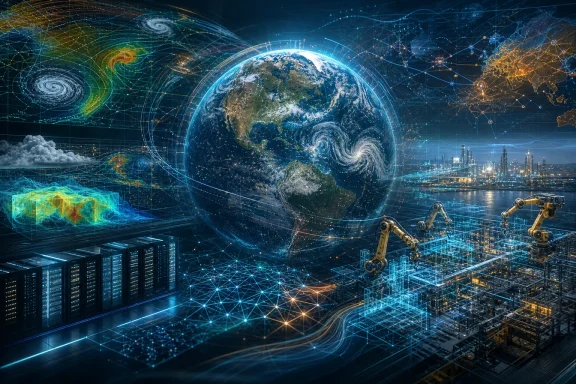 The AI industry is placing its bets
The most vocal advocate is Yann LeCun, Meta’s former chief AI scientist, who left the company at the end of 2025 to establish Advanced Machine Intelligence Labs. As reported by the Associated Press, LeCun’s new work is aimed at systems that can understand the physical world, retain persistent memory, reason, and plan actions—capabilities he has long argued cannot emerge from language prediction alone.Other major players are taking adjacent paths. Google DeepMind’s weather research, NVIDIA’s Earth-2 simulation stack, and Fei-Fei Li’s World Labs all focus on models that handle spatial or physical relationships. World Labs raised $1 billion in February to pursue what it calls spatial intelligence, according to Reuters coverage carried by Channel NewsAsia.
That funding does not prove a unified technical breakthrough. “World model” remains an industry catch-all, and some researchers dispute whether generated video alone demonstrates a durable understanding of objects, causality, or physics.
Weather is the most immediate proof point
The strongest near-term examples are narrower than general-purpose AI. DeepMind’s GraphCast research showed that a learned weather system could outperform a leading deterministic operational forecast across many benchmark measures. NVIDIA, meanwhile, is positioning Earth-2 as tooling for AI-driven local forecasting, downscaling, and simulation; the company says Israel’s Meteorological Service is using one Earth-2 component operationally for high-resolution forecasts.These systems do not replace conventional numerical weather prediction, particularly for rare and extreme events. But they can generate forecasts much faster and at lower compute cost, which makes large ensembles and localized forecasts more practical.
The larger ambition is to combine observed data with known physical constraints, letting AI learn parts of complex systems that remain hard to express in equations. That could eventually help with coupled climate processes, supply chains, robotic operations, drug discovery, and digital twins.
What it means for Windows users and IT teams
For now, world models are not a new desktop AI category. The practical impact will arrive through GPU-heavy infrastructure, simulation platforms, and specialist applications rather than a Windows update or chatbot feature.Organizations using NVIDIA workstations, Windows-based engineering software, or hybrid HPC environments should expect more AI-assisted simulation workflows and increasing demand for accelerated compute. Administrators do not need to deploy anything yet, but the term is worth tracking because vendors are likely to attach it to the next generation of robotics, visualization, weather, and industrial AI products.
References
- Primary source: aol.com
Published: 2026-07-15T10:00:03+00:00
World Models Are AI’s Next Frontier - AOL
The potential for solving problems in climate, oceans, the biosphere, and the biology of disease is vast, writes Celine Herweijer. The question is what we build them for.www.aol.com - Related coverage: infoworld.com
Why world models are AI’s next frontier | InfoWorld
Instead of just predicting words, world models actually learn how the physical world works, which is the "common sense" AI needs to finally reach AGI.www.infoworld.com
