

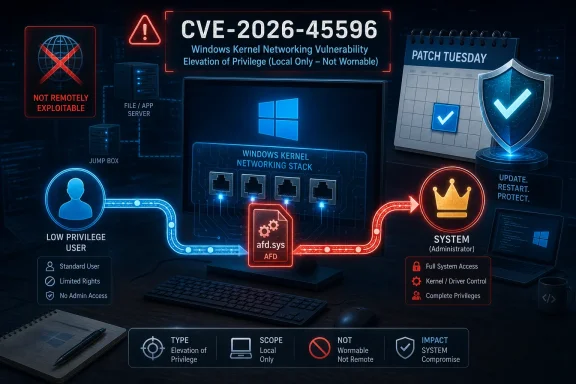
Microsoft disclosed CVE-2026-45596 on June 9, 2026, as a Windows Ancillary Function Driver for WinSock elevation-of-privilege vulnerability, putting another kernel-adjacent networking component into the monthly patch spotlight for Windows clients and servers. The important part is not that this is a remote wormable bug; Microsoft’s framing points instead to a local privilege escalation path. That makes it less cinematic than a network RCE and more familiar to defenders: the sort of flaw attackers use after the first foothold, when “user” is not enough and SYSTEM is the prize. The quiet danger is that AFD sits close to a lot of ordinary Windows networking behavior, so administrators should treat this as a patching priority even if public exploit details remain sparse.
The Windows Ancillary Function Driver for WinSock, commonly surfaced as
An elevation-of-privilege flaw in this area does not normally let an attacker stroll in from the internet unauthenticated. It typically assumes the attacker already has some ability to run code locally, whether through malware, a compromised account, a malicious document chain, a browser escape, or abuse of a lower-privileged service account. Once there, a reliable AFD vulnerability can turn a limited compromise into a machine-level one.
That distinction matters because too many patch conversations still rank vulnerabilities by whether they are remotely exploitable from the outside. Enterprise compromise rarely works as a single magic trick. It works as a sequence: initial access, execution, persistence, privilege escalation, credential access, lateral movement, and cleanup. Local privilege escalation is the gear that lets the whole machine turn.
CVE-2026-45596 belongs in that uncomfortable middle category. It is not necessarily the first stage of an intrusion, but it may be the stage that decides whether containment is possible.
Microsoft’s Security Update Guide often publishes enough information for defenders to prioritize but not enough for attackers to immediately reproduce the issue. That is a deliberate tradeoff. A CVE entry may identify the affected component, impact, attack vector, and remediation without spelling out the vulnerable function, structure, IOCTL path, race window, or memory corruption primitive.
For administrators, report confidence should be read less like an academic grade and more like a weather forecast. A confirmed vendor advisory means the vulnerability exists in a product you run, even if the public write-up does not yet tell you exactly how it works. The urgency rises when the affected component is privileged, broadly deployed, reachable by low-privilege code, and historically fertile ground for exploit chains.
AFD checks too many of those boxes to dismiss. Windows machines use networking constantly, and the kernel-mode machinery beneath that networking is not optional on normal systems. Even when a bug requires local access, the blast radius after exploitation may include full administrative control, tampering with security tools, dumping credentials, or installing persistent services.
That is the curse of Windows engineering. The platform must preserve decades of application behavior while hardening kernel interfaces that were designed across several eras of threat modeling. A component like AFD is not an app that can be rewritten on a product manager’s whim. It is a load-bearing wall.
This is why defenders should resist the temptation to treat “another AFD EoP” as routine noise. Routine vulnerabilities are precisely the ones attackers love when they can be weaponized reliably. They blend into the monthly patch stream, they often receive less executive attention than splashy remote-code-execution bugs, and they are useful in real intrusion chains.
The attacker’s question is not “Can this bug compromise a fully patched, isolated host from across the internet?” The attacker’s question is “Can this bug help me turn a weak foothold into control before detection catches up?” That is the right frame for CVE-2026-45596.
Once code execution exists, privilege boundaries matter enormously. A local privilege escalation vulnerability can allow malware to disable endpoint protection, access memory that should be off-limits, harvest credentials, modify system files, install drivers, or create administrator-level persistence. On servers, it can collapse separation between application identities and the underlying operating system. On shared workstations, it can turn one user’s compromise into a device compromise.
This is especially relevant for organizations that depend heavily on standard user configurations. Least privilege is still one of the most effective controls in Windows environments, but it assumes the kernel and core services enforce the boundary. A privilege escalation flaw is an attack on that assumption.
For home users, the practical story is simpler. If Windows Update offers the security update that covers this CVE, install it. If the machine is used for gaming mods, cracked software, remote work, development tooling, or frequent downloads, the difference between user-level malware and elevated malware is the difference between an annoyance and a rebuild.
That repeatability is what defenders should fear. A single local privilege escalation exploit can be folded into commodity malware, post-exploitation frameworks, ransomware deployment playbooks, and red-team toolchains. It may not make headlines immediately. It may not even be exploited in the wild on day one. But once someone develops a stable exploit across common Windows builds, the vulnerability’s practical severity changes.
This is also why Microsoft’s sparse public details are not a reason for complacency. Attackers do not need Microsoft to publish a proof of concept if they can reverse-engineer patches, compare binaries, inspect changed code paths, and infer the vulnerable behavior. Patch diffing is now a mature discipline, and AI-assisted vulnerability analysis has made that work faster for teams that already know where to look.
The defender’s advantage is time. Patch early enough, and the public exploit window may never matter. Delay long enough, and a “theoretical” privilege escalation becomes just another module in an operator’s kit.
The highest-value targets are systems where limited code execution is plausible and elevated access would unlock something broader. That includes remote desktop hosts, build servers, help desk workstations, VDI pools, terminal servers, file servers, and endpoints used by administrators. It also includes machines running security tools, deployment agents, monitoring services, or automation frameworks.
Developer systems deserve special attention because they often sit at the intersection of trust and messiness. They run unsigned tools, local services, preview SDKs, package scripts, test harnesses, and privileged virtualization features. If a local EoP exploit lands there, the prize may not simply be the machine; it may be source code, signing material, deployment credentials, or access to internal services.
For small businesses, the danger is often concentration. One Windows server may be file server, print server, accounting backend, remote access target, and domain controller in spirit if not in name. A local privilege escalation on that box can become a business continuity event.
Where patching must be delayed, defenders should focus on reducing opportunities for local code execution and limiting what a post-exploitation process can do. Application control, attack surface reduction rules, endpoint detection, standard user enforcement, credential isolation, and careful monitoring of privileged process creation all matter. None of them is a substitute for the patch, but they can reduce the chance that a local EoP becomes a domain-wide problem.
Administrators should also watch for the usual post-patch realities. Kernel and networking fixes can occasionally expose compatibility problems in VPN clients, endpoint agents, traffic inspection tools, legacy line-of-business software, or drivers that depend on undocumented behavior. That does not mean the patch should be avoided. It means test rings and rollback plans still matter.
The right posture is staged urgency: test quickly, deploy broadly, monitor carefully. Waiting for exploit chatter before acting gives attackers the initiative.
That communication gap matters inside organizations. Security teams may understand why a kernel privilege escalation is serious, but operations teams are juggling uptime, change freezes, vendor certification, help desk volume, and business pressure. If the advisory says little beyond “Windows Ancillary Function Driver for WinSock Elevation of Privilege Vulnerability,” someone has to translate that into operational risk.
The translation is straightforward: this is a flaw in privileged Windows networking plumbing that may allow an already-authenticated or locally executing attacker to gain higher privileges. It is not primarily about inbound firewall exposure. It is about what happens after code runs.
That framing should shape both patch priority and incident response assumptions. If a host was compromised before the relevant update was installed, defenders should not assume the attacker remained at the original privilege level. The possibility of local escalation should influence forensic review, credential rotation, and containment decisions.
The exploitability of a vulnerability depends on more than the base vector. It depends on whether exploit code appears, whether the affected builds are common, whether the bug is reliable, whether mitigations interfere with exploitation, whether attackers can chain it with common initial access paths, and whether the affected component is present on high-value systems. CVE-2026-45596 should be evaluated through that broader lens.
For Windows administrators, the more useful questions are practical. Are affected systems internet-facing through services that may provide code execution paths? Are users local administrators? Are endpoint controls able to detect suspicious privilege escalation behavior? Are administrative workstations patched first or last? Are servers rebooted promptly, or do updates sit installed but inactive for weeks?
A vulnerability is not patched until the fixed code is actually running. In Windows land, that often means the reboot is part of the security control.
The deeper story is that Windows security is now a race between increasingly hardened default protections and increasingly industrialized exploit development. Microsoft can patch AFD, harden interfaces, and limit public detail, but defenders still have to close the loop in their own estates. Attackers only need one unpatched system with the right privileges and the wrong timing.
For WindowsForum readers, the practical conclusion is blunt: patch CVE-2026-45596 promptly, watch the machines where privilege matters most, and do not wait for proof-of-concept code to decide whether a kernel-adjacent local escalation deserves attention. The next phase of this story will not be the advisory itself; it will be whether exploit writers find a stable path before lagging environments finish the reboot.
 AFD Is Not Glamorous, Which Is Exactly Why It Matters
The Windows Ancillary Function Driver for WinSock, commonly surfaced as afd.sys, is one of those components most users never think about and most administrators only notice when debugging low-level networking problems. It supports Windows sockets operations from kernel mode, meaning it lives in the plumbing between ordinary applications and the operating system’s networking stack. That position makes it deeply useful, deeply privileged, and repeatedly interesting to vulnerability researchers.An elevation-of-privilege flaw in this area does not normally let an attacker stroll in from the internet unauthenticated. It typically assumes the attacker already has some ability to run code locally, whether through malware, a compromised account, a malicious document chain, a browser escape, or abuse of a lower-privileged service account. Once there, a reliable AFD vulnerability can turn a limited compromise into a machine-level one.
That distinction matters because too many patch conversations still rank vulnerabilities by whether they are remotely exploitable from the outside. Enterprise compromise rarely works as a single magic trick. It works as a sequence: initial access, execution, persistence, privilege escalation, credential access, lateral movement, and cleanup. Local privilege escalation is the gear that lets the whole machine turn.
CVE-2026-45596 belongs in that uncomfortable middle category. It is not necessarily the first stage of an intrusion, but it may be the stage that decides whether containment is possible.
The Report Confidence Language Is a Warning About What We Do Not Know
The user-supplied MSRC text describes the report confidence concept: how certain the industry is that a vulnerability exists and how credible the known technical details are. That is not a throwaway scoring footnote. In modern patch management, the absence of exploit code is not the same thing as the absence of risk, and the absence of root-cause detail is not the same thing as uncertainty that the bug is real.Microsoft’s Security Update Guide often publishes enough information for defenders to prioritize but not enough for attackers to immediately reproduce the issue. That is a deliberate tradeoff. A CVE entry may identify the affected component, impact, attack vector, and remediation without spelling out the vulnerable function, structure, IOCTL path, race window, or memory corruption primitive.
For administrators, report confidence should be read less like an academic grade and more like a weather forecast. A confirmed vendor advisory means the vulnerability exists in a product you run, even if the public write-up does not yet tell you exactly how it works. The urgency rises when the affected component is privileged, broadly deployed, reachable by low-privilege code, and historically fertile ground for exploit chains.
AFD checks too many of those boxes to dismiss. Windows machines use networking constantly, and the kernel-mode machinery beneath that networking is not optional on normal systems. Even when a bug requires local access, the blast radius after exploitation may include full administrative control, tampering with security tools, dumping credentials, or installing persistent services.
The Patch Tuesday Pattern Makes This Bigger Than One CVE
CVE-2026-45596 is best understood as part of a recurring Windows pattern rather than as a one-off oddity. Over the years, Microsoft has patched multiple elevation-of-privilege vulnerabilities in AFD and Winsock-adjacent code. The details differ, but the strategic lesson is steady: old, central, compatibility-sensitive subsystems accumulate enormous security importance because everything depends on them and almost nothing can simply be removed.That is the curse of Windows engineering. The platform must preserve decades of application behavior while hardening kernel interfaces that were designed across several eras of threat modeling. A component like AFD is not an app that can be rewritten on a product manager’s whim. It is a load-bearing wall.
This is why defenders should resist the temptation to treat “another AFD EoP” as routine noise. Routine vulnerabilities are precisely the ones attackers love when they can be weaponized reliably. They blend into the monthly patch stream, they often receive less executive attention than splashy remote-code-execution bugs, and they are useful in real intrusion chains.
The attacker’s question is not “Can this bug compromise a fully patched, isolated host from across the internet?” The attacker’s question is “Can this bug help me turn a weak foothold into control before detection catches up?” That is the right frame for CVE-2026-45596.
Local Does Not Mean Low Priority
The word local has done a lot of damage in security prioritization. It sounds comforting because it implies the attacker is already inside. But in 2026, “already inside” is not a rare condition. Phished users, exposed remote access, compromised browser sessions, stolen developer tokens, misconfigured services, and supply-chain tooling all provide ways to run code somewhere with limited rights.Once code execution exists, privilege boundaries matter enormously. A local privilege escalation vulnerability can allow malware to disable endpoint protection, access memory that should be off-limits, harvest credentials, modify system files, install drivers, or create administrator-level persistence. On servers, it can collapse separation between application identities and the underlying operating system. On shared workstations, it can turn one user’s compromise into a device compromise.
This is especially relevant for organizations that depend heavily on standard user configurations. Least privilege is still one of the most effective controls in Windows environments, but it assumes the kernel and core services enforce the boundary. A privilege escalation flaw is an attack on that assumption.
For home users, the practical story is simpler. If Windows Update offers the security update that covers this CVE, install it. If the machine is used for gaming mods, cracked software, remote work, development tooling, or frequent downloads, the difference between user-level malware and elevated malware is the difference between an annoyance and a rebuild.
Kernel Bugs Change the Economics of an Intrusion
A Windows elevation-of-privilege vulnerability in a kernel-mode component is valuable because it can reduce the attacker’s workload. Without privilege escalation, an intruder may need credentials, token theft, social engineering, misconfigured services, or administrator mistakes. With a working local exploit, that path can become shorter and more repeatable.That repeatability is what defenders should fear. A single local privilege escalation exploit can be folded into commodity malware, post-exploitation frameworks, ransomware deployment playbooks, and red-team toolchains. It may not make headlines immediately. It may not even be exploited in the wild on day one. But once someone develops a stable exploit across common Windows builds, the vulnerability’s practical severity changes.
This is also why Microsoft’s sparse public details are not a reason for complacency. Attackers do not need Microsoft to publish a proof of concept if they can reverse-engineer patches, compare binaries, inspect changed code paths, and infer the vulnerable behavior. Patch diffing is now a mature discipline, and AI-assisted vulnerability analysis has made that work faster for teams that already know where to look.
The defender’s advantage is time. Patch early enough, and the public exploit window may never matter. Delay long enough, and a “theoretical” privilege escalation becomes just another module in an operator’s kit.
The Real Risk Sits on Servers, Jump Boxes, and Developer Machines
Not every Windows system carries the same risk from CVE-2026-45596. A kiosk with a locked-down workload, limited user interaction, and rapid patching is not the same as a developer workstation full of compilers, package managers, SSH keys, containers, test agents, and cached cloud credentials. A domain-joined admin jump box is not the same as a family laptop used mostly for streaming.The highest-value targets are systems where limited code execution is plausible and elevated access would unlock something broader. That includes remote desktop hosts, build servers, help desk workstations, VDI pools, terminal servers, file servers, and endpoints used by administrators. It also includes machines running security tools, deployment agents, monitoring services, or automation frameworks.
Developer systems deserve special attention because they often sit at the intersection of trust and messiness. They run unsigned tools, local services, preview SDKs, package scripts, test harnesses, and privileged virtualization features. If a local EoP exploit lands there, the prize may not simply be the machine; it may be source code, signing material, deployment credentials, or access to internal services.
For small businesses, the danger is often concentration. One Windows server may be file server, print server, accounting backend, remote access target, and domain controller in spirit if not in name. A local privilege escalation on that box can become a business continuity event.
Mitigation Is Mostly Boring, and Boring Is Correct
There is no reason to overcomplicate the operational response. The primary mitigation is to apply the Microsoft security update that addresses CVE-2026-45596 for the affected Windows versions in your environment. If the machine is unsupported, isolated, or difficult to patch because of vendor dependencies, that should be treated as a risk decision rather than a scheduling inconvenience.Where patching must be delayed, defenders should focus on reducing opportunities for local code execution and limiting what a post-exploitation process can do. Application control, attack surface reduction rules, endpoint detection, standard user enforcement, credential isolation, and careful monitoring of privileged process creation all matter. None of them is a substitute for the patch, but they can reduce the chance that a local EoP becomes a domain-wide problem.
Administrators should also watch for the usual post-patch realities. Kernel and networking fixes can occasionally expose compatibility problems in VPN clients, endpoint agents, traffic inspection tools, legacy line-of-business software, or drivers that depend on undocumented behavior. That does not mean the patch should be avoided. It means test rings and rollback plans still matter.
The right posture is staged urgency: test quickly, deploy broadly, monitor carefully. Waiting for exploit chatter before acting gives attackers the initiative.
Microsoft’s Minimalism Leaves Admins Doing the Translation
The MSRC style is efficient but often unsatisfying. It gives the security ecosystem a canonical record, a CVE identifier, a component, an impact, and update guidance. It rarely gives administrators the narrative they need to explain why a local EoP deserves attention during a crowded Patch Tuesday.That communication gap matters inside organizations. Security teams may understand why a kernel privilege escalation is serious, but operations teams are juggling uptime, change freezes, vendor certification, help desk volume, and business pressure. If the advisory says little beyond “Windows Ancillary Function Driver for WinSock Elevation of Privilege Vulnerability,” someone has to translate that into operational risk.
The translation is straightforward: this is a flaw in privileged Windows networking plumbing that may allow an already-authenticated or locally executing attacker to gain higher privileges. It is not primarily about inbound firewall exposure. It is about what happens after code runs.
That framing should shape both patch priority and incident response assumptions. If a host was compromised before the relevant update was installed, defenders should not assume the attacker remained at the original privilege level. The possibility of local escalation should influence forensic review, credential rotation, and containment decisions.
The CVSS Score Is Not the Whole Story
Security teams love scores because scores fit dashboards. But CVSS is a starting point, not a verdict. A local privilege escalation with a “High” rating can be more operationally dangerous than a higher-scored flaw that is difficult to reach, constrained by configuration, or irrelevant to the organization’s actual estate.The exploitability of a vulnerability depends on more than the base vector. It depends on whether exploit code appears, whether the affected builds are common, whether the bug is reliable, whether mitigations interfere with exploitation, whether attackers can chain it with common initial access paths, and whether the affected component is present on high-value systems. CVE-2026-45596 should be evaluated through that broader lens.
For Windows administrators, the more useful questions are practical. Are affected systems internet-facing through services that may provide code execution paths? Are users local administrators? Are endpoint controls able to detect suspicious privilege escalation behavior? Are administrative workstations patched first or last? Are servers rebooted promptly, or do updates sit installed but inactive for weeks?
A vulnerability is not patched until the fixed code is actually running. In Windows land, that often means the reboot is part of the security control.
The One-Week Plan for a Vulnerability That Should Not Linger
For organizations trying to turn CVE-2026-45596 into action rather than anxiety, the response should be concrete and fast. The goal is not to panic-patch blindly across every production system. The goal is to keep the testing window short enough that exploit development does not outrun deployment.- Inventory Windows endpoints and servers that receive the relevant June 2026 security updates, and separate unsupported systems into an explicit exception list.
- Prioritize administrator workstations, remote access hosts, VDI infrastructure, developer machines, and servers that process untrusted user activity.
- Deploy through existing rings, but compress the timeline for broad rollout unless testing reveals a real compatibility blocker.
- Confirm that systems have rebooted into the updated build rather than merely downloaded or staged the update.
- Treat pre-patch compromises on sensitive hosts as potentially elevated until logs and endpoint telemetry suggest otherwise.
- Use this CVE as a prompt to review least privilege, application control, and credential exposure on machines where local code execution is most likely.
This Is the Kind of Windows Bug That Rewards Discipline
CVE-2026-45596 is not the vulnerability that should make defenders abandon nuance. It is not, based on Microsoft’s public framing, a remote unauthenticated catastrophe. But it is exactly the sort of Windows elevation-of-privilege issue that punishes slow patching, overreliance on perimeter thinking, and casual treatment of “local” bugs.The deeper story is that Windows security is now a race between increasingly hardened default protections and increasingly industrialized exploit development. Microsoft can patch AFD, harden interfaces, and limit public detail, but defenders still have to close the loop in their own estates. Attackers only need one unpatched system with the right privileges and the wrong timing.
For WindowsForum readers, the practical conclusion is blunt: patch CVE-2026-45596 promptly, watch the machines where privilege matters most, and do not wait for proof-of-concept code to decide whether a kernel-adjacent local escalation deserves attention. The next phase of this story will not be the advisory itself; it will be whether exploit writers find a stable path before lagging environments finish the reboot.
References
- Primary source: MSRC
Published: 2026-06-09T07:00:00-07:00
Security Update Guide - Microsoft Security Response Center
 msrc.microsoft.com
- Related coverage: datacomm.com
- Related coverage: rapid7.com
Rapid7 Vulnerability Database
Rapid7's VulnDB is curated repository of vetted computer software exploits and exploitable vulnerabilities.www.rapid7.com - Related coverage: mindray.com
- Related coverage: nccgroup.com
- Related coverage: absolute.com
- Related coverage: ws.buildingsbt.stage.honeywell.com
