

Pinecone announced on June 3, 2026, at Microsoft Build in San Francisco that Pinecone Nexus now integrates with Microsoft OneLake, letting AI agents query governed enterprise data in Microsoft Fabric through structured, cited artifacts rather than raw retrieval pipelines. The announcement is small in surface area but large in implication: it treats enterprise data access as a knowledge-interface problem, not merely a vector-search problem. If Pinecone’s claims hold up in production, the integration gives Microsoft-centric organizations a more direct path from Fabric data estates to operational AI agents. It also sharpens a question every CIO is already facing: who gets to define the retrieval layer between corporate data and the agents now acting on it?
The most important thing about this announcement is not that Pinecone has added another connector. Enterprise AI is already drowning in connectors, many of them useful, many of them indistinguishable in a slide deck. The more interesting claim is architectural: Pinecone argues that agents should not spend runtime budget rummaging through raw enterprise data, assembling context, and asking a frontier model to reason over whatever fragments happen to be retrieved.
That is the familiar retrieval-augmented generation model in its most common enterprise form. Data is indexed, chunks are retrieved, context is stuffed into a prompt, and the model is asked to synthesize an answer. It works well enough for demos, support bots, and constrained knowledge bases. It becomes much less comfortable when the question spans documents, tables, semantic models, security boundaries, and a business process with consequences.
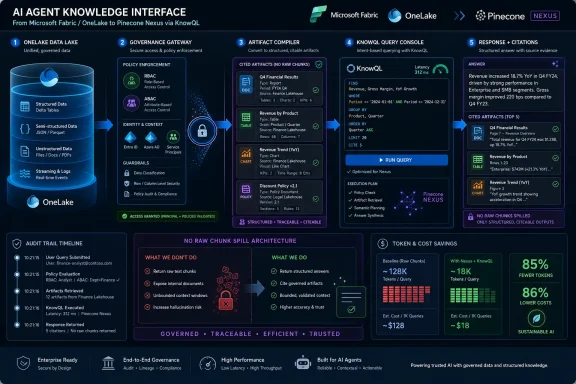
Pinecone Nexus attempts to shift that work upstream. Instead of having an agent discover and assemble context at the moment of execution, Nexus builds what Pinecone calls artifacts: structured, task-specific knowledge objects generated from enterprise data before or during the task flow. The agent then queries those artifacts through KnowQL, Pinecone’s query language for knowledge retrieval.
That distinction matters because modern agent systems are increasingly limited less by raw model capability than by orchestration cost and context quality. A powerful model with a sloppy context pipeline still produces unreliable answers. A fast agent that burns tokens calling tools, parsing search results, and reconciling conflicting snippets is not really fast at all; it is merely hiding latency and cost behind an API boundary.
Pinecone’s pitch is that the retrieval layer needs to become a reasoning substrate. Nexus does not just find relevant data; it prepares the shape in which an agent should consume that data. In a market crowded with claims about “AI-ready” data, that is at least a more specific thesis than the usual promise that a model will magically understand the lakehouse.
That positioning makes OneLake a natural place for AI agent vendors to land. If an enterprise has already invested in Fabric, Power BI semantic models, lakehouses, data warehouses, shortcuts, and governance policies, it does not want to replicate that estate into a separate AI retrieval silo. The more data must be copied, normalized, re-permissioned, and re-indexed elsewhere, the more the AI program inherits the very fragmentation it was supposed to overcome.
Pinecone’s integration promises to connect Nexus directly to OneLake without manual imports or upload steps. In the announced model, Nexus queries OneLake, assembles task-scoped artifacts according to the user’s permissions, and returns a structured, cited response through KnowQL. Pinecone also says answers trace back to source material, personally identifiable information can be tagged at ingest, and access is governed through role-based and attribute-based controls.
That is exactly the language enterprise buyers want to hear because it maps to their real blockers. The limiting factor for production AI agents is not usually whether an LLM can draft a memo or summarize a document. It is whether the system can answer from the right data, under the right identity, with the right audit trail, without leaking restricted information or generating an expensive hallucination wrapped in enterprise branding.
Microsoft also benefits from the framing. Build 2026 has been heavy on agents, governance, Fabric, and the idea that business data should become directly usable by AI systems. A Pinecone integration reinforces OneLake as an AI substrate rather than merely an analytics repository. It tells Microsoft customers that the lakehouse is not a static destination; it is becoming an operational layer for agentic applications.
The industry has spent the past two years treating retrieval as plumbing. Teams glue together embeddings, search APIs, vector stores, rerankers, chunking strategies, permission filters, and prompt templates. The result often works until the second team builds a different version, the third team adds another data source, and the security team asks who can prove what was retrieved and why.
KnowQL is Pinecone’s argument that agents need a common contract with knowledge systems. Not just “search this index,” but “return a governed, cited, structured knowledge object within this latency and output shape.” If that contract becomes stable, developers can reason about retrieval as an interface rather than a bespoke pipeline.
There is risk in that ambition. Query languages succeed when ecosystems adopt them, not merely when vendors announce them. SQL endured because it mapped to a durable model of relational data and became a lingua franca across products. KnowQL is entering a younger and messier market, where every vendor has an incentive to define the agent-data interface in its own image.
Still, the need is real. Enterprise agents cannot be governed at scale if every application invents its own retrieval semantics. A support agent, procurement agent, finance agent, and security analyst agent may all need different outputs, but the organization needs consistent rules for permissioning, provenance, citation, retention, cost controls, and auditability. KnowQL is an attempt to make those rules part of the query rather than buried in application code.
But the more important implication is not simply that fewer tokens are cheaper. It is that fewer runtime retrieval and reasoning steps create fewer opportunities for the system to lose control. Every tool call is a point of latency, failure, leakage, and ambiguity. Every extra chunk in a context window is another chance for irrelevant, stale, or unauthorized information to influence an answer.
If Nexus can assemble task-specific artifacts with governance applied before the frontier model sees the prompt, then the model’s job becomes narrower. It does not need to infer structure from a pile of excerpts. It does not need to reconcile five sources when the knowledge engine has already selected, scoped, and formatted the relevant context. That is the strategic appeal of moving reasoning upstream.
Of course, this also moves trust upstream. If the artifact is wrong, incomplete, or built from stale assumptions, the agent may fail more confidently. Structured context can reduce chaos, but it can also launder upstream errors into authoritative-looking responses. The operational burden shifts from prompt engineering to knowledge engineering.
That is why citations and source tracing are central to the announcement. In enterprise systems, an answer without provenance is not an answer; it is a liability with fluent grammar. The promise that every answer traces back to source material is not a decorative feature. It is the minimum requirement for using agents in workflows where people must defend decisions, investigate incidents, or satisfy auditors.
Agent systems punish data sprawl. If customer entitlements live in one system, contracts in another, telemetry in another, tickets in another, and finance controls in yet another, an agent must either call everything at runtime or rely on brittle preprocessing. Both approaches create cost and governance headaches. The dream is to make the enterprise’s existing governed data estate directly consumable by agents without rebuilding it around each application.
The OneLake integration is Pinecone’s attempt to ride that dream rather than compete with it. Pinecone is not asking Microsoft customers to abandon Fabric. It is presenting Nexus as the knowledge layer that makes Fabric’s data usable by agents. That is a smart posture because Microsoft customers are often less interested in adopting another AI island than in making the Microsoft estate they already own produce more value.
The deeper competitive question is whether Microsoft eventually absorbs more of this layer itself. Microsoft already has Copilot Studio, Azure AI Foundry, Purview, Entra, Fabric, Power BI, and a growing agent governance story. It would be surprising if Redmond did not continue pushing native capabilities for grounding, retrieval, data agents, and governed context.
That does not make Pinecone’s move futile. Specialized infrastructure vendors often thrive when platform vendors create a market but cannot satisfy every advanced use case quickly enough. Pinecone’s advantage is focus: vector search, knowledge infrastructure, and now a higher-level model for task-specific artifacts. Microsoft’s advantage is distribution and control of the enterprise platform. The integration is useful precisely because it sits in the tension between those two strengths.
Production systems need more than semantic similarity. They need freshness guarantees, permission filters, structured outputs, citation policies, latency targets, cost budgets, and task-specific context assembly. They need to know whether a user is allowed to see a row, a column, a document, a workspace, or a semantic model measure. They need to combine unstructured text with structured business data without turning the prompt into a junk drawer.
That is where the “artifact” idea is interesting. It suggests that the unit of retrieval should not always be the chunk. Sometimes the unit should be a compiled knowledge object aligned to a task: a customer-risk summary, a contract-renewal brief, a compliance exception package, an incident timeline, or a sales forecast explanation. Those are not merely search results. They are reusable, governed contexts.
If that direction wins, the value shifts from owning the index to owning the knowledge compilation layer. Vector databases remain important, but they become one component in a broader system. The winning products will not just retrieve; they will transform enterprise data into shapes that agents can safely act on.
That is a much higher bar. It requires deep integration with identity, metadata, governance, lineage, and application semantics. It also requires organizations to define tasks clearly enough that artifacts can be scoped and evaluated. “Answer questions over our data” is not a production requirement. “Generate a cited renewal-risk brief for this account using only data available to this account team” is closer to one.
The first question is how permissions are enforced end to end. Pinecone says artifacts are scoped to RBAC and ABAC permissions, and Microsoft’s OneLake security model is designed to enforce granular access across Fabric experiences. In practice, administrators will need to understand exactly which identity is used when Nexus queries OneLake, how service principals or managed identities are handled, how user delegation works, and how permission changes propagate into artifacts.
The second question is freshness. If artifacts are assembled in advance, they must age, expire, or refresh according to the task. A stale artifact in a sales-support workflow may be annoying. A stale artifact in a compliance, finance, or security workflow may be dangerous. The more upstream reasoning a system performs, the more explicit its invalidation rules must become.
The third question is observability. Token dashboards are useful, but enterprise operators will need deeper telemetry: what data sources were touched, which artifacts were created, which user identity governed the result, which source citations supported the answer, how long the artifact remained valid, and whether the agent acted on it. This is not just for debugging. It is for accountability.
The fourth question is portability. KnowQL may reduce fragmentation if it gains adoption, but it may also become another interface teams must bet on. Enterprises should welcome structured retrieval contracts while avoiding designs that make it impossible to move workloads, compare engines, or preserve governance controls outside a single vendor’s runtime.
None of these concerns invalidates the integration. They are simply the difference between a compelling architecture and a production system. The organizations most likely to benefit are those already disciplined about Fabric governance, identity, data modeling, and operational monitoring. Nexus cannot compensate for a chaotic data estate; it can only make a well-governed one more useful to agents.
That is why OneLake is strategically important to Microsoft. It gives Redmond a data foundation around which agent systems can be governed. If enterprise applications store and expose data through Fabric and OneLake, Microsoft has a stronger story for Copilot, Foundry, Purview, Entra, and third-party agent ecosystems. The lake becomes not just a repository but a control point.
Pinecone is positioning Nexus as the layer that turns that control point into agent-ready knowledge. It is a pragmatic bet. Enterprises are unlikely to let agents roam across production systems without strict boundaries. They are also unlikely to tolerate AI systems that require each team to build a bespoke retrieval stack. A governed knowledge layer between OneLake and agents is not a luxury; it is the kind of middleware enterprises eventually standardize.
The irony is that the more “agentic” software becomes, the more traditional enterprise architecture reasserts itself. The industry may talk about autonomous reasoning, but production deployments still depend on access control, metadata, contracts, versioning, and audit trails. Pinecone’s announcement is notable because it acknowledges that reality rather than pretending the model can absorb it all.
That shift favors companies that sit close to enterprise data. Microsoft has that advantage through Fabric, Microsoft 365, Azure, Entra, Purview, and Power BI. Snowflake, Databricks, Google, Amazon, Oracle, Salesforce, ServiceNow, and others are pursuing their own versions of the same thesis. Pinecone’s task is to remain relevant as the context layer becomes strategic rather than merely technical.
Nexus is Pinecone’s answer. It extends the company beyond being associated primarily with vector databases and into a higher-level claim: AI systems need trusted knowledge infrastructure. That is a sensible evolution because vector search alone is becoming a feature in many platforms. The defensible value is increasingly in the orchestration, governance, and task alignment around retrieval.
The OneLake integration gives Pinecone a way to sell that value into Microsoft-heavy enterprises without asking them to abandon their data platform strategy. That matters because enterprise AI buyers are consolidating, not expanding, their infrastructure sprawl. A vendor that plugs into the chosen data foundation has a better shot than one that demands a parallel universe.
The competitive risk is that everyone is now saying some version of this. “Trusted knowledge,” “grounded agents,” “AI-ready data,” and “governed context” are rapidly becoming industry wallpaper. Pinecone will need to prove that Nexus materially improves task completion, latency, cost, and auditability in workloads customers actually care about. Press-release metrics are a starting point; repeatable production evidence is the prize.
The most concrete takeaways are not about whether Pinecone has produced a magic agent brain. It has not, and no vendor has. They are about how enterprises should think about the new retrieval layer forming between data platforms and AI applications.
 Pinecone Is Trying to Move the Bottleneck Out of the Prompt
The most important thing about this announcement is not that Pinecone has added another connector. Enterprise AI is already drowning in connectors, many of them useful, many of them indistinguishable in a slide deck. The more interesting claim is architectural: Pinecone argues that agents should not spend runtime budget rummaging through raw enterprise data, assembling context, and asking a frontier model to reason over whatever fragments happen to be retrieved.That is the familiar retrieval-augmented generation model in its most common enterprise form. Data is indexed, chunks are retrieved, context is stuffed into a prompt, and the model is asked to synthesize an answer. It works well enough for demos, support bots, and constrained knowledge bases. It becomes much less comfortable when the question spans documents, tables, semantic models, security boundaries, and a business process with consequences.
Pinecone Nexus attempts to shift that work upstream. Instead of having an agent discover and assemble context at the moment of execution, Nexus builds what Pinecone calls artifacts: structured, task-specific knowledge objects generated from enterprise data before or during the task flow. The agent then queries those artifacts through KnowQL, Pinecone’s query language for knowledge retrieval.
That distinction matters because modern agent systems are increasingly limited less by raw model capability than by orchestration cost and context quality. A powerful model with a sloppy context pipeline still produces unreliable answers. A fast agent that burns tokens calling tools, parsing search results, and reconciling conflicting snippets is not really fast at all; it is merely hiding latency and cost behind an API boundary.
Pinecone’s pitch is that the retrieval layer needs to become a reasoning substrate. Nexus does not just find relevant data; it prepares the shape in which an agent should consume that data. In a market crowded with claims about “AI-ready” data, that is at least a more specific thesis than the usual promise that a model will magically understand the lakehouse.
OneLake Gives Pinecone the Enterprise Beachhead It Needed
The Microsoft angle is what gives the announcement weight. OneLake is not just another storage destination; it is Microsoft’s attempt to make Fabric the unified analytical substrate for the enterprise. Microsoft describes OneLake as a single logical data lake for the organization, automatically available with Fabric and tied into the broader Microsoft data, analytics, governance, and BI stack.That positioning makes OneLake a natural place for AI agent vendors to land. If an enterprise has already invested in Fabric, Power BI semantic models, lakehouses, data warehouses, shortcuts, and governance policies, it does not want to replicate that estate into a separate AI retrieval silo. The more data must be copied, normalized, re-permissioned, and re-indexed elsewhere, the more the AI program inherits the very fragmentation it was supposed to overcome.
Pinecone’s integration promises to connect Nexus directly to OneLake without manual imports or upload steps. In the announced model, Nexus queries OneLake, assembles task-scoped artifacts according to the user’s permissions, and returns a structured, cited response through KnowQL. Pinecone also says answers trace back to source material, personally identifiable information can be tagged at ingest, and access is governed through role-based and attribute-based controls.
That is exactly the language enterprise buyers want to hear because it maps to their real blockers. The limiting factor for production AI agents is not usually whether an LLM can draft a memo or summarize a document. It is whether the system can answer from the right data, under the right identity, with the right audit trail, without leaking restricted information or generating an expensive hallucination wrapped in enterprise branding.
Microsoft also benefits from the framing. Build 2026 has been heavy on agents, governance, Fabric, and the idea that business data should become directly usable by AI systems. A Pinecone integration reinforces OneLake as an AI substrate rather than merely an analytics repository. It tells Microsoft customers that the lakehouse is not a static destination; it is becoming an operational layer for agentic applications.
KnowQL Is a Bet That Retrieval Needs a Contract
KnowQL may be the most consequential part of the announcement, even if it sounds like the least glamorous. Pinecone describes it as a query language for agents to specify what they need to know, how the answer should be formatted, what citation standard is required, and what latency budget applies. That is a more disciplined interface than the ad hoc tool calls and prompt templates that currently pass for retrieval orchestration in many agent stacks.The industry has spent the past two years treating retrieval as plumbing. Teams glue together embeddings, search APIs, vector stores, rerankers, chunking strategies, permission filters, and prompt templates. The result often works until the second team builds a different version, the third team adds another data source, and the security team asks who can prove what was retrieved and why.
KnowQL is Pinecone’s argument that agents need a common contract with knowledge systems. Not just “search this index,” but “return a governed, cited, structured knowledge object within this latency and output shape.” If that contract becomes stable, developers can reason about retrieval as an interface rather than a bespoke pipeline.
There is risk in that ambition. Query languages succeed when ecosystems adopt them, not merely when vendors announce them. SQL endured because it mapped to a durable model of relational data and became a lingua franca across products. KnowQL is entering a younger and messier market, where every vendor has an incentive to define the agent-data interface in its own image.
Still, the need is real. Enterprise agents cannot be governed at scale if every application invents its own retrieval semantics. A support agent, procurement agent, finance agent, and security analyst agent may all need different outputs, but the organization needs consistent rules for permissioning, provenance, citation, retention, cost controls, and auditability. KnowQL is an attempt to make those rules part of the query rather than buried in application code.
The Token Story Is Really a Governance Story
Pinecone’s headline performance claims are bold: more than 95 percent reduction in frontier LLM token usage, 30-times faster task execution, and task completion rates above 90 percent in early results. Those numbers will attract attention because every enterprise AI budget eventually collides with inference cost. Token burn is no longer an abstract developer metric; it is a line item.But the more important implication is not simply that fewer tokens are cheaper. It is that fewer runtime retrieval and reasoning steps create fewer opportunities for the system to lose control. Every tool call is a point of latency, failure, leakage, and ambiguity. Every extra chunk in a context window is another chance for irrelevant, stale, or unauthorized information to influence an answer.
If Nexus can assemble task-specific artifacts with governance applied before the frontier model sees the prompt, then the model’s job becomes narrower. It does not need to infer structure from a pile of excerpts. It does not need to reconcile five sources when the knowledge engine has already selected, scoped, and formatted the relevant context. That is the strategic appeal of moving reasoning upstream.
Of course, this also moves trust upstream. If the artifact is wrong, incomplete, or built from stale assumptions, the agent may fail more confidently. Structured context can reduce chaos, but it can also launder upstream errors into authoritative-looking responses. The operational burden shifts from prompt engineering to knowledge engineering.
That is why citations and source tracing are central to the announcement. In enterprise systems, an answer without provenance is not an answer; it is a liability with fluent grammar. The promise that every answer traces back to source material is not a decorative feature. It is the minimum requirement for using agents in workflows where people must defend decisions, investigate incidents, or satisfy auditors.
Microsoft Fabric Becomes More Valuable When Agents Stop Copying Its Data
Microsoft has spent years trying to reduce the gravitational pull of scattered data platforms. Fabric brought together data engineering, warehousing, real-time analytics, data science, and Power BI under a lake-centric SaaS model, with OneLake as the shared storage foundation. That strategy was always partly about convenience, but AI has made it more urgent.Agent systems punish data sprawl. If customer entitlements live in one system, contracts in another, telemetry in another, tickets in another, and finance controls in yet another, an agent must either call everything at runtime or rely on brittle preprocessing. Both approaches create cost and governance headaches. The dream is to make the enterprise’s existing governed data estate directly consumable by agents without rebuilding it around each application.
The OneLake integration is Pinecone’s attempt to ride that dream rather than compete with it. Pinecone is not asking Microsoft customers to abandon Fabric. It is presenting Nexus as the knowledge layer that makes Fabric’s data usable by agents. That is a smart posture because Microsoft customers are often less interested in adopting another AI island than in making the Microsoft estate they already own produce more value.
The deeper competitive question is whether Microsoft eventually absorbs more of this layer itself. Microsoft already has Copilot Studio, Azure AI Foundry, Purview, Entra, Fabric, Power BI, and a growing agent governance story. It would be surprising if Redmond did not continue pushing native capabilities for grounding, retrieval, data agents, and governed context.
That does not make Pinecone’s move futile. Specialized infrastructure vendors often thrive when platform vendors create a market but cannot satisfy every advanced use case quickly enough. Pinecone’s advantage is focus: vector search, knowledge infrastructure, and now a higher-level model for task-specific artifacts. Microsoft’s advantage is distribution and control of the enterprise platform. The integration is useful precisely because it sits in the tension between those two strengths.
The Old RAG Stack Is Starting to Look Like Middleware Debt
The announcement also says something broader about the state of retrieval-augmented generation. The first wave of enterprise RAG was built around a simple mental model: index the documents, retrieve the chunks, send them to the model, and hope the answer is grounded. That pattern will not disappear, but it is starting to look like assembly language for knowledge applications.Production systems need more than semantic similarity. They need freshness guarantees, permission filters, structured outputs, citation policies, latency targets, cost budgets, and task-specific context assembly. They need to know whether a user is allowed to see a row, a column, a document, a workspace, or a semantic model measure. They need to combine unstructured text with structured business data without turning the prompt into a junk drawer.
That is where the “artifact” idea is interesting. It suggests that the unit of retrieval should not always be the chunk. Sometimes the unit should be a compiled knowledge object aligned to a task: a customer-risk summary, a contract-renewal brief, a compliance exception package, an incident timeline, or a sales forecast explanation. Those are not merely search results. They are reusable, governed contexts.
If that direction wins, the value shifts from owning the index to owning the knowledge compilation layer. Vector databases remain important, but they become one component in a broader system. The winning products will not just retrieve; they will transform enterprise data into shapes that agents can safely act on.
That is a much higher bar. It requires deep integration with identity, metadata, governance, lineage, and application semantics. It also requires organizations to define tasks clearly enough that artifacts can be scoped and evaluated. “Answer questions over our data” is not a production requirement. “Generate a cited renewal-risk brief for this account using only data available to this account team” is closer to one.
IT Pros Should Read the Fine Print Before Believing the Demo
For WindowsForum.com readers in IT operations, security, and data engineering, the announcement should inspire interest, not autopilot procurement. The claims are promising, but the operational questions are where the real story lives. An integration that sounds seamless in a press release can still require careful identity mapping, data classification, monitoring, exception handling, and lifecycle management.The first question is how permissions are enforced end to end. Pinecone says artifacts are scoped to RBAC and ABAC permissions, and Microsoft’s OneLake security model is designed to enforce granular access across Fabric experiences. In practice, administrators will need to understand exactly which identity is used when Nexus queries OneLake, how service principals or managed identities are handled, how user delegation works, and how permission changes propagate into artifacts.
The second question is freshness. If artifacts are assembled in advance, they must age, expire, or refresh according to the task. A stale artifact in a sales-support workflow may be annoying. A stale artifact in a compliance, finance, or security workflow may be dangerous. The more upstream reasoning a system performs, the more explicit its invalidation rules must become.
The third question is observability. Token dashboards are useful, but enterprise operators will need deeper telemetry: what data sources were touched, which artifacts were created, which user identity governed the result, which source citations supported the answer, how long the artifact remained valid, and whether the agent acted on it. This is not just for debugging. It is for accountability.
The fourth question is portability. KnowQL may reduce fragmentation if it gains adoption, but it may also become another interface teams must bet on. Enterprises should welcome structured retrieval contracts while avoiding designs that make it impossible to move workloads, compare engines, or preserve governance controls outside a single vendor’s runtime.
None of these concerns invalidates the integration. They are simply the difference between a compelling architecture and a production system. The organizations most likely to benefit are those already disciplined about Fabric governance, identity, data modeling, and operational monitoring. Nexus cannot compensate for a chaotic data estate; it can only make a well-governed one more useful to agents.
The Build 2026 Subtext Is That Agents Need Less Magic and More Plumbing
Microsoft Build has become a stage for agent ambition, but the Pinecone announcement is a reminder that the agent era depends on deeply unglamorous infrastructure. Identity matters. Data lineage matters. Query interfaces matter. Caching, citations, latency budgets, and cost controls matter. The fantasy of autonomous agents collapses quickly when they cannot reliably know what they are allowed to know.That is why OneLake is strategically important to Microsoft. It gives Redmond a data foundation around which agent systems can be governed. If enterprise applications store and expose data through Fabric and OneLake, Microsoft has a stronger story for Copilot, Foundry, Purview, Entra, and third-party agent ecosystems. The lake becomes not just a repository but a control point.
Pinecone is positioning Nexus as the layer that turns that control point into agent-ready knowledge. It is a pragmatic bet. Enterprises are unlikely to let agents roam across production systems without strict boundaries. They are also unlikely to tolerate AI systems that require each team to build a bespoke retrieval stack. A governed knowledge layer between OneLake and agents is not a luxury; it is the kind of middleware enterprises eventually standardize.
The irony is that the more “agentic” software becomes, the more traditional enterprise architecture reasserts itself. The industry may talk about autonomous reasoning, but production deployments still depend on access control, metadata, contracts, versioning, and audit trails. Pinecone’s announcement is notable because it acknowledges that reality rather than pretending the model can absorb it all.
The Enterprise AI Race Is Moving From Models to Context Control
The first phase of generative AI competition centered on model quality. The second phase centered on application wrappers. The current phase is increasingly about context control: which system can deliver the right knowledge to the right model or agent at the right time, under the right governance policy, at an acceptable cost.That shift favors companies that sit close to enterprise data. Microsoft has that advantage through Fabric, Microsoft 365, Azure, Entra, Purview, and Power BI. Snowflake, Databricks, Google, Amazon, Oracle, Salesforce, ServiceNow, and others are pursuing their own versions of the same thesis. Pinecone’s task is to remain relevant as the context layer becomes strategic rather than merely technical.
Nexus is Pinecone’s answer. It extends the company beyond being associated primarily with vector databases and into a higher-level claim: AI systems need trusted knowledge infrastructure. That is a sensible evolution because vector search alone is becoming a feature in many platforms. The defensible value is increasingly in the orchestration, governance, and task alignment around retrieval.
The OneLake integration gives Pinecone a way to sell that value into Microsoft-heavy enterprises without asking them to abandon their data platform strategy. That matters because enterprise AI buyers are consolidating, not expanding, their infrastructure sprawl. A vendor that plugs into the chosen data foundation has a better shot than one that demands a parallel universe.
The competitive risk is that everyone is now saying some version of this. “Trusted knowledge,” “grounded agents,” “AI-ready data,” and “governed context” are rapidly becoming industry wallpaper. Pinecone will need to prove that Nexus materially improves task completion, latency, cost, and auditability in workloads customers actually care about. Press-release metrics are a starting point; repeatable production evidence is the prize.
The Details That Will Decide Whether This Becomes Infrastructure or Another Integration
Pinecone’s OneLake integration is best read as an early marker of where enterprise AI architecture is headed. The direction is credible: fewer raw tool calls, more governed knowledge objects, better source tracing, and tighter coupling to existing data estates. The open question is execution.The most concrete takeaways are not about whether Pinecone has produced a magic agent brain. It has not, and no vendor has. They are about how enterprises should think about the new retrieval layer forming between data platforms and AI applications.
- Pinecone Nexus now connects to Microsoft OneLake so agents can consume structured, cited artifacts built from Fabric data rather than relying only on raw retrieval at runtime.
- KnowQL is Pinecone’s attempt to define a common contract for agent knowledge queries, including output format, citation expectations, and latency constraints.
- The integration is most relevant to organizations already standardizing on Microsoft Fabric, OneLake, Power BI semantic models, and Microsoft’s governance stack.
- Pinecone’s performance claims around token reduction and faster task execution are significant, but they should be validated against real workloads before being treated as planning assumptions.
- Administrators should focus on identity propagation, artifact freshness, audit logs, permission enforcement, and data classification before putting agent workflows into production.
- The broader trend is clear: enterprise AI value is moving from model access toward governed context delivery.
References
- Primary source: HPCwire
Published: 2026-06-03T18:30:35.993821
BigDATAwire - Data Science • AI • Advanced Analytics
Pinecone Nexus integration with Microsoft OneLake moves reasoning upstream and delivers trusted knowledge to AI agents querying enterprise data, at a fraction of the cost of traditional approaches. SAN FRANCISCO, […]www.hpcwire.com - Related coverage: pinecone.io
Pinecone Nexus Now Integrates with Microsoft OneLake, Bringing AI Agents Directly to Enterprise Data | Pinecone
Search through billions of items for similar matches to any object, in milliseconds. It’s the next generation of search, an API call away.www.pinecone.io - Official source: learn.microsoft.com
Microsoft OneLake documentation - Microsoft Fabric | Microsoft Learn
Microsoft OneLake is included with every Fabric tenant and is designed to be the single place for all your analytics data.learn.microsoft.com - Official source: microsoft.com
Microsoft OneLake | Microsoft Fabric
Learn what sets Microsoft OneLake apart. See how this AI-powered data lake in Microsoft Fabric unifies your entire data estate.www.microsoft.com
- Related coverage: investing.com
Pinecone integrates Nexus with Microsoft OneLake for AI agents By Investing.com
Pinecone integrates Nexus with Microsoft OneLake for AI agentswww.investing.com - Related coverage: techtarget.com
Microsoft boosts Fabric to make it a foundation for AI | TechTarget
With new features that fuel agents with contextually relevant data, Microsoft is making its Fabric platform a foundation layer for AI.www.techtarget.com
- Official source: blogs.microsoft.com
Microsoft leads shift beyond data unification to organization, delivering next-gen AI readiness with new Microsoft Fabric capabilities - The Official Microsoft Blog
We’re in a hinge moment for AI. The experiments are over and the real work has begun. Centralizing data, once the finish line, is now the starting point. The definition of “AI readiness” is evolving as increasingly sophisticated agents demand rich, contextualized data grounded in business...blogs.microsoft.com - Official source: marketplace.microsoft.com
Microsoft Fabric
Fabric delivers an end-to-end analytics platform from the data lake to the business usermarketplace.microsoft.com
- Official source: azure.microsoft.com
Introducing Microsoft Fabric: The data platform for the era of AI | Microsoft Azure Blog | Microsoft Azure
Announcing Microsoft Fabric—a unified analytics platform that brings together all the data and analytics tools that organizations need. Learn more. azure.microsoft.com
- Official source: marketingassets.microsoft.com
Open Lakes, Not Walled Gardens. Unlocking Data for the Age of AI.
PDF documentmarketingassets.microsoft.com
- Related coverage: reply.com
- Official source: news.microsoft.com
Microsoft Build 2026
 news.microsoft.com
- Related coverage: isg-one.com
MSFT Blueprint 2026
Business people join puzzle pieces in office. Concept of teamwork and partnership. double exposure with light effectsisg-one.com
- Official source: info.microsoft.com
