

Microsoft reportedly used Build 2026 on June 2 in San Francisco to position Project Polaris as the new default engine for GitHub Copilot, replacing GPT-4 Turbo beginning in August while expanding VS Code into a multi-agent development workspace. The move is less a model swap than a declaration of independence. After years of selling Copilot as the friendly face of OpenAI-powered programming, Microsoft now appears ready to make the coding assistant a vertically integrated Microsoft platform. That changes the bargain for developers, enterprises, and every Windows shop that has treated Copilot as a feature rather than infrastructure.
GitHub Copilot began as the most useful consumer-facing proof that large language models could make software development faster. It was also, implicitly, an OpenAI showcase. The magic came from GitHub’s editor integration and Microsoft’s distribution, but the model story was inseparable from GPT.
Project Polaris changes that center of gravity. If the Tech Times report is accurate, Microsoft is not merely adding another selectable model to Copilot’s already crowded menu. It is making an in-house coding model the default for millions of developers, which means the most common Copilot experience will increasingly be shaped by Microsoft’s own training priorities, safety filters, latency targets, cost structure, and enterprise promises.
That distinction matters because defaults are policy. A model buried in a picker is an experiment; a model chosen automatically for Business and Enterprise seats becomes part of the software supply chain. For administrators, the question is no longer just whether Copilot is allowed in the IDE. It is whether Microsoft’s own agentic coding stack is now a dependency that must be governed like source control, CI/CD, identity, and endpoint management.
This is the kind of move Microsoft makes when it believes a product has crossed from novelty into platform. Windows did not win by being one executable. Office did not become enterprise infrastructure by being one app. Copilot’s next phase is the same playbook: own the experience, own the defaults, and make the rest of the ecosystem plug into your surface area.
That arrangement worked beautifully while GPT models were the obvious benchmark. But it also exposed a strategic weakness. If Copilot’s perceived quality depended mostly on whichever frontier model was best this quarter, then Microsoft risked becoming a reseller with better UX.
The last two years have made that risk harder to ignore. Anthropic, Google, OpenAI, xAI, and specialized coding startups have all pushed into developer tooling. The market has shifted from “does AI autocomplete work?” to “which agent can understand my repo, plan a change, run tests, fix failures, and produce a reviewable pull request without wrecking the codebase?”
That is a much more expensive and more defensible problem. It rewards model quality, but it also rewards orchestration, identity, permissions, telemetry, editor state, repository context, cloud execution, and enterprise controls. Microsoft has unusually strong assets in all of those layers. Project Polaris is the company acting as though those layers should no longer be subordinated to an external model brand.
There is also a cost story hiding under the product story. Copilot at global scale is a brutal inference business. Every chat, completion, edit, code review, and autonomous task consumes tokens, GPU time, and margin. A Microsoft-owned coding model gives the company more room to optimize for the boring but decisive things: caching, routing, latency, hardware utilization, pricing tiers, and predictable enterprise contracts.
VS Code’s agent architecture already shows where Microsoft is headed. The editor is no longer just a window into files. It is becoming a controlled runtime where an AI system can inspect the workspace, call tools, modify files, run commands, evaluate test results, and iterate. The model proposes actions, but the harness decides what context it sees, which tools it can use, when a loop stops, and how the result is presented to the developer.
That harness is where Microsoft has leverage. VS Code can see unsaved buffers, terminals, extensions, diagnostics, Git state, language servers, test runners, containers, remote sessions, and cloud-connected services. GitHub can see issues, pull requests, Actions, code review history, security alerts, and repository permissions. Azure can provide execution, deployment, observability, and policy enforcement. A model plugged into that system is powerful because the system is powerful.
This is why the reported multi-agent VS Code push matters as much as Polaris itself. The future Microsoft is selling is not one assistant chatting in a sidebar. It is an editor where multiple agents can take on different roles: one plans, one edits, one tests, one reviews, one searches documentation, and one perhaps runs in the background on a GitHub issue while the human works elsewhere.
The agentic IDE turns software development into a delegation interface. That may sound grandiose, but the pieces are already visible. Developers are assigning issues to agents, asking tools to refactor across files, letting models generate tests, and using AI review as a first pass before human review. The question is not whether this workflow exists. It is whether it becomes trustworthy enough to be normal.
Once agents can run locally, in the cloud, and across GitHub surfaces, the editor becomes the place where AI labor is scheduled, observed, interrupted, and judged. That makes VS Code less like Notepad with extensions and more like a cockpit. The developer is still in charge, but the work surface is designed around supervising concurrent automated activity.
This is a profound shift for teams that standardized on VS Code because it felt neutral. A Python shop, a JavaScript startup, a Rust hobbyist, and a Windows admin writing PowerShell could all inhabit the same tool without buying into the same platform. Multi-agent Copilot changes the incentives. The more useful the agents become, the more value flows through GitHub identity, Copilot subscription tiers, organizational policy, and Microsoft’s cloud-backed execution paths.
That does not mean VS Code suddenly becomes closed. The opposite may be true at the extension and model-provider layer. Microsoft has every reason to make the editor look open to third-party agents, because the winning interface in an agent market is the one that can host rivals without surrendering the customer relationship.
The browser analogy is useful. Chrome won not merely because Google Search existed, but because the browser became the daily frame through which users encountered the web. Microsoft wants VS Code to be that frame for agentic programming. Polaris is the default brain, but the interface is the beachhead.
Agentic coding makes those questions look quaint. A coding agent does not just answer; it acts. It can edit files, invoke tools, run commands, open pull requests, and potentially trigger workflows. That means governance has to move from content policy to behavior policy.
A bank, hospital, defense contractor, or software vendor cannot evaluate this purely by asking whether the model is good. It must ask what the agent is allowed to do when it is wrong. Can it modify infrastructure code? Can it touch authentication logic? Can it run scripts against production-like environments? Can it create dependencies? Can it approve its own work indirectly through automation? Can it generate migration code that passes tests but weakens auditability?
This is where Microsoft’s enterprise instincts may help. The company knows how to sell admins on policy layers, logs, tenant controls, conditional access, compliance boundaries, and procurement-friendly roadmaps. If Polaris is positioned as Microsoft-controlled rather than simply Microsoft-integrated, Redmond can argue that it has a clearer accountability chain than a rotating cast of external model providers.
But that argument cuts both ways. A Microsoft default also concentrates risk. If a Polaris behavior changes after a model update, a prompt-routing adjustment, or an agent harness revision, the effect could ripple across organizations that never consciously chose that particular model for that particular task. The more invisible the default, the more important change management becomes.
Programmers are unusually sensitive to the texture of AI mistakes. A model can benchmark well and still feel bad if it over-edits, misses local conventions, invents APIs, ignores failing tests, or produces plausible code that takes longer to review than writing it manually. Coding assistants live or die in the gap between “impressive demo” and “I trust this on a Tuesday afternoon when production is already on fire.”
That is why replacing a known GPT-based default is risky. Even if Polaris is technically better on Microsoft’s internal evaluations, developers will compare it against muscle memory. They will notice latency changes. They will notice whether completions feel more conservative. They will notice whether explanations become more verbose, whether refactors are too ambitious, whether generated tests are brittle, and whether the agent gets stuck in loops.
Microsoft can soften the transition by keeping alternative models available. The report suggests Polaris is a default, not an exclusive replacement, and that matters. Model choice gives power users an escape hatch and gives enterprises time to test. But defaults still shape the mainstream experience, especially in organizations where admins lock down options for cost, compliance, or support reasons.
The company also has to avoid the trap of making Copilot feel like a manager’s productivity fantasy rather than a developer’s tool. Multi-agent demos can look spectacular when they produce a pull request from a vague issue. Real engineering often lives in ambiguity, undocumented constraints, social knowledge, and code nobody fully understands. The agent that confidently changes the wrong thing is not a coworker. It is a liability with autocomplete.
That has practical consequences. Organizations will need to decide whether AI-generated changes require special labels, whether agent-authored pull requests need stricter review, whether logs are retained long enough for incident analysis, and whether generated code can be tied back to the prompt, context, model, and tool permissions that produced it. “Copilot helped” is not an audit trail.
There is also the Windows endpoint angle. If VS Code is running agent sessions that can execute commands, inspect workspaces, interact with local tools, and connect to cloud services, endpoint hardening matters more. Developers’ machines have always been privileged environments. Agentic tooling increases the blast radius of sloppy permissions, poisoned repositories, malicious instructions hidden in files, and unsafe automation habits.
The security community has already spent years warning about prompt injection in systems that ingest untrusted text. Code repositories are full of untrusted text: comments, issues, README files, logs, test fixtures, dependency metadata, and generated artifacts. A multi-agent coding workspace must assume that some of the context it reads may be adversarial.
Microsoft will almost certainly present this as a managed, governable environment. That is the right pitch. But customers should demand evidence at the control boundary: what the agent can read, what it can write, which commands require confirmation, how tool calls are logged, how secrets are protected, and how policies follow a developer from local VS Code to GitHub-hosted agents.
That is exactly the point. Microsoft does not need to abandon OpenAI to reduce dependence on it. It needs optionality. In strategic terms, Polaris gives Microsoft negotiating leverage, product independence, and a fallback path if model economics, latency, safety requirements, or competitive dynamics make an external default unattractive.
This is the maturing of the AI platform market. Early applications proudly advertised the model underneath them because the model was the product. Mature platforms abstract the model because the workflow is the product. Users do not ask which ranking model powers every search result, which spam model filtered every email, or which recommendation model sorted every feed. They judge the system.
Copilot is moving toward that stage. Microsoft would prefer developers to ask whether Copilot solved the task, not whether GPT, Polaris, Claude, or Codex did. But developers are not passive consumers. Many have strong preferences, and the best coding model can vary by language, framework, repository shape, and task type.
That tension will define the next year of Copilot. Microsoft wants to hide complexity without removing choice. Power users want choice without administrative chaos. Enterprises want standardization without falling behind the best available model. There is no elegant resolution, only policy, telemetry, and a lot of angry threads when the default changes.
Microsoft’s advantage is distribution. GitHub is where the code lives. VS Code is where much of it is edited. Azure is where many enterprises deploy it. Microsoft Entra is where many organizations govern identity. Defender, Purview, Intune, and the rest of the Microsoft management stack give Redmond a language for risk that startup IDE vendors cannot easily match.
Its disadvantage is trust at the developer edge. Developers may use Microsoft tools constantly while remaining skeptical of Microsoft’s defaults, telemetry, bundling, and licensing moves. A forced-feeling model migration could revive old anxieties: that the editor is becoming an upsell surface, that GitHub is becoming less neutral, and that Copilot is being optimized for Microsoft’s margin before developer preference.
The multi-agent strategy tries to square that circle by making VS Code a host rather than a prison. If Microsoft can say, credibly, that Claude, Codex, Polaris, and custom agents can coexist under a coherent policy and billing model, it can turn competitors into tenants. That is an old platform move, but a good one.
The danger is that the agents become indistinguishable to managers and painfully distinct to developers. Procurement may see one Copilot SKU. Engineers may see six different failure modes. Microsoft’s job is to make the abstraction useful without flattening the differences that matter.
A useful coding model must do more than emit syntactically valid code. It must infer project conventions, preserve architectural intent, understand test structure, avoid unnecessary churn, and make changes small enough for humans to review. The best agent is not the one that writes the most code. It is the one that reduces the total cost of a correct change.
This is why Microsoft’s GitHub ownership matters. GitHub has an enormous amount of workflow context that pure IDE tools do not. Issues, discussions, pull request comments, review patterns, Actions failures, CodeQL alerts, dependency updates, and commit histories all encode how software teams actually work. If Polaris and the Copilot harness can use that context safely and effectively, Microsoft has a defensible advantage.
But using that context safely is the hard part. Enterprise repositories contain secrets-adjacent information, proprietary architecture, customer-specific assumptions, and years of undocumented decisions. A model that appears context-aware in a demo may still overfit to irrelevant patterns or miss the one comment explaining why an ugly workaround must remain.
The review burden will not disappear. It will move. Instead of reviewing only human-written diffs, senior developers will review AI-generated intent, tool traces, prompt context, and the absence of unintended side effects. That is not necessarily worse, but it is different. Teams that pretend agentic coding is free labor will pay for it later in debugging, security review, and architectural drift.
Administrators need levers that map to real-world risk. They need to allow an agent to suggest edits but not commit them. They need to permit test execution but block arbitrary shell commands. They need repository-level policy, language-level exceptions, audit exports, model selection controls, and a way to stage new model defaults before they hit regulated teams. They need to know whether a developer’s local agent session and a cloud agent session are governed by the same rules.
They also need cost controls that are intelligible. Multi-agent workflows can burn through usage quickly. A single developer supervising several agents across multiple branches may be productive, or may be running a very expensive experiment in parallel confusion. Microsoft’s licensing and request accounting will matter because finance departments will eventually notice.
There is a cultural side to administration as well. Some teams will ban autonomous changes in critical repositories. Others will require labels for agent-authored code. Some will treat AI review as advisory only. Others will use it as a mandatory gate before human review. The technology is moving faster than the norms, and Microsoft’s defaults will influence those norms.
The strongest version of Copilot Enterprise is not the one that promises maximum automation. It is the one that lets organizations choose where automation is appropriate. A junior developer’s sample app, a line-of-business PowerShell script, a kernel driver, and a payment authorization service should not have the same agent policy.
That is an audacious bet because software developers are both highly tool-dependent and highly resistant to feeling managed. They will happily adopt a tool that saves time. They will also revolt against a tool that adds friction, hides costs, or makes bad changes with corporate confidence.
Microsoft’s best argument is integration. A Polaris-backed Copilot inside VS Code and GitHub can know more about the work than a standalone chatbot. It can move between local context and repository workflow. It can participate in issue triage, code generation, test repair, review, and deployment preparation. It can be governed by the same organization that already governs developer identity and code hosting.
Microsoft’s weakest argument is inevitability. Developers do not owe Copilot loyalty because it was first. If Polaris feels worse than the alternatives, power users will route around it. If VS Code becomes too heavy-handed, competitors will market themselves as the independent developer’s refuge. If enterprise controls are too blunt, security teams will slow adoption rather than bless it.
That is the knife edge. Copilot can become the operating layer for AI-assisted development, or it can become another bundled assistant that developers tolerate while using something else for the serious work.
A responsible rollout should give organizations advance notice, side-by-side testing, opt-out periods, evaluation guidance, and clear documentation of known differences. It should acknowledge that some teams will prefer GPT-based behavior for specific workloads. It should avoid pretending that “new default” means “strictly better in every case.”
Microsoft also needs to be honest about what Polaris is optimized for. A coding model can be tuned for speed, agent planning, long-context edits, secure code suggestions, enterprise languages, test generation, or cost efficiency. No model is best at everything. The more clearly Microsoft explains the tradeoffs, the easier it will be for serious teams to evaluate the migration.
For individual developers, the advice is simpler. Treat the switch as you would any major dependency change. Test it against real repositories, not toy prompts. Compare generated diffs, not vibes. Watch for changes in review time, test failure rate, and the amount of cleanup required. If your organization allows model choice, keep notes on which model performs best for which task.
The people most likely to be disappointed are those expecting Polaris to feel magical on day one. The people most likely to benefit are those who treat it as one component in a disciplined workflow: constrained permissions, small tasks, tests first, human review always.
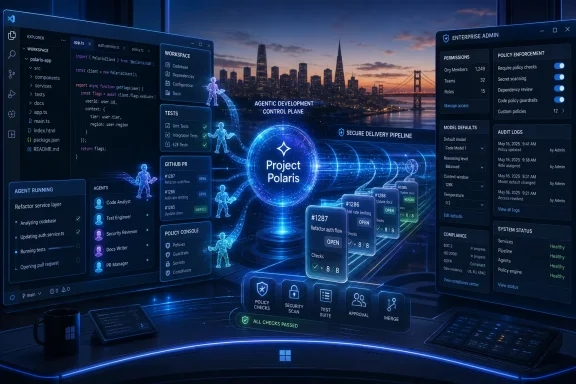 Microsoft Wants Copilot to Stop Being Someone Else’s Demo
GitHub Copilot began as the most useful consumer-facing proof that large language models could make software development faster. It was also, implicitly, an OpenAI showcase. The magic came from GitHub’s editor integration and Microsoft’s distribution, but the model story was inseparable from GPT.Project Polaris changes that center of gravity. If the Tech Times report is accurate, Microsoft is not merely adding another selectable model to Copilot’s already crowded menu. It is making an in-house coding model the default for millions of developers, which means the most common Copilot experience will increasingly be shaped by Microsoft’s own training priorities, safety filters, latency targets, cost structure, and enterprise promises.
That distinction matters because defaults are policy. A model buried in a picker is an experiment; a model chosen automatically for Business and Enterprise seats becomes part of the software supply chain. For administrators, the question is no longer just whether Copilot is allowed in the IDE. It is whether Microsoft’s own agentic coding stack is now a dependency that must be governed like source control, CI/CD, identity, and endpoint management.
This is the kind of move Microsoft makes when it believes a product has crossed from novelty into platform. Windows did not win by being one executable. Office did not become enterprise infrastructure by being one app. Copilot’s next phase is the same playbook: own the experience, own the defaults, and make the rest of the ecosystem plug into your surface area.
The GPT Era Made Copilot Famous, but It Also Made Copilot Vulnerable
The original Copilot bargain was simple. Developers got autocomplete that felt uncannily useful, GitHub got a paid productivity product, and Microsoft got a front-row seat in the AI application layer. OpenAI supplied the raw intelligence, and Copilot supplied the workflow.That arrangement worked beautifully while GPT models were the obvious benchmark. But it also exposed a strategic weakness. If Copilot’s perceived quality depended mostly on whichever frontier model was best this quarter, then Microsoft risked becoming a reseller with better UX.
The last two years have made that risk harder to ignore. Anthropic, Google, OpenAI, xAI, and specialized coding startups have all pushed into developer tooling. The market has shifted from “does AI autocomplete work?” to “which agent can understand my repo, plan a change, run tests, fix failures, and produce a reviewable pull request without wrecking the codebase?”
That is a much more expensive and more defensible problem. It rewards model quality, but it also rewards orchestration, identity, permissions, telemetry, editor state, repository context, cloud execution, and enterprise controls. Microsoft has unusually strong assets in all of those layers. Project Polaris is the company acting as though those layers should no longer be subordinated to an external model brand.
There is also a cost story hiding under the product story. Copilot at global scale is a brutal inference business. Every chat, completion, edit, code review, and autonomous task consumes tokens, GPU time, and margin. A Microsoft-owned coding model gives the company more room to optimize for the boring but decisive things: caching, routing, latency, hardware utilization, pricing tiers, and predictable enterprise contracts.
The Real Product Is the Agent Loop, Not the Model Name
The temptation is to treat Polaris as a horse race entry: GPT versus Polaris, Claude versus Polaris, Codex versus Polaris. That framing is emotionally satisfying and operationally incomplete. In modern coding tools, the model is only one actor inside a larger agent loop.VS Code’s agent architecture already shows where Microsoft is headed. The editor is no longer just a window into files. It is becoming a controlled runtime where an AI system can inspect the workspace, call tools, modify files, run commands, evaluate test results, and iterate. The model proposes actions, but the harness decides what context it sees, which tools it can use, when a loop stops, and how the result is presented to the developer.
That harness is where Microsoft has leverage. VS Code can see unsaved buffers, terminals, extensions, diagnostics, Git state, language servers, test runners, containers, remote sessions, and cloud-connected services. GitHub can see issues, pull requests, Actions, code review history, security alerts, and repository permissions. Azure can provide execution, deployment, observability, and policy enforcement. A model plugged into that system is powerful because the system is powerful.
This is why the reported multi-agent VS Code push matters as much as Polaris itself. The future Microsoft is selling is not one assistant chatting in a sidebar. It is an editor where multiple agents can take on different roles: one plans, one edits, one tests, one reviews, one searches documentation, and one perhaps runs in the background on a GitHub issue while the human works elsewhere.
The agentic IDE turns software development into a delegation interface. That may sound grandiose, but the pieces are already visible. Developers are assigning issues to agents, asking tools to refactor across files, letting models generate tests, and using AI review as a first pass before human review. The question is not whether this workflow exists. It is whether it becomes trustworthy enough to be normal.
VS Code Becomes the Control Plane for AI Labor
For WindowsForum readers, the VS Code angle is especially important because it turns a familiar cross-platform editor into a strategic control plane. VS Code has always been more than a text editor, but Microsoft has been careful to preserve the illusion that it is lightweight, modular, and developer-directed. Multi-agent development strains that illusion.Once agents can run locally, in the cloud, and across GitHub surfaces, the editor becomes the place where AI labor is scheduled, observed, interrupted, and judged. That makes VS Code less like Notepad with extensions and more like a cockpit. The developer is still in charge, but the work surface is designed around supervising concurrent automated activity.
This is a profound shift for teams that standardized on VS Code because it felt neutral. A Python shop, a JavaScript startup, a Rust hobbyist, and a Windows admin writing PowerShell could all inhabit the same tool without buying into the same platform. Multi-agent Copilot changes the incentives. The more useful the agents become, the more value flows through GitHub identity, Copilot subscription tiers, organizational policy, and Microsoft’s cloud-backed execution paths.
That does not mean VS Code suddenly becomes closed. The opposite may be true at the extension and model-provider layer. Microsoft has every reason to make the editor look open to third-party agents, because the winning interface in an agent market is the one that can host rivals without surrendering the customer relationship.
The browser analogy is useful. Chrome won not merely because Google Search existed, but because the browser became the daily frame through which users encountered the web. Microsoft wants VS Code to be that frame for agentic programming. Polaris is the default brain, but the interface is the beachhead.
Enterprise IT Now Has to Govern Behavior, Not Just Access
The first wave of Copilot governance was mostly about data exposure. Could the assistant see private code? Would prompts be retained? Could generated output resemble public code? Which users were licensed? Which repositories were excluded?Agentic coding makes those questions look quaint. A coding agent does not just answer; it acts. It can edit files, invoke tools, run commands, open pull requests, and potentially trigger workflows. That means governance has to move from content policy to behavior policy.
A bank, hospital, defense contractor, or software vendor cannot evaluate this purely by asking whether the model is good. It must ask what the agent is allowed to do when it is wrong. Can it modify infrastructure code? Can it touch authentication logic? Can it run scripts against production-like environments? Can it create dependencies? Can it approve its own work indirectly through automation? Can it generate migration code that passes tests but weakens auditability?
This is where Microsoft’s enterprise instincts may help. The company knows how to sell admins on policy layers, logs, tenant controls, conditional access, compliance boundaries, and procurement-friendly roadmaps. If Polaris is positioned as Microsoft-controlled rather than simply Microsoft-integrated, Redmond can argue that it has a clearer accountability chain than a rotating cast of external model providers.
But that argument cuts both ways. A Microsoft default also concentrates risk. If a Polaris behavior changes after a model update, a prompt-routing adjustment, or an agent harness revision, the effect could ripple across organizations that never consciously chose that particular model for that particular task. The more invisible the default, the more important change management becomes.
Developers Will Notice the Small Failures Before the Strategic Logic
The boardroom version of this story is about platform control. The developer version is harsher: does Polaris write better code, break fewer tests, understand bigger repos, and waste less time?Programmers are unusually sensitive to the texture of AI mistakes. A model can benchmark well and still feel bad if it over-edits, misses local conventions, invents APIs, ignores failing tests, or produces plausible code that takes longer to review than writing it manually. Coding assistants live or die in the gap between “impressive demo” and “I trust this on a Tuesday afternoon when production is already on fire.”
That is why replacing a known GPT-based default is risky. Even if Polaris is technically better on Microsoft’s internal evaluations, developers will compare it against muscle memory. They will notice latency changes. They will notice whether completions feel more conservative. They will notice whether explanations become more verbose, whether refactors are too ambitious, whether generated tests are brittle, and whether the agent gets stuck in loops.
Microsoft can soften the transition by keeping alternative models available. The report suggests Polaris is a default, not an exclusive replacement, and that matters. Model choice gives power users an escape hatch and gives enterprises time to test. But defaults still shape the mainstream experience, especially in organizations where admins lock down options for cost, compliance, or support reasons.
The company also has to avoid the trap of making Copilot feel like a manager’s productivity fantasy rather than a developer’s tool. Multi-agent demos can look spectacular when they produce a pull request from a vague issue. Real engineering often lives in ambiguity, undocumented constraints, social knowledge, and code nobody fully understands. The agent that confidently changes the wrong thing is not a coworker. It is a liability with autocomplete.
Windows Shops Should Read This as a Supply-Chain Story
For Windows administrators and enterprise developers, the Build announcement should land closer to the software supply chain than the productivity aisle. Copilot is not just a nice-to-have extension when it participates in code creation, review, testing, and repository workflow. It becomes part of how software is manufactured.That has practical consequences. Organizations will need to decide whether AI-generated changes require special labels, whether agent-authored pull requests need stricter review, whether logs are retained long enough for incident analysis, and whether generated code can be tied back to the prompt, context, model, and tool permissions that produced it. “Copilot helped” is not an audit trail.
There is also the Windows endpoint angle. If VS Code is running agent sessions that can execute commands, inspect workspaces, interact with local tools, and connect to cloud services, endpoint hardening matters more. Developers’ machines have always been privileged environments. Agentic tooling increases the blast radius of sloppy permissions, poisoned repositories, malicious instructions hidden in files, and unsafe automation habits.
The security community has already spent years warning about prompt injection in systems that ingest untrusted text. Code repositories are full of untrusted text: comments, issues, README files, logs, test fixtures, dependency metadata, and generated artifacts. A multi-agent coding workspace must assume that some of the context it reads may be adversarial.
Microsoft will almost certainly present this as a managed, governable environment. That is the right pitch. But customers should demand evidence at the control boundary: what the agent can read, what it can write, which commands require confirmation, how tool calls are logged, how secrets are protected, and how policies follow a developer from local VS Code to GitHub-hosted agents.
The OpenAI Relationship Is Changing, Not Ending
It would be too easy to frame Polaris as Microsoft breaking up with OpenAI. The reality is more complicated. Microsoft still benefits from OpenAI’s frontier research, brand recognition, API ecosystem, and broader Copilot portfolio. GitHub Copilot can still offer OpenAI models as options while Microsoft makes its own model the default.That is exactly the point. Microsoft does not need to abandon OpenAI to reduce dependence on it. It needs optionality. In strategic terms, Polaris gives Microsoft negotiating leverage, product independence, and a fallback path if model economics, latency, safety requirements, or competitive dynamics make an external default unattractive.
This is the maturing of the AI platform market. Early applications proudly advertised the model underneath them because the model was the product. Mature platforms abstract the model because the workflow is the product. Users do not ask which ranking model powers every search result, which spam model filtered every email, or which recommendation model sorted every feed. They judge the system.
Copilot is moving toward that stage. Microsoft would prefer developers to ask whether Copilot solved the task, not whether GPT, Polaris, Claude, or Codex did. But developers are not passive consumers. Many have strong preferences, and the best coding model can vary by language, framework, repository shape, and task type.
That tension will define the next year of Copilot. Microsoft wants to hide complexity without removing choice. Power users want choice without administrative chaos. Enterprises want standardization without falling behind the best available model. There is no elegant resolution, only policy, telemetry, and a lot of angry threads when the default changes.
The Competition Is No Longer Another Chatbot
The competitive field around Copilot has become much more serious than it was when Copilot first popularized AI autocomplete. Anthropic’s Claude has earned developer affection for code reasoning and long-context work. OpenAI’s Codex lineage has returned as a more explicit agentic coding play. Cursor, Windsurf-style IDEs, Google’s developer AI tools, and specialized autonomous agents have trained users to expect whole-task execution, not just suggestions.Microsoft’s advantage is distribution. GitHub is where the code lives. VS Code is where much of it is edited. Azure is where many enterprises deploy it. Microsoft Entra is where many organizations govern identity. Defender, Purview, Intune, and the rest of the Microsoft management stack give Redmond a language for risk that startup IDE vendors cannot easily match.
Its disadvantage is trust at the developer edge. Developers may use Microsoft tools constantly while remaining skeptical of Microsoft’s defaults, telemetry, bundling, and licensing moves. A forced-feeling model migration could revive old anxieties: that the editor is becoming an upsell surface, that GitHub is becoming less neutral, and that Copilot is being optimized for Microsoft’s margin before developer preference.
The multi-agent strategy tries to square that circle by making VS Code a host rather than a prison. If Microsoft can say, credibly, that Claude, Codex, Polaris, and custom agents can coexist under a coherent policy and billing model, it can turn competitors into tenants. That is an old platform move, but a good one.
The danger is that the agents become indistinguishable to managers and painfully distinct to developers. Procurement may see one Copilot SKU. Engineers may see six different failure modes. Microsoft’s job is to make the abstraction useful without flattening the differences that matter.
Polaris Will Be Judged by the Pull Request
The unit of success for agentic coding is not the chat response. It is the pull request that survives review, tests, security scanning, and future maintenance. That is where Polaris will earn or lose credibility.A useful coding model must do more than emit syntactically valid code. It must infer project conventions, preserve architectural intent, understand test structure, avoid unnecessary churn, and make changes small enough for humans to review. The best agent is not the one that writes the most code. It is the one that reduces the total cost of a correct change.
This is why Microsoft’s GitHub ownership matters. GitHub has an enormous amount of workflow context that pure IDE tools do not. Issues, discussions, pull request comments, review patterns, Actions failures, CodeQL alerts, dependency updates, and commit histories all encode how software teams actually work. If Polaris and the Copilot harness can use that context safely and effectively, Microsoft has a defensible advantage.
But using that context safely is the hard part. Enterprise repositories contain secrets-adjacent information, proprietary architecture, customer-specific assumptions, and years of undocumented decisions. A model that appears context-aware in a demo may still overfit to irrelevant patterns or miss the one comment explaining why an ugly workaround must remain.
The review burden will not disappear. It will move. Instead of reviewing only human-written diffs, senior developers will review AI-generated intent, tool traces, prompt context, and the absence of unintended side effects. That is not necessarily worse, but it is different. Teams that pretend agentic coding is free labor will pay for it later in debugging, security review, and architectural drift.
The Admin Console Becomes as Important as the Demo
If Microsoft wants Copilot to become the enterprise standard for agentic development, the decisive product surface may not be the chat pane. It may be the admin console.Administrators need levers that map to real-world risk. They need to allow an agent to suggest edits but not commit them. They need to permit test execution but block arbitrary shell commands. They need repository-level policy, language-level exceptions, audit exports, model selection controls, and a way to stage new model defaults before they hit regulated teams. They need to know whether a developer’s local agent session and a cloud agent session are governed by the same rules.
They also need cost controls that are intelligible. Multi-agent workflows can burn through usage quickly. A single developer supervising several agents across multiple branches may be productive, or may be running a very expensive experiment in parallel confusion. Microsoft’s licensing and request accounting will matter because finance departments will eventually notice.
There is a cultural side to administration as well. Some teams will ban autonomous changes in critical repositories. Others will require labels for agent-authored code. Some will treat AI review as advisory only. Others will use it as a mandatory gate before human review. The technology is moving faster than the norms, and Microsoft’s defaults will influence those norms.
The strongest version of Copilot Enterprise is not the one that promises maximum automation. It is the one that lets organizations choose where automation is appropriate. A junior developer’s sample app, a line-of-business PowerShell script, a kernel driver, and a payment authorization service should not have the same agent policy.
The Build Message Is Really About Control
Build keynotes are theater, but platform strategy leaks through the choreography. By putting Polaris and multi-agent VS Code in the same story, Microsoft is telling developers that the next era of programming will be mediated through agents and that Microsoft intends to own the most important mediation layer.That is an audacious bet because software developers are both highly tool-dependent and highly resistant to feeling managed. They will happily adopt a tool that saves time. They will also revolt against a tool that adds friction, hides costs, or makes bad changes with corporate confidence.
Microsoft’s best argument is integration. A Polaris-backed Copilot inside VS Code and GitHub can know more about the work than a standalone chatbot. It can move between local context and repository workflow. It can participate in issue triage, code generation, test repair, review, and deployment preparation. It can be governed by the same organization that already governs developer identity and code hosting.
Microsoft’s weakest argument is inevitability. Developers do not owe Copilot loyalty because it was first. If Polaris feels worse than the alternatives, power users will route around it. If VS Code becomes too heavy-handed, competitors will market themselves as the independent developer’s refuge. If enterprise controls are too blunt, security teams will slow adoption rather than bless it.
That is the knife edge. Copilot can become the operating layer for AI-assisted development, or it can become another bundled assistant that developers tolerate while using something else for the serious work.
The August Switch Will Be a Test of Microsoft’s AI Maturity
The reported August default change gives Microsoft a narrow window to prove it has learned how to manage AI product transitions. Model migrations are not like traditional software updates. They can alter tone, behavior, accuracy, latency, and failure modes without changing a visible UI element. That makes them uniquely hard to communicate.A responsible rollout should give organizations advance notice, side-by-side testing, opt-out periods, evaluation guidance, and clear documentation of known differences. It should acknowledge that some teams will prefer GPT-based behavior for specific workloads. It should avoid pretending that “new default” means “strictly better in every case.”
Microsoft also needs to be honest about what Polaris is optimized for. A coding model can be tuned for speed, agent planning, long-context edits, secure code suggestions, enterprise languages, test generation, or cost efficiency. No model is best at everything. The more clearly Microsoft explains the tradeoffs, the easier it will be for serious teams to evaluate the migration.
For individual developers, the advice is simpler. Treat the switch as you would any major dependency change. Test it against real repositories, not toy prompts. Compare generated diffs, not vibes. Watch for changes in review time, test failure rate, and the amount of cleanup required. If your organization allows model choice, keep notes on which model performs best for which task.
The people most likely to be disappointed are those expecting Polaris to feel magical on day one. The people most likely to benefit are those who treat it as one component in a disciplined workflow: constrained permissions, small tasks, tests first, human review always.
The Copilot Era Gets Its Enterprise Fine Print
The practical reading of the Build news is neither panic nor hype. It is that Copilot is becoming more central, more capable, and more administratively consequential at the same time. That combination deserves attention before the default changes, not after developers start asking why the assistant feels different.- Microsoft reportedly plans to make Project Polaris the default GitHub Copilot engine in August 2026, turning an in-house coding model into the standard experience rather than a side option.
- VS Code’s multi-agent direction matters because the editor is becoming a place where developers supervise automated work, not merely request completions.
- Enterprises should evaluate Copilot agents as part of the software supply chain, including permissions, logging, review rules, and model-change management.
- Developers should judge Polaris by real pull requests, test outcomes, and review burden instead of benchmark claims or keynote demos.
- Microsoft’s strategic advantage is the integration of VS Code, GitHub, Azure, and enterprise governance, but that advantage depends on preserving enough model choice to keep developers from routing around the platform.
References
- Primary source: Tech Times
Published: Tue, 02 Jun 2026 11:05:18 GMT
GitHub Copilot Replaces GPT-4 With Project Polaris, Ships Multi-Agent VS Code at Build
GitHub Copilot multi-agent support for VS Code launched at Microsoft Build 2026 alongside Project Polaris, an in-house AI coding model replacing GPT-4 Turbo in August. Copilot Workspace also reachedwww.techtimes.com - Related coverage: techradar.com
50 Microsoft tools you can use for free just in time for Build 2026 | TechRadar
Free tools from across the Microsoft ecosystemwww.techradar.com - Related coverage: enterprisedna.co
Build 2026: Polaris Replaces GPT-4 in GitHub Copilot — Enterprise DNA
At Build 2026, Microsoft unveiled Project Polaris to replace GPT-4 Turbo in GitHub Copilot by August and open-sourced the Windows Agent Framework under MIT.enterprisedna.co - Official source: docs.github.com
About third-party coding agents - GitHub Docs
You can use third-party coding agents alongside Copilot cloud agent to work asynchronously on your development tasks on GitHub. docs.github.com
- Related coverage: thegputrade.com
Microsoft's Project Polaris to Replace GPT-4 Turbo in Copilot
Polaris — an in‑house MoE coding model — becomes Copilot’s default in August 2026thegputrade.com
- Related coverage: code.visualstudio.com
The Coding Harness Behind GitHub Copilot in VS Code
Learn why the coding harness around GitHub Copilot in VS Code matters as models, tools, agents, and providers evolve.code.visualstudio.com
- Official source: devblogs.microsoft.com
Build and run agents at scale with Microsoft Foundry at Build 2026 | Microsoft Foundry Blog
Learn how Microsoft Foundry helps developers build, deploy, and operate production-ready agents with Agent Framework, Toolboxes, hosted agents, Microsoft 365 distribution, observability, and agent optimization.devblogs.microsoft.com - Related coverage: visualstudiomagazine.com
VS Code 1.109 Deemed a Multi-Agent Development Platform -- Visual Studio Magazine
The January 2026 release of Visual Studio Code expands AI-assisted development with structured planning agents, parallel subagents, and unified orchestration across local and cloud environments.visualstudiomagazine.com - Related coverage: agentmarketcap.ai
The February 2026 Multi-Agent Sprint: When Seven Players Shipped Parallel Agents in Two Weeks | AgentMarketCap
How seven major AI coding platforms shipped multi-agent capabilities in the same two-week window, making parallel autonomous execution table stakes overnight.agentmarketcap.ai - Related coverage: cursor-alternatives.com
GitHub Copilot Coding Agent: Complete Guide for 2026
GitHub Copilot Coding Agent vs Agent Mode explained. How to set up AGENTS.md, assign issues, write effective prompts, and get PRs instead of suggestions. cursor-alternatives.com
- Related coverage: windowscentral.com
GitHub Copilot adds GPT-5.4 to VSCode and more coding apps | Windows Central
GitHub Copilot has added support for OpenAI’s GPT-5.4 coding model, bringing improved reasoning and support for multi-step tasks.www.windowscentral.com - Related coverage: mr-kelly.github.io
