

Microsoft unveiled Project Solara at Build 2026 on June 2 in San Francisco as an early “agent-first” device platform built around Microsoft 365 Copilot, Azure-backed services, enterprise management, and concept hardware including a smart badge and desk display. The important part is not that Microsoft has invented another gadget category. It is that Redmond is trying to move AI agents from browser tabs and PC sidebars into the physical workplace. If Windows was the interface for files and apps, Solara is Microsoft’s attempt to define the interface for delegated work.
Project Solara is best understood as Microsoft’s answer to a question the PC industry has been avoiding: if AI agents are supposed to do work for us, why are they still trapped inside apps designed for humans?
The last two years of AI product design have mostly stapled chat boxes onto existing software. Copilot sits beside Word, Outlook, Teams, Edge, and Windows. It can summarize, draft, search, and increasingly take action, but the underlying metaphor remains familiar: the human opens the application, asks the assistant for help, and then returns to the old interface.
Solara pushes against that arrangement. Microsoft’s pitch is that agents are becoming both a unit of programming and a unit of interaction. In plain English, the agent is no longer merely a feature inside an app; it becomes the thing the user invokes directly, across apps, devices, data stores, and workflows.
That is a subtle but serious platform ambition. Microsoft is not just chasing another AI hardware fad. It is trying to make the agent runtime the next place where developers, device makers, IT departments, and enterprise customers meet.
Those details matter less than the scenarios Microsoft chose. A badge is not a consumer status object. It is workplace infrastructure. A desk display is not a replacement for a PC. It is an always-available access point for agents that can sit next to a PC, hand tasks back and forth, or act as a Windows 365 client when connected to a display.
That tells us where Microsoft thinks the first credible market is. It is not the Humane AI Pin crowd, and it is not the “replace your smartphone” fantasy that has swallowed several ambitious hardware startups. Solara is aimed at organizations already invested in Microsoft 365, identity, Intune, Windows 365, Teams, and Copilot.
This is why the demo hardware looks almost boring. A badge can live in a hospital, retail floor, warehouse, corporate campus, or field-service workflow. A desk companion can live in offices where calendar triage, meeting capture, task handoff, and Copilot voice interactions are already plausible. Microsoft is not promising a new computer for everyone; it is proposing new endpoints for enterprises that already run on Microsoft’s cloud.
That may sound strange for a Windows-centric audience, but it fits Microsoft’s post-Windows platform strategy perfectly. Modern Microsoft is less interested in forcing every endpoint to run Windows than in making every endpoint authenticate through Microsoft, manage through Microsoft, call Microsoft services, and monetize Microsoft cloud usage.
This is the same strategic logic that turned Microsoft from a Windows licensing company into a cloud, identity, productivity, and management company. Windows remains enormously important, especially on PCs. But for specialized devices, the operating system kernel is not necessarily where the leverage lives. The leverage is in identity, policy, agent orchestration, cloud state, developer tools, and integration with Microsoft 365 data.
Solara’s real “OS” is therefore less a traditional operating system than a stack: device firmware, AOSP-based management, an agent shell, Microsoft identity, Intune controls, Azure-backed state, and Copilot-family services. Microsoft can call that chip-to-cloud. IT departments will recognize it as the next expansion of the managed endpoint estate.
The company’s claim is that agents lower the cost of specialization. Historically, building a new type of computer required building a full stack: hardware, operating system, application model, user interface, management, security, developer tooling, and ecosystem. That is why many specialized devices are either expensive industrial systems or underpowered consumer curiosities.
Agents change the economics if the interface can be generated or adapted on demand. Microsoft calls this just-in-time UI: the idea that an agent experience can present itself differently across a badge, desk display, PC, phone, or future wearable without every developer hand-crafting a complete app for every screen size and input method.
That is the optimistic version. The skeptical version is that “just-in-time UI” risks becoming another way of saying inconsistent, hard-to-test, model-mediated software. Enterprise buyers will want the former and fear the latter. In regulated industries, a dynamically generated interface that changes based on context is powerful only if it is predictable, auditable, and governable.
Today’s Copilot experience is still largely session-based. You ask something, receive something, maybe ask a follow-up, and then perform or approve an action. But real work is not a single prompt. It is long-running, interruptible, multi-system, and politically messy. It involves documents, calendars, chats, permissions, approvals, compliance rules, and colleagues who may not want a machine wandering through their workflows.
Solara gestures toward that mess. Microsoft talks about multiple agents rather than one dominant assistant. It describes a world where organizations use Microsoft agents, third-party agents, and their own custom agents. It also references agent dispatching and task management, which points to a future where agents are surfaced, delegated, or coordinated depending on context.
That is a much bigger claim than “Copilot on a smart speaker.” If Microsoft can make agents manageable across devices, identities, and corporate boundaries, it has a platform. If it cannot, Solara becomes another demonstration of how easy it is to make AI look magical in a keynote and maddening in production.
Still, the social problem is larger than the hardware spec sheet. A nurse wearing an AI badge into a patient room changes the expectations of everyone in that room. A retail manager using a badge to record a hallway conversation creates questions about consent, retention, access, and labor policy. A field worker using a camera-enabled agent in a customer’s home raises issues that no amount of “user control” language can fully dissolve.
This is where Microsoft’s enterprise focus cuts both ways. Companies can create policy, train employees, manage devices, and enforce identity controls. They can also normalize surveillance-like tools faster than consumers would tolerate them in personal life.
The success of Solara-style devices will depend on whether Microsoft and its customers treat privacy as an operating condition rather than a marketing slide. Physical switches, authentication, and Intune policies are necessary. They are not sufficient. The hard work will be disclosure, consent, retention limits, audit trails, and the ability for workers and bystanders to understand when an agent is listening, seeing, recording, or acting.
The desk concept is the clearest bridge. It can serve as a standalone agent endpoint, a companion to a Windows PC, or a Windows 365 client when connected to an external display. That makes it less like an Echo Show for business and more like a thin-client-plus-agent terminal.
This matters because Microsoft’s agent strategy needs continuity. If an agent summarizes a meeting on a badge, turns it into tasks on a desk display, updates documents in Microsoft 365, and hands a workflow back to a Windows PC, Microsoft has made the PC more valuable by surrounding it with managed context. The PC is no longer the only place where work happens, but it remains the place where much of the deepest work is completed.
That is probably the future Microsoft wants: Windows as the full-fidelity workbench, Solara devices as ambient access points, and Microsoft 365 as the connective tissue. The operating system boundary becomes less important than the trust boundary.
The badge concept makes most sense for frontline and mobile workers. The desk concept makes most sense for information workers who live in meetings, documents, calendars, and messaging. In both cases, Microsoft is selling reduced friction: fewer app launches, fewer missed tasks, fewer manual notes, faster access to organizational context.
But reduced friction is not the same as reduced complexity. Enterprises adopting Solara would need to decide which agents can access which data, which actions require approval, how recordings are stored, how mistakes are reviewed, how devices are patched, and whether employees can opt out of certain interactions.
This is why Intune and identity are as important as microphones and displays. Microsoft’s strongest argument is not that it can build cute AI hardware. It is that it can make that hardware governable inside environments where unmanaged gadgets are dead on arrival.
The value proposition is obvious. If developers can build an agent once and have it appear appropriately on a badge, desk device, Windows PC, Teams surface, or future wearable, Microsoft has created a new distribution layer. That would be the agent-era equivalent of getting an app into the right store, except the “store” is the user’s workflow.
The unresolved question is how much control developers will really have. Agentic systems depend heavily on context, identity, model behavior, policy, and orchestration. If Microsoft owns the shell, the dispatcher, the business data context, the management layer, and the preferred Copilot surfaces, third-party agents may be extensible without being equal.
This is a familiar platform tension. Microsoft says there will not be one dominant agent. But platform owners have a way of becoming dominant even when they embrace plurality. The more Solara depends on Microsoft 365 data and Azure services, the more “bring your own agent” will be constrained by the shape of Microsoft’s ecosystem.
Microsoft appears to have learned at least one lesson from that cycle. It is not selling Solara as a consumer lifestyle revolution. It is framing the platform around enterprise pilots, reference designs, silicon partners, and managed scenarios. That is a more credible route.
But the ghosts still matter. AI hardware fails when the device exists before the use case. It fails when voice is treated as a universal interface despite noisy environments and social awkwardness. It fails when the cloud round trip makes simple tasks feel slow. It fails when the assistant cannot do enough to justify carrying, charging, securing, and explaining another device.
Solara’s advantage is that Microsoft can embed it into workflows where the pain is already known. Meeting capture, task triage, calendar awareness, field notes, quick lookups, and guided workflows are not science fiction. The risk is that these use cases may still be better served by phones, watches, Teams Rooms, laptops, or existing rugged devices unless Solara endpoints prove meaningfully easier to use.
That makes Solara’s “enterprise-ready” framing more than packaging. These devices need strong authentication, hardware-backed trust, clear permissioning, device management, remote wipe, update controls, audit logging, and data-loss protections. They also need runtime controls specific to agents: what the agent can see, what it can remember, what it can call, what it can send externally, and when a human must approve an action.
Traditional endpoint security assumes software behavior can be described in relatively stable terms. Agent behavior is more fluid. It changes based on prompts, context, tools, and model updates. That complicates testing, compliance, and incident response.
The best version of Solara would give administrators a policy plane for agents as mature as the one they expect for devices. The worst version would give employees a fleet of eager assistants with microphones, cameras, cloud access, and poorly understood delegation rules. Microsoft knows which version enterprises will pay for. The question is how quickly it can make the first one real.
AI agents become useful when they know enough about the user’s calendar, documents, chats, meetings, tasks, permissions, role, location, and business process to act intelligently. Microsoft already has a privileged position here through Microsoft 365, Entra ID, Teams, SharePoint, OneDrive, Outlook, Windows, Intune, and Azure.
Solara extends that advantage into physical space. A badge in a hospital, a desk display in an office, or a specialized device in a store becomes another point where Microsoft can surface organizational context and receive user intent. The more places Microsoft’s agents appear, the more natural it becomes for businesses to define work through Microsoft’s graph of people, content, and permissions.
Competitors will not ignore this. Google has Android, Workspace, Gemini, and enormous mobile reach. Apple has hardware trust, wearables, and device integration, though its enterprise AI story remains less complete. Amazon has Alexa history, AWS, and industrial ambitions. Smaller AI startups may innovate faster, but they lack Microsoft’s enterprise distribution.
Solara is Microsoft saying that the agent platform is not merely a model API or a chatbot. It is identity plus data plus devices plus management plus cloud execution. That is a very Microsoft definition of a platform, and it is probably the one most likely to resonate with CIOs.
The early deployments will likely be narrow. A retailer may test task triage for managers. A healthcare organization may explore meeting or encounter capture under strict controls. A corporate team may try desk agents for briefing, prioritization, and Copilot voice. A developer group may experiment with agent progress monitoring and voice-driven workflow updates.
The success metrics should be brutally practical. Does the device save time? Does it reduce missed work? Does it improve documentation quality? Does it avoid annoying employees? Does it comply with policy? Does it work when the network is imperfect? Does it fail safely?
If the answer is yes in even a few verticals, Solara can grow. If the answer is “it is impressive when it works,” it will join the long list of enterprise gadgets that looked strategic in a keynote and became drawerware after procurement moved on.
 Microsoft Wants the Agent to Escape the App Window
Project Solara is best understood as Microsoft’s answer to a question the PC industry has been avoiding: if AI agents are supposed to do work for us, why are they still trapped inside apps designed for humans?The last two years of AI product design have mostly stapled chat boxes onto existing software. Copilot sits beside Word, Outlook, Teams, Edge, and Windows. It can summarize, draft, search, and increasingly take action, but the underlying metaphor remains familiar: the human opens the application, asks the assistant for help, and then returns to the old interface.
Solara pushes against that arrangement. Microsoft’s pitch is that agents are becoming both a unit of programming and a unit of interaction. In plain English, the agent is no longer merely a feature inside an app; it becomes the thing the user invokes directly, across apps, devices, data stores, and workflows.
That is a subtle but serious platform ambition. Microsoft is not just chasing another AI hardware fad. It is trying to make the agent runtime the next place where developers, device makers, IT departments, and enterprise customers meet.
The Hardware Is a Demo, Not the Point
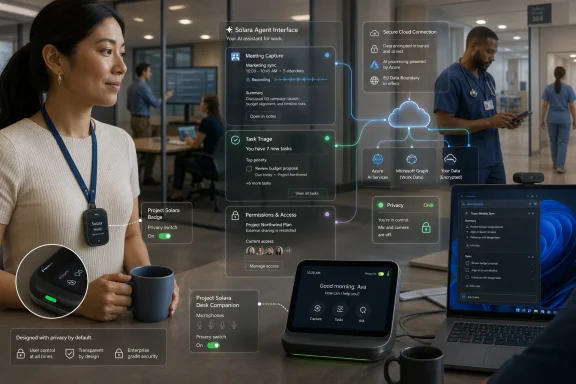
The two concept devices shown around Solara are deliberately modest. One is a badge-like portable device with a small display, camera, speaker, microphone array, fingerprint authentication, privacy controls, wireless connectivity, and Qualcomm wearable silicon. The other is a desk companion with a touchscreen, face authentication, far-field microphones, speaker, ultra-wideband presence sensing, USB-C, wireless connectivity, and MediaTek IoT silicon.Those details matter less than the scenarios Microsoft chose. A badge is not a consumer status object. It is workplace infrastructure. A desk display is not a replacement for a PC. It is an always-available access point for agents that can sit next to a PC, hand tasks back and forth, or act as a Windows 365 client when connected to a display.
That tells us where Microsoft thinks the first credible market is. It is not the Humane AI Pin crowd, and it is not the “replace your smartphone” fantasy that has swallowed several ambitious hardware startups. Solara is aimed at organizations already invested in Microsoft 365, identity, Intune, Windows 365, Teams, and Copilot.
This is why the demo hardware looks almost boring. A badge can live in a hospital, retail floor, warehouse, corporate campus, or field-service workflow. A desk companion can live in offices where calendar triage, meeting capture, task handoff, and Copilot voice interactions are already plausible. Microsoft is not promising a new computer for everyone; it is proposing new endpoints for enterprises that already run on Microsoft’s cloud.
The Android-Based Detail Is the Most Windows Thing About It
One of the more revealing aspects of Solara is that it is not simply “Windows for AI gadgets.” Microsoft says the device-side foundation includes Microsoft Device Ecosystem Platform, an enterprise-grade operating system built on AOSP, the open-source base of Android.That may sound strange for a Windows-centric audience, but it fits Microsoft’s post-Windows platform strategy perfectly. Modern Microsoft is less interested in forcing every endpoint to run Windows than in making every endpoint authenticate through Microsoft, manage through Microsoft, call Microsoft services, and monetize Microsoft cloud usage.
This is the same strategic logic that turned Microsoft from a Windows licensing company into a cloud, identity, productivity, and management company. Windows remains enormously important, especially on PCs. But for specialized devices, the operating system kernel is not necessarily where the leverage lives. The leverage is in identity, policy, agent orchestration, cloud state, developer tools, and integration with Microsoft 365 data.
Solara’s real “OS” is therefore less a traditional operating system than a stack: device firmware, AOSP-based management, an agent shell, Microsoft identity, Intune controls, Azure-backed state, and Copilot-family services. Microsoft can call that chip-to-cloud. IT departments will recognize it as the next expansion of the managed endpoint estate.
The Pitch Is Specialization Without Rebuilding the Stack
Microsoft’s argument for Solara rests on an old computing pattern: new interaction models create new device categories. Mainframes did not kill PCs, PCs did not kill phones, and phones did not kill watches. Each new form factor succeeded when it made computing useful in a more specific context.The company’s claim is that agents lower the cost of specialization. Historically, building a new type of computer required building a full stack: hardware, operating system, application model, user interface, management, security, developer tooling, and ecosystem. That is why many specialized devices are either expensive industrial systems or underpowered consumer curiosities.
Agents change the economics if the interface can be generated or adapted on demand. Microsoft calls this just-in-time UI: the idea that an agent experience can present itself differently across a badge, desk display, PC, phone, or future wearable without every developer hand-crafting a complete app for every screen size and input method.
That is the optimistic version. The skeptical version is that “just-in-time UI” risks becoming another way of saying inconsistent, hard-to-test, model-mediated software. Enterprise buyers will want the former and fear the latter. In regulated industries, a dynamically generated interface that changes based on context is powerful only if it is predictable, auditable, and governable.
Microsoft Is Building the Missing Middle Between Copilot and the Real World
The most interesting thing about Solara is not the badge. It is the layer Microsoft wants to place between human intent and distributed execution.Today’s Copilot experience is still largely session-based. You ask something, receive something, maybe ask a follow-up, and then perform or approve an action. But real work is not a single prompt. It is long-running, interruptible, multi-system, and politically messy. It involves documents, calendars, chats, permissions, approvals, compliance rules, and colleagues who may not want a machine wandering through their workflows.
Solara gestures toward that mess. Microsoft talks about multiple agents rather than one dominant assistant. It describes a world where organizations use Microsoft agents, third-party agents, and their own custom agents. It also references agent dispatching and task management, which points to a future where agents are surfaced, delegated, or coordinated depending on context.
That is a much bigger claim than “Copilot on a smart speaker.” If Microsoft can make agents manageable across devices, identities, and corporate boundaries, it has a platform. If it cannot, Solara becomes another demonstration of how easy it is to make AI look magical in a keynote and maddening in production.
The Badge Makes Privacy Concrete
A wearable workplace AI device with a camera and far-field microphones is both useful and alarming. Microsoft seems to know this, which is why the reference badge includes authentication, a privacy switch, visible controls, and enterprise management hooks.Still, the social problem is larger than the hardware spec sheet. A nurse wearing an AI badge into a patient room changes the expectations of everyone in that room. A retail manager using a badge to record a hallway conversation creates questions about consent, retention, access, and labor policy. A field worker using a camera-enabled agent in a customer’s home raises issues that no amount of “user control” language can fully dissolve.
This is where Microsoft’s enterprise focus cuts both ways. Companies can create policy, train employees, manage devices, and enforce identity controls. They can also normalize surveillance-like tools faster than consumers would tolerate them in personal life.
The success of Solara-style devices will depend on whether Microsoft and its customers treat privacy as an operating condition rather than a marketing slide. Physical switches, authentication, and Intune policies are necessary. They are not sufficient. The hard work will be disclosure, consent, retention limits, audit trails, and the ability for workers and bystanders to understand when an agent is listening, seeing, recording, or acting.
Windows Is Still the Center of Gravity, Even When It Is Not the OS
For Windows users, the temptation is to see Solara as a distraction from the PC. It is not. It is part of the same campaign to make Windows-era work visible to agents and make agents visible to Windows-era workers.The desk concept is the clearest bridge. It can serve as a standalone agent endpoint, a companion to a Windows PC, or a Windows 365 client when connected to an external display. That makes it less like an Echo Show for business and more like a thin-client-plus-agent terminal.
This matters because Microsoft’s agent strategy needs continuity. If an agent summarizes a meeting on a badge, turns it into tasks on a desk display, updates documents in Microsoft 365, and hands a workflow back to a Windows PC, Microsoft has made the PC more valuable by surrounding it with managed context. The PC is no longer the only place where work happens, but it remains the place where much of the deepest work is completed.
That is probably the future Microsoft wants: Windows as the full-fidelity workbench, Solara devices as ambient access points, and Microsoft 365 as the connective tissue. The operating system boundary becomes less important than the trust boundary.
The Enterprise Sales Motion Is Obvious
Microsoft has named early areas such as healthcare, retail, financial services, legal, industrial, hospitality, and field service. That is not random. These are industries where employees spend significant time away from traditional PCs but still need access to schedules, records, instructions, approvals, and communications.The badge concept makes most sense for frontline and mobile workers. The desk concept makes most sense for information workers who live in meetings, documents, calendars, and messaging. In both cases, Microsoft is selling reduced friction: fewer app launches, fewer missed tasks, fewer manual notes, faster access to organizational context.
But reduced friction is not the same as reduced complexity. Enterprises adopting Solara would need to decide which agents can access which data, which actions require approval, how recordings are stored, how mistakes are reviewed, how devices are patched, and whether employees can opt out of certain interactions.
This is why Intune and identity are as important as microphones and displays. Microsoft’s strongest argument is not that it can build cute AI hardware. It is that it can make that hardware governable inside environments where unmanaged gadgets are dead on arrival.
The Developer Story Is Promising and Unfinished
For developers, Solara is an invitation to stop thinking of agents as chatbots attached to websites. Microsoft wants agents to move across form factors and modalities, using frameworks such as Copilot extensibility, Copilot Studio, Microsoft 365 Agents SDK, and Microsoft Agent Framework.The value proposition is obvious. If developers can build an agent once and have it appear appropriately on a badge, desk device, Windows PC, Teams surface, or future wearable, Microsoft has created a new distribution layer. That would be the agent-era equivalent of getting an app into the right store, except the “store” is the user’s workflow.
The unresolved question is how much control developers will really have. Agentic systems depend heavily on context, identity, model behavior, policy, and orchestration. If Microsoft owns the shell, the dispatcher, the business data context, the management layer, and the preferred Copilot surfaces, third-party agents may be extensible without being equal.
This is a familiar platform tension. Microsoft says there will not be one dominant agent. But platform owners have a way of becoming dominant even when they embrace plurality. The more Solara depends on Microsoft 365 data and Azure services, the more “bring your own agent” will be constrained by the shape of Microsoft’s ecosystem.
The Ghosts of Failed AI Gadgets Are in the Room
Solara arrives after a rough stretch for AI hardware. The market has already seen devices that promised to liberate users from smartphones, only to run into familiar problems: latency, limited utility, unclear workflows, battery constraints, privacy discomfort, and the simple fact that phones and PCs are very good at being general-purpose computers.Microsoft appears to have learned at least one lesson from that cycle. It is not selling Solara as a consumer lifestyle revolution. It is framing the platform around enterprise pilots, reference designs, silicon partners, and managed scenarios. That is a more credible route.
But the ghosts still matter. AI hardware fails when the device exists before the use case. It fails when voice is treated as a universal interface despite noisy environments and social awkwardness. It fails when the cloud round trip makes simple tasks feel slow. It fails when the assistant cannot do enough to justify carrying, charging, securing, and explaining another device.
Solara’s advantage is that Microsoft can embed it into workflows where the pain is already known. Meeting capture, task triage, calendar awareness, field notes, quick lookups, and guided workflows are not science fiction. The risk is that these use cases may still be better served by phones, watches, Teams Rooms, laptops, or existing rugged devices unless Solara endpoints prove meaningfully easier to use.
The Security Model Has to Be Better Than the Demo
An agent-first device is a security story before it is a productivity story. A bad app can leak data. A bad agent can leak data, take action, misunderstand intent, chain together tools, and create consequences across systems.That makes Solara’s “enterprise-ready” framing more than packaging. These devices need strong authentication, hardware-backed trust, clear permissioning, device management, remote wipe, update controls, audit logging, and data-loss protections. They also need runtime controls specific to agents: what the agent can see, what it can remember, what it can call, what it can send externally, and when a human must approve an action.
Traditional endpoint security assumes software behavior can be described in relatively stable terms. Agent behavior is more fluid. It changes based on prompts, context, tools, and model updates. That complicates testing, compliance, and incident response.
The best version of Solara would give administrators a policy plane for agents as mature as the one they expect for devices. The worst version would give employees a fleet of eager assistants with microphones, cameras, cloud access, and poorly understood delegation rules. Microsoft knows which version enterprises will pay for. The question is how quickly it can make the first one real.
The Platform War Moves From Apps to Context
The deeper contest around Solara is not about devices. It is about who owns work context.AI agents become useful when they know enough about the user’s calendar, documents, chats, meetings, tasks, permissions, role, location, and business process to act intelligently. Microsoft already has a privileged position here through Microsoft 365, Entra ID, Teams, SharePoint, OneDrive, Outlook, Windows, Intune, and Azure.
Solara extends that advantage into physical space. A badge in a hospital, a desk display in an office, or a specialized device in a store becomes another point where Microsoft can surface organizational context and receive user intent. The more places Microsoft’s agents appear, the more natural it becomes for businesses to define work through Microsoft’s graph of people, content, and permissions.
Competitors will not ignore this. Google has Android, Workspace, Gemini, and enormous mobile reach. Apple has hardware trust, wearables, and device integration, though its enterprise AI story remains less complete. Amazon has Alexa history, AWS, and industrial ambitions. Smaller AI startups may innovate faster, but they lack Microsoft’s enterprise distribution.
Solara is Microsoft saying that the agent platform is not merely a model API or a chatbot. It is identity plus data plus devices plus management plus cloud execution. That is a very Microsoft definition of a platform, and it is probably the one most likely to resonate with CIOs.
The First Buyers Will Be Pilots, Not Believers
Microsoft says it will begin piloting the Solara ecosystem with industry partners in the coming months. That is the right word: piloting. Nobody should confuse concept reference devices with a mature product line.The early deployments will likely be narrow. A retailer may test task triage for managers. A healthcare organization may explore meeting or encounter capture under strict controls. A corporate team may try desk agents for briefing, prioritization, and Copilot voice. A developer group may experiment with agent progress monitoring and voice-driven workflow updates.
The success metrics should be brutally practical. Does the device save time? Does it reduce missed work? Does it improve documentation quality? Does it avoid annoying employees? Does it comply with policy? Does it work when the network is imperfect? Does it fail safely?
If the answer is yes in even a few verticals, Solara can grow. If the answer is “it is impressive when it works,” it will join the long list of enterprise gadgets that looked strategic in a keynote and became drawerware after procurement moved on.
The Solara Bet Comes Down to Six Enterprise Realities
Solara is early, but it is concrete enough to judge the shape of Microsoft’s bet. The company is not merely wrapping Copilot in new plastic. It is trying to define the managed hardware layer for agents before someone else does.- Project Solara is a platform play first and a hardware story second, with Microsoft using concept devices to show how agents might move into physical workplaces.
- The AOSP-based device foundation shows that Microsoft’s real leverage is identity, management, cloud state, and Microsoft 365 context rather than the Windows kernel alone.
- The badge and desk concepts make the most sense in enterprises where frontline work, meetings, documentation, and task triage already create measurable friction.
- Privacy and consent will be decisive because camera-and-microphone AI devices in workplaces affect bystanders, customers, patients, and employees as much as device owners.
- Developers may gain a new distribution surface for agents, but Microsoft’s control of the shell, data context, and management plane will shape how open that ecosystem really becomes.
- The platform will be judged less by keynote intelligence than by mundane deployment realities such as policy control, latency, battery life, auditability, and employee acceptance.
References
- Primary source: The Verge
Published: Tue, 02 Jun 2026 17:24:34 GMT
Microsoft’s AI agent OS: Project Solara. | The Verge
Microsoft just introduced a couple of concept gadgets at Build 2026 that are powered by a new platform, Project Solara, which is made to run AI agents on devices taking the form of everything from smart speakers to security badges or earbuds. [Link: Microsoft’s Project Solara is an OS for AI...www.theverge.com
- Independent coverage: PCMag
Published: Tue, 02 Jun 2026 19:45:58 GMT
Meet Project Solara: Microsoft's Effort to Push AI Agents Into Smart Devices | PCMag
Move over, smart speakers. Microsoft wants to unleash more powerful 'agent-first devices,' including a desk display and a badge concept that can hang around your neck.www.pcmag.com - Related coverage: tomsguide.com
Microsoft Build 2026 preview — all the big announcements to expect | Tom's Guide
Microsoft Build 2026 should be a showcase for the company's latest and upcoming AI efforts. Here are some of the big announcements we expect to see.www.tomsguide.com - Related coverage: techradar.com
50 Microsoft tools you can use for free just in time for Build 2026 | TechRadar
Free tools from across the Microsoft ecosystemwww.techradar.com - Related coverage: pcworld.com
An AI agent in a security badge? That’s Microsoft’s Project Solara pitch | PCWorld
From smart speakers to smart security badges, AI agents could be coming out into the world in a wide variety of devices, and Project Solara is Microsoft’s platform for it.www.pcworld.com - Official source: commandline.microsoft.com
Composing a new platform for agent-first devices - Command Line
New interaction technology enables new types of computers. Learn more about Microsoft’s Project Solara.commandline.microsoft.com
- Official source: microsofters.com
Project Solara: Microsoft prepara dispositivos con agentes IA | Microsofters
Microsoft presenta Project Solara, una plataforma basada en MDEP para crear dispositivos empresariales centrados en agentes de IA. microsofters.com
- Related coverage: investing.com
Microsoft unveils Project Solara for mobile AI devices By Investing.com
Microsoft unveils Project Solara for mobile AI deviceswww.investing.com - Related coverage: thenextweb.com
Microsoft unveils Project Solara: an OS for agent-first devices
Microsoft's Project Solara is a new platform for devices that run AI agents instead of apps. Two concept designs, a badge and desk device, are piloting with Best Buy, CVS, Levi's, and Target.thenextweb.com - Related coverage: techbuzz.ai
Microsoft Unveils Project Solara OS for AI Agent Gadgets | The Tech Buzz
Microsoft launches Android-based Project Solara at Build 2026 to power AI agent hardwarewww.techbuzz.ai - Official source: opensource.microsoft.com
From open source to agentic systems: Microsoft at Open Source Summit North America 2026 | Microsoft Open Source Blog
Discover how Azure Linux 4.0 and Azure Container Linux deliver a secure, scalable Linux foundation for cloud native apps, containers, and AI workloads.opensource.microsoft.com - Related coverage: engadget.com
Microsoft Announces Project Solara, Its Take On An AI Agent Platform
The company demoed Solara on an Echo Show-style smart display and a smart key badge.www.engadget.com - Related coverage: ebisuda.net
Microsoft Build 2026:WindowsがAIエージェント実行基盤に進化、Azure Agent Meshでオンプレ・クラウド横断の分散エージェント管理を実現 | ebisuda.net
Build 2026でMicrosoftがWindows Agent RuntimeとAzure Agent Meshを発表。WindowsをAIエージェントのOSレベル実行プラットフォームとして正式に位置づけた。www.ebisuda.net
- Related coverage: heise.de
Microsoft "Project Solara": The vision of agent-centric hardware | heise online
Microsoft's Project Solara aims to establish a new device category with AI agents instead of apps. The focus is on the business sector. www.heise.de
- Related coverage: stuff.tv
Microsoft shows off Project Solara smart badge and smart display concepts as AI-first hardware | Stuff
Microsoft is building an AI agent-first platform called Project Solara, and is showing off some interesting hardware designs.www.stuff.tv - Related coverage: windowscentral.com
Microsoft just revealed how Windows 11 is evolving into an agentic OS — finally the explanation we've all been waiting for | Windows Central
A new agentic workspace feature will contain AI agents in their own secure session, which users can share data with or shut down at a moment's notice.www.windowscentral.com - Related coverage: itpro.com
Microsoft is hell-bent on making Windows an ‘agentic OS’ – forgive me if I don’t want inescapable AI features shoehorned into every part of the operating system | IT Pro
We don’t need an ‘agentic OS’ filled with pointless features, we need an operating system that workswww.itpro.com - Related coverage: ieeecs-media.computer.org
- Official source: microsoft.github.io
