

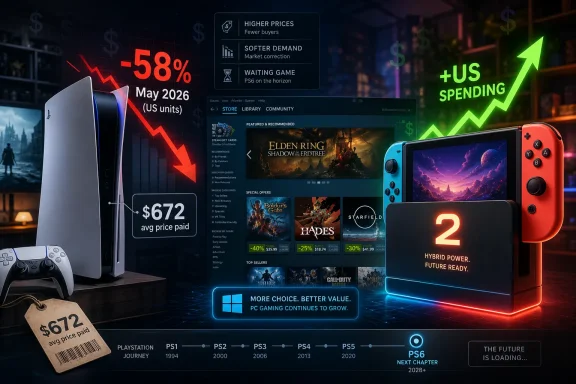
Sony’s PlayStation hardware unit sales in the United States fell 58 percent year over year in May 2026, hitting their lowest May total since 2000, while Nintendo’s Switch 2 pushed overall US console spending sharply higher. That is the contradiction at the center of the modern console market: the industry can look healthy in dollars while one of its most important platforms suddenly looks exhausted in units. The PlayStation 5 is not dead, and Sony is not in crisis, but the old console-cycle playbook is plainly fraying. A machine that once sold itself on scarcity and demand is now asking late-cycle buyers to pay more, wait for the next thing, or look elsewhere.
The cleanest way to misunderstand May’s numbers is to treat them as a one-month embarrassment. Console sales are seasonal, supply chains wobble, promotions matter, and late-generation hardware naturally slows. But a 58 percent year-over-year drop in PlayStation units is too large to file under ordinary fatigue, especially when it lands against a market that was not broadly collapsing.
The headline is brutal because of the comparison point. The last time PlayStation had a May this weak in US unit terms, Sony was still in the awkward handoff between the original PlayStation and the PlayStation 2. In May 2000, the PS2 had not yet launched in the United States, and Sony’s US hardware business was waiting for the next generation to arrive.
May 2026 is a very different kind of valley. The PS5 is not pre-launch hardware. It is a mature, widely known console with a strong library, a large installed base, and years of brand momentum behind it. If sales have fallen to a 26-year May low anyway, the problem is not awareness.
The more persuasive explanation is value. Sony raised PS5 pricing in the United States in 2025 and again in spring 2026, and the reported average price paid for a PS5 in May reached roughly $672. That figure turns the PS5 from a mainstream living-room purchase into something much closer to a discretionary premium device, especially for families buying into the ecosystem late.
That distinction matters because late adopters are not early adopters with worse timing. They are more price-sensitive, more likely to compare platforms, and more likely to ask whether the console still has enough runway to justify the buy-in. Sony spent the first half of the PS5 generation fighting to satisfy demand; now it has to convince people that paying more for aging hardware is still rational.
The Switch 2 was the top-selling console in the United States and Europe for the month, and Circana’s reporting has put it among the fastest-selling game hardware launches in US tracked history. That creates an uncomfortable contrast for Sony and Microsoft. Consumers did not reject game boxes in May; they rejected particular game boxes at particular prices.
Nintendo’s advantage is not merely novelty, though novelty helps. The Switch 2 occupies a cleaner slot in the buyer’s mind. It is a new platform with a portable-home hybrid identity, a first-party software cadence that feels distinct, and a reason to exist even in a household that already owns another gaming device. For many buyers, it is not competing only with the PS5; it is competing with tablets, handheld PCs, and family entertainment spending.
Sony’s position is murkier. The PS5 remains powerful and commercially important, but in 2026 it is also a box that increasingly overlaps with PCs, cloud saves, cross-platform releases, and Sony’s own expanding Windows strategy. When a console’s games travel more freely and the hardware gets more expensive, the platform holder has to work harder to explain why the box itself remains essential.
That is the trap of success in the middle of a long generation. Sony built a huge PS5 audience, which makes cross-gen support and PC ports financially attractive. But those same choices can make the hardware feel less urgent to the holdouts. The people who have not bought a PS5 by mid-2026 may not be waiting for a sale; they may be waiting for a reason.
Instead, the late-cycle console has become more expensive in several markets. Inflation, component costs, currency pressure, tariffs, memory prices, and supply-chain decisions all play a part, but consumers do not buy footnotes. They see a higher shelf price for hardware that is older than it was yesterday.
The reported average PS5 spending level in May is especially damaging because it changes the comparison set. A console at $399 or $499 competes as a dedicated gaming appliance. A console closer to $700 starts sharing mental space with handheld PCs, discounted gaming laptops, used desktops, premium tablets, and simply waiting for the next generation.
Microsoft faces its own version of this problem. Xbox hardware unit sales reportedly fell 12 percent year over year in May, and the platform hit its lowest May unit total on record. The decline was smaller than PlayStation’s, but the long-term picture is arguably more complicated for Xbox because Microsoft has spent years teaching customers that Xbox is a service layer as much as a console.
Sony has not gone that far, but it has moved in the same direction at the edges. Helldivers 2 became a case study in how PlayStation-published games can find enormous audiences beyond PlayStation hardware. Sony’s PC releases have expanded the reach of its franchises, and the company has every financial reason to keep exploring that route. The trouble is that every successful expansion beyond the console also chips away at the console’s aura of necessity.
This does not mean exclusives are the only reason people buy hardware. Ease of use, friends lists, subscriptions, trophies, controllers, libraries, and habit all matter. But exclusivity used to do much of the explanatory work. In a world where hardware is pricier and software is more fluid, the pitch becomes more delicate.
By 2026, the PS5 is a known quantity. The DualSense is familiar, the performance profile is familiar, the first-party lineup has matured, and the argument for upgrading from a PS4 is no longer fresh. The remaining audience includes some enthusiastic holdouts, but also plenty of buyers who have been content with other hardware.
That other hardware now matters more than it did in 2020. The Switch 2 offers a new Nintendo cycle. Steam Deck and Windows handhelds have normalized the idea of portable PC gaming. The rumored and announced push toward living-room PC-style devices, including Valve’s renewed interest in Steam-branded hardware, threatens the old binary between console simplicity and PC flexibility.
For WindowsForum readers, that is the deeper industry shift. The old console war was fought among closed boxes under the TV. The new battle is fought across operating systems, storefronts, subscriptions, portability, account libraries, and silicon supply. Windows PCs are no longer the intimidating alternative to consoles for hobbyists only; they are increasingly part of the mainstream comparison.
That does not automatically make a gaming PC a better buy for everyone. Consoles still offer convenience, standardization, lower maintenance, and a curated experience that many players prefer. But the friction gap is narrower than it used to be, especially for households already comfortable with Microsoft accounts, Discord, Steam, cloud saves, and cross-play.
The PS5’s May decline should be read in that context. Sony is not merely competing with Xbox for a fixed console customer. It is competing with Nintendo for family novelty, with PC handhelds for flexibility, with Windows machines for library continuity, and with its own eventual PS6 for patience.
In the first two years of a console generation, buyers tolerate thin libraries, rough firmware, and high prices because they are buying the future. In the sixth year, they evaluate the installed reality. They look at the games already available, the games still coming, and the likelihood that a successor will arrive before they feel they have received full value.
That is why the PS6 shadow matters even if Sony has not formally dated the machine. The industry expectation that PlayStation 6 will not arrive until 2028 or later still leaves buyers in an awkward window. If a PS5 costs substantially more than it did a year earlier, a rational consumer may decide to stretch a PS4, buy a Switch 2, use a PC, or wait.
The waiting game is particularly dangerous because console purchases are ecosystem commitments. A customer who postpones buying a PS5 may not simply buy a PS6 later. They may spend the next two years building a Steam library, subscribing to Game Pass on PC, or buying Nintendo software for a Switch 2. Delay can become defection by habit.
Sony’s challenge is therefore not only to move units. It must preserve the habit of PlayStation as the default premium gaming destination. Hardware sales are the front door to that habit, and May suggests fewer people walked through it.
There is also a household economics issue that gaming companies often underplay. A $672 average hardware purchase does not exist alone. It comes with a second controller, a subscription, a storage decision, $70 games, digital storefront lock-in, and sometimes a new TV or headset. The sticker shock is not the whole cost; it is the opening bid.
Microsoft has spent years softening the importance of Xbox hardware. Game Pass, PC releases, cloud gaming, and “play anywhere” messaging all make strategic sense if the goal is to reach players wherever they are. But that strategy also makes weak console sales less surprising. If Xbox is everywhere, the Xbox console becomes only one way to participate.
Sony’s problem is different because PlayStation hardware has historically been more central to the identity of the business. A weak May therefore lands with more symbolic force. When Xbox hardware struggles, it fits the narrative of Microsoft becoming less console-dependent. When PlayStation hardware struggles, it raises questions about whether Sony can keep console hardware premium without narrowing its audience.
The two companies are converging in one respect: both are asking players to pay more for boxes that are no longer the only obvious way to access major games. Microsoft has more ideological cover for that transition. Sony has more brand equity tied to resisting it.
That makes May a useful stress test. Nintendo, with a distinctive device and a clearer hardware identity, surged. Sony and Microsoft, with expensive living-room boxes and more platform ambiguity, weakened. The result does not prove the console market is dying. It suggests generic premium consoles are becoming harder to sell when they do not feel new.
But strong software can conceal hardware fragility until the next transition arrives. Platform power depends on installed base growth, developer confidence, storefront gravity, and the feeling that the console is where cultural gaming moments happen first. If hardware growth slows too sharply, the platform becomes more dependent on existing users spending more.
That is a viable business model, but it is a different one. It leans on whales, subscriptions, deluxe editions, live-service retention, and digital storefront margins. It may be excellent for quarterly revenue while making the platform feel less accessible to new entrants.
Sony has also had a complicated live-service era. The company has benefited from major hits, but it has also seen cancellations, delays, and strategic course corrections. Hardware momentum can paper over those uncertainties; when hardware weakens, the software slate receives harsher scrutiny.
The PS5 still has a formidable catalog, and Sony’s first-party reputation remains a major asset. But late-generation hardware sales depend on more than a greatest-hits library. They depend on the sense that buying now places the customer at the center of what comes next. That sense is harder to maintain when the price rises and the next generation is already visible on the horizon.
A price increase late in the life of a console feels different from a high launch price. At launch, buyers understand they are paying early-adopter tax. Late in the cycle, they expect deals, bundles, or at least stability. When the price moves the other way, it violates a deeply ingrained expectation about consumer electronics.
Sony can argue that its costs changed, and that may be true. Component markets have been volatile, and global hardware companies are not operating in the gentle cost environment that defined earlier console generations. But the consumer-facing consequence is still simple: the PS5 became less attractive to people who had already decided not to buy it at a lower price.
That point is easy to miss. The pool of remaining PS5 buyers in 2026 is not identical to the launch audience. Many people who valued the console highly already bought one. The customers left are more likely to need a discount, a killer app, or a family justification. Raising the price hits precisely the group most likely to be deterred.
There is a reputational cost too. Sony spent years cultivating PlayStation as the premium but attainable console brand. If the PS5 increasingly reads as premium and less attainable, Nintendo gains room below it, PC handhelds gain room beside it, and the PS6 inherits a more skeptical audience.
This is why the May number matters even if June or July improves. A single bad month can be explained. A broken value story is harder to fix.
New hardware has an emotional advantage. It gives buyers permission to believe they are entering at the beginning of a cycle rather than catching the end of one. Nintendo’s hybrid identity amplifies that advantage because its console is not simply a weaker or cheaper version of what Sony and Microsoft sell. It is a different promise.
That promise is powerful in 2026 because the gaming market is fragmented. Players want continuity across screens, but they also want devices that have a clear purpose. The Switch 2 says: play Nintendo games, play portably, dock when you want, share the household screen less. The PS5 says: play high-end console games on the TV. That is still compelling, but it is less differentiated than it once was.
Sony’s hardware can deliver spectacle that Nintendo cannot match. But spectacle is not a universal purchasing argument, especially when many blockbuster games are cross-platform and visually impressive on multiple devices. The technical superiority of a box matters most when consumers can see, feel, and afford the difference.
Nintendo also benefits from family purchasing cycles that Sony does not fully control. Parents buying a Switch 2 for children, households upgrading from the original Switch, and longtime Nintendo fans entering a fresh ecosystem all create momentum. Sony’s late-cycle PS5 buyer is more likely to be weighing alternatives than joining a wave.
Steam’s storefront dominance, Windows handhelds, better controller support, widespread cross-play, and more console-publisher PC releases have made PC gaming less isolated from the console mainstream. The PC still has complexity, but it also has continuity. A Steam library survives hardware upgrades in a way console libraries only partially emulate.
That continuity is a threat to late-cycle consoles. If a buyer is about to spend close to $700, a PC ecosystem starts to look less extravagant, particularly if the household already owns a capable machine. Even handheld PCs, with all their compromises, make an argument consoles cannot: your games follow you across form factors.
The rumored and expected push toward Steam Machine-like living-room hardware sharpens this pressure. Even if such devices remain niche, they influence the conversation. They tell consumers that the living room does not have to be a closed-console space. For power users and WindowsForum regulars, that is not a radical idea; for mainstream gaming, it is becoming less exotic.
Sony knows this, which is why its PC strategy exists in the first place. But the company is trying to benefit from PC growth without teaching too many customers that PlayStation hardware is optional. May’s data suggests that balance will become harder as prices rise.
The irony is that Sony’s best games may strengthen the very platforms that compete with its console hardware. A successful PlayStation PC release earns money and grows the franchise. It also gives a patient consumer one more reason not to buy the console immediately.
But the next PlayStation will inherit the expectations created by the PS5 generation. Consumers will remember price increases. They will remember cross-platform releases. They will remember whether Sony made the PS5 feel like a good long-term purchase or an expensive bridge to something else.
The PS6 therefore has to answer a trust question: if players buy in, will the hardware feel essential for long enough to justify the cost? Performance alone cannot answer that. Nor can backward compatibility, though it will be important. Sony needs a complete value story that makes the box feel like the center of the ecosystem rather than one access point among many.
That is particularly true if the PS6 launches into an even more hybrid hardware market. Nintendo will still have its own lane. Microsoft may be deeper into device-agnostic Xbox. PC handhelds may be more mature. Living-room PCs may be less clunky. Cloud gaming may still be uneven, but it will continue to exist as a pressure on hardware assumptions.
Sony’s advantage is that PlayStation remains a beloved brand with deep developer relationships and a global audience. Its disadvantage is that premium loyalty is easier to maintain when prices fall over time, not when they rise. May 2026 is a reminder that brand heat is not the same as price immunity.
 Sony’s May Was Not a Blip, It Was a Warning From the Price Tag
The cleanest way to misunderstand May’s numbers is to treat them as a one-month embarrassment. Console sales are seasonal, supply chains wobble, promotions matter, and late-generation hardware naturally slows. But a 58 percent year-over-year drop in PlayStation units is too large to file under ordinary fatigue, especially when it lands against a market that was not broadly collapsing.The headline is brutal because of the comparison point. The last time PlayStation had a May this weak in US unit terms, Sony was still in the awkward handoff between the original PlayStation and the PlayStation 2. In May 2000, the PS2 had not yet launched in the United States, and Sony’s US hardware business was waiting for the next generation to arrive.
May 2026 is a very different kind of valley. The PS5 is not pre-launch hardware. It is a mature, widely known console with a strong library, a large installed base, and years of brand momentum behind it. If sales have fallen to a 26-year May low anyway, the problem is not awareness.
The more persuasive explanation is value. Sony raised PS5 pricing in the United States in 2025 and again in spring 2026, and the reported average price paid for a PS5 in May reached roughly $672. That figure turns the PS5 from a mainstream living-room purchase into something much closer to a discretionary premium device, especially for families buying into the ecosystem late.
That distinction matters because late adopters are not early adopters with worse timing. They are more price-sensitive, more likely to compare platforms, and more likely to ask whether the console still has enough runway to justify the buy-in. Sony spent the first half of the PS5 generation fighting to satisfy demand; now it has to convince people that paying more for aging hardware is still rational.
Nintendo Proved the Console Market Was Not Simply Out of Money
If the entire hardware market had fallen in May, Sony could point to macroeconomics and move on. Instead, US hardware spending reportedly rose around 38 percent year over year to about $249 million. The money was there. It just flowed toward Nintendo.The Switch 2 was the top-selling console in the United States and Europe for the month, and Circana’s reporting has put it among the fastest-selling game hardware launches in US tracked history. That creates an uncomfortable contrast for Sony and Microsoft. Consumers did not reject game boxes in May; they rejected particular game boxes at particular prices.
Nintendo’s advantage is not merely novelty, though novelty helps. The Switch 2 occupies a cleaner slot in the buyer’s mind. It is a new platform with a portable-home hybrid identity, a first-party software cadence that feels distinct, and a reason to exist even in a household that already owns another gaming device. For many buyers, it is not competing only with the PS5; it is competing with tablets, handheld PCs, and family entertainment spending.
Sony’s position is murkier. The PS5 remains powerful and commercially important, but in 2026 it is also a box that increasingly overlaps with PCs, cloud saves, cross-platform releases, and Sony’s own expanding Windows strategy. When a console’s games travel more freely and the hardware gets more expensive, the platform holder has to work harder to explain why the box itself remains essential.
That is the trap of success in the middle of a long generation. Sony built a huge PS5 audience, which makes cross-gen support and PC ports financially attractive. But those same choices can make the hardware feel less urgent to the holdouts. The people who have not bought a PS5 by mid-2026 may not be waiting for a sale; they may be waiting for a reason.
The Console Cycle Has Become a Margin Cycle
Traditional console wisdom says hardware gets cheaper over time. The launch model is expensive, manufacturing improves, components fall in price, and platform holders eventually use lower prices to reach broader audiences. The PS5 generation has not followed that story neatly.Instead, the late-cycle console has become more expensive in several markets. Inflation, component costs, currency pressure, tariffs, memory prices, and supply-chain decisions all play a part, but consumers do not buy footnotes. They see a higher shelf price for hardware that is older than it was yesterday.
The reported average PS5 spending level in May is especially damaging because it changes the comparison set. A console at $399 or $499 competes as a dedicated gaming appliance. A console closer to $700 starts sharing mental space with handheld PCs, discounted gaming laptops, used desktops, premium tablets, and simply waiting for the next generation.
Microsoft faces its own version of this problem. Xbox hardware unit sales reportedly fell 12 percent year over year in May, and the platform hit its lowest May unit total on record. The decline was smaller than PlayStation’s, but the long-term picture is arguably more complicated for Xbox because Microsoft has spent years teaching customers that Xbox is a service layer as much as a console.
Sony has not gone that far, but it has moved in the same direction at the edges. Helldivers 2 became a case study in how PlayStation-published games can find enormous audiences beyond PlayStation hardware. Sony’s PC releases have expanded the reach of its franchises, and the company has every financial reason to keep exploring that route. The trouble is that every successful expansion beyond the console also chips away at the console’s aura of necessity.
This does not mean exclusives are the only reason people buy hardware. Ease of use, friends lists, subscriptions, trophies, controllers, libraries, and habit all matter. But exclusivity used to do much of the explanatory work. In a world where hardware is pricier and software is more fluid, the pitch becomes more delicate.
The PS5 Is Aging Into a More Crowded Living Room
The PS5 launched into a pandemic-distorted market where demand was so intense that availability became part of the story. For years, buying one felt like beating a supply problem. That psychology is gone.By 2026, the PS5 is a known quantity. The DualSense is familiar, the performance profile is familiar, the first-party lineup has matured, and the argument for upgrading from a PS4 is no longer fresh. The remaining audience includes some enthusiastic holdouts, but also plenty of buyers who have been content with other hardware.
That other hardware now matters more than it did in 2020. The Switch 2 offers a new Nintendo cycle. Steam Deck and Windows handhelds have normalized the idea of portable PC gaming. The rumored and announced push toward living-room PC-style devices, including Valve’s renewed interest in Steam-branded hardware, threatens the old binary between console simplicity and PC flexibility.
For WindowsForum readers, that is the deeper industry shift. The old console war was fought among closed boxes under the TV. The new battle is fought across operating systems, storefronts, subscriptions, portability, account libraries, and silicon supply. Windows PCs are no longer the intimidating alternative to consoles for hobbyists only; they are increasingly part of the mainstream comparison.
That does not automatically make a gaming PC a better buy for everyone. Consoles still offer convenience, standardization, lower maintenance, and a curated experience that many players prefer. But the friction gap is narrower than it used to be, especially for households already comfortable with Microsoft accounts, Discord, Steam, cloud saves, and cross-play.
The PS5’s May decline should be read in that context. Sony is not merely competing with Xbox for a fixed console customer. It is competing with Nintendo for family novelty, with PC handhelds for flexibility, with Windows machines for library continuity, and with its own eventual PS6 for patience.
Late-Generation Buyers Are Asking a Different Question
Early adopters ask whether a new console is exciting. Late adopters ask whether it is worth entering now. Those are brutally different sales conversations.In the first two years of a console generation, buyers tolerate thin libraries, rough firmware, and high prices because they are buying the future. In the sixth year, they evaluate the installed reality. They look at the games already available, the games still coming, and the likelihood that a successor will arrive before they feel they have received full value.
That is why the PS6 shadow matters even if Sony has not formally dated the machine. The industry expectation that PlayStation 6 will not arrive until 2028 or later still leaves buyers in an awkward window. If a PS5 costs substantially more than it did a year earlier, a rational consumer may decide to stretch a PS4, buy a Switch 2, use a PC, or wait.
The waiting game is particularly dangerous because console purchases are ecosystem commitments. A customer who postpones buying a PS5 may not simply buy a PS6 later. They may spend the next two years building a Steam library, subscribing to Game Pass on PC, or buying Nintendo software for a Switch 2. Delay can become defection by habit.
Sony’s challenge is therefore not only to move units. It must preserve the habit of PlayStation as the default premium gaming destination. Hardware sales are the front door to that habit, and May suggests fewer people walked through it.
There is also a household economics issue that gaming companies often underplay. A $672 average hardware purchase does not exist alone. It comes with a second controller, a subscription, a storage decision, $70 games, digital storefront lock-in, and sometimes a new TV or headset. The sticker shock is not the whole cost; it is the opening bid.
Xbox’s Smaller Drop Still Tells the Same Story
The Xbox comparison can make Sony’s month look uniquely bad, but that would be too generous to Microsoft. Xbox hardware falling 12 percent and hitting its lowest May on record is not a victory. It is another sign that the high-end console box is struggling to justify itself late in the generation.Microsoft has spent years softening the importance of Xbox hardware. Game Pass, PC releases, cloud gaming, and “play anywhere” messaging all make strategic sense if the goal is to reach players wherever they are. But that strategy also makes weak console sales less surprising. If Xbox is everywhere, the Xbox console becomes only one way to participate.
Sony’s problem is different because PlayStation hardware has historically been more central to the identity of the business. A weak May therefore lands with more symbolic force. When Xbox hardware struggles, it fits the narrative of Microsoft becoming less console-dependent. When PlayStation hardware struggles, it raises questions about whether Sony can keep console hardware premium without narrowing its audience.
The two companies are converging in one respect: both are asking players to pay more for boxes that are no longer the only obvious way to access major games. Microsoft has more ideological cover for that transition. Sony has more brand equity tied to resisting it.
That makes May a useful stress test. Nintendo, with a distinctive device and a clearer hardware identity, surged. Sony and Microsoft, with expensive living-room boxes and more platform ambiguity, weakened. The result does not prove the console market is dying. It suggests generic premium consoles are becoming harder to sell when they do not feel new.
Sony’s Software Strength May Be Masking Hardware Fragility
One reason Sony can absorb a bad hardware month is that PlayStation is much larger than monthly console sell-through. The installed base is enormous, software spending remains central, subscriptions generate recurring revenue, and PC ports open additional profit pools. A weak May does not erase any of that.But strong software can conceal hardware fragility until the next transition arrives. Platform power depends on installed base growth, developer confidence, storefront gravity, and the feeling that the console is where cultural gaming moments happen first. If hardware growth slows too sharply, the platform becomes more dependent on existing users spending more.
That is a viable business model, but it is a different one. It leans on whales, subscriptions, deluxe editions, live-service retention, and digital storefront margins. It may be excellent for quarterly revenue while making the platform feel less accessible to new entrants.
Sony has also had a complicated live-service era. The company has benefited from major hits, but it has also seen cancellations, delays, and strategic course corrections. Hardware momentum can paper over those uncertainties; when hardware weakens, the software slate receives harsher scrutiny.
The PS5 still has a formidable catalog, and Sony’s first-party reputation remains a major asset. But late-generation hardware sales depend on more than a greatest-hits library. They depend on the sense that buying now places the customer at the center of what comes next. That sense is harder to maintain when the price rises and the next generation is already visible on the horizon.
Price Increases Turn Brand Loyalty Into a Math Problem
Console makers prefer to talk about engagement, ecosystems, and experiences. Consumers often start with arithmetic. That arithmetic got worse for PlayStation buyers.A price increase late in the life of a console feels different from a high launch price. At launch, buyers understand they are paying early-adopter tax. Late in the cycle, they expect deals, bundles, or at least stability. When the price moves the other way, it violates a deeply ingrained expectation about consumer electronics.
Sony can argue that its costs changed, and that may be true. Component markets have been volatile, and global hardware companies are not operating in the gentle cost environment that defined earlier console generations. But the consumer-facing consequence is still simple: the PS5 became less attractive to people who had already decided not to buy it at a lower price.
That point is easy to miss. The pool of remaining PS5 buyers in 2026 is not identical to the launch audience. Many people who valued the console highly already bought one. The customers left are more likely to need a discount, a killer app, or a family justification. Raising the price hits precisely the group most likely to be deterred.
There is a reputational cost too. Sony spent years cultivating PlayStation as the premium but attainable console brand. If the PS5 increasingly reads as premium and less attainable, Nintendo gains room below it, PC handhelds gain room beside it, and the PS6 inherits a more skeptical audience.
This is why the May number matters even if June or July improves. A single bad month can be explained. A broken value story is harder to fix.
Nintendo’s Timing Made Everyone Else Look Older
Nintendo’s success in May was not just a matter of units sold. It changed the lighting in the room. Against the Switch 2, the PS5 and Xbox Series consoles looked less like established platforms and more like aging propositions.New hardware has an emotional advantage. It gives buyers permission to believe they are entering at the beginning of a cycle rather than catching the end of one. Nintendo’s hybrid identity amplifies that advantage because its console is not simply a weaker or cheaper version of what Sony and Microsoft sell. It is a different promise.
That promise is powerful in 2026 because the gaming market is fragmented. Players want continuity across screens, but they also want devices that have a clear purpose. The Switch 2 says: play Nintendo games, play portably, dock when you want, share the household screen less. The PS5 says: play high-end console games on the TV. That is still compelling, but it is less differentiated than it once was.
Sony’s hardware can deliver spectacle that Nintendo cannot match. But spectacle is not a universal purchasing argument, especially when many blockbuster games are cross-platform and visually impressive on multiple devices. The technical superiority of a box matters most when consumers can see, feel, and afford the difference.
Nintendo also benefits from family purchasing cycles that Sony does not fully control. Parents buying a Switch 2 for children, households upgrading from the original Switch, and longtime Nintendo fans entering a fresh ecosystem all create momentum. Sony’s late-cycle PS5 buyer is more likely to be weighing alternatives than joining a wave.
The PC Is No Longer Just the Enthusiast Escape Hatch
For a Windows-focused audience, the most interesting part of Sony’s May trouble is not that Nintendo won. It is that the definition of “alternative hardware” keeps expanding. A player skipping PS5 in 2026 has more credible options than a player skipping PS3 or PS4 did at comparable moments.Steam’s storefront dominance, Windows handhelds, better controller support, widespread cross-play, and more console-publisher PC releases have made PC gaming less isolated from the console mainstream. The PC still has complexity, but it also has continuity. A Steam library survives hardware upgrades in a way console libraries only partially emulate.
That continuity is a threat to late-cycle consoles. If a buyer is about to spend close to $700, a PC ecosystem starts to look less extravagant, particularly if the household already owns a capable machine. Even handheld PCs, with all their compromises, make an argument consoles cannot: your games follow you across form factors.
The rumored and expected push toward Steam Machine-like living-room hardware sharpens this pressure. Even if such devices remain niche, they influence the conversation. They tell consumers that the living room does not have to be a closed-console space. For power users and WindowsForum regulars, that is not a radical idea; for mainstream gaming, it is becoming less exotic.
Sony knows this, which is why its PC strategy exists in the first place. But the company is trying to benefit from PC growth without teaching too many customers that PlayStation hardware is optional. May’s data suggests that balance will become harder as prices rise.
The irony is that Sony’s best games may strengthen the very platforms that compete with its console hardware. A successful PlayStation PC release earns money and grows the franchise. It also gives a patient consumer one more reason not to buy the console immediately.
The PS6 Has to Solve a Trust Problem, Not Just a Performance Problem
The obvious response to late-cycle weakness is that new generations reset the board. The PS6 will arrive with better hardware, a fresh marketing campaign, and the promise of games that finally leave the PS4 and PS5 era behind. That will help.But the next PlayStation will inherit the expectations created by the PS5 generation. Consumers will remember price increases. They will remember cross-platform releases. They will remember whether Sony made the PS5 feel like a good long-term purchase or an expensive bridge to something else.
The PS6 therefore has to answer a trust question: if players buy in, will the hardware feel essential for long enough to justify the cost? Performance alone cannot answer that. Nor can backward compatibility, though it will be important. Sony needs a complete value story that makes the box feel like the center of the ecosystem rather than one access point among many.
That is particularly true if the PS6 launches into an even more hybrid hardware market. Nintendo will still have its own lane. Microsoft may be deeper into device-agnostic Xbox. PC handhelds may be more mature. Living-room PCs may be less clunky. Cloud gaming may still be uneven, but it will continue to exist as a pressure on hardware assumptions.
Sony’s advantage is that PlayStation remains a beloved brand with deep developer relationships and a global audience. Its disadvantage is that premium loyalty is easier to maintain when prices fall over time, not when they rise. May 2026 is a reminder that brand heat is not the same as price immunity.
The May Console Shock Leaves Sony With Fewer Easy Answers
The practical lessons from May are not subtle, but they are uncomfortable. Sony can still recover momentum through bundles, promotions, software beats, and inventory management. What it cannot do is pretend that late-generation PlayStation demand is immune to price and platform drift.- Sony’s May 2026 US PlayStation hardware unit sales fell to their lowest May level since 2000, making the decline historically significant rather than merely seasonal.
- The broader US hardware market still grew in dollar terms, which means PlayStation’s weakness was not simply a sign that consumers stopped buying gaming devices.
- Nintendo’s Switch 2 benefited from a clearer hardware identity and fresher cycle timing, exposing how old the PS5 and Xbox Series value propositions now feel.
- Higher average selling prices make late-cycle consoles harder to justify for buyers who have already waited years to enter the generation.
- Sony’s expanding PC strategy creates useful software revenue, but it also makes PlayStation hardware feel less mandatory to patient or platform-flexible players.
- The PS6 will need to sell confidence in the ecosystem as much as it sells better graphics and faster silicon.
References
- Primary source: extremetech.com
Published: Tue, 30 Jun 2026 11:00:00 GMT
This Was the Roughest May PlayStation Hardware Has Had Since 2000 | Extremetech
Xbox had its worst May sales ever.www.extremetech.com - Related coverage: techradar.com
New report reveals the Nintendo Switch 2 is the second fastest-selling video game hardware in US history, as Xbox and PS5 unit sales struggle | TechRadar
The Nintendo Switch 2 has hit a new sales record in the US in its first 12 months of release, but Xbox and PS5 console unit sales have seen a steep decline.www.techradar.com - Related coverage: techspot.com
PlayStation sales just had its worst May in 25 years, and Xbox's was the worst ever | TechSpot
Market research firm Circana's Mat Piscatella reports that May 2026 saw the lowest number of PlayStation consoles sold in the United States during any May since 2000,...www.techspot.com - Related coverage: xboxachievements.com
Xbox Has Worst May For Hardware Sales in Over 25 Years As Console Price Rises Loom | XboxAchievements.com
As another wave of price increases loom, Xbox has recorded its worst May since 2000 in terms of hardware sales, thanks in no small part to a rise in t...www.xboxachievements.com - Related coverage: tweaktown.com
PlayStation and Xbox record their worst May in decades after recent price increases
Recent price hikes crush console hardware sales, as new sales data shows PlayStation posted its worst May since 2000 and Xbox its worst May ever. www.tweaktown.com
- Related coverage: insider-gaming.com
PlayStation Hardware Crashes to Lowest May Numbers in 25 Years - Insider Gaming
PlayStation has experienced the worst May numbers for hardware sales in the past 25 years. Here are more details.insider-gaming.com
- Related coverage: gamedev.net
PlayStation hardware sales fall to their lowest May total since … | GameDev.net
PS5 unit sales in the US fell 58% year over year in May, hitting their weakest May since 2000, while Xbox also logged its lowest May ever. The surprise is that… gamedev.net
- Related coverage: en.as.com
Switch 2 is the second fastest-selling console in U.S. history as hardware prices rise - Meristation
Nintendo Switch 2 hits 5.9 million sales in the US, but Circana’s May 2026 report warns of massive price hikes for PS5 and Xbox ahead of GTA 6.en.as.com - Related coverage: tomshardware.com
Nintendo reportedly plans to cut Switch 2 production by 33% after a lackluster holiday season — gaming giant slashes 2 million units from planned output | Tom's Hardware
This is bad news for the creator of Mario Bros.www.tomshardware.com - Related coverage: pcgamer.com
Sony hikes the PS5 price by $100, PS5 Pro by $150: 'this was a necessary step' | PC Gamer
Ouch, and for a generation that's over five years old.www.pcgamer.com - Related coverage: windowscentral.com
Black Ops 7 tops US PlayStation sales ahead of Battlefield 6 | Windows Central
Circana data shows Black Ops 7 leading premium sales on PlayStation, whilst NBA 2K26 leads on Xbox.www.windowscentral.com - Related coverage: tomsguide.com
PS5 vs. PS5 Pro: Which console should you buy in 2026? | Tom's Guide
After Sony’s latest PS5 price hikes, which version should you buy? We compare new prices, performance, gaming PCs, and whether to wait for PS6.www.tomsguide.com
