

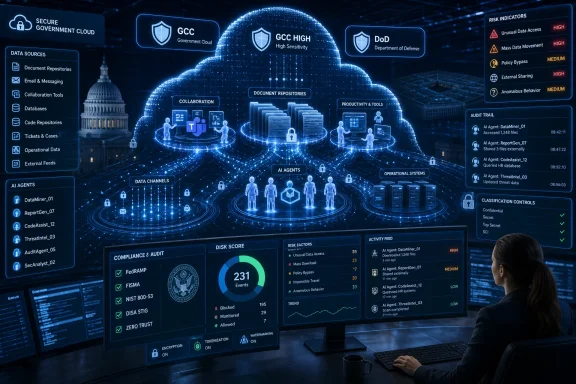
Microsoft is preparing to extend Purview Insider Risk Management’s agent-monitoring capabilities to U.S. government cloud customers in October 2026. The feature will introduce agent-specific activity indicators and risk scoring across GCC, GCC High, and Department of Defense environments, treating autonomous software as part of the organization’s digital workforce rather than merely another application.
The rollout appears in Microsoft 365 Roadmap item 545063, which Microsoft updated on July 13. It remains marked “In development,” with general availability scheduled for October, although roadmap dates are estimates and may change.
Microsoft’s accompanying description frames AI agents as machine-speed insiders: identities that can interpret requests, retrieve and alter enterprise information, invoke tools, and make decisions in real time. Purview will correlate those activities to identify potential intellectual property theft, data leakage, security violations, and accidental exposure.
Traditional insider-risk programs are built around people. They watch for events such as unusual downloads, transfers of sensitive files, policy violations, or activity that differs materially from a user’s established behavior.
Agents complicate that model because they can perform many of the same actions without a person directly clicking through each step. An agent might query a repository, extract information from several documents, generate a response, call an external service, and distribute the result as part of one automated task. The individual operations may appear legitimate in isolation even when the overall sequence creates unacceptable risk.
Microsoft’s planned agent indicators are intended to give Purview a vocabulary for interpreting that behavior. The associated insider risk score for agents should allow security and compliance teams to prioritize activity using workflows already established for human identities, rather than building an entirely separate investigation system for autonomous software.
Microsoft Learn documentation already describes a Risky Agents policy in preview. That policy can detect risky prompts, agents generating sensitive responses, access to sensitive data, and visits to risky websites. Microsoft currently lists Copilot Studio agents, Microsoft Foundry agents, and agents created with the P4AI SDK among the supported types.
When activity meets policy conditions, Purview creates an alert that analysts can review through the standard Insider Risk Management investigation process. Microsoft says the resulting agent-risk information can also be shared with Data Security Posture Management for AI and the Microsoft 365 admin center.
The October roadmap entry therefore looks less like the invention of a new Purview discipline and more like the general-availability expansion of an emerging one, specifically for Microsoft’s regulated U.S. government clouds. That distinction matters: commercial documentation may already describe preview functionality, but GCC, GCC High, and DoD tenants operate on separate deployment schedules and cannot assume that a feature available elsewhere has reached their environments.
A human user is constrained by attention, working hours, interface speed, and the number of actions that can reasonably be performed at once. An agent can process large volumes of information continuously and repeat a flawed or malicious action across thousands of records before an analyst reacts.
That makes velocity an important part of the risk calculation. A permissions mistake affecting a person may expose a handful of files; the same mistake attached to an automated agent could result in systematic collection, transformation, or transmission of sensitive data.
Agents can also combine individually permitted actions into an outcome that was never intended. Accessing a SharePoint document, summarizing it, and posting a response may each be authorized. The security issue emerges when the document contains protected information, the response preserves that information, and the destination falls outside the approved boundary.
Purview’s value will depend on whether its agent-specific indicators can capture that context without overwhelming analysts with alerts generated by normal automation. Risk scoring is not enforcement by itself. It is a method of ranking signals, and its usefulness will hinge on thresholds, policy design, data classification quality, and an organization’s understanding of what each agent is supposed to do.
Microsoft’s documentation allows organizations to use a default Risky Agents policy or create custom policies aligned with their own risk posture. That flexibility is necessary because a research assistant, a customer-support bot, and an infrastructure-remediation agent have radically different normal behaviors. A sensitive-data lookup could be suspicious for one and central to the job of another.
Microsoft says its telemetry can cover agent-to-human, human-to-agent, agent-to-tool, and agent-to-agent interactions. That last category becomes increasingly important as organizations move from isolated assistants toward systems in which one agent delegates work to another.
For administrators, the practical task is no longer limited to controlling what information a user may provide to an AI interface. Teams must inventory agent identities, map their permissions, identify the tools they can call, and determine where their outputs can travel. Purview can supply signals and investigation workflows, but it cannot compensate for an unknown population of agents or broadly assigned access.
Government customers preparing for the October release should use the intervening months to establish that baseline. Useful preparation includes confirming which agents are deployed, ensuring sensitive information is classified consistently, reviewing agent service identities in Microsoft Entra, and documenting expected access patterns before alerts begin to arrive.
Organizations should also decide who owns an agent-related case. An alert may implicate the employee who initiated a task, the team that created the agent, the administrator who granted access, or the business unit responsible for the destination system. Treating every event as a conventional user investigation risks focusing on the last person in the chain while overlooking the configuration that made the incident possible.
Those controls were designed primarily around employees, where pseudonymization can reduce bias and unnecessary exposure of personal information during triage. Agents raise a different set of questions. Hiding an agent’s recognizable identity could make an investigation less intuitive, while displaying its owner, prompts, responses, and connected resources could expose information about the people who use it.
Microsoft’s current agent-monitoring documentation also identifies at least one visibility limitation: when guest users interact with agents, investigators cannot see the full prompt and response content. They instead receive indicators showing that sensitive information was detected. This protects content but may leave analysts with less context when deciding whether an alert represents a real incident.
Government tenants will need to align the feature with internal privacy, records-management, legal, and labor requirements before broad deployment. The presence of a risk score should not be treated as proof of malicious activity, particularly when an agent’s behavior may originate from faulty instructions, excessive permissions, compromised tools, or an unexpected interaction between systems.
Human review remains essential. Agent risk monitoring can show that a machine identity behaved dangerously, but determining responsibility and intent will require evidence from configuration history, audit records, identity controls, and the business process surrounding the activity.
Microsoft’s October target gives GCC, GCC High, and DoD administrators a concrete planning window rather than an immediate deployment task. The important milestone will not simply be when the Purview controls appear in the portal, but whether organizations have already defined what normal agent behavior looks like before machine-speed insiders begin generating machine-speed alerts.
The rollout appears in Microsoft 365 Roadmap item 545063, which Microsoft updated on July 13. It remains marked “In development,” with general availability scheduled for October, although roadmap dates are estimates and may change.
Microsoft’s accompanying description frames AI agents as machine-speed insiders: identities that can interpret requests, retrieve and alter enterprise information, invoke tools, and make decisions in real time. Purview will correlate those activities to identify potential intellectual property theft, data leakage, security violations, and accidental exposure.
 Purview Turns the Insider Model Toward Machines
Traditional insider-risk programs are built around people. They watch for events such as unusual downloads, transfers of sensitive files, policy violations, or activity that differs materially from a user’s established behavior.Agents complicate that model because they can perform many of the same actions without a person directly clicking through each step. An agent might query a repository, extract information from several documents, generate a response, call an external service, and distribute the result as part of one automated task. The individual operations may appear legitimate in isolation even when the overall sequence creates unacceptable risk.
Microsoft’s planned agent indicators are intended to give Purview a vocabulary for interpreting that behavior. The associated insider risk score for agents should allow security and compliance teams to prioritize activity using workflows already established for human identities, rather than building an entirely separate investigation system for autonomous software.
Microsoft Learn documentation already describes a Risky Agents policy in preview. That policy can detect risky prompts, agents generating sensitive responses, access to sensitive data, and visits to risky websites. Microsoft currently lists Copilot Studio agents, Microsoft Foundry agents, and agents created with the P4AI SDK among the supported types.
When activity meets policy conditions, Purview creates an alert that analysts can review through the standard Insider Risk Management investigation process. Microsoft says the resulting agent-risk information can also be shared with Data Security Posture Management for AI and the Microsoft 365 admin center.
The October roadmap entry therefore looks less like the invention of a new Purview discipline and more like the general-availability expansion of an emerging one, specifically for Microsoft’s regulated U.S. government clouds. That distinction matters: commercial documentation may already describe preview functionality, but GCC, GCC High, and DoD tenants operate on separate deployment schedules and cannot assume that a feature available elsewhere has reached their environments.
An Agent Is Not Just a Faster User
Microsoft’s decision to model agents as insiders reflects a practical identity problem. Enterprise agents increasingly have accounts, permissions, access paths, and audit trails that resemble those of employees or service principals, but their operating characteristics are very different.A human user is constrained by attention, working hours, interface speed, and the number of actions that can reasonably be performed at once. An agent can process large volumes of information continuously and repeat a flawed or malicious action across thousands of records before an analyst reacts.
That makes velocity an important part of the risk calculation. A permissions mistake affecting a person may expose a handful of files; the same mistake attached to an automated agent could result in systematic collection, transformation, or transmission of sensitive data.
Agents can also combine individually permitted actions into an outcome that was never intended. Accessing a SharePoint document, summarizing it, and posting a response may each be authorized. The security issue emerges when the document contains protected information, the response preserves that information, and the destination falls outside the approved boundary.
Purview’s value will depend on whether its agent-specific indicators can capture that context without overwhelming analysts with alerts generated by normal automation. Risk scoring is not enforcement by itself. It is a method of ranking signals, and its usefulness will hinge on thresholds, policy design, data classification quality, and an organization’s understanding of what each agent is supposed to do.
Microsoft’s documentation allows organizations to use a default Risky Agents policy or create custom policies aligned with their own risk posture. That flexibility is necessary because a research assistant, a customer-support bot, and an infrastructure-remediation agent have radically different normal behaviors. A sensitive-data lookup could be suspicious for one and central to the job of another.
Existing Governance Moves With the Agent Identity
The broader Purview strategy is to include agents in the same governance estate as users. Microsoft Learn documentation for Windows 365 for Agents says agent instances can be incorporated into sensitivity-label, data loss prevention, Insider Risk Management, communication compliance, eDiscovery, and data-lifecycle policies.Microsoft says its telemetry can cover agent-to-human, human-to-agent, agent-to-tool, and agent-to-agent interactions. That last category becomes increasingly important as organizations move from isolated assistants toward systems in which one agent delegates work to another.
For administrators, the practical task is no longer limited to controlling what information a user may provide to an AI interface. Teams must inventory agent identities, map their permissions, identify the tools they can call, and determine where their outputs can travel. Purview can supply signals and investigation workflows, but it cannot compensate for an unknown population of agents or broadly assigned access.
Government customers preparing for the October release should use the intervening months to establish that baseline. Useful preparation includes confirming which agents are deployed, ensuring sensitive information is classified consistently, reviewing agent service identities in Microsoft Entra, and documenting expected access patterns before alerts begin to arrive.
Organizations should also decide who owns an agent-related case. An alert may implicate the employee who initiated a task, the team that created the agent, the administrator who granted access, or the business unit responsible for the destination system. Treating every event as a conventional user investigation risks focusing on the last person in the chain while overlooking the configuration that made the incident possible.
Privacy Controls Now Face a New Identity Problem
Microsoft emphasizes that Insider Risk Management is built with privacy protections, including pseudonymization by default, role-based access controls, explicit administrative configuration, and audit logs. Its privacy guidance also recommends separating policy administration from alert investigation and granting users the least-privileged Purview role appropriate to their work.Those controls were designed primarily around employees, where pseudonymization can reduce bias and unnecessary exposure of personal information during triage. Agents raise a different set of questions. Hiding an agent’s recognizable identity could make an investigation less intuitive, while displaying its owner, prompts, responses, and connected resources could expose information about the people who use it.
Microsoft’s current agent-monitoring documentation also identifies at least one visibility limitation: when guest users interact with agents, investigators cannot see the full prompt and response content. They instead receive indicators showing that sensitive information was detected. This protects content but may leave analysts with less context when deciding whether an alert represents a real incident.
Government tenants will need to align the feature with internal privacy, records-management, legal, and labor requirements before broad deployment. The presence of a risk score should not be treated as proof of malicious activity, particularly when an agent’s behavior may originate from faulty instructions, excessive permissions, compromised tools, or an unexpected interaction between systems.
Human review remains essential. Agent risk monitoring can show that a machine identity behaved dangerously, but determining responsibility and intent will require evidence from configuration history, audit records, identity controls, and the business process surrounding the activity.
Microsoft’s October target gives GCC, GCC High, and DoD administrators a concrete planning window rather than an immediate deployment task. The important milestone will not simply be when the Purview controls appear in the portal, but whether organizations have already defined what normal agent behavior looks like before machine-speed insiders begin generating machine-speed alerts.
References
- Primary source: Microsoft 365 Roadmap
Published: 2026-07-13T23:07:14.8221961Z
Microsoft 365 Roadmap | Microsoft 365
The Microsoft 365 Roadmap lists updates that are currently planned for applicable subscribers. Check here for more information on the status of new features and updates.www.microsoft.com
- Official source: learn.microsoft.com
Data governance with Microsoft Purview | Microsoft Learn
Learn how Windows 365 for Agents integrates with Microsoft Purview to extend enterprise data governance to agent-driven activities.learn.microsoft.com - Official source: techcommunity.microsoft.com
