

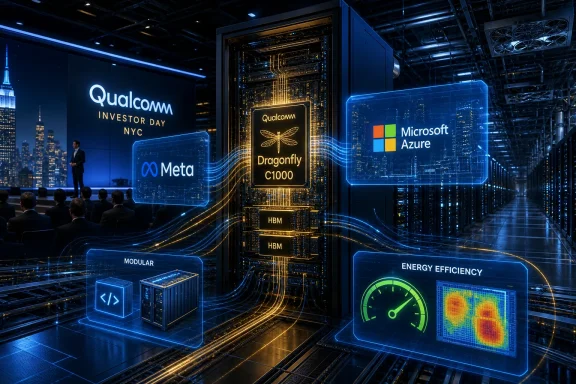
Qualcomm used its June 24, 2026 Investor Day in New York to announce a full data center push built around Dragonfly server CPUs, AI accelerators, High Bandwidth Compute, a Meta server deal, a Microsoft Azure architecture agreement, and a $3.9 billion plan to acquire Modular. The message was not subtle: the San Diego company no longer wants to be valued as a handset-cycle supplier with interesting side businesses. It wants investors, hyperscalers, developers, and rivals to treat it as a serious participant in the AI infrastructure buildout. That is an audacious pivot, but not an irrational one.
For years, Qualcomm’s diversification story has had a familiar rhythm. The company would point to automotive design wins, connected PCs, industrial IoT, XR, networking, and edge AI, while Wall Street continued to see a business whose center of gravity was still the smartphone modem and application processor cycle. That old story is not dead, but it is no longer sufficient.
The June Investor Day was Qualcomm’s attempt to make the center of gravity move in public. Management told investors that handset revenue should fall to roughly one-third of Qualcomm Technologies revenue by fiscal 2029, not because phones stop mattering, but because everything else is supposed to grow faster. Data center revenue, the company now says, could reach several billion dollars by the end of calendar 2026 and more than $15 billion by fiscal 2029.
That is the sort of forecast that changes the conversation only if customers make it believable. Qualcomm therefore did not simply unveil a roadmap; it put Meta and Microsoft on stage, the two names most likely to make investors pause before dismissing the data center plan as another “adjacent market” slide. Meta is attached to the Dragonfly C1000 CPU. Microsoft is attached to Qualcomm’s High Bandwidth Compute architecture for Azure AI infrastructure.
The ambition is bigger than selling a few chips into a few racks. Qualcomm is trying to argue that the next AI infrastructure cycle will reward not only raw accelerator dominance, but also power efficiency, memory bandwidth, software portability, and heterogeneous compute. That framing plays directly to Qualcomm’s self-image: the company that made its fortune by turning wireless complexity into repeatable silicon platforms now wants to do something similar for distributed AI.
This time, Qualcomm is entering with a different industry behind it. The data center is no longer just a contest over general-purpose compute. It is a power, cooling, memory, networking, and inference-efficiency contest, and hyperscalers are now large enough to bend server design around their own workloads rather than buy only what the incumbent ecosystem tells them to buy.
Meta’s role is therefore crucial. Qualcomm says the Dragonfly C1000 is planned for Meta’s next-generation server fleet under a multi-generation agreement, with shipping expected in the second half of 2028. That date matters: this is not a product that suddenly displaces x86 servers this year, and it is not an overnight answer to Nvidia’s accelerator moat. It is a long-cycle platform bet aimed at the infrastructure Meta expects to need after the current wave of AI buildout.
The timing also cuts both ways. A 2028 shipping target gives Qualcomm time to execute, but it gives competitors time to respond. AMD, Intel, Nvidia, Arm platform vendors, and the hyperscalers’ own silicon teams are not standing still. By the time C1000 arrives in volume, today’s performance claims will be measured against a new generation of CPUs, accelerators, memory systems, and rack-scale architectures.
Still, the Meta announcement does something Qualcomm badly needed: it turns Dragonfly from a concept into a customer-anchored program. In the data center, an unnamed hyperscaler can be useful intrigue; a named Meta agreement is a market signal.
Qualcomm’s High Bandwidth Compute pitch is that tightly coupling compute with high memory bandwidth can improve performance and energy efficiency for AI workloads. Microsoft’s decision to work with Qualcomm on deploying HBC in Azure-supporting data centers suggests that the cloud giant sees enough potential to explore the architecture at scale. It does not mean Azure is suddenly a Qualcomm shop. It does mean Microsoft is willing to widen the set of silicon experiments it runs beneath its AI services.
That is consistent with the broader cloud trend. Hyperscalers are increasingly allergic to single-vendor dependency, even when the dominant vendor’s products are excellent. They want optionality against Nvidia accelerators, against x86 CPU concentration, against memory bottlenecks, and against software stacks that trap workloads too tightly to one hardware path.
Qualcomm’s opening is not that it can beat every incumbent at every layer. Its opening is that the AI data center is fragmenting into workload-specific systems, and fragmentation creates room for new architectures. If a platform can lower total cost of ownership for enough inference workloads, it does not need to win the whole market to become a very large business.
For WindowsForum readers, this is not just cloud plumbing trivia. Azure’s silicon choices eventually shape the economics of Microsoft 365 Copilot, GitHub Copilot, Windows AI features, enterprise AI services, and the back-end capacity behind whatever “agentic” workflows Microsoft pushes next. Cheaper inference is not an abstract hyperscaler concern; it is one of the things that determines whether AI features become expensive premium add-ons or ordinary platform capabilities.
Modular’s pitch is portability. Its platform is designed to let AI workloads run across different hardware architectures without developers rewriting everything for each accelerator. That is exactly the kind of story Qualcomm needs if it wants hyperscalers and enterprises to take its data center accelerators seriously.
The acquisition is also a defensive move against irrelevance. If Qualcomm brings impressive silicon to market but leaves the software story to chance, it risks becoming another hardware vendor admired in benchmark decks and avoided in production. Modular gives Qualcomm a developer-facing layer at the moment it is asking customers to believe in a multi-year data center roadmap.
There is a tension here, though. Qualcomm and Modular are describing an open, heterogeneous, developer-friendly world, but acquisitions by large silicon vendors tend to make customers ask how neutral the “neutral” layer will remain. The best version of this deal gives Qualcomm a credible cross-hardware AI software platform and gives developers more freedom. The worst version turns a portability story into a Qualcomm enablement stack with better marketing.
That distinction will matter. Hyperscalers like optionality, but they are not sentimental about it. If Modular’s technology helps workloads move fluidly among CPUs, GPUs, NPUs, custom ASICs, and accelerators, Qualcomm gains relevance even where it does not own every chip. If the platform narrows around Qualcomm’s roadmap, it becomes just another vendor SDK in a market already overloaded with them.
But the more accurate reading is that Qualcomm is attacking the shape of the AI infrastructure market, not only its leader. Nvidia dominates accelerated AI because it controls a powerful combination of GPUs, networking, systems, software, and developer mindshare. Qualcomm is unlikely to break that dominance with one roadmap. What it can do is exploit the parts of the market where hyperscalers do not want to pay a universal Nvidia tax for workloads that may not require Nvidia’s most capable systems.
That puts Qualcomm into a more complicated competitive map. AMD is already pushing hard with Instinct accelerators and EPYC CPUs. Intel is trying to keep its server footprint while rebuilding credibility in process technology and accelerators. Cloud providers are building their own silicon. Arm server CPU suppliers have spent years proving that the architecture can work at scale. Broadcom and Marvell remain important custom-silicon players. Nvidia itself is expanding deeper into CPUs, networking, and rack-scale systems.
Qualcomm’s advantage is that it has spent decades optimizing performance per watt under brutal power constraints. Its disadvantage is that data centers are not smartphones with bigger fans. Server buyers demand long-term support, predictable supply, platform management maturity, security features, and a software ecosystem that survives procurement committees and production incidents.
That is why Meta and Microsoft matter so much. They are not just customers; they are validators. Their involvement tells the market that Qualcomm is not merely building elegant silicon in search of a use case. It is building against workloads that some of the largest AI infrastructure operators already understand.
The market Qualcomm is entering now is different. Amazon’s Graviton has normalized Arm CPUs in the cloud. Ampere helped prove there was room for cloud-native Arm server silicon. Nvidia’s Grace CPU made Arm part of a high-end AI systems story. Apple’s Mac transition, while not a data center event, helped remind developers that Arm could be a high-performance architecture rather than only a mobile one.
Qualcomm also has a stronger CPU story than it did a decade ago. Its Nuvia acquisition reshaped its ambitions in custom cores, first visible to many users through Snapdragon X chips for Windows PCs. That PC push has been imperfect but important. It gave Qualcomm a public platform for arguing that Arm-based compute could compete on battery life and performance in a market long dominated by x86 assumptions.
The data center version of that argument is not about battery life. It is about power budgets, rack density, cooling limits, and the cost of inference at scale. If Qualcomm can turn its low-power design culture into server-grade throughput, the market will listen. If it cannot, the Dragonfly brand will become another reminder that mobile excellence does not automatically translate into data center durability.
The lesson from Windows on Arm is relevant here. Hardware wins attention; compatibility wins adoption. In PCs, that means drivers, apps, emulation, and enterprise manageability. In data centers, it means compilers, kernels, orchestration, observability, security tooling, and workload migration. Qualcomm’s data center plan will live or die in that unglamorous middle layer.
That matters because Microsoft’s AI strategy is increasingly split between on-device inference and cloud-scale inference. Some tasks will run locally for latency, privacy, cost, or offline access. Others will run in Azure because they need larger models, more context, enterprise data integration, or centralized governance. Qualcomm wants to supply silicon and software for both halves.
If the company succeeds, Microsoft gets more flexibility in deciding where AI workloads run. A Windows PC with a competent NPU can handle lightweight or privacy-sensitive tasks locally. Azure infrastructure with more efficient AI compute can handle heavy agentic workloads. The bridge between those worlds is not just branding; it is software portability and model deployment.
This is why Modular is so strategically important to the Windows ecosystem even if most Windows users have never heard of it. A practical, cross-hardware AI software layer could make it easier for developers to target local NPUs, cloud accelerators, CPUs, and GPUs without maintaining a maze of vendor-specific code paths. That would not solve all compatibility problems, but it would reduce one of the barriers to broader AI application deployment.
The catch is that Microsoft, Qualcomm, Nvidia, AMD, Intel, and the cloud providers all have incentives to make portability sound easier than it is. Developers know better. The history of computing is littered with “write once, run anywhere” promises that became “write once, tune everywhere.” Qualcomm’s challenge is not to produce a slogan. It is to make the tuning burden small enough that customers care.
That is also why skepticism is warranted. Data center silicon roadmaps are full of ramps that slipped, sockets that shrank, and customers that diversified away before volume arrived. A multi-generation agreement is important, but it is not the same as guaranteed revenue at a specific margin. A cloud architecture agreement is promising, but it is not the same as broad production deployment across Azure.
The near-term claim that data center agreements could generate more than $1 billion by the end of 2026 is particularly striking because the Dragonfly C1000 is not expected to ship until the second half of 2028. That implies Qualcomm’s early data center revenue will come from other products, custom silicon, connectivity, AI accelerator work, or customer-specific programs rather than the headline Meta CPU itself. Investors should separate the near-term revenue bridge from the long-term Dragonfly CPU story.
The stock reaction after Investor Day reflected both excitement and uncertainty. Shares rose sharply around the announcements, then gave back some of the move as the market digested execution risk. That is rational. Qualcomm presented a bigger future, but the proof will arrive in purchase orders, production deployments, developer adoption, and margins — not in conference-stage confidence.
The most persuasive part of the Investor Day was not the size of the addressable market. Every large technology company can produce a giant TAM slide. The persuasive part was that Qualcomm tied its diversification story to named customers and a software acquisition that addresses a known adoption barrier.
That is both commercially logical and strategically delicate. China remains too large a semiconductor market for Qualcomm to ignore, but AI accelerators and advanced data center chips are now among the most politically sensitive technologies in the world. Nvidia’s recent experience shows how quickly export rules can reshape product plans and revenue expectations.
Qualcomm’s historical strength in global wireless markets may help it navigate that complexity. The company is accustomed to operating across regulatory regimes, standards bodies, and national technology priorities. But AI data center silicon is subject to a different level of scrutiny because it sits closer to strategic compute capacity.
For enterprise customers, the geopolitical issue shows up as supply-chain risk. If Qualcomm’s roadmap depends on export-compliant variants, regional segmentation, and regulatory interpretation, customers will want clarity about availability and support. For investors, China could be both an upside market and a source of sudden constraint.
The broader lesson is that AI infrastructure is no longer just a technology market. It is industrial policy with earnings calls. Qualcomm is entering at precisely the moment when compute capacity, energy consumption, export law, and cloud sovereignty are becoming part of the same conversation.
That argument fits Qualcomm’s DNA. The company has always been more comfortable talking about systems than isolated chips. In phones, it sold modems, application processors, RF front ends, wireless IP, and reference designs into a complex ecosystem. In automotive and IoT, it has pursued platforms rather than bare silicon. In data centers, Dragonfly, HBC, AI accelerators, connectivity, custom silicon, and Modular form the same kind of platform thesis.
The difficulty is that data center customers do not reward elegance by default. They reward operational advantage. A chip that is 20 percent more efficient on paper can lose if the software stack is immature. A portable framework can lose if developers cannot debug it at 3 a.m. A lower-cost inference platform can lose if procurement teams fear vendor lock-in of a different kind.
Qualcomm’s opportunity is that hyperscalers are uniquely capable of absorbing early complexity. Meta and Microsoft have the engineering resources to help shape platforms that ordinary enterprises would not yet touch. If Qualcomm can prove itself inside hyperscaler environments, broader adoption becomes more plausible.
But that adoption path will be gradual. The first meaningful wins may be invisible to most users: a specific inference service, a back-end model-serving tier, an internal AI workload, a custom data center deployment. Qualcomm does not need a dramatic consumer-facing moment. It needs boring, repeatable production scale.
Large models cannot always run locally. Local models cannot always access enterprise context. Cloud inference can be expensive and latency-sensitive. Edge inference can be constrained by memory, thermals, and model size. The future is likely to be hybrid by necessity, not preference.
Qualcomm wants to make that hybrid future its home turf. It can point to Snapdragon in phones and PCs, automotive platforms in vehicles, Dragonwing for industrial and edge systems, and now Dragonfly for data centers. The naming may be a little too neat, but the architecture of the pitch is coherent: AI workloads will move around, and Qualcomm wants a platform at every stop.
This is where Windows becomes strategically important again. The PC is the most familiar edge device in enterprise computing. If Microsoft continues pushing AI deeper into Windows, Microsoft 365, developer tools, and endpoint management, the boundary between local and cloud AI will become a daily operational issue for IT departments.
Qualcomm’s PC chips alone cannot define that future. But if Qualcomm can pair client silicon, Azure-side infrastructure, and a software layer from Modular, it can argue for a more integrated role in Microsoft’s AI stack. That is a far more ambitious goal than selling another generation of thin-and-light laptop processors.
Still, the announcement changes Qualcomm’s posture. The company is no longer asking investors to believe that automotive, IoT, and PCs will slowly offset handset concentration. It is asking them to believe that Qualcomm can enter the defining infrastructure market of the decade with enough customer pull, software leverage, and energy-efficiency advantage to matter.
That is a harder story, but it is also a better one. The handset market is mature, replacement cycles are uneven, and premium smartphone growth is not enough to justify every semiconductor ambition Qualcomm has accumulated. AI infrastructure, by contrast, is chaotic, capital-intensive, and still unresolved. It is exactly the sort of market where a late entrant can fail expensively — or arrive just as customers start demanding alternatives.
For sysadmins and IT pros, the practical consequence is not that tomorrow’s servers will suddenly be Qualcomm-powered. It is that the AI infrastructure stack behind cloud services is becoming more diverse. That diversity will eventually influence pricing, availability, deployment patterns, compliance conversations, and the hardware assumptions baked into enterprise software.
 Qualcomm Is Trying to Reprice Itself Before the Market Reprices Handsets
For years, Qualcomm’s diversification story has had a familiar rhythm. The company would point to automotive design wins, connected PCs, industrial IoT, XR, networking, and edge AI, while Wall Street continued to see a business whose center of gravity was still the smartphone modem and application processor cycle. That old story is not dead, but it is no longer sufficient.The June Investor Day was Qualcomm’s attempt to make the center of gravity move in public. Management told investors that handset revenue should fall to roughly one-third of Qualcomm Technologies revenue by fiscal 2029, not because phones stop mattering, but because everything else is supposed to grow faster. Data center revenue, the company now says, could reach several billion dollars by the end of calendar 2026 and more than $15 billion by fiscal 2029.
That is the sort of forecast that changes the conversation only if customers make it believable. Qualcomm therefore did not simply unveil a roadmap; it put Meta and Microsoft on stage, the two names most likely to make investors pause before dismissing the data center plan as another “adjacent market” slide. Meta is attached to the Dragonfly C1000 CPU. Microsoft is attached to Qualcomm’s High Bandwidth Compute architecture for Azure AI infrastructure.
The ambition is bigger than selling a few chips into a few racks. Qualcomm is trying to argue that the next AI infrastructure cycle will reward not only raw accelerator dominance, but also power efficiency, memory bandwidth, software portability, and heterogeneous compute. That framing plays directly to Qualcomm’s self-image: the company that made its fortune by turning wireless complexity into repeatable silicon platforms now wants to do something similar for distributed AI.
Dragonfly Gives Qualcomm a Flag to Plant in the Server Room
The Dragonfly C1000 is the symbolic centerpiece because server CPUs are not a casual market entry. Data centers are conservative, validation-heavy environments where roadmaps, firmware, compilers, platform management, supply guarantees, and ecosystem support matter almost as much as core counts. Qualcomm knows this; its previous Arm server efforts never turned into a durable franchise.This time, Qualcomm is entering with a different industry behind it. The data center is no longer just a contest over general-purpose compute. It is a power, cooling, memory, networking, and inference-efficiency contest, and hyperscalers are now large enough to bend server design around their own workloads rather than buy only what the incumbent ecosystem tells them to buy.
Meta’s role is therefore crucial. Qualcomm says the Dragonfly C1000 is planned for Meta’s next-generation server fleet under a multi-generation agreement, with shipping expected in the second half of 2028. That date matters: this is not a product that suddenly displaces x86 servers this year, and it is not an overnight answer to Nvidia’s accelerator moat. It is a long-cycle platform bet aimed at the infrastructure Meta expects to need after the current wave of AI buildout.
The timing also cuts both ways. A 2028 shipping target gives Qualcomm time to execute, but it gives competitors time to respond. AMD, Intel, Nvidia, Arm platform vendors, and the hyperscalers’ own silicon teams are not standing still. By the time C1000 arrives in volume, today’s performance claims will be measured against a new generation of CPUs, accelerators, memory systems, and rack-scale architectures.
Still, the Meta announcement does something Qualcomm badly needed: it turns Dragonfly from a concept into a customer-anchored program. In the data center, an unnamed hyperscaler can be useful intrigue; a named Meta agreement is a market signal.
Microsoft’s Azure Deal Points to the Real Bottleneck: Memory
The Microsoft announcement may prove more strategically interesting than the CPU news because it goes after the “memory wall,” the constraint that increasingly defines AI inference economics. Training gets the headlines, but inference is where AI becomes a recurring operating expense. If agents, copilots, recommendation systems, coding assistants, and multimodal models become more common, the cost per token becomes infrastructure destiny.Qualcomm’s High Bandwidth Compute pitch is that tightly coupling compute with high memory bandwidth can improve performance and energy efficiency for AI workloads. Microsoft’s decision to work with Qualcomm on deploying HBC in Azure-supporting data centers suggests that the cloud giant sees enough potential to explore the architecture at scale. It does not mean Azure is suddenly a Qualcomm shop. It does mean Microsoft is willing to widen the set of silicon experiments it runs beneath its AI services.
That is consistent with the broader cloud trend. Hyperscalers are increasingly allergic to single-vendor dependency, even when the dominant vendor’s products are excellent. They want optionality against Nvidia accelerators, against x86 CPU concentration, against memory bottlenecks, and against software stacks that trap workloads too tightly to one hardware path.
Qualcomm’s opening is not that it can beat every incumbent at every layer. Its opening is that the AI data center is fragmenting into workload-specific systems, and fragmentation creates room for new architectures. If a platform can lower total cost of ownership for enough inference workloads, it does not need to win the whole market to become a very large business.
For WindowsForum readers, this is not just cloud plumbing trivia. Azure’s silicon choices eventually shape the economics of Microsoft 365 Copilot, GitHub Copilot, Windows AI features, enterprise AI services, and the back-end capacity behind whatever “agentic” workflows Microsoft pushes next. Cheaper inference is not an abstract hyperscaler concern; it is one of the things that determines whether AI features become expensive premium add-ons or ordinary platform capabilities.
Modular Is Qualcomm’s CUDA Problem in Acquisition Form
The $3.9 billion Modular acquisition is Qualcomm’s most direct admission that hardware alone is not enough. Every would-be Nvidia challenger eventually runs into the same wall: developers do not buy theoretical silicon; they buy working software paths, libraries, frameworks, tooling, documentation, debugging, deployment patterns, and institutional familiarity. CUDA is not merely an API. It is a habit, a labor market, and a default assumption.Modular’s pitch is portability. Its platform is designed to let AI workloads run across different hardware architectures without developers rewriting everything for each accelerator. That is exactly the kind of story Qualcomm needs if it wants hyperscalers and enterprises to take its data center accelerators seriously.
The acquisition is also a defensive move against irrelevance. If Qualcomm brings impressive silicon to market but leaves the software story to chance, it risks becoming another hardware vendor admired in benchmark decks and avoided in production. Modular gives Qualcomm a developer-facing layer at the moment it is asking customers to believe in a multi-year data center roadmap.
There is a tension here, though. Qualcomm and Modular are describing an open, heterogeneous, developer-friendly world, but acquisitions by large silicon vendors tend to make customers ask how neutral the “neutral” layer will remain. The best version of this deal gives Qualcomm a credible cross-hardware AI software platform and gives developers more freedom. The worst version turns a portability story into a Qualcomm enablement stack with better marketing.
That distinction will matter. Hyperscalers like optionality, but they are not sentimental about it. If Modular’s technology helps workloads move fluidly among CPUs, GPUs, NPUs, custom ASICs, and accelerators, Qualcomm gains relevance even where it does not own every chip. If the platform narrows around Qualcomm’s roadmap, it becomes just another vendor SDK in a market already overloaded with them.
Nvidia Is the Target, but Not the Only One
It is tempting to frame Qualcomm’s data center push as a frontal attack on Nvidia. Qualcomm itself encouraged that interpretation by pairing AI accelerators, memory architecture, and software portability in one strategic package. Modular’s anti-lock-in narrative also invites comparison with CUDA.But the more accurate reading is that Qualcomm is attacking the shape of the AI infrastructure market, not only its leader. Nvidia dominates accelerated AI because it controls a powerful combination of GPUs, networking, systems, software, and developer mindshare. Qualcomm is unlikely to break that dominance with one roadmap. What it can do is exploit the parts of the market where hyperscalers do not want to pay a universal Nvidia tax for workloads that may not require Nvidia’s most capable systems.
That puts Qualcomm into a more complicated competitive map. AMD is already pushing hard with Instinct accelerators and EPYC CPUs. Intel is trying to keep its server footprint while rebuilding credibility in process technology and accelerators. Cloud providers are building their own silicon. Arm server CPU suppliers have spent years proving that the architecture can work at scale. Broadcom and Marvell remain important custom-silicon players. Nvidia itself is expanding deeper into CPUs, networking, and rack-scale systems.
Qualcomm’s advantage is that it has spent decades optimizing performance per watt under brutal power constraints. Its disadvantage is that data centers are not smartphones with bigger fans. Server buyers demand long-term support, predictable supply, platform management maturity, security features, and a software ecosystem that survives procurement committees and production incidents.
That is why Meta and Microsoft matter so much. They are not just customers; they are validators. Their involvement tells the market that Qualcomm is not merely building elegant silicon in search of a use case. It is building against workloads that some of the largest AI infrastructure operators already understand.
The Arm Server Story Finally Has Better Timing
Qualcomm’s server ambitions have history, and not all of it is flattering. The company’s earlier Centriq effort in the 2010s arrived before the Arm server market had enough momentum and before hyperscaler AI demand turned efficiency into an existential constraint. It was technically interesting, strategically plausible, and commercially short-lived.The market Qualcomm is entering now is different. Amazon’s Graviton has normalized Arm CPUs in the cloud. Ampere helped prove there was room for cloud-native Arm server silicon. Nvidia’s Grace CPU made Arm part of a high-end AI systems story. Apple’s Mac transition, while not a data center event, helped remind developers that Arm could be a high-performance architecture rather than only a mobile one.
Qualcomm also has a stronger CPU story than it did a decade ago. Its Nuvia acquisition reshaped its ambitions in custom cores, first visible to many users through Snapdragon X chips for Windows PCs. That PC push has been imperfect but important. It gave Qualcomm a public platform for arguing that Arm-based compute could compete on battery life and performance in a market long dominated by x86 assumptions.
The data center version of that argument is not about battery life. It is about power budgets, rack density, cooling limits, and the cost of inference at scale. If Qualcomm can turn its low-power design culture into server-grade throughput, the market will listen. If it cannot, the Dragonfly brand will become another reminder that mobile excellence does not automatically translate into data center durability.
The lesson from Windows on Arm is relevant here. Hardware wins attention; compatibility wins adoption. In PCs, that means drivers, apps, emulation, and enterprise manageability. In data centers, it means compilers, kernels, orchestration, observability, security tooling, and workload migration. Qualcomm’s data center plan will live or die in that unglamorous middle layer.
The Windows Angle Is Bigger Than Snapdragon Laptops
WindowsForum readers naturally connect Qualcomm with Snapdragon X laptops and Windows on Arm. That connection still matters, but the data center strategy should broaden how we think about Qualcomm’s role in the Microsoft ecosystem. The company is no longer only trying to get into client PCs. It is trying to sit on both sides of Microsoft’s AI future: local Windows devices and Azure data centers.That matters because Microsoft’s AI strategy is increasingly split between on-device inference and cloud-scale inference. Some tasks will run locally for latency, privacy, cost, or offline access. Others will run in Azure because they need larger models, more context, enterprise data integration, or centralized governance. Qualcomm wants to supply silicon and software for both halves.
If the company succeeds, Microsoft gets more flexibility in deciding where AI workloads run. A Windows PC with a competent NPU can handle lightweight or privacy-sensitive tasks locally. Azure infrastructure with more efficient AI compute can handle heavy agentic workloads. The bridge between those worlds is not just branding; it is software portability and model deployment.
This is why Modular is so strategically important to the Windows ecosystem even if most Windows users have never heard of it. A practical, cross-hardware AI software layer could make it easier for developers to target local NPUs, cloud accelerators, CPUs, and GPUs without maintaining a maze of vendor-specific code paths. That would not solve all compatibility problems, but it would reduce one of the barriers to broader AI application deployment.
The catch is that Microsoft, Qualcomm, Nvidia, AMD, Intel, and the cloud providers all have incentives to make portability sound easier than it is. Developers know better. The history of computing is littered with “write once, run anywhere” promises that became “write once, tune everywhere.” Qualcomm’s challenge is not to produce a slogan. It is to make the tuning burden small enough that customers care.
The Revenue Targets Are Enormous Because the Risk Is Enormous
A target of more than $15 billion in fiscal 2029 data center revenue is not a side bet. It is a proposed transformation of Qualcomm’s business mix. For comparison, Qualcomm reported $44.28 billion in fiscal 2025 revenue, according to the San Diego Business Journal’s company profile in the submitted report. A data center business of that scale would materially change how investors model the company.That is also why skepticism is warranted. Data center silicon roadmaps are full of ramps that slipped, sockets that shrank, and customers that diversified away before volume arrived. A multi-generation agreement is important, but it is not the same as guaranteed revenue at a specific margin. A cloud architecture agreement is promising, but it is not the same as broad production deployment across Azure.
The near-term claim that data center agreements could generate more than $1 billion by the end of 2026 is particularly striking because the Dragonfly C1000 is not expected to ship until the second half of 2028. That implies Qualcomm’s early data center revenue will come from other products, custom silicon, connectivity, AI accelerator work, or customer-specific programs rather than the headline Meta CPU itself. Investors should separate the near-term revenue bridge from the long-term Dragonfly CPU story.
The stock reaction after Investor Day reflected both excitement and uncertainty. Shares rose sharply around the announcements, then gave back some of the move as the market digested execution risk. That is rational. Qualcomm presented a bigger future, but the proof will arrive in purchase orders, production deployments, developer adoption, and margins — not in conference-stage confidence.
The most persuasive part of the Investor Day was not the size of the addressable market. Every large technology company can produce a giant TAM slide. The persuasive part was that Qualcomm tied its diversification story to named customers and a software acquisition that addresses a known adoption barrier.
China Will Test the Strategy Before 2028
Qualcomm’s data center plan also has a geopolitical dimension that cannot be ignored. The company has long had major exposure to China through smartphones, and any AI infrastructure push will run into export controls, customer segmentation, and national technology policy. Reports after Investor Day indicated that Qualcomm plans China-compliant versions of its Dragonfly data center products, designed to operate within U.S. export restrictions.That is both commercially logical and strategically delicate. China remains too large a semiconductor market for Qualcomm to ignore, but AI accelerators and advanced data center chips are now among the most politically sensitive technologies in the world. Nvidia’s recent experience shows how quickly export rules can reshape product plans and revenue expectations.
Qualcomm’s historical strength in global wireless markets may help it navigate that complexity. The company is accustomed to operating across regulatory regimes, standards bodies, and national technology priorities. But AI data center silicon is subject to a different level of scrutiny because it sits closer to strategic compute capacity.
For enterprise customers, the geopolitical issue shows up as supply-chain risk. If Qualcomm’s roadmap depends on export-compliant variants, regional segmentation, and regulatory interpretation, customers will want clarity about availability and support. For investors, China could be both an upside market and a source of sudden constraint.
The broader lesson is that AI infrastructure is no longer just a technology market. It is industrial policy with earnings calls. Qualcomm is entering at precisely the moment when compute capacity, energy consumption, export law, and cloud sovereignty are becoming part of the same conversation.
Qualcomm’s Best Argument Is Efficiency, Not Replacement
The strongest version of Qualcomm’s pitch is not “we will replace Nvidia” or “we will replace x86.” It is that AI infrastructure is becoming too large, too expensive, and too energy-constrained to run through a single architectural funnel. If that is true, the market will reward companies that can deliver better efficiency for specific workloads and make those workloads easier to deploy.That argument fits Qualcomm’s DNA. The company has always been more comfortable talking about systems than isolated chips. In phones, it sold modems, application processors, RF front ends, wireless IP, and reference designs into a complex ecosystem. In automotive and IoT, it has pursued platforms rather than bare silicon. In data centers, Dragonfly, HBC, AI accelerators, connectivity, custom silicon, and Modular form the same kind of platform thesis.
The difficulty is that data center customers do not reward elegance by default. They reward operational advantage. A chip that is 20 percent more efficient on paper can lose if the software stack is immature. A portable framework can lose if developers cannot debug it at 3 a.m. A lower-cost inference platform can lose if procurement teams fear vendor lock-in of a different kind.
Qualcomm’s opportunity is that hyperscalers are uniquely capable of absorbing early complexity. Meta and Microsoft have the engineering resources to help shape platforms that ordinary enterprises would not yet touch. If Qualcomm can prove itself inside hyperscaler environments, broader adoption becomes more plausible.
But that adoption path will be gradual. The first meaningful wins may be invisible to most users: a specific inference service, a back-end model-serving tier, an internal AI workload, a custom data center deployment. Qualcomm does not need a dramatic consumer-facing moment. It needs boring, repeatable production scale.
The Handset Giant Is Building a Cloud-to-Edge Wedge
Qualcomm’s diversification story is not merely about escaping smartphone cyclicality. It is about arguing that AI will be distributed across the entire computing continuum, from data centers to PCs to cars to robots to industrial devices. That phrase can sound like corporate vapor, but there is a real technical logic behind it.Large models cannot always run locally. Local models cannot always access enterprise context. Cloud inference can be expensive and latency-sensitive. Edge inference can be constrained by memory, thermals, and model size. The future is likely to be hybrid by necessity, not preference.
Qualcomm wants to make that hybrid future its home turf. It can point to Snapdragon in phones and PCs, automotive platforms in vehicles, Dragonwing for industrial and edge systems, and now Dragonfly for data centers. The naming may be a little too neat, but the architecture of the pitch is coherent: AI workloads will move around, and Qualcomm wants a platform at every stop.
This is where Windows becomes strategically important again. The PC is the most familiar edge device in enterprise computing. If Microsoft continues pushing AI deeper into Windows, Microsoft 365, developer tools, and endpoint management, the boundary between local and cloud AI will become a daily operational issue for IT departments.
Qualcomm’s PC chips alone cannot define that future. But if Qualcomm can pair client silicon, Azure-side infrastructure, and a software layer from Modular, it can argue for a more integrated role in Microsoft’s AI stack. That is a far more ambitious goal than selling another generation of thin-and-light laptop processors.
The Real News Is That Qualcomm Has Chosen a Harder Story
The temptation after a splashy Investor Day is to declare a winner before the race begins. That would be a mistake. Qualcomm has announced a strategy, not completed a transformation. The Dragonfly C1000 is still years from expected shipment, the Modular deal still needs to close, and Microsoft’s HBC deployment work still has to prove itself in production economics.Still, the announcement changes Qualcomm’s posture. The company is no longer asking investors to believe that automotive, IoT, and PCs will slowly offset handset concentration. It is asking them to believe that Qualcomm can enter the defining infrastructure market of the decade with enough customer pull, software leverage, and energy-efficiency advantage to matter.
That is a harder story, but it is also a better one. The handset market is mature, replacement cycles are uneven, and premium smartphone growth is not enough to justify every semiconductor ambition Qualcomm has accumulated. AI infrastructure, by contrast, is chaotic, capital-intensive, and still unresolved. It is exactly the sort of market where a late entrant can fail expensively — or arrive just as customers start demanding alternatives.
For sysadmins and IT pros, the practical consequence is not that tomorrow’s servers will suddenly be Qualcomm-powered. It is that the AI infrastructure stack behind cloud services is becoming more diverse. That diversity will eventually influence pricing, availability, deployment patterns, compliance conversations, and the hardware assumptions baked into enterprise software.
The Dragonfly Bet Comes Down to These Proof Points
Qualcomm’s Investor Day should be read neither as a coronation nor as a fantasy. It is a credible bid for relevance in AI infrastructure, backed by serious customers, but it still has to survive the brutal translation from roadmap to rack. The next two years will reveal whether Dragonfly is a platform or a press-release umbrella.- Qualcomm has made data center revenue a central part of its diversification plan rather than a distant experiment.
- Meta’s multi-generation Dragonfly C1000 agreement gives the CPU roadmap a named hyperscaler anchor, with shipments expected in the second half of 2028.
- Microsoft’s Azure work with Qualcomm’s High Bandwidth Compute architecture shows that memory bandwidth and inference efficiency are becoming first-order cloud design problems.
- The $3.9 billion Modular acquisition is Qualcomm’s clearest attempt to solve the software portability problem that has protected Nvidia’s ecosystem.
- The strategy’s credibility will depend on production deployments, developer adoption, power efficiency, and support maturity more than on headline performance claims.
- Windows users should watch this because Microsoft’s AI future depends on both local silicon and cloud infrastructure, and Qualcomm is now trying to influence both.
References
- Primary source: San Diego Business Journal
Published: 2026-06-29T12:30:08.802791
QCOM Unveils New Data Center Strategy - San Diego Business Journal
SAN DIEGO – Qualcomm, Inc. (Nasdaq: QCOM) expects to generate several billion dollars of revenue by the end of the calendar year from its data center business www.sdbj.com
- Related coverage: tomshardware.com
Qualcomm plans China-specific data center chips — new Dragonfly lineup will include nerfed AI accelerators that comply with export thresholds | Tom's Hardware
The Dragonfly lineup heads into a market where buyers are being “nudged” toward Huawei and Cambricon.www.tomshardware.com - Related coverage: qualcomm.com
Qualcomm Unveils Comprehensive Data Center Roadmap for the Agentic AI Era with New Qualcomm Dragonfly Portfolio | Qualcomm
Qualcomm is introducing new data center solutions, including the Dragonfly™ C1000 CPU, High Bandwidth Compute (HBC), and Dragonfly™ AI300 accelerator, alongside advanced connectivity and custom silicon. The AI300 extends a multi-generation roadmap with annual releases, while HBC improves...www.qualcomm.com - Related coverage: investor.qualcomm.com
Qualcomm - Qualcomm Accelerates Diversification with Comprehensive Strategy for Data Center and Sees Multiple Inflection Points Over the Next 3 to 5 Years
– Establishes Strong Foundation for Long-Term Growth in the Agentic Era – – Expands Beyond Silicon to Deliver a Range of Full-Stack AI Platforms, from Edge to Cloud – Qualcomm Incorporated (NASDAQ: QCOM): Highlights: Raises its fiscal 2029 non-handset revenue target to $40 billion, approximately...investor.qualcomm.com - Related coverage: storagereview.com
Qualcomm Unveils Dragonfly Data Center Roadmap: C1000 CPU, AI300 Accelerator, and Modular Acquisition - StorageReview.com
Qualcomm's Investor Day data center push: Dragonfly C1000 CPU, HBC, AI300 accelerator, the Modular acquisition, and a Meta CPU deal. www.storagereview.com
- Related coverage: investing.com
Qualcomm unveils Meta as first data center customer, shares climb By Investing.com
Qualcomm unveils Meta as first data center customer, shares climbwww.investing.com
- Related coverage: nasdaq.com
Qualcomm and Meta Announce Strategic Multi-Generation Agreement on Data Center CPUs | Nasdaq
Qualcomm and Meta have announced a collaboration on a multi-generation roadmap for CPU products supporting Meta’ s growing compute footprint. Qualcomm’ s first-generation Qualcomm Dragonfly™ C1000 CPU will be in production starting in the second half of 2028.. Qualcomm Technologies, Inc. and...www.nasdaq.com - Related coverage: beatsinbrief.com
Qualcomm Targets Nvidia's Dominance with $3.9 Billion Software Play, Partnering with Meta
Qualcomm acquired Modular for USD 3.9 billion and unveiled the Dragonfly C1000 with Meta as its first customer. Here is what the strategy is and whether it can work.beatsinbrief.com - Related coverage: thenextweb.com
Qualcomm lands Meta as first named customer for its Dragonfly data centre chips
Qualcomm unveiled its Dragonfly C1000 data centre chip with Meta as its first named customer and confirmed its $3.9 billion acquisition of AI startup Modular.thenextweb.com
