

Reprise announced on June 16, 2026, that its Model Context Protocol server is generally available to all Reprise customers, letting MCP-compatible assistants such as Claude, ChatGPT, Microsoft Copilot, and Gemini create, customize, manage, and refresh enterprise product demos through a conversational interface. The pitch is simple: the demo platform no longer wants to be another tab in the seller’s browser. It wants to become a tool an AI agent can operate on behalf of the seller, sales engineer, or marketer. That makes this less a feature launch than a small but revealing marker in the bigger shift from “AI that drafts” to “AI that drives software.”
The important word in Reprise’s announcement is not “AI.” It is “server.” By shipping an MCP server, Reprise is not merely adding a chatbot to its own product; it is exposing the machinery of its demo platform to outside AI clients that know how to speak the Model Context Protocol.
That matters because enterprise software has spent the last two years bolting copilots onto existing interfaces. Those copilots often summarize a record, draft an email, or suggest a next step, but the user still has to navigate the product’s own workflows. Reprise is making a different claim: if the assistant already has the account context, the call notes, the CRM record, and the seller’s intent, then the assistant should also be able to assemble the demo itself.
For sales teams, that is an attractive story. Customized demos have always been one of the rituals of enterprise software selling, and one of its time sinks. Everyone agrees that a prospect should see its own logo, industry language, plausible data, and a narrative that matches its pain points; fewer organizations have the presales capacity to do that well for every account.
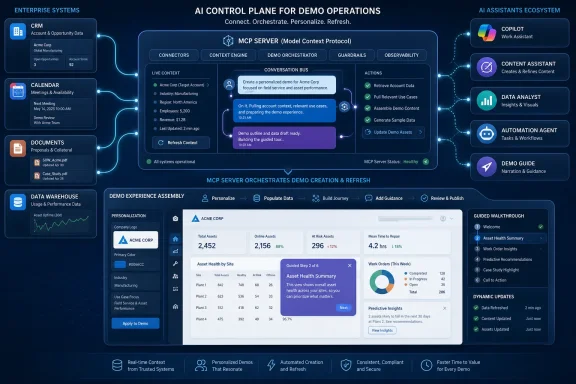
Reprise’s MCP server is an attempt to move demo production from artisanal labor to repeatable orchestration. The seller prompts. The assistant gathers context. Reprise turns that context into a branded tour, a data-injected story, or a cloned environment. If it works as advertised, the sales engineer is no longer the only person who can translate discovery notes into a product narrative.
In practical terms, an MCP server tells an assistant what actions are available and how to call them. A CRM server might expose accounts, opportunities, and contacts. A developer tool might expose repositories, issues, and deployments. Reprise’s server exposes demo-building operations: capturing product experiences, modifying content, injecting data, managing libraries, and generating guided flows.
That changes the role of the chat interface. In the first phase of generative AI adoption, the chat window was mostly a drafting surface. In the second phase, it became a retrieval interface, pulling answers out of documents, transcripts, tickets, and wikis. MCP pushes it toward being an operational console, where the assistant can coordinate several systems in sequence.
For WindowsForum readers who live in Microsoft 365, Azure, Entra, Intune, Dynamics, GitHub, and the rest of the modern enterprise sprawl, this is the part worth watching. MCP is not tied to one vendor’s user interface. It is an integration layer that lets the assistant become the front end for many back ends. That is powerful, and it is also where governance starts to get uncomfortable.
Historically, a seller or sales engineer had to convert that material into a product story by hand. They changed names and logos. They rewrote screen copy. They seeded fake but credible records. They chose which workflow to show and which landmines to avoid. The result could be impressive, but it did not scale cleanly.
Reprise is positioning its MCP server as the missing bridge between enterprise context and demo execution. If an assistant can already read the discovery call and inspect the opportunity record, it can infer which persona is in the room, which use case matters, and which proof points should appear in the walkthrough. The demo platform then becomes the rendering engine for that narrative.
That is why the company’s emphasis on “more than 100 tools” is not just a numbers game. A shallow integration that can only find or share an existing demo is useful, but it does not change the production model. Reprise is claiming end-to-end platform control across Product Tours, Data Injection, and Clones, which is a much bigger bet: that AI assistants should not merely retrieve demo assets, but actively build and maintain them.
That is the presales tax Reprise is trying to reduce. Large accounts get customized demos because the deal size justifies the time. Mid-market opportunities often get lightly modified assets. Smaller deals may get whatever the marketing team already produced. The result is a hierarchy of personalization based less on buyer need than on internal capacity.
An MCP-driven workflow promises to flatten that hierarchy. A seller could ask an assistant to create a healthcare-specific version of a demo, update the sample data, swap branding, generate a guided walkthrough, and refresh the supporting library assets. The same seller could then repeat the process for a financial services account, a public-sector account, or a security operations team without opening the demo authoring interface.
That does not eliminate sales engineering, and vendors should be careful not to imply that it does. The most valuable sales engineers do far more than change logos and seed databases. They diagnose technical fit, handle architecture objections, validate integrations, and keep sellers from overpromising. But if AI can absorb the repetitive parts of demo assembly, presales teams can spend more time on the judgment-heavy work that actually wins or saves deals.
That stack is forming quickly. Revenue teams already connect AI assistants to CRM systems, call recording platforms, calendars, productivity suites, and knowledge bases. Those systems know what was said, who said it, when the next meeting happens, what the account cares about, and which internal assets exist. What they usually do not do is turn that context into a polished product experience.
Reprise is trying to occupy that last mile. The company’s examples are deliberately cross-system: pull last week’s discovery call, check the CRM, create a demo with the prospect’s logo, populate it with industry data, and generate a custom guide. This is not “AI in Reprise.” It is Reprise inside the AI workflow.
That distinction matters because the center of gravity in enterprise software may be shifting. If users begin their day inside an assistant that can operate many tools, individual SaaS products risk becoming services behind the conversation. The application still matters, but its native interface may matter less for routine operations.
If a revenue team can use its approved assistant to operate Reprise, the purchasing argument changes. Instead of asking users to adopt yet another AI interface, Reprise can present itself as a capability that plugs into the assistant strategy the company already chose. That is a much easier sell to IT than a standalone bot with its own identity, permissions, and shadow workflows.
The same logic applies to ChatGPT Enterprise, Claude for teams, Gemini, and other managed AI environments. Enterprises do not want every SaaS vendor inventing a separate copilot experience with separate guardrails. They want governed assistants that can use approved tools through auditable connections. MCP is becoming one of the ways vendors make that pitch.
For Windows administrators, the near-term implication is not that Reprise will appear in the Start menu. It is that the AI client is becoming a practical enterprise shell. The old question was whether a user had access to an application. The new question is whether an assistant has permission to operate that application on the user’s behalf.
No-admin setup can mean a better user experience. It can also mean another path for sensitive customer context to move across systems. Demo platforms may contain synthetic data, but they also often reflect real product flows, competitive positioning, account-specific narratives, internal messaging, and sometimes customer-identifiable information imported for realism. Connecting that environment to an AI assistant raises legitimate questions about permissions and auditability.
The risk is not that Reprise is uniquely dangerous. The risk is that every vendor is racing to become agent-operable. Once assistants can act across CRM, meeting transcripts, calendars, documents, and demo tooling, the blast radius of a mistaken prompt or overbroad permission increases. A bad export is no longer just a bad export; it may be the output of a multi-system workflow that no single application fully understands.
Enterprises will need to treat MCP servers as integration endpoints, not convenience features. That means asking who can connect them, what scopes they expose, how actions are logged, whether data leaves the tenant boundary, and how prompts are constrained when the assistant has write access. The phrase “no admin involvement” may reduce friction, but it should not become an excuse for bypassing governance.
Reprise’s server is hosted by Reprise, according to its support materials, and uses the same infrastructure as the rest of the platform. That may simplify vendor review compared with a local process that runs on a user’s machine. It does not answer every security question, but it frames the connection as a cloud service extension rather than a desktop hack.
The sharper issue is authorization. A useful demo agent needs enough access to modify assets, generate data, change branding, and potentially refresh libraries at scale. Those are not read-only powers. If the assistant misunderstands a prompt, if a user asks for the wrong account, or if malicious content enters the context window through a transcript or document, the system needs guardrails beyond “the model probably knows what you meant.”
This is where enterprise adoption will divide. Smaller teams may accept the productivity gain and trust the vendor defaults. Larger organizations will demand role-based access, logs, approval workflows, sandboxing, and clear separation between synthetic demo data and regulated customer information. The agent era does not abolish classic IT controls; it makes them more important.
Demo libraries decay. Product names change. UI labels move. Screenshots become stale. Sample data loses credibility. Messaging drifts from current positioning. In many organizations, nobody owns the cleanup until a seller discovers the problem in front of a prospect.
If an assistant can scan a demo library, identify outdated elements, and apply coordinated updates, then demos become more like managed content systems than one-off artifacts. Marketing can update positioning. Product marketing can align flows with new launches. Sales engineering can refresh technical details. Sellers can request account-specific variants without forking the entire library into chaos.
That is the hidden promise of agentic tooling in enterprise software: not just faster creation, but continuous maintenance. The same system that builds a demo for one account can help keep the underlying assets accurate for the next hundred. In a world where product interfaces and messaging change constantly, that maintenance burden is real work.
The best version is more interesting. A seller uses AI to do the mechanical assembly, then applies human judgment to the story. A sales engineer reviews the technical claims before a high-stakes meeting. Marketing maintains canonical narratives while letting the assistant adapt them to industry and account context. The AI handles the repetitive scaffolding; humans keep the demo honest.
That distinction will separate serious deployments from novelty demos. Personalization is not the same as relevance. A prospect’s logo, industry jargon, and plausible sample data can make a demo feel familiar, but relevance comes from understanding the buyer’s actual problem. AI can help infer that from context, but it can also hallucinate confidence where discovery was thin.
Reprise’s launch therefore lands in a moment of both opportunity and fatigue. Revenue teams want leverage. Buyers want relevance. IT wants control. AI vendors want to sit at the center of the workflow. The winners will be the tools that make work faster without making the output feel cheaper.
That is a different threshold from summarizing a meeting. A bad summary is annoying. A bad demo can misrepresent a product, expose the wrong data, or damage trust with a buyer. The closer AI gets to the customer experience, the more the workflow needs review, permissions, and rollback.
Still, the direction is hard to dismiss. The enterprise software market has spent decades training users to click through specialized interfaces. AI assistants are now challenging that model by acting as connective tissue across those interfaces. Reprise is betting that demo creation is one of the workflows where the conversational control plane will feel obviously better than the old way.
The risk for competitors is that partial integrations may not be enough. If one vendor lets an assistant discover and share demos while another lets it build, brand, populate, guide, audit, and refresh them, buyers will notice the difference. MCP makes breadth of tool exposure a product feature in its own right.
 Reprise Is Selling the Demo Engineer as an Interface, Not a Person
The important word in Reprise’s announcement is not “AI.” It is “server.” By shipping an MCP server, Reprise is not merely adding a chatbot to its own product; it is exposing the machinery of its demo platform to outside AI clients that know how to speak the Model Context Protocol.That matters because enterprise software has spent the last two years bolting copilots onto existing interfaces. Those copilots often summarize a record, draft an email, or suggest a next step, but the user still has to navigate the product’s own workflows. Reprise is making a different claim: if the assistant already has the account context, the call notes, the CRM record, and the seller’s intent, then the assistant should also be able to assemble the demo itself.
For sales teams, that is an attractive story. Customized demos have always been one of the rituals of enterprise software selling, and one of its time sinks. Everyone agrees that a prospect should see its own logo, industry language, plausible data, and a narrative that matches its pain points; fewer organizations have the presales capacity to do that well for every account.
Reprise’s MCP server is an attempt to move demo production from artisanal labor to repeatable orchestration. The seller prompts. The assistant gathers context. Reprise turns that context into a branded tour, a data-injected story, or a cloned environment. If it works as advertised, the sales engineer is no longer the only person who can translate discovery notes into a product narrative.
MCP Turns the AI Chat Window Into a Control Plane
The Model Context Protocol has become one of the more consequential plumbing standards in the AI stack because it gives assistants a common way to discover tools, read external context, and perform actions. Anthropic introduced MCP in late 2024 as an open standard for connecting AI applications to external systems, and the idea has since spread across the broader agent ecosystem. Its usual shorthand — a “USB-C port for AI applications” — is overused, but the metaphor holds: the point is not one integration, but a reusable connection pattern.In practical terms, an MCP server tells an assistant what actions are available and how to call them. A CRM server might expose accounts, opportunities, and contacts. A developer tool might expose repositories, issues, and deployments. Reprise’s server exposes demo-building operations: capturing product experiences, modifying content, injecting data, managing libraries, and generating guided flows.
That changes the role of the chat interface. In the first phase of generative AI adoption, the chat window was mostly a drafting surface. In the second phase, it became a retrieval interface, pulling answers out of documents, transcripts, tickets, and wikis. MCP pushes it toward being an operational console, where the assistant can coordinate several systems in sequence.
For WindowsForum readers who live in Microsoft 365, Azure, Entra, Intune, Dynamics, GitHub, and the rest of the modern enterprise sprawl, this is the part worth watching. MCP is not tied to one vendor’s user interface. It is an integration layer that lets the assistant become the front end for many back ends. That is powerful, and it is also where governance starts to get uncomfortable.
The Demo Bottleneck Was Always a Data Problem
Reprise’s argument begins with a familiar sales complaint: demo creation is slow because it is too manual. But the deeper problem is that a good demo is a data transformation exercise. The raw material lives in discovery calls, CRM notes, support histories, competitive intelligence, industry assumptions, and internal positioning documents.Historically, a seller or sales engineer had to convert that material into a product story by hand. They changed names and logos. They rewrote screen copy. They seeded fake but credible records. They chose which workflow to show and which landmines to avoid. The result could be impressive, but it did not scale cleanly.
Reprise is positioning its MCP server as the missing bridge between enterprise context and demo execution. If an assistant can already read the discovery call and inspect the opportunity record, it can infer which persona is in the room, which use case matters, and which proof points should appear in the walkthrough. The demo platform then becomes the rendering engine for that narrative.
That is why the company’s emphasis on “more than 100 tools” is not just a numbers game. A shallow integration that can only find or share an existing demo is useful, but it does not change the production model. Reprise is claiming end-to-end platform control across Product Tours, Data Injection, and Clones, which is a much bigger bet: that AI assistants should not merely retrieve demo assets, but actively build and maintain them.
Sales Teams Want Personalization Without the Presales Tax
Enterprise buyers have become hard to impress with generic product tours. They expect vendors to understand their business before the first serious meeting. The best sellers respond with tailored stories, but personalization has a cost: someone must build the thing.That is the presales tax Reprise is trying to reduce. Large accounts get customized demos because the deal size justifies the time. Mid-market opportunities often get lightly modified assets. Smaller deals may get whatever the marketing team already produced. The result is a hierarchy of personalization based less on buyer need than on internal capacity.
An MCP-driven workflow promises to flatten that hierarchy. A seller could ask an assistant to create a healthcare-specific version of a demo, update the sample data, swap branding, generate a guided walkthrough, and refresh the supporting library assets. The same seller could then repeat the process for a financial services account, a public-sector account, or a security operations team without opening the demo authoring interface.
That does not eliminate sales engineering, and vendors should be careful not to imply that it does. The most valuable sales engineers do far more than change logos and seed databases. They diagnose technical fit, handle architecture objections, validate integrations, and keep sellers from overpromising. But if AI can absorb the repetitive parts of demo assembly, presales teams can spend more time on the judgment-heavy work that actually wins or saves deals.
The Platform Claim Is Broader Than the Press Release Headline
The headline version of this launch is easy to understand: any MCP-compatible assistant can now act like a Reprise demo engineer. The more strategic claim is that Reprise wants to be the demo layer for the agentic sales stack.That stack is forming quickly. Revenue teams already connect AI assistants to CRM systems, call recording platforms, calendars, productivity suites, and knowledge bases. Those systems know what was said, who said it, when the next meeting happens, what the account cares about, and which internal assets exist. What they usually do not do is turn that context into a polished product experience.
Reprise is trying to occupy that last mile. The company’s examples are deliberately cross-system: pull last week’s discovery call, check the CRM, create a demo with the prospect’s logo, populate it with industry data, and generate a custom guide. This is not “AI in Reprise.” It is Reprise inside the AI workflow.
That distinction matters because the center of gravity in enterprise software may be shifting. If users begin their day inside an assistant that can operate many tools, individual SaaS products risk becoming services behind the conversation. The application still matters, but its native interface may matter less for routine operations.
Windows and Microsoft Shops Should Read This as an Ecosystem Signal
Reprise explicitly names Microsoft Copilot alongside Claude, ChatGPT, Gemini, and other MCP-compatible clients. For Microsoft-heavy organizations, that framing is significant even if the actual implementation details will vary by tenant, client, and security posture. Copilot is not just another chatbot in many enterprises; it is increasingly the sanctioned AI surface attached to Microsoft 365 identity, documents, meetings, and workflows.If a revenue team can use its approved assistant to operate Reprise, the purchasing argument changes. Instead of asking users to adopt yet another AI interface, Reprise can present itself as a capability that plugs into the assistant strategy the company already chose. That is a much easier sell to IT than a standalone bot with its own identity, permissions, and shadow workflows.
The same logic applies to ChatGPT Enterprise, Claude for teams, Gemini, and other managed AI environments. Enterprises do not want every SaaS vendor inventing a separate copilot experience with separate guardrails. They want governed assistants that can use approved tools through auditable connections. MCP is becoming one of the ways vendors make that pitch.
For Windows administrators, the near-term implication is not that Reprise will appear in the Start menu. It is that the AI client is becoming a practical enterprise shell. The old question was whether a user had access to an application. The new question is whether an assistant has permission to operate that application on the user’s behalf.
“Zero Setup” Is a Sales Promise, Not an IT Strategy
Reprise says the MCP server works with any existing Reprise license, requires no new SKU, and takes minutes to connect without admin involvement. That is a compelling adoption message, especially for sales teams that do not want to wait through a quarter of procurement and security review. It is also exactly the kind of claim that should make IT leaders slow down.No-admin setup can mean a better user experience. It can also mean another path for sensitive customer context to move across systems. Demo platforms may contain synthetic data, but they also often reflect real product flows, competitive positioning, account-specific narratives, internal messaging, and sometimes customer-identifiable information imported for realism. Connecting that environment to an AI assistant raises legitimate questions about permissions and auditability.
The risk is not that Reprise is uniquely dangerous. The risk is that every vendor is racing to become agent-operable. Once assistants can act across CRM, meeting transcripts, calendars, documents, and demo tooling, the blast radius of a mistaken prompt or overbroad permission increases. A bad export is no longer just a bad export; it may be the output of a multi-system workflow that no single application fully understands.
Enterprises will need to treat MCP servers as integration endpoints, not convenience features. That means asking who can connect them, what scopes they expose, how actions are logged, whether data leaves the tenant boundary, and how prompts are constrained when the assistant has write access. The phrase “no admin involvement” may reduce friction, but it should not become an excuse for bypassing governance.
The Security Conversation Follows the Agent
MCP’s rise has also brought scrutiny. Security researchers and practitioners have warned that tool-calling agents introduce new classes of risk, including prompt injection, confused-deputy behavior, unsafe tool execution, and unclear trust boundaries between local clients, remote servers, and connected data. Some recent reporting has focused on vulnerabilities and risky implementation patterns in parts of the MCP ecosystem, reinforcing a lesson enterprise IT already knows: standards do not remove the need for threat modeling.Reprise’s server is hosted by Reprise, according to its support materials, and uses the same infrastructure as the rest of the platform. That may simplify vendor review compared with a local process that runs on a user’s machine. It does not answer every security question, but it frames the connection as a cloud service extension rather than a desktop hack.
The sharper issue is authorization. A useful demo agent needs enough access to modify assets, generate data, change branding, and potentially refresh libraries at scale. Those are not read-only powers. If the assistant misunderstands a prompt, if a user asks for the wrong account, or if malicious content enters the context window through a transcript or document, the system needs guardrails beyond “the model probably knows what you meant.”
This is where enterprise adoption will divide. Smaller teams may accept the productivity gain and trust the vendor defaults. Larger organizations will demand role-based access, logs, approval workflows, sandboxing, and clear separation between synthetic demo data and regulated customer information. The agent era does not abolish classic IT controls; it makes them more important.
Demo Libraries Are About to Become Living Systems
One underrated part of Reprise’s announcement is library management. The company says its MCP server can audit, organize, update, and refresh demo libraries across hundreds of assets. That may sound less glamorous than an AI-generated personalized demo, but it could be the more durable operational win.Demo libraries decay. Product names change. UI labels move. Screenshots become stale. Sample data loses credibility. Messaging drifts from current positioning. In many organizations, nobody owns the cleanup until a seller discovers the problem in front of a prospect.
If an assistant can scan a demo library, identify outdated elements, and apply coordinated updates, then demos become more like managed content systems than one-off artifacts. Marketing can update positioning. Product marketing can align flows with new launches. Sales engineering can refresh technical details. Sellers can request account-specific variants without forking the entire library into chaos.
That is the hidden promise of agentic tooling in enterprise software: not just faster creation, but continuous maintenance. The same system that builds a demo for one account can help keep the underlying assets accurate for the next hundred. In a world where product interfaces and messaging change constantly, that maintenance burden is real work.
The Best Version of This Future Still Needs Human Taste
It is easy to imagine the worst version of AI-generated demos: every prospect gets a thinly personalized, logo-swapped simulation that feels like it was produced by a machine because it was. Enterprise buyers are already drowning in automated outreach. They will not be grateful for automated demos if the substance is weak.The best version is more interesting. A seller uses AI to do the mechanical assembly, then applies human judgment to the story. A sales engineer reviews the technical claims before a high-stakes meeting. Marketing maintains canonical narratives while letting the assistant adapt them to industry and account context. The AI handles the repetitive scaffolding; humans keep the demo honest.
That distinction will separate serious deployments from novelty demos. Personalization is not the same as relevance. A prospect’s logo, industry jargon, and plausible sample data can make a demo feel familiar, but relevance comes from understanding the buyer’s actual problem. AI can help infer that from context, but it can also hallucinate confidence where discovery was thin.
Reprise’s launch therefore lands in a moment of both opportunity and fatigue. Revenue teams want leverage. Buyers want relevance. IT wants control. AI vendors want to sit at the center of the workflow. The winners will be the tools that make work faster without making the output feel cheaper.
The Agentic Sales Stack Gets Its First Real Test
The Reprise MCP server is useful as a product announcement, but it is more useful as a test case for agentic enterprise software. It asks whether organizations are ready to let AI assistants perform multi-step work across systems that directly affect customer-facing output.That is a different threshold from summarizing a meeting. A bad summary is annoying. A bad demo can misrepresent a product, expose the wrong data, or damage trust with a buyer. The closer AI gets to the customer experience, the more the workflow needs review, permissions, and rollback.
Still, the direction is hard to dismiss. The enterprise software market has spent decades training users to click through specialized interfaces. AI assistants are now challenging that model by acting as connective tissue across those interfaces. Reprise is betting that demo creation is one of the workflows where the conversational control plane will feel obviously better than the old way.
The risk for competitors is that partial integrations may not be enough. If one vendor lets an assistant discover and share demos while another lets it build, brand, populate, guide, audit, and refresh them, buyers will notice the difference. MCP makes breadth of tool exposure a product feature in its own right.
The Practical Read for Revenue and IT Teams
Reprise’s announcement should not be read as magic, and it should not be dismissed as mere AI packaging. It is a concrete example of how SaaS products are being refactored for an assistant-first workflow, where the value lies in what the AI can safely do across tools.- Reprise’s MCP server makes the company’s demo platform operable from MCP-compatible assistants, including Claude, ChatGPT, Microsoft Copilot, Gemini, and similar clients.
- The launch is aimed at sales, presales, and marketing teams that want account-specific demos without manually rebuilding assets for every opportunity.
- The strongest operational promise is not just faster demo creation, but ongoing maintenance of demo libraries that otherwise become stale and inconsistent.
- The biggest IT concern is not the demo workflow itself, but the permissions model that allows an assistant to take action across CRM, transcripts, calendars, documents, and demo assets.
- The competitive implication is that AI integrations will increasingly be judged by how much of the underlying platform they expose, not by whether they add a chatbot.
References
- Primary source: FinancialContent
Published: 2026-06-16T16:35:17.311061
- Related coverage: reprise.com
Reprise | Enterprise Demo Creation Platform
Reprise is the demo creation platform enterprise sales and marketing teams trust to build no-code, interactive product demos that win more deals.www.reprise.com - Related coverage: reprise.zendesk.com
The Reprise MCP: Meet your AI Demo Engineer – Reprise
The Reprise MCP (Model Context Protocol) connects your Reprise account to the AI assistant you already use — Claude, ChatGPT, Codex,...reprise.zendesk.com - Related coverage: techradar.com
Anthropic's official Git MCP server had some worrying security flaws - this is what happened next | TechRadar
Bugs could be chained for devastating effectwww.techradar.com
