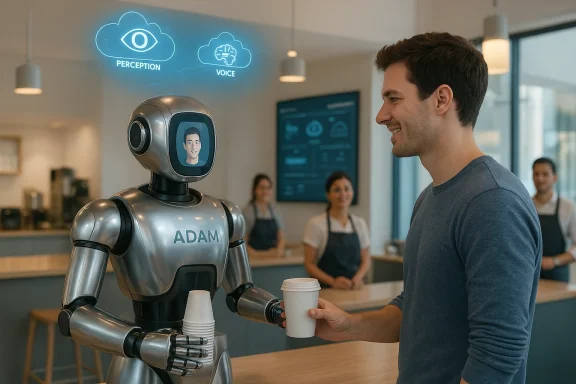
Richtech Robotics’ new collaboration with Microsoft marks a deliberate pivot from hardware-first hype to cloud-driven intelligence, and it could be the clearest signal yet that agentic AI is moving from lab demos into real-world robotics deployments. Announced as a hands-on engineering effort with Microsoft’s AI Co‑Innovation Labs, the deal equips Richtech’s ADAM beverage robot with Azure‑powered vision, voice, and autonomous reasoning, enabling contextual behavior tied to time of day, weather, promotions, and operational signals. On paper this is exactly the kind of software‑first, fleet‑level upgrade that robotics customers — particularly in retail and logistics — have been asking for: richer perception and decisioning without wholesale hardware swaps. But the headline also raises hard questions about reliability, data governance, vendor concentration, and the commercial track record of the vendor bringing the bots to market.
Richtech Robotics has positioned the collaboration as a joint engineering effort with Microsoft’s AI Co‑Innovation Labs to add agentic capabilities — systems that can perceive, reason, set short‑term goals, and act with limited human direction — to ADAM and, by extension, other Richtech platforms. The enhancements reported include:
For the robotics market this matters: the shift from deterministic task automation to contextual, adaptive robotics is a required step if robots are to behave reliably in messy, real‑world retail and logistics environments where variables change minute‑to‑minute.
Benefits include:
Potential mitigations:
Best practice requires:
Critical controls:
Considerations:
What to watch:
However, several non‑technical barriers remain. Real‑world reliability, data governance, connectivity fallbacks, vendor credibility, and workforce impacts are not solved by a press release. Especially given prior controversies and third‑party skepticism around the company’s historic deal claims and execution, customers should demand operational proof points, transparent metrics, and contractual protections before committing to broad deployments.
Yet commercialization will only follow if vendors can demonstrate predictable, auditable, and safe behavior at scale — and if customers can buy outcomes, not promises. The Microsoft co‑engineering story accelerates the technical road map; the rest depends on rigorous, measurable field performance and transparent commercial execution.
Richtech’s ADAM may be an early public example, but the real test will be whether agentic robots can continuously deliver operational value across hundreds of locations, under diverse conditions, and without introducing new safety or privacy liabilities. If Microsoft and Richtech can meet that test — and customers insist on the right contractual and technical safeguards — retail robots could evolve from novelty to dependable frontline tools. If not, agentic AI risks becoming another cycle of hype that falls short at scale.
Source: MLQ.ai MLQ.ai | AI for investors
 Background: what’s new and why it matters
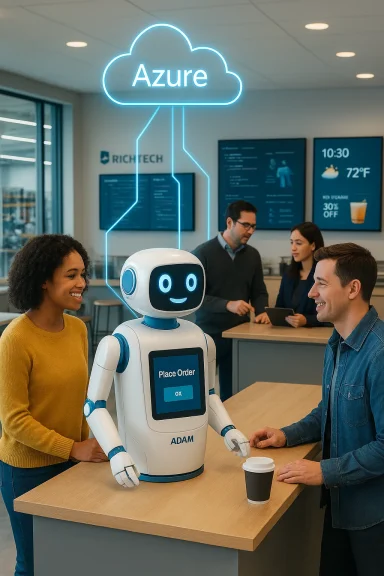
Richtech Robotics has positioned the collaboration as a joint engineering effort with Microsoft’s AI Co‑Innovation Labs to add agentic capabilities — systems that can perceive, reason, set short‑term goals, and act with limited human direction — to ADAM and, by extension, other Richtech platforms. The enhancements reported include:- Vision models that maintain throughput and quality during peak demand.
- Voice understanding and natural language responses for conversational customer interactions.
- Context awareness that factors time of day, local weather, and in‑store promotions into recommendations and behavior.
- Operational monitoring, such as ingredient or equipment anomaly detection and staff alerting.
For the robotics market this matters: the shift from deterministic task automation to contextual, adaptive robotics is a required step if robots are to behave reliably in messy, real‑world retail and logistics environments where variables change minute‑to‑minute.
Overview of the technology stack
Agentic AI: what it means in robotics
Agentic AI describes systems that can maintain situational awareness, prioritize tasks, plan short sequences of actions, and interact conversationally. In a retail robot this looks like:- Choosing to pause a nonessential task during a sudden rush.
- Recommending a seasonal drink when the weather turns cold.
- Escalating equipment alerts automatically and routing notifications to the correct staff member.
Cloud models + edge inferencing: a hybrid approach
The reported architecture is hybrid:- On‑device components for low‑latency control, sensor fusion, and safety‑critical loops.
- Cloud models on Azure for heavy perception, multi‑modal reasoning, and stateful agentic decisioning.
- Orchestration and monitoring via Richtech’s robotics cloud platform (ACP), enabling fleet updates and telemetry.
Business implications: scale, costs, and deployment model
Software upgrades vs hardware refreshes
One of the most attractive claims of the partnership is software‑driven upgrades that scale across existing hardware. For customers operating legacy fleets or constrained by capital budgets, upgrading behavior via cloud models rather than replacing robots can dramatically reduce deployment costs.Benefits include:
- Faster time to deploy new features across many units.
- Lower capital expenditure (CapEx) and a shorter payback for incremental capability.
- Centralized model updates and monitoring, improving consistency across sites.
Robots‑as‑a‑Service (RaaS) and recurring revenue
Richtech has emphasized RaaS agreements in prior filings and announcements. Agentic capabilities delivered as part of a RaaS contract create recurring revenue opportunities for Richtech and software margin expansion for the vendor. For clients, the RaaS model aligns incentives: vendor uptime and software improvements directly affect service levels customers pay for.Market sectors: retail, logistics, hospitality, manufacturing
While ADAM is a retail‑facing beverage robot, the same agentic primitives have clear use cases across:- Retail: shelf monitoring, in‑aisle voice assistance, queue management.
- Logistics: dynamic route reprioritization, anomaly detection in fulfillment.
- Hospitality: guest interaction and operational sensing (e.g., minibar levels).
- Manufacturing: line inspection with conversation‑style operator interaction.
Technical strengths: what gives me confidence
- Proven cloud scale: Azure offers enterprise‑grade compute, security, and model management, which reduces the integration burden for a smaller robotics firm that lacks datacenter scale.
- Hybrid deployment model preserves safety**: keeping real‑time control on the robot reduces latency‑related risk and adheres to best practice for physical systems.
- Contextual awareness is the right problem: adding environmental and business signals (weather, promotions) addresses the core weakness of many earlier robotic deployments — brittleness when context changes.
- Lower hardware churn: software updates that improve fleet behavior are a commercially efficient path that aligns with how large retailers prefer to buy (capability upgrades, not forklift replacements).
Key risks and open questions
1. Reliability in messy real‑world environments
Robots that work in controlled demos can fail spectacularly when lighting, occlusion, or ad hoc human actions occur. Agentic systems introduce more paths for surprising behavior: a reasoning model might prioritize a task that conflicts with human expectations or safety policies.Potential mitigations:
- Conservative, safety‑first failover policies on device controllers.
- Extensive real‑world testing across diverse stores and peak conditions.
- Explainable audit logs to trace why a robot chose a particular action.
2. Latency, connectivity, and edge fallbacks
Relying on cloud models raises connectivity concerns. Retail locations often have sub‑optimal Wi‑Fi, and transient outages could affect agentic reasoning that sits in the cloud.Best practice requires:
- Local caching of decision policies and fallbacks for disconnected operation.
- Graceful degradation modes where robot reverts to deterministic behaviors when connectivity drops.
- Monitoring and alerts for degraded cloud performance.
3. Data governance, privacy, and regulatory exposure
Vision and voice models in stores implicate customer and staff privacy. Who owns the data, how long is it retained, and where does processing occur?Critical controls:
- Clear, auditable data retention policies and minimization.
- Edge processing of raw media with only derived insights sent to cloud.
- Compliance with local privacy laws and explicit customer notice where required.
4. Vendor lock‑in and platform dependence
Shipping core reasoning on Azure accelerates development, but creates vendor dependence. Customers buying a Richtech+Azure solution could face migration costs if they later wish to move workloads off Microsoft.Considerations:
- Contracts that clarify portability of models, data exports, and interop.
- Use of open model standards and containerization to ease migration risk.
5. Commercial credibility of the vendor
Richtech’s past announcements and growth trajectory have attracted both bullish coverage and critical scrutiny. Short‑seller reports and independent investigations have raised questions about deal authenticity and operational execution in prior product rollouts. These concerns matter when customers sign multi‑site RaaS contracts: operational reliability and vendor integrity are as important as the technology itself.What to watch:
- Customer references and live case studies validating sustained deployments.
- Public financial filings and disclosures on RaaS contracts and service metrics.
- Independent audits or third‑party verification of deployed fleets.
Competitive landscape: why this partnership shifts the game
Big cloud vendors partnering with robotics firms is not new, but the depth of Microsoft’s AI engineering involvement raises several competitive implications:- Cloud‑first differentiation: competitors that tie agentic reasoning to proprietary hardware may struggle to match the speed and scale of cloud‑driven updates.
- Ecosystem effects: Microsoft’s retail and enterprise sales channels could accelerate PoC to production cycles for adopters who already use Azure.
- Pressure on chip incumbents: previous launches that leaned heavily on NVIDIA GPUs for on‑device perception may find themselves competing with hybrid models that offload heavier reasoning to cloud GPUs and leverage on‑device inference for safety loops.
Financial and market context: hype versus execution
Agentic AI announcements can move markets, but they also invite skepticism. Richtech’s stock has demonstrated volatility around corporate news, and past product launches have produced mixed investor reactions. For enterprise customers and integrators evaluating deals, the important metrics are not press‑release headlines but:- Mean time between failures (MTBF) in deployed sites.
- Percentage improvement in throughput, queue times, or labor hours.
- Net promoter score (NPS) or other customer satisfaction indicators.
- Contractual clarity on maintenance, model updates, and liability.
Implementation checklist for IT and operations teams
If your retail or logistics operation is evaluating Richtech + Microsoft agentic AI pilots, prioritize these concrete steps:- Define success metrics up front (e.g., 20% reduction in peak wait time).
- Specify safety and fallback behaviors in binding SOWs and SLAs.
- Require a staged deployment (pilot → limited roll → scale) with measurable gates.
- Include data governance clauses: ownership, retention, anonymization, and export rights.
- Insist on local edge fallbacks and formal acceptance testing under poor connectivity scenarios.
- Validate real customer references and on‑site performance logs before expanding.
Ethical and workforce considerations
Agentic robots shift tasks formerly done by humans into a new automated layer. The impacts are multifaceted:- Positive effects: freeing staff from repetitive tasks, improving consistency, and providing real‑time operational intelligence that reduces surprise failures.
- Negative effects: potential job displacement in low‑skill roles, and the risk of overreliance on autonomous decisioning for customer‑facing interactions.
- Upskill programs to transition workers into supervisory or higher‑value roles.
- Transparent customer communications when robots interact in a way that affects experience or privacy.
- Governance boards to review edge cases and ethical tradeoffs as systems scale.
What the Microsoft angle uniquely delivers
Microsoft’s participation brings several practical advantages beyond brand cachet:- Azure’s enterprise security and identity stack, which helps with authentication, role‑based access, and compliance.
- Model operations: better tooling for versioning, auditing, and rolling back models in production — a necessity for agentic systems that evolve quickly.
- Cross‑industry playbooks from Microsoft’s retail engagements that help map pilot outcomes to broader digital transformation objectives (often packaged under “Frontier Transformation” messaging).
Balanced verdict: opportunity, but prove it in the field
Richtech Robotics’ collaboration with Microsoft is a pragmatic, credible path toward bringing agentic AI into customer‑facing robotics. The combination of Azure’s cloud capabilities and on‑device safety loops offers a commercially attractive route: improved behavior without expensive hardware upgrades. For retailers and logistics operators, the promise is compelling — better customer interactions, fewer operational surprises, and an easier path to scale.However, several non‑technical barriers remain. Real‑world reliability, data governance, connectivity fallbacks, vendor credibility, and workforce impacts are not solved by a press release. Especially given prior controversies and third‑party skepticism around the company’s historic deal claims and execution, customers should demand operational proof points, transparent metrics, and contractual protections before committing to broad deployments.
Practical recommendations for stakeholders
- For CIOs and CTOs: Treat pilot agreements as experiments with measurable gates. Require explicit rollback and failover plans and insist on edge capability for degraded connectivity.
- For operations leaders: Prioritize metrics that reflect customer experience and uptime over feature checklists. Short pilot cycles with iterative improvements often reveal brittle assumptions early.
- For investors and market watchers: Distinguish partnership headlines from durable, recurring contract wins. Track verifiable deployment numbers and independent customer validations.
- For regulators and privacy officers: Ensure vision and voice data are handled under strict minimization and anonymization regimes, and that customers and staff are adequately informed where legal requirements apply.
The bigger picture: agentic AI’s commercialization hinge
The Richtech‑Microsoft collaboration points to a broader industry shift: the race is not just for better hardware or flashier demos, it’s for operational intelligence that fits the real constraints of frontline businesses. If agentic reasoning can be delivered as a managed cloud capability, applied across diverse existing hardware, and proven in noisy, high‑throughput environments, we’ll see the next wave of commercial robotics adoption.Yet commercialization will only follow if vendors can demonstrate predictable, auditable, and safe behavior at scale — and if customers can buy outcomes, not promises. The Microsoft co‑engineering story accelerates the technical road map; the rest depends on rigorous, measurable field performance and transparent commercial execution.
Richtech’s ADAM may be an early public example, but the real test will be whether agentic robots can continuously deliver operational value across hundreds of locations, under diverse conditions, and without introducing new safety or privacy liabilities. If Microsoft and Richtech can meet that test — and customers insist on the right contractual and technical safeguards — retail robots could evolve from novelty to dependable frontline tools. If not, agentic AI risks becoming another cycle of hype that falls short at scale.
Source: MLQ.ai MLQ.ai | AI for investors