

Samsung plans to introduce paid SmartThings API tiers for commercial partners and a $4.99-per-month personal developer plan in October 2026, while keeping current API access free through the third quarter and saying ordinary SmartThings app use is not being changed today. That is the narrow factual answer, but it understates the consequence. Samsung is not charging users to tap a light icon; it is putting a price on the connective tissue that lets SmartThings behave like part of a larger, programmable smart home. For power users, independent developers, and service operators, the smart home’s free-cloud era is getting another end date.
The important word in Samsung’s announcement is not “paid.” It is API. SmartThings has long been valuable because it can sit between devices, cloud services, dashboards, routines, rental-property tools, and enthusiast automation platforms. The app is the consumer face of that system, but the API is the part that lets other software ask SmartThings what exists, what changed, and what should happen next.
Samsung is framing the move as a developer-platform update rather than a consumer subscription. That distinction is real, and it matters. A person who uses the SmartThings app to control a Samsung appliance or a compatible light switch is not suddenly being asked for $4.99 a month merely to keep using the app.
But smart homes rarely stay inside the neat boundaries imagined by platform vendors. Once a household has a few dozen devices, a dashboard on a wall tablet, a voice assistant, a Home Assistant instance, an energy monitor, a short-term rental workflow, or a bespoke routine that does not fit Samsung’s app-first model, the API stops being an obscure developer feature. It becomes infrastructure.
That is why the October 2026 target is more than a billing milestone. It marks the point at which Samsung begins turning an integration commons into a metered product.
APIs cost money to run, and abusive or inefficient API usage can create real operational load. Commercial services that use SmartThings as a backend layer are not just tinkering; they may be building products that depend on Samsung’s infrastructure. From Samsung’s perspective, it is reasonable to ask whether a rental-management company, an energy-optimization vendor, or an API aggregator should receive indefinite free access to a platform that helps make their own product possible.
The harder part is that the same API surface can serve very different constituencies. A company using SmartThings to manage thousands of units is not the same as a technically minded homeowner trying to bridge a handful of devices into a local automation stack. Yet both are downstream of the same policy shift, and Samsung has so far confirmed only one public price: $4.99 per month for non-commercial individual developers.
That price is modest if it buys reliability, transparent quotas, better tooling, and a sustainable developer program. It is less modest if it becomes a cover charge for capabilities users reasonably believed were part of the product they already bought.
Still, the announcement leaves several practical questions unanswered. Samsung has not published the full commercial price sheet. It has not clearly explained the rate limits that will apply to each tier, the overage behavior, the definition of “commercial” in edge cases, or whether some low-volume integrations will remain free after October. It has not yet given developers enough information to model the full cost of staying put.
That uncertainty is not a footnote; it is the story. A $4.99 personal plan is easy to quote, but API economics are determined by thresholds. If the plan allows generous usage for household-scale projects, many enthusiasts may grumble and pay. If common dashboard refreshes, polling integrations, webhook bridges, or device-history queries can push users toward higher tiers, the change becomes much more disruptive.
Samsung says a new Developer Center and API Usage Dashboard will help developers view call volume over time and choose the appropriate plan. That is a necessary tool, but it arrives after the strategic decision has already been made. Developers are being told to inspect their usage because usage is about to become a billable fact.
The affected group is smaller but more consequential. It includes people who have turned SmartThings into one node in a broader automation system rather than treating it as the whole system. These are the users who connect SmartThings to dashboards, scripts, bridges, alerting systems, voice workflows, energy tools, device-history collectors, and third-party automation engines.
That group is not necessarily large compared with Samsung’s registered-user base, but it is disproportionately influential. Power users write guides, maintain integrations, test edge cases, recommend ecosystems, and rescue platforms from the limitations of their official apps. They are the people who turn a product from “works fine” into “fits my house.”
Charging them can be rational and still risky. A platform can monetize its most engaged users, but it should expect those users to become more calculating in return. Once an API has a monthly price, enthusiasts stop treating it as a convenience and start comparing it to alternatives.
SmartThings and Home Assistant have long occupied different philosophical territory. SmartThings is a consumer-friendly ecosystem with cloud reach, partner branding, and Samsung account integration. Home Assistant is a user-controlled automation platform whose appeal grows every time a vendor changes terms, kills a cloud service, or decides that an integration is now a subscription feature.
If a SmartThings integration depends on Samsung’s cloud API, then Samsung’s new pricing can become a Home Assistant user’s problem even if Home Assistant itself remains free and open-source. That is the part that frustrates enthusiasts: the monthly fee may not be paying for Home Assistant, or for the devices, or for the local automation logic. It may be paying for the right to keep Samsung’s cloud in the loop.
This is also why the Matter and Thread era has not eliminated old smart-home anxieties. The industry has made real progress toward common device-control standards, but cloud APIs remain deeply embedded in account features, history, presence, complex devices, partner integrations, and vendor-specific capabilities. Matter can reduce dependence on proprietary clouds for some device classes, but it does not magically replace every platform API.
Smart homes make that tension especially sharp because they involve hardware. Users do not merely sign up for a website; they buy hubs, appliances, sensors, switches, locks, thermostats, and other devices that may remain physically installed for years. When the cloud rules change later, the user experiences the change as a shift in the product, not just a developer-policy update.
Samsung’s defenders will argue that the company is not taking anything away from ordinary app users and that serious API consumers should contribute to the cost of the platform. Samsung’s critics will answer that smart-home buyers have already paid for devices and that API access is part of what made those devices attractive. Both claims can be true, which is why this kind of transition is so combustible.
The question is not whether Samsung has the legal or technical right to charge. The question is whether the resulting ecosystem feels more trustworthy after the change. In smart homes, trust is not just about security patches. It is about whether today’s automation will still be possible next year without a new tollbooth.
For commercial partners, that dashboard could improve engineering discipline. A service that polls too aggressively may be able to reduce call volume. A dashboard that refreshes every few seconds might be redesigned around events. A property-management platform might discover that a handful of expensive workflows drive most of its API usage.
For individual developers, the value is more psychological as well as technical. A homeowner who can see that a personal automation setup uses a trivial number of calls may feel less anxious. A user who discovers that one plug-in or bridge is generating most of the traffic can make a targeted decision rather than blaming the entire platform.
But metering changes behavior even before the bill arrives. Developers start optimizing not only for reliability and functionality, but for cost exposure. That can be healthy when it reduces waste. It can be corrosive when it makes users afraid to experiment.
Smaller services will face a harder calculation. If a product’s value proposition is partly that it connects cheaply to SmartThings, then API fees can squeeze margins or complicate pricing. If the commercial tiers come with better support, reliability guarantees, or higher limits, some partners may welcome the move. If the tiers are expensive or vague, they may begin steering customers toward more open integration paths.
Hobbyists have less room to maneuver. A company can spread platform costs across customers; a homeowner pays the bill directly. A developer maintaining a niche plug-in for the community may not want to become a subscription administrator just to keep a bridge alive. A smart-home enthusiast who has already paid for devices may object on principle even if $4.99 is affordable.
That divide matters because smart-home ecosystems are often supported by unpaid labor. Documentation gaps, integration bugs, migration paths, and practical advice are frequently handled by communities before companies catch up. If the new model discourages that labor, Samsung could save on API abuse while losing some of the ecosystem energy that makes SmartThings more useful.
A user might never write code but still depend on an API-based integration installed through a third-party service. A household dashboard may have been set up by a friend, a consultant, or a community guide. A rental operator may use a polished interface that hides SmartThings completely while relying on it underneath. A homeowner may think they are “using SmartThings” when they are actually using three layers of software that call the SmartThings API in the background.
That is why October could produce confusion even if Samsung’s policy is technically precise. The person who experiences a broken dashboard or a newly paid integration may not care whether the fee is charged to a developer account, a service provider, or an intermediary. They will see a smart-home function that used to work without an extra subscription and now has conditions.
Samsung can reduce that confusion by being unusually explicit. It should publish example scenarios, not just tier names. It should say what happens to a single-user Home Assistant integration, a personal webhook, a small open-source plug-in, a commercial dashboard, and a large partner service. In smart-home policy, ambiguity is not neutral; it gets interpreted as bad news.
SmartThings is not uniquely guilty here. The entire industry has leaned on cloud services to paper over fragmented device standards, inconsistent local APIs, and consumer expectations for easy setup. The result is a market where a light switch can last longer than the business model behind the software controlling it.
For WindowsForum readers, this should feel familiar. PC users have watched software move from perpetual licenses to subscriptions, local settings to cloud accounts, and optional online services to default infrastructure. The smart home is going through a similar transition, but with a more physical sting: the “software” is attached to locks, lights, thermostats, appliances, and sensors scattered throughout a building.
The lesson is not that cloud platforms are bad. The lesson is that cloud dependence should be treated as a design constraint, not an invisible convenience. If an automation matters, users should know whether it can run locally, whether it requires a vendor API, and what happens if that API changes.
That requires more than a price point. Samsung needs to define the policy in plain language. It needs to distinguish between commercial resale, personal experimentation, community integrations, and ordinary account-linked services. It needs to explain whether paid access brings support, reliability commitments, higher limits, or merely continued permission to use what already exists.
The company also needs to avoid punishing efficient integrations. A well-designed event-driven bridge should not be treated the same as a poorly written service that hammers endpoints all day. If the dashboard is paired with guidance and reasonable quotas, Samsung can nudge developers toward better behavior. If it is paired with opaque thresholds, it becomes a meter without a manual.
Most of all, Samsung needs to remember that smart-home platform loyalty is fragile. Users tolerate friction when they trust the roadmap. They flee when every integration feels like a future billing surprise.
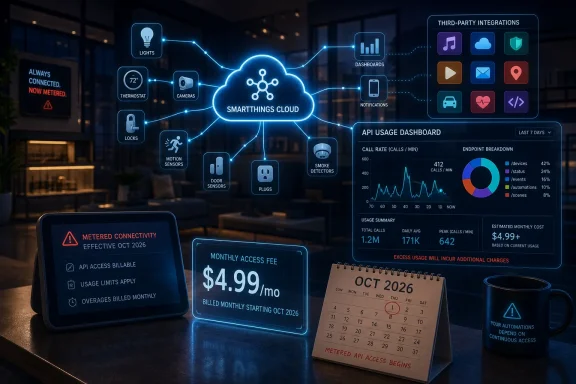 Samsung Is Charging the Layer That Made SmartThings Useful Beyond Samsung
The important word in Samsung’s announcement is not “paid.” It is API. SmartThings has long been valuable because it can sit between devices, cloud services, dashboards, routines, rental-property tools, and enthusiast automation platforms. The app is the consumer face of that system, but the API is the part that lets other software ask SmartThings what exists, what changed, and what should happen next.Samsung is framing the move as a developer-platform update rather than a consumer subscription. That distinction is real, and it matters. A person who uses the SmartThings app to control a Samsung appliance or a compatible light switch is not suddenly being asked for $4.99 a month merely to keep using the app.
But smart homes rarely stay inside the neat boundaries imagined by platform vendors. Once a household has a few dozen devices, a dashboard on a wall tablet, a voice assistant, a Home Assistant instance, an energy monitor, a short-term rental workflow, or a bespoke routine that does not fit Samsung’s app-first model, the API stops being an obscure developer feature. It becomes infrastructure.
That is why the October 2026 target is more than a billing milestone. It marks the point at which Samsung begins turning an integration commons into a metered product.
The Free Cloud Was Always a Temporary Subsidy
Samsung’s case is not hard to understand. SmartThings is not a static app on a phone; it is a cloud platform that has to authenticate accounts, process events, expose device states, receive commands, enforce permissions, support partner services, maintain documentation, and keep doing all of that at scale. Samsung says SmartThings has more than 460 million registered users and hundreds of Works With SmartThings partner brands. Even allowing for the fuzziness that always surrounds registered-user counts, this is not a hobby server in someone’s closet.APIs cost money to run, and abusive or inefficient API usage can create real operational load. Commercial services that use SmartThings as a backend layer are not just tinkering; they may be building products that depend on Samsung’s infrastructure. From Samsung’s perspective, it is reasonable to ask whether a rental-management company, an energy-optimization vendor, or an API aggregator should receive indefinite free access to a platform that helps make their own product possible.
The harder part is that the same API surface can serve very different constituencies. A company using SmartThings to manage thousands of units is not the same as a technically minded homeowner trying to bridge a handful of devices into a local automation stack. Yet both are downstream of the same policy shift, and Samsung has so far confirmed only one public price: $4.99 per month for non-commercial individual developers.
That price is modest if it buys reliability, transparent quotas, better tooling, and a sustainable developer program. It is less modest if it becomes a cover charge for capabilities users reasonably believed were part of the product they already bought.
October Is the Real Deadline Because the Price Sheet Is Still Missing
Samsung’s timeline is carefully staged. The company says it will not interrupt current API usage right now, that free access remains available through the third quarter, and that new limits or the phaseout of free access will not begin until October 2026. In platform-transition terms, that is a warning shot rather than a guillotine.Still, the announcement leaves several practical questions unanswered. Samsung has not published the full commercial price sheet. It has not clearly explained the rate limits that will apply to each tier, the overage behavior, the definition of “commercial” in edge cases, or whether some low-volume integrations will remain free after October. It has not yet given developers enough information to model the full cost of staying put.
That uncertainty is not a footnote; it is the story. A $4.99 personal plan is easy to quote, but API economics are determined by thresholds. If the plan allows generous usage for household-scale projects, many enthusiasts may grumble and pay. If common dashboard refreshes, polling integrations, webhook bridges, or device-history queries can push users toward higher tiers, the change becomes much more disruptive.
Samsung says a new Developer Center and API Usage Dashboard will help developers view call volume over time and choose the appropriate plan. That is a necessary tool, but it arrives after the strategic decision has already been made. Developers are being told to inspect their usage because usage is about to become a billable fact.
SmartThings Power Users Are Not Ordinary App Users, and That Is the Point
The most comforting version of the announcement is also the most incomplete: regular SmartThings app users do not need to do anything today. That is true as far as it goes. If your smart home is mostly Samsung appliances, the SmartThings app, a few routines, and perhaps some Works With SmartThings devices, October may pass without visible drama.The affected group is smaller but more consequential. It includes people who have turned SmartThings into one node in a broader automation system rather than treating it as the whole system. These are the users who connect SmartThings to dashboards, scripts, bridges, alerting systems, voice workflows, energy tools, device-history collectors, and third-party automation engines.
That group is not necessarily large compared with Samsung’s registered-user base, but it is disproportionately influential. Power users write guides, maintain integrations, test edge cases, recommend ecosystems, and rescue platforms from the limitations of their official apps. They are the people who turn a product from “works fine” into “fits my house.”
Charging them can be rational and still risky. A platform can monetize its most engaged users, but it should expect those users to become more calculating in return. Once an API has a monthly price, enthusiasts stop treating it as a convenience and start comparing it to alternatives.
Home Assistant Is the Shadow Hanging Over the Announcement
Samsung did not make the announcement as a Home Assistant story, but the community quickly read it that way. That reaction is predictable because Home Assistant has become the gravitational center of serious smart-home tinkering. It is where users go when they want local control, cross-vendor automation, deeper dashboards, and fewer surprises from cloud roadmaps.SmartThings and Home Assistant have long occupied different philosophical territory. SmartThings is a consumer-friendly ecosystem with cloud reach, partner branding, and Samsung account integration. Home Assistant is a user-controlled automation platform whose appeal grows every time a vendor changes terms, kills a cloud service, or decides that an integration is now a subscription feature.
If a SmartThings integration depends on Samsung’s cloud API, then Samsung’s new pricing can become a Home Assistant user’s problem even if Home Assistant itself remains free and open-source. That is the part that frustrates enthusiasts: the monthly fee may not be paying for Home Assistant, or for the devices, or for the local automation logic. It may be paying for the right to keep Samsung’s cloud in the loop.
This is also why the Matter and Thread era has not eliminated old smart-home anxieties. The industry has made real progress toward common device-control standards, but cloud APIs remain deeply embedded in account features, history, presence, complex devices, partner integrations, and vendor-specific capabilities. Matter can reduce dependence on proprietary clouds for some device classes, but it does not magically replace every platform API.
Samsung’s Move Fits a Wider Retreat From Free Developer Access
The consumer internet spent years training users and developers to assume that APIs would be free until proven otherwise. That bargain has been collapsing across industries. Companies have learned that open API access can be expensive, strategically leaky, hard to moderate, and easy for third parties to monetize without returning revenue to the platform owner.Smart homes make that tension especially sharp because they involve hardware. Users do not merely sign up for a website; they buy hubs, appliances, sensors, switches, locks, thermostats, and other devices that may remain physically installed for years. When the cloud rules change later, the user experiences the change as a shift in the product, not just a developer-policy update.
Samsung’s defenders will argue that the company is not taking anything away from ordinary app users and that serious API consumers should contribute to the cost of the platform. Samsung’s critics will answer that smart-home buyers have already paid for devices and that API access is part of what made those devices attractive. Both claims can be true, which is why this kind of transition is so combustible.
The question is not whether Samsung has the legal or technical right to charge. The question is whether the resulting ecosystem feels more trustworthy after the change. In smart homes, trust is not just about security patches. It is about whether today’s automation will still be possible next year without a new tollbooth.
The Dashboard Is Useful, but It Also Makes the Meter Visible
Samsung’s planned API Usage Dashboard is the most constructive piece of the announcement. Developers need to see how many calls their integrations generate, which endpoints are busiest, and whether a spike comes from legitimate usage or inefficient code. Without that visibility, any paid-tier model becomes a guessing game.For commercial partners, that dashboard could improve engineering discipline. A service that polls too aggressively may be able to reduce call volume. A dashboard that refreshes every few seconds might be redesigned around events. A property-management platform might discover that a handful of expensive workflows drive most of its API usage.
For individual developers, the value is more psychological as well as technical. A homeowner who can see that a personal automation setup uses a trivial number of calls may feel less anxious. A user who discovers that one plug-in or bridge is generating most of the traffic can make a targeted decision rather than blaming the entire platform.
But metering changes behavior even before the bill arrives. Developers start optimizing not only for reliability and functionality, but for cost exposure. That can be healthy when it reduces waste. It can be corrosive when it makes users afraid to experiment.
Commercial Partners Will Adapt Faster Than Hobbyists
The commercial API tiers are likely to be absorbed in the same way many platform costs are absorbed: quietly, unevenly, and eventually by customers. A service that already charges landlords, energy managers, or enterprise customers can model Samsung’s API access as a cost of goods sold. It may raise prices, impose usage limits, bundle the cost into higher tiers, or redesign integrations to reduce dependency.Smaller services will face a harder calculation. If a product’s value proposition is partly that it connects cheaply to SmartThings, then API fees can squeeze margins or complicate pricing. If the commercial tiers come with better support, reliability guarantees, or higher limits, some partners may welcome the move. If the tiers are expensive or vague, they may begin steering customers toward more open integration paths.
Hobbyists have less room to maneuver. A company can spread platform costs across customers; a homeowner pays the bill directly. A developer maintaining a niche plug-in for the community may not want to become a subscription administrator just to keep a bridge alive. A smart-home enthusiast who has already paid for devices may object on principle even if $4.99 is affordable.
That divide matters because smart-home ecosystems are often supported by unpaid labor. Documentation gaps, integration bugs, migration paths, and practical advice are frequently handled by communities before companies catch up. If the new model discourages that labor, Samsung could save on API abuse while losing some of the ecosystem energy that makes SmartThings more useful.
The App Is Safe Today, but the Boundary Is Blurry
Samsung is drawing a clear line between app users and API users. In the abstract, that line makes sense. In practice, modern smart homes blur it constantly.A user might never write code but still depend on an API-based integration installed through a third-party service. A household dashboard may have been set up by a friend, a consultant, or a community guide. A rental operator may use a polished interface that hides SmartThings completely while relying on it underneath. A homeowner may think they are “using SmartThings” when they are actually using three layers of software that call the SmartThings API in the background.
That is why October could produce confusion even if Samsung’s policy is technically precise. The person who experiences a broken dashboard or a newly paid integration may not care whether the fee is charged to a developer account, a service provider, or an intermediary. They will see a smart-home function that used to work without an extra subscription and now has conditions.
Samsung can reduce that confusion by being unusually explicit. It should publish example scenarios, not just tier names. It should say what happens to a single-user Home Assistant integration, a personal webhook, a small open-source plug-in, a commercial dashboard, and a large partner service. In smart-home policy, ambiguity is not neutral; it gets interpreted as bad news.
The Smart Home Keeps Rediscovering the Same Cloud Problem
Every few years, the smart-home industry rediscovers that cloud convenience and long-term ownership do not always point in the same direction. Cloud platforms make setup easier, remote access simpler, account linking cleaner, and partner integrations more scalable. They also create a continuing dependency on a company’s pricing model, product priorities, and willingness to maintain old assumptions.SmartThings is not uniquely guilty here. The entire industry has leaned on cloud services to paper over fragmented device standards, inconsistent local APIs, and consumer expectations for easy setup. The result is a market where a light switch can last longer than the business model behind the software controlling it.
For WindowsForum readers, this should feel familiar. PC users have watched software move from perpetual licenses to subscriptions, local settings to cloud accounts, and optional online services to default infrastructure. The smart home is going through a similar transition, but with a more physical sting: the “software” is attached to locks, lights, thermostats, appliances, and sensors scattered throughout a building.
The lesson is not that cloud platforms are bad. The lesson is that cloud dependence should be treated as a design constraint, not an invisible convenience. If an automation matters, users should know whether it can run locally, whether it requires a vendor API, and what happens if that API changes.
Samsung Still Has Time to Make This a Boring Transition
The best outcome for Samsung is not applause. It is boredom. If October arrives with clear tiers, generous personal limits, sensible commercial pricing, a useful dashboard, and no surprise breakage for common low-volume setups, the controversy may fade into the background noise of platform maintenance.That requires more than a price point. Samsung needs to define the policy in plain language. It needs to distinguish between commercial resale, personal experimentation, community integrations, and ordinary account-linked services. It needs to explain whether paid access brings support, reliability commitments, higher limits, or merely continued permission to use what already exists.
The company also needs to avoid punishing efficient integrations. A well-designed event-driven bridge should not be treated the same as a poorly written service that hammers endpoints all day. If the dashboard is paired with guidance and reasonable quotas, Samsung can nudge developers toward better behavior. If it is paired with opaque thresholds, it becomes a meter without a manual.
Most of all, Samsung needs to remember that smart-home platform loyalty is fragile. Users tolerate friction when they trust the roadmap. They flee when every integration feels like a future billing surprise.
The October Clock Gives SmartThings Users One Sensible Job
The next few months should not be spent panicking, but they should not be wasted either. Anyone using SmartThings only through Samsung’s app can mostly watch. Anyone using SmartThings as part of a broader automation stack should treat October 2026 as a planning date.- SmartThings app users are not being charged for ordinary app control under the announced change.
- API-dependent dashboards, bridges, scripts, and third-party services are the setups most likely to be affected after October 2026.
- Samsung has confirmed the $4.99 monthly personal developer plan, but the full commercial pricing and detailed limits still need to be published.
- Developers should use the coming dashboard to identify high-volume integrations before usage becomes a billing issue.
- Power users should inventory which automations depend on Samsung’s cloud API and which can be moved to local or standards-based control.
- Service providers should be prepared either to absorb Samsung’s API costs, pass them through, or redesign integrations to reduce dependency.
References
- Primary source: Tech My Money
Published: 2026-06-26T22:50:12.506700
SmartThings API Paid Tiers Target October
Samsung says SmartThings API paid tiers target October 2026, with free access through Q3 and a $4.99 personal developer plan. techmymoney.com
- Related coverage: megamobilecontent.com
- Related coverage: samsung.gadgethacks.com

Samsung SmartThings API Pricing: New Fees and Who They Affect << Samsung :: Gadget Hacks
Samsung SmartThings API Pricing: New Fees and Who They Affect Samsung is ending free access to the SmartThings API, with paid subscription tiers targeting...
samsung.gadgethacks.com
- Related coverage: techscurrent.com
Samsung SmartThings API Fees Put Integrations on Notice
Samsung will add paid SmartThings API tiers in October 2026. Home Assistant and advanced smart-home users should review cloud integrations before access changes.techscurrent.com - Related coverage: androidauthority.com
Samsung SmartThings API fees could impact your favorite smart home apps
Samsung has announced that it is ending free access to SmartThings API. The company will roll out paid commercial tiers and a personal plan.www.androidauthority.com - Related coverage: community.smartthings.com
A New Enhanced SmartThings API Experience - #17 by Andreas_Roedl - Announcements - SmartThings Community
A New Enhanced SmartThings API Experience Upcoming Changes to the SmartThings API Please note, this was also shared on the SmartThings blog. Over the last several years, the SmartThings platform has grown into one of&hellip; community.smartthings.com
- Related coverage: finance.sina.com.cn
三星 10 月调整 SmartThings 智能家居平台:个人 API 调用收取 5 美元月费_新浪科技_新浪网
IT之家 6 月 27 日消息,科技媒体 Android Headline 昨日(6 月 26 日)发布博文,报道称三星官宣将于 2026 年 10 月开始对 SmartThings 的个人 API 访问收取 4.99 美元(现汇率约合 3...finance.sina.com.cn - Related coverage: blog.smartthings.com
SmartThings Blog
 blog.smartthings.com
- Related coverage: dday.it
Le API di SmartThings diventano a pagamento per tutti: sgambetto a Home Assistant | DDay.it
Samsung ha deciso di cambiare la sua policy riguardo all’accesso a SmartThings via API da parte di servizi di terze parti: saranno a pagamento anche per gli utenti individuali, il che significa che occorrerà un abbonamento per integrare SmartThings con piattaforme come Home Assistantwww.dday.it
- Related coverage: images.samsung.com
