

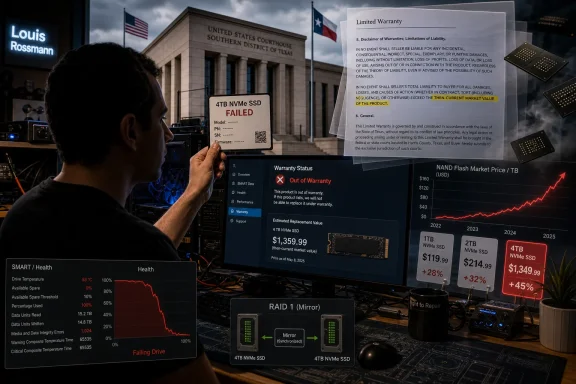
Louis Rossmann, the repair-rights advocate and YouTuber, says he is preparing to take Samsung to court in Texas after the company declined to replace his failed 4TB 990 Pro SSD under warranty and instead offered a refund based on his original purchase price. The dispute is small in dollars but large in meaning. At a moment when SSD prices are rising and NAND supply is tightening, Samsung’s warranty language is being stress-tested by the very market conditions warranties are supposed to survive.
The case is not really about one dead drive. It is about whether a premium hardware warranty promises a working equivalent product, or merely gives the manufacturer a cheap exit when replacement inventory becomes expensive. For Windows users, workstation builders, homelab operators, and IT departments that buy storage on reputation as much as benchmarks, that distinction matters.
Samsung’s 990 Pro has spent much of its life in the halo tier of consumer NVMe storage. It is the kind of drive buyers choose when they want speed, endurance, firmware support, and the comfort of a major brand’s warranty behind a mission-critical machine. That makes this dispute more damaging than a random support-ticket failure involving a bargain-bin part.
Rossmann says the 4TB 990 Pro was purchased from Best Buy for roughly $330 less than two years ago. According to reports summarizing his video and correspondence, the drive was used in a RAID 1 mirror, cooled with a heatsink and fans, and failed well inside Samsung’s stated five-year or 2,400 TBW coverage window for that model. In other words, this was not presented as a worn-out drive at the end of a hard life.
The support trail is the part that turned a warranty claim into a public spectacle. Samsung reportedly acknowledged from logs that the drive appeared to be suffering a fatal controller or firmware-level failure, later tested it, returned it as “verified as good,” and then offered a cash refund when Rossmann continued to say the SSD remained defective. That refund offer was reportedly around the original purchase price, not the replacement cost of the same drive in today’s market.
This is where the optics become brutal for Samsung. The same 4TB 990 Pro was reportedly available through Samsung’s own Amazon storefront for about $949, while Samsung’s support channel cited a shortage and offered roughly $330. A customer who accepted that offer would not be made whole in any practical sense; he would be handed a receipt-shaped memory of what SSD prices used to look like.
Manufacturers like flexibility because warranty service is messy. Products go out of stock, SKUs change, regional service centers run through inventory, and exact replacements can become impractical. A refund option is not inherently abusive; it can be the fairest outcome when a product has depreciated or disappeared from the market.
But this situation runs in the opposite direction. The price of an equivalent SSD appears to have risen sharply, so a refund based on the original transaction price may shift the market shock from Samsung to the customer. If the warranty says “then-current market value,” a literal reading points toward the cost of an equivalent product at the time of the claim, not the bargain price paid during a more favorable market.
Samsung may argue that its liability is capped by other limitation language, or that service-channel inventory is distinct from retail inventory. It may also argue that the tested drive did not qualify for replacement after its own diagnostics. But as a customer-relations matter, the story already looks like a premium vendor trying to arbitrage its own warranty terms.
That is the danger of warranties written for normal depreciation curves. They work smoothly when electronics get cheaper over time. They become combustible when memory prices spike and the old “refund what you paid” shortcut no longer buys the same thing.
That matters because warranties depend on physical inventory. A replacement promise is easy when the service department has a bin of drives that cost less than last quarter’s drives. It becomes more expensive when every 4TB SSD is worth more on the open market than the unit originally sold for.
The result is a quiet collision between support policy and allocation economics. Retail channels may show stock because selling inventory at today’s price is profitable. Warranty channels may show shortage because replacing old purchases with new high-value inventory is costly. To the customer, however, both channels carry the Samsung name.
That split is precisely what consumers find so hard to accept. If a company can sell the same model publicly at a much higher price, telling a warranty claimant that no replacement is available sounds less like logistics and more like prioritization. Even if the internal systems are more complicated than that, the external message is simple: paying customers can get one, warranty customers cannot.
The right-to-repair movement has always been about more than screwdrivers and schematics. It is about control after purchase. Who gets to diagnose a device? Who gets to decide whether it is meaningfully broken? Who bears the cost when a sealed, proprietary, or encrypted component fails?
SSDs are an unusually sharp example because they are both mundane and opaque. A failed NVMe drive is not a cracked phone screen or a clogged fan. It can fail in ways that are difficult for ordinary users to prove, and data recovery can be constrained by proprietary controllers, firmware behavior, and always-on encryption. The customer may know the drive is unusable, while the vendor’s test harness may produce a reassuring pass.
That asymmetry gives manufacturers enormous power in warranty disputes. If the company says “no trouble found,” most consumers do not have specialized equipment, public reach, or the patience to keep fighting. Rossmann does, and that is why this particular case is attracting attention beyond the storage aisle.
Desktop users increasingly treat high-capacity NVMe drives as primary storage, game libraries, scratch disks, VM stores, and backup staging areas. In Windows 11 systems, a single 4TB SSD may hold a boot volume, development environments, Hyper-V images, Steam libraries, family media, and work documents. When that drive fails, the difference between a fast replacement and a partial refund is not academic.
For small businesses and IT shops, the lesson is even sharper. Consumer and prosumer SSDs often find their way into lab servers, creator workstations, point-of-sale machines, and lightly managed office PCs because they are fast and easy to buy. The warranty may look generous on paper, but the operational value depends on how the vendor behaves when supply is tight.
This is why administrators should pay closer attention to warranty remedy language. “Five years” is only one dimension. The more important question is what happens during those five years if the product class becomes expensive, scarce, superseded, or contested.
Instead, the issue is narrow: a product allegedly failed under warranty, and the offered remedy allegedly does not buy an equivalent replacement. That makes the dispute easier for the public to understand and harder to dismiss as an edge case driven by data loss panic.
It also highlights a basic storage truth that should never be lost in warranty debates. A warranty is not a backup. The best possible outcome of a warranty claim is a working device at some later date; it is not the return of your files, your uptime, or your weekend.
For WindowsForum readers, this is the boring advice that remains undefeated. Use File History, Windows Backup where appropriate, image your boot drives, keep offline copies, and do not treat RAID as a substitute for backup. Rossmann’s mirror reportedly prevented data loss; it did not prevent the warranty fight.
It is also possible that a support representative’s phrase about shortage does not map neatly onto the company’s legal position. Retail inventory, warranty inventory, distributor inventory, and service-center parts are not identical pools. A company can have a product for sale somewhere and still claim that the warranty operation lacks allocated replacement stock.
But that distinction will not satisfy most customers because the warranty relationship is with the brand. Samsung benefits when buyers trust the logo on the box. It cannot easily retreat into channel segmentation when honoring the promise becomes expensive.
The most damaging interpretation is not that Samsung cannot replace the drive. It is that Samsung does not want to replace the drive at today’s effective cost. If that perception sticks, the company risks turning a single SSD claim into a broader referendum on whether its premium storage warranty is a real safety net or a pricing-era loophole.
Consumer hardware companies usually do not want warranty practices dissected by technically literate audiences. A warranty denial can be framed as routine when it happens in private. It becomes a case study when email threads, diagnostics, market prices, and policy language are placed side by side.
Samsung may settle, replace the drive, revise the remedy, or defend its handling. Any of those outcomes will be watched by buyers who are now thinking about what their own SSD warranty is worth in a market where replacement costs can exceed purchase prices. That audience includes people who influence purchasing decisions far beyond one consumer drive.
The industry should pay attention too. If memory volatility persists, this will not be the last warranty dispute where the original purchase price and current replacement price diverge dramatically. Vendors that keep using refund policies built for depreciating electronics may discover that customers read “market value” very differently when the market moves against them.
For buyers, the concrete takeaways are straightforward:
The case is not really about one dead drive. It is about whether a premium hardware warranty promises a working equivalent product, or merely gives the manufacturer a cheap exit when replacement inventory becomes expensive. For Windows users, workstation builders, homelab operators, and IT departments that buy storage on reputation as much as benchmarks, that distinction matters.
 Samsung’s Premium SSD Brand Meets a Very Ordinary Warranty Fight
Samsung’s 990 Pro has spent much of its life in the halo tier of consumer NVMe storage. It is the kind of drive buyers choose when they want speed, endurance, firmware support, and the comfort of a major brand’s warranty behind a mission-critical machine. That makes this dispute more damaging than a random support-ticket failure involving a bargain-bin part.Rossmann says the 4TB 990 Pro was purchased from Best Buy for roughly $330 less than two years ago. According to reports summarizing his video and correspondence, the drive was used in a RAID 1 mirror, cooled with a heatsink and fans, and failed well inside Samsung’s stated five-year or 2,400 TBW coverage window for that model. In other words, this was not presented as a worn-out drive at the end of a hard life.
The support trail is the part that turned a warranty claim into a public spectacle. Samsung reportedly acknowledged from logs that the drive appeared to be suffering a fatal controller or firmware-level failure, later tested it, returned it as “verified as good,” and then offered a cash refund when Rossmann continued to say the SSD remained defective. That refund offer was reportedly around the original purchase price, not the replacement cost of the same drive in today’s market.
This is where the optics become brutal for Samsung. The same 4TB 990 Pro was reportedly available through Samsung’s own Amazon storefront for about $949, while Samsung’s support channel cited a shortage and offered roughly $330. A customer who accepted that offer would not be made whole in any practical sense; he would be handed a receipt-shaped memory of what SSD prices used to look like.
The Warranty Clause That Now Matters More Than the Benchmark Chart
The key language in Samsung’s SSD warranty gives the company options. If a covered product is defective, Samsung may repair it, replace it with a new or refurbished product of equal or greater capacity and functionality, or refund the then-current market value if Samsung is unable to repair or replace it. That last phrase is the hinge of the dispute.Manufacturers like flexibility because warranty service is messy. Products go out of stock, SKUs change, regional service centers run through inventory, and exact replacements can become impractical. A refund option is not inherently abusive; it can be the fairest outcome when a product has depreciated or disappeared from the market.
But this situation runs in the opposite direction. The price of an equivalent SSD appears to have risen sharply, so a refund based on the original transaction price may shift the market shock from Samsung to the customer. If the warranty says “then-current market value,” a literal reading points toward the cost of an equivalent product at the time of the claim, not the bargain price paid during a more favorable market.
Samsung may argue that its liability is capped by other limitation language, or that service-channel inventory is distinct from retail inventory. It may also argue that the tested drive did not qualify for replacement after its own diagnostics. But as a customer-relations matter, the story already looks like a premium vendor trying to arbitrage its own warranty terms.
That is the danger of warranties written for normal depreciation curves. They work smoothly when electronics get cheaper over time. They become combustible when memory prices spike and the old “refund what you paid” shortcut no longer buys the same thing.
The Memory Shortage Turns Support Desks Into Allocation Desks
The timing is not incidental. The memory market is under pressure from AI infrastructure demand, enterprise SSD purchasing, and supply discipline among manufacturers that remember the pain of oversupply. Consumer storage has become collateral damage in a market increasingly shaped by cloud providers and data-center buyers willing to commit early and pay more.That matters because warranties depend on physical inventory. A replacement promise is easy when the service department has a bin of drives that cost less than last quarter’s drives. It becomes more expensive when every 4TB SSD is worth more on the open market than the unit originally sold for.
The result is a quiet collision between support policy and allocation economics. Retail channels may show stock because selling inventory at today’s price is profitable. Warranty channels may show shortage because replacing old purchases with new high-value inventory is costly. To the customer, however, both channels carry the Samsung name.
That split is precisely what consumers find so hard to accept. If a company can sell the same model publicly at a much higher price, telling a warranty claimant that no replacement is available sounds less like logistics and more like prioritization. Even if the internal systems are more complicated than that, the external message is simple: paying customers can get one, warranty customers cannot.
Rossmann Is a Dangerous Plaintiff Because the Story Is Already About Repair
Louis Rossmann is not a random aggrieved buyer with a dead SSD. He has built a public career around repair restrictions, manufacturer accountability, hostile service policies, and the gap between what companies promise and what customers experience. That does not automatically make his legal claim stronger, but it makes the dispute harder for Samsung to contain.The right-to-repair movement has always been about more than screwdrivers and schematics. It is about control after purchase. Who gets to diagnose a device? Who gets to decide whether it is meaningfully broken? Who bears the cost when a sealed, proprietary, or encrypted component fails?
SSDs are an unusually sharp example because they are both mundane and opaque. A failed NVMe drive is not a cracked phone screen or a clogged fan. It can fail in ways that are difficult for ordinary users to prove, and data recovery can be constrained by proprietary controllers, firmware behavior, and always-on encryption. The customer may know the drive is unusable, while the vendor’s test harness may produce a reassuring pass.
That asymmetry gives manufacturers enormous power in warranty disputes. If the company says “no trouble found,” most consumers do not have specialized equipment, public reach, or the patience to keep fighting. Rossmann does, and that is why this particular case is attracting attention beyond the storage aisle.
Windows Users Should Read This as a Reliability Story, Not Just a Legal Story
For Windows enthusiasts, the first instinct may be to argue about RAID, SMART data, firmware, or whether Rossmann’s test environment differs from Samsung’s. Those details matter, but they are not the whole story. A storage warranty is a reliability promise wrapped in legal language.Desktop users increasingly treat high-capacity NVMe drives as primary storage, game libraries, scratch disks, VM stores, and backup staging areas. In Windows 11 systems, a single 4TB SSD may hold a boot volume, development environments, Hyper-V images, Steam libraries, family media, and work documents. When that drive fails, the difference between a fast replacement and a partial refund is not academic.
For small businesses and IT shops, the lesson is even sharper. Consumer and prosumer SSDs often find their way into lab servers, creator workstations, point-of-sale machines, and lightly managed office PCs because they are fast and easy to buy. The warranty may look generous on paper, but the operational value depends on how the vendor behaves when supply is tight.
This is why administrators should pay closer attention to warranty remedy language. “Five years” is only one dimension. The more important question is what happens during those five years if the product class becomes expensive, scarce, superseded, or contested.
The Data Was Safe This Time, Which Is Exactly Why the Fight Could Stay Focused
One reason this dispute has remained clean is that Rossmann reportedly had the SSD in a RAID 1 array and did not lose data. That removes the emotional fog that usually surrounds storage failures. The fight is not about irreplaceable files, data recovery bills, or consequential damages that warranties typically disclaim.Instead, the issue is narrow: a product allegedly failed under warranty, and the offered remedy allegedly does not buy an equivalent replacement. That makes the dispute easier for the public to understand and harder to dismiss as an edge case driven by data loss panic.
It also highlights a basic storage truth that should never be lost in warranty debates. A warranty is not a backup. The best possible outcome of a warranty claim is a working device at some later date; it is not the return of your files, your uptime, or your weekend.
For WindowsForum readers, this is the boring advice that remains undefeated. Use File History, Windows Backup where appropriate, image your boot drives, keep offline copies, and do not treat RAID as a substitute for backup. Rossmann’s mirror reportedly prevented data loss; it did not prevent the warranty fight.
Samsung’s Legal Position May Be Defensible While Its Customer Position Gets Worse
It is possible Samsung has a legal argument. Warranty documents often include liability limits, arbitration clauses, exclusions, diagnostic discretion, and language designed to prevent open-ended exposure. Courts do not always read customer-friendly summaries the way angry comment sections do.It is also possible that a support representative’s phrase about shortage does not map neatly onto the company’s legal position. Retail inventory, warranty inventory, distributor inventory, and service-center parts are not identical pools. A company can have a product for sale somewhere and still claim that the warranty operation lacks allocated replacement stock.
But that distinction will not satisfy most customers because the warranty relationship is with the brand. Samsung benefits when buyers trust the logo on the box. It cannot easily retreat into channel segmentation when honoring the promise becomes expensive.
The most damaging interpretation is not that Samsung cannot replace the drive. It is that Samsung does not want to replace the drive at today’s effective cost. If that perception sticks, the company risks turning a single SSD claim into a broader referendum on whether its premium storage warranty is a real safety net or a pricing-era loophole.
The Courtroom May Matter Less Than the Precedent Set in Public
Rossmann reportedly gave Samsung 60 days to provide a replacement or equivalent working 4TB 990 Pro before filing suit in Travis County, Texas. If this lands in small claims court or a similar venue, the legal stakes may remain modest. The reputational stakes are already larger.Consumer hardware companies usually do not want warranty practices dissected by technically literate audiences. A warranty denial can be framed as routine when it happens in private. It becomes a case study when email threads, diagnostics, market prices, and policy language are placed side by side.
Samsung may settle, replace the drive, revise the remedy, or defend its handling. Any of those outcomes will be watched by buyers who are now thinking about what their own SSD warranty is worth in a market where replacement costs can exceed purchase prices. That audience includes people who influence purchasing decisions far beyond one consumer drive.
The industry should pay attention too. If memory volatility persists, this will not be the last warranty dispute where the original purchase price and current replacement price diverge dramatically. Vendors that keep using refund policies built for depreciating electronics may discover that customers read “market value” very differently when the market moves against them.
The Fine Print Has Become Part of the Product
The practical lesson is not that every Samsung SSD is suspect or that every warranty dispute will end badly. The lesson is that premium hardware now includes the support process as part of the product experience. If the warranty cannot survive a shortage, then the warranty is less valuable than the box suggests.For buyers, the concrete takeaways are straightforward:
- Keep the receipt, serial number, photos, logs, and diagnostic screenshots for every high-value SSD you buy.
- Read the warranty remedy language before assuming a five-year term means five years of equivalent replacement protection.
- Treat retailer stock and warranty stock as separate realities, but do not accept that distinction uncritically when the same product remains publicly available.
- Maintain real backups, because even a successful warranty claim will not recover lost files or guarantee uptime.
- For business or workstation deployments, consider vendors and product lines with advance replacement options, clear enterprise support terms, or spare-drive strategies you control.
- Watch how Samsung resolves this dispute, because the outcome may shape how other storage makers handle claims during the current memory squeeze.
References
- Primary source: Firstpost
Published: Sun, 14 Jun 2026 15:28:02 GMT
- Independent coverage: bgr.com
Published: Sun, 14 Jun 2026 11:47:00 GMT
Samsung Might Be Going To Court Over A Major YouTuber's Warranty Claim
Despite being one of the most prominent SSD makers, Samsung might soon face a lawsuit from the famous YouTuber Louis Rossmann over an SSD warranty dispute.www.bgr.com - Related coverage: tomshardware.com
Louis Rossmann is suing Samsung after firm offers $330 refund for defective SSD while selling the drives on Amazon for $949 — spat over 4TB 990 Pro SSD is headed to court | Tom's Hardware
Samsung has 60 days to give Rossman a working replacement before he takes the company to court in Austin Texas.www.tomshardware.com - Related coverage: techspot.com
YouTuber says he will sue Samsung for dodging 990 Pro SSD warranty replacement amid memory crisis | TechSpot
Rossmann says he bought the Samsung 990 Pro 4TB from Best Buy less than two years ago for around $330. The drive was being used with a...www.techspot.com - Related coverage: rossmanngroup.com
Samsung SSD Data Recovery | 980 PRO, 990 PRO, 870 EVO Failures | Rossmann Group
Samsung SSD data recovery for controller failures, firmware bugs, and NAND degradation. SATA from From $200, NVMe from From $200. Free evaluation. No data, no fee.rossmanngroup.com
- Related coverage: macrumors.com
Apple Agrees to Let Jon Prosser Formally Contest iOS 26 Leak Lawsuit
Apple and leaker Jon Prosser have jointly asked a federal court to set aside the default judgment entered against him last October, with Prosser agreeing to hand over documents he had thus far failed to fully produce. Apple filed suit against Prosser and Michael Ramacciotti in July 2025...www.macrumors.com
- Related coverage: pcgamer.com
Consumer rights champion and tech-whizz Louis Rossman is taking Samsung to court over a failed 990 Pro SSD it says it can't replace, even though Amazon has plenty of them in stock | PC Gamer
The fact that they now cost $949 instead of $300 surely has nothing to do with it, right?www.pcgamer.com - Related coverage: sammobile.com
Why is Samsung picking a battle not worth fighting over an SSD claim? - SamMobile
Samsung making lowball cash offers for SSD claims without regard for the impact it has on loyalty is a battle that it doesn't need to pick. - SamMobilewww.sammobile.com - Related coverage: hwupgrade.it
Uno YouTuber vuole denunciare Samsung: la sostituzione di un SSD 990 Pro guasto diventa un caso | Hardware Upgrade
Lo youtuber Louis Rossmann vuole portare Samsung in tribunale dopo il guasto di un SSD 990 Pro da 4 TB ancora in garanzia. L'azienda si sarebbe rifiutata di sostituire il prodotto per la mancanza di scorte, offrendo solo il rimborso del prezzo originale. Lo YouTuber chiede un'unità equivalente o...www.hwupgrade.it - Related coverage: sammyfans.com
Right to Repair activist challenges Samsung’s warranty terms in a US court over SSD
Louis Rossman, a well-known Right to Repair activist, has filed suit against Samsung’s warranty terms in Texas, US, due to a 990 Pro SSD warranty dispute. The activist purchased a 4TB Samsung 990 Pro SSD for $330. It failed within the warranty period. He did everything right: error logs...www.sammyfans.com - Related coverage: tecnoandroid.it
Samsung a rischio causa: non ha rispettato la garanzia di un SSD
Samsung si ritrova di nuovo sotto i riflettori, e stavolta non per un nuovo smartphone o per qualche annuncio scintillante. Il motivo è ben più scomodo: la mawww.tecnoandroid.it - Related coverage: upguard.com
Samsung Settles Lawsuit Over Privacy Breach | UpGuard
Samsung Electronics reaches a settlement over allegations of unauthorized data collection via Smart TV ACR technology.www.upguard.com - Related coverage: techradar.com
The RAM crisis will last 'quite a few years' says Nvidia CEO Jensen Huang — so despite hiked prices, I think if you want a new laptop, now might be the time to buy | TechRadar
Should you buy a new laptop or PC now, or wait? And what about standalone PC components?www.techradar.com - Related coverage: ldeepai.com
DRAM and NAND Contract Prices Surge 80–90% Amid AI-Driven Shortage Risks | LDeepAI Tech Hub
DRAM and NAND contract prices jumped 80–90% QoQ as AI servers absorb supply. Structural shortages may emerge by 2026–2027, raising BOM risk for OEMs.www.ldeepai.com - Related coverage: omdia.tech.informa.com
