

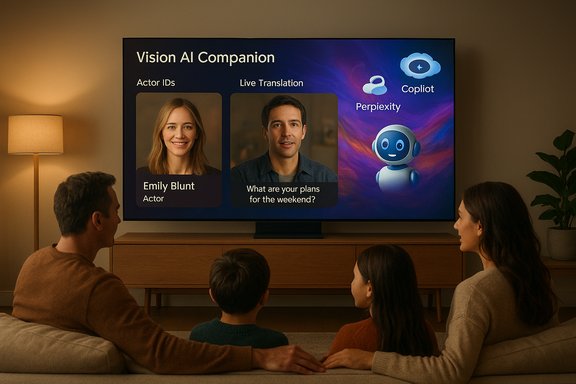
Samsung has begun rolling out a generative AI upgrade for its 2025 televisions that transforms Bixby into a multimodal, conversational hub — Vision AI Companion — letting viewers ask natural-language questions about what’s on screen, summon web-backed answers via selectable cloud agents, and access a suite of on-device AI features such as Live Translate, AI picture tuning, and adaptive audio.
Samsung’s Vision AI Companion is the productized evolution of years of incremental work: earlier on-device vision features, the company’s Bixby assistant, and the “screen-aware” concepts shown at trade shows became a unified platform at IFA 2025. The goal is simple in pitch: make the TV an active, shared conversational surface so viewers don’t need to reach for a phone when they want to know who an actor is, translate dialogue in real time, or get tailored recommendations.
The rollout is being delivered as a staged software update for eligible 2025 Samsung TVs and selected smart monitors. Samsung positions this as more than a one-off feature: Vision AI Companion is intended to become the central hub for the company’s display AI functions and to orchestrate multiple third‑party generative agents rather than locking users into a single assistant.
The rollout is phased and region‑dependent rather than an instantaneous global flip: expect availability and feature sets to vary across countries and model tiers as Samsung expands coverage.
That promise comes with important caveats. The experience will vary by model and market, critical telemetry details remain unpublished, and several commercial reports (notably investment talk around Perplexity) should be treated as provisional until companies publish confirmations. For consumers and organizations alike, the new Vision AI Companion is compelling — but assessing its trustworthiness will require careful attention to account linking, privacy settings, and the evolving terms of Samsung’s and its partners’ cloud services.
Overall, the move pushes the TV toward being an active, helpful, and conversational surface in the home; the ultimate test will be execution — how feature parity, privacy controls, and partner reliability play out as Samsung scales the Vision AI Companion across regions and device tiers.
Source: The Verge Samsung brings a generative AI-powered Bixby to its TVs
 Background
Samsung’s Vision AI Companion is the productized evolution of years of incremental work: earlier on-device vision features, the company’s Bixby assistant, and the “screen-aware” concepts shown at trade shows became a unified platform at IFA 2025. The goal is simple in pitch: make the TV an active, shared conversational surface so viewers don’t need to reach for a phone when they want to know who an actor is, translate dialogue in real time, or get tailored recommendations.The rollout is being delivered as a staged software update for eligible 2025 Samsung TVs and selected smart monitors. Samsung positions this as more than a one-off feature: Vision AI Companion is intended to become the central hub for the company’s display AI functions and to orchestrate multiple third‑party generative agents rather than locking users into a single assistant.
What Vision AI Companion does — feature map
At a glance, Vision AI Companion bundles conversational generative AI, visual recognition, translation, and adaptive media processing into one TV‑optimized experience:- Conversational, multi‑turn Q&A — Ask about on‑screen content, follow up naturally, and preserve context across turns.
- On‑screen visual intelligence — Identify actors, artwork, locations or products and surface related clips or facts with large, distance‑legible visual cards.
- Live Translate — Near‑real‑time subtitle and dialogue translation using local device processing where possible to minimize latency.
- AI Picture / AI Upscaling Pro — Scene‑by‑scene perceptual tuning and upscaling to improve perceived image quality automatically.
- Active Voice Amplifier (AVA) Pro — Adaptive audio for improved dialog clarity in noisy rooms.
- AI Gaming Mode — Latency and responsiveness tweaks when the TV is used for gaming.
- Generative Wallpaper — AI‑generated ambient imagery for idle states created from text prompts.
- Third‑party agent apps — Embedded, selectable agents such as Microsoft Copilot and Perplexity that handle different types of web retrieval, summarization and generative answering.
How it works: hybrid edge + cloud architecture
Vision AI Companion uses a hybrid approach that balances low latency for media tasks with the broader knowledge and generative capacity of cloud agents.- On‑device (edge) processing handles latency‑sensitive perceptual tasks: Live Translate subtitling, scene analysis for object/actor recognition, AI upscaling, audio tuning, wake-word and mic processing. Keeping these processes local reduces pause and improves the real‑time feel when queries happen during playback.
- Cloud agents perform large‑context generative reasoning, web retrieval and multi‑turn conversational synthesis. Microsoft Copilot and Perplexity are surfaced as embedded agent apps inside the Vision AI shell; when heavy reasoning or up‑to‑date retrieval is needed, the TV routes the request to the partner cloud back end.
Supported devices, languages and rollout cadence
Samsung says Vision AI Companion is available now on the company’s 2025 TV lineup as a staged software update. At launch, the experience is focused on higher‑end 2025 sets and selected smart monitors:- Primary TV families called out at launch: Micro LED (Micro RGB), Neo QLED, OLED, The Frame and The Frame Pro.
- Smart monitors initially supported include M7, M8 and M9 models.
The rollout is phased and region‑dependent rather than an instantaneous global flip: expect availability and feature sets to vary across countries and model tiers as Samsung expands coverage.
Partnerships and the multi‑agent strategy
A defining element of Vision AI Companion is Samsung’s multi‑agent orchestration: rather than forcing a single assistant, Samsung embeds multiple third‑party agents and lets users pick the “best tool for the job.”- Microsoft Copilot — Presented as a conversational, entertainment‑centric agent that supports content discovery, spoiler‑safe recaps, and light productivity on smart monitors. Copilot on TV features an animated, lip‑synced persona and large visual cards. Optional Microsoft Account sign‑in via QR code unlocks personalization and Copilot Memory.
- Perplexity — Positioned as a retrieval‑heavy agent optimized for web‑centric, sourced answers and summarization. Early reports and vendor materials indicate Perplexity will be available as a standalone agent in the Vision AI shell. Some commercial ties (investment or preloads onto Galaxy devices) have been widely reported but are not universally confirmed in vendor technical docs; treat investment claims as reported but not fully verified.
- Google Gemini — Mentioned in Samsung’s broader Galaxy AI context and already present in many Galaxy devices; Samsung’s public strategy signals that multiple vendor agents — including Gemini where appropriate — can coexist in the Vision AI ecosystem.
UX: how people will interact with the system
The interaction model is designed for the living room:- Press the remote’s dedicated AI/Copilot or microphone button, or open the Vision AI tile in the Tizen home.
- Speak naturally; the system supports follow‑up context so users don’t have to restate prior details.
- Receive a spoken reply paired with a large visual card containing images, metadata and quick actions like “Play” or “Add to watchlist.” When Copilot is used, an animated avatar may provide visible presence and lip‑syncing cues.
- Optionally scan a QR code with a phone to sign in to a Microsoft Account (or other supported accounts) and unlock personalization and memory features. Basic functionality remains available without sign‑in.
Privacy, data flows and security considerations
Vision AI Companion’s hybrid model raises clear privacy and security questions that buyers should weigh.- Account linkage — Deeper personalization and memory features require explicit account sign‑in (for example, a Microsoft Account for Copilot), often via a QR code to reduce friction on TV sign‑in. That linkage enables cross‑device continuity but also broadens the surface for profile aggregation.
- On‑device vs cloud processing — Some perceptual tasks are done locally (improving speed and arguably protecting some data from cloud exfiltration), while generative answers and web retrievals are routed to partner clouds. The exact telemetry, what is recorded, and retention windows are not fully disclosed in public consumer materials; those are important gaps users should demand clarity on.
- Visual inputs and sensitive content — The TV’s visual recognition features identify actors, artwork and objects in frames. When cameras or third‑party video feeds are involved (e.g., displaying SmartThings camera views), users should check device settings and consent dialogs to understand whether images or video snippets are sent to the cloud.
- Third‑party agent governance — Different agents have different data practices. If a query is routed to Perplexity or Copilot, the cloud operator’s privacy policy and data handling rules apply; users should verify those separately and be wary of cross‑service aggregation.
- Unverified telemetry details — Samsung and partner press materials describe high‑level architecture but do not publish exhaustive telemetry maps (for example, retention periods for audio transcripts, or whether image crops are stored for training). Statements about exact model names or internal data flows are not fully verifiable from public materials and must be treated with caution.
- Use local device controls to disable or limit voice history and camera access.
- Avoid account linking unless you want cross‑device personalization.
- Review partner privacy policies for Microsoft, Perplexity and Samsung to understand how queries and context might be stored or used.
- Monitor firmware updates, because the feature set and privacy controls can change as agents and partners evolve.
Strengths and strategic implications
- A meaningful upgrade to TV UX. The combination of on‑device perceptual speed and cloud generative power solves a common friction: finding contextual information without interrupting playback or switching devices. That alone will improve discoverability and make TVs more helpful in everyday scenarios.
- Open agent orchestration. Samsung’s multi‑agent stance is strategically smart: it avoids putting all eggs into one partner and gives users functional choice. That makes Samsung an appealing platform partner for multiple AI vendors.
- Attractive for Microsoft. Copilot on the TV extends Microsoft’s “Copilot Everywhere” strategy into shared, living‑room contexts where family or group interactions dominate, potentially growing engagement with Microsoft services.
- Differentiation for Samsung hardware. Promising advanced AI features across displays — combined with a seven‑year software upgrade commitment on eligible models — gives Samsung a clear marketing advantage in a crowded TV market.
Risks, unknowns and technical caveats
- Data governance opacity. The most important missing detail is an exhaustive, public telemetry and retention map. Without it, enterprise IT teams and privacy advocates cannot fully evaluate compliance risk or data residency issues. Treat vendor statements about local processing as helpful but not a complete substitute for concrete privacy commitments.
- Regional and hardware variability. The experience and feature parity will vary by model and market. Buyers should confirm that the exact models they’re considering receive the full Vision AI feature set. Early rollout notes emphasize a phased approach rather than blanket availability.
- Dependence on network and partner clouds. The most powerful features require cloud connectivity and rely on partner services. Outages, degraded networks, or changes in partner agreements could reduce functionality unexpectedly.
- Unverified commercial claims. Reports that Samsung planned or completed investments in Perplexity, or that certain trial promotions exist, were widely reported in 2025 coverage — but such commercial details were not uniformly confirmed in official technical documentation at the time of the Vision AI announcement. Flag investment and promotional claims as provisional until confirmed by vendor filings.
Practical buying guidance
- If you own or plan to buy a 2025 Samsung premium model (Micro LED, Neo QLED, OLED, The Frame) and want a TV that does more than stream, the Vision AI Companion upgrade is a clear value add — particularly if you value on‑screen discovery, live translation, and integrated smart‑home control.
- For privacy‑sensitive households: avoid linking accounts you don’t want associated with the TV, keep voice and camera permissions tight, and use the device’s privacy controls. Demand transparency about retention windows before granting long‑term memory features.
- For organizations buying displays for public or semi‑public spaces, investigate the exact telemetry and enterprise configuration options. Confirm whether network traffic for generative queries can be routed through corporate controls or whether it must travel to partner clouds in ways that conflict with policy.
The competitive landscape — what this move signals
Samsung’s pivot toward a multi‑agent, visual‑first assistant on the TV is consequential for the broader assistant wars. It signals:- A move away from single‑assistant lock‑in. OEMs can be orchestration layers rather than assistant proprietors, enabling partnerships that mix Google, Microsoft and specialist agents.
- Microsoft’s push into shared screens. Copilot’s living‑room presence means Microsoft isn’t only a desktop and phone companion — it wants a role in family and shared experiences.
- New monetization and partnership vectors. Preloads, trials (for example Perplexity Pro promotional windows) and co‑marketing with partners could be important revenue complements to hardware sales — but commercial terms and promotions vary by region and remain partially unverified in public reporting.
Conclusion
Vision AI Companion represents a significant design and strategic shift for Samsung’s displays: Bixby has been reimagined as a visual‑first, multi‑agent orchestration layer that brings generative AI directly to the living room. The combination of on‑device perceptual speed and cloud‑backed generative partners like Microsoft Copilot and Perplexity promises genuinely useful, context‑aware interactions — from spoiler‑safe recaps and actor facts to live translation and adaptive picture tuning — all surfaced in a UI optimized for group viewing.That promise comes with important caveats. The experience will vary by model and market, critical telemetry details remain unpublished, and several commercial reports (notably investment talk around Perplexity) should be treated as provisional until companies publish confirmations. For consumers and organizations alike, the new Vision AI Companion is compelling — but assessing its trustworthiness will require careful attention to account linking, privacy settings, and the evolving terms of Samsung’s and its partners’ cloud services.
Overall, the move pushes the TV toward being an active, helpful, and conversational surface in the home; the ultimate test will be execution — how feature parity, privacy controls, and partner reliability play out as Samsung scales the Vision AI Companion across regions and device tiers.
Source: The Verge Samsung brings a generative AI-powered Bixby to its TVs
