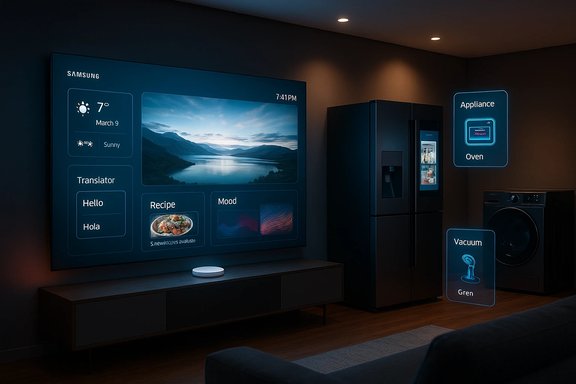
Samsung’s CES push makes clear that AI is no longer a feature add‑on for appliances and displays — it’s the connective tissue Samsung expects to bind TVs, fridges, vacuums, cars and health services into a single, conversational ecosystem built around a new Vision AI strategy.
Samsung opened its CES First Look event with a wide‑ranging declaration: AI must be embedded across the product stack to reshape everyday experiences — from what we watch to how our homes manage energy and health. The company framed this under the banner “Your Companion to AI Living,” with the Vision AI Companion (VAC) as the display‑side anchor and SmartThings AI as the broader home and device orchestration layer. That message is both strategic and practical. Samsung is shipping:
However, Samsung has not published exhaustive telemetry boundaries or detailed latency benchmarks for VAC’s multi‑agent orchestration — an omission that matters for real‑time conversational performance and for the privacy implications of routing speech and visual metadata off‑device. Expect reviewers and privacy auditors to press on this point.
Independent coverage and Samsung materials confirm both Copilot integration and the Perplexity TV app as launch partners. Those integrations extend Microsoft’s Copilot into the living room while giving Perplexity a retrieval‑centric presence on a large communal screen. The practical result: creative, conversational answers from Copilot alongside sourced, citation‑aware summaries from Perplexity when users want rigorous references.
If Samsung opts for a curated, partner‑first model (Copilot/Perplexity/selected OEMs) rather than an open developer platform, the ecosystem will be wider but less extensible — good for tight UX control, bad for custom vertical solutions. Conversely, opening APIs broadly raises integration possibilities but increases security and privacy management needs. Both tradeoffs matter to enterprise buyers and hospitality / senior‑living operators that might want to build bespoke experiences on top of Vision AI.
But execution risk is high. The product promise depends on four measurable realities that Samsung has not fully disclosed:
That path — however promising — is littered with implementation questions that matter to consumers, IT managers and regulated industries: where inference runs, how fast conversational flows feel, how data is stewarded across vendors, and whether third parties can build the integrations needed for hospitality, senior living and enterprise use. The coming quarter will be telling: independent lab tests, vendor‑published telemetry, developer SDKs and privacy documentation will turn marketing promises into verifiable capabilities or reveal the limits of the Vision AI vision. Until those proofs are public, the right approach for cautious buyers and IT stewards is pragmatic curiosity — evaluate the demos, insist on measurable specs and data governance, and favor staged pilots where outcomes can be empirically validated.
Source: Asia Business Outlook Samsung Unveils Vision AI Strategy Ahead of CES 2026
 Background / Overview
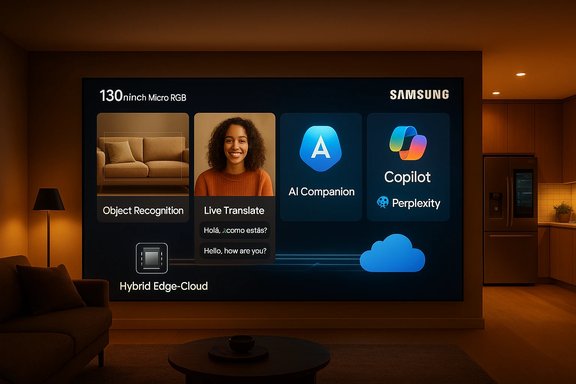
Samsung opened its CES First Look event with a wide‑ranging declaration: AI must be embedded across the product stack to reshape everyday experiences — from what we watch to how our homes manage energy and health. The company framed this under the banner “Your Companion to AI Living,” with the Vision AI Companion (VAC) as the display‑side anchor and SmartThings AI as the broader home and device orchestration layer. That message is both strategic and practical. Samsung is shipping:- a headline 130‑inch Micro RGB TV (a new architecture blending microscopic RGB emitters with an LCD stack),
- an expanded Vision AI Companion that orchestrates multiple cloud agents (not a single proprietary LLM), and
- SmartThings AI and appliance upgrades that promise tighter Home‑to‑Car and health integrations.
What Vision AI Companion actually is
A conversational, visual-first TV assistant
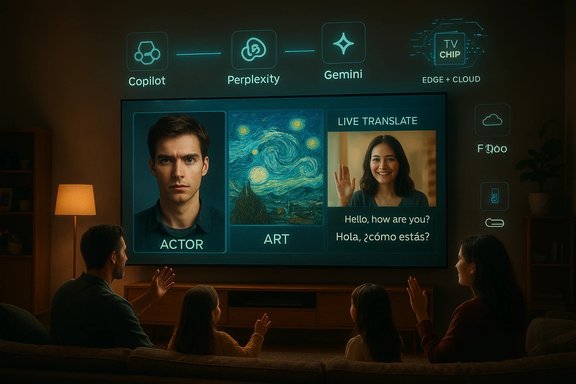
Vision AI Companion is Samsung’s attempt to turn the television — the communal, largest screen in most homes — into a shared, voice‑first conversational surface. It combines:- on‑screen visual recognition (identify actors, artwork, products),
- multi‑turn conversational Q&A optimized for couch‑distance readability,
- real‑time media features (Live Translate, AI upscaling, adaptive audio), and
- a multi‑agent orchestration layer that can call external agents such as Microsoft Copilot and Perplexity.
Hybrid architecture: edge + cloud
Samsung’s stated architecture is hybrid by design. Latency‑sensitive perceptual tasks — actor recognition, live subtitling (Live Translate), AI upscaling and some audio processing — are intended to run on‑device to preserve playback responsiveness. When a query needs long‑context reasoning, web retrieval, or “memory” tied to a user account, the system routes that work to cloud agents such as Microsoft Copilot or Perplexity. This split is pragmatic: TV system‑on‑chips (SoCs) cannot run large LLMs locally at scale, and the hybrid approach balances local responsiveness with the capabilities of cloud models.However, Samsung has not published exhaustive telemetry boundaries or detailed latency benchmarks for VAC’s multi‑agent orchestration — an omission that matters for real‑time conversational performance and for the privacy implications of routing speech and visual metadata off‑device. Expect reviewers and privacy auditors to press on this point.
Partnerships and the multi‑agent strategy
Copilot, Perplexity and pluralism
Samsung’s decision to surface multiple cloud agents — notably Microsoft Copilot for conversational discovery and Perplexity for retrieval‑focused, citation‑forward answers — is its most consequential platform choice. Rather than vendor‑locking users to a single assistant, VAC routes each query to “the best tool for the job,” or lets users pick an agent. That model improves functional flexibility but multiplies the number of backend endpoints and governance surfaces that must be audited.Independent coverage and Samsung materials confirm both Copilot integration and the Perplexity TV app as launch partners. Those integrations extend Microsoft’s Copilot into the living room while giving Perplexity a retrieval‑centric presence on a large communal screen. The practical result: creative, conversational answers from Copilot alongside sourced, citation‑aware summaries from Perplexity when users want rigorous references.
Broader ecosystem: Google Gemini and device AI
Samsung is also integrating Google’s Gemini family in some appliance and Galaxy device contexts (for example, AI Vision features on Family Hub refrigerators). The net effect is a pluralistic partner map — Samsung acts as the UI and orchestration layer while tapping different AI providers across device classes. That business model gives Samsung breadth but requires clear account linking, consent flows, and cross‑vendor privacy guarantees.The hardware story: displays, processors and HDR ambitions
Micro RGB: a new display axis
Samsung’s 2026 showcase centers on a Micro RGB family that uses sub‑100 μm red/green/blue emitters in the backlight to increase color volume and peak luminance relative to conventional Mini‑LED backlights. Micro RGB isn’t self‑emissive microLED — it remains an LCD stack — but by shifting color mixing into the backlight itself Samsung claims significant gains in saturated color and HDR highlights. Early claims include VDE verification of expanded color coverage. Buyers should note the tradeoffs: higher color volume and extreme peak brightness can coexist with LCD‑class black‑level limitations and potential haloing if local dimming algorithms are not tightly tuned.HDR10+ Advanced and HDR fragmentation
Samsung confirmed that select 2026 models will support HDR10+ Advanced, a step beyond HDR10+ that focuses on higher peak brightness, color accuracy and motion processing. The company released model lists indicating HDR10+ Advanced compatibility (notably across high‑end QN and R-series SKUs), but HDR format fragmentation remains real: Samsung continues to push HDR10+ as its HDR standard rather than Dolby Vision, which may produce inconsistent playback behavior across services and titles. Verify HDR support and tone‑mapping behavior per SKU before purchase.TV compute: NQ8 AI Gen3 and the unknowns for 2026
Samsung’s 2024 Neo QLED 8K TVs used the NQ8 AI Gen3 processor (a significant jump in on‑device neural capability compared with earlier generations), and Samsung’s public materials continue to highlight on‑device NPUs as essential to Vision AI’s perceptual features (upscaling, AVA Pro audio, Live Translate). Independent pages from Samsung and coverage of the NQ8 family document the Gen3’s increased neural‑network counts and faster NPU, GPU and CPU elements. Crucially, Samsung has not published comparable chipset or NPU specifications for the 2026 Micro RGB or Vision AI‑shipped models (for example, peak TOPS, local LLM inference capability, or memory bandwidth dedicated to VAC tasks). That gap leaves an important unknown: which VAC features truly run locally and which require cloud fallbacks under typical network conditions. Until Samsung or third‑party labs publish measured on‑device compute and latency figures, claims about “on‑device” AI should be treated as architectural intent rather than verifiable metrics.SmartThings, appliances and health: the broader AI surface
SmartThings AI expansion
Samsung is extending SmartThings beyond simple device control to a proactive, AI‑infused orchestration layer for the home. Announcements at CES outlined SmartThings improvements such as battery‑aware EV charging guidance, AI Energy optimizations, and expanded Home‑to‑Car/Car‑to‑Home integrations with Hyundai/Kia/Genesis. SmartThings now claims a broad installed base (hundreds of millions of users), which gives Samsung scale to apply aggregated, opt‑in learning across devices — but also raises the stakes for privacy and consent when data crosses contexts.Appliances: Family Hub and AI Vision
The Family Hub refrigerator and Bespoke appliance lines received concrete AI upgrades. AI Vision on Family Hub — now using Google Gemini in certain markets — promises finer food recognition, inventory tracking and recipe suggestions tied to what’s inside the fridge. Samsung paired appliance AI with partnerships such as Hartford Steam Boiler for insurance incentives, where connected appliance telemetry could potentially inform premium discounts. These are commercially interesting but operationally complex: insurers will want clear SLA and data governance, while consumers will want control over what is shared and retained.Health: sensor fusion, prediction and risk flags
Samsung is expanding AI into health analytics, promising that Samsung Health features will analyze sleep, nutrition and activity data to identify risk markers for chronic disease and provide personalized insights. The headline is attractive — early detection and personalized nudges matter — but health‑grade claims require careful clinical validation, data provenance and regulatory oversight. Samsung has signalled intent, but specifics about model validation, clinical trials or FDA/CE‑level medical device classification for new features were not supplied in detail at CES. Buyers and health partners should ask for validation studies, privacy terms and explicit disclaimers about clinical use.Developer ecosystem and APIs: what’s public and what’s not
One of the most consequential unknowns for the SmartThings and VAC ecosystem is whether Samsung will expose public APIs for Vision AI or SmartThings AI that let developers create voice skills, custom automations, or health data integrations. SmartThings historically offered SDKs and third‑party device support; Samsung’s promises about expanded AI suggest potential new APIs, but the company has not committed to clear, public developer gateways for VAC’s multi‑agent features. That leaves integrators, hotel/housing operators and third‑party service providers uncertain about the timing and terms for deep integrations.If Samsung opts for a curated, partner‑first model (Copilot/Perplexity/selected OEMs) rather than an open developer platform, the ecosystem will be wider but less extensible — good for tight UX control, bad for custom vertical solutions. Conversely, opening APIs broadly raises integration possibilities but increases security and privacy management needs. Both tradeoffs matter to enterprise buyers and hospitality / senior‑living operators that might want to build bespoke experiences on top of Vision AI.
Real‑world use cases and vertical opportunity
Samsung positioned VAC and SmartThings AI as relevant beyond the living room. Notable vertical opportunities include:- Hospitality and multi‑dwelling: in‑room TVs that act as concierge agents for guests (check‑in, local tips, language translation), integrated with SmartThings building sensors for energy and comfort control.
- Senior living and assisted care: TV‑based companions that can translate medication reminders, monitor activity patterns and surface health alerts to caregivers — provided the data governance and consent frameworks are robust.
- Automotive/home convergence: Home‑to‑Car features with Hyundai and partners that let cars and homes coordinate EV charging, pre‑conditioning and security automations through SmartThings.
Risks, caveats and governance
Latency and real-time performance
Samsung has not published end‑to‑end latency metrics for conversational VAC use cases, nor has it disclosed which VAC capabilities fall back to cloud inference under poor network conditions. That matters: a perceived “laggy” assistant during playback or a delayed Live Translate will undermine the communal user experience. Until benchmarked latency and on‑device compute figures are published, claims about deep conversational fluency and “real‑time” operation remain aspirational.Privacy, telemetry and multi‑cloud data flows
A multi‑agent strategy increases the number of cloud endpoints that may receive voice transcripts, visual metadata or contextual logs. Samsung’s public messaging points to Knox and Knox Matrix as foundational security components, but precise telemetry retention, redaction policies, and cross‑vendor data sharing arrangements are not fully documented in public CES materials. For privacy‑sensitive households or regulated environments (healthcare, elder care facilities), administrators should demand explicit data flow maps and retention/erasure controls before deploying VAC at scale.Hallucinations and factual integrity
When TVs or fridges provide answers that influence decisions (health prompts, repair guidance, insurance triggers), hallucinations or inaccurate outputs from LLMs carry real risk. The Perplexity integration helps by offering citation‑aware answers for retrieval tasks, but Samsung’s multi‑agent orchestration must include agent‑selection transparency and user‑facing sourcing to reduce trust erosion. Feature designers should require fallback confirmations for high‑risk recommendations.Regulatory and clinical claims
Health features that claim disease‑risk detection or diagnostic capability can intersect with medical device regulations. Samsung has signalled risk‑flagging and personalized insights, but buyers should insist on published validation studies, model training provenance, and clarity about whether features are for wellness/education or for clinical diagnosis. The difference determines regulatory classification and legal obligations.Practical guidance: what buyers and IT managers should check
- Confirm exact feature parity for your SKU and region — VAC, Copilot, Perplexity, HDR10+ Advanced and Live Translate availability can vary by model and country.
- Evaluate your network and edge compute budget — ask Samsung for on‑device compute specs and latency benchmarks relevant to your use cases. If low latency is required, insist on on‑device fallbacks and measurable SLAs.
- Audit privacy and telemetry docs — request data‑flow diagrams showing what data leaves the device, where it goes, how long it is retained, and how partners handle it. Make sure account linking (Microsoft, Google) is optional and revocable.
- For health or enterprise deployments, require model validation and contractual guarantees around false positives/negatives and liability. Obtain clarity on whether features are clinical or wellness tools.
- For hospitality or multi‑dwelling deployments, demand APIs, integration roadmaps and service‑level commitments around updates, security patches, and remote management. If public APIs are unavailable, secure partner programs or device management alternatives.
Assessment: strengths and potential pitfalls
Samsung’s Vision AI strategy is, in several ways, the right play for 2026. By:- leveraging a hybrid edge/cloud architecture,
- orchestrating multiple specialized agents,
- pairing display‑class perceptual AI with massive installed SmartThings scale, and
- promising extended software support,
But execution risk is high. The product promise depends on four measurable realities that Samsung has not fully disclosed:
- precise on‑device NPU/SoC specifications for the 2026 lineup,
- reproducible latency metrics for conversational VAC flows,
- transparent telemetry and retention policies across partners, and
- clear developer APIs for extensibility and vertical integration.
Conclusion
Samsung has made a decisive strategic move at CES: Vision AI Companion and a broader SmartThings AI expansion place generative and perceptual AI at the center of its product roadmap. The company’s pluralistic agent approach (Copilot, Perplexity, Gemini and others), the Micro RGB display innovations and the health/appliance ambitions create a plausible path to an AI‑driven home that is helpful, conversational and visually intelligent.That path — however promising — is littered with implementation questions that matter to consumers, IT managers and regulated industries: where inference runs, how fast conversational flows feel, how data is stewarded across vendors, and whether third parties can build the integrations needed for hospitality, senior living and enterprise use. The coming quarter will be telling: independent lab tests, vendor‑published telemetry, developer SDKs and privacy documentation will turn marketing promises into verifiable capabilities or reveal the limits of the Vision AI vision. Until those proofs are public, the right approach for cautious buyers and IT stewards is pragmatic curiosity — evaluate the demos, insist on measurable specs and data governance, and favor staged pilots where outcomes can be empirically validated.
Source: Asia Business Outlook Samsung Unveils Vision AI Strategy Ahead of CES 2026