Samsung Vision AI Living: CES 2026 Multi-Agent Home AI Ecosystem

  • Thread Author
Samsung’s CES push makes clear that AI is no longer a feature add‑on for appliances and displays — it’s the connective tissue Samsung expects to bind TVs, fridges, vacuums, cars and health services into a single, conversational ecosystem built around a new Vision AI strategy.

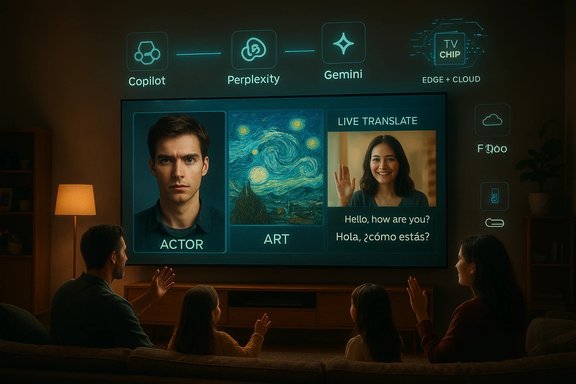
A family watches a living-room screen displaying AI panels: Actor, Art, and Live Translate.Background / Overview​

Samsung opened its CES First Look event with a wide‑ranging declaration: AI must be embedded across the product stack to reshape everyday experiences — from what we watch to how our homes manage energy and health. The company framed this under the banner “Your Companion to AI Living,” with the Vision AI Companion (VAC) as the display‑side anchor and SmartThings AI as the broader home and device orchestration layer. That message is both strategic and practical. Samsung is shipping:
  • a headline 130‑inch Micro RGB TV (a new architecture blending microscopic RGB emitters with an LCD stack),
  • an expanded Vision AI Companion that orchestrates multiple cloud agents (not a single proprietary LLM), and
  • SmartThings AI and appliance upgrades that promise tighter Home‑to‑Car and health integrations.
Taken together, these moves represent a pivot from isolated smart devices toward a unified, multi‑agent AI surface — but the strategy raises equally important questions about latency, compute location (edge vs cloud), privacy, developer access and how real‑world performance will map to vendor claims.

What Vision AI Companion actually is​

A conversational, visual-first TV assistant​

Vision AI Companion is Samsung’s attempt to turn the television — the communal, largest screen in most homes — into a shared, voice‑first conversational surface. It combines:
  • on‑screen visual recognition (identify actors, artwork, products),
  • multi‑turn conversational Q&A optimized for couch‑distance readability,
  • real‑time media features (Live Translate, AI upscaling, adaptive audio), and
  • a multi‑agent orchestration layer that can call external agents such as Microsoft Copilot and Perplexity.
The UX is intentionally social: answers are delivered as large cards and spoken responses so a family can see and hear results without grabbing a phone. A dedicated AI button on supported remotes and an optional QR code sign‑in for account linking make activation and personalization straightforward.

Hybrid architecture: edge + cloud​

Samsung’s stated architecture is hybrid by design. Latency‑sensitive perceptual tasks — actor recognition, live subtitling (Live Translate), AI upscaling and some audio processing — are intended to run on‑device to preserve playback responsiveness. When a query needs long‑context reasoning, web retrieval, or “memory” tied to a user account, the system routes that work to cloud agents such as Microsoft Copilot or Perplexity. This split is pragmatic: TV system‑on‑chips (SoCs) cannot run large LLMs locally at scale, and the hybrid approach balances local responsiveness with the capabilities of cloud models.
However, Samsung has not published exhaustive telemetry boundaries or detailed latency benchmarks for VAC’s multi‑agent orchestration — an omission that matters for real‑time conversational performance and for the privacy implications of routing speech and visual metadata off‑device. Expect reviewers and privacy auditors to press on this point.

Partnerships and the multi‑agent strategy​

Copilot, Perplexity and pluralism​

Samsung’s decision to surface multiple cloud agents — notably Microsoft Copilot for conversational discovery and Perplexity for retrieval‑focused, citation‑forward answers — is its most consequential platform choice. Rather than vendor‑locking users to a single assistant, VAC routes each query to “the best tool for the job,” or lets users pick an agent. That model improves functional flexibility but multiplies the number of backend endpoints and governance surfaces that must be audited.
Independent coverage and Samsung materials confirm both Copilot integration and the Perplexity TV app as launch partners. Those integrations extend Microsoft’s Copilot into the living room while giving Perplexity a retrieval‑centric presence on a large communal screen. The practical result: creative, conversational answers from Copilot alongside sourced, citation‑aware summaries from Perplexity when users want rigorous references.

Broader ecosystem: Google Gemini and device AI​

Samsung is also integrating Google’s Gemini family in some appliance and Galaxy device contexts (for example, AI Vision features on Family Hub refrigerators). The net effect is a pluralistic partner map — Samsung acts as the UI and orchestration layer while tapping different AI providers across device classes. That business model gives Samsung breadth but requires clear account linking, consent flows, and cross‑vendor privacy guarantees.

The hardware story: displays, processors and HDR ambitions​

Micro RGB: a new display axis​

Samsung’s 2026 showcase centers on a Micro RGB family that uses sub‑100 μm red/green/blue emitters in the backlight to increase color volume and peak luminance relative to conventional Mini‑LED backlights. Micro RGB isn’t self‑emissive microLED — it remains an LCD stack — but by shifting color mixing into the backlight itself Samsung claims significant gains in saturated color and HDR highlights. Early claims include VDE verification of expanded color coverage. Buyers should note the tradeoffs: higher color volume and extreme peak brightness can coexist with LCD‑class black‑level limitations and potential haloing if local dimming algorithms are not tightly tuned.

HDR10+ Advanced and HDR fragmentation​

Samsung confirmed that select 2026 models will support HDR10+ Advanced, a step beyond HDR10+ that focuses on higher peak brightness, color accuracy and motion processing. The company released model lists indicating HDR10+ Advanced compatibility (notably across high‑end QN and R-series SKUs), but HDR format fragmentation remains real: Samsung continues to push HDR10+ as its HDR standard rather than Dolby Vision, which may produce inconsistent playback behavior across services and titles. Verify HDR support and tone‑mapping behavior per SKU before purchase.

TV compute: NQ8 AI Gen3 and the unknowns for 2026​

Samsung’s 2024 Neo QLED 8K TVs used the NQ8 AI Gen3 processor (a significant jump in on‑device neural capability compared with earlier generations), and Samsung’s public materials continue to highlight on‑device NPUs as essential to Vision AI’s perceptual features (upscaling, AVA Pro audio, Live Translate). Independent pages from Samsung and coverage of the NQ8 family document the Gen3’s increased neural‑network counts and faster NPU, GPU and CPU elements. Crucially, Samsung has not published comparable chipset or NPU specifications for the 2026 Micro RGB or Vision AI‑shipped models (for example, peak TOPS, local LLM inference capability, or memory bandwidth dedicated to VAC tasks). That gap leaves an important unknown: which VAC features truly run locally and which require cloud fallbacks under typical network conditions. Until Samsung or third‑party labs publish measured on‑device compute and latency figures, claims about “on‑device” AI should be treated as architectural intent rather than verifiable metrics.

SmartThings, appliances and health: the broader AI surface​

SmartThings AI expansion​

Samsung is extending SmartThings beyond simple device control to a proactive, AI‑infused orchestration layer for the home. Announcements at CES outlined SmartThings improvements such as battery‑aware EV charging guidance, AI Energy optimizations, and expanded Home‑to‑Car/Car‑to‑Home integrations with Hyundai/Kia/Genesis. SmartThings now claims a broad installed base (hundreds of millions of users), which gives Samsung scale to apply aggregated, opt‑in learning across devices — but also raises the stakes for privacy and consent when data crosses contexts.

Appliances: Family Hub and AI Vision​

The Family Hub refrigerator and Bespoke appliance lines received concrete AI upgrades. AI Vision on Family Hub — now using Google Gemini in certain markets — promises finer food recognition, inventory tracking and recipe suggestions tied to what’s inside the fridge. Samsung paired appliance AI with partnerships such as Hartford Steam Boiler for insurance incentives, where connected appliance telemetry could potentially inform premium discounts. These are commercially interesting but operationally complex: insurers will want clear SLA and data governance, while consumers will want control over what is shared and retained.

Health: sensor fusion, prediction and risk flags​

Samsung is expanding AI into health analytics, promising that Samsung Health features will analyze sleep, nutrition and activity data to identify risk markers for chronic disease and provide personalized insights. The headline is attractive — early detection and personalized nudges matter — but health‑grade claims require careful clinical validation, data provenance and regulatory oversight. Samsung has signalled intent, but specifics about model validation, clinical trials or FDA/CE‑level medical device classification for new features were not supplied in detail at CES. Buyers and health partners should ask for validation studies, privacy terms and explicit disclaimers about clinical use.

Developer ecosystem and APIs: what’s public and what’s not​

One of the most consequential unknowns for the SmartThings and VAC ecosystem is whether Samsung will expose public APIs for Vision AI or SmartThings AI that let developers create voice skills, custom automations, or health data integrations. SmartThings historically offered SDKs and third‑party device support; Samsung’s promises about expanded AI suggest potential new APIs, but the company has not committed to clear, public developer gateways for VAC’s multi‑agent features. That leaves integrators, hotel/housing operators and third‑party service providers uncertain about the timing and terms for deep integrations.
If Samsung opts for a curated, partner‑first model (Copilot/Perplexity/selected OEMs) rather than an open developer platform, the ecosystem will be wider but less extensible — good for tight UX control, bad for custom vertical solutions. Conversely, opening APIs broadly raises integration possibilities but increases security and privacy management needs. Both tradeoffs matter to enterprise buyers and hospitality / senior‑living operators that might want to build bespoke experiences on top of Vision AI.

Real‑world use cases and vertical opportunity​

Samsung positioned VAC and SmartThings AI as relevant beyond the living room. Notable vertical opportunities include:
  • Hospitality and multi‑dwelling: in‑room TVs that act as concierge agents for guests (check‑in, local tips, language translation), integrated with SmartThings building sensors for energy and comfort control.
  • Senior living and assisted care: TV‑based companions that can translate medication reminders, monitor activity patterns and surface health alerts to caregivers — provided the data governance and consent frameworks are robust.
  • Automotive/home convergence: Home‑to‑Car features with Hyundai and partners that let cars and homes coordinate EV charging, pre‑conditioning and security automations through SmartThings.
These scenarios highlight both upside and complexity: operational savings, convenience and accessibility gains are real, but so are liability and compliance questions when AI recommendations touch medical or safety‑critical decisions.

Risks, caveats and governance​

Latency and real-time performance​

Samsung has not published end‑to‑end latency metrics for conversational VAC use cases, nor has it disclosed which VAC capabilities fall back to cloud inference under poor network conditions. That matters: a perceived “laggy” assistant during playback or a delayed Live Translate will undermine the communal user experience. Until benchmarked latency and on‑device compute figures are published, claims about deep conversational fluency and “real‑time” operation remain aspirational.

Privacy, telemetry and multi‑cloud data flows​

A multi‑agent strategy increases the number of cloud endpoints that may receive voice transcripts, visual metadata or contextual logs. Samsung’s public messaging points to Knox and Knox Matrix as foundational security components, but precise telemetry retention, redaction policies, and cross‑vendor data sharing arrangements are not fully documented in public CES materials. For privacy‑sensitive households or regulated environments (healthcare, elder care facilities), administrators should demand explicit data flow maps and retention/erasure controls before deploying VAC at scale.

Hallucinations and factual integrity​

When TVs or fridges provide answers that influence decisions (health prompts, repair guidance, insurance triggers), hallucinations or inaccurate outputs from LLMs carry real risk. The Perplexity integration helps by offering citation‑aware answers for retrieval tasks, but Samsung’s multi‑agent orchestration must include agent‑selection transparency and user‑facing sourcing to reduce trust erosion. Feature designers should require fallback confirmations for high‑risk recommendations.

Regulatory and clinical claims​

Health features that claim disease‑risk detection or diagnostic capability can intersect with medical device regulations. Samsung has signalled risk‑flagging and personalized insights, but buyers should insist on published validation studies, model training provenance, and clarity about whether features are for wellness/education or for clinical diagnosis. The difference determines regulatory classification and legal obligations.

Practical guidance: what buyers and IT managers should check​

  • Confirm exact feature parity for your SKU and region — VAC, Copilot, Perplexity, HDR10+ Advanced and Live Translate availability can vary by model and country.
  • Evaluate your network and edge compute budget — ask Samsung for on‑device compute specs and latency benchmarks relevant to your use cases. If low latency is required, insist on on‑device fallbacks and measurable SLAs.
  • Audit privacy and telemetry docs — request data‑flow diagrams showing what data leaves the device, where it goes, how long it is retained, and how partners handle it. Make sure account linking (Microsoft, Google) is optional and revocable.
  • For health or enterprise deployments, require model validation and contractual guarantees around false positives/negatives and liability. Obtain clarity on whether features are clinical or wellness tools.
  • For hospitality or multi‑dwelling deployments, demand APIs, integration roadmaps and service‑level commitments around updates, security patches, and remote management. If public APIs are unavailable, secure partner programs or device management alternatives.

Assessment: strengths and potential pitfalls​

Samsung’s Vision AI strategy is, in several ways, the right play for 2026. By:
  • leveraging a hybrid edge/cloud architecture,
  • orchestrating multiple specialized agents,
  • pairing display‑class perceptual AI with massive installed SmartThings scale, and
  • promising extended software support,
Samsung positions itself to deliver a coherent, cross‑device AI experience that can scale across homes and verticals. The Micro RGB hardware and HDR10+ Advanced claims signal concrete display innovation that, if validated by labs, will push the industry on color and brightness.
But execution risk is high. The product promise depends on four measurable realities that Samsung has not fully disclosed:
  • precise on‑device NPU/SoC specifications for the 2026 lineup,
  • reproducible latency metrics for conversational VAC flows,
  • transparent telemetry and retention policies across partners, and
  • clear developer APIs for extensibility and vertical integration.
Until those pieces are published and third‑party labs validate performance and privacy controls, the Vision AI narrative should be interpreted as an ambitious platform announcement rather than a completed, fully‑audited solution.

Conclusion​

Samsung has made a decisive strategic move at CES: Vision AI Companion and a broader SmartThings AI expansion place generative and perceptual AI at the center of its product roadmap. The company’s pluralistic agent approach (Copilot, Perplexity, Gemini and others), the Micro RGB display innovations and the health/appliance ambitions create a plausible path to an AI‑driven home that is helpful, conversational and visually intelligent.
That path — however promising — is littered with implementation questions that matter to consumers, IT managers and regulated industries: where inference runs, how fast conversational flows feel, how data is stewarded across vendors, and whether third parties can build the integrations needed for hospitality, senior living and enterprise use. The coming quarter will be telling: independent lab tests, vendor‑published telemetry, developer SDKs and privacy documentation will turn marketing promises into verifiable capabilities or reveal the limits of the Vision AI vision. Until those proofs are public, the right approach for cautious buyers and IT stewards is pragmatic curiosity — evaluate the demos, insist on measurable specs and data governance, and favor staged pilots where outcomes can be empirically validated.

Source: Asia Business Outlook Samsung Unveils Vision AI Strategy Ahead of CES 2026
 

Samsung’s CES “First Look” in Las Vegas crystallized a new corporate thesis: AI will be the connective tissue across displays, appliances, health services and the smart‑home — not an optional add‑on. The company announced the Vision AI Companion for its TVs and smart monitors, expanded HDR support with HDR10+ ADVANCED, deeper SmartThings intelligence for appliances and home automation, and new Samsung Health capabilities that promise AI‑driven insights about sleep, nutrition and chronic‑disease risk. These moves are anchored to a hybrid edge/cloud strategy and a multi‑agent approach that integrates partners such as Microsoft Copilot and Perplexity, and in several appliance cases Google Gemini.

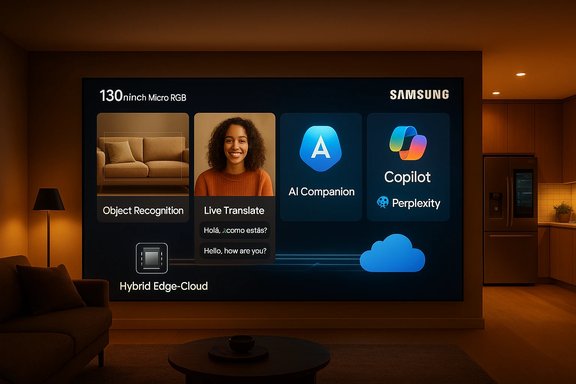
Samsung 130-inch Micro RGB wall display showcasing AI tools like Object Recognition and Live Translate.Background / Overview​

Samsung presented “Your Companion to AI Living” as a product and platform strategy at CES 2026, positioning AI as a pervasive experience across phones, TVs, appliances and services. The company showcased a striking 130‑inch Micro RGB flagship and emphasized a long update window and platform commitments aimed at keeping AI features current over time. Samsung also highlighted SmartThings scale (over 430 million users reported) and announced ecosystem partnerships and product integrations intended to make AI useful for everyday tasks such as identifying on‑screen content, suggesting recipes from fridge contents, or surfacing health‑related insights from wearable data. Samsung framed the technical architecture as hybrid: low‑latency perceptual tasks (vision recognition, Live Translate, AI upscaling) will run on device where possible, while large‑context generative reasoning and retrieval will route to cloud agents. That split is the company’s practical answer to the reality that TV SoCs are not designed to run full‑size LLMs locally, while cloud agents offer broader knowledge and memory capabilities. Yet the company left several detailed execution metrics unspecified, which matters for real‑world latency, privacy and on‑device capability claims.

Vision AI Companion: what it is and what it actually does​

A living‑room, multi‑agent conversational surface​

Vision AI Companion (VAC) is Samsung’s attempt to convert the TV from a passive screen into a shared, conversational hub optimized for “lean‑back” interaction. The UX is explicitly communal: answers are presented as large, glanceable cards plus spoken narration so multiple viewers can read and hear responses without reaching for a phone. Core advertised features include:
  • Conversational multi‑turn Q&A about what’s on screen (actors, plot points, related clips).
  • On‑screen visual intelligence (actor, object, artwork recognition).
  • Live Translate for near‑real‑time subtitles and transcription.
  • Integrated agents (Microsoft Copilot for conversational exploration; Perplexity for retrieval and citations).
  • Close coupling to display features (AI upscaling, scene‑by‑scene HDR remastering, AI gaming mode).
  • Generative Wallpaper and ambient, mood‑based recommendations.

Multi‑agent orchestration — the pragmatic hedge​

Samsung intentionally designed VAC as an orchestration layer rather than a single monolithic assistant. At launch the company surfaced Microsoft Copilot and Perplexity as named agents; Copilot is positioned for conversational discovery and recommendations, while Perplexity provides retrieval‑focused, citation‑aware answers. This design lets Samsung route queries to the best tool for the job and keeps options open as partner capabilities evolve. The multi‑agent stance is strategically important: it avoids a single‑vendor lock and leverages best‑in‑class retrieval or reasoning engines as needed.

On‑device vs cloud: what Samsung says — and what it doesn’t​

Samsung describes a hybrid approach: latency‑sensitive perceptual tasks will run locally, while web retrieval, long‑context reasoning and personalization (memories tied to accounts) will be processed in the cloud. That model is sensible, but Samsung did not publish detailed NPU throughput, on‑chip memory, or explicit latency budgets for multi‑agent conversational flows — the exact data buyers and developers need to gauge whether “visual conversational” queries will feel instant or will suffer from cloud round‑trip delays. Independent reporting and Samsung’s own product pages confirm the hybrid split but leave the on‑device compute floor and cloud dependencies underspecified. This gap matters for privacy, responsiveness and the user experience.

Display and processing: HDR10+ ADVANCED, Micro RGB and the NQ8 AI Gen3​

HDR10+ ADVANCED — what’s new (and verified)​

Samsung announced that its 2026 TV portfolio will support HDR10+ ADVANCED, a format the company frames as improving brightness, color volume and motion processing to better exploit very high‑brightness and wide‑gamut panels. Samsung’s press materials list the first group of supporting models by name, showing HDR10+ ADVANCED is a vendor‑managed extension of HDR10+ targeted at next‑generation displays. This is a visible move to differentiate on processing and tone‑mapping rather than relying solely on external HDR formats.

Micro RGB and the 130‑inch showcase​

Samsung used CES to debut a 130‑inch Micro RGB flagship that pairs microscopic RGB emitters with advanced control engines (branded Micro RGBAI Engine Pro). The company claims the architecture yields exceptional color volume and supports HDR10+ ADVANCED processing, positioning Micro RGB as a step toward large, gallery‑grade displays that sit between traditional LED/LCD and fully self‑emissive (MicroLED/OLED) designs. Samsung’s newsroom and show materials promote this as a flagship product for integrators and luxury buyers.

NQ8 AI Gen3 — verification of Samsung’s claims​

Samsung’s high‑end Neo QLED models use the NQ8 AI Gen3 processor. Samsung’s product documentation states the NQ8 Gen3 powers 8K AI Upscaling Pro with up to 512 neural networks for per‑frame, perceptual tuning and that the NPU is materially faster than the prior generation. Independent product pages and editorial coverage corroborate the 512‑network claim and the marketing of NQ8 as the most advanced TV‑grade SoC in Samsung’s lineup. However, Samsung’s public materials emphasize neural‑network counts and relative speed improvements rather than absolute NPU TOPS, memory bandwidth, or precise inference latencies — metrics that would allow rigorous comparison with other edge NPUs. For readers evaluating responsiveness for Vision AI Companion features (object recognition, Live Translate), this omission is a practical concern.

SmartThings, appliances and the “AI home” play​

SmartThings AI and integrated appliances​

Samsung presented SmartThings as the orchestration backbone for the AI home. Announcements highlighted appliances that use camera, sensor and voice data to automate tasks — refrigerators that track food and suggest recipes, ovens that convert recipe steps into device actions, washers that detect fabric and soil levels, and robot vacuums that feed video to the hub for monitoring. Samsung also emphasized logistics and partner integrations, including a pilot with insurance partner Hartford Steam Boiler to explore cost savings tied to SmartThings telemetry.

Family Hub, Google Gemini and AI Vision​

Samsung’s Family Hub refrigerators are being upgraded with AI Vision powered by Google Gemini for improved food recognition and inventory tracking. That integration is explicitly cited in Samsung’s materials and corroborated by several news outlets. The upgrade aims to improve meal planning, food waste reduction and cross‑device automation (send a recipe to an oven or start a cook mode), but Samsung cautions recognition has limits — freezers and certain items may not be identified automatically. These are practical, incremental automation gains, not magic.

Developer access, APIs and ecosystem opportunities — unknowns that matter​

SmartThings historically offered SDKs for third‑party IoT devices. Samsung’s strategic choice to open Vision AI Companion and SmartThings AI through well‑documented APIs would be a major accelerator for developers and integrators (hospitality, senior‑care, multi‑dwelling units). At CES Samsung emphasized partner integrations and Home‑to‑Car services with Hyundai, but the company has not publicly committed to a detailed Vision AI developer API program or confirmed the data model and privacy boundaries for third‑party access. That uncertainty constrains enterprise use cases (e.g., eldercare monitoring with cognitive decline detection) until Samsung publishes formal platform APIs, documentation and privacy controls.

Samsung Health: clinical‑grade claims vs consumer insights​

Samsung described a set of upcoming Samsung Health features that will analyze sleep, nutrition and activity data to identify potential chronic‑disease risks and offer personalized recommendations. The pitch positions Samsung Health as more proactive: detecting patterns early and nudging users toward preventive actions. The company tied this to wearable telemetry (Galaxy Watch family) and cross‑device continuity to present charts and recommendations on TV or monitor surfaces.
Important caveats apply:
  • The materials describe risk identification and personalized guidance — not medical diagnoses. Regulatory and clinical validation requirements differ by market and by the level of actionability claimed.
  • Samsung’s public statements do not include the underlying models, clinical validation studies, or thresholds used to escalate risk. Those are essential for clinicians and privacy regulators to assess real‑world safety and efficacy.
  • For consumers, Samsung Health’s recommendations should be treated as lifestyle guidance pending formal clinical validation and regulatory clearance where applicable. Samsung’s documentation notes general accuracy caveats and account‑link requirements.

Strengths: why Samsung’s approach matters​

  • Ecosystem scale and continuity. Samsung has major reach across phones, TVs, appliances and wearables; that cross‑device footprint (Samsung Account + SmartThings) gives the company a rare opportunity to deliver joined‑up experiences at home.
  • Pragmatic hybrid architecture. By separating low‑latency perceptual tasks (on‑device) from heavy reasoning (cloud agents) Samsung keeps the UI responsive for media playback while still enabling powerful cloud‑backed features.
  • Multi‑agent flexibility. The federated agent approach lets Samsung combine Copilot’s conversational strengths with Perplexity’s retrieval accuracy and third‑party specialist models, improving answer quality and resilience to a single partner’s limitations.
  • Longer software support promise. Samsung’s commitment to extended One UI Tizen updates for eligible models boosts device longevity for AI features that evolve over years, which is a buyer advantage.

Risks and unanswered questions​

1) Execution and latency for visual conversational queries​

Routing heavy inference to cloud agents creates real risk of perceptible delay for multi‑modal queries (e.g., “Who’s that actor?” while pausing playback). Samsung’s materials emphasize on‑device perceptual tasks but do not publish NPU TOPS, memory, or latency targets. That lack of hard metrics makes it hard to predict whether complex, exploratory conversations will feel instant or lagged. Independent hands‑on reviews and lab measurements will be decisive.

2) Privacy and data flows across partners​

Vision AI Companion’s multi‑agent model implies data sharing across Samsung, Microsoft, Perplexity, Google (in appliances) and other partners. Samsung cites Knox protections and red‑team model approval processes, but the company has not published granular telemetry or retention policies for queries routed to third‑party agents. In shared living‑room contexts, users may not expect queries to be forwarded to cloud agents tied to external accounts unless onboarding flows are explicit and granular. Clear, accessible privacy controls will be critical to user trust.

3) Platform openness and developer terms​

Third‑party ISVs and integrators stand to gain if Vision AI Companion and SmartThings AI ship with robust APIs and data contracts. Samsung has not, at CES, published a detailed developer roadmap for Vision AI or comprehensive API availability for the multi‑agent surface. That uncertainty slows ecosystem innovation until official documentation and SDKs appear.

4) Clinical and regulatory rigor for health features​

Health‑adjacent claims that identify chronic‑disease risk require careful clinical validation and clear user guidance. Samsung’s materials present these features as preventive insights rather than diagnoses, but absent peer‑reviewed validation or regulatory clearances the functionality should be treated as informational rather than clinical. Users and integrators should exercise caution implementing automation that depends on health flags without human oversight.

5) HDR and format fragmentation​

HDR10+ ADVANCED is a vendor‑managed enhancement. The industry has multiple HDR standards, and while Samsung is pushing HDR10+ ADVANCED to exploit its own high‑brightness displays, consumers and integrators should expect format fragmentation to persist across premium ecosystems. This complicates mastering workflows and content delivery for integrators specifying rooms and installations.

What developers, integrators and power users should watch​

  • Vendor documentation and API availability: confirm whether Vision AI Companion and SmartThings AI expose public SDKs and event hooks for third‑party automations. The sooner Samsung publishes APIs, the faster integrators can build vertical solutions (senior care, hospitality, multi‑dwelling automation).
  • Firmware and OS support lists: verify model‑level compatibility with VAC and HDR10+ ADVANCED. Samsung has pledged staged rollouts and extended updates, but not every model will support every feature.
  • Lab measurements for NPU performance and latency: independent testing is the only way to know how responsive visual conversational flows will be in living rooms. Look for measured inference latencies, NPU TOPS, and memory bandwidth figures.
  • Privacy controls and data residency: confirm default data flows, retention periods and whether third‑party agents receive only anonymized, session‑limited contexts or persistent, account‑linked history.
  • Clinical validation details for Samsung Health: request published validation studies, model descriptions and regulatory clearances for any features that claim disease risk detection. Treat recommendations as lifestyle prompts until clinical evidence is documented.

Practical buying and deployment guidance​

  • For consumers who prioritize immediate, snappy on‑screen assistance and privacy, favor models with the most advanced on‑device SoCs (Neo QLED with NQ8 Gen3 family) and confirm local processing claims in the hands‑on reviews. The NQ8 Gen3 marketing materials show 512 neural networks and performance uplifts, which aligns with Samsung’s responsiveness goals, but absolute NPU metrics are not published.
  • For integrators deploying SmartThings in commercial settings (senior living, hospitality), insist on documented APIs, data contracts, and an agreed support SLA with Samsung or certified partners before building health‑adjacent automation. Without explicit platform guarantees, risk and liability can quickly become barriers.
  • For privacy‑sensitive households, verify account linking flows for Copilot, Perplexity and Google Gemini integrations; ensure families understand when on‑device queries will be handled locally versus forwarded to cloud agents. Samsung’s onboarding options include QR sign‑in for partner accounts, but defaults and telemetry practices should be audited.

The broader industry context and implications​

Samsung’s CES 2026 posture reflects a broader trend: hardware vendors are packaging edge AI (NPUs, vision engines) with cloud orchestration to create practical, usable experiences. By integrating specialist agents, partnering with major AI providers, and promising extended OS updates, Samsung is betting that consumers will value platform continuity and cross‑device convenience. If executed well, this could accelerate the adoption of ambient AI surfaces in the home. If execution falters — particularly around latency, privacy, or API openness — the strategy risks fragmenting user trust and developer investment. Reuters and other outlets report Samsung doubling down on partnerships (including expanding Gemini on mobile devices), reinforcing that this is a strategic company‑wide shift, not a single product splash.

Conclusion​

Samsung’s CES announcements mark a clear strategic pivot: AI is moving from feature add‑on to platform foundation across displays, appliances and health services. The Vision AI Companion and SmartThings AI promise genuinely new living‑room and home scenarios, while HDR10+ ADVANCED and Micro RGB target high‑end visual fidelity for new form factors. Strengths include Samsung’s ecosystem scale, multi‑agent flexibility and hybrid edge/cloud pragmatism. Key risks center on execution details that Samsung has not fully disclosed — notably absolute NPU metrics, latency budgets for multi‑modal conversation, developer API commitments, and clinical validation for health claims. For buyers, integrators and developers the next critical milestones will be published APIs and privacy contracts, independent latency and NPU measurements, and third‑party lab verification of display claims. Until then, Samsung’s vision is compelling on paper and offers real opportunity — but the practical experience will hinge on technical transparency and robust platform governance.
Source: Tech in Asia https://www.techinasia.com/news/samsung-to-apply-ai-across-entire-product-lineup/amp/
 

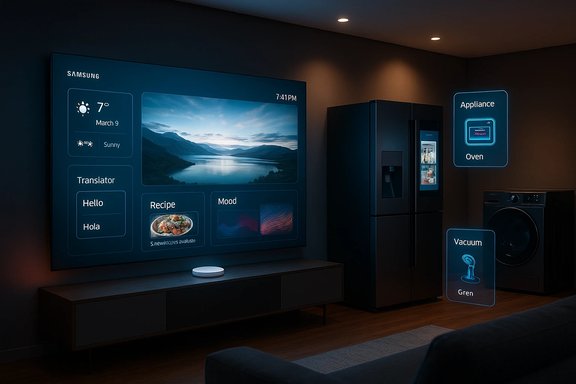
Futuristic living room with a Samsung wall display and holographic appliance controls.
Samsung is applying artificial intelligence across its entire product lineup, unveiling a sweeping “Companion to AI Living” strategy at its pre‑CES 2026 press events that stitches together new TVs, an expanded SmartThings hub, AI‑enabled appliances, and health features that promise personalized wellness insights.

Background / Overview​

Samsung framed CES 2026 as the moment when AI stops being a feature and becomes the platform: a single thread woven into displays, home appliances, mobility integrations and health services. The company introduced the Vision AI Companion (VAC) as the conversational and multimodal layer for TVs, rolled out HDR10+ Advanced and a 130‑inch Micro RGB flagship to push display fidelity, and announced AI upgrades for the Family Hub refrigerator and Samsung Health. Samsung also emphasized scale — reporting SmartThings has grown into a mass platform — and reiterated its hybrid edge/cloud strategy, with on‑device perceptual work paired with cloud agents for broader reasoning and retrieval.
This is a deliberate repositioning. Samsung is using three strengths it already controls — hardware scale, device diversity (phones, TVs, appliances), and an installed ecosystem (SmartThings) — to deliver integrated AI experiences that are meant to feel helpful rather than gimmicky. The announcements at the Wynn and in Samsung’s newsroom provided a broad vision; the technical and operational details needed to evaluate performance and privacy remain unevenly specified.

Vision AI Companion: a living‑room AI orchestrator​

What Samsung says VAC will do​

Vision AI Companion is positioned as a multi‑modal, multi‑agent assistant that sits on top of Samsung’s TV and lifestyle displays. Key consumer‑facing functions Samsung showcased include:
  • Conversational discovery — multi‑turn Q&A about what’s on screen (actors, scenes, context) presented as large visual cards and spoken narration.
  • Visual intelligence — object and actor recognition tied to on‑screen content for click‑to‑search and contextual prompts.
  • Live Translate — near‑real‑time transcription and subtitle translation for in‑program audio.
  • Proactive recommendations — suggestions for shows, recipes, music and mood‑based content.
  • Third‑party agent access — orchestrated calls to partner agents such as Microsoft Copilot for conversational exploration and Perplexity for retrieval‑focused answers.
VAC is explicitly communal in design: its UI and spoken responses are optimized for small groups watching together rather than single‑user phone interactions. Samsung also highlighted convenience features like an AI button on certain remotes and QR‑based account linking for personalization.

Multi‑agent design: pragmatic, but complex​

The multi‑agent approach is strategic. Instead of betting on a single proprietary model, VAC is an orchestration layer that routes queries to the best tool — a retrieval agent for citation‑aware answers, a reasoning agent for deeper conversation, and on‑device models for perceptual tasks. This flexibility reduces vendor lock‑in and lets Samsung leverage partner strengths, but it multiplies operational complexity:
  • Data must flow across multiple cloud endpoints.
  • Query routing logic must decide, in real time, what runs local and what runs remotely.
  • User expectations for latency and privacy increase as more services handle the same interaction.
Samsung’s public descriptions of VAC emphasize hybrid processing — on‑device for latency‑sensitive perception, cloud for long‑context reasoning — but they stop short of publishable latency targets or a clear list of what always runs locally versus what can be routed to partners.

TVs, HDR10+ Advanced and Micro RGB: hardware meets AI​

HDR10+ Advanced — display processing gets an upgrade​

Samsung announced HDR10+ Advanced as the new HDR processing tier for its 2026 TV portfolio. The company frames this format as tailored to very high‑brightness, wide‑gamut panels and claims it brings improved tone‑mapping, color volume handling and motion processing. Samsung listed a set of 2026 models that will adopt the format, signaling it intends HDR10+ Advanced to be a platform differentiator for high‑end sets.
This is less about inventing a new file format and more about using smarter per‑frame processing pipelines to extract fidelity from next‑generation displays. HDR10+ Advanced is a vendor‑driven enhancement to existing HDR10+ metadata workflows to exploit brighter panels and finer local control.

Micro RGB 130‑inch — a flagship showpiece​

Samsung used CES to show a striking 130‑inch Micro RGB display, marketing it as a new category that brings microscopic red, green and blue emitters together with advanced AI engines (branded Micro RGB AI Engine Pro) to deliver exceptional color coverage and tone control. The set is pitched at luxury installations and integrators who need gallery‑scale imagery.
The Micro RGB hardware is coupled with software stacks meant to manage per‑emitter color precision, temporal stability and adaptive tone‑mapping. That software dependency is both a power and a vulnerability: when tuned well, it enables consistently outstanding imagery; when rushed or poorly updated, it can produce visible artifacts or color shifts.

NQ8 AI Gen3 — the processor story, and contradictory numbers​

Samsung’s high‑end Neo QLED family uses the NQ8 AI Gen3 processor, which Samsung marketing materials say powers advanced 8K upscaling and per‑frame AI features. Published specs vary by region and product page: some materials describe the processor as using 512 AI neural networks, while other Samsung regional pages later mention 768 neural networks and list relative NPU, GPU and CPU performance improvements.
These inconsistencies matter. Neural‑network counts and relative claims are useful marketing shorthand, but they are poor substitutes for concrete metrics that actually predict real‑world responsiveness: inference throughput (TOPS), memory bandwidth, on‑chip SRAM, batching latency and thermal headroom. Samsung has not consistently disclosed those measurements, and the discrepancy between 512 and 768 networks across public pages underlines the need for independent lab verification.

SmartThings, appliances and the AI home​

SmartThings becomes the orchestration backbone​

Samsung is positioning SmartThings as the orchestration and telemetry backbone for the AI home. With an installed base Samsung describes as hundreds of millions of users, SmartThings already handles device discovery, scenes and automations across Samsung’s own devices and thousands of third‑party IoT objects. The plan is to augment that orchestration with AI so appliances can interact more intelligently — refrigerators that suggest recipes, ovens that convert a recipe into device actions, vacuums that act as remote cameras, and washers that optimize cycles based on detected fabric types.
The company touted integrations such as SmartThings Home‑to‑Car with Hyundai and a pilot insurance program that explores premium reductions based on device telemetry. These partnerships show the breadth of use cases for SmartThings AI, but they also highlight the growing complexity of cross‑company data sharing.

Family Hub and AI Vision: Google Gemini enters the kitchen​

Samsung announced an upgrade to Family Hub that integrates AI Vision powered by Google Gemini for improved food recognition and inventory management. The refrigerator’s internal camera plus AI processing is meant to track items placed in and out, recommend recipes, and generate weekly food reports. Samsung described features like “Video to Recipe” (convert cooking videos into step‑by‑step guides) and FoodNote, a weekly recap of eating patterns.
This is a sensible place to apply constrained computer vision models, where a controlled camera angle and limited domain (food items) make accuracy achievable. Still, the company’s own materials caution that recognition will not be perfect, require occasional user correction, and may not cover frozen items — sensible caveats for a feature at preview stage.

Samsung Health: wellness insights, risk detection, and clinical caution​

What was announced​

Samsung said Samsung Health will add AI features to analyze sleep, nutrition and activity data with the aim of identifying potential chronic‑disease risks and delivering personalized recommendations. The company also previewed technology that analyzes walking speed and finger movement patterns to surface potential signs of cognitive decline.

Why this needs clinical validation​

Turning sensor data into clinically meaningful risk signals is tempting, but it is also high stakes. Small changes in gait, finger tapping or sleep architecture can correlate with early cognitive changes or cardiometabolic risk, but clinical use requires:
  1. Validated algorithms: peer‑reviewed studies showing sensitivity, specificity and predictive value.
  2. Regulatory oversight: medical claims typically trigger device and software‑as‑medical‑device classifications in multiple jurisdictions.
  3. Transparent data governance: clear user consent, opt‑in flows and retention policies.
Samsung’s roadmap suggests a wellness‑first posture rather than diagnostic claims, but the company must be explicit about the difference. Until independent validation and regulatory clearance (where applicable) appear, these features should be treated as informative wellness guidance rather than clinical diagnostics.

Developer and partner implications: are APIs coming?​

Samsung’s SmartThings platform historically exposes SDKs and APIs for third‑party integrations, and the company has publicly referenced partner agent integrations and scale. What remains unclear is whether Vision AI Companion itself will open programmable APIs for developers to create custom automations, voice skills or vertical apps.
Potential outcomes:
  • If Samsung exposes VAC APIs and a developer SDK, third‑party developers and systems integrators could rapidly build vertical solutions (eldercare monitoring, hospitality integrations, multi‑dwelling automation).
  • If VAC remains a closed orchestration only linking named partners, innovation will be constrained to Samsung and selected platform partners.
The difference is meaningful. An open VAC with clear, well‑documented APIs could spark a wave of niche AI services built on millions of SmartThings endpoints. A closed model could preserve user experience control but slow ecosystem innovation.

Execution risks and governance — the tough questions​

1) Latency and the hybrid split​

Samsung repeatedly says latency‑sensitive tasks will run on device and long‑context reasoning will run in the cloud. However, the company has not published end‑to‑end latency budgets, NPU TOPS, memory allocation or fallbacks for poor networks. For a conversational TV experience to feel natural — especially when queries reference live video — sub‑second responses are critical. Without measured benchmarks, consumer experiences may vary widely.

2) Privacy, telemetry and cross‑vendor data flows​

VAC’s multi‑agent architecture routes data to partners (Microsoft, Perplexity, Google Gemini in appliances). That increases the number of cloud endpoints that may see voice transcripts, visual metadata, and contextual logs. Samsung calls out Knox and Knox Matrix as foundational protections, but the public materials lack granular detail about:
  • Which data is retained and for how long.
  • Whether visual captures are persisted, redacted or anonymized.
  • How consent is obtained and how opt‑outs are enforced across partner agents.
Buyers should expect detailed privacy controls and transparency documentation before enabling deep VAC features.

3) Inconsistent performance claims and specification gaps​

Marketing numbers like “512 neural networks” or “768 neural networks” and statements of relative NPU speed don’t answer the real technical question: what does the processor deliver under sustained, multi‑modal workloads? Clear metrics (TOPS, memory bandwidth, measured inference latency for typical queries) are needed to predict user‑perceived responsiveness.

4) Health claims require clinical and regulatory clarity​

Analytics that flag chronic disease risk or cognitive change risk cross a regulatory line. Samsung must either limit these features to non‑diagnostic wellness suggestions or subject them to clinical trials and regulatory filings where required. Users should be told explicitly what the features can and cannot do, and how results should be handled with medical professionals.

Strengths and opportunities​

Ecosystem scale and device diversity​

Samsung’s unique advantage is the breadth of its device ecosystem. Combining TVs, refrigerators, phones, wearables and home appliances under SmartThings provides a dataset and control plane few competitors can match. That scale is a powerful enabler for practical AI features that rely on cross‑device signals.

Partner strategy reduces single‑vendor risk​

The multi‑agent approach leverages specialized partners for retrieval and reasoning, which can accelerate capability delivery and ensure best‑in‑class components — for example, partnering with Microsoft for Copilot and Google for Gemini in appliances.

Developer potential and new verticals​

If APIs are opened, the SmartThings + VAC platform could enable an array of vertical applications:
  • Elder care monitoring combining gait data, fridge access patterns and wearable activity.
  • Hospitality in‑room services that use VAC for concierge interactions and integrate with property automation.
  • Assisted living memory aids that combine on‑screen prompts with scheduled appliance and environment changes.
These scenarios could transform existing smart‑home value propositions into service offerings for integrators and ISVs.

Competitive landscape: who’s reacting?​

Competitors are not standing still. Rivals are pushing their own on‑device AI processors, hybrid models, and TV assistants. Samsung’s Micro RGB and HDR10+ Advanced address a premium display segment, but LG, Sony and others are also advancing micro‑emissive and software‑led picture stacks. The multi‑agent orchestration has potential, but competitors may match or outflank Samsung with clearer privacy postures, more transparent performance claims, or more open developer ecosystems.

What to watch next — milestones that matter​

  1. Published NPU metrics and latency benchmarks — measured TOPS, memory, and real‑world inference times for VAC tasks.
  2. Firmware and SDK releases — documentation and APIs for Vision AI Companion and any developer programs tied to SmartThings.
  3. Privacy and data‑handling documentation — clear retention policies, redaction rules for images and audio, and partner data‑sharing agreements.
  4. Clinical validation or regulatory filings for Samsung Health features that claim disease risk detection or cognitive decline screening.
  5. Independent reviews and lab tests — hands‑on latency testing for visual‑conversational tasks and third‑party verification of HDR10+ Advanced and Micro RGB performance.
Those milestones will determine whether Samsung’s vision translates into reliable, accountable consumer experiences.

Practical guidance for buyers, integrators and developers​

  • For buyers: treat early VAC features as useful experiments, especially for health‑related insights. Demand privacy controls and ask for region‑specific availability before committing sensitive data.
  • For integrators: monitor Samsung’s developer announcements. If APIs are made available, the platform could be a high‑value channel for vertical services in elder care, hospitality and multi‑dwelling automation.
  • For developers: prepare for hybrid integration. Expect a mix of on‑device SDKs for perception and cloud webhook/agent interfaces for retrieval and long‑context reasoning.
  • For enterprise partners and insurers: evaluate telemetry benefits carefully against operational and privacy risks. Pilots and opt‑in user consent frameworks will be essential.

Conclusion​

Samsung’s CES 2026 announcements articulate an ambitious and believable direction: convert scale into intelligence by turning devices into a single, connected AI companion for the home. The company’s strengths — hardware scale, SmartThings reach, and strategic partner relationships — give it a realistic path to deliver utility that matters to everyday users.
Yet compelling marketing and powerful demos do not automatically equal consistent, private, low‑latency experiences in the real world. The most important near‑term gaps are measurable execution details: NPU throughput and latency budgets, explicit on‑device vs cloud partitions, clear developer APIs, and rigorous governance for health and privacy. Until Samsung discloses these hard numbers and publishes SDKs and privacy contracts, the Vision AI Companion will remain an exciting platform with important unanswered questions.
If Samsung can close those gaps with transparent technical specs, robust developer access and responsible data practices, it can turn a strong CES narrative into a genuine, lasting advantage in the AI home. The coming months — firmware releases, SDK announcements and independent performance reviews — will reveal whether the company’s AI across an entire product lineup becomes everyday practical or simply impressively ambitious.

Source: Tech in Asia https://www.techinasia.com/news/samsung-to-apply-ai-across-entire-product-lineup/
 

Back
Top