

Schneider Electric’s PowerLogic P7 protection and control platform, used in advanced electrical network environments worldwide, is affected by three disclosed vulnerabilities in firmware version 0.2.003.001.000 and earlier, with CISA republishing Schneider’s advisory on June 25, 2026, after the vendor’s June 9 release. The fix is PowerLogic P7 firmware V02.004.001, and applying it requires a reboot. The uncomfortable part is not that a relay-adjacent platform has bugs; it is that the bugs sit exactly where modern substations, industrial power systems, and critical facilities have been adding convenience: network-exposed management services, touch HMIs, and remote configuration paths. The P7 advisory is a small document with a large message for operators: power infrastructure is now software infrastructure, and software infrastructure needs patch discipline even when reboot windows are politically expensive.
On paper, this is a straightforward industrial control systems advisory. Schneider Electric says affected PowerLogic P7 versions include 0.2.003.001.000 and prior, and that firmware V02.004.001 contains fixes for the reported issues. Customers are directed to Schneider Electric’s Customer Care Center to obtain the firmware, and the remediation requires a reboot.
That last sentence is where the industrial world diverges from ordinary enterprise IT. A laptop reboot is an annoyance; a protection and control platform reboot can become a change-control event involving operations teams, electrical engineers, vendor support, maintenance windows, and risk sign-off. The advisory does not say exploitation is happening in the wild, but it does say the consequences can include unauthorized privileged command execution or loss of HMI and configuration functionality.
The affected device class matters. PowerLogic P7 is not a consumer router or a forgotten web camera on a shelf. It is a protection and control platform intended for demanding electrical network applications, the kind of kit that lives close to the systems facilities depend on when everything else is already under stress.
That is why these three CVEs should not be read as an isolated firmware footnote. They are a reminder that the security perimeter around operational technology is only as strong as the services quietly listening inside it.
The second high-severity issue, CVE-2026-9717, is the one that will draw the most attention from security teams. It is an OS command injection vulnerability rated CVSS 7.2, and Schneider describes it as allowing unauthorized execution of commands with elevated privileges when a privileged authenticated user interacts with a vulnerable network-exposed service. The privilege requirement tempers the remote-exploit panic, but it does not make the issue benign.
In industrial networks, “privileged authenticated user” is not always the narrow category it should be. Shared engineering accounts, vendor maintenance access, old laptops, remote support jump boxes, and flat management segments have a way of turning a theoretically constrained bug into a practical incident path. A vulnerability that requires privileges is still dangerous if the environment has normalized broad privileges as an operational convenience.
The third vulnerability, CVE-2026-9718, is a reachable assertion flaw rated CVSS 4.9. It requires authentication and can allow a specially crafted request to trigger a denial-of-service condition. Its medium score may make it look secondary, but in a power operations context, repeated or well-timed availability failures can be more consequential than their numeric severity suggests.
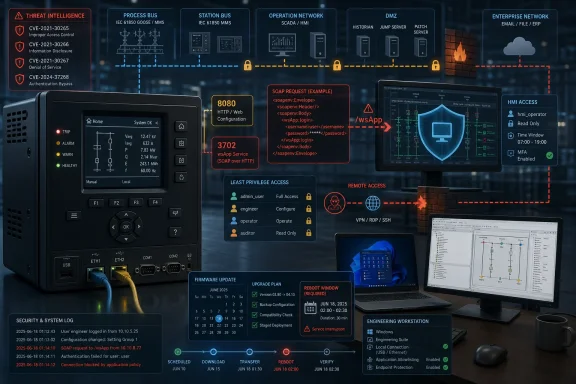
The advisory’s mitigation language points directly at the likely exposure surface. Schneider recommends restricting network access to P7 service endpoints on ports 8080 and 3702, monitoring anomalous SOAP requests targeting wsApp, and applying least privilege to users interacting with the device. That is not generic boilerplate; it is a useful map of where defenders should look first.
That is a recurring pattern in modern OT risk. The systems that once required local presence, serial cables, or physically controlled engineering stations now support richer remote workflows. Those workflows are valuable. They reduce truck rolls, speed diagnosis, and fit the reality of distributed facilities. But every convenience layer creates code, and every code layer creates failure modes.
For WindowsForum readers, the lesson maps neatly onto the enterprise management story we already know. Remote administration begins as efficiency, then becomes dependency, then becomes critical attack surface. The difference in OT is that the managed endpoint may be tied to electrical protection, plant uptime, or facility resilience rather than a user’s desktop profile.
The advisory does not claim the P7 would misoperate protection functions as a direct result of these flaws. It does warn of possible loss of control over system operations and disruption of critical services if remediation is not applied. That distinction matters: this is not a movie-plot “hack the grid” narrative, but neither is it routine IT housekeeping.
The P7 advisory shows why defenders should treat severity scores as triage inputs, not final judgments. CVE-2026-9716 requires no privileges, no user interaction, low attack complexity, and network access. That combination deserves fast segmentation review even before firmware can be applied. If the vulnerable interface is reachable from networks it should not be reachable from, the organization has a live architectural problem, not merely a pending patch.
CVE-2026-9717 has a higher barrier because it requires high privileges, but its potential impact is broader: confidentiality, integrity, and availability are all rated high. In practical terms, that means the bug belongs in the same conversation as credential hygiene, remote access controls, and privileged access management. A patch fixes the bug; it does not fix an environment where too many users or systems can reach sensitive services with administrative authority.
CVE-2026-9718 is the quiet one. Authenticated denial of service is the kind of weakness that can be dismissed during a busy patch cycle, particularly if there is no known exploitation. But when the same affected product already needs a reboot for two higher-severity issues, there is little argument for leaving this one behind.
The CISA version also makes clear that this is a verbatim republication of Schneider Electric’s CSAF advisory, not an independent technical teardown. That matters because readers should not mistake the federal wrapper for a separate investigation or additional validation of exploitability. The value of the CISA posting is visibility and standardization, not necessarily new technical evidence.
Still, visibility is not trivial. Critical infrastructure operators live under advisory fatigue, especially when vendors release monthly bundles across large product portfolios. A CISA ICS advisory gives security teams a common reference point for vulnerability management meetings, regulator-facing conversations, and internal risk registers.
It also gives attackers a common reference point. That is the awkward tradeoff of all coordinated disclosure. Once advisories are public, defenders gain clarity, but so do researchers, red teams, and malicious actors. The mitigation clock starts whether or not the maintenance window is ready.
The affected version boundary is clear enough: PowerLogic P7 version 0.2.003.001.000 and earlier. But in many environments, the firmware version of a field device is not visible in the same dashboards that track Windows Server patch levels or endpoint detection coverage. Engineering tools may know; central IT may not.
That divide is one of the persistent weaknesses in OT security. IT has tooling maturity, change cadence, and vulnerability process. OT has physical context, operational authority, and deep device knowledge. Advisories like this demand both sides at once.
The practical first step is not to download firmware blindly. It is to identify every P7 device, confirm firmware versions, determine whether ports 8080 and 3702 are reachable beyond intended engineering networks, and decide whether temporary segmentation can be applied before the reboot window. In mature environments, that should be routine. In many real ones, it will expose uncomfortable gaps.
For the P7 specifically, restricting access to ports 8080 and 3702 should become an immediate network-control task. If those services are reachable from general corporate networks, wireless networks, unmanaged vendor laptops, or broad VPN pools, the organization has more exposure than the advisory’s idealized assumptions imply. If they are reachable from the internet, the problem is urgent.
Monitoring SOAP requests targeting wsApp is another useful clue. SOAP may feel like yesterday’s enterprise plumbing, but industrial environments keep protocols and middleware around for long lifecycles. Security tools tuned only for modern web APIs can miss the operational relevance of older service patterns.
Least privilege is the hardest mitigation because it requires changing habits. Engineering teams often value speed and certainty, and administrative rights become the grease that keeps maintenance moving. But CVE-2026-9717 shows why privileged access must be narrow, attributable, and temporary wherever possible.
That means a PowerLogic P7 vulnerability can become a Windows administration problem through the management path. If a domain-joined engineering workstation has access to P7 service endpoints, then endpoint compromise, credential theft, or sloppy remote access can become part of the risk chain. The vulnerable device may be OT, but the route to it may run through ordinary enterprise infrastructure.
This is where many organizations still get the model wrong. They imagine OT risk as something sealed behind a firewall and owned by specialists. In practice, the firewall has exceptions, the specialists use Windows laptops, the vendor needs remote access, and the maintenance workflow depends on shared identity and file transfer systems.
The right response is not for IT to seize control of OT or for OT to reject IT involvement. It is for both teams to map the actual dependencies. Which Windows systems can reach P7 management services? Which accounts can authenticate? Which remote access paths land near the device? Which logs would show anomalous SOAP traffic? Those are Windows-adjacent questions with operational consequences.
After patching, operators should verify that the device is no longer running an affected version, that the reboot completed cleanly, and that configuration and HMI functions remain healthy. They should also preserve the change record, because OT patch history often becomes critical during audits, incident response, and future vulnerability triage.
Then comes the harder part: deciding why the vulnerable services were reachable by whoever could reach them. If the answer is “because that is how it has always been,” the next advisory will recreate the same scramble. If the answer is a documented operational requirement, the access path should be limited, monitored, and reviewed.
There is also a vendor-management lesson here. Schneider’s firmware is available through Customer Care rather than a casual public download path. That is common in industrial equipment, but it means organizations need support relationships, entitlement clarity, and tested procedures before an advisory lands. The middle of a security event is a poor time to discover that nobody knows who can request firmware.
The least prepared organizations will discover that they have PowerLogic devices but no authoritative owner, firmware versions but no central record, remote access but no precise access list, and logs that cannot easily distinguish normal engineering traffic from suspicious requests. That discovery is painful, but it is still useful if leadership treats it as a systems problem rather than an operator failure.
The concrete actions are not mysterious:
PowerLogic P7 operators should patch, segment, and monitor, but the broader takeaway is architectural: every new management interface in critical infrastructure is both a productivity feature and a security promise. The organizations that keep that promise will be the ones that know what they own, know who can reach it, and can update it without turning every firmware release into an emergency.
 The Patch Is Simple; the Environment Is Not
On paper, this is a straightforward industrial control systems advisory. Schneider Electric says affected PowerLogic P7 versions include 0.2.003.001.000 and prior, and that firmware V02.004.001 contains fixes for the reported issues. Customers are directed to Schneider Electric’s Customer Care Center to obtain the firmware, and the remediation requires a reboot.That last sentence is where the industrial world diverges from ordinary enterprise IT. A laptop reboot is an annoyance; a protection and control platform reboot can become a change-control event involving operations teams, electrical engineers, vendor support, maintenance windows, and risk sign-off. The advisory does not say exploitation is happening in the wild, but it does say the consequences can include unauthorized privileged command execution or loss of HMI and configuration functionality.
The affected device class matters. PowerLogic P7 is not a consumer router or a forgotten web camera on a shelf. It is a protection and control platform intended for demanding electrical network applications, the kind of kit that lives close to the systems facilities depend on when everything else is already under stress.
That is why these three CVEs should not be read as an isolated firmware footnote. They are a reminder that the security perimeter around operational technology is only as strong as the services quietly listening inside it.
Network-Exposed Services Turn Local Engineering Tools Into Remote Risk
The most severe of the three issues by score is CVE-2026-9716, a null pointer dereference rated CVSS 7.5. It can be triggered over exposed network interfaces with malformed requests and can render the device’s HMI and configuration functionality unavailable. In ordinary software terms, that is a denial-of-service bug; in an OT environment, it is the difference between an operator having visibility and configuration access, and an operator suddenly needing fallback procedures.The second high-severity issue, CVE-2026-9717, is the one that will draw the most attention from security teams. It is an OS command injection vulnerability rated CVSS 7.2, and Schneider describes it as allowing unauthorized execution of commands with elevated privileges when a privileged authenticated user interacts with a vulnerable network-exposed service. The privilege requirement tempers the remote-exploit panic, but it does not make the issue benign.
In industrial networks, “privileged authenticated user” is not always the narrow category it should be. Shared engineering accounts, vendor maintenance access, old laptops, remote support jump boxes, and flat management segments have a way of turning a theoretically constrained bug into a practical incident path. A vulnerability that requires privileges is still dangerous if the environment has normalized broad privileges as an operational convenience.
The third vulnerability, CVE-2026-9718, is a reachable assertion flaw rated CVSS 4.9. It requires authentication and can allow a specially crafted request to trigger a denial-of-service condition. Its medium score may make it look secondary, but in a power operations context, repeated or well-timed availability failures can be more consequential than their numeric severity suggests.
The advisory’s mitigation language points directly at the likely exposure surface. Schneider recommends restricting network access to P7 service endpoints on ports 8080 and 3702, monitoring anomalous SOAP requests targeting wsApp, and applying least privilege to users interacting with the device. That is not generic boilerplate; it is a useful map of where defenders should look first.
The HMI Is Part of the Attack Surface Now
The HMI angle is especially important because industrial security discussions still often separate “the network” from “the operator interface,” as if one is cyber and the other is purely operational. The P7 advisory collapses that distinction. One vulnerability can make HMI and configuration functionality unavailable, which means a network request can degrade the human interface used to understand and manage equipment state.That is a recurring pattern in modern OT risk. The systems that once required local presence, serial cables, or physically controlled engineering stations now support richer remote workflows. Those workflows are valuable. They reduce truck rolls, speed diagnosis, and fit the reality of distributed facilities. But every convenience layer creates code, and every code layer creates failure modes.
For WindowsForum readers, the lesson maps neatly onto the enterprise management story we already know. Remote administration begins as efficiency, then becomes dependency, then becomes critical attack surface. The difference in OT is that the managed endpoint may be tied to electrical protection, plant uptime, or facility resilience rather than a user’s desktop profile.
The advisory does not claim the P7 would misoperate protection functions as a direct result of these flaws. It does warn of possible loss of control over system operations and disruption of critical services if remediation is not applied. That distinction matters: this is not a movie-plot “hack the grid” narrative, but neither is it routine IT housekeeping.
CVSS Scores Understate Operational Consequence
CVSS is useful, but it is not a plant manager. A 7.5 availability issue and a 7.2 command injection issue tell security teams where to start, yet they do not capture the scheduling difficulty, safety review, and business risk that surround patching protection and control equipment. In OT, a medium-severity denial-of-service bug may receive urgent attention if the affected asset sits in a brittle or heavily loaded environment.The P7 advisory shows why defenders should treat severity scores as triage inputs, not final judgments. CVE-2026-9716 requires no privileges, no user interaction, low attack complexity, and network access. That combination deserves fast segmentation review even before firmware can be applied. If the vulnerable interface is reachable from networks it should not be reachable from, the organization has a live architectural problem, not merely a pending patch.
CVE-2026-9717 has a higher barrier because it requires high privileges, but its potential impact is broader: confidentiality, integrity, and availability are all rated high. In practical terms, that means the bug belongs in the same conversation as credential hygiene, remote access controls, and privileged access management. A patch fixes the bug; it does not fix an environment where too many users or systems can reach sensitive services with administrative authority.
CVE-2026-9718 is the quiet one. Authenticated denial of service is the kind of weakness that can be dismissed during a busy patch cycle, particularly if there is no known exploitation. But when the same affected product already needs a reboot for two higher-severity issues, there is little argument for leaving this one behind.
CISA’s Republication Changes the Audience
Schneider Electric published the advisory first; CISA later republished it as ICSA-26-176-07. That distinction is more than administrative. Vendor advisories reach product owners and subscribers; CISA republication pushes the issue into the broader critical infrastructure security bloodstream.The CISA version also makes clear that this is a verbatim republication of Schneider Electric’s CSAF advisory, not an independent technical teardown. That matters because readers should not mistake the federal wrapper for a separate investigation or additional validation of exploitability. The value of the CISA posting is visibility and standardization, not necessarily new technical evidence.
Still, visibility is not trivial. Critical infrastructure operators live under advisory fatigue, especially when vendors release monthly bundles across large product portfolios. A CISA ICS advisory gives security teams a common reference point for vulnerability management meetings, regulator-facing conversations, and internal risk registers.
It also gives attackers a common reference point. That is the awkward tradeoff of all coordinated disclosure. Once advisories are public, defenders gain clarity, but so do researchers, red teams, and malicious actors. The mitigation clock starts whether or not the maintenance window is ready.
The Real Test Is Inventory, Not Awareness
Most organizations that own PowerLogic P7 devices will not fail because nobody read the advisory. They will fail, if they fail, because the asset inventory is incomplete, the firmware state is uncertain, or the network path to the device is not documented. Industrial vulnerability management still begins with the deceptively hard question: “Do we have this, and where?”The affected version boundary is clear enough: PowerLogic P7 version 0.2.003.001.000 and earlier. But in many environments, the firmware version of a field device is not visible in the same dashboards that track Windows Server patch levels or endpoint detection coverage. Engineering tools may know; central IT may not.
That divide is one of the persistent weaknesses in OT security. IT has tooling maturity, change cadence, and vulnerability process. OT has physical context, operational authority, and deep device knowledge. Advisories like this demand both sides at once.
The practical first step is not to download firmware blindly. It is to identify every P7 device, confirm firmware versions, determine whether ports 8080 and 3702 are reachable beyond intended engineering networks, and decide whether temporary segmentation can be applied before the reboot window. In mature environments, that should be routine. In many real ones, it will expose uncomfortable gaps.
Segmentation Is the Control That Buys Time
Schneider’s mitigations are familiar because they are the core of OT defense: isolate control system networks, keep devices off the public internet, put firewalls between business and control networks, and use secure remote access where remote access is unavoidable. The reason vendors keep repeating these recommendations is not laziness. It is that the same architectural failures keep turning manageable product bugs into organization-wide risk.For the P7 specifically, restricting access to ports 8080 and 3702 should become an immediate network-control task. If those services are reachable from general corporate networks, wireless networks, unmanaged vendor laptops, or broad VPN pools, the organization has more exposure than the advisory’s idealized assumptions imply. If they are reachable from the internet, the problem is urgent.
Monitoring SOAP requests targeting wsApp is another useful clue. SOAP may feel like yesterday’s enterprise plumbing, but industrial environments keep protocols and middleware around for long lifecycles. Security tools tuned only for modern web APIs can miss the operational relevance of older service patterns.
Least privilege is the hardest mitigation because it requires changing habits. Engineering teams often value speed and certainty, and administrative rights become the grease that keeps maintenance moving. But CVE-2026-9717 shows why privileged access must be narrow, attributable, and temporary wherever possible.
Windows Shops Cannot Treat OT as Someone Else’s Network
WindowsForum readers may reasonably ask why a Schneider Electric protection platform belongs in a Windows-focused community. The answer is that the boundary between Windows administration and industrial operations has been dissolving for years. Engineering workstations, jump servers, historian systems, monitoring platforms, patch repositories, VPN clients, and identity infrastructure are often Windows-based, even when the field device is not.That means a PowerLogic P7 vulnerability can become a Windows administration problem through the management path. If a domain-joined engineering workstation has access to P7 service endpoints, then endpoint compromise, credential theft, or sloppy remote access can become part of the risk chain. The vulnerable device may be OT, but the route to it may run through ordinary enterprise infrastructure.
This is where many organizations still get the model wrong. They imagine OT risk as something sealed behind a firewall and owned by specialists. In practice, the firewall has exceptions, the specialists use Windows laptops, the vendor needs remote access, and the maintenance workflow depends on shared identity and file transfer systems.
The right response is not for IT to seize control of OT or for OT to reject IT involvement. It is for both teams to map the actual dependencies. Which Windows systems can reach P7 management services? Which accounts can authenticate? Which remote access paths land near the device? Which logs would show anomalous SOAP traffic? Those are Windows-adjacent questions with operational consequences.
The Firmware Fix Should Not End the Review
Applying V02.004.001 is the clean remediation. But the organizations that treat the firmware update as the entire project will miss the advisory’s larger value. Every vulnerability notice is also a free architecture review prompt.After patching, operators should verify that the device is no longer running an affected version, that the reboot completed cleanly, and that configuration and HMI functions remain healthy. They should also preserve the change record, because OT patch history often becomes critical during audits, incident response, and future vulnerability triage.
Then comes the harder part: deciding why the vulnerable services were reachable by whoever could reach them. If the answer is “because that is how it has always been,” the next advisory will recreate the same scramble. If the answer is a documented operational requirement, the access path should be limited, monitored, and reviewed.
There is also a vendor-management lesson here. Schneider’s firmware is available through Customer Care rather than a casual public download path. That is common in industrial equipment, but it means organizations need support relationships, entitlement clarity, and tested procedures before an advisory lands. The middle of a security event is a poor time to discover that nobody knows who can request firmware.
The P7 Advisory Rewards the Teams That Already Did the Boring Work
The most prepared organizations will not experience this advisory as a crisis. They will check inventory, identify affected assets, confirm reachability, schedule firmware deployment, and apply temporary network restrictions. That outcome is not glamorous, but it is the real measure of industrial cyber maturity.The least prepared organizations will discover that they have PowerLogic devices but no authoritative owner, firmware versions but no central record, remote access but no precise access list, and logs that cannot easily distinguish normal engineering traffic from suspicious requests. That discovery is painful, but it is still useful if leadership treats it as a systems problem rather than an operator failure.
The concrete actions are not mysterious:
- Organizations running PowerLogic P7 version 0.2.003.001.000 or earlier should plan an upgrade to firmware V02.004.001 and account for the required reboot.
- Network teams should immediately verify whether ports 8080 and 3702 are reachable only from approved engineering and management zones.
- Security teams should look for anomalous SOAP traffic targeting wsApp, especially from unexpected hosts or remote access networks.
- Administrators should review privileged accounts that can interact with P7 services and remove standing access that is not operationally justified.
- Asset owners should document the firmware state, compensating controls, and patch timeline so the next advisory begins with facts rather than discovery.
PowerLogic P7 operators should patch, segment, and monitor, but the broader takeaway is architectural: every new management interface in critical infrastructure is both a productivity feature and a security promise. The organizations that keep that promise will be the ones that know what they own, know who can reach it, and can update it without turning every firmware release into an emergency.
References
- Primary source: CISA
Published: 2026-06-25T12:00:00+00:00

Schneider Electric PowerLogic P7 | CISA
www.cisa.gov
- Related coverage: schneider-electric.cn
- Related coverage: aviatrix.ai
Schneider Electric EcoStruxure Panel Server Vulnerability CVE-2026-6866
A critical vulnerability in Schneider Electric's EcoStruxure Panel Server devices allows credentials to revert to factory defaults, posing risks to OT networks.aviatrix.ai - Related coverage: incibe.es
Múltiples vulnerabilidades en productos de Schneider Electric | INCIBE-CERT | INCIBE
Schneider Electric ha publicado 6 vulnerabilidades: 4 de severidad alta y 2 medias que, en caso de serwww.incibe.es
