

Shopify is trying to turn AI assistants into a new storefront for independent merchants in 2026, using agentic commerce integrations, structured product data, and payments infrastructure to push products into shopping experiences inside ChatGPT, Microsoft Copilot, Google AI services, and other emerging AI surfaces. The pitch is simple but consequential: if shoppers begin journeys in AI chats instead of search boxes, Shopify wants its merchants to be present at the moment of intent. The opportunity is real, but it is not yet the same thing as a proven growth channel. Agentic commerce could become Shopify’s next distribution layer, or it could become another platform dependency dressed up as innovation.
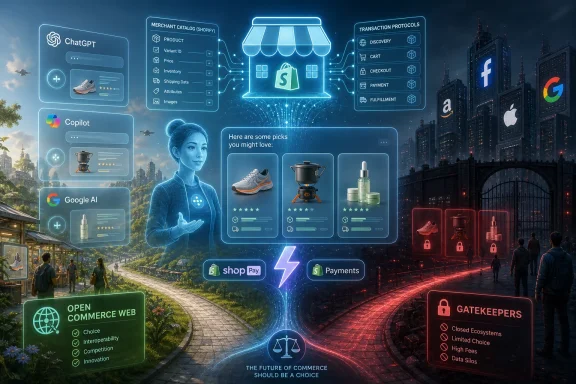
The most important thing about Shopify’s agentic commerce push is not that AI can recommend a pair of shoes, a camping stove, or a skincare product. Recommendation engines have existed for decades. The shift Shopify is betting on is that the interface for commerce may move from browsing pages to delegating tasks: “Find me a carry-on that fits United’s rules, ships by Friday, and costs under $200.”
That sounds like a consumer convenience story, but for merchants it is a distribution story. Search gave merchants a reason to invest in SEO. Social platforms gave them a reason to buy ads, court creators, and build brand feeds. Marketplaces gave them access to demand in exchange for tighter rules, fees, and reduced customer ownership. AI assistants threaten to reshuffle that order by inserting a new decision-maker between buyer and seller.
Shopify’s answer is to make its merchant catalog legible to the machines that will increasingly mediate those decisions. The company says it has structured more than 1 billion products with clean attributes, real-time pricing, and inventory data. That may sound like plumbing, but in agentic commerce plumbing is strategy. An AI agent cannot reliably recommend what it cannot understand, price, compare, reserve, or hand off to checkout.
This is why Shopify’s early traffic numbers matter. In the first quarter of 2026, AI-driven traffic to Shopify stores reportedly rose eightfold year over year, while orders from AI-powered searches rose nearly thirteenfold. New buyer orders from AI searches also arrived at nearly twice the rate of traditional organic search. Those figures do not prove that agentic commerce is already material to Shopify’s financial model, but they do suggest something more interesting than hype: AI referrals are behaving less like idle curiosity and more like high-intent traffic.
Customer acquisition costs rose. Search became more crowded. Social commerce became more algorithmic and less predictable. Privacy changes made ad targeting harder. Marketplaces kept expanding their gravitational pull. A small merchant could still build a beautiful store on Shopify, but beauty does not create demand by itself.
Agentic commerce, if it works, gives Shopify a way to reframe that discovery problem. Instead of asking every merchant to win the old search-and-social lottery alone, Shopify can package merchant data into formats AI systems can query, compare, and transact against. The storefront remains important, but the first meaningful interaction may happen somewhere else.
That is a subtle but major change in Shopify’s role. Historically, Shopify’s strongest merchant promise was that it gave sellers the tools to run online commerce on their own terms. In an AI-mediated world, Shopify may increasingly sell itself as the interpreter between merchant systems and external agents. The merchant still owns the business, but Shopify becomes the machine-readable commercial layer that lets that business participate in new demand channels.
The risk is that this is not entirely under Shopify’s control. ChatGPT, Copilot, Gemini, Perplexity, Claude, and future assistants will decide how results are ranked, displayed, explained, and trusted. If the AI answer becomes the new shelf, then shelf placement becomes the new SEO. Shopify can prepare the catalog, but it cannot guarantee that independent merchants will get prime placement when the assistant has incentives of its own.
That does not make the signal meaningless. Early internet commerce, mobile shopping, social checkout, and buy-now-pay-later adoption all had awkward periods when usage numbers looked impressive but investors could reasonably ask whether the behavior would persist. The question is not whether AI referrals are already as important as organic search. They are almost certainly not. The question is whether their conversion profile suggests a structurally different kind of demand.
On that front, Shopify’s data is more interesting. AI-referred shoppers reportedly convert better than traditional organic search users and carry higher average order values. That makes intuitive sense. A shopper who asks an AI assistant to narrow choices has already expressed a concrete need. By the time that user clicks through, the assistant may have performed some of the comparison work that a search results page or product category page used to handle.
For merchants, this could change the function of the product page. A product page optimized for Google often tries to rank, educate, persuade, cross-sell, and close. A product page receiving AI-assisted traffic may need to behave more like a landing zone for a decision that is already half-made. That puts more pressure on accuracy, inventory, shipping promises, trust signals, returns, and checkout speed.
It also raises a measurement problem. Merchants are used to asking where traffic came from. In agentic commerce, attribution may become blurrier. A shopper may discover a product through Gemini, compare it in ChatGPT, check reviews on Reddit, and complete checkout through Shop Pay. Shopify can count sessions and transactions, but the industry will have to develop a more mature view of AI-assisted buying paths before anyone can say precisely how much value the AI layer created.
The idea behind a common protocol is straightforward. If every AI assistant, retailer, merchant platform, payment provider, and fulfillment system needs a bespoke integration, agentic commerce will remain a demo. A standard gives agents a way to discover product data, understand merchant capabilities, initiate checkout, and support post-purchase flows without every participant reinventing the interface.
That matters because commerce is not just a product recommendation problem. It is a chain of commitments. The system has to know whether the item exists, whether the price is current, whether shipping can meet the buyer’s deadline, whether taxes and duties apply, whether the merchant supports returns, whether the payment method is valid, and whether the buyer has authorized the agent to act. The more autonomous the agent becomes, the more the boring parts of commerce become the critical parts.
The Universal Commerce Protocol also gives Shopify a way to avoid being trapped inside any single AI company’s commercial rails. If Google, Microsoft, Amazon, Meta, Salesforce, Stripe, and others are participating in the standards discussion, Shopify gains a chance to make its merchants available across many surfaces rather than negotiating one-off paths into each assistant. That is the optimistic reading.
The more cautious reading is that standards bodies often reflect power as much as openness. Large platforms do not join commerce protocols out of charity. They join because they want influence over where value accrues. Shopify’s task is to make sure independent merchants are not merely the inventory layer beneath someone else’s AI shopping interface.
This is different from the usual “AI feature” narrative. Many software companies now sprinkle AI into dashboards, support tools, website builders, and marketing assistants. Shopify does those things too, but agentic commerce is more ambitious because it uses Shopify’s existing merchant base as the asset. The AI system does not just help a merchant write a product description. It helps a buyer find and potentially purchase the product.
That distinction is why Shopify’s opportunity differs from Wix’s. Wix is using AI to simplify site creation and business workflows, which is valuable for small businesses that need to get online quickly. But Shopify’s strongest AI-commerce angle is closer to transaction execution: product discovery, checkout, payments, merchant services, and post-purchase operations. One approach helps a business build a digital presence; the other tries to put that business into a new buying path.
The catalog argument also exposes a quality gap. AI agents are only as useful as the data they can trust. Bad product attributes, stale inventory, ambiguous variants, poor images, unclear shipping rules, and weak return policies all become ranking disadvantages when machines are comparing options on behalf of users. Merchants that treat catalog hygiene as clerical work may discover that it becomes the new search optimization.
That could create a divide inside Shopify’s merchant base. Larger and more sophisticated sellers will be better equipped to maintain structured data, manage feeds, test AI referrals, and tune landing pages. Smaller merchants may benefit from Shopify abstracting away much of that work, but only if the platform makes AI-readiness automatic rather than another expert-only growth tactic.
Shopify Payments processed about $67 billion of GMV in the first quarter of 2026, up 41 percent year over year, with penetration reaching roughly 67 percent of total GMV. Shop Pay processed about $35 billion of GMV, growing 59 percent. Those figures show that Shopify is not merely hosting storefronts; it is increasingly capturing the transaction layer of commerce on its platform.
Agentic commerce could amplify that if AI-led shopping sends incremental buyers into Shopify-controlled checkout flows. The company’s ideal scenario is not simply that an AI assistant says, “Here is a Shopify merchant.” The ideal scenario is that the assistant surfaces a relevant product, the buyer trusts the recommendation, checkout is fast, payment runs through Shopify’s rails, and the merchant remains tied to Shopify for future operations.
That is why Shop Pay is strategically important. AI agents may reduce the time users spend browsing, but checkout friction can still kill a transaction. A trusted accelerated checkout system gives Shopify a way to convert high-intent AI traffic before the user drifts away. If agentic shopping becomes a world of brief, delegated decisions, speed and trust become even more valuable.
There is also a defensive logic. If AI platforms steer commerce toward their own payment flows, wallets, or marketplace-like experiences, Shopify could lose some of the economic upside even if its merchants gain sales. By embedding payments and checkout deeply into its agentic commerce strategy, Shopify is trying to ensure that the new channel does not bypass the parts of the stack that make the company money.
Amazon’s AI strategy can lean on data that Shopify does not have in the same form. It knows how millions of products sell inside its marketplace, how shoppers behave, which items are returned, which sellers perform reliably, and which fulfillment promises can be kept. That data is not just useful for search ranking; it is useful for agentic recommendations that need confidence.
But Amazon’s strength is also its constraint. Its model is marketplace-centered and controlled. Many brands use Amazon because they must, not because they want Amazon to own the customer relationship. Shopify’s pitch to merchants is that agentic commerce does not have to mean surrendering to a marketplace. If the new AI shopping layer can route demand to independent storefronts, Shopify becomes the counterweight.
That is a compelling story, but it depends on consumer behavior. Shoppers trust Amazon because it absorbs complexity: shipping, returns, customer service, and payment. An AI agent recommending an independent merchant has to overcome the same trust hurdle that direct-to-consumer brands have faced for years. Shopify can help with checkout trust, but it cannot instantly make every merchant feel as safe as Amazon.
The long-term fight may not be Amazon versus Shopify in a clean head-to-head contest. It may be Amazon’s closed demand machine versus a federated commerce web where AI agents can transact across many merchants. Shopify wants to be the operating system for the second model. Amazon will work hard to ensure the first model remains the path of least resistance.
Traditional search at least presents a list. Social feeds show content, ads, comments, and creators. AI assistants tend to compress options into answers. That compression is convenient for users, but it is dangerous for merchants. If the assistant recommends three products instead of showing thirty links, the difference between being included and excluded becomes enormous.
This is where Shopify’s standardization push does not solve everything. A protocol can make products discoverable and transactions possible. It cannot guarantee fair ranking, transparent explanations, or equal opportunity. AI shopping systems will need to decide which products are relevant, which merchants are trustworthy, which offers are best, and which commercial relationships influence placement.
There is also a branding problem. If a shopper asks an AI assistant for “the best travel backpack under $150,” the assistant may foreground attributes, reviews, shipping, and price rather than the merchant’s story. That favors products with clear specifications and strong trust signals. It may disadvantage brands that rely on narrative, visual merchandising, community, or emotional appeal.
Merchants will adapt, as they always do. They will learn to optimize product data for AI retrieval, monitor referral quality, create clearer comparison points, and improve post-purchase reliability. But the promise that agentic commerce democratizes discovery should be treated carefully. New interfaces often create new winners before they create broad access.
That does not mean Windows is about to become a mall. Microsoft has to balance user trust, enterprise policy, privacy expectations, and commercial opportunity. IT administrators will be skeptical of any feature that blurs work assistance with consumer purchasing, especially in managed environments. But the broader direction is clear: the assistant layer is moving closer to the user’s daily workflow.
For consumers, this could make shopping more contextual. A user planning a trip in Edge, comparing specs in a document, or asking Copilot for gift ideas might encounter commerce without opening a shopping site first. For merchants, that means visibility may depend on whether their products can be interpreted correctly by the assistant’s ecosystem.
For administrators, the governance questions will arrive quickly. If agents can recommend vendors, initiate procurement workflows, or hand users to checkout, organizations will want policies around data leakage, approved suppliers, payment authorization, and audit trails. The consumer version of agentic commerce may look like convenience. The enterprise version will look like risk management.
Microsoft’s participation in agentic commerce standards discussions matters because it suggests the company sees commerce as part of the assistant economy. Whether that becomes a major Windows behavior is uncertain. But if Copilot becomes a practical shopping and procurement interface, Shopify merchants will want to be present there — and Microsoft will want the transaction experience to feel controlled, safe, and compliant.
But valuation matters. Shopify has often traded like a company expected to keep compounding at exceptional rates, and its forward price-to-sales multiple remains above many industry comparisons. That does not invalidate the opportunity, but it raises the bar. Investors are not paying for Shopify merely to participate in agentic commerce. They are paying for Shopify to turn it into measurable, durable growth.
The first-quarter 2026 operating backdrop helps. Shopify cleared more than $100 billion in quarterly GMV, revenue growth remained strong, and payments penetration continued rising. That means the agentic commerce narrative is being layered onto a business that is already scaling, not being used to distract from stagnation. The best AI stories are usually attached to companies with distribution, data, and existing customer behavior. Shopify has all three.
Still, AI commerce metrics need to mature. Investors should want to know the absolute size of AI-driven sessions and orders, repeat rates, merchant category mix, take rate implications, payment attachment, customer acquisition costs, and whether AI-led buyers return through owned channels. A 13x growth rate is the opening paragraph, not the full model.
There is also margin uncertainty. If AI platforms become powerful sources of demand, they may eventually charge for placement, preferred access, conversion tools, or transaction facilitation. Merchants may pay. Shopify may pay. Consumers may see sponsored recommendations. The economics of agentic commerce are not settled, and every participant will try to capture the value created by reducing friction.
Today’s AI shopping experience is uneven. Assistants can summarize choices well, but they can still hallucinate, miss constraints, cite stale prices, misunderstand variants, or recommend products without enough accountability. For low-stakes discovery, that may be tolerable. For actual purchasing, trust has to be higher. A buyer needs to know that the item exists, the delivery date is real, and the return policy will not turn into a scavenger hunt.
This is why Shopify’s infrastructure role matters. Real-time pricing and inventory are not glamorous, but they address exactly the weaknesses that make AI shopping risky. If an assistant can query reliable product data and hand off to a trusted checkout, the experience moves from “interesting recommendation” to “usable transaction.” That is the bridge Shopify is trying to build.
But habit formation will depend on repeated success. A user who asks an AI assistant to find a product and gets a good result may try again. A user who receives a bad recommendation, a broken checkout, or a misleading shipping promise may retreat to Amazon, Google, or a familiar retailer. Agentic commerce has to be boringly reliable before it can become revolutionary.
Merchants will also need to decide how much control they are willing to delegate. An AI assistant that filters, summarizes, and recommends products may not present the brand exactly as the merchant would. It may compare products more aggressively on price. It may compress carefully crafted positioning into a few attributes. The channel could bring new buyers, but it may also make differentiation harder.
That would be good for Shopify, but it could also be good for consumers and merchants. More merchant participation means more product variety. More standardized data means better comparisons. Better checkout integration means less friction. If implemented well, agentic commerce could reduce the advantage of scale in discovery without eliminating the importance of trust.
The less optimistic version is that agentic commerce becomes paid placement with better natural-language wrapping. The assistant recommends what its commercial incentives favor. The biggest platforms and retailers buy distribution. Smaller merchants get technically indexed but rarely surfaced. Consumers experience convenience, but the market becomes even more intermediated.
Shopify’s strategy is an attempt to prevent that second outcome from becoming inevitable. By getting merchant catalogs ready early, participating in protocol development, and tying discovery to checkout and payments, the company is trying to make independent commerce usable by AI agents before the rules fully harden. Timing matters. Standards and habits formed early in platform shifts can last for years.
That does not mean Shopify controls the future. It means Shopify has identified the right pressure point. If AI is going to become a primary interface for shopping, the companies that own product data, transaction trust, and merchant relationships will have leverage. Shopify owns enough of that stack to matter.
 Shopify Is Chasing the Next Search Box Before It Fully Exists
The most important thing about Shopify’s agentic commerce push is not that AI can recommend a pair of shoes, a camping stove, or a skincare product. Recommendation engines have existed for decades. The shift Shopify is betting on is that the interface for commerce may move from browsing pages to delegating tasks: “Find me a carry-on that fits United’s rules, ships by Friday, and costs under $200.”That sounds like a consumer convenience story, but for merchants it is a distribution story. Search gave merchants a reason to invest in SEO. Social platforms gave them a reason to buy ads, court creators, and build brand feeds. Marketplaces gave them access to demand in exchange for tighter rules, fees, and reduced customer ownership. AI assistants threaten to reshuffle that order by inserting a new decision-maker between buyer and seller.
Shopify’s answer is to make its merchant catalog legible to the machines that will increasingly mediate those decisions. The company says it has structured more than 1 billion products with clean attributes, real-time pricing, and inventory data. That may sound like plumbing, but in agentic commerce plumbing is strategy. An AI agent cannot reliably recommend what it cannot understand, price, compare, reserve, or hand off to checkout.
This is why Shopify’s early traffic numbers matter. In the first quarter of 2026, AI-driven traffic to Shopify stores reportedly rose eightfold year over year, while orders from AI-powered searches rose nearly thirteenfold. New buyer orders from AI searches also arrived at nearly twice the rate of traditional organic search. Those figures do not prove that agentic commerce is already material to Shopify’s financial model, but they do suggest something more interesting than hype: AI referrals are behaving less like idle curiosity and more like high-intent traffic.
The Merchant Problem Is Discovery, Not Just Checkout
Shopify has spent years positioning itself as the anti-marketplace: software for merchants that want to own their brand, customer relationship, storefront, and data. That story worked because the web still rewarded merchants who could build a direct channel through search, email, social, or paid media. But the open web’s commerce bargain has been fraying.Customer acquisition costs rose. Search became more crowded. Social commerce became more algorithmic and less predictable. Privacy changes made ad targeting harder. Marketplaces kept expanding their gravitational pull. A small merchant could still build a beautiful store on Shopify, but beauty does not create demand by itself.
Agentic commerce, if it works, gives Shopify a way to reframe that discovery problem. Instead of asking every merchant to win the old search-and-social lottery alone, Shopify can package merchant data into formats AI systems can query, compare, and transact against. The storefront remains important, but the first meaningful interaction may happen somewhere else.
That is a subtle but major change in Shopify’s role. Historically, Shopify’s strongest merchant promise was that it gave sellers the tools to run online commerce on their own terms. In an AI-mediated world, Shopify may increasingly sell itself as the interpreter between merchant systems and external agents. The merchant still owns the business, but Shopify becomes the machine-readable commercial layer that lets that business participate in new demand channels.
The risk is that this is not entirely under Shopify’s control. ChatGPT, Copilot, Gemini, Perplexity, Claude, and future assistants will decide how results are ranked, displayed, explained, and trusted. If the AI answer becomes the new shelf, then shelf placement becomes the new SEO. Shopify can prepare the catalog, but it cannot guarantee that independent merchants will get prime placement when the assistant has incentives of its own.
The 13x Figure Is Powerful, but the Base Still Matters
The headline number around Shopify’s AI orders is dramatic because “13x” looks like a channel exploding into relevance. It probably is exploding, in relative terms. But relative growth from a small base can produce eye-catching charts before it produces meaningful revenue.That does not make the signal meaningless. Early internet commerce, mobile shopping, social checkout, and buy-now-pay-later adoption all had awkward periods when usage numbers looked impressive but investors could reasonably ask whether the behavior would persist. The question is not whether AI referrals are already as important as organic search. They are almost certainly not. The question is whether their conversion profile suggests a structurally different kind of demand.
On that front, Shopify’s data is more interesting. AI-referred shoppers reportedly convert better than traditional organic search users and carry higher average order values. That makes intuitive sense. A shopper who asks an AI assistant to narrow choices has already expressed a concrete need. By the time that user clicks through, the assistant may have performed some of the comparison work that a search results page or product category page used to handle.
For merchants, this could change the function of the product page. A product page optimized for Google often tries to rank, educate, persuade, cross-sell, and close. A product page receiving AI-assisted traffic may need to behave more like a landing zone for a decision that is already half-made. That puts more pressure on accuracy, inventory, shipping promises, trust signals, returns, and checkout speed.
It also raises a measurement problem. Merchants are used to asking where traffic came from. In agentic commerce, attribution may become blurrier. A shopper may discover a product through Gemini, compare it in ChatGPT, check reviews on Reddit, and complete checkout through Shop Pay. Shopify can count sessions and transactions, but the industry will have to develop a more mature view of AI-assisted buying paths before anyone can say precisely how much value the AI layer created.
Universal Commerce Protocol Is Shopify’s Standards Bet
Shopify’s work with Google on the Universal Commerce Protocol is the most strategically important part of the story because it shows that Shopify is not merely adding AI features to its admin panel. It is trying to help define the transaction grammar for agent-led shopping.The idea behind a common protocol is straightforward. If every AI assistant, retailer, merchant platform, payment provider, and fulfillment system needs a bespoke integration, agentic commerce will remain a demo. A standard gives agents a way to discover product data, understand merchant capabilities, initiate checkout, and support post-purchase flows without every participant reinventing the interface.
That matters because commerce is not just a product recommendation problem. It is a chain of commitments. The system has to know whether the item exists, whether the price is current, whether shipping can meet the buyer’s deadline, whether taxes and duties apply, whether the merchant supports returns, whether the payment method is valid, and whether the buyer has authorized the agent to act. The more autonomous the agent becomes, the more the boring parts of commerce become the critical parts.
The Universal Commerce Protocol also gives Shopify a way to avoid being trapped inside any single AI company’s commercial rails. If Google, Microsoft, Amazon, Meta, Salesforce, Stripe, and others are participating in the standards discussion, Shopify gains a chance to make its merchants available across many surfaces rather than negotiating one-off paths into each assistant. That is the optimistic reading.
The more cautious reading is that standards bodies often reflect power as much as openness. Large platforms do not join commerce protocols out of charity. They join because they want influence over where value accrues. Shopify’s task is to make sure independent merchants are not merely the inventory layer beneath someone else’s AI shopping interface.
The Catalog Is the Moat Shopify Wants Investors to Notice
When Shopify talks about more than 1 billion structured products, it is making a quiet platform argument. The company is saying that it has something AI systems need: a vast, normalized, commerce-ready catalog from independent sellers, connected to pricing, inventory, payments, and fulfillment logic. In a world where large language models need reliable external data, that catalog has value.This is different from the usual “AI feature” narrative. Many software companies now sprinkle AI into dashboards, support tools, website builders, and marketing assistants. Shopify does those things too, but agentic commerce is more ambitious because it uses Shopify’s existing merchant base as the asset. The AI system does not just help a merchant write a product description. It helps a buyer find and potentially purchase the product.
That distinction is why Shopify’s opportunity differs from Wix’s. Wix is using AI to simplify site creation and business workflows, which is valuable for small businesses that need to get online quickly. But Shopify’s strongest AI-commerce angle is closer to transaction execution: product discovery, checkout, payments, merchant services, and post-purchase operations. One approach helps a business build a digital presence; the other tries to put that business into a new buying path.
The catalog argument also exposes a quality gap. AI agents are only as useful as the data they can trust. Bad product attributes, stale inventory, ambiguous variants, poor images, unclear shipping rules, and weak return policies all become ranking disadvantages when machines are comparing options on behalf of users. Merchants that treat catalog hygiene as clerical work may discover that it becomes the new search optimization.
That could create a divide inside Shopify’s merchant base. Larger and more sophisticated sellers will be better equipped to maintain structured data, manage feeds, test AI referrals, and tune landing pages. Smaller merchants may benefit from Shopify abstracting away much of that work, but only if the platform makes AI-readiness automatic rather than another expert-only growth tactic.
Payments Turn Discovery Into Shopify Economics
Traffic alone does not build a durable financial channel for Shopify. The economics improve when discovery flows into transactions that use Shopify Payments, Shop Pay, and the company’s broader merchant services stack. That is where the first-quarter numbers around payments matter.Shopify Payments processed about $67 billion of GMV in the first quarter of 2026, up 41 percent year over year, with penetration reaching roughly 67 percent of total GMV. Shop Pay processed about $35 billion of GMV, growing 59 percent. Those figures show that Shopify is not merely hosting storefronts; it is increasingly capturing the transaction layer of commerce on its platform.
Agentic commerce could amplify that if AI-led shopping sends incremental buyers into Shopify-controlled checkout flows. The company’s ideal scenario is not simply that an AI assistant says, “Here is a Shopify merchant.” The ideal scenario is that the assistant surfaces a relevant product, the buyer trusts the recommendation, checkout is fast, payment runs through Shopify’s rails, and the merchant remains tied to Shopify for future operations.
That is why Shop Pay is strategically important. AI agents may reduce the time users spend browsing, but checkout friction can still kill a transaction. A trusted accelerated checkout system gives Shopify a way to convert high-intent AI traffic before the user drifts away. If agentic shopping becomes a world of brief, delegated decisions, speed and trust become even more valuable.
There is also a defensive logic. If AI platforms steer commerce toward their own payment flows, wallets, or marketplace-like experiences, Shopify could lose some of the economic upside even if its merchants gain sales. By embedding payments and checkout deeply into its agentic commerce strategy, Shopify is trying to ensure that the new channel does not bypass the parts of the stack that make the company money.
Amazon Remains the Benchmark Shopify Cannot Ignore
Amazon is the unavoidable comparison because it already solved the hardest problem in online retail: aggregating demand. It has a massive buyer base, a default shopping habit, a fulfillment network, a powerful ad business, and a marketplace where consumers often begin product searches without touching Google. If agentic commerce is about compressing discovery and purchase, Amazon starts with enormous advantages.Amazon’s AI strategy can lean on data that Shopify does not have in the same form. It knows how millions of products sell inside its marketplace, how shoppers behave, which items are returned, which sellers perform reliably, and which fulfillment promises can be kept. That data is not just useful for search ranking; it is useful for agentic recommendations that need confidence.
But Amazon’s strength is also its constraint. Its model is marketplace-centered and controlled. Many brands use Amazon because they must, not because they want Amazon to own the customer relationship. Shopify’s pitch to merchants is that agentic commerce does not have to mean surrendering to a marketplace. If the new AI shopping layer can route demand to independent storefronts, Shopify becomes the counterweight.
That is a compelling story, but it depends on consumer behavior. Shoppers trust Amazon because it absorbs complexity: shipping, returns, customer service, and payment. An AI agent recommending an independent merchant has to overcome the same trust hurdle that direct-to-consumer brands have faced for years. Shopify can help with checkout trust, but it cannot instantly make every merchant feel as safe as Amazon.
The long-term fight may not be Amazon versus Shopify in a clean head-to-head contest. It may be Amazon’s closed demand machine versus a federated commerce web where AI agents can transact across many merchants. Shopify wants to be the operating system for the second model. Amazon will work hard to ensure the first model remains the path of least resistance.
AI Shopping Could Make Merchants More Dependent on Gatekeepers
The most uncomfortable part of agentic commerce is that it may recreate the platform dependency merchants already know too well. A decade ago, merchants worried about Google search rankings. Then they worried about Facebook ad costs, Instagram reach, TikTok virality, Amazon marketplace rules, and Apple privacy changes. AI agents could become the next gatekeeper, only with a more opaque decision process.Traditional search at least presents a list. Social feeds show content, ads, comments, and creators. AI assistants tend to compress options into answers. That compression is convenient for users, but it is dangerous for merchants. If the assistant recommends three products instead of showing thirty links, the difference between being included and excluded becomes enormous.
This is where Shopify’s standardization push does not solve everything. A protocol can make products discoverable and transactions possible. It cannot guarantee fair ranking, transparent explanations, or equal opportunity. AI shopping systems will need to decide which products are relevant, which merchants are trustworthy, which offers are best, and which commercial relationships influence placement.
There is also a branding problem. If a shopper asks an AI assistant for “the best travel backpack under $150,” the assistant may foreground attributes, reviews, shipping, and price rather than the merchant’s story. That favors products with clear specifications and strong trust signals. It may disadvantage brands that rely on narrative, visual merchandising, community, or emotional appeal.
Merchants will adapt, as they always do. They will learn to optimize product data for AI retrieval, monitor referral quality, create clearer comparison points, and improve post-purchase reliability. But the promise that agentic commerce democratizes discovery should be treated carefully. New interfaces often create new winners before they create broad access.
The Windows Angle Is Copilot as a Commerce Surface
For WindowsForum readers, the most relevant piece of this story is Microsoft Copilot’s emergence as one of the surfaces Shopify wants to reach. Windows users are already watching Microsoft push Copilot into the operating system, Edge, Bing, Microsoft 365, and enterprise workflows. If AI assistants become ambient rather than destination-based, shopping prompts may appear in places that were never traditional storefronts.That does not mean Windows is about to become a mall. Microsoft has to balance user trust, enterprise policy, privacy expectations, and commercial opportunity. IT administrators will be skeptical of any feature that blurs work assistance with consumer purchasing, especially in managed environments. But the broader direction is clear: the assistant layer is moving closer to the user’s daily workflow.
For consumers, this could make shopping more contextual. A user planning a trip in Edge, comparing specs in a document, or asking Copilot for gift ideas might encounter commerce without opening a shopping site first. For merchants, that means visibility may depend on whether their products can be interpreted correctly by the assistant’s ecosystem.
For administrators, the governance questions will arrive quickly. If agents can recommend vendors, initiate procurement workflows, or hand users to checkout, organizations will want policies around data leakage, approved suppliers, payment authorization, and audit trails. The consumer version of agentic commerce may look like convenience. The enterprise version will look like risk management.
Microsoft’s participation in agentic commerce standards discussions matters because it suggests the company sees commerce as part of the assistant economy. Whether that becomes a major Windows behavior is uncertain. But if Copilot becomes a practical shopping and procurement interface, Shopify merchants will want to be present there — and Microsoft will want the transaction experience to feel controlled, safe, and compliant.
The Stock Story Is Stronger Than the Proof
The investor case for Shopify’s agentic commerce push is seductive because it combines three narratives Wall Street already likes: AI adoption, payments expansion, and platform leverage. Shopify can argue that it is not just adding AI; it is positioned to monetize AI-driven demand through GMV, payments, checkout, and merchant services. That is a more concrete story than a chatbot bolted onto a SaaS product.But valuation matters. Shopify has often traded like a company expected to keep compounding at exceptional rates, and its forward price-to-sales multiple remains above many industry comparisons. That does not invalidate the opportunity, but it raises the bar. Investors are not paying for Shopify merely to participate in agentic commerce. They are paying for Shopify to turn it into measurable, durable growth.
The first-quarter 2026 operating backdrop helps. Shopify cleared more than $100 billion in quarterly GMV, revenue growth remained strong, and payments penetration continued rising. That means the agentic commerce narrative is being layered onto a business that is already scaling, not being used to distract from stagnation. The best AI stories are usually attached to companies with distribution, data, and existing customer behavior. Shopify has all three.
Still, AI commerce metrics need to mature. Investors should want to know the absolute size of AI-driven sessions and orders, repeat rates, merchant category mix, take rate implications, payment attachment, customer acquisition costs, and whether AI-led buyers return through owned channels. A 13x growth rate is the opening paragraph, not the full model.
There is also margin uncertainty. If AI platforms become powerful sources of demand, they may eventually charge for placement, preferred access, conversion tools, or transaction facilitation. Merchants may pay. Shopify may pay. Consumers may see sponsored recommendations. The economics of agentic commerce are not settled, and every participant will try to capture the value created by reducing friction.
The Real Test Is Whether AI Becomes Habit, Not Feature
Consumers do not adopt commerce interfaces because the industry gives them names like agentic commerce. They adopt them when the experience saves time, reduces uncertainty, and feels trustworthy. That is the real test for Shopify’s new channel.Today’s AI shopping experience is uneven. Assistants can summarize choices well, but they can still hallucinate, miss constraints, cite stale prices, misunderstand variants, or recommend products without enough accountability. For low-stakes discovery, that may be tolerable. For actual purchasing, trust has to be higher. A buyer needs to know that the item exists, the delivery date is real, and the return policy will not turn into a scavenger hunt.
This is why Shopify’s infrastructure role matters. Real-time pricing and inventory are not glamorous, but they address exactly the weaknesses that make AI shopping risky. If an assistant can query reliable product data and hand off to a trusted checkout, the experience moves from “interesting recommendation” to “usable transaction.” That is the bridge Shopify is trying to build.
But habit formation will depend on repeated success. A user who asks an AI assistant to find a product and gets a good result may try again. A user who receives a bad recommendation, a broken checkout, or a misleading shipping promise may retreat to Amazon, Google, or a familiar retailer. Agentic commerce has to be boringly reliable before it can become revolutionary.
Merchants will also need to decide how much control they are willing to delegate. An AI assistant that filters, summarizes, and recommends products may not present the brand exactly as the merchant would. It may compare products more aggressively on price. It may compress carefully crafted positioning into a few attributes. The channel could bring new buyers, but it may also make differentiation harder.
Shopify’s Best Case Is the Open Web With a Checkout Button
The most optimistic version of Shopify’s agentic commerce strategy is that it gives the open commerce web a fighting chance in the AI era. Instead of AI assistants defaulting to the biggest marketplaces or a handful of retail giants, they could query a broad universe of independent merchants and complete purchases through standardized rails. Shopify would become the connective tissue for that world.That would be good for Shopify, but it could also be good for consumers and merchants. More merchant participation means more product variety. More standardized data means better comparisons. Better checkout integration means less friction. If implemented well, agentic commerce could reduce the advantage of scale in discovery without eliminating the importance of trust.
The less optimistic version is that agentic commerce becomes paid placement with better natural-language wrapping. The assistant recommends what its commercial incentives favor. The biggest platforms and retailers buy distribution. Smaller merchants get technically indexed but rarely surfaced. Consumers experience convenience, but the market becomes even more intermediated.
Shopify’s strategy is an attempt to prevent that second outcome from becoming inevitable. By getting merchant catalogs ready early, participating in protocol development, and tying discovery to checkout and payments, the company is trying to make independent commerce usable by AI agents before the rules fully harden. Timing matters. Standards and habits formed early in platform shifts can last for years.
That does not mean Shopify controls the future. It means Shopify has identified the right pressure point. If AI is going to become a primary interface for shopping, the companies that own product data, transaction trust, and merchant relationships will have leverage. Shopify owns enough of that stack to matter.
The AI Checkout Bet Comes Down to These Frictions
Shopify’s agentic commerce push should be read as an early platform move rather than a finished revenue engine. The first data points are encouraging, but the durable opportunity depends on whether AI shopping becomes a repeated consumer behavior and whether Shopify can keep enough of the transaction economics inside its own ecosystem.- AI-driven traffic and orders are growing quickly on Shopify, but the absolute scale of the channel remains the missing number investors and merchants need most.
- Shopify’s structured catalog is central to the strategy because AI agents need clean product attributes, current pricing, and accurate inventory before they can recommend or transact reliably.
- Payments and Shop Pay are what turn AI referrals into Shopify economics, making checkout attachment as important as discovery.
- Amazon remains the hardest competitive benchmark because it already combines demand, fulfillment, trust, and purchase history inside one controlled marketplace.
- Universal Commerce Protocol gives Shopify a credible standards play, but ranking power and consumer trust will still sit heavily with the AI platforms.
- Merchants should treat AI discovery as a new optimization surface, not as a replacement for brand, service, or owned customer relationships.
References
- Primary source: TradingView
Published: 2026-06-26T14:50:20.595698
Can Shopify's Agentic Commerce Push Unlock a New Growth Channel? — TradingView News
Shopify Inc. SHOP is positioning agentic commerce as a potential new demand channel for merchants as artificial intelligence begins to reshape how shoppers discover, compare and purchase products online. The company is embedding its platform into emerging AI shopping ecosystems, giving merchants an…www.tradingview.com
- Related coverage: shopify.com
The agentic commerce platform: Shopify connects any merchant to every AI conversation
Shopify now enables native commerce at scale across all major AI channels and built an open standard, co-developed with Google.www.shopify.com - Related coverage: wrkngdigital.com
Shopify's Own Data Says AI-Driven Orders Grew 13x in Q1 2026. Here's What the Stores Driving Those Orders Have in Common.
Shopify's Q1 2026 data shows AI-driven traffic grew 8x YoY, orders grew 13x, and catalog-connected AI searches convert 2x more. Here's what separates stores on the right side of this data.wrkngdigital.com
- Related coverage: fool.com
Shopify (SHOP) Q1 2026 Earnings Transcript | The Motley Fool
Shopify (SHOP) Q1 2026 Earnings Transcriptwww.fool.com - Related coverage: pymnts.com
PYMNTS | AI Drove Orders on Shopify Up 13 Times in Q1
Orders from AI-powered searches on Shopify grew nearly 13 times in Q1, faster than any channel the company has tracked. www.pymnts.com
- Related coverage: stellagent.ai
Shopify Q1 2026: AI Orders Up 13x and ChatGPT/Claude Store Control via MCP | Stellagent
Shopify Q1 2026 earnings show AI-search orders grew nearly 13x year over year, while new MCP connectors let merchants run their stores directly from ChatGPT and Claude.stellagent.ai
- Related coverage: news.seonib.com
Agentic Commerce on Shopify 2026: How AI Agents Are Transforming Ecommerce | SEONIB
Discover how Shopify's agentic commerce tools—Agentic Storefronts and Universal Commerce Protocol—enable AI agents to shop for consumers, driving 13x order growth. Learn benefits, setup, and market impact.news.seonib.com - Related coverage: ai.blab.com
Shopify Reports 13-Fold Surge in AI-Driven Orders and Expands Share Buyback Program | Artificial Intelligence News | Blab AI
When Shopify announced its first‑quarter 2026 results on June 1, the headline that captured attention was a 13‑fold increase in orders that arrive at mer...ai.blab.com - Related coverage: quartr.com
Shopify (SHOP) Q1 2026 Summary | Quartr
Summary of Shopify (SHOP) Q1 2026, combining transcript, slides, and related documents.quartr.com - Related coverage: eco.com
Universal Commerce Protocol (UCP) Explained | Support
Universal Commerce Protocol (UCP) is Google and Shopify's open standard for AI agent commerce. How UCP works, partners, AP2 composition.eco.com - Related coverage: androidcentral.com
How Google's new protocol transforms AI agents into shopping powerhouses | Android Central
Google has unveiled a new open standard called Universal Commerce Protocol that lets AI agents shop, check out, and handle payments for you.www.androidcentral.com - Related coverage: techradar.com
Google is going all-out on "agentic shopping" with new AI ecommerce tools | TechRadar
It seems that every AI agent is bidding for your shopping customwww.techradar.com - Related coverage: axios.com
Google, Shopify, retailers push new AI shopping standard at NRF 2026
Google and Shopify unveiled a new standard at NRF 2026 to help AI complete purchases across different shopping platforms.www.axios.com
- Related coverage: agentic-commerce.dev
