

Siemens’ WinCC Certificate Manager vulnerability, disclosed by Siemens ProductCERT on June 9, 2026 and republished by CISA on June 23, affects SIMATIC WinCC Unified PC Runtime versions V16 through V21 before V21 Update 2, exposing insufficiently protected cryptographic key material on local systems. It is not a wormable internet bug, and it is not a remote-code-execution headline grabber. But in industrial environments, a local information disclosure flaw in the machinery that manages trust can become the quiet precondition for much uglier compromises. The real story is that certificate hygiene has become operational technology hygiene, and Siemens is pushing that reality onto administrators who may still treat runtime updates as rare maintenance-window luxuries.
The advisory describes CVE-2026-24349 as an insufficient protection issue in WinCC Certificate Manager that could allow an attacker to extract sensitive information. The associated weakness classification is CWE-313, cleartext storage in a file or on disk, and Siemens assigns the vulnerability a CVSS 3.1 score of 7.1, high severity.
That score deserves some unpacking. The attack vector is local, the complexity is low, no privileges are required, and no user interaction is needed. The impact is concentrated on confidentiality, not integrity or availability, but the scope is changed — a sign that the exposed material could matter beyond the immediate component that stored it badly.
In plain English: this is not the kind of bug that lets a random internet scanner take over a plant floor workstation from the outside. It is the kind of bug that can reward an attacker who has already landed on, or gained access to, a relevant Windows host. Once there, the attacker may be able to pull sensitive key material from storage that should have been better protected.
That distinction is important, but it is not comforting. Industrial compromises often unfold in stages, with phishing, stolen VPN credentials, exposed remote access, contractor laptops, or ordinary Windows endpoint compromise serving as the first move. A local certificate-management weakness can then become a force multiplier, helping an intruder understand, impersonate, or weaken the trust relationships that keep supervisory and runtime systems stitched together.
That version range matters because WinCC Unified has been part of Siemens’ larger push to modernize HMI and SCADA-style visualization around web technologies, unified engineering, and more integrated runtime environments. Many sites do not move from one major industrial automation version to the next at consumer-software speed. In OT, a “current enough” runtime can remain deployed for years because it is attached to validated projects, tested recipes, qualified hardware, safety processes, and maintenance contracts.
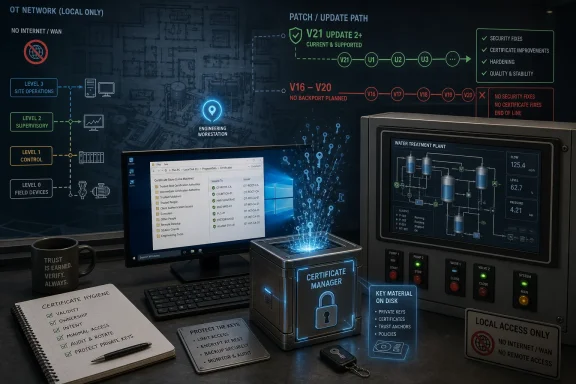
Siemens’ remediation posture reflects that reality, but not necessarily in a way administrators will love. For V21, the vendor fix is straightforward: update to V21 Update 2 or a later version. For older affected versions, the advisory states that no fix is currently planned.
That split turns the vulnerability into an upgrade decision rather than just a patch decision. A Windows admin may hear “update to the latest version” and think in terms of a monthly cumulative update. A plant engineer may hear the same phrase and think of project migration, runtime validation, downtime coordination, vendor support checks, rollback planning, and a change-control meeting with people who do not enjoy surprises.
A local attacker in this context does not have to be a person in a hard hat standing at the cabinet. It can be malware running under an unexpected user context, a compromised service account, a remote access session that should have been constrained, or an attacker who has reached a Windows workstation used for engineering or runtime support. Once the adversary is inside that layer, secret material on disk becomes one of the first things worth looking for.
Certificates and keys are also qualitatively different from many other secrets. A stolen password may be rotated, detected through login telemetry, or constrained by MFA. Stolen key material can be more opaque. Depending on how it is used, it may allow impersonation, decryption, signing, or the reconstruction of trust relationships that administrators assumed were anchored safely.
The advisory does not claim that all of those outcomes are possible in every deployment, and responsible defenders should not overstate the exploit chain. But the warning is clear enough: key material was not protected as well as it should have been, and Siemens considers the confidentiality consequence serious.
That shift is easy to miss because industrial security conversations often still orbit firewalls, VLANs, remote access, and patch cadence. Those controls remain necessary, but they do not solve identity on their own. As OT systems adopt web-based HMIs, encrypted channels, role-based access, certificate-backed trust, and integration with broader enterprise infrastructure, certificate management stops being an administrative afterthought and becomes a control-plane dependency.
WinCC Unified sits squarely in that world. It is not just drawing process graphics on a screen; it is part of a runtime ecosystem where Windows hosts, engineering tools, browser-facing components, and industrial networks intersect. If the component that manages certificates stores sensitive material poorly, the weakness lands at a junction between Windows administration and plant-floor trust.
That is why the CVE is more interesting than its immediate exploitability. It points to the industry’s uncomfortable middle phase: OT products are adopting modern security primitives, but the operational maturity around those primitives is uneven. Certificates make systems safer when implemented and managed correctly. When they are mishandled, they create a new class of fragile assumptions.
The advisory’s “no fix planned” language for earlier versions is the sentence that should stop administrators from reading this as routine housekeeping. Siemens is effectively drawing the supported remediation line at the current V21 update track. Sites on V16 through V20 are not being handed a backported fix for the Certificate Manager issue, at least not under the advisory as published.
There are defensible reasons vendors do this. Maintaining security fixes across multiple industrial software generations is expensive and technically risky. Backporting changes to certificate-handling behavior can affect existing projects, backups, migrations, and compatibility. In OT, the cure can break production if it is applied without careful testing.
But the operational burden still lands on customers. If a facility is on V18 because the rest of its automation stack was validated there, “upgrade to V21 Update 2” may mean more than installing a patch. It may mean confirming engineering project compatibility, testing HMI behavior, revalidating certificate workflows, coordinating with Siemens support or integrators, and scheduling downtime around production realities.
That is the hidden cost of industrial software security. A bug can be one line in an advisory and six months of internal planning.
That does not make the advisory untrustworthy. Siemens ProductCERT is the authoritative source for Siemens product security information, and CISA’s ICS advisories are an important distribution channel for US critical infrastructure operators. But it does mean readers should understand the chain of custody.
This is vendor-disclosed, vendor-scored, vendor-remediated information amplified by CISA. The agency is not claiming to have independently reproduced the vulnerability, nor is it adding evidence of exploitation in the text provided. For defenders, that distinction matters because it separates “known bad activity is underway” from “a credible vendor says this is a real weakness you need to account for.”
There is no indication in the advisory text that CVE-2026-24349 is being actively exploited in the wild. That absence should not be converted into reassurance. It simply means the patching conversation belongs in risk management rather than incident response — unless an organization has separate telemetry suggesting suspicious access to affected WinCC systems.
That sector list is broad because WinCC is a platform technology. Visualization and runtime systems show up wherever industrial processes need operators, alarms, dashboards, control interfaces, or production context. The same class of software may sit near a packaging line, a water-adjacent utility process, a pharmaceutical environment, a rail-support facility, or a building automation-adjacent deployment.
In those places, “local access” is not automatically a low-risk condition. Shared engineering workstations, vendor maintenance accounts, remote support appliances, removable media workflows, and domain-joined Windows hosts can all create paths into environments that were once thought of as isolated. Even where segmentation is good, an attacker who compromises the correct intermediate host may find that “local” means “already past the expensive controls.”
That is why CISA repeats its familiar defensive guidance: minimize network exposure for control systems, avoid internet accessibility, put control networks and remote devices behind firewalls, isolate them from business networks, and use more secure remote access methods such as VPNs while keeping those tools updated. The language is boilerplate, but the principle fits this vulnerability: do not let an attacker casually arrive at the machine where local weaknesses become useful.
The irony is that VPNs and remote access systems themselves have become frequent entry points. CISA’s caveat that a VPN is only as secure as its connected devices is not filler. It is an acknowledgement that “use a VPN” is no longer a complete security strategy; it is merely one control in a chain that includes identity, endpoint hardening, patching, monitoring, and least privilege.
That makes detection harder. There may be no crash, no obvious service outage, and no operator-facing alarm. The “impact” may be a copy operation, a file read, a backup export, or some other action that looks mundane unless defenders know exactly what sensitive stores should and should not be touched.
For Windows administrators supporting OT, this is a reminder that endpoint telemetry on engineering and runtime hosts matters. Too many industrial environments treat those machines as fragile appliances: do not touch them, do not install agents, do not change baselines, do not risk downtime. That caution is understandable, but it can leave defenders blind to precisely the kind of local activity this vulnerability makes valuable.
The better answer is not to dump enterprise EDR onto production systems without testing. It is to define a supportable monitoring model for critical Windows-based OT assets: known-good file paths, certificate stores, administrative actions, remote session logs, service-account behavior, backup locations, and change windows. If a certificate-management component is sensitive enough to warrant a CVE when it mishandles key material, it is sensitive enough to warrant monitoring.
This is where vulnerability management and asset management collide. Organizations cannot responsibly respond to this advisory without knowing which WinCC Unified PC Runtime versions are deployed, where they sit, what projects depend on them, who owns the upgrade decision, and what downtime constraints apply. A spreadsheet that says “Siemens WinCC present” is no longer enough.
The usual enterprise patching categories also break down. In office IT, an unsupported or unpatched application is often treated as a compliance exception with a deadline. In OT, that same application may be tied to a validated production process where upgrading casually could interrupt operations, trigger requalification work, or require vendor involvement.
That does not mean older versions should be excused indefinitely. It means the risk register has to be honest. If V16 through V20 remain in production, the organization should document that the vendor fix path is not a backport, that the affected systems rely on compensating controls, and that migration planning is the only durable remediation. “No fix planned” is not a mitigation; it is a lifecycle signal.
Siemens also points customers toward its operational guidelines for industrial security and product manuals. CISA adds its standard defensive measures: reduce exposure, isolate networks, use firewalls, keep remote access secure and updated, and perform impact analysis before deploying defensive measures. None of this is exotic. All of it matters more when a local weakness can expose sensitive material.
For affected V21 deployments, the most concrete action is to plan and apply V21 Update 2 or later. Administrators should pay particular attention to certificate authority migration and backup handling, because Siemens’ own update documentation around V21 Update 2 references changes related to password protection in WinCC Unified Certificate Manager and migration requirements for certificate authorities created before the update or their backups.
For older branches, the immediate action is containment rather than closure. Reduce the number of people and processes that can log onto affected hosts. Review remote access paths. Check whether runtime machines are domain-joined and what that implies for credential exposure. Confirm that backups containing certificate material are protected. Treat engineering workstations as high-value systems, not generic desktops with expensive software installed.
That is why this Siemens advisory belongs in a Windows security conversation. The vulnerability is in Siemens software, but exploitation would likely play out through ordinary Windows realities: who can log in locally, what files are readable, which administrative shares exist, whether RDP is exposed inside the plant network, how backups are staged, what local security policy allows, and whether monitoring can see suspicious file access.
The old mental separation between “IT security” and “OT security” fails here. Certificate material is an identity asset. The file system is a Windows control plane. The runtime is an industrial component. The network path may cross enterprise infrastructure. No single team owns the whole risk unless the organization deliberately makes that ownership explicit.
This is also where patch testing should be more disciplined than heroic. Applying V21 Update 2 to a lab or staging environment that mirrors production is the right answer. Clicking through an update on a production runtime because a CVSS score says 7.1 is not. The lesson is not “patch immediately at any cost”; it is “build the capability to patch critical industrial Windows hosts without gambling the process.”
 Siemens Patches the Lockbox, Not the Door
The advisory describes CVE-2026-24349 as an insufficient protection issue in WinCC Certificate Manager that could allow an attacker to extract sensitive information. The associated weakness classification is CWE-313, cleartext storage in a file or on disk, and Siemens assigns the vulnerability a CVSS 3.1 score of 7.1, high severity.That score deserves some unpacking. The attack vector is local, the complexity is low, no privileges are required, and no user interaction is needed. The impact is concentrated on confidentiality, not integrity or availability, but the scope is changed — a sign that the exposed material could matter beyond the immediate component that stored it badly.
In plain English: this is not the kind of bug that lets a random internet scanner take over a plant floor workstation from the outside. It is the kind of bug that can reward an attacker who has already landed on, or gained access to, a relevant Windows host. Once there, the attacker may be able to pull sensitive key material from storage that should have been better protected.
That distinction is important, but it is not comforting. Industrial compromises often unfold in stages, with phishing, stolen VPN credentials, exposed remote access, contractor laptops, or ordinary Windows endpoint compromise serving as the first move. A local certificate-management weakness can then become a force multiplier, helping an intruder understand, impersonate, or weaken the trust relationships that keep supervisory and runtime systems stitched together.
The Affected Versions Span an Entire WinCC Unified Era
The affected product list is broad enough to make this more than a niche patch note. Siemens identifies SIMATIC WinCC Unified PC Runtime V16, V17, V18, V19, and V20 as affected across all versions. SIMATIC WinCC Unified PC Runtime V21 is affected in versions earlier than V21 Update 2.That version range matters because WinCC Unified has been part of Siemens’ larger push to modernize HMI and SCADA-style visualization around web technologies, unified engineering, and more integrated runtime environments. Many sites do not move from one major industrial automation version to the next at consumer-software speed. In OT, a “current enough” runtime can remain deployed for years because it is attached to validated projects, tested recipes, qualified hardware, safety processes, and maintenance contracts.
Siemens’ remediation posture reflects that reality, but not necessarily in a way administrators will love. For V21, the vendor fix is straightforward: update to V21 Update 2 or a later version. For older affected versions, the advisory states that no fix is currently planned.
That split turns the vulnerability into an upgrade decision rather than just a patch decision. A Windows admin may hear “update to the latest version” and think in terms of a monthly cumulative update. A plant engineer may hear the same phrase and think of project migration, runtime validation, downtime coordination, vendor support checks, rollback planning, and a change-control meeting with people who do not enjoy surprises.
A Local Bug Still Belongs in the Threat Model
It is tempting to discount local vulnerabilities in industrial advisories, especially when no privileges are required but physical or system access is implied. That is a mistake. The modern OT perimeter is less a castle wall than a series of controlled handshakes between IT, vendors, engineering stations, remote support, historians, jump hosts, and runtime machines.A local attacker in this context does not have to be a person in a hard hat standing at the cabinet. It can be malware running under an unexpected user context, a compromised service account, a remote access session that should have been constrained, or an attacker who has reached a Windows workstation used for engineering or runtime support. Once the adversary is inside that layer, secret material on disk becomes one of the first things worth looking for.
Certificates and keys are also qualitatively different from many other secrets. A stolen password may be rotated, detected through login telemetry, or constrained by MFA. Stolen key material can be more opaque. Depending on how it is used, it may allow impersonation, decryption, signing, or the reconstruction of trust relationships that administrators assumed were anchored safely.
The advisory does not claim that all of those outcomes are possible in every deployment, and responsible defenders should not overstate the exploit chain. But the warning is clear enough: key material was not protected as well as it should have been, and Siemens considers the confidentiality consequence serious.
Certificate Management Has Become Part of the Control System
The phrase “Certificate Manager” can sound like plumbing. In business IT, certificates are already a familiar headache: TLS renewals, internal CAs, service identities, browser trust stores, load balancers, endpoint management, and automation scripts that fail at 2 a.m. because something expired. In industrial systems, the same machinery is increasingly inseparable from secure operation.That shift is easy to miss because industrial security conversations often still orbit firewalls, VLANs, remote access, and patch cadence. Those controls remain necessary, but they do not solve identity on their own. As OT systems adopt web-based HMIs, encrypted channels, role-based access, certificate-backed trust, and integration with broader enterprise infrastructure, certificate management stops being an administrative afterthought and becomes a control-plane dependency.
WinCC Unified sits squarely in that world. It is not just drawing process graphics on a screen; it is part of a runtime ecosystem where Windows hosts, engineering tools, browser-facing components, and industrial networks intersect. If the component that manages certificates stores sensitive material poorly, the weakness lands at a junction between Windows administration and plant-floor trust.
That is why the CVE is more interesting than its immediate exploitability. It points to the industry’s uncomfortable middle phase: OT products are adopting modern security primitives, but the operational maturity around those primitives is uneven. Certificates make systems safer when implemented and managed correctly. When they are mishandled, they create a new class of fragile assumptions.
The Fix Exists, but Only on the Forward Path
For SIMATIC WinCC Unified PC Runtime V21, Siemens’ answer is V21 Update 2 or later. That is clean from a product-maintenance perspective. It is less clean for anyone standardized on older runtime branches.The advisory’s “no fix planned” language for earlier versions is the sentence that should stop administrators from reading this as routine housekeeping. Siemens is effectively drawing the supported remediation line at the current V21 update track. Sites on V16 through V20 are not being handed a backported fix for the Certificate Manager issue, at least not under the advisory as published.
There are defensible reasons vendors do this. Maintaining security fixes across multiple industrial software generations is expensive and technically risky. Backporting changes to certificate-handling behavior can affect existing projects, backups, migrations, and compatibility. In OT, the cure can break production if it is applied without careful testing.
But the operational burden still lands on customers. If a facility is on V18 because the rest of its automation stack was validated there, “upgrade to V21 Update 2” may mean more than installing a patch. It may mean confirming engineering project compatibility, testing HMI behavior, revalidating certificate workflows, coordinating with Siemens support or integrators, and scheduling downtime around production realities.
That is the hidden cost of industrial software security. A bug can be one line in an advisory and six months of internal planning.
CISA’s Republication Is Visibility, Not Independent Validation
CISA’s June 23 republication is also worth reading carefully. The agency labels the item as a verbatim republication of Siemens ProductCERT advisory SSA-063511, converted from the vendor’s Common Security Advisory Framework material. CISA explicitly says the republished advisory is provided as-is for visibility and that CISA is not responsible for the editorial or technical accuracy of the vendor advisory.That does not make the advisory untrustworthy. Siemens ProductCERT is the authoritative source for Siemens product security information, and CISA’s ICS advisories are an important distribution channel for US critical infrastructure operators. But it does mean readers should understand the chain of custody.
This is vendor-disclosed, vendor-scored, vendor-remediated information amplified by CISA. The agency is not claiming to have independently reproduced the vulnerability, nor is it adding evidence of exploitation in the text provided. For defenders, that distinction matters because it separates “known bad activity is underway” from “a credible vendor says this is a real weakness you need to account for.”
There is no indication in the advisory text that CVE-2026-24349 is being actively exploited in the wild. That absence should not be converted into reassurance. It simply means the patching conversation belongs in risk management rather than incident response — unless an organization has separate telemetry suggesting suspicious access to affected WinCC systems.
Critical Infrastructure Makes “Local” a Smaller Word
CISA lists the relevant sectors as critical manufacturing, transportation systems, energy, healthcare and public health, financial services, and government services and facilities. Siemens’ own deployment footprint is worldwide, with headquarters in Germany and customers across heavily regulated, uptime-sensitive industries.That sector list is broad because WinCC is a platform technology. Visualization and runtime systems show up wherever industrial processes need operators, alarms, dashboards, control interfaces, or production context. The same class of software may sit near a packaging line, a water-adjacent utility process, a pharmaceutical environment, a rail-support facility, or a building automation-adjacent deployment.
In those places, “local access” is not automatically a low-risk condition. Shared engineering workstations, vendor maintenance accounts, remote support appliances, removable media workflows, and domain-joined Windows hosts can all create paths into environments that were once thought of as isolated. Even where segmentation is good, an attacker who compromises the correct intermediate host may find that “local” means “already past the expensive controls.”
That is why CISA repeats its familiar defensive guidance: minimize network exposure for control systems, avoid internet accessibility, put control networks and remote devices behind firewalls, isolate them from business networks, and use more secure remote access methods such as VPNs while keeping those tools updated. The language is boilerplate, but the principle fits this vulnerability: do not let an attacker casually arrive at the machine where local weaknesses become useful.
The irony is that VPNs and remote access systems themselves have become frequent entry points. CISA’s caveat that a VPN is only as secure as its connected devices is not filler. It is an acknowledgement that “use a VPN” is no longer a complete security strategy; it is merely one control in a chain that includes identity, endpoint hardening, patching, monitoring, and least privilege.
The Vulnerability Rewards Attackers Who Already Know Where They Are
A key-material disclosure bug in an industrial runtime is not usually the first exploit in an intrusion. It is more likely to be an after the beachhead opportunity. The attacker has compromised something, explored the environment, identified Siemens software, and begun collecting material that helps persistence, lateral movement, impersonation, or intelligence gathering.That makes detection harder. There may be no crash, no obvious service outage, and no operator-facing alarm. The “impact” may be a copy operation, a file read, a backup export, or some other action that looks mundane unless defenders know exactly what sensitive stores should and should not be touched.
For Windows administrators supporting OT, this is a reminder that endpoint telemetry on engineering and runtime hosts matters. Too many industrial environments treat those machines as fragile appliances: do not touch them, do not install agents, do not change baselines, do not risk downtime. That caution is understandable, but it can leave defenders blind to precisely the kind of local activity this vulnerability makes valuable.
The better answer is not to dump enterprise EDR onto production systems without testing. It is to define a supportable monitoring model for critical Windows-based OT assets: known-good file paths, certificate stores, administrative actions, remote session logs, service-account behavior, backup locations, and change windows. If a certificate-management component is sensitive enough to warrant a CVE when it mishandles key material, it is sensitive enough to warrant monitoring.
Older Runtime Branches Become a Governance Problem
The most uncomfortable part of the advisory is not the CVSS score. It is the lifecycle implication. Siemens is telling customers that V21 Update 2 is the fixed path, while older major versions are affected without a planned fix.This is where vulnerability management and asset management collide. Organizations cannot responsibly respond to this advisory without knowing which WinCC Unified PC Runtime versions are deployed, where they sit, what projects depend on them, who owns the upgrade decision, and what downtime constraints apply. A spreadsheet that says “Siemens WinCC present” is no longer enough.
The usual enterprise patching categories also break down. In office IT, an unsupported or unpatched application is often treated as a compliance exception with a deadline. In OT, that same application may be tied to a validated production process where upgrading casually could interrupt operations, trigger requalification work, or require vendor involvement.
That does not mean older versions should be excused indefinitely. It means the risk register has to be honest. If V16 through V20 remain in production, the organization should document that the vendor fix path is not a backport, that the affected systems rely on compensating controls, and that migration planning is the only durable remediation. “No fix planned” is not a mitigation; it is a lifecycle signal.
The Practical Countermeasures Are Boring Because They Are Correct
Siemens recommends operating affected products only with qualified personnel and in accordance with relevant documentation, warning notices, and safety instructions. That may sound like legal boilerplate, but it has operational content: do not let untrained users administer certificate infrastructure on industrial runtime hosts, and do not treat certificate migration, backup, or recreation as clerical work.Siemens also points customers toward its operational guidelines for industrial security and product manuals. CISA adds its standard defensive measures: reduce exposure, isolate networks, use firewalls, keep remote access secure and updated, and perform impact analysis before deploying defensive measures. None of this is exotic. All of it matters more when a local weakness can expose sensitive material.
For affected V21 deployments, the most concrete action is to plan and apply V21 Update 2 or later. Administrators should pay particular attention to certificate authority migration and backup handling, because Siemens’ own update documentation around V21 Update 2 references changes related to password protection in WinCC Unified Certificate Manager and migration requirements for certificate authorities created before the update or their backups.
For older branches, the immediate action is containment rather than closure. Reduce the number of people and processes that can log onto affected hosts. Review remote access paths. Check whether runtime machines are domain-joined and what that implies for credential exposure. Confirm that backups containing certificate material are protected. Treat engineering workstations as high-value systems, not generic desktops with expensive software installed.
Windows Is the Substrate Nobody Gets to Ignore
WindowsForum readers know the pattern: industrial software often appears in advisories as if it exists in a vendor-defined universe, but the practical work happens on Windows machines. SIMATIC WinCC Unified PC Runtime runs in environments where Windows hardening, local accounts, file permissions, service configuration, remote desktop policy, backup software, antivirus exclusions, and patch compatibility all matter.That is why this Siemens advisory belongs in a Windows security conversation. The vulnerability is in Siemens software, but exploitation would likely play out through ordinary Windows realities: who can log in locally, what files are readable, which administrative shares exist, whether RDP is exposed inside the plant network, how backups are staged, what local security policy allows, and whether monitoring can see suspicious file access.
The old mental separation between “IT security” and “OT security” fails here. Certificate material is an identity asset. The file system is a Windows control plane. The runtime is an industrial component. The network path may cross enterprise infrastructure. No single team owns the whole risk unless the organization deliberately makes that ownership explicit.
This is also where patch testing should be more disciplined than heroic. Applying V21 Update 2 to a lab or staging environment that mirrors production is the right answer. Clicking through an update on a production runtime because a CVSS score says 7.1 is not. The lesson is not “patch immediately at any cost”; it is “build the capability to patch critical industrial Windows hosts without gambling the process.”
The June Advisory Turns Certificate Hygiene Into Plant-Floor Work
The concrete lessons from CVE-2026-24349 are narrower than a sweeping cyberwar narrative and broader than a routine vendor bulletin. Siemens has patched the current V21 track, but the advisory leaves many installations facing compensating controls and migration planning rather than a simple hotfix. That makes the vulnerability a useful test of whether an organization’s OT security program can handle trust infrastructure as deliberately as it handles firewalls and backups.- Organizations running SIMATIC WinCC Unified PC Runtime V21 should evaluate and deploy V21 Update 2 or later through their normal OT change-control and validation process.
- Sites using V16, V17, V18, V19, or V20 should treat the absence of a planned fix as a lifecycle risk that requires documented compensating controls and a migration path.
- Administrators should review who can access affected Windows hosts locally or through remote support paths, because the vulnerability’s local attack vector still matters after an initial compromise.
- Security teams should identify and protect backups, exports, and certificate authority material associated with WinCC Unified Certificate Manager, not merely the active runtime installation.
- OT and IT teams should monitor certificate-management activity on engineering and runtime systems where feasible, because quiet file access may be more relevant than noisy exploitation.
- Management should avoid treating this as a Siemens-only issue; the broader problem is that industrial trust infrastructure now depends on Windows operational discipline, product lifecycle planning, and tested upgrade capacity.
References
- Primary source: CISA
Published: 2026-06-23T12:00:00+00:00

Siemens WinCC Certificate Manager | CISA
www.cisa.gov
- Related coverage: cert-portal.siemens.com
- Related coverage: docs.tia.siemens.cloud
TIA Portal Information System
docs.tia.siemens.cloud
- Related coverage: siemens.com
CERT Services | Siemens
The central expert teams for immediate response to security threats and issues affecting Siemens products, solutions, services or infrastructure. www.siemens.com
- Related coverage: incibe.es
Boletín de seguridad de Siemens: junio de 2026 | INCIBE-CERT | INCIBE
Siemens ha publicado su boletín mensual de seguridad en el que se incluyen 7 vulnerabilidades: 1 de sewww.incibe.es
- Related coverage: 365trust.me
Updates for Siemens products (AL08/260609/CSIRT-ITA) - 365TRUST.ME
Summary Siemens has released security updates to address multiple vulnerabilities in its products, including four classified as ‘high’ severity. Risk Estimated impact of the vulnerability on the target community: High (65.12) Type Affected products and/or versions Siemens N.B. For further...365trust.me
- Related coverage: support.industry.siemens.com
