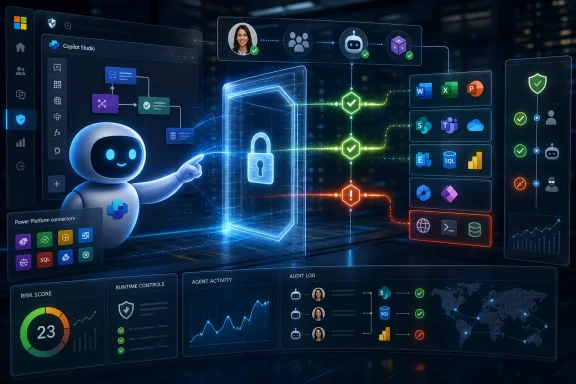
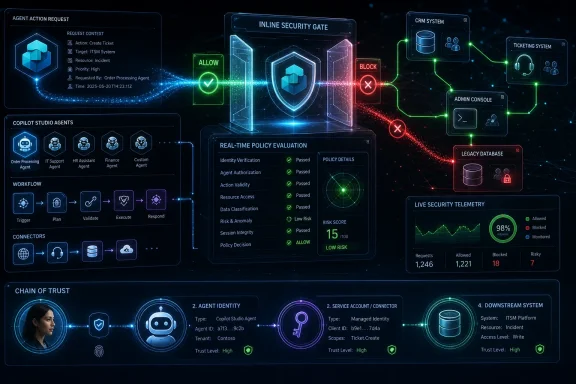
Silverfort on June 8, 2026 launched an early-access integration that applies real-time identity and access controls to AI agents built in Microsoft Copilot Studio, evaluating each agent action before it executes across enterprise systems. The announcement is narrow in product terms but broad in implication: the industry is moving from asking whether employees may use agents to asking what agents are allowed to do while they are doing it. That is a much harder governance problem than approving a chatbot. It is also the problem Windows shops will inherit first, because Microsoft has made Copilot Studio the low-code front door for agentic automation inside the enterprise.
The pitch from Silverfort is simple enough: an agent should not become a privileged actor merely because a user asked it to act. But the real story is not one vendor adding one control to one Microsoft platform. It is the arrival of a new identity layer in which humans, service accounts, app registrations, Entra agent identities, connectors, and machine-to-machine workflows all become part of the same authorization chain.
The first wave of enterprise generative AI governance was largely about data exposure. Could the model see confidential files? Would it leak customer data? Could a user paste source code into a public chatbot? Those were real problems, and they still are, but they belonged to a world in which AI mostly answered questions.
Copilot Studio agents are different because they are designed to do things. A useful agent can read from SharePoint, summarize email, open tickets, update CRM records, trigger Power Automate flows, and reach into line-of-business systems through connectors. The moment an agent can call tools, it stops being only a conversational interface and becomes a workflow participant.
That is why identity becomes the pressure point. An agent action is rarely a single clean authentication event. It can involve the user’s delegated permission, the agent’s own identity, connector permissions, Power Platform policy, cloud app access, and sometimes an on-premises system that was never designed for this style of automation. If that chain is loose, the agent may have more practical reach than anyone intended.
Microsoft has been moving toward more explicit agent identity primitives in Entra, including agent identities for Copilot Studio agents and governance visibility for connector permissions. That is an important platform step, but it does not eliminate the operational gap that security teams worry about: the decision that matters often happens at runtime, when the agent is about to touch a resource.
Silverfort’s integration is a bet that enterprises will not be satisfied with static policy alone. If an agent’s request looks wrong in context, the control must fire before the action runs, not after a SIEM dashboard lights up.
Silverfort’s language around “runtime identity enforcement” is therefore not just marketing polish. It reflects a genuine architectural shift. The question is no longer only whether an agent has a permission assigned somewhere in the directory. The question is whether this agent, acting for this user, through this connector, from this context, should be allowed to perform this action now.
That is the distinction between governance as paperwork and governance as control. A policy that says finance agents should not access engineering repositories is useful. A runtime enforcement point that blocks the access attempt before the agent reads the repository is materially more useful.
The industry has seen this movie before. Endpoint detection became endpoint prevention when attackers got too fast for analysts. Cloud security moved from periodic posture checks to inline controls because misconfigurations could be exploited immediately. Identity is now being pulled in the same direction by AI agents.
For Windows and Microsoft 365 administrators, this is not abstract. Copilot Studio is attractive precisely because it lets business units build agents without waiting for a full software development lifecycle. That democratization is powerful, but it also means identity teams may discover new automation paths after they already exist. Runtime controls are an attempt to put a brake inside the machine rather than hoping every maker reads the policy handbook.
But that same integration depth makes the governance stakes higher. A Copilot Studio agent is not a toy if it can interact with business data and trigger workflows. It sits near the nervous system of the Microsoft estate.
Microsoft’s own architecture increasingly recognizes this. Copilot Studio can use Entra agent identities, and agent permissions can be represented in ways administrators can inspect through Microsoft identity tooling. Power Platform data loss prevention policies and advanced connector policies give admins ways to govern which connectors can be used and under what conditions. Audit logs and Sentinel integrations help security teams observe agent activity.
Those controls matter. They also reveal the complexity of the model. Some connector calls run on behalf of the user. Some governance capabilities vary by channel. Some permissions are visible in Entra but mediated by the Power Platform connector runtime. Existing agents may still be on legacy app registrations during transition periods. The enterprise does not get one clean “agent permission” switch.
That is the trap: low-code agent building feels simple to the maker, while the underlying authorization graph is anything but simple to the administrator. A sales operations analyst may see a helpful assistant that updates records. The identity team sees delegated access, connector scopes, service principals, conditional access, data policies, and audit trails that must all line up correctly.
Silverfort is trying to sell a simplifying layer across that mess. Its promise is not that Microsoft’s native controls are irrelevant. It is that enterprises running multiple agent platforms need a runtime control plane that can evaluate actions across human, machine, and agentic identities without forcing every security decision into a single vendor’s admin console.
Service accounts, automation accounts, app registrations, managed identities, API keys, workload identities, and machine credentials already perform enormous amounts of work inside large organizations. Many are overprivileged. Many are poorly documented. Many are exempted from multifactor authentication because they cannot complete a human challenge. Many are owned by teams that no longer exist.
AI agents add a new class of non-human actor, but they also increase the usefulness — and risk — of the old ones. An agent that can invoke a workflow may indirectly rely on a service account. A connector may bridge the agent into a system with its own authorization model. A prompt-injection attack may not need to “hack” the model if it can trick the agent into using an already-authorized path.
That is why Silverfort’s positioning around human, machine, service, and agentic identities is important. The security boundary is not the chat interface. It is the full chain of identities involved in an action. If one link in that chain has excessive privilege, the agent may inherit the practical ability to do damage even if its own identity appears constrained.
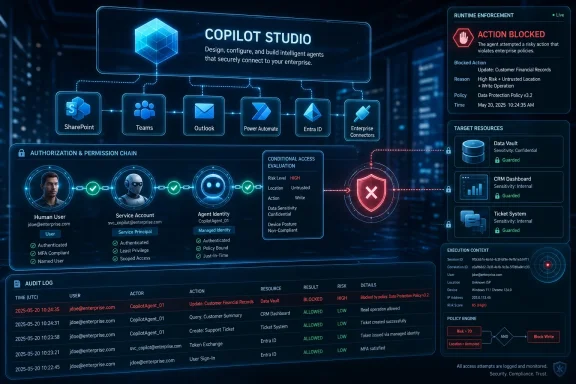
The audit challenge follows naturally. Enterprises do not merely need to know that an agent touched a resource. They need to know which human initiated the interaction, which agent interpreted the task, which connector or workflow executed it, which machine identity participated, and which policy allowed it. Without that chain, accountability dissolves into a fog of automation.
This is where the phrase agentic AI becomes operationally annoying. Agents are sold as autonomous helpers, but enterprises cannot govern them as autonomous moral actors. Somebody owns the agent. Somebody approved the connector. Somebody configured the policy. Somebody benefits from the workflow. Runtime identity controls are partly about making that responsibility visible again.
The company’s Runtime Access Protection technology has long been pitched as a way to enforce identity controls across systems that are difficult to protect consistently, including legacy and on-premises environments. Fabrix gives Silverfort a stronger AI-era story: decisions must be made at machine speed, with enough context to distinguish legitimate automation from overreach.
That is a compelling narrative because it maps cleanly onto the anxiety security teams already have. They know they cannot manually approve every agent action. They also know static access reviews will not catch every misuse case quickly enough. If agents are going to act continuously, the control layer must evaluate continuously.
Silverfort says its Copilot Studio integration can limit privilege elevation, block anomalous access attempts before execution, adapt access policies based on real-time context and risk, and log activity back to the human user. In practical terms, that means the agent’s action is treated as an identity event worthy of inspection before the workflow proceeds.
The early-access label is worth noticing. This is not yet a mature commodity category with settled standards and predictable deployment patterns. It is a market forming around a problem that many enterprises are only beginning to understand. The winners will be the vendors that can integrate deeply without becoming another brittle policy layer administrators have to babysit.
That means adoption can arrive from multiple directions at once. IT may sponsor some agents. Business units may build others. Employees may use sanctioned agents in Teams while also experimenting with unsanctioned tools elsewhere. Developers may build custom agents outside Copilot Studio. Vendors may arrive with their own embedded assistants.
The result is not a single agent rollout. It is agent sprawl.
Microsoft has acknowledged the need for governance by building more agent identity and policy capabilities into its stack. But the practical Microsoft customer is rarely Microsoft-only in the places that matter. Enterprises have Salesforce, ServiceNow, Workday, SAP, Google Cloud, AWS, custom applications, legacy Windows Server workloads, and a thicket of SaaS tools with their own identities and permissions.
This is why Silverfort’s “single control plane” argument has traction. A Copilot Studio integration is valuable because Microsoft is a central platform. But the bigger enterprise ask is cross-platform visibility. If every agent platform ships its own governance model, administrators will face the same fragmentation they already face with SaaS permissions and cloud identities.
The WindowsForum audience should recognize the pattern. Microsoft often creates the default administrative center of gravity, but third-party vendors thrive where heterogeneous reality intrudes. Endpoint management, backup, identity governance, privileged access, and SIEM all followed that path. Agent identity is likely to as well.
A perfectly aligned agent with excessive permissions is still dangerous if misconfigured. A badly prompted agent with narrow permissions is annoying but contained. The security priority is not to pretend models can be made immune to trickery. It is to ensure that trickery cannot easily become unauthorized action.
This is where AI security sometimes talks past enterprise security. Model-centric discussions focus on jailbreaks, hallucinations, and adversarial prompts. Enterprise administrators care about who can read payroll data, who can change a firewall rule, who can approve an invoice, and who can create a new privileged account. The model’s behavior matters because it may trigger those actions, but the controls around the action decide the blast radius.
Runtime identity enforcement sits at that practical layer. It does not require perfect prediction of every malicious prompt. It asks whether the requested action is legitimate in context. That makes it familiar to security teams even if the actor is new.
The stronger version of this approach will combine several signals: the human user’s role, the agent’s intended purpose, the connector being used, the sensitivity of the resource, the recent behavior of the agent, the device or session context, and the risk posture of the environment. The weaker version will become another allow-deny matrix that cannot keep up with real usage.
Silverfort’s challenge is to prove it can deliver the stronger version without burying admins under false positives. Blocking a malicious access attempt is good. Blocking the quarterly close because a finance agent touched an unusual but legitimate workbook is the kind of incident that turns governance tools into shelfware.
Security teams can ban unsanctioned agents, and in some cases they should. But prohibition rarely survives contact with productivity pressure. If an employee can automate a repetitive process in an afternoon, the business incentive to use agents will be strong. The question becomes whether the organization can provide safer paths that are good enough to displace the risky ones.
Copilot Studio is Microsoft’s answer to that demand: build the agents where the enterprise can see them. Silverfort’s answer is more skeptical: visibility inside one platform is not enough if agents and identities operate across a wider estate. Both views can be true.
The rise of shadow agents also changes how administrators should think about policy. It is not enough to approve a platform and declare the problem solved. Agents should be governed by what they can do, what data they can touch, and what identities they can activate. A sanctioned agent can still be unsafe; an unsanctioned one can be invisible until it causes a problem.
For Windows-heavy organizations, the most fragile boundary may be the bridge between modern cloud identity and older systems. Many enterprises still depend on legacy applications, file shares, domain-joined resources, and workflows with service accounts that predate today’s Zero Trust assumptions. Agents that can reach those systems through connectors or automation layers may expose old identity debt in new ways.
That is why this product category will resonate with sysadmins even if the marketing is full of AI buzzwords. At bottom, the issue is painfully familiar: too many accounts, too many permissions, too many exceptions, and not enough context at the moment access is requested.
Enterprises have long struggled with shared accounts and service accounts because they obscure individual responsibility. If “svc_automation_prod” changed a setting, investigators still need to know which process invoked it, which person triggered the process, and whether the action was authorized. Agents add natural-language ambiguity to that old problem.
A user may say, “Clean up this list,” and an agent may interpret that instruction in ways the user did not fully anticipate. A business unit may publish an agent that later gets repurposed by another team. A connector may allow a broader operation set than the maker realized. When something goes wrong, the audit trail must reconstruct both the technical path and the human context.
This requirement will increasingly shape procurement. Buyers will ask whether an agent platform can show who created an agent, who owns it, what connectors it can use, what actions it performed, which user initiated each action, and which policy allowed or blocked it. Vendors that cannot answer those questions will be treated as experimental, not enterprise-ready.
The audit trail also matters for incident response. If a compromised account uses an agent to perform actions, responders need to distinguish between ordinary user activity, agent-mediated activity, and direct abuse of underlying credentials. Lumping all of that together under the user’s identity may satisfy a simplistic log entry but fail the actual investigation.
Silverfort’s integration will need to prove that its logs are not merely voluminous but usable. Security teams do not need another stream of opaque AI events. They need a coherent identity narrative: this person, using this agent, attempted this action, through this path, and this control made this decision.
Runtime enforcement is only as good as the policy model behind it. Organizations need to decide which agents are allowed to exist, who may create them, what data classes they may access, which connectors are permissible, which actions require stronger conditions, and which workflows are too sensitive for autonomous execution. These are business decisions expressed through identity controls.
The most mature organizations will likely classify agents by risk. A benefits FAQ agent that reads approved HR documents is not the same as an IT operations agent that can reset accounts or modify endpoint groups. A sales summarization agent is not the same as a finance agent that can trigger payment workflows. Treating all agents equally will either overburden low-risk use cases or underprotect high-risk ones.
There is also a lifecycle problem. Agents need owners, reviews, decommissioning, and change control. If an agent’s purpose changes, its permissions should change. If a connector is added, the risk profile changes. If the owner leaves the company, the agent should not drift into orphaned automation.
None of this is glamorous, and none of it will fit neatly into an AI keynote. But it is where enterprise AI either becomes manageable infrastructure or another layer of unmanaged technical debt. Silverfort’s product story is strongest when it acknowledges that runtime controls complement governance discipline rather than replacing it.
That means familiar controls need to be applied with new urgency. Least privilege matters more when agents can act quickly. Conditional access matters more when authentication events include non-human actors. Data loss prevention matters more when agents can combine information from multiple systems. Service account hygiene matters more when those accounts become part of agent workflows.
It also means administrators should resist the false comfort of “the agent only acts as the user.” On-behalf-of access is useful, but it is not a magic shield. Users often have excessive access. Connectors may expose broad operations. Workflows may run under separate identities. The agent’s practical power is the sum of these relationships, not a single permission label.
The right question is not whether an agent is allowed in the tenant. The right question is what the agent can cause to happen. That framing forces a move from inventory to consequence.
Silverfort’s announcement is useful because it pushes the conversation toward that consequence layer. If agent governance stops at cataloging agents, it will fail. If it reaches the moment of action, it has a chance.
That is not necessarily a weakness. Microsoft’s ecosystem has always depended on partners filling gaps for specific operational realities. The question is whether Microsoft and its partners can make those layers coherent rather than duplicative.
For Copilot Studio to succeed in regulated and security-conscious environments, administrators need confidence that agent actions can be constrained before harm occurs. They also need confidence that the controls will work across Teams, Power Platform, Entra, connectors, and eventually the broader mesh of agents Microsoft is building across its product line. Any inconsistency will become a place where risk hides.
Silverfort’s early-access integration should therefore be read as a marker of where the market is going. Agent security will not be one feature. It will be a stack: identity, runtime authorization, connector governance, data controls, audit, incident response, and model-level protections. Enterprises will mix native Microsoft capabilities with third-party overlays when they need broader reach or deeper enforcement.
The competitive pressure will be healthy if it forces clearer primitives. Administrators need fewer ambiguous agent concepts and more inspectable identities, permissions, logs, and policies. They need to understand not only that an agent exists, but what it can do and why it was allowed to do it.
A useful starting point is to treat every agent as a software asset with an identity footprint. It should have an owner, a purpose, a data classification, a connector inventory, an approval path, and a retirement plan. If that sounds bureaucratic, remember that the alternative is discovering six months later that a “simple assistant” can trigger actions across finance, HR, and operations.
Silverfort’s integration adds one possible enforcement mechanism to that operating model. Whether an organization uses Silverfort, Microsoft-native controls, another identity security platform, or a combination, the architectural principle is the same: evaluate access at the point where the agent is about to act.
The details will vary by environment. A small business experimenting with a few internal agents may rely on Power Platform policies and careful maker governance. A Fortune 500 company with hybrid infrastructure, multiple clouds, and a large service-account estate will need more centralized visibility and runtime control. Both should start from the assumption that agent permissions will expand unless actively constrained.
The practical takeaways are already visible:
The pitch from Silverfort is simple enough: an agent should not become a privileged actor merely because a user asked it to act. But the real story is not one vendor adding one control to one Microsoft platform. It is the arrival of a new identity layer in which humans, service accounts, app registrations, Entra agent identities, connectors, and machine-to-machine workflows all become part of the same authorization chain.
 Agents Have Stopped Being Chat Windows
The first wave of enterprise generative AI governance was largely about data exposure. Could the model see confidential files? Would it leak customer data? Could a user paste source code into a public chatbot? Those were real problems, and they still are, but they belonged to a world in which AI mostly answered questions.Copilot Studio agents are different because they are designed to do things. A useful agent can read from SharePoint, summarize email, open tickets, update CRM records, trigger Power Automate flows, and reach into line-of-business systems through connectors. The moment an agent can call tools, it stops being only a conversational interface and becomes a workflow participant.
That is why identity becomes the pressure point. An agent action is rarely a single clean authentication event. It can involve the user’s delegated permission, the agent’s own identity, connector permissions, Power Platform policy, cloud app access, and sometimes an on-premises system that was never designed for this style of automation. If that chain is loose, the agent may have more practical reach than anyone intended.
Microsoft has been moving toward more explicit agent identity primitives in Entra, including agent identities for Copilot Studio agents and governance visibility for connector permissions. That is an important platform step, but it does not eliminate the operational gap that security teams worry about: the decision that matters often happens at runtime, when the agent is about to touch a resource.
Silverfort’s integration is a bet that enterprises will not be satisfied with static policy alone. If an agent’s request looks wrong in context, the control must fire before the action runs, not after a SIEM dashboard lights up.
Runtime Is Where the Blast Radius Is Decided
Traditional identity governance is excellent at defining who should have access in theory. It is weaker at deciding whether a specific access attempt makes sense in the moment. That weakness was manageable when the actor was a person logging into an application a few times a day. It becomes far more dangerous when the actor is an AI-driven workflow that may perform many actions quickly, across systems, on behalf of a user who may not understand the permission chain underneath.Silverfort’s language around “runtime identity enforcement” is therefore not just marketing polish. It reflects a genuine architectural shift. The question is no longer only whether an agent has a permission assigned somewhere in the directory. The question is whether this agent, acting for this user, through this connector, from this context, should be allowed to perform this action now.
That is the distinction between governance as paperwork and governance as control. A policy that says finance agents should not access engineering repositories is useful. A runtime enforcement point that blocks the access attempt before the agent reads the repository is materially more useful.
The industry has seen this movie before. Endpoint detection became endpoint prevention when attackers got too fast for analysts. Cloud security moved from periodic posture checks to inline controls because misconfigurations could be exploited immediately. Identity is now being pulled in the same direction by AI agents.
For Windows and Microsoft 365 administrators, this is not abstract. Copilot Studio is attractive precisely because it lets business units build agents without waiting for a full software development lifecycle. That democratization is powerful, but it also means identity teams may discover new automation paths after they already exist. Runtime controls are an attempt to put a brake inside the machine rather than hoping every maker reads the policy handbook.
Microsoft’s Agent Stack Creates a Governance Opportunity and a Governance Trap
Microsoft has done something strategically clever with Copilot Studio. It has placed agent creation inside the ecosystem where enterprise work already happens: Microsoft 365, Teams, Power Platform, Entra, SharePoint, Outlook, Dynamics, and the connector universe. That gives organizations a plausible route to sanctioned AI automation rather than leaving employees to improvise with random SaaS agents.But that same integration depth makes the governance stakes higher. A Copilot Studio agent is not a toy if it can interact with business data and trigger workflows. It sits near the nervous system of the Microsoft estate.
Microsoft’s own architecture increasingly recognizes this. Copilot Studio can use Entra agent identities, and agent permissions can be represented in ways administrators can inspect through Microsoft identity tooling. Power Platform data loss prevention policies and advanced connector policies give admins ways to govern which connectors can be used and under what conditions. Audit logs and Sentinel integrations help security teams observe agent activity.
Those controls matter. They also reveal the complexity of the model. Some connector calls run on behalf of the user. Some governance capabilities vary by channel. Some permissions are visible in Entra but mediated by the Power Platform connector runtime. Existing agents may still be on legacy app registrations during transition periods. The enterprise does not get one clean “agent permission” switch.
That is the trap: low-code agent building feels simple to the maker, while the underlying authorization graph is anything but simple to the administrator. A sales operations analyst may see a helpful assistant that updates records. The identity team sees delegated access, connector scopes, service principals, conditional access, data policies, and audit trails that must all line up correctly.
Silverfort is trying to sell a simplifying layer across that mess. Its promise is not that Microsoft’s native controls are irrelevant. It is that enterprises running multiple agent platforms need a runtime control plane that can evaluate actions across human, machine, and agentic identities without forcing every security decision into a single vendor’s admin console.
The Agent Is Not the Only Identity in the Room
The biggest misconception in agent security is that the agent is the identity problem. It is not. The agent is the most visible part of a much larger non-human identity problem that enterprises have allowed to grow for years.Service accounts, automation accounts, app registrations, managed identities, API keys, workload identities, and machine credentials already perform enormous amounts of work inside large organizations. Many are overprivileged. Many are poorly documented. Many are exempted from multifactor authentication because they cannot complete a human challenge. Many are owned by teams that no longer exist.
AI agents add a new class of non-human actor, but they also increase the usefulness — and risk — of the old ones. An agent that can invoke a workflow may indirectly rely on a service account. A connector may bridge the agent into a system with its own authorization model. A prompt-injection attack may not need to “hack” the model if it can trick the agent into using an already-authorized path.
That is why Silverfort’s positioning around human, machine, service, and agentic identities is important. The security boundary is not the chat interface. It is the full chain of identities involved in an action. If one link in that chain has excessive privilege, the agent may inherit the practical ability to do damage even if its own identity appears constrained.
The audit challenge follows naturally. Enterprises do not merely need to know that an agent touched a resource. They need to know which human initiated the interaction, which agent interpreted the task, which connector or workflow executed it, which machine identity participated, and which policy allowed it. Without that chain, accountability dissolves into a fog of automation.
This is where the phrase agentic AI becomes operationally annoying. Agents are sold as autonomous helpers, but enterprises cannot govern them as autonomous moral actors. Somebody owns the agent. Somebody approved the connector. Somebody configured the policy. Somebody benefits from the workflow. Runtime identity controls are partly about making that responsibility visible again.
Silverfort Is Turning a Recent Acquisition Into a Product Argument
Silverfort’s Copilot Studio integration arrives shortly after its April 2026 acquisition of Fabrix Security, an AI-native identity company focused on runtime decisioning. That timing matters. Silverfort is not merely bolting a Microsoft connector onto an existing identity product; it is trying to frame runtime decisioning as the new center of gravity for identity security.The company’s Runtime Access Protection technology has long been pitched as a way to enforce identity controls across systems that are difficult to protect consistently, including legacy and on-premises environments. Fabrix gives Silverfort a stronger AI-era story: decisions must be made at machine speed, with enough context to distinguish legitimate automation from overreach.
That is a compelling narrative because it maps cleanly onto the anxiety security teams already have. They know they cannot manually approve every agent action. They also know static access reviews will not catch every misuse case quickly enough. If agents are going to act continuously, the control layer must evaluate continuously.
Silverfort says its Copilot Studio integration can limit privilege elevation, block anomalous access attempts before execution, adapt access policies based on real-time context and risk, and log activity back to the human user. In practical terms, that means the agent’s action is treated as an identity event worthy of inspection before the workflow proceeds.
The early-access label is worth noticing. This is not yet a mature commodity category with settled standards and predictable deployment patterns. It is a market forming around a problem that many enterprises are only beginning to understand. The winners will be the vendors that can integrate deeply without becoming another brittle policy layer administrators have to babysit.
The Microsoft Ecosystem Makes Runtime Controls Easier to Justify
Microsoft’s dominance in enterprise productivity gives agent governance a built-in urgency. If agents were confined to experimental developer tools, security teams could slow-roll their response. But Copilot Studio lives in the same broad administrative universe as Teams, SharePoint, Outlook, Power Platform, and Entra — the places where corporate work already happens.That means adoption can arrive from multiple directions at once. IT may sponsor some agents. Business units may build others. Employees may use sanctioned agents in Teams while also experimenting with unsanctioned tools elsewhere. Developers may build custom agents outside Copilot Studio. Vendors may arrive with their own embedded assistants.
The result is not a single agent rollout. It is agent sprawl.
Microsoft has acknowledged the need for governance by building more agent identity and policy capabilities into its stack. But the practical Microsoft customer is rarely Microsoft-only in the places that matter. Enterprises have Salesforce, ServiceNow, Workday, SAP, Google Cloud, AWS, custom applications, legacy Windows Server workloads, and a thicket of SaaS tools with their own identities and permissions.
This is why Silverfort’s “single control plane” argument has traction. A Copilot Studio integration is valuable because Microsoft is a central platform. But the bigger enterprise ask is cross-platform visibility. If every agent platform ships its own governance model, administrators will face the same fragmentation they already face with SaaS permissions and cloud identities.
The WindowsForum audience should recognize the pattern. Microsoft often creates the default administrative center of gravity, but third-party vendors thrive where heterogeneous reality intrudes. Endpoint management, backup, identity governance, privileged access, and SIEM all followed that path. Agent identity is likely to as well.
Prompt Injection Is the Wrong Place to Stop the Conversation
Silverfort also says it is working with Microsoft on additional AI security features, including detection of prompt injection and jailbreak attempts using recursive language modeling. That is noteworthy, but it should not distract from the identity story. Prompt injection is one way an agent can be manipulated. Overbroad access is what turns manipulation into damage.A perfectly aligned agent with excessive permissions is still dangerous if misconfigured. A badly prompted agent with narrow permissions is annoying but contained. The security priority is not to pretend models can be made immune to trickery. It is to ensure that trickery cannot easily become unauthorized action.
This is where AI security sometimes talks past enterprise security. Model-centric discussions focus on jailbreaks, hallucinations, and adversarial prompts. Enterprise administrators care about who can read payroll data, who can change a firewall rule, who can approve an invoice, and who can create a new privileged account. The model’s behavior matters because it may trigger those actions, but the controls around the action decide the blast radius.
Runtime identity enforcement sits at that practical layer. It does not require perfect prediction of every malicious prompt. It asks whether the requested action is legitimate in context. That makes it familiar to security teams even if the actor is new.
The stronger version of this approach will combine several signals: the human user’s role, the agent’s intended purpose, the connector being used, the sensitivity of the resource, the recent behavior of the agent, the device or session context, and the risk posture of the environment. The weaker version will become another allow-deny matrix that cannot keep up with real usage.
Silverfort’s challenge is to prove it can deliver the stronger version without burying admins under false positives. Blocking a malicious access attempt is good. Blocking the quarterly close because a finance agent touched an unusual but legitimate workbook is the kind of incident that turns governance tools into shelfware.
Shadow Agents Will Force Security Teams to Govern Behavior, Not Just Platforms
The uncomfortable statistic in Microsoft’s recent AI governance messaging is not just that large enterprises are deploying agents rapidly. It is that a significant share of employees are already using unsanctioned AI agents for work tasks. That means the governance perimeter is porous from the start.Security teams can ban unsanctioned agents, and in some cases they should. But prohibition rarely survives contact with productivity pressure. If an employee can automate a repetitive process in an afternoon, the business incentive to use agents will be strong. The question becomes whether the organization can provide safer paths that are good enough to displace the risky ones.
Copilot Studio is Microsoft’s answer to that demand: build the agents where the enterprise can see them. Silverfort’s answer is more skeptical: visibility inside one platform is not enough if agents and identities operate across a wider estate. Both views can be true.
The rise of shadow agents also changes how administrators should think about policy. It is not enough to approve a platform and declare the problem solved. Agents should be governed by what they can do, what data they can touch, and what identities they can activate. A sanctioned agent can still be unsafe; an unsanctioned one can be invisible until it causes a problem.
For Windows-heavy organizations, the most fragile boundary may be the bridge between modern cloud identity and older systems. Many enterprises still depend on legacy applications, file shares, domain-joined resources, and workflows with service accounts that predate today’s Zero Trust assumptions. Agents that can reach those systems through connectors or automation layers may expose old identity debt in new ways.
That is why this product category will resonate with sysadmins even if the marketing is full of AI buzzwords. At bottom, the issue is painfully familiar: too many accounts, too many permissions, too many exceptions, and not enough context at the moment access is requested.
Audit Trails Are Becoming a Product Feature, Not a Compliance Afterthought
One of the most important claims in Silverfort’s announcement is that activity can be tied back to the human using the agent. That is more than a compliance nicety. It is the difference between accountable automation and plausible deniability at machine speed.Enterprises have long struggled with shared accounts and service accounts because they obscure individual responsibility. If “svc_automation_prod” changed a setting, investigators still need to know which process invoked it, which person triggered the process, and whether the action was authorized. Agents add natural-language ambiguity to that old problem.
A user may say, “Clean up this list,” and an agent may interpret that instruction in ways the user did not fully anticipate. A business unit may publish an agent that later gets repurposed by another team. A connector may allow a broader operation set than the maker realized. When something goes wrong, the audit trail must reconstruct both the technical path and the human context.
This requirement will increasingly shape procurement. Buyers will ask whether an agent platform can show who created an agent, who owns it, what connectors it can use, what actions it performed, which user initiated each action, and which policy allowed or blocked it. Vendors that cannot answer those questions will be treated as experimental, not enterprise-ready.
The audit trail also matters for incident response. If a compromised account uses an agent to perform actions, responders need to distinguish between ordinary user activity, agent-mediated activity, and direct abuse of underlying credentials. Lumping all of that together under the user’s identity may satisfy a simplistic log entry but fail the actual investigation.
Silverfort’s integration will need to prove that its logs are not merely voluminous but usable. Security teams do not need another stream of opaque AI events. They need a coherent identity narrative: this person, using this agent, attempted this action, through this path, and this control made this decision.
The Hard Part Is Policy Design, Not Product Installation
The temptation with any new security integration is to treat it as a checkbox. Enable runtime controls. Connect to Copilot Studio. Turn on logging. Declare the agent estate governed. That would miss the harder work.Runtime enforcement is only as good as the policy model behind it. Organizations need to decide which agents are allowed to exist, who may create them, what data classes they may access, which connectors are permissible, which actions require stronger conditions, and which workflows are too sensitive for autonomous execution. These are business decisions expressed through identity controls.
The most mature organizations will likely classify agents by risk. A benefits FAQ agent that reads approved HR documents is not the same as an IT operations agent that can reset accounts or modify endpoint groups. A sales summarization agent is not the same as a finance agent that can trigger payment workflows. Treating all agents equally will either overburden low-risk use cases or underprotect high-risk ones.
There is also a lifecycle problem. Agents need owners, reviews, decommissioning, and change control. If an agent’s purpose changes, its permissions should change. If a connector is added, the risk profile changes. If the owner leaves the company, the agent should not drift into orphaned automation.
None of this is glamorous, and none of it will fit neatly into an AI keynote. But it is where enterprise AI either becomes manageable infrastructure or another layer of unmanaged technical debt. Silverfort’s product story is strongest when it acknowledges that runtime controls complement governance discipline rather than replacing it.
The Windows Admin’s Agent Problem Is Already an Identity Problem
For the Windows administrator, the near-term takeaway is not that every organization needs Silverfort specifically. It is that agent adoption should be reviewed as an identity expansion, not just an application rollout. Every agent is a potential actor. Every connector is a potential permission bridge. Every workflow is a potential escalation path.That means familiar controls need to be applied with new urgency. Least privilege matters more when agents can act quickly. Conditional access matters more when authentication events include non-human actors. Data loss prevention matters more when agents can combine information from multiple systems. Service account hygiene matters more when those accounts become part of agent workflows.
It also means administrators should resist the false comfort of “the agent only acts as the user.” On-behalf-of access is useful, but it is not a magic shield. Users often have excessive access. Connectors may expose broad operations. Workflows may run under separate identities. The agent’s practical power is the sum of these relationships, not a single permission label.
The right question is not whether an agent is allowed in the tenant. The right question is what the agent can cause to happen. That framing forces a move from inventory to consequence.
Silverfort’s announcement is useful because it pushes the conversation toward that consequence layer. If agent governance stops at cataloging agents, it will fail. If it reaches the moment of action, it has a chance.
The Copilot Studio Control Plane Now Has to Prove It Can Hold
This launch leaves Microsoft in an interesting position. On one hand, third-party runtime controls validate Microsoft’s decision to make agent identity more explicit. If agents were not becoming real enterprise actors, nobody would need a specialized enforcement layer around them. On the other hand, the need for such integrations highlights that native platform governance alone may not satisfy complex customers.That is not necessarily a weakness. Microsoft’s ecosystem has always depended on partners filling gaps for specific operational realities. The question is whether Microsoft and its partners can make those layers coherent rather than duplicative.
For Copilot Studio to succeed in regulated and security-conscious environments, administrators need confidence that agent actions can be constrained before harm occurs. They also need confidence that the controls will work across Teams, Power Platform, Entra, connectors, and eventually the broader mesh of agents Microsoft is building across its product line. Any inconsistency will become a place where risk hides.
Silverfort’s early-access integration should therefore be read as a marker of where the market is going. Agent security will not be one feature. It will be a stack: identity, runtime authorization, connector governance, data controls, audit, incident response, and model-level protections. Enterprises will mix native Microsoft capabilities with third-party overlays when they need broader reach or deeper enforcement.
The competitive pressure will be healthy if it forces clearer primitives. Administrators need fewer ambiguous agent concepts and more inspectable identities, permissions, logs, and policies. They need to understand not only that an agent exists, but what it can do and why it was allowed to do it.
The Practical Reading for IT Shops Deploying Agents This Summer
The immediate task for enterprises is to slow down just enough to avoid building an agent estate they cannot govern. That does not mean freezing AI projects. It means making identity review part of agent deployment from the beginning, before business units normalize unmanaged automation.A useful starting point is to treat every agent as a software asset with an identity footprint. It should have an owner, a purpose, a data classification, a connector inventory, an approval path, and a retirement plan. If that sounds bureaucratic, remember that the alternative is discovering six months later that a “simple assistant” can trigger actions across finance, HR, and operations.
Silverfort’s integration adds one possible enforcement mechanism to that operating model. Whether an organization uses Silverfort, Microsoft-native controls, another identity security platform, or a combination, the architectural principle is the same: evaluate access at the point where the agent is about to act.
The details will vary by environment. A small business experimenting with a few internal agents may rely on Power Platform policies and careful maker governance. A Fortune 500 company with hybrid infrastructure, multiple clouds, and a large service-account estate will need more centralized visibility and runtime control. Both should start from the assumption that agent permissions will expand unless actively constrained.
The First Rules of Agent Identity Are Being Written in Production
The most concrete lesson from Silverfort’s Copilot Studio move is that agent governance is not waiting for a standards body or a final Microsoft architecture diagram. It is being built in production, under pressure from business teams that want automation and security teams that know automation changes the risk math.The practical takeaways are already visible:
- Copilot Studio agents should be inventoried as active identities and workflow actors, not merely as chatbot projects.
- Runtime authorization matters because static permissions cannot capture every high-risk agent action in context.
- Human accountability must remain attached to agent activity, especially when connectors, service accounts, and machine identities participate in the workflow.
- Native Microsoft controls are necessary but may not be sufficient for enterprises with multiple agent platforms and hybrid infrastructure.
- Prompt-injection defenses are useful, but least privilege and action-level enforcement decide how much damage a manipulated agent can do.
- Agent lifecycle management should include ownership, connector review, policy review, logging, and decommissioning from the start.
References
- Primary source: SiliconANGLE
Published: Mon, 08 Jun 2026 12:00:55 GMT
Silverfort brings runtime identity controls to Microsoft Copilot Studio agents - SiliconANGLE
Silverfort brings runtime identity controls to Microsoft Copilot Studio agents - SiliconANGLE siliconangle.com
- Related coverage: silverfort.com
Silverfort Acquires Fabrix Security to Deliver Autonomous Runtime Identity Security for the AI Era - Silverfort
Pioneering the first AI-driven runtime access control engine, designed with the context and speed to protect all human, machine, and agentic identities www.silverfort.com
- Related coverage: breakingagent.com
Fortune 500 adoption of AI agents hits 80%, led by Microsoft tools — BreakingAgent
Microsoft reports that 80% of Fortune 500 companies now run operational AI agents built with Copilot Studio or Agent Builder. breakingagent.com
- Related coverage: trysignalbase.com
Fabrix Security Acquired by Silverfort | M&A News | Signalbase
Silverfort has acquired Fabrix Security for an undisclosed amount, marking a significant move in the identity security landscape. Fabrix Security specializes in developing AI agents for identity security, providing Identity and Access Management (IAM) teams with intelligent, explainable access... www.trysignalbase.com
- Related coverage: webdisclosure.com
Silverfort Ltd |
Silverfort acquires Fabrix Security to deliver autonomous runtime identity security for the AI era. Combining AI-driven runtime access control engine for seamless protection of human, machine, and agentic identities www.webdisclosure.com
- Official source: news.microsoft.com
Microsoft Cyber Pulse: How AI Agents Power Business Growth
AI agents are becoming digital coworkers. Microsoft’s Cyber Pulse shows how strong governance helps organizations unlock innovation, productivity, and scale with confidence. news.microsoft.com
- Related coverage: unite.ai
Silverfort Acquires Fabrix Security to Build Autonomous Identity Security for the AI Era
Silverfort has announced its acquisition of Fabrix Security, bringing together two companies focused on addressing one of the fastest-growing challenges in cybersecurity: how to control access in environments increasingl...www.unite.ai
- Related coverage: citybiz.co
Silverfort Acquires Fabrix Security to Launch Autonomous Identity Security Platform for AI-Driven Enterprises
Silverfort, a provider of identity security infrastructure, has acquired Fabrix Security, an AI-native identity security company, in a move aimed... Read More www.citybiz.co
- Related coverage: creati.ai
Microsoft Report: 80% of Fortune 500 Companies Now Deploy Active AI Agents Using Low-Code Tools
New Microsoft Cyber Pulse report reveals over 80% of Fortune 500 companies are deploying AI agents with low-code/no-code tools, emphasizing governance and security.creati.ai
- Related coverage: cbinsights.com
Silverfort Stock Price, Funding, Valuation, Revenue & Financial Statements
See Silverfort funding rounds, investors, investments, exits and more. Evaluate their financials based on Silverfort's post-money valuation and revenue.www.cbinsights.com
- Official source: microsoft.com
- Related coverage: birlasoft.com