

Siemens Solid Edge SE2026 versions before V226.0 Update 5 are affected by two newly disclosed PAR file parsing vulnerabilities, published by Siemens ProductCERT on May 12, corrected in title metadata on May 13, and republished by CISA on May 14, 2026. The fix is straightforward: install Update 5 or later. The more interesting story is why a desktop CAD parser belongs in the same risk conversation as industrial control systems, engineering workstations, and critical manufacturing networks. File formats have become one of the quietest attack surfaces in enterprise Windows environments, and CAD files are now part of that perimeter.
The Siemens advisory is not a tale of internet-facing servers, exposed PLCs, or a forgotten VPN appliance waiting for a scanner to find it. It is a user-interaction vulnerability in a Windows engineering application: the victim opens a specially crafted Solid Edge part file, and the parser does the attacker’s work.
That distinction matters, but it should not reassure anyone too much. Modern attacks often begin with a document, drawing, archive, model, spreadsheet, or installer that appears to belong in the recipient’s workflow. For engineers, suppliers, contractors, and manufacturing partners, a
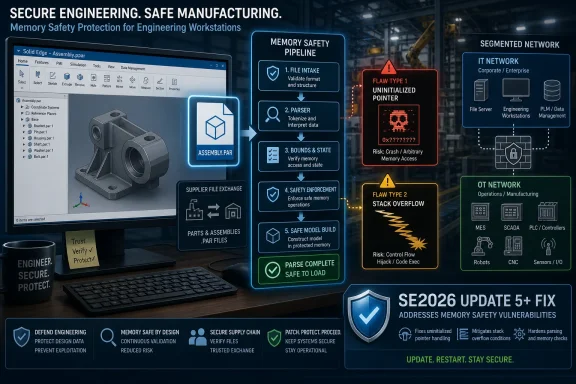
The two vulnerabilities affect Solid Edge SE2026 before Update 5 and are tied to the application’s handling of PAR files. One involves access to an uninitialized pointer, and the other is a stack-based buffer overflow. Siemens says both could allow code execution in the context of the current process, which is a polite way of saying that a malicious file could potentially turn a design workstation into an initial foothold.
CVSS 7.8 is not the sort of score that automatically triggers panic in every security operations center. But in this case, the number understates the organizational importance of the target. CAD workstations are often trusted machines with access to design repositories, supplier exchanges, licensing infrastructure, manufacturing documentation, and sometimes production-adjacent networks.
That makes it easy for ownership to blur. The desktop team may see it as a Windows application. The engineering team may see it as a design tool. The OT security team may see it as out of scope because it is not running on a plant floor controller. The vulnerability management team may see Siemens and CISA tags and assume someone else is already handling it.
The CISA republication places the advisory under industrial control system visibility because Solid Edge is used in critical manufacturing environments, not because the flaw magically turns a CAD seat into a PLC exploit. That distinction is important. The operational risk comes from workflow proximity: engineering files move between companies, departments, and trust zones with a speed that many security architectures still do not model well.
An attacker does not need Solid Edge to be internet-facing if the file itself is the delivery mechanism. The workstation becomes the point of ingestion, and the supply chain becomes the transport layer. In industries where outside files are routinely exchanged for quotes, revisions, tooling, inspection, and manufacturing prep, “do not open untrusted files” is more slogan than control.
The uninitialized pointer issue, tracked as CVE-2026-44411, points to memory being used before it has been reliably prepared. The stack-based overflow, tracked as CVE-2026-44412, is the older and more infamous class of memory corruption bug. Both are the sort of flaw that defenders have seen across image viewers, PDF readers, office suites, archive utilities, media players, and engineering software.
The security lesson is not that Solid Edge is uniquely careless. It is that complex file formats are executable-adjacent even when they are not supposed to be executable. If an application must interpret a rich binary structure supplied by someone else, its parser becomes a security boundary whether the vendor, user, or administrator planned for that or not.
Windows administrators already understand this pattern from Office macros, preview handlers, and attachment filtering. CAD simply brings the pattern into a different culture. Engineering users may be more resistant to interruption, because file exchange is not a convenience layer on top of the work; it is the work.
Still, “local with user interaction” is a familiar phrase in successful intrusion chains. Phishing, supplier compromise, stolen project data, and fake bid packages all exist to solve the user-interaction problem. If the target role regularly opens technical files from outside parties, the interaction requirement becomes less of a barrier and more of an expected business process.
The “current process” language also deserves attention. Code execution in the context of Solid Edge inherits what that user and process can reach. If engineering users have broad file share permissions, cached credentials, access to product lifecycle management systems, or local administrative rights for legacy plug-ins and drivers, the vulnerability’s practical impact grows.
This is why patch priority should not be assigned by score alone. A lightly used lab installation with no outside file intake is not the same as a supplier-facing engineering department receiving models all day. The vulnerable version number is identical, but the exposure is not.
The revision history is also a reminder that metadata can shift quickly. The initial Siemens publication appeared on May 12, 2026. A May 13 revision corrected an error in the title, changing the version reference from SE225 to SE226. CISA then republished the advisory on May 14.
That chronology is not scandalous; it is normal vulnerability-publishing machinery. But it does mean vulnerability teams should avoid overfitting automation to advisory titles alone. Product names, branch numbers, and update labels can be corrected after first publication, while CVEs, affected-version ranges, and remediation text carry the more durable meaning.
For Windows administrators, the actionable statement is simple: Solid Edge SE2026 installations older than V226.0 Update 5 are in scope. If your asset inventory only knows “Solid Edge 2026” and not the installed update level, it is not detailed enough to close this issue confidently.
That reality often produces a quiet double standard. Browsers and office suites get emergency patch lanes because everyone understands their exposure. CAD applications, simulation tools, CAM software, and product data utilities are treated as “special” and updated on slower engineering-controlled schedules. Attackers, unfortunately, are not required to respect internal ownership boundaries.
Solid Edge Update 5 should therefore be handled as both a security patch and an engineering change. The right process is not blind deployment to every design workstation in the middle of a release deadline. But it is also not indefinite deferral until the next comfortable maintenance window.
The practical path is to identify exposed users first: those receiving files from outside the organization, those working with suppliers, those using shared intake mailboxes or portals, and those with privileged access to design repositories. Patch those systems quickly after validation, then finish the broader fleet. If validation takes days rather than hours, compensating controls should be explicit, not assumed.
That means organizations need controls around engineering file intake itself. Attachments should be scanned, quarantined when unusual, and traceable to sender and project. Engineering workstations should not be treated as unrestricted bridges between corporate IT, vendor collaboration spaces, and plant-adjacent resources.
Application isolation is another underused option. Some organizations already open risky files in virtual machines, sandboxed review stations, or low-privilege environments before moving them into trusted project spaces. That model can feel heavy-handed for high-throughput engineering teams, but it is increasingly rational for high-value programs.
Least privilege matters here too. If exploiting a parser only grants the rights of a constrained user on a well-managed workstation, the incident is smaller. If the same exploit lands inside a local-admin engineering account with mapped drives to sensitive design libraries, the file parser has effectively become a doorway into the company’s intellectual property.
This is not just a Siemens story. CAD and engineering tools across the market have repeatedly seen file parsing advisories over the years. The pattern is structural: high-value software, complex formats, deep legacy compatibility, and users who must open files from semi-trusted outsiders.
The industry’s long-term answer is a mix of safer languages, hardened parsers, fuzzing, exploit mitigations, sandboxing, and stronger update discipline. But those improvements arrive unevenly. In the meantime, defenders have to treat “engineering document” as a possible attack vector, not merely a file type.
For WindowsForum readers, the Windows angle is unavoidable. These applications run on Windows endpoints that may be managed by Microsoft Intune, Configuration Manager, third-party patching suites, or old-fashioned manual engineering images. If the software is outside the normal patch catalog, it is still inside the attacker’s opportunity catalog.
That may sound elementary, but specialist applications often evade clean inventory. Installations may be tied to named engineers, lab machines, training workstations, offline build stations, contractor laptops, or community and academic variants used for prototyping. Software asset management that works well for browsers and endpoint agents may be much less precise for engineering software.
Where possible, administrators should pair software inventory with user role and data-flow information. A vulnerable install on a machine that never opens external files is still a problem, but it is not the same problem as a vulnerable install used by a supplier-facing design engineer. Patch reporting should reflect that difference.
Organizations should also keep the advisory title correction in mind. The affected product is Solid Edge SE2026, and the fixed threshold is V226.0 Update 5. If a scanner, ticket, or spreadsheet still references the earlier SE225 wording from the initial advisory title, clean it up before it creates confusion.
For most organizations, the immediate job is not dramatic. Update Solid Edge SE2026 to V226.0 Update 5 or later. Warn users not to open unexpected PAR files, especially from new or unverified external contacts. Review whether engineering workstations have more access than they need. Confirm that file intake and supplier collaboration channels leave enough logging to investigate suspicious activity later.
The deeper job is cultural. Engineering applications need to be managed with the same security seriousness as browsers, email clients, and document readers because they parse untrusted content too. The fact that the files contain mechanical parts rather than invoices or resumes does not make them safer.
Source: CISA Siemens Solid Edge | CISA
 The Dangerous File Is Still the One Someone Wants to Open
The Siemens advisory is not a tale of internet-facing servers, exposed PLCs, or a forgotten VPN appliance waiting for a scanner to find it. It is a user-interaction vulnerability in a Windows engineering application: the victim opens a specially crafted Solid Edge part file, and the parser does the attacker’s work.That distinction matters, but it should not reassure anyone too much. Modern attacks often begin with a document, drawing, archive, model, spreadsheet, or installer that appears to belong in the recipient’s workflow. For engineers, suppliers, contractors, and manufacturing partners, a
.par file is not suspicious by default; it is business as usual.The two vulnerabilities affect Solid Edge SE2026 before Update 5 and are tied to the application’s handling of PAR files. One involves access to an uninitialized pointer, and the other is a stack-based buffer overflow. Siemens says both could allow code execution in the context of the current process, which is a polite way of saying that a malicious file could potentially turn a design workstation into an initial foothold.
CVSS 7.8 is not the sort of score that automatically triggers panic in every security operations center. But in this case, the number understates the organizational importance of the target. CAD workstations are often trusted machines with access to design repositories, supplier exchanges, licensing infrastructure, manufacturing documentation, and sometimes production-adjacent networks.
Solid Edge Is a Desktop App, but the Blast Radius Is Industrial
Solid Edge occupies a category that security teams have historically struggled to classify. It is not a server, not a controller, not an endpoint productivity app in the Microsoft Office sense, and not quite an operational technology device. Yet it lives in the middle of the engineering pipeline that feeds factories, machine shops, contractors, and critical manufacturing programs.That makes it easy for ownership to blur. The desktop team may see it as a Windows application. The engineering team may see it as a design tool. The OT security team may see it as out of scope because it is not running on a plant floor controller. The vulnerability management team may see Siemens and CISA tags and assume someone else is already handling it.
The CISA republication places the advisory under industrial control system visibility because Solid Edge is used in critical manufacturing environments, not because the flaw magically turns a CAD seat into a PLC exploit. That distinction is important. The operational risk comes from workflow proximity: engineering files move between companies, departments, and trust zones with a speed that many security architectures still do not model well.
An attacker does not need Solid Edge to be internet-facing if the file itself is the delivery mechanism. The workstation becomes the point of ingestion, and the supply chain becomes the transport layer. In industries where outside files are routinely exchanged for quotes, revisions, tooling, inspection, and manufacturing prep, “do not open untrusted files” is more slogan than control.
The Parser Is the Perimeter
File parsing bugs are old, but they keep returning because parsers sit at the intersection of complexity and trust. A mature engineering format may contain geometry, metadata, references, embedded structures, version-specific assumptions, and years of compatibility behavior. Every edge case that lets legitimate legacy content keep working is also a place where malformed content may push code into unsafe territory.The uninitialized pointer issue, tracked as CVE-2026-44411, points to memory being used before it has been reliably prepared. The stack-based overflow, tracked as CVE-2026-44412, is the older and more infamous class of memory corruption bug. Both are the sort of flaw that defenders have seen across image viewers, PDF readers, office suites, archive utilities, media players, and engineering software.
The security lesson is not that Solid Edge is uniquely careless. It is that complex file formats are executable-adjacent even when they are not supposed to be executable. If an application must interpret a rich binary structure supplied by someone else, its parser becomes a security boundary whether the vendor, user, or administrator planned for that or not.
Windows administrators already understand this pattern from Office macros, preview handlers, and attachment filtering. CAD simply brings the pattern into a different culture. Engineering users may be more resistant to interruption, because file exchange is not a convenience layer on top of the work; it is the work.
The Score Says High, but the Workflow Says Urgent
Both vulnerabilities carry a CVSS v3.1 base score of 7.8 and a CVSS v4.0 base score of 7.3. The vector is local and requires user interaction, which is why this is not rated like a wormable remote service flaw. There is no indication in the advisory that exploitation is currently active in the wild, and defenders should avoid inventing crisis where the public record does not show one.Still, “local with user interaction” is a familiar phrase in successful intrusion chains. Phishing, supplier compromise, stolen project data, and fake bid packages all exist to solve the user-interaction problem. If the target role regularly opens technical files from outside parties, the interaction requirement becomes less of a barrier and more of an expected business process.
The “current process” language also deserves attention. Code execution in the context of Solid Edge inherits what that user and process can reach. If engineering users have broad file share permissions, cached credentials, access to product lifecycle management systems, or local administrative rights for legacy plug-ins and drivers, the vulnerability’s practical impact grows.
This is why patch priority should not be assigned by score alone. A lightly used lab installation with no outside file intake is not the same as a supplier-facing engineering department receiving models all day. The vulnerable version number is identical, but the exposure is not.
CISA’s Republication Is a Signal, Not a Substitute for Vendor Tracking
CISA’s advisory is a republication of Siemens ProductCERT SSA-921111, converted from the vendor’s Common Security Advisory Framework material. That detail may sound bureaucratic, but it matters for how teams should consume the information. CISA is amplifying the issue for visibility; Siemens remains the authoritative source for product-specific remediation.The revision history is also a reminder that metadata can shift quickly. The initial Siemens publication appeared on May 12, 2026. A May 13 revision corrected an error in the title, changing the version reference from SE225 to SE226. CISA then republished the advisory on May 14.
That chronology is not scandalous; it is normal vulnerability-publishing machinery. But it does mean vulnerability teams should avoid overfitting automation to advisory titles alone. Product names, branch numbers, and update labels can be corrected after first publication, while CVEs, affected-version ranges, and remediation text carry the more durable meaning.
For Windows administrators, the actionable statement is simple: Solid Edge SE2026 installations older than V226.0 Update 5 are in scope. If your asset inventory only knows “Solid Edge 2026” and not the installed update level, it is not detailed enough to close this issue confidently.
Engineering Workstations Remain the Awkward Middle Child of Patch Management
The hard part of patching CAD software is rarely clicking the installer. It is proving that the new build does not break add-ins, templates, licensing, automation scripts, drawing standards, file compatibility, or project deadlines. Engineering environments tend to accumulate fragile dependencies that do not appear in a normal endpoint management dashboard.That reality often produces a quiet double standard. Browsers and office suites get emergency patch lanes because everyone understands their exposure. CAD applications, simulation tools, CAM software, and product data utilities are treated as “special” and updated on slower engineering-controlled schedules. Attackers, unfortunately, are not required to respect internal ownership boundaries.
Solid Edge Update 5 should therefore be handled as both a security patch and an engineering change. The right process is not blind deployment to every design workstation in the middle of a release deadline. But it is also not indefinite deferral until the next comfortable maintenance window.
The practical path is to identify exposed users first: those receiving files from outside the organization, those working with suppliers, those using shared intake mailboxes or portals, and those with privileged access to design repositories. Patch those systems quickly after validation, then finish the broader fleet. If validation takes days rather than hours, compensating controls should be explicit, not assumed.
The File Intake Problem Is Bigger Than This Patch
Siemens and CISA both repeat familiar industrial-security guidance: reduce unnecessary exposure, segment networks, protect remote access, and keep VPNs and connected devices updated. Those are sensible recommendations, but they do not fully answer the desktop-file problem. A malicious PAR file can enter through email, chat, a supplier portal, a shared drive, or a project management system without ever touching an exposed control system.That means organizations need controls around engineering file intake itself. Attachments should be scanned, quarantined when unusual, and traceable to sender and project. Engineering workstations should not be treated as unrestricted bridges between corporate IT, vendor collaboration spaces, and plant-adjacent resources.
Application isolation is another underused option. Some organizations already open risky files in virtual machines, sandboxed review stations, or low-privilege environments before moving them into trusted project spaces. That model can feel heavy-handed for high-throughput engineering teams, but it is increasingly rational for high-value programs.
Least privilege matters here too. If exploiting a parser only grants the rights of a constrained user on a well-managed workstation, the incident is smaller. If the same exploit lands inside a local-admin engineering account with mapped drives to sensitive design libraries, the file parser has effectively become a doorway into the company’s intellectual property.
Memory Safety Keeps Haunting the Tools That Build the Physical World
The vulnerability classes in this advisory are not exotic. Uninitialized pointer access and stack-based buffer overflow are among the classic memory-safety failures that modern secure development practices are supposed to reduce. Their persistence in engineering software reflects the long tail of complex native-code applications that must handle old files, fast rendering, plug-ins, and performance-sensitive geometry operations.This is not just a Siemens story. CAD and engineering tools across the market have repeatedly seen file parsing advisories over the years. The pattern is structural: high-value software, complex formats, deep legacy compatibility, and users who must open files from semi-trusted outsiders.
The industry’s long-term answer is a mix of safer languages, hardened parsers, fuzzing, exploit mitigations, sandboxing, and stronger update discipline. But those improvements arrive unevenly. In the meantime, defenders have to treat “engineering document” as a possible attack vector, not merely a file type.
For WindowsForum readers, the Windows angle is unavoidable. These applications run on Windows endpoints that may be managed by Microsoft Intune, Configuration Manager, third-party patching suites, or old-fashioned manual engineering images. If the software is outside the normal patch catalog, it is still inside the attacker’s opportunity catalog.
The Version Number Is the Control
The most useful thing an administrator can do after reading the advisory is not write a policy memo. It is determine which machines have Solid Edge SE2026 installed and whether they are running V226.0 Update 5 or later. Everything else flows from that inventory fact.That may sound elementary, but specialist applications often evade clean inventory. Installations may be tied to named engineers, lab machines, training workstations, offline build stations, contractor laptops, or community and academic variants used for prototyping. Software asset management that works well for browsers and endpoint agents may be much less precise for engineering software.
Where possible, administrators should pair software inventory with user role and data-flow information. A vulnerable install on a machine that never opens external files is still a problem, but it is not the same problem as a vulnerable install used by a supplier-facing design engineer. Patch reporting should reflect that difference.
Organizations should also keep the advisory title correction in mind. The affected product is Solid Edge SE2026, and the fixed threshold is V226.0 Update 5. If a scanner, ticket, or spreadsheet still references the earlier SE225 wording from the initial advisory title, clean it up before it creates confusion.
The Practical Lesson Hidden in a CAD Patch
This advisory is small enough to patch, but large enough to teach. It shows how a narrowly described desktop vulnerability can matter to industrial security because the desktop sits in the engineering workflow. It also shows why file-based attack paths are so persistent: they exploit trust relationships that businesses cannot simply turn off.For most organizations, the immediate job is not dramatic. Update Solid Edge SE2026 to V226.0 Update 5 or later. Warn users not to open unexpected PAR files, especially from new or unverified external contacts. Review whether engineering workstations have more access than they need. Confirm that file intake and supplier collaboration channels leave enough logging to investigate suspicious activity later.
The deeper job is cultural. Engineering applications need to be managed with the same security seriousness as browsers, email clients, and document readers because they parse untrusted content too. The fact that the files contain mechanical parts rather than invoices or resumes does not make them safer.
Update 5 Is the Fix, but Inventory Is the Test
The advisory leaves administrators with a few concrete actions that are easy to state and sometimes harder to execute. The organizations that do best here will be the ones that already know where engineering software lives, who uses it, and what kinds of files flow through it.- Solid Edge SE2026 installations before V226.0 Update 5 should be treated as affected and updated to Update 5 or a later release.
- The two disclosed flaws are CVE-2026-44411 and CVE-2026-44412, both involving specially crafted PAR files and potential code execution in the current process.
- The risk is highest for engineering users who routinely receive Solid Edge part files from suppliers, customers, contractors, or other external partners.
- Security teams should verify installed update levels rather than relying on broad product names such as “Solid Edge 2026.”
- Engineering workstations should be reviewed for excessive privileges, broad share access, and weak separation from business and production-adjacent networks.
- File intake processes for CAD data should be logged, scanned, and treated as part of the organization’s attack surface.
Source: CISA Siemens Solid Edge | CISA
