

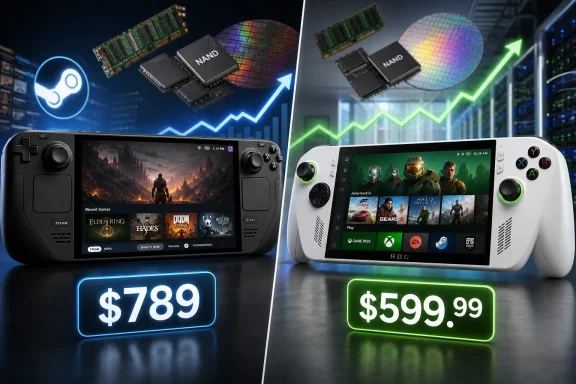
Valve’s Steam Deck has not suddenly become a poor handheld gaming PC, but its dramatic 2026 price increase has dismantled the value proposition that made it the default recommendation for four years. With the 512GB Steam Deck OLED now priced at $789 and the 1TB version at $949, Valve’s aging but polished portable faces an uncomfortable comparison: Asus and Microsoft’s standard ROG Xbox Ally remains $599.99, offers broadly comparable performance, and runs the full Windows gaming ecosystem without the compatibility compromises associated with Linux. The Steam Deck still wins important battles in usability, display quality, software coherence, and community support, yet it can no longer win the argument simply by being cheaper.
Valve changed the market by combining custom AMD silicon, aggressive pricing, a console-like interface, and direct integration with Steam. The entry-level LCD model launched at $399, creating a price point that smaller hardware manufacturers could not easily match and transforming the handheld PC from an exotic gadget into a mainstream gaming category.
The Deck also arrived with a clearly defined performance target. Its 1280-by-800 display reduced the rendering burden, while the custom AMD accelerated processing unit combined four Zen 2 CPU cores with eight RDNA 2 graphics compute units. Rather than chasing maximum benchmark scores, Valve optimized around efficient performance at relatively low power levels.
That decision aged well. Newer handhelds eventually surpassed the Deck in raw performance, but many required substantially more electrical power to do so. The Steam Deck remained competitive because it delivered predictable results at 10 to 15 watts while providing unusually mature power controls, shader management, game profiles, and suspend-and-resume behavior.
At its original $549 starting price, the 512GB OLED model was easy to defend. It cost more than the original entry-level Deck, but buyers received meaningful improvements to battery life, image quality, thermals, controls, and storage.
That balance is what the 2026 pricing disruption has broken. The machine itself has not meaningfully changed, but the economic environment around it has.
Those are not ordinary mid-cycle adjustments. They reposition the Steam Deck from an affordable portable PC into premium hardware territory without adding a faster processor, more memory, a newer graphics architecture, or any other corresponding performance upgrade.
At $549, the Deck could lose benchmark comparisons and still win on price, efficiency, and overall convenience. At $789, buyers have every reason to scrutinize its four-core Zen 2 CPU, 16GB memory configuration, RDNA 2 graphics, and limited support for some multiplayer games.
The comparison becomes even more difficult at $949. A 1TB Steam Deck OLED now approaches the cost of substantially faster handhelds, gaming laptops, and complete desktop systems. Storage capacity alone cannot justify that premium when an SSD can be replaced by technically confident owners.
The problem is availability. Refurbished inventory is intermittent, discontinued configurations are becoming harder to find, and desirable models can disappear quickly.
Third-party resale markets are less predictable. Used Steam Decks frequently appear between $450 and $500, but buyers must account for battery wear, damaged USB-C ports, worn analog sticks, stripped internal screws, unofficial SSD upgrades, and screens with scratches or pressure damage.
A used Deck at the right price can still be compelling, but the process requires more diligence than buying a new, warrantied Xbox Ally from a major retailer. The old advice to “just buy a Steam Deck” has become conditional advice.
The relationship is not as simple as an AI accelerator using exactly the same memory found inside a handheld. Different products require different memory technologies, packaging, validation, and production processes.
The pressure spreads through the supply chain because major memory manufacturers have finite wafer capacity and strong financial incentives to prioritize high-margin server and high-bandwidth memory products. When production resources shift toward datacenter customers, less capacity remains available for conventional PC DRAM, graphics memory, smartphones, consumer SSDs, and game systems.
Handheld PCs are especially exposed because memory is normally soldered directly to the motherboard. Manufacturers cannot simply substitute a cheaper retail memory kit at the last moment; they need specific packages, validated board designs, firmware support, and reliable production contracts.
This helps explain why the 1TB Steam Deck received a larger absolute increase than the 512GB model. It does not make the resulting retail price attractive, but it illustrates why Valve could not necessarily preserve the previous gap between its configurations.
Memory shortages also create indirect costs:
Confusing the two leads to misleading recommendations. The Ally X is the performance model, equipped with 24GB of memory and a 1TB SSD, but it costs $400 more than the standard machine and $50 more than the 1TB Steam Deck OLED.
The standard Xbox Ally is the value story because it now undercuts the least expensive new Steam Deck OLED by approximately $189. It includes 16GB of memory, a 512GB PCIe 4.0 SSD, a 60Wh battery, Windows 11, and a seven-inch 1920-by-1080 IPS display running at up to 120Hz with variable refresh rate support.
Its Ryzen Z2 A is not a high-end handheld processor. It uses four CPU cores and occupies roughly the same broad performance category as the Steam Deck rather than decisively surpassing it.
That used to be a weakness. When the Steam Deck OLED cost $549, paying more for the standard Ally could look like exchanging Valve’s refined experience and OLED display for Windows compatibility and a higher-resolution screen. Now the Asus device is cheaper, flipping the argument.
Valve sells the Steam Deck primarily through Steam, giving it tight control over the transaction but fewer opportunities for retailer-funded discounts. That approach worked when Valve itself provided the aggressive price.
In the present market, broad retail competition may help Asus hold an effective price advantage. Even if the official price remains $599.99, temporary promotions and open-box deals could widen the gap.
A seven-percent lead is measurable, but it is not transformational. A game running at 30 frames per second on one device will not automatically become a stable 60 frames per second on the other.
The significance lies in the combination of performance and price. The cheaper system is no longer conceding the benchmark result; it is matching or slightly beating the more expensive device.
Synthetic benchmarks still cannot describe the complete handheld experience. Results vary with power limits, cooling modes, memory allocation, driver versions, operating-system updates, and whether a test is performed while connected to external power.
If both devices run a game at native resolution, the Ally may need to render more than twice as many pixels. Its modest synthetic advantage is not enough to overcome that difference in demanding games.
Practical Xbox Ally users will often select 1280 by 720, 1600 by 900, dynamic resolution, or an upscaling mode rather than insist on native 1080p. The 1080p screen remains useful for text, menus, older games, video, and desktop applications, but it should not be treated as a promise that every modern title will run well at full resolution.
The Deck’s Zen 2 CPU can struggle in simulation-heavy games, dense open worlds, and titles targeting newer desktop processors. The standard Ally’s Ryzen Z2 A does not create enough CPU headroom to eliminate those concerns.
For sustained performance, buyers should prioritize independent game tests over a single synthetic score. Useful comparisons should include:
Suspend and resume remain particularly valuable on portable hardware. Players can pause many games, put the Deck to sleep, and return later without navigating a full Windows shutdown or relaunching several desktop applications.
Valve also controls the major layers of the platform: hardware design, operating system, Steam client, graphics translation software, and distribution service. That vertical integration allows the company to issue targeted fixes and create game-specific profiles more easily than a Windows hardware vendor.
Shader pre-caching can reduce some forms of stutter, while Proton allows thousands of Windows games to run on Linux without native ports. The compatibility system has matured enormously since 2022 and remains one of Valve’s most consequential engineering achievements.
Other launchers can be installed, but the process is less convenient than opening the same services on Windows. Game Pass PC downloads are also a major dividing line: the Deck can stream supported games through cloud services, but it cannot natively install the Windows Game Pass catalog under SteamOS.
These limitations matter more at $789 than they did at $399 or $549. Buyers paying premium hardware prices may reasonably expect access to every major PC storefront and multiplayer release.
SteamOS remains more elegant, but Windows remains more universal.
The Xbox full-screen experience on the ROG Xbox Ally does not remove Windows, but it creates a more appropriate controller-first front end. Players can boot into a gaming interface, browse installed titles, open Game Bar features, and reach multiple storefronts without beginning every session at the desktop.
This is an important shift for Microsoft. Windows already possessed the broadest game compatibility, but it lacked the coherent living-room and handheld interface that SteamOS supplied.
A better shell allows Microsoft and Asus to turn Windows compatibility from a technical advantage into a visible consumer benefit. Game Pass, Xbox Remote Play, cloud gaming, Steam, Epic Games Store, GOG, Battle.net, and conventional Windows applications can coexist on one device.
Sleep reliability can vary by game and configuration. Background processes may consume memory, battery power, or CPU time. A poorly timed update can be more disruptive on a handheld than on a desktop because users expect the device to wake and play immediately.
Windows therefore wins on breadth, while SteamOS wins on discipline. The ROG Xbox Ally’s software experience is more approachable than earlier Windows handhelds, but Valve still offers the cleaner appliance-like design.
The Deck’s 7.4-inch panel is also slightly larger than the standard Ally’s seven-inch display. Its 90Hz maximum refresh rate is lower than the Ally’s 120Hz, but 90Hz remains more than sufficient for hardware that frequently targets 30, 40, 45, or 60 frames per second.
The Ally counters with higher 1080p resolution, 500-nit rated brightness, and FreeSync Premium variable refresh rate. Variable refresh rate can smooth fluctuating performance without forcing the user to maintain a rigid frame-rate target.
Neither display wins every category:
Both devices can deliver long sessions in lightweight indie games and much shorter sessions in demanding releases. Users should be skeptical of single battery-life figures that do not specify the title, frame-rate cap, brightness, wireless state, and power limit.
Valve’s advantage lies in system-wide power tuning and a low-resolution performance target. Asus benefits from the larger battery and an efficient processor, but Windows creates additional variables.
The Xbox Ally adopts deeper, Xbox-controller-inspired grips that may feel more familiar during long sessions. It sacrifices the Deck’s dual-trackpad layout, however, reducing flexibility in games without strong controller support.
Comfort is highly personal. Buyers who can handle both machines in a store should do so, because a theoretically better device has little value if it causes wrist fatigue after 30 minutes.
They also tend to occupy higher price tiers. Once a handheld approaches or exceeds $1,000, buyers begin comparing it not only with other portables but with gaming laptops and desktops that can deliver far more performance.
The Steam Deck previously served as the category’s pricing anchor. Competitors could charge more because Valve occupied the budget position, while buyers could always fall back to the Deck if premium features did not justify their cost.
At $789, that anchor has moved. The standard Xbox Ally now occupies the accessible middle of the market almost by default, while refurbished Decks and older clearance models serve the budget segment when available.
Several explanations could account for the stable price. Asus may have secured inventory under earlier contracts, accepted lower margins, received marketing support, or treated the product as a strategic way to expand its installed base.
None of those conditions is guaranteed to continue. A future shipment assembled with more expensive components could force a price change, while strong demand could reduce the need for retailer discounts.
Waiting for prices to fall is therefore not automatically the safest strategy. In a normal hardware cycle, aging devices become cheaper. In the 2026 memory market, an older device can become more expensive without becoming better.
A budget-conscious buyer now has to assemble value from imperfect options: a used Deck, a scarce refurbished unit, an open-box Windows handheld, a discounted gaming laptop, or a console with less portable flexibility.
This fragmentation increases the research burden. Buyers must compare battery health, warranty status, game compatibility, storage capacity, upgrade costs, and operating-system preferences rather than choosing a clearly superior entry-level model.
Owners do not need to replace functional hardware merely because the new retail price has become unattractive. In fact, the higher replacement cost makes maintenance more valuable.
Existing owners should consider practical steps:
A game that runs acceptably on Steam Deck is also more likely to scale across integrated graphics, older gaming laptops, and other low-power handhelds. Deck optimization therefore benefits a wider segment of Windows users even when the device itself no longer represents the best new-hardware value.
The risk is that increasingly demanding games move beyond its CPU and memory limits. Developers can reduce graphical settings, but they cannot always scale away simulation complexity, traversal stutter, or high memory requirements.
That raises a strategic question: how much short-term hardware pain is Valve willing to absorb to protect the ecosystem? The 2026 price increase suggests there is a limit.
Subsidizing hardware becomes dangerous when component costs rise unpredictably. Selling millions of units at a substantial loss could erase the software revenue those devices generate, especially when buyers already possess large Steam libraries.
Valve may instead prioritize supply stability and accept lower unit volume until component conditions improve. That is financially understandable, but it creates room for Microsoft and Asus to shape the next phase of handheld PC gaming.
If the device succeeds, Microsoft can encourage more partners to adopt the same full-screen experience. Windows handhelds could begin to resemble a hardware ecosystem rather than a collection of unrelated miniature PCs.
The danger for Microsoft is inconsistency. Different processors, screen sizes, control layouts, power limits, and vendor utilities could recreate the fragmentation familiar to gaming-laptop buyers.
Execution will determine whether the opening lasts. Driver quality, warranty service, replacement parts, BIOS updates, and long-term software support matter more as the installed base grows.
Handheld buyers remember hardware failures. Asus must ensure the Xbox Ally’s value story extends beyond its retail sticker.
If Asus raises the price sharply, the market could lose its clearest value option. Consumers would then be choosing among different forms of premium compromise rather than between a budget model and expensive alternatives.
A faster successor would require newer silicon and potentially more memory, precisely the components under the greatest pressure. Launching too soon could produce an exceptionally expensive Deck 2, while waiting leaves the current machine competing at premium prices with 2022-class performance.
Valve could respond through several routes:
The remaining challenge is not merely visual design. Microsoft must improve sleep behavior, update management, input handling, background-process control, and performance consistency.
A full-screen launcher is useful. A genuinely handheld-aware operating mode could reshape the entire Windows gaming market.
Consumers should therefore avoid assuming that every 2026 price increase will reverse in 2027. Some products may fall in price because demand weakens, but structural component costs could keep new systems expensive.
The most rational purchasing strategy is to evaluate present needs, present prices, and actual available inventory. Waiting makes sense when existing hardware remains adequate, but not because a return to pre-crisis pricing is guaranteed.
The Steam Deck’s fall from automatic recommendation is ultimately a story about more than one handheld. It shows how quickly hardware value can change when component economics move faster than product generations. At $789, the Steam Deck OLED remains an excellent portable gaming experience wrapped around increasingly difficult arithmetic; at $599.99, the standard ROG Xbox Ally now offers the more persuasive new-device deal for buyers who can tolerate Windows. Valve still owns the category’s most refined software and one of its best displays, but Asus currently owns the price argument—and until memory supply improves or Valve introduces new hardware, that may be the argument that matters most.
 Background
How the Steam Deck became the default recommendation
When Valve released the original Steam Deck in February 2022, it did not invent the handheld gaming PC. Companies including GPD, AyaNeo, and One-Netbook had already demonstrated that Windows games could run on portable x86 hardware, but those machines generally occupied an expensive enthusiast niche.Valve changed the market by combining custom AMD silicon, aggressive pricing, a console-like interface, and direct integration with Steam. The entry-level LCD model launched at $399, creating a price point that smaller hardware manufacturers could not easily match and transforming the handheld PC from an exotic gadget into a mainstream gaming category.
The Deck also arrived with a clearly defined performance target. Its 1280-by-800 display reduced the rendering burden, while the custom AMD accelerated processing unit combined four Zen 2 CPU cores with eight RDNA 2 graphics compute units. Rather than chasing maximum benchmark scores, Valve optimized around efficient performance at relatively low power levels.
That decision aged well. Newer handhelds eventually surpassed the Deck in raw performance, but many required substantially more electrical power to do so. The Steam Deck remained competitive because it delivered predictable results at 10 to 15 watts while providing unusually mature power controls, shader management, game profiles, and suspend-and-resume behavior.
The OLED refresh strengthened the formula
The Steam Deck OLED arrived in November 2023 as a refinement rather than a full generational replacement. Valve retained essentially the same performance class but moved to a more efficient processor manufacturing process, installed a larger battery, improved wireless connectivity, reduced weight, and replaced the LCD with a 7.4-inch OLED panel capable of a 90Hz refresh rate.At its original $549 starting price, the 512GB OLED model was easy to defend. It cost more than the original entry-level Deck, but buyers received meaningful improvements to battery life, image quality, thermals, controls, and storage.
That balance is what the 2026 pricing disruption has broken. The machine itself has not meaningfully changed, but the economic environment around it has.
The Price Increase Changes the Entire Comparison
Valve’s new pricing is not a minor adjustment
Valve raised the 512GB Steam Deck OLED from $549 to $789, an increase of $240 or roughly 44 percent. The 1TB model rose from $649 to $949, an increase of $300 or approximately 46 percent.Those are not ordinary mid-cycle adjustments. They reposition the Steam Deck from an affordable portable PC into premium hardware territory without adding a faster processor, more memory, a newer graphics architecture, or any other corresponding performance upgrade.
At $549, the Deck could lose benchmark comparisons and still win on price, efficiency, and overall convenience. At $789, buyers have every reason to scrutinize its four-core Zen 2 CPU, 16GB memory configuration, RDNA 2 graphics, and limited support for some multiplayer games.
The comparison becomes even more difficult at $949. A 1TB Steam Deck OLED now approaches the cost of substantially faster handhelds, gaming laptops, and complete desktop systems. Storage capacity alone cannot justify that premium when an SSD can be replaced by technically confident owners.
Used and refurbished Decks are no longer a guaranteed escape route
Valve’s refurbished program has occasionally offered older LCD models at highly attractive prices, including entry-level units around $279. These remain excellent purchases when available because the refurbishment comes directly from the manufacturer and generally includes testing, a warranty, and appropriate packaging.The problem is availability. Refurbished inventory is intermittent, discontinued configurations are becoming harder to find, and desirable models can disappear quickly.
Third-party resale markets are less predictable. Used Steam Decks frequently appear between $450 and $500, but buyers must account for battery wear, damaged USB-C ports, worn analog sticks, stripped internal screws, unofficial SSD upgrades, and screens with scratches or pressure damage.
A used Deck at the right price can still be compelling, but the process requires more diligence than buying a new, warrantied Xbox Ally from a major retailer. The old advice to “just buy a Steam Deck” has become conditional advice.
Why Memory Costs Are Driving the Crisis
AI infrastructure is reshaping component allocation
Valve has attributed the higher Steam Deck prices to rising memory and storage costs, alongside wider logistical challenges. That explanation fits the broader semiconductor market of 2026, where persistent demand from AI servers and hyperscale datacenters has placed extraordinary pressure on DRAM, high-bandwidth memory, and NAND flash supply.The relationship is not as simple as an AI accelerator using exactly the same memory found inside a handheld. Different products require different memory technologies, packaging, validation, and production processes.
The pressure spreads through the supply chain because major memory manufacturers have finite wafer capacity and strong financial incentives to prioritize high-margin server and high-bandwidth memory products. When production resources shift toward datacenter customers, less capacity remains available for conventional PC DRAM, graphics memory, smartphones, consumer SSDs, and game systems.
Handheld PCs are especially exposed because memory is normally soldered directly to the motherboard. Manufacturers cannot simply substitute a cheaper retail memory kit at the last moment; they need specific packages, validated board designs, firmware support, and reliable production contracts.
Storage is part of the problem too
NAND flash affects the price of the built-in SSD, but its influence extends beyond the drive itself. Handheld manufacturers need compact, power-efficient storage with suitable thermal characteristics, and large-capacity configurations naturally consume more flash.This helps explain why the 1TB Steam Deck received a larger absolute increase than the 512GB model. It does not make the resulting retail price attractive, but it illustrates why Valve could not necessarily preserve the previous gap between its configurations.
Memory shortages also create indirect costs:
- Suppliers gain more pricing power, forcing device manufacturers to accept less favorable contracts.
- Production planning becomes harder, increasing the risk of delays or inconsistent availability.
- Manufacturers may need to secure components earlier, tying up capital that could have funded development or marketing.
- Logistical costs rise when substitute parts require new validation, packaging, or manufacturing arrangements.
- Warranty replacements become more expensive if identical components are scarce late in a product’s life.
The ROG Xbox Ally Has Become the Value Alternative
The standard model is the important comparison
The ROG Xbox Ally family includes two substantially different machines. The standard white Xbox Ally costs $599.99 and uses AMD’s Ryzen Z2 A processor, while the black Xbox Ally X costs $999.99 and uses the much faster Ryzen AI Z2 Extreme.Confusing the two leads to misleading recommendations. The Ally X is the performance model, equipped with 24GB of memory and a 1TB SSD, but it costs $400 more than the standard machine and $50 more than the 1TB Steam Deck OLED.
The standard Xbox Ally is the value story because it now undercuts the least expensive new Steam Deck OLED by approximately $189. It includes 16GB of memory, a 512GB PCIe 4.0 SSD, a 60Wh battery, Windows 11, and a seven-inch 1920-by-1080 IPS display running at up to 120Hz with variable refresh rate support.
Its Ryzen Z2 A is not a high-end handheld processor. It uses four CPU cores and occupies roughly the same broad performance category as the Steam Deck rather than decisively surpassing it.
That used to be a weakness. When the Steam Deck OLED cost $549, paying more for the standard Ally could look like exchanging Valve’s refined experience and OLED display for Windows compatibility and a higher-resolution screen. Now the Asus device is cheaper, flipping the argument.
Retail availability matters
Asus also benefits from conventional retail distribution. Buyers can find the Xbox Ally through major electronics stores, where financing, returns, trade-in promotions, local pickup, open-box inventory, and extended protection plans may be available.Valve sells the Steam Deck primarily through Steam, giving it tight control over the transaction but fewer opportunities for retailer-funded discounts. That approach worked when Valve itself provided the aggressive price.
In the present market, broad retail competition may help Asus hold an effective price advantage. Even if the official price remains $599.99, temporary promotions and open-box deals could widen the gap.
Benchmark Results Need Careful Interpretation
Time Spy shows a small Ally advantage
The supplied 3DMark Time Spy results place the standard ROG Xbox Ally at 1,834 points and the Steam Deck at 1,715. That gives the Asus machine an advantage of approximately 7 percent.A seven-percent lead is measurable, but it is not transformational. A game running at 30 frames per second on one device will not automatically become a stable 60 frames per second on the other.
The significance lies in the combination of performance and price. The cheaper system is no longer conceding the benchmark result; it is matching or slightly beating the more expensive device.
Synthetic benchmarks still cannot describe the complete handheld experience. Results vary with power limits, cooling modes, memory allocation, driver versions, operating-system updates, and whether a test is performed while connected to external power.
Resolution can erase the apparent advantage
The Steam Deck OLED renders to a 1280-by-800 screen, while the Xbox Ally’s native resolution is 1920 by 1080. Full HD contains substantially more pixels, creating a heavier graphics workload.If both devices run a game at native resolution, the Ally may need to render more than twice as many pixels. Its modest synthetic advantage is not enough to overcome that difference in demanding games.
Practical Xbox Ally users will often select 1280 by 720, 1600 by 900, dynamic resolution, or an upscaling mode rather than insist on native 1080p. The 1080p screen remains useful for text, menus, older games, video, and desktop applications, but it should not be treated as a promise that every modern title will run well at full resolution.
Real games expose CPU and memory constraints
Modern PC releases increasingly challenge handhelds through CPU load, shader compilation, asset streaming, and memory consumption rather than pure graphics demand. Both the Deck and standard Ally remain constrained systems with 16GB of shared memory that must serve Windows or Linux, game data, and graphics workloads simultaneously.The Deck’s Zen 2 CPU can struggle in simulation-heavy games, dense open worlds, and titles targeting newer desktop processors. The standard Ally’s Ryzen Z2 A does not create enough CPU headroom to eliminate those concerns.
For sustained performance, buyers should prioritize independent game tests over a single synthetic score. Useful comparisons should include:
- Identical in-game settings and output resolutions.
- Equivalent power limits and performance modes.
- One-percent-low frame rates, not only averages.
- Battery power testing as well as plugged-in testing.
- Frame-time consistency during asset streaming.
- Fan noise and surface temperature.
- Total battery life at the tested settings.
SteamOS Remains Valve’s Strongest Advantage
The Deck behaves more like a console
SteamOS is central to the Steam Deck’s appeal. Valve’s Gaming Mode hides most desktop complexity behind a controller-friendly interface, providing quick access to games, power settings, frame-rate limits, refresh-rate controls, cloud saves, screenshots, and community controller layouts.Suspend and resume remain particularly valuable on portable hardware. Players can pause many games, put the Deck to sleep, and return later without navigating a full Windows shutdown or relaunching several desktop applications.
Valve also controls the major layers of the platform: hardware design, operating system, Steam client, graphics translation software, and distribution service. That vertical integration allows the company to issue targeted fixes and create game-specific profiles more easily than a Windows hardware vendor.
Shader pre-caching can reduce some forms of stutter, while Proton allows thousands of Windows games to run on Linux without native ports. The compatibility system has matured enormously since 2022 and remains one of Valve’s most consequential engineering achievements.
Compatibility remains imperfect
SteamOS does not support everything. Certain competitive multiplayer titles use anti-cheat systems that either do not work through Proton or have not been enabled by their publishers.Other launchers can be installed, but the process is less convenient than opening the same services on Windows. Game Pass PC downloads are also a major dividing line: the Deck can stream supported games through cloud services, but it cannot natively install the Windows Game Pass catalog under SteamOS.
These limitations matter more at $789 than they did at $399 or $549. Buyers paying premium hardware prices may reasonably expect access to every major PC storefront and multiplayer release.
SteamOS remains more elegant, but Windows remains more universal.
Windows 11 Is Improving on Handhelds
The Xbox full-screen experience reduces friction
Early Windows handhelds often felt like miniature laptops controlled through gamepads. Users encountered desktop pop-ups, tiny installation dialogs, overlapping launchers, awkward virtual keyboards, and updates that demanded a mouse-like pointer.The Xbox full-screen experience on the ROG Xbox Ally does not remove Windows, but it creates a more appropriate controller-first front end. Players can boot into a gaming interface, browse installed titles, open Game Bar features, and reach multiple storefronts without beginning every session at the desktop.
This is an important shift for Microsoft. Windows already possessed the broadest game compatibility, but it lacked the coherent living-room and handheld interface that SteamOS supplied.
A better shell allows Microsoft and Asus to turn Windows compatibility from a technical advantage into a visible consumer benefit. Game Pass, Xbox Remote Play, cloud gaming, Steam, Epic Games Store, GOG, Battle.net, and conventional Windows applications can coexist on one device.
Windows still carries maintenance overhead
The underlying operating system has not disappeared. Driver updates, firmware utilities, Windows Update, account prompts, security notifications, and multiple launcher services can still interrupt the console illusion.Sleep reliability can vary by game and configuration. Background processes may consume memory, battery power, or CPU time. A poorly timed update can be more disruptive on a handheld than on a desktop because users expect the device to wake and play immediately.
Windows therefore wins on breadth, while SteamOS wins on discipline. The ROG Xbox Ally’s software experience is more approachable than earlier Windows handhelds, but Valve still offers the cleaner appliance-like design.
Display, Battery, and Ergonomics Complicate the Value Equation
The Deck OLED has the superior panel technology
Price and benchmarks do not erase the Steam Deck OLED’s display advantage. OLED produces true blacks, high contrast, rapid pixel response, and vivid color, qualities that are particularly noticeable in dark games and high-contrast scenes.The Deck’s 7.4-inch panel is also slightly larger than the standard Ally’s seven-inch display. Its 90Hz maximum refresh rate is lower than the Ally’s 120Hz, but 90Hz remains more than sufficient for hardware that frequently targets 30, 40, 45, or 60 frames per second.
The Ally counters with higher 1080p resolution, 500-nit rated brightness, and FreeSync Premium variable refresh rate. Variable refresh rate can smooth fluctuating performance without forcing the user to maintain a rigid frame-rate target.
Neither display wins every category:
- Steam Deck OLED delivers better contrast and black levels.
- Xbox Ally provides a sharper desktop and interface image.
- Steam Deck offers a slightly larger viewing area.
- Xbox Ally reaches a higher maximum refresh rate.
- Variable refresh rate gives the Ally more flexibility when frame rates move between targets.
- The Deck’s lower native resolution is easier for its GPU to drive.
Battery capacity is only part of endurance
The standard Xbox Ally includes a 60Wh battery, while the Steam Deck OLED uses a 50Wh battery. The larger Asus battery does not guarantee proportionally longer runtime because screen resolution, brightness, processor behavior, Windows background activity, and performance mode all affect consumption.Both devices can deliver long sessions in lightweight indie games and much shorter sessions in demanding releases. Users should be skeptical of single battery-life figures that do not specify the title, frame-rate cap, brightness, wireless state, and power limit.
Valve’s advantage lies in system-wide power tuning and a low-resolution performance target. Asus benefits from the larger battery and an efficient processor, but Windows creates additional variables.
Comfort cannot be reduced to dimensions
The Steam Deck is wide and relatively heavy, but its controls, grips, trackpads, and rear buttons make it versatile. The trackpads are especially valuable in strategy games, older PC titles, desktop navigation, and games designed around mouse input.The Xbox Ally adopts deeper, Xbox-controller-inspired grips that may feel more familiar during long sessions. It sacrifices the Deck’s dual-trackpad layout, however, reducing flexibility in games without strong controller support.
Comfort is highly personal. Buyers who can handle both machines in a store should do so, because a theoretically better device has little value if it causes wrist fatigue after 30 minutes.
The Wider Handheld Market Is Being Repriced
Lenovo and MSI face the same economic pressures
The market includes capable alternatives such as Lenovo’s Legion Go line and MSI’s Claw family. These devices often offer larger displays, faster processors, detachable controls, Intel-based options, or other features that distinguish them from Valve and Asus.They also tend to occupy higher price tiers. Once a handheld approaches or exceeds $1,000, buyers begin comparing it not only with other portables but with gaming laptops and desktops that can deliver far more performance.
The Steam Deck previously served as the category’s pricing anchor. Competitors could charge more because Valve occupied the budget position, while buyers could always fall back to the Deck if premium features did not justify their cost.
At $789, that anchor has moved. The standard Xbox Ally now occupies the accessible middle of the market almost by default, while refurbished Decks and older clearance models serve the budget segment when available.
Asus may not be able to hold $599 indefinitely
The Xbox Ally’s current price is compelling partly because it has not yet absorbed a comparable increase. Asus faces the same DRAM and NAND environment as Valve, and Microsoft’s involvement does not make the hardware immune to component inflation.Several explanations could account for the stable price. Asus may have secured inventory under earlier contracts, accepted lower margins, received marketing support, or treated the product as a strategic way to expand its installed base.
None of those conditions is guaranteed to continue. A future shipment assembled with more expensive components could force a price change, while strong demand could reduce the need for retailer discounts.
Waiting for prices to fall is therefore not automatically the safest strategy. In a normal hardware cycle, aging devices become cheaper. In the 2026 memory market, an older device can become more expensive without becoming better.
Impact on Consumers and the PC Ecosystem
Budget buyers have fewer straightforward options
The greatest loss is not that affluent enthusiasts must choose between two premium handhelds. It is that the original Steam Deck created a credible sub-$500 route into PC gaming, and that route is disappearing.A budget-conscious buyer now has to assemble value from imperfect options: a used Deck, a scarce refurbished unit, an open-box Windows handheld, a discounted gaming laptop, or a console with less portable flexibility.
This fragmentation increases the research burden. Buyers must compare battery health, warranty status, game compatibility, storage capacity, upgrade costs, and operating-system preferences rather than choosing a clearly superior entry-level model.
Existing Deck owners should not panic
The price increase does not reduce the usefulness of Steam Decks already in circulation. Valve continues to support the platform, and the large installed base gives developers a strong reason to include handheld presets and Deck-specific optimization.Owners do not need to replace functional hardware merely because the new retail price has become unattractive. In fact, the higher replacement cost makes maintenance more valuable.
Existing owners should consider practical steps:
- Clean vents and avoid blocking the cooling intake.
- Monitor battery health rather than leaving the system permanently discharged.
- Use a suitable USB-C Power Delivery charger.
- Protect the screen and analog sticks during travel.
- Replace the SSD only with a compatible model and proper installation procedure.
- Preserve original parts if warranty service may be required.
- Use frame-rate caps and upscaling to extend useful performance.
Developers may target the Deck for longer
Higher prices could eventually slow new Steam Deck sales, but millions of existing units remain relevant. That installed base provides a stable low-end specification for PC developers.A game that runs acceptably on Steam Deck is also more likely to scale across integrated graphics, older gaming laptops, and other low-power handhelds. Deck optimization therefore benefits a wider segment of Windows users even when the device itself no longer represents the best new-hardware value.
The risk is that increasingly demanding games move beyond its CPU and memory limits. Developers can reduce graphical settings, but they cannot always scale away simulation complexity, traversal stutter, or high memory requirements.
Competitive Implications for Valve, Microsoft, and Asus
Valve must decide whether to protect hardware volume
Valve’s primary business is software distribution, not hardware margin. The original Deck strategy made sense because every device could deepen a user’s relationship with Steam and encourage additional game purchases.That raises a strategic question: how much short-term hardware pain is Valve willing to absorb to protect the ecosystem? The 2026 price increase suggests there is a limit.
Subsidizing hardware becomes dangerous when component costs rise unpredictably. Selling millions of units at a substantial loss could erase the software revenue those devices generate, especially when buyers already possess large Steam libraries.
Valve may instead prioritize supply stability and accept lower unit volume until component conditions improve. That is financially understandable, but it creates room for Microsoft and Asus to shape the next phase of handheld PC gaming.
Microsoft gains without manufacturing a traditional Xbox portable alone
The ROG Xbox Ally allows Microsoft to extend Xbox branding into portable PC hardware while sharing manufacturing responsibility with Asus. It reinforces Windows, Game Pass, cloud gaming, Remote Play, and the Xbox interface without requiring Microsoft to build a fully closed handheld console.If the device succeeds, Microsoft can encourage more partners to adopt the same full-screen experience. Windows handhelds could begin to resemble a hardware ecosystem rather than a collection of unrelated miniature PCs.
The danger for Microsoft is inconsistency. Different processors, screen sizes, control layouts, power limits, and vendor utilities could recreate the fragmentation familiar to gaming-laptop buyers.
Asus has a temporary opening
Asus now possesses the strongest price position among prominent new handheld PCs in the United States. The company can use that advantage to expand market share, build familiarity with its control software, and establish the Xbox Ally as the standard Windows alternative to Steam Deck.Execution will determine whether the opening lasts. Driver quality, warranty service, replacement parts, BIOS updates, and long-term software support matter more as the installed base grows.
Handheld buyers remember hardware failures. Asus must ensure the Xbox Ally’s value story extends beyond its retail sticker.
Strengths and Opportunities
The new market hierarchy gives each platform distinct strengths rather than producing one universal winner.- The standard ROG Xbox Ally offers the strongest current new-device price position. Its $599.99 price, full Windows compatibility, 512GB SSD, 120Hz variable-refresh display, and 60Wh battery create a credible mainstream package.
- The Steam Deck OLED still offers the most cohesive handheld operating experience. SteamOS, reliable game profiles, trackpads, efficient power controls, and console-like navigation remain difficult for Windows competitors to match.
- The Deck’s OLED screen remains a premium feature. Buyers who prioritize contrast, black levels, and image quality may still prefer it despite the higher cost.
- Windows provides the broadest software access. Native support for Game Pass downloads and third-party launchers is a decisive advantage for players with libraries spread across multiple services.
- Refurbished hardware can restore the Deck’s value. A Valve-certified unit at a substantial discount remains one of the most attractive ways to enter handheld PC gaming, provided stock is available.
- Retail competition may create Xbox Ally discounts. Open-box sales, bundles, and retailer promotions can improve an already favorable comparison.
- The memory crisis may encourage better optimization. Developers and platform owners have stronger incentives to reduce memory use, improve upscaling, and support lower-power hardware.
Risks and Concerns
The apparent victory for the standard Xbox Ally comes with significant caveats.- Asus could increase prices later. Current pricing may reflect previously secured inventory, strategic subsidies, or temporary margin decisions that cannot survive continued component inflation.
- Windows remains less predictable than SteamOS. Updates, background services, desktop dialogs, and launcher conflicts can undermine the console-like experience.
- The Ally’s 1080p screen can encourage unrealistic settings. Native resolution is too demanding for many modern games, requiring upscaling or lower output resolutions.
- Steam Deck performance is increasingly limited by its CPU. No amount of OLED image quality can overcome severe CPU bottlenecks in future games.
- Used-market buyers face condition uncertainty. Battery degradation, unauthorized repairs, damaged ports, and worn controls can turn an apparent bargain into an expensive project.
- High prices could shrink the handheld audience. If mainstream models settle near $800 or more, developers may see less incentive to optimize specifically for portable PCs.
- Frame generation can conceal rather than solve performance problems. It may improve perceived smoothness, but poor base frame rates, high input latency, and traversal stutter can remain.
- A benchmark lead does not guarantee a better experience. Software stability, ergonomics, battery life, screen behavior, and game compatibility often matter more than a single synthetic score.
What to Watch Next
Whether Asus follows Valve
The first major indicator will be the Xbox Ally’s retail price through the second half of 2026. If it remains at $599.99 while inventory stays healthy, the device will solidify its position as the practical mainstream recommendation.If Asus raises the price sharply, the market could lose its clearest value option. Consumers would then be choosing among different forms of premium compromise rather than between a budget model and expensive alternatives.
Valve’s next hardware move
Valve has consistently suggested that a true next-generation Steam Deck should deliver a substantial performance improvement without sacrificing efficiency or battery life. That remains the correct philosophy, but the company now faces a pricing dilemma.A faster successor would require newer silicon and potentially more memory, precisely the components under the greatest pressure. Launching too soon could produce an exceptionally expensive Deck 2, while waiting leaves the current machine competing at premium prices with 2022-class performance.
Valve could respond through several routes:
- It could introduce a lower-capacity OLED configuration if component availability permits.
- It could expand refurbishment inventory and extend official support for older LCD units.
- It could license or promote SteamOS more aggressively on third-party handhelds.
- It could improve Proton compatibility for games blocked by anti-cheat systems.
- It could wait for a more efficient AMD architecture and improved memory supply before launching new hardware.
The evolution of Xbox full-screen mode
Microsoft’s handheld interface will also be critical. If the Xbox full-screen experience becomes reliable across more Windows 11 devices, SteamOS will lose some of its software exclusivity as a selling point.The remaining challenge is not merely visual design. Microsoft must improve sleep behavior, update management, input handling, background-process control, and performance consistency.
A full-screen launcher is useful. A genuinely handheld-aware operating mode could reshape the entire Windows gaming market.
Memory supply and the possibility of prolonged inflation
Industry forecasts suggest the memory imbalance may persist rather than disappear after a few quarters. New manufacturing capacity takes years to build, qualify, and ramp, while AI infrastructure demand continues to absorb high-value output.Consumers should therefore avoid assuming that every 2026 price increase will reverse in 2027. Some products may fall in price because demand weakens, but structural component costs could keep new systems expensive.
The most rational purchasing strategy is to evaluate present needs, present prices, and actual available inventory. Waiting makes sense when existing hardware remains adequate, but not because a return to pre-crisis pricing is guaranteed.
The Steam Deck’s fall from automatic recommendation is ultimately a story about more than one handheld. It shows how quickly hardware value can change when component economics move faster than product generations. At $789, the Steam Deck OLED remains an excellent portable gaming experience wrapped around increasingly difficult arithmetic; at $599.99, the standard ROG Xbox Ally now offers the more persuasive new-device deal for buyers who can tolerate Windows. Valve still owns the category’s most refined software and one of its best displays, but Asus currently owns the price argument—and until memory supply improves or Valve introduces new hardware, that may be the argument that matters most.
References
- Primary source: games.gg
Published: 2026-07-20T14:21:51.240000+00:00
The Steam Deck was once the best handheld gaming PC | GAMES.GG
Valve's Steam Deck OLED now costs $789 for 512GB, making the $599 Asus ROG Xbox Ally the better value pick for budget handheld shoppers in mid-2026.games.gg - Related coverage: pcgamer.com
How to buy a Steam Deck in Australia | PC Gamer
After over two years, Australians can now order the Steam Deck direct.www.pcgamer.com - Related coverage: gamesradar.com
Best gaming handheld | GamesRadar+
Here are the best gaming handheld options in 2026, including the Nintendo Switch 2, portable PCs like the Steam Deck OLED, and various other great devices.www.gamesradar.com - Related coverage: windowscentral.com
The Xbox Ultimate Game Sale 2026 is live — it might be one of Microsoft's best ever. Here are all of the deals. | Windows Central
The sales event is so big that it's making our content management system lag out as I type this. I've also already spent over $100 on it. Damn.www.windowscentral.com - Related coverage: tomshardware.com
Valve hikes Steam Deck OLED prices — 512GB is now $789, while 1TB climbs to $949 | Tom's Hardware
A $240 increase for 512GB and a whopping $300 for the 1TB model.www.tomshardware.com - Related coverage: techspot.com
Steam Deck OLED is back in stock with a $300 price hike | TechSpot
The Steam Deck OLED 512GB variant has risen from $549 to $789, while the 1TB model has climbed from $649 to $949. The entry-level LCD Steam Deck,...www.techspot.com
