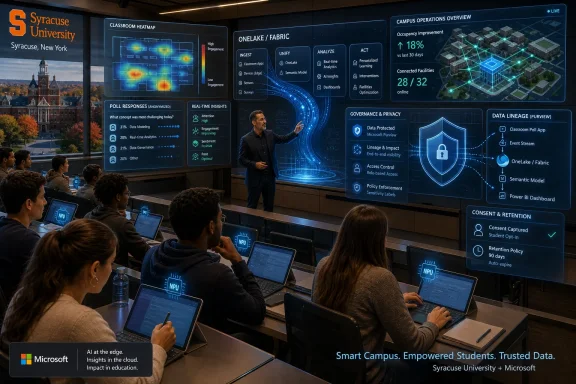
Syracuse University said on June 2, 2026, that it is using Microsoft Surface devices, Microsoft Fabric, Microsoft Foundry, Power Platform, Intune, Windows Autopilot, and a PwC implementation partnership to build a connected, AI-enabled campus serving more than 22,000 students in Syracuse, New York. The announcement is a customer story, not a neutral benchmark, but it is still a useful marker of where Microsoft wants Windows hardware to go. The PC is no longer being pitched merely as an endpoint; it is being pitched as the classroom sensor, AI inference box, identity terminal, and managed enterprise node. That is the real story for WindowsForum readers: higher education is becoming one of the test beds for edge AI at institutional scale.
Microsoft’s Syracuse story is not really about a university buying new laptops. It is about Microsoft trying to make the modern Windows device feel indispensable in places where software, data governance, identity, and hardware procurement all collide.
That matters because universities are unusually difficult IT environments. They have enterprise-grade security needs, consumer-grade user expectations, research workloads, public-sector privacy obligations, transient populations, and faculty who often regard centralized technology programs with skepticism. If a platform vendor can make a credible case there, it gets a sales pitch that travels well into government, healthcare, and large enterprise.
Syracuse’s version of that pitch is organized around the phrase “connected campus.” In practice, that means bringing classroom signals, Wi-Fi and sensor data, facilities data, student-facing workflows, device management, and AI tooling into a more unified Microsoft stack. The compelling part is not that each product is new. It is that Microsoft is trying to collapse the distance between them.
This is the shift Windows administrators should pay attention to. The PC estate is being pulled into the data platform conversation, and the data platform is being pulled back toward the edge. That is a very different procurement argument from “these machines have better battery life” or “this version of Windows is easier to manage.”
That is an old pedagogical dream with a new infrastructure story. Clickers, learning-management-system quizzes, and classroom response apps have been around for years. What Microsoft and Syracuse are describing is something more ambitious: a system in which Surface devices with built-in neural processing units run AI closer to the point of instruction, while small language models and Microsoft Foundry help synthesize the classroom signal.
The phrase that should make IT pros sit up is AI at the edge. For the last two years, the default enterprise assumption has often been that generative AI means calling a cloud model somewhere, logging prompts, waiting for output, and then trying to retrofit governance onto the result. Syracuse’s deployment points to a different pattern: lightweight, classroom-proximate inference for tasks that are immediate, contextual, and potentially privacy-sensitive.
That does not mean the cloud disappears. Microsoft Foundry, Fabric, Power BI, Purview, and the rest of the stack remain central to the story. But it does mean the endpoint becomes more than a screen. In this model, the device participates in the AI workflow rather than merely displaying the result.
The university is using Surface devices with NPUs, and Microsoft’s case study emphasizes Qualcomm’s ARM-based processors and all-day battery life. That detail is not incidental. If AI-enabled classroom workflows are supposed to happen where students and instructors already are, the machines cannot be tethered to power outlets or dependent on a constant round trip to distant cloud services for every interaction.
This is where Microsoft’s Copilot+ PC strategy starts to overlap with institutional IT. The NPU is not just a consumer feature for background blur, recall-like indexing, or image tricks. It is a local compute budget that Microsoft can point at enterprise and education scenarios where latency, privacy, bandwidth, and reliability matter.
For Windows admins, the strategic question is not whether every AI workload should run locally. It clearly should not. The more interesting question is which workloads become good enough to run locally and valuable enough to justify a new hardware refresh cycle. Syracuse’s classroom-response use case is exactly the kind of example Microsoft needs: narrow, repeatable, visible to end users, and tied to a core institutional mission.
The catch is that “AI PC” remains a broad and sometimes slippery category. A device with an NPU is not automatically a better classroom tool, and a small language model is not automatically pedagogically useful. The value comes from the workflow around it: prompts, faculty adoption, data governance, integration with teaching platforms, and a willingness to measure whether students actually benefit.
This is a classic enterprise data problem wearing a university hoodie. Campuses are full of fragmented systems: card access, Wi-Fi, classroom scheduling, facilities management, student services, learning platforms, lab equipment, and departmental spreadsheets that somehow become mission-critical. Everyone says they want a single view; almost nobody starts with clean data.
Microsoft Fabric is designed to make the “single view” pitch easier by putting data engineering, real-time analytics, warehousing, data science, and Power BI under one umbrella. Syracuse’s use of Fabric Real-Time Intelligence for occupancy and resource data is a clean example of the platform story Microsoft has been pushing since Fabric’s launch: stop stitching together separate analytics services and start treating organizational data as one governed estate.
The reported operational impact is concrete. Microsoft says Syracuse improved occupancy accuracy from 80 percent to 95 percent and unlocked more than 40 connected-campus insights around space-use gaps, cost-avoidance opportunities, shared-service bottlenecks, and student-experience pain points. Those numbers come from a vendor-published customer story, so they deserve the usual caution, but they are specific enough to show what Microsoft wants buyers to notice.
This is not AI as a chatbot. It is AI-adjacent data plumbing: knowing where people are, where demand is building, where services are underused, and where facilities planning is still based on stale assumptions. For a university with a 400-acre campus, that can be more valuable than a flashy assistant.
Syracuse’s CTO, Eric Sedore, frames the PwC relationship around acceleration. That is the polite enterprise way of saying transformation efforts die when they move at committee speed. Large institutions can spend years producing AI strategies, data-governance charters, classroom pilots, and procurement frameworks without getting anything into daily use.
A systems integrator changes the tempo. PwC brings delivery muscle, Microsoft brings platform gravity, and Syracuse brings the messy institutional problems that make the project meaningful. The risk is that this model can also make transformation dependent on outside consultants, especially if internal teams do not inherit the architecture, operating model, and skills.
That risk is not unique to Syracuse. Every large organization currently trying to “do AI” faces the same trade-off. Partner-led acceleration can prevent paralysis, but it can also obscure whether the institution is building durable capability or buying a fast-moving demo.
In this case, the stronger evidence of internal capability comes from the MakerSpace example. A Syracuse staff member used Power Apps, Power Automate, and Microsoft Lists to build a queuing system after third-party apps proved costly or limiting. Microsoft says that system has handled more than 900 clients. That is modest compared with the campus-wide AI narrative, but it may be the more important cultural signal: low-code tools are useful when people close to the problem can build without waiting for a full software project.
Personalization can mean many things. At its best, it means instructors get faster feedback, students who are struggling become visible sooner, and teaching adapts to the actual class rather than an imagined average student. At its worst, it becomes a dashboard-heavy regime where engagement is mistaken for learning and every click becomes a proxy for understanding.
The Syracuse model, as described, is more defensible than many AI-in-education fantasies because it keeps faculty in the loop. The system synthesizes responses and class dialogue, but instructors decide how to adjust. That distinction matters. AI that informs teaching is different from AI that replaces teaching judgment.
Still, institutions will need to be careful about how these systems are introduced. Students may respond differently if they believe every classroom interaction is being analyzed. Faculty may resist if AI-generated summaries are treated as performance metrics. Administrators may be tempted to use aggregate learning signals for purposes that were not part of the original classroom bargain.
Purview and anonymization help, but governance is not just a technical setting. It is a social contract. A connected campus that feels helpful can quickly become a monitored campus if policies, retention rules, access controls, and communication are vague.
In a higher-education setting, data privacy is not a decorative compliance concern. Student records, classroom behavior, location-adjacent signals, research activity, accessibility needs, and employment data can all intersect in uncomfortable ways. Even when data is technically anonymized, combinations of time, place, course, device, and activity can create re-identification risks if governance is weak.
This is why Microsoft’s integrated-stack argument is attractive to CIOs. If Fabric, Purview, Intune, Entra identity, Surface, Windows Hello, and Autopilot all operate within a coherent control plane, the university can argue that it has fewer seams to manage. Fewer seams can mean fewer policy gaps, fewer unmanaged exports, and fewer shadow systems.
But integration cuts both ways. A unified platform can improve governance, but it can also concentrate power. The more campus workflows move into a single vendor ecosystem, the more important it becomes to define who can see what, how long data is retained, how models are evaluated, and what happens when a vendor changes licensing, APIs, or product names.
Windows admins already know this pattern from Microsoft 365. The suite can simplify management and security, but it also turns licensing, tenant configuration, identity hygiene, and data-classification discipline into strategic dependencies. Syracuse’s AI campus story is that same pattern extended into physical space and pedagogy.
That is not a side note. If universities are going to place AI-capable endpoints into classrooms, labs, offices, and student-facing services, they need provisioning and management that do not collapse under enrollment churn and support volume. Autopilot and Intune are the mechanisms that let Microsoft describe Surface not just as hardware but as a managed fleet.
This matters more with ARM-based Windows devices. Organizations considering Qualcomm-powered Surface hardware need confidence around application compatibility, driver support, security baselines, lifecycle management, and deployment repeatability. A great battery-life story will not survive if the help desk is buried in exceptions.
The Syracuse case study presents Surface as a “window” into infrastructure, data, cloud, and generative AI. That metaphor is useful because the window still has to lock. Identity, device compliance, patching, conditional access, recovery, inventory, and data protection are what turn classroom AI from a pilot into something a university can defend.
For sysadmins, this is the practical layer behind the hype. AI adoption is not just a model-selection problem. It is an endpoint-management problem, a network problem, a permissions problem, and a support problem.
Microsoft’s strongest enterprise pitch has always been integration. Buy the suite, reduce friction, centralize policy, and give users tools that already understand each other. In the AI era, that pitch becomes even stronger because AI systems are only as useful as the data, identity, and workflow context they can safely reach.
The lock-in risk is not that Syracuse has chosen Microsoft products. Universities choose strategic vendors all the time. The risk is that AI projects can entangle data architecture, classroom practice, device refresh cycles, low-code workflows, security policy, and analytics models so tightly that future switching costs become enormous.
That does not make the project misguided. It means the governance conversation should include exit paths and interoperability from the beginning. Can data be exported cleanly? Can classroom-response workflows survive a platform change? Are models interchangeable? Are policies documented outside vendor-specific consoles? Are faculty and staff building generalizable skills or only learning one vendor’s abstractions?
These questions are not anti-Microsoft. They are pro-institution. A connected campus should make the university more capable, not merely more dependent.
It also gives Microsoft a way to connect Windows hardware to institutional outcomes. If Surface devices help faculty see student understanding in real time, the NPU has a story. If Fabric helps facilities teams understand space demand, the data platform has a story. If Power Platform helps a MakerSpace replace a manual sign-in process, low-code has a story. If Intune and Autopilot keep the fleet manageable, Windows management has a story.
That is a much better narrative than “AI PCs are coming, please refresh your hardware.” It creates a ladder from endpoint silicon to organizational transformation. Every rung may not be equally strong, but the ladder is coherent.
For Microsoft, this is crucial because the AI PC category still needs convincing enterprise proof points. Consumers may not buy a new machine solely for local AI features. Businesses may wait until Windows 10 replacement cycles, Windows 11 standardization, security baselines, and application compatibility force the issue. Education deployments like Syracuse give Microsoft examples that are more concrete than benchmark charts.
The success of that strategy depends on whether these scenarios replicate. A connected-campus story is useful marketing; a repeatable architecture is a market. The difference will show up when other universities try to copy the model without Syracuse’s leadership, PwC’s acceleration, or Microsoft’s close attention.
The weaker version would turn the same signals into automated judgment. A dashboard could imply that a class is disengaged when students are simply thinking. A model could flatten minority viewpoints into a majority summary. A department could pressure faculty to optimize for measurable interaction rather than deep learning. Administrators could mistake the presence of real-time data for the presence of real-time wisdom.
This is not hypothetical hand-wringing. Every analytics system creates incentives. Once an institution measures something, people adapt to the measurement. In education, that can be especially dangerous because the most valuable learning is not always the easiest to capture.
Syracuse’s challenge will be to preserve the instructor’s authority over interpretation. AI can surface confusion, highlight themes, and suggest where a room is stuck. It should not become the hidden co-teacher whose outputs are treated as neutral truth.
That is where training matters. Faculty need to know what the system can and cannot infer. Students need to know how their input is used. IT needs to know where data flows. Administrators need to resist turning classroom insight into surveillance by spreadsheet.
If student-response synthesis, local inference, classroom dialogue capture, and real-time analytics become part of instruction, then endpoint design becomes pedagogical infrastructure. Device selection affects what teaching patterns are practical. Identity and privacy settings affect what students are willing to share. Network and model performance affect whether faculty trust the system in front of 300 people.
That is a heavier burden for IT, but also a larger role. The connected classroom cannot be left entirely to ed-tech vendors or academic departments because it depends on enterprise architecture. Conversely, it cannot be dictated entirely by IT because pedagogy is not just another workflow to optimize.
The Syracuse story shows the emerging middle ground. Microsoft supplies the stack, PwC accelerates implementation, university leadership frames the academic mission, and staff build local solutions where commercial tools do not fit. If that balance holds, the technology has a chance of becoming infrastructure rather than theater.
For Windows professionals, the lesson is clear: AI PC deployment will not be won only with spec sheets. It will be won when endpoints are tied to credible institutional workflows, governed data, manageable fleets, and users who can explain why the new capability is worth changing habits.
Microsoft’s Syracuse story is therefore best read as a preview of the next Windows enterprise argument: the device, the cloud, the data estate, and the AI platform are becoming one procurement conversation. That may produce better campuses and better classrooms, but only if institutions remember that connection is not the same as understanding. The next phase will be decided not by whether universities can wire everything together, but by whether they can use that wiring to make teaching, services, and student life measurably better without turning the campus into a dashboard for its own sake.
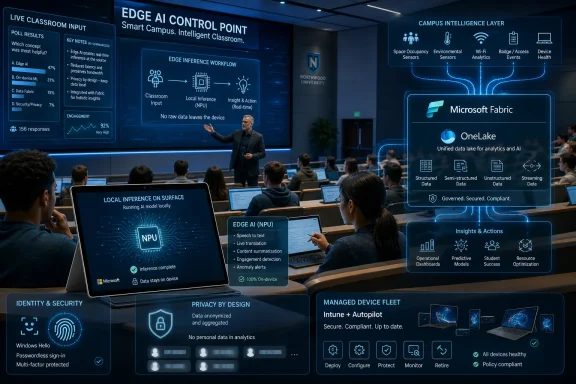 Microsoft Turns the Campus PC Into an AI Control Point
Microsoft’s Syracuse story is not really about a university buying new laptops. It is about Microsoft trying to make the modern Windows device feel indispensable in places where software, data governance, identity, and hardware procurement all collide.That matters because universities are unusually difficult IT environments. They have enterprise-grade security needs, consumer-grade user expectations, research workloads, public-sector privacy obligations, transient populations, and faculty who often regard centralized technology programs with skepticism. If a platform vendor can make a credible case there, it gets a sales pitch that travels well into government, healthcare, and large enterprise.
Syracuse’s version of that pitch is organized around the phrase “connected campus.” In practice, that means bringing classroom signals, Wi-Fi and sensor data, facilities data, student-facing workflows, device management, and AI tooling into a more unified Microsoft stack. The compelling part is not that each product is new. It is that Microsoft is trying to collapse the distance between them.
This is the shift Windows administrators should pay attention to. The PC estate is being pulled into the data platform conversation, and the data platform is being pulled back toward the edge. That is a very different procurement argument from “these machines have better battery life” or “this version of Windows is easier to manage.”
The Lecture Hall Becomes the Edge Case Microsoft Wanted
The most striking claim in the Syracuse case study is that large lectures can become more responsive when student input is captured and synthesized during class. Faculty can use prompts, polls, and activities to get a better view of whether students are following the material, then adjust while the class is still happening.That is an old pedagogical dream with a new infrastructure story. Clickers, learning-management-system quizzes, and classroom response apps have been around for years. What Microsoft and Syracuse are describing is something more ambitious: a system in which Surface devices with built-in neural processing units run AI closer to the point of instruction, while small language models and Microsoft Foundry help synthesize the classroom signal.
The phrase that should make IT pros sit up is AI at the edge. For the last two years, the default enterprise assumption has often been that generative AI means calling a cloud model somewhere, logging prompts, waiting for output, and then trying to retrofit governance onto the result. Syracuse’s deployment points to a different pattern: lightweight, classroom-proximate inference for tasks that are immediate, contextual, and potentially privacy-sensitive.
That does not mean the cloud disappears. Microsoft Foundry, Fabric, Power BI, Purview, and the rest of the stack remain central to the story. But it does mean the endpoint becomes more than a screen. In this model, the device participates in the AI workflow rather than merely displaying the result.
Surface Is Doing More Work Than the Marketing Lets On
Surface is easy to dismiss as the shiny hardware layer in Microsoft customer stories. In the Syracuse deployment, though, the hardware is carrying a significant part of the argument.The university is using Surface devices with NPUs, and Microsoft’s case study emphasizes Qualcomm’s ARM-based processors and all-day battery life. That detail is not incidental. If AI-enabled classroom workflows are supposed to happen where students and instructors already are, the machines cannot be tethered to power outlets or dependent on a constant round trip to distant cloud services for every interaction.
This is where Microsoft’s Copilot+ PC strategy starts to overlap with institutional IT. The NPU is not just a consumer feature for background blur, recall-like indexing, or image tricks. It is a local compute budget that Microsoft can point at enterprise and education scenarios where latency, privacy, bandwidth, and reliability matter.
For Windows admins, the strategic question is not whether every AI workload should run locally. It clearly should not. The more interesting question is which workloads become good enough to run locally and valuable enough to justify a new hardware refresh cycle. Syracuse’s classroom-response use case is exactly the kind of example Microsoft needs: narrow, repeatable, visible to end users, and tied to a core institutional mission.
The catch is that “AI PC” remains a broad and sometimes slippery category. A device with an NPU is not automatically a better classroom tool, and a small language model is not automatically pedagogically useful. The value comes from the workflow around it: prompts, faculty adoption, data governance, integration with teaching platforms, and a willingness to measure whether students actually benefit.
Fabric Moves the Campus From Data Lake Talk to Facilities Reality
The other half of the Syracuse story is less glamorous but arguably more important. The university is using Microsoft Fabric to pull Wi-Fi and sensor data into OneLake, creating a more real-time view of campus resource use. Power BI turns that into operational insight, while Purview is positioned as the governance layer that keeps signals anonymous.This is a classic enterprise data problem wearing a university hoodie. Campuses are full of fragmented systems: card access, Wi-Fi, classroom scheduling, facilities management, student services, learning platforms, lab equipment, and departmental spreadsheets that somehow become mission-critical. Everyone says they want a single view; almost nobody starts with clean data.
Microsoft Fabric is designed to make the “single view” pitch easier by putting data engineering, real-time analytics, warehousing, data science, and Power BI under one umbrella. Syracuse’s use of Fabric Real-Time Intelligence for occupancy and resource data is a clean example of the platform story Microsoft has been pushing since Fabric’s launch: stop stitching together separate analytics services and start treating organizational data as one governed estate.
The reported operational impact is concrete. Microsoft says Syracuse improved occupancy accuracy from 80 percent to 95 percent and unlocked more than 40 connected-campus insights around space-use gaps, cost-avoidance opportunities, shared-service bottlenecks, and student-experience pain points. Those numbers come from a vendor-published customer story, so they deserve the usual caution, but they are specific enough to show what Microsoft wants buyers to notice.
This is not AI as a chatbot. It is AI-adjacent data plumbing: knowing where people are, where demand is building, where services are underused, and where facilities planning is still based on stale assumptions. For a university with a 400-acre campus, that can be more valuable than a flashy assistant.
PwC Supplies the Ingredient Universities Often Lack: Velocity
The PwC partnership is a revealing part of the announcement because it acknowledges something universities rarely solve with software alone. They do not just need tools; they need implementation capacity.Syracuse’s CTO, Eric Sedore, frames the PwC relationship around acceleration. That is the polite enterprise way of saying transformation efforts die when they move at committee speed. Large institutions can spend years producing AI strategies, data-governance charters, classroom pilots, and procurement frameworks without getting anything into daily use.
A systems integrator changes the tempo. PwC brings delivery muscle, Microsoft brings platform gravity, and Syracuse brings the messy institutional problems that make the project meaningful. The risk is that this model can also make transformation dependent on outside consultants, especially if internal teams do not inherit the architecture, operating model, and skills.
That risk is not unique to Syracuse. Every large organization currently trying to “do AI” faces the same trade-off. Partner-led acceleration can prevent paralysis, but it can also obscure whether the institution is building durable capability or buying a fast-moving demo.
In this case, the stronger evidence of internal capability comes from the MakerSpace example. A Syracuse staff member used Power Apps, Power Automate, and Microsoft Lists to build a queuing system after third-party apps proved costly or limiting. Microsoft says that system has handled more than 900 clients. That is modest compared with the campus-wide AI narrative, but it may be the more important cultural signal: low-code tools are useful when people close to the problem can build without waiting for a full software project.
Personalization at Scale Is the Promise and the Trap
The boldest line in Microsoft’s story comes from Jeff Rubin, Syracuse’s senior vice president and chief digital officer, who argues that universities now have the ability to personalize learning in a way that scale previously prevented. That is the promise behind much of education technology, and it is also where skepticism is most warranted.Personalization can mean many things. At its best, it means instructors get faster feedback, students who are struggling become visible sooner, and teaching adapts to the actual class rather than an imagined average student. At its worst, it becomes a dashboard-heavy regime where engagement is mistaken for learning and every click becomes a proxy for understanding.
The Syracuse model, as described, is more defensible than many AI-in-education fantasies because it keeps faculty in the loop. The system synthesizes responses and class dialogue, but instructors decide how to adjust. That distinction matters. AI that informs teaching is different from AI that replaces teaching judgment.
Still, institutions will need to be careful about how these systems are introduced. Students may respond differently if they believe every classroom interaction is being analyzed. Faculty may resist if AI-generated summaries are treated as performance metrics. Administrators may be tempted to use aggregate learning signals for purposes that were not part of the original classroom bargain.
Purview and anonymization help, but governance is not just a technical setting. It is a social contract. A connected campus that feels helpful can quickly become a monitored campus if policies, retention rules, access controls, and communication are vague.
Privacy Is the Feature That Has to Work Before the AI Does
Microsoft’s customer story says Purview keeps campus signals anonymous. That sentence carries a lot of weight.In a higher-education setting, data privacy is not a decorative compliance concern. Student records, classroom behavior, location-adjacent signals, research activity, accessibility needs, and employment data can all intersect in uncomfortable ways. Even when data is technically anonymized, combinations of time, place, course, device, and activity can create re-identification risks if governance is weak.
This is why Microsoft’s integrated-stack argument is attractive to CIOs. If Fabric, Purview, Intune, Entra identity, Surface, Windows Hello, and Autopilot all operate within a coherent control plane, the university can argue that it has fewer seams to manage. Fewer seams can mean fewer policy gaps, fewer unmanaged exports, and fewer shadow systems.
But integration cuts both ways. A unified platform can improve governance, but it can also concentrate power. The more campus workflows move into a single vendor ecosystem, the more important it becomes to define who can see what, how long data is retained, how models are evaluated, and what happens when a vendor changes licensing, APIs, or product names.
Windows admins already know this pattern from Microsoft 365. The suite can simplify management and security, but it also turns licensing, tenant configuration, identity hygiene, and data-classification discipline into strategic dependencies. Syracuse’s AI campus story is that same pattern extended into physical space and pedagogy.
Intune and Autopilot Are the Quiet Backbone
The least glamorous products in the Syracuse announcement may be the ones WindowsForum readers know best. Surface devices are managed through Microsoft Intune and Windows Autopilot, with Windows Hello providing passwordless sign-in.That is not a side note. If universities are going to place AI-capable endpoints into classrooms, labs, offices, and student-facing services, they need provisioning and management that do not collapse under enrollment churn and support volume. Autopilot and Intune are the mechanisms that let Microsoft describe Surface not just as hardware but as a managed fleet.
This matters more with ARM-based Windows devices. Organizations considering Qualcomm-powered Surface hardware need confidence around application compatibility, driver support, security baselines, lifecycle management, and deployment repeatability. A great battery-life story will not survive if the help desk is buried in exceptions.
The Syracuse case study presents Surface as a “window” into infrastructure, data, cloud, and generative AI. That metaphor is useful because the window still has to lock. Identity, device compliance, patching, conditional access, recovery, inventory, and data protection are what turn classroom AI from a pilot into something a university can defend.
For sysadmins, this is the practical layer behind the hype. AI adoption is not just a model-selection problem. It is an endpoint-management problem, a network problem, a permissions problem, and a support problem.
The Connected Campus Is Also a Vendor Lock-In Machine
The Microsoft stack in the Syracuse deployment is impressively comprehensive: Surface, Fabric, Foundry, Power BI, Purview, Power Platform, Lists, Intune, Autopilot, Windows Hello, and Microsoft’s partner ecosystem through PwC. That breadth is the point. It is also the concern.Microsoft’s strongest enterprise pitch has always been integration. Buy the suite, reduce friction, centralize policy, and give users tools that already understand each other. In the AI era, that pitch becomes even stronger because AI systems are only as useful as the data, identity, and workflow context they can safely reach.
The lock-in risk is not that Syracuse has chosen Microsoft products. Universities choose strategic vendors all the time. The risk is that AI projects can entangle data architecture, classroom practice, device refresh cycles, low-code workflows, security policy, and analytics models so tightly that future switching costs become enormous.
That does not make the project misguided. It means the governance conversation should include exit paths and interoperability from the beginning. Can data be exported cleanly? Can classroom-response workflows survive a platform change? Are models interchangeable? Are policies documented outside vendor-specific consoles? Are faculty and staff building generalizable skills or only learning one vendor’s abstractions?
These questions are not anti-Microsoft. They are pro-institution. A connected campus should make the university more capable, not merely more dependent.
Higher Education Becomes Microsoft’s Showcase for Local AI
Microsoft’s choice of Syracuse as a Surface-and-AI showcase is not accidental. Higher education offers a more emotionally resonant story than office productivity. Personalized learning sounds more meaningful than summarizing meeting notes. Campus operations sound more tangible than another generic copilot demo.It also gives Microsoft a way to connect Windows hardware to institutional outcomes. If Surface devices help faculty see student understanding in real time, the NPU has a story. If Fabric helps facilities teams understand space demand, the data platform has a story. If Power Platform helps a MakerSpace replace a manual sign-in process, low-code has a story. If Intune and Autopilot keep the fleet manageable, Windows management has a story.
That is a much better narrative than “AI PCs are coming, please refresh your hardware.” It creates a ladder from endpoint silicon to organizational transformation. Every rung may not be equally strong, but the ladder is coherent.
For Microsoft, this is crucial because the AI PC category still needs convincing enterprise proof points. Consumers may not buy a new machine solely for local AI features. Businesses may wait until Windows 10 replacement cycles, Windows 11 standardization, security baselines, and application compatibility force the issue. Education deployments like Syracuse give Microsoft examples that are more concrete than benchmark charts.
The success of that strategy depends on whether these scenarios replicate. A connected-campus story is useful marketing; a repeatable architecture is a market. The difference will show up when other universities try to copy the model without Syracuse’s leadership, PwC’s acceleration, or Microsoft’s close attention.
The Classroom Dashboard Must Not Become the Classroom Boss
The strongest version of Syracuse’s approach treats AI as instrumentation for human teaching. Faculty ask questions, students respond, the system summarizes patterns, and instructors adapt. That is a sensible use of AI because it compresses feedback loops without pretending the model understands the full educational context.The weaker version would turn the same signals into automated judgment. A dashboard could imply that a class is disengaged when students are simply thinking. A model could flatten minority viewpoints into a majority summary. A department could pressure faculty to optimize for measurable interaction rather than deep learning. Administrators could mistake the presence of real-time data for the presence of real-time wisdom.
This is not hypothetical hand-wringing. Every analytics system creates incentives. Once an institution measures something, people adapt to the measurement. In education, that can be especially dangerous because the most valuable learning is not always the easiest to capture.
Syracuse’s challenge will be to preserve the instructor’s authority over interpretation. AI can surface confusion, highlight themes, and suggest where a room is stuck. It should not become the hidden co-teacher whose outputs are treated as neutral truth.
That is where training matters. Faculty need to know what the system can and cannot infer. Students need to know how their input is used. IT needs to know where data flows. Administrators need to resist turning classroom insight into surveillance by spreadsheet.
Windows IT Gets Pulled Into the Pedagogy Stack
For decades, campus IT often treated classrooms as a specialized AV and endpoint problem. Make sure the projector works, the podium PC is patched, the Wi-Fi holds, the LMS is available, and the help desk can respond before the lecture is over. AI changes the boundary.If student-response synthesis, local inference, classroom dialogue capture, and real-time analytics become part of instruction, then endpoint design becomes pedagogical infrastructure. Device selection affects what teaching patterns are practical. Identity and privacy settings affect what students are willing to share. Network and model performance affect whether faculty trust the system in front of 300 people.
That is a heavier burden for IT, but also a larger role. The connected classroom cannot be left entirely to ed-tech vendors or academic departments because it depends on enterprise architecture. Conversely, it cannot be dictated entirely by IT because pedagogy is not just another workflow to optimize.
The Syracuse story shows the emerging middle ground. Microsoft supplies the stack, PwC accelerates implementation, university leadership frames the academic mission, and staff build local solutions where commercial tools do not fit. If that balance holds, the technology has a chance of becoming infrastructure rather than theater.
For Windows professionals, the lesson is clear: AI PC deployment will not be won only with spec sheets. It will be won when endpoints are tied to credible institutional workflows, governed data, manageable fleets, and users who can explain why the new capability is worth changing habits.
The Syracuse Model Gives IT Leaders a Checklist With Teeth
Syracuse’s deployment is not a universal blueprint, but it does expose the questions other institutions should ask before chasing the same vision. The practical value is in the dependencies, not the slogans.- The campus AI strategy depends on clean data flows and governance before it depends on clever models.
- Surface devices with NPUs make the most sense when local inference reduces latency, bandwidth use, or privacy exposure in a real workflow.
- Microsoft Fabric is being positioned as the campus data fabric, but institutions should validate data portability and governance boundaries early.
- Foundry gives developers and platform teams a more unified AI operations layer, but model choice, evaluation, and monitoring still require local discipline.
- Intune, Autopilot, and Windows Hello are not administrative afterthoughts; they are prerequisites for scaling AI-capable endpoints responsibly.
- Faculty and student trust will determine whether classroom AI becomes useful instrumentation or another resisted layer of institutional monitoring.
Microsoft’s Syracuse story is therefore best read as a preview of the next Windows enterprise argument: the device, the cloud, the data estate, and the AI platform are becoming one procurement conversation. That may produce better campuses and better classrooms, but only if institutions remember that connection is not the same as understanding. The next phase will be decided not by whether universities can wire everything together, but by whether they can use that wiring to make teaching, services, and student life measurably better without turning the campus into a dashboard for its own sake.
References
- Primary source: Microsoft
Published: 2026-06-02T23:42:06.796652
Syracuse University builds a connected campus with Microsoft Surface and AI | Microsoft Customer Stories
Syracuse University uses Microsoft Fabric, Surface, and AI to unify campus data, personalize learning in real time, and improve operations.www.microsoft.com