

Microsoft is preparing to require explicit recording consent from PSTN callers joining Teams meetings in GCC High and Department of Defense environments. The change, listed as Microsoft 365 Roadmap item 567304, is currently marked in development with general availability targeted for August 2026.
When recording or transcription is enabled in a meeting, callers who join through the public switched telephone network will hear a consent prompt before they can unmute. A caller who does not provide consent will remain muted for the rest of the meeting.
The behavior already exists for Teams client participants in the public cloud and GCC. Microsoft is extending it to its sovereign GCC High and DoD offerings, where organizations commonly operate under stricter records-management, legal, and compliance obligations.
The practical distinction matters because PSTN participants are not using the Teams desktop, web, or mobile interface. A visual consent notice in the Teams client does not reach someone dialing in from a desk phone, mobile phone, conference-room system, or other telephone endpoint. The new prompt is intended to ensure those callers actively acknowledge that a meeting is being recorded or transcribed rather than merely being informed after joining.
Microsoft describes the feature as applying when either recording, transcription, or both are active. It does not appear to change how a meeting organizer starts those functions; it changes what a PSTN participant must do before contributing audio.
The rollout is scoped to GCC High and DoD, not the standard commercial Teams service. The roadmap also lists Teams across Android, desktop, iOS, Mac, and web, reflecting the meeting environment rather than a requirement for PSTN callers to use those clients.
Microsoft’s roadmap entry is an advance notice, not a completed deployment, and its stated August 2026 availability date remains subject to change.
Useful preparation includes:
When recording or transcription is enabled in a meeting, callers who join through the public switched telephone network will hear a consent prompt before they can unmute. A caller who does not provide consent will remain muted for the rest of the meeting.
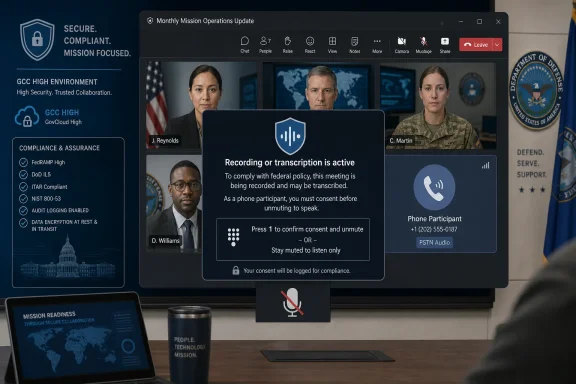 Bringing dial-in callers in line with Teams users
The behavior already exists for Teams client participants in the public cloud and GCC. Microsoft is extending it to its sovereign GCC High and DoD offerings, where organizations commonly operate under stricter records-management, legal, and compliance obligations.The practical distinction matters because PSTN participants are not using the Teams desktop, web, or mobile interface. A visual consent notice in the Teams client does not reach someone dialing in from a desk phone, mobile phone, conference-room system, or other telephone endpoint. The new prompt is intended to ensure those callers actively acknowledge that a meeting is being recorded or transcribed rather than merely being informed after joining.
Microsoft describes the feature as applying when either recording, transcription, or both are active. It does not appear to change how a meeting organizer starts those functions; it changes what a PSTN participant must do before contributing audio.
Impact on meeting operations
Admins should expect a small but potentially disruptive change in meetings that routinely include dial-in attendees. A caller who misses, misunderstands, or declines the prompt will still be connected but unable to speak. That could be particularly awkward for external participants, senior stakeholders dialing in from mobile devices, or emergency meetings where a moderator assumes every attendee can immediately contribute.The rollout is scoped to GCC High and DoD, not the standard commercial Teams service. The roadmap also lists Teams across Android, desktop, iOS, Mac, and web, reflecting the meeting environment rather than a requirement for PSTN callers to use those clients.
Microsoft’s roadmap entry is an advance notice, not a completed deployment, and its stated August 2026 availability date remains subject to change.
What admins should do
Organizations using Teams Audio Conferencing in GCC High or DoD should notify frequent dial-in users before the rollout and update meeting-host guidance. In particular, help-desk and conferencing teams should know that a muted PSTN caller may be waiting at a recording-consent prompt rather than experiencing an audio fault.Useful preparation includes:
- Tell meeting organizers to warn dial-in attendees when recording or transcription will be enabled.
- Update conference-call instructions to explain that callers must affirm consent before speaking.
- Review workflows that rely on PSTN participation from external agencies, vendors, or phone-only conference rooms.
- Ensure meeting hosts know to check whether a silent caller has completed the consent prompt.
References
- Primary source: Microsoft 365 Roadmap
Published: 2026-07-16T23:08:19.0663227Z
Loading…
www.microsoft.com
