

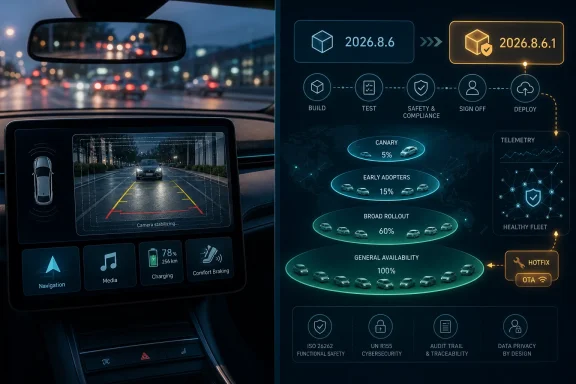
Tesla’s 2026.8 branch began as a routine spring software rollout in March 2026, bringing small usability features to supported vehicles, before 2026.8.6 triggered a rear-camera compliance recall that Tesla corrected with the 2026.8.6.1 over-the-air update in April. That sequence matters more than the individual release-note blurbs. It shows how modern vehicle software has crossed the line from infotainment polish into regulated safety behavior, where a point release can be both a convenience update and a federal defect remedy.
For WindowsForum readers, the Tesla angle is not just car culture. It is a familiar enterprise-software story wearing wheels: staged rollouts, undocumented deltas, telemetry-driven triage, hotfixes, and a vendor that increasingly treats hardware capability as a software entitlement. The difference is that when Windows botches a patch, your webcam may fail; when an EV update botches a display pipeline, the rearview camera can become a safety issue.
The 2026.8 family appears to have landed as one of Tesla’s ordinary production branches, the kind of release that mixes small interface changes, app integrations, localized improvements, and vehicle-specific refinements. Reported release-note items around the branch included minor fixes, navigation conveniences, Spotify queue behavior, charging-data sharing, paint-shop customization, a phone-left-on-charger chime, and comfort-oriented braking behavior for the refreshed Model Y.
That is Tesla’s normal software cadence: not one monolithic update, but a branch with multiple point releases that may vary by vehicle, country, hardware generation, and feature eligibility. To owners, it can feel like a lottery. To anyone who manages Windows feature updates, Intune rings, driver deployments, or firmware baselines, it looks less exotic: controlled exposure, staged availability, and a constant struggle to keep public messaging aligned with what actually ships.
The interesting part is not that Tesla added small conveniences. The interesting part is that one branch carried both harmless creature comforts and a safety-relevant defect. Software version 2026.8.6 was halted after Tesla identified a delayed rearview image display condition, and 2026.8.6.1 was pushed as the fix.
That is the core tension in Tesla’s model. The same invisible update pipeline that delivers Spotify polish and app notifications is also the mechanism for correcting defects in required vehicle systems. The car is no longer a product that receives software. The car is a software estate with wheels, sensors, regulatory obligations, and impatient users.
That timeline is short, and in isolation it makes Tesla look efficient. A defect is detected, rollout is stopped, a fix goes out the next day, and the remedy reaches nearly all affected cars quickly. Compared with the old recall model — letters, dealer appointments, parts availability, and weeks of owner inconvenience — this is exactly the kind of response that software-defined vehicles were supposed to make possible.
But speed is not the same thing as transparency. Owners often see a version number and a set of release notes that emphasize features or “minor fixes,” while regulators see the safety narrative. That gap is familiar to Windows administrators who have learned that the phrase “quality improvements” can cover anything from a cosmetic correction to a system-breaking regression.
A rearview camera delay is not a theatrical failure. It is mundane, reproducible, and precisely the kind of defect that shows why software releases in vehicles cannot be treated like app updates. The backup image is not merely a convenience screen; it is part of a regulated safety environment. If the display is late after wake, the failure mode may last only moments, but those moments are exactly when the driver expects the system to be ready.
Tesla’s advantage is that the company can correct software faults at fleet scale. Tesla’s liability is that the same fleet-scale mechanism can distribute faults before traditional quality filters catch them. The 2026.8.6 episode is not a scandal on its face; Tesla reported no known crashes, injuries, or fatalities tied to the condition. It is, however, a reminder that “over the air” is not magic. It is release engineering, and release engineering can fail.
An enthusiast wants every diff. A normal driver wants to know whether anything changed that affects daily use. A regulator wants to know whether a safety-relevant system was modified. A service technician wants to know what symptom was fixed, what hardware is affected, and what version should be installed before further troubleshooting.
Tesla’s 2026.8 branch illustrates the problem with compressing all of that into consumer-facing notes. The memorable items are small: cabin alerts, media behavior, navigation tweaks, and vehicle personalization. The operationally important item is the point release that corrected a camera delay. Those are not equivalent, yet they live in the same update stream.
This is where Tesla resembles Microsoft at its least communicative. Windows users have spent years watching cumulative updates arrive with bland descriptions, while administrators hunt through known-issue pages, support bulletins, telemetry dashboards, and community reports to understand what changed. Tesla owners now do something similar with third-party trackers, owner forums, service conversations, and recall filings.
The result is a shadow documentation economy. When official notes are too thin, communities fill the gap. That is useful, but it is also uneven. Enthusiasts can spot patterns quickly, but crowd-sourced rollout data is not a substitute for vendor-grade release documentation. It is a workaround for the fact that the vendor’s official changelog is written for confidence, not forensic clarity.
This is Tesla at its best. Instead of waiting for a model-year refresh or a dealership calibration, the car can receive a behavior improvement after delivery. A vehicle bought in March can feel more polished in May. The line between engineering and ownership becomes porous.
That also changes user expectations. Once owners learn that pedal feel, display behavior, charging logic, media playback, and driver-assistance behavior can be altered remotely, every annoyance becomes a potential software ticket. The car is never finished, which can be thrilling when updates improve it and maddening when updates change behavior without enough explanation.
Windows users know this emotional cycle well. A new build fixes something you hated, breaks something you relied on, and quietly changes a default. You gain features without buying new hardware, but you also lose the stability of a sealed appliance. Tesla has imported that bargain into the driveway.
Comfort Braking is the friendly face of the model. The rear-camera hotfix is the uncomfortable face. Together they show the same truth: Tesla’s product is not the vehicle as shipped, but the vehicle as continuously revised.
That is not unique to Tesla, but Tesla’s branding has sometimes encouraged owners to think of software as universally deliverable. The reality is messier. Sensors, cameras, compute modules, display controllers, brake hardware, and regional regulations all define what a vehicle can safely and legally receive.
For IT pros, this is the same problem as endpoint heterogeneity. You can call everything “Windows 11,” but a fleet with different CPUs, TPM versions, GPUs, docks, Wi-Fi chipsets, and driver stacks will not behave as one homogeneous target. Tesla can call a branch 2026.8, but the experienced owner knows the real question is: which car, which hardware, which region, which subscription, which rollout ring?
This matters because software-defined vehicles can create a secondary class system. Owners of newer hardware get the more exciting changes; older vehicles receive compatibility fixes and maybe a promise of future support. That is normal in technology, but cars are not phones. People finance them over years, expect long service lives, and treat capability promises as part of the purchase value.
The more Tesla ties feature velocity to hardware capability, the more it must communicate those boundaries clearly. Otherwise each release becomes a Rorschach test: some owners see innovation, others see fragmentation, and still others see the slow depreciation of software promises.
But there is a cultural risk in celebrating OTA recalls too much. If the industry learns that defects can be patched quickly after release, the pressure to prevent them before release may weaken. In software, we have seen this pattern for decades. Ship now, monitor, patch, repeat.
That attitude is survivable in many consumer apps. It is tolerable, with caveats, in desktop operating systems. It becomes more fraught in vehicles, where a regression can affect visibility, braking feel, driver assistance, battery behavior, or access to the car itself.
Tesla is hardly alone in this transition. Automakers across the industry are moving toward centralized compute, remote updates, subscription features, and software-defined platforms. Tesla simply lives furthest down that road, so its incidents become previews of the larger industry’s governance problem.
The question is not whether OTA fixes are good. They are. The question is whether vendors will treat fast remediation as a backstop or as a substitute for conservative release discipline. Tesla’s 2026.8.6 sequence deserves credit for rapid containment, but it should also raise the bar for pre-release validation on wake-from-sleep display paths and other safety-adjacent systems.
That is both impressive and absurd. Imagine if the clearest view of a Windows cumulative update rollout came not from Microsoft’s own dashboard, but from a loose federation of volunteer endpoint telemetry sites. In some ways, Windows administrators already live near that reality, relying on Reddit threads, enterprise forums, and independent testers to detect patterns before official known-issue pages catch up.
For Tesla, the community layer is especially important because staged rollouts create ambiguity. If your car has not received 2026.8.6.1, is that because your vehicle is unaffected, your region is later in the queue, your Wi-Fi is unavailable, your branch is different, or Tesla paused the release? Without a clear owner-facing explanation, the answer is often inferred from other owners’ dashboards.
This creates a trust problem. Tesla’s software operation may be sophisticated internally, but external opacity makes even routine updates feel mysterious. That mystery is fun for enthusiasts who enjoy version archaeology. It is less fun for families who just want to know whether their backup camera issue is fixed.
The cure is not to publish every internal engineering note. The cure is to separate feature notes from operational advisories. A car owner should not need to cross-reference third-party rollout charts and federal filings to understand whether an update was a safety remedy.
That visibility changes accountability. If an update improves braking smoothness, Tesla gets credit immediately. If a point release causes a camera delay, Tesla owns that too. The software version becomes a public artifact, not an internal service detail.
Traditional automakers may envy Tesla’s speed, but they should also study the support burden that comes with it. Once customers understand that their vehicle is patchable, they expect patch notes. Once they expect patch notes, vague language starts to look evasive. Once vague language looks evasive, community speculation fills the vacuum.
Microsoft learned this lesson the hard way. Enterprise customers pushed for clearer update histories, known-issue documentation, release health dashboards, and deployment controls because “trust us” was not enough. Automakers will face the same pressure as software-defined vehicles become mainstream.
Tesla still has time to set the norm rather than be dragged toward it. It could provide clearer branch-level histories, distinguish feature releases from compliance remedies, indicate affected hardware more plainly, and explain when a point release is a hotfix rather than a general enhancement. None of that would slow innovation. It would make innovation legible.
That framing may sound glib, but it explains why Tesla can move faster than legacy automakers and why its missteps land differently. A conventional vehicle defect is often bounded by manufacturing date, part number, and service campaign. A software defect can be bounded by version, branch, hardware profile, wake state, region, and rollout exposure.
In enterprise IT, mature organizations build processes around exactly this complexity. They use phased deployments, rollback plans, telemetry, incident response, change records, and clear user communications. Tesla plainly has some version of that machinery internally. The 2026.8.6 halt and 2026.8.6.1 remedy show that the company can detect and respond quickly.
What is less mature is the public interface to that machinery. Owners see the effects but not the map. They know an update arrived, but not always why. They may know a bug disappeared, but not whether it was acknowledged. They may know a recall exists, but only after the fix has already landed.
For a consumer electronics company, that ambiguity may be tolerable. For a car company, it is increasingly insufficient. Software-defined vehicles need software-defined accountability.
Administrators and security-minded readers should also notice the direction of travel. The vehicle is now an endpoint with a regulatory blast radius. Its changelog can affect physical behavior, not just UI state. Its telemetry can drive rapid fixes, but its opacity can leave users guessing.
For WindowsForum readers, the Tesla angle is not just car culture. It is a familiar enterprise-software story wearing wheels: staged rollouts, undocumented deltas, telemetry-driven triage, hotfixes, and a vendor that increasingly treats hardware capability as a software entitlement. The difference is that when Windows botches a patch, your webcam may fail; when an EV update botches a display pipeline, the rearview camera can become a safety issue.
 Tesla’s Spring Branch Turned a Car Into a Patch Tuesday Case Study
The 2026.8 family appears to have landed as one of Tesla’s ordinary production branches, the kind of release that mixes small interface changes, app integrations, localized improvements, and vehicle-specific refinements. Reported release-note items around the branch included minor fixes, navigation conveniences, Spotify queue behavior, charging-data sharing, paint-shop customization, a phone-left-on-charger chime, and comfort-oriented braking behavior for the refreshed Model Y.That is Tesla’s normal software cadence: not one monolithic update, but a branch with multiple point releases that may vary by vehicle, country, hardware generation, and feature eligibility. To owners, it can feel like a lottery. To anyone who manages Windows feature updates, Intune rings, driver deployments, or firmware baselines, it looks less exotic: controlled exposure, staged availability, and a constant struggle to keep public messaging aligned with what actually ships.
The interesting part is not that Tesla added small conveniences. The interesting part is that one branch carried both harmless creature comforts and a safety-relevant defect. Software version 2026.8.6 was halted after Tesla identified a delayed rearview image display condition, and 2026.8.6.1 was pushed as the fix.
That is the core tension in Tesla’s model. The same invisible update pipeline that delivers Spotify polish and app notifications is also the mechanism for correcting defects in required vehicle systems. The car is no longer a product that receives software. The car is a software estate with wheels, sensors, regulatory obligations, and impatient users.
The Rear Camera Recall Is the Story Hidden Inside the Point Release
The most consequential fact in the 2026.8 sequence is that Tesla’s own recall chronology says its engineering teams were notified on April 10, 2026, of an engineering vehicle running 2026.8.6 that experienced a delayed rearview image after vehicle wake. Tesla halted further release of 2026.8.6 to the customer fleet the same day, then sent 2026.8.6.1 to customers on April 11 as an over-the-air correction.That timeline is short, and in isolation it makes Tesla look efficient. A defect is detected, rollout is stopped, a fix goes out the next day, and the remedy reaches nearly all affected cars quickly. Compared with the old recall model — letters, dealer appointments, parts availability, and weeks of owner inconvenience — this is exactly the kind of response that software-defined vehicles were supposed to make possible.
But speed is not the same thing as transparency. Owners often see a version number and a set of release notes that emphasize features or “minor fixes,” while regulators see the safety narrative. That gap is familiar to Windows administrators who have learned that the phrase “quality improvements” can cover anything from a cosmetic correction to a system-breaking regression.
A rearview camera delay is not a theatrical failure. It is mundane, reproducible, and precisely the kind of defect that shows why software releases in vehicles cannot be treated like app updates. The backup image is not merely a convenience screen; it is part of a regulated safety environment. If the display is late after wake, the failure mode may last only moments, but those moments are exactly when the driver expects the system to be ready.
Tesla’s advantage is that the company can correct software faults at fleet scale. Tesla’s liability is that the same fleet-scale mechanism can distribute faults before traditional quality filters catch them. The 2026.8.6 episode is not a scandal on its face; Tesla reported no known crashes, injuries, or fatalities tied to the condition. It is, however, a reminder that “over the air” is not magic. It is release engineering, and release engineering can fail.
The Release Notes Tell Owners Less Than the Version Numbers Do
Tesla’s public-facing release notes have always had a strange dual role. They are owner education, marketing copy, support document, and changelog all at once. That is a difficult thing to write honestly, because different audiences want different truths.An enthusiast wants every diff. A normal driver wants to know whether anything changed that affects daily use. A regulator wants to know whether a safety-relevant system was modified. A service technician wants to know what symptom was fixed, what hardware is affected, and what version should be installed before further troubleshooting.
Tesla’s 2026.8 branch illustrates the problem with compressing all of that into consumer-facing notes. The memorable items are small: cabin alerts, media behavior, navigation tweaks, and vehicle personalization. The operationally important item is the point release that corrected a camera delay. Those are not equivalent, yet they live in the same update stream.
This is where Tesla resembles Microsoft at its least communicative. Windows users have spent years watching cumulative updates arrive with bland descriptions, while administrators hunt through known-issue pages, support bulletins, telemetry dashboards, and community reports to understand what changed. Tesla owners now do something similar with third-party trackers, owner forums, service conversations, and recall filings.
The result is a shadow documentation economy. When official notes are too thin, communities fill the gap. That is useful, but it is also uneven. Enthusiasts can spot patterns quickly, but crowd-sourced rollout data is not a substitute for vendor-grade release documentation. It is a workaround for the fact that the vendor’s official changelog is written for confidence, not forensic clarity.
Comfort Braking Shows the Other Side of the Same Software Bet
Not every 2026.8 story is a defect story. Reported notes around the branch point to Comfort Braking for the refreshed Model Y, a feature aimed at smoothing deceleration and reducing the final-stop jerk that can make one-pedal driving feel abrupt. On a brake-by-wire or heavily software-mediated platform, that sort of refinement is exactly what software-defined vehicles promise.This is Tesla at its best. Instead of waiting for a model-year refresh or a dealership calibration, the car can receive a behavior improvement after delivery. A vehicle bought in March can feel more polished in May. The line between engineering and ownership becomes porous.
That also changes user expectations. Once owners learn that pedal feel, display behavior, charging logic, media playback, and driver-assistance behavior can be altered remotely, every annoyance becomes a potential software ticket. The car is never finished, which can be thrilling when updates improve it and maddening when updates change behavior without enough explanation.
Windows users know this emotional cycle well. A new build fixes something you hated, breaks something you relied on, and quietly changes a default. You gain features without buying new hardware, but you also lose the stability of a sealed appliance. Tesla has imported that bargain into the driveway.
Comfort Braking is the friendly face of the model. The rear-camera hotfix is the uncomfortable face. Together they show the same truth: Tesla’s product is not the vehicle as shipped, but the vehicle as continuously revised.
Hardware Generations Are Becoming Software Borders
Tesla’s release branches are increasingly shaped by hardware eligibility. A feature may appear for the refreshed Model Y but not earlier versions. Full Self-Driving builds may target AI4 hardware differently from HW3. Infotainment features may depend on processor generation. Even apparently simple interface changes can have platform constraints beneath them.That is not unique to Tesla, but Tesla’s branding has sometimes encouraged owners to think of software as universally deliverable. The reality is messier. Sensors, cameras, compute modules, display controllers, brake hardware, and regional regulations all define what a vehicle can safely and legally receive.
For IT pros, this is the same problem as endpoint heterogeneity. You can call everything “Windows 11,” but a fleet with different CPUs, TPM versions, GPUs, docks, Wi-Fi chipsets, and driver stacks will not behave as one homogeneous target. Tesla can call a branch 2026.8, but the experienced owner knows the real question is: which car, which hardware, which region, which subscription, which rollout ring?
This matters because software-defined vehicles can create a secondary class system. Owners of newer hardware get the more exciting changes; older vehicles receive compatibility fixes and maybe a promise of future support. That is normal in technology, but cars are not phones. People finance them over years, expect long service lives, and treat capability promises as part of the purchase value.
The more Tesla ties feature velocity to hardware capability, the more it must communicate those boundaries clearly. Otherwise each release becomes a Rorschach test: some owners see innovation, others see fragmentation, and still others see the slow depreciation of software promises.
The OTA Recall Is Efficient, but It Also Normalizes Defects After Sale
The regulatory filing around the rear camera issue contains a striking modern idea: the remedy was software, delivered remotely, with no further owner action required once the corrected version was installed. That is a genuine consumer benefit. It reduces friction, avoids service-center congestion, and fixes many vehicles faster than old recall systems could.But there is a cultural risk in celebrating OTA recalls too much. If the industry learns that defects can be patched quickly after release, the pressure to prevent them before release may weaken. In software, we have seen this pattern for decades. Ship now, monitor, patch, repeat.
That attitude is survivable in many consumer apps. It is tolerable, with caveats, in desktop operating systems. It becomes more fraught in vehicles, where a regression can affect visibility, braking feel, driver assistance, battery behavior, or access to the car itself.
Tesla is hardly alone in this transition. Automakers across the industry are moving toward centralized compute, remote updates, subscription features, and software-defined platforms. Tesla simply lives furthest down that road, so its incidents become previews of the larger industry’s governance problem.
The question is not whether OTA fixes are good. They are. The question is whether vendors will treat fast remediation as a backstop or as a substitute for conservative release discipline. Tesla’s 2026.8.6 sequence deserves credit for rapid containment, but it should also raise the bar for pre-release validation on wake-from-sleep display paths and other safety-adjacent systems.
Community Trackers Have Become the Sysadmin Console Tesla Never Built
Tesla’s owner community has built a parallel observability layer around the company’s updates. Third-party trackers compile rollout counts, version adoption, country distribution, pending installs, and anecdotal reports from connected vehicles. These services are not official, but they are often where owners and enthusiasts go first to understand whether an update is spreading, paused, or superseded.That is both impressive and absurd. Imagine if the clearest view of a Windows cumulative update rollout came not from Microsoft’s own dashboard, but from a loose federation of volunteer endpoint telemetry sites. In some ways, Windows administrators already live near that reality, relying on Reddit threads, enterprise forums, and independent testers to detect patterns before official known-issue pages catch up.
For Tesla, the community layer is especially important because staged rollouts create ambiguity. If your car has not received 2026.8.6.1, is that because your vehicle is unaffected, your region is later in the queue, your Wi-Fi is unavailable, your branch is different, or Tesla paused the release? Without a clear owner-facing explanation, the answer is often inferred from other owners’ dashboards.
This creates a trust problem. Tesla’s software operation may be sophisticated internally, but external opacity makes even routine updates feel mysterious. That mystery is fun for enthusiasts who enjoy version archaeology. It is less fun for families who just want to know whether their backup camera issue is fixed.
The cure is not to publish every internal engineering note. The cure is to separate feature notes from operational advisories. A car owner should not need to cross-reference third-party rollout charts and federal filings to understand whether an update was a safety remedy.
Tesla’s Changelog Problem Is Now an Industry Problem
Automakers used to hide complexity behind dealerships. If a calibration changed, a service bulletin might exist, but most owners never saw the software boundary. Tesla’s model makes the boundary visible. The version number is on the screen. The car tells you an update is ready. The owner becomes part of the deployment process.That visibility changes accountability. If an update improves braking smoothness, Tesla gets credit immediately. If a point release causes a camera delay, Tesla owns that too. The software version becomes a public artifact, not an internal service detail.
Traditional automakers may envy Tesla’s speed, but they should also study the support burden that comes with it. Once customers understand that their vehicle is patchable, they expect patch notes. Once they expect patch notes, vague language starts to look evasive. Once vague language looks evasive, community speculation fills the vacuum.
Microsoft learned this lesson the hard way. Enterprise customers pushed for clearer update histories, known-issue documentation, release health dashboards, and deployment controls because “trust us” was not enough. Automakers will face the same pressure as software-defined vehicles become mainstream.
Tesla still has time to set the norm rather than be dragged toward it. It could provide clearer branch-level histories, distinguish feature releases from compliance remedies, indicate affected hardware more plainly, and explain when a point release is a hotfix rather than a general enhancement. None of that would slow innovation. It would make innovation legible.
The Real Product Is the Update Pipeline
The 2026.8 branch makes one thing hard to ignore: Tesla’s most important product is not any single feature, but the pipeline that delivers and corrects features. The car is the endpoint. The fleet is the deployment ring. The owner is the local admin with limited privileges.That framing may sound glib, but it explains why Tesla can move faster than legacy automakers and why its missteps land differently. A conventional vehicle defect is often bounded by manufacturing date, part number, and service campaign. A software defect can be bounded by version, branch, hardware profile, wake state, region, and rollout exposure.
In enterprise IT, mature organizations build processes around exactly this complexity. They use phased deployments, rollback plans, telemetry, incident response, change records, and clear user communications. Tesla plainly has some version of that machinery internally. The 2026.8.6 halt and 2026.8.6.1 remedy show that the company can detect and respond quickly.
What is less mature is the public interface to that machinery. Owners see the effects but not the map. They know an update arrived, but not always why. They may know a bug disappeared, but not whether it was acknowledged. They may know a recall exists, but only after the fix has already landed.
For a consumer electronics company, that ambiguity may be tolerable. For a car company, it is increasingly insufficient. Software-defined vehicles need software-defined accountability.
The 2026.8 Lesson Is Written in the Small Print
The practical reading of Tesla’s spring branch is not complicated, even if the rollout mechanics are. Owners should treat Tesla updates with the same seriousness that IT professionals bring to firmware and operating-system patches. Most will be routine, some will be valuable, and a few will matter for safety or compliance.Administrators and security-minded readers should also notice the direction of travel. The vehicle is now an endpoint with a regulatory blast radius. Its changelog can affect physical behavior, not just UI state. Its telemetry can drive rapid fixes, but its opacity can leave users guessing.
- Tesla’s 2026.8 branch was not just a feature update; it became the basis for a safety-relevant hotfix after 2026.8.6 was halted.
- The 2026.8.6.1 update corrected a delayed rearview image condition through an over-the-air remedy rather than a service visit.
- Convenience features such as media tweaks, charging-data sharing, customization, navigation changes, and comfort braking show the upside of Tesla’s continuous-delivery model.
- Hardware generation, region, and vehicle configuration increasingly determine which Tesla features an owner actually receives.
- Third-party rollout trackers have become essential because Tesla’s own consumer-facing release notes rarely provide the full operational picture.
- The broader auto industry should treat Tesla’s experience as a warning that fast OTA repair must be paired with clearer changelogs and stronger release governance.
References
- Primary source: Not a Tesla App
Published: 2026-06-20T09:30:16.406485
2026.8 Official Tesla Release Notes - Software Updates
Tesla software update 2026.8 includes Autopilot Naming Update, Blind Spot Warning While Parked, Komfortní brzdění, Drobné aktualizace, Drobné opravy, Dashcam Viewer Improvements, Driver Profile, Slovak Language Support, Service Mode Improvements.www.notateslaapp.com - Related coverage: techtimes.com
Tesla Cybertruck Finally Gets Actually Smart Summon: v14.3.4 Ships With MLIR-Powered Speed Gain
Tesla Cybertruck Actually Smart Summon arrives June 12 with FSD v14.3.4, closing a 20-month feature gap for Cybertruck owners who have watched the rest of the fleet enjoy it since September 2024 —www.techtimes.com - Related coverage: tparts.com
Tesla Update 2026.8: Smoother Braking for Model Y and a Major App Surp | Tparts
Tesla has officially started rolling out its latest software version 2026.8. This update focuses on enhancing passenger comfort and refining the digital experience. It introduces a highly requested driver tracking feature in the mobile app and a specialized braking mode. Tesla update 2026.8 adds... www.tparts.com
- Related coverage: teslaupdates.org
Tesla Release Notes for Model S,3,X,Y and HW2,HW3 | Tesla Updates
Tesla update history and release notes, featuring availablity information.teslaupdates.org - Related coverage: teslascope.com
2026.14.6.6 Tesla Software Update - Teslascope
The release notes and rollout for the Tesla software update, 2026.14.6.6.teslascope.com - Related coverage: switchtotesla.com
Tesla Updates: What's New in June 2026 – FSD V14.3.3, Hey Grok, Pet Mode & More
June 2026 Tesla updates: FSD V14.3.3 with intervention-free streak counter, Hey Grok voice assistant, Pet Mode with Cyberhog, 24-hour dashcam, blind spot lights, and Supercharger virtual queue.switchtotesla.com
- Related coverage: teslaacessories.com
Tesla Releases Software Update 2026.8.3 Enhanced Comfort, Security, and Convenience for Owners Across the US and Europe
As Tesla owners across the United States and Europe check their apps and touchscreens on this bright March 23, 2026 morning, a familiar yet exciting notification is lighting up dashboards from California highways to German autobahns. Software update 2026.8.3 the latest point release in the...www.teslaacessories.com - Related coverage: tesla.com
- Related coverage: service.tesla.com
- Related coverage: tesla.cn
