

On July 11, 2026, construction-permit reporting indicated that Tesla’s Robotaxi Hub in Austin includes a cleaning robot, the first documented appearance of such a machine in official filings, while separate video shared by Sawyer Merritt suggested at least one autonomous cleaner was already operating. That is meaningful evidence of internal deployment, but it is not proof that Tesla has built a consumer vacuum, settled the machine’s design, or prepared a retail launch. The more consequential reading is operational: Tesla appears to be treating cleaning as part of the autonomy stack required to keep a robotaxi network moving. A humble floor-and-cabin cleaner may therefore reveal more about Tesla’s near-term robotics strategy than another polished Optimus demonstration.
The strongest new evidence is not the social-media video. It is the construction-permit reporting for Tesla’s Robotaxi Hub in Austin, which identifies a cleaning robot as part of the facility and, according to BASENOR’s July 11 update, marks the first documented appearance of the machine in official construction filings.
That distinction matters because a video can show a prototype, a controlled demonstration, or a borrowed device without explaining whether it belongs in an operating plan. A construction filing places the robot in a different category: planned facility equipment. It suggests that somebody designing the Hub considered automated cleaning sufficiently concrete to include in the physical and operational environment.
The named account @TeslaNewswire summarized the discovery on July 11 by saying the Austin Hub “has a cleaning robot inside the facility” and that it could be the robot Tesla showed in an earlier video. The first half is tied to the permit; the second remains a possibility, not an identification. Keeping those two claims separate is essential, because the permit establishes the function while the available footage does not establish the manufacturer, hardware platform, or commercial status.
BASENOR senior writer Sarah Chen framed the filing as significant support for the idea that the machine is moving from internal demonstration toward real-world work. That is a reasonable interpretation, provided commercial rollout is understood here as deployment inside Tesla’s own operation rather than a product being offered to outside customers. The permit is evidence of institutional intent, not a sales announcement.
This is also why the official-announcement gap should not be treated as a trivial omission. Tesla did not announce the cleaning robot’s inclusion; it was identified through a construction permit. The public is therefore looking at the outlines of a system through operational paperwork and a short clip, not through a product page, technical specification, safety document, or launch presentation.
The result is unusually solid evidence of a narrow fact and unusually weak evidence for the larger claims already forming around it. Tesla appears to have a cleaning robot in its Robotaxi Hub plan. Almost everything beyond that sentence still requires careful qualification.
A consumer appliance launch would require answers the clip does not even begin to provide. Buyers would need to know what the machine cleans, where it can navigate, how it maps a home, what maintenance it requires, how it handles privacy, how it is supported, and whether it is intended for floors, vehicle cabins, or both. None of that is established by the permit or the video.
An internal fleet robot has a much narrower job. It can operate in a known building, encounter a constrained set of surfaces, use infrastructure designed around it, and hand exceptions to staff. It does not have to survive every staircase, pet, cable, rug, doorway, toy, spilled drink, and household network that makes consumer robotics difficult.
The Austin Hub context further narrows the likely mission. A robotaxi facility exists to service vehicles and return them to operation; routine cleaning is not peripheral to that task. A driverless ride may eliminate the paid driver, but it does not eliminate dirt, discarded items, smudged screens, wet floors, or the need to inspect a cabin between passengers.
That makes the cleaning robot less like an unrelated gadget and more like depot equipment. Its value would not come from impressing a customer in a showroom. It would come from reducing repetitive work, standardizing part of the turnaround process, and allowing the facility to reserve human attention for exceptions the machine cannot resolve.
The important strategic shift is from autonomy as a feature of the vehicle to autonomy as a property of the operation. A robotaxi network is not merely a collection of cars that can drive themselves. It is a service system that must dispatch, charge, inspect, clean, stage, recover, and maintain those cars with as little friction as possible.
Seen in that light, the cleaning robot is not a side project. It is a missing piece of the same operating model. Tesla’s vehicle autonomy can only deliver its intended economics if the supposedly driverless fleet does not recreate a large manual workforce behind the depot doors.
The first possibility is the most intuitively exciting and the easiest to overstate. If Tesla designed the device, the robot could represent a new specialized platform built around the predictable geometry of its own facilities and vehicles. But visual proximity to Tesla operations does not prove Tesla authorship; factories routinely contain equipment made by specialist vendors.
The second possibility may be less dramatic but more practical. Tesla does not need to manufacture every wheel, brush, vacuum motor, or cleaning chassis to automate the workflow. A third-party platform connected to Tesla’s scheduling, perception, access-control, or fleet-management systems could produce most of the operational benefit while shortening the path to deployment.
The third possibility depends on what Optimus-adjacent means. It need not mean a humanoid body holding a vacuum. It could mean shared perception, planning, simulation, data tooling, remote-assistance processes, or organizational knowledge moving from one robotics effort into a task-specific machine.
That distinction goes to the heart of Tesla’s robotics thesis. A humanoid is attractive because it promises to work in spaces designed for humans, but a dedicated machine can be cheaper, safer, and more efficient when the task is repetitive and the environment can be redesigned. The presence of a non-humanoid cleaner would not contradict Optimus; it could show that Tesla is willing to choose the form factor that fits the job.
There is also a fourth interpretation that should be resisted because the evidence does not support it: that the machine is already a finished product category. An operating prototype can be useful without being manufacturable at scale. A permitted facility component can be real without becoming a retail business.
The correct status is therefore neither “just a rumor” nor “Tesla launches a vacuum.” This is evidence of internal deployment, not a consumer-product launch. It is a documented operational inclusion accompanied by video that reportedly suggests real use, with the device’s identity unresolved.
Cleaning is one of those steps because shared vehicles are public-facing machines with private-space expectations. Passengers expect a cabin to feel ready for them, even though the previous rider may have left behind dirt or damage. A conventional ride-hailing driver continuously performs low-level inspection and cleanup; a robotaxi service must replace that attention with sensors, depot processes, remote review, automation, or some combination of all four.
A cleaning robot can address only part of the problem. Vacuuming debris is different from identifying a lost wallet, detecting a spill, recognizing damaged upholstery, sanitizing a contact surface, or determining whether a vehicle is safe to return to service. The operational breakthrough would not be a robot that cleans perfectly, but a system that knows which cases the robot can handle and which require escalation.
That makes orchestration more important than spectacle. The cleaner has to receive a task, identify or be assigned the correct vehicle or zone, gain access, complete a defined procedure, report results, and avoid interfering with people, cars, charging equipment, and other robots. A machine that can navigate impressively but cannot participate reliably in that workflow is a demonstration, not infrastructure.
The permit’s significance is that Tesla appears to be accounting for this layer while designing the Hub. Facilities built around robots can provide predictable docking points, clear travel lanes, known charging locations, machine-readable zones, controlled lighting, and fewer awkward thresholds. Designing the environment and the robot together is often more realistic than demanding a robot solve every environmental problem through intelligence alone.
This is where the phrase “minimal human intervention” needs discipline. The source update suggests the Hub is being designed as a highly automated environment, but a cleaning robot does not prove a human-free facility. It indicates that Tesla is targeting at least one repetitive maintenance task; it says nothing conclusive about staffing levels, exception handling, repairs, supervision, or safety oversight.
Even limited automation, however, can matter at fleet scale. The business case is not necessarily eliminating every cleaner. It may be extending service hours, handling predictable debris, reducing turnaround variation, or allowing staff to focus on the messy edge cases that are expensive to automate.
The cleaning machine therefore belongs in the same analytical frame as charging and dispatch. It is part of the hidden system that determines whether autonomous vehicles spend their time earning revenue or waiting for human attention. The robotaxi may be the product passengers see, but the Hub is the product operation depends on.
Humanoid robots dominate attention because they package a broad technological ambition into a recognizable body. They also invite broad claims: one machine, many tasks, human spaces, general-purpose labor. A cleaner inside a controlled facility makes a narrower promise, but narrow promises are easier to test against daily work.
That is why mundane deployments deserve scrutiny. A robot that performs the same task repeatedly, reports failures, accepts maintenance, and fits into a production schedule creates operational data. It exposes battery limitations, navigation mistakes, dirty sensors, blocked paths, unreliable docks, software-update problems, and all the uncinematic details that determine whether robotics leaves the lab.
If the Austin machine is purpose-built by Tesla, it could indicate a portfolio approach in which specialized robots handle constrained jobs while Optimus develops toward broader capability. If it is third-party hardware, it could indicate that Tesla views the software and orchestration layer as more valuable than owning every chassis. If it is Optimus-adjacent, it could be a proving ground for components or workflows without forcing a humanoid form onto a task that does not need one.
All three interpretations lead to the same strategic observation: Tesla’s robotics future may be an ecosystem rather than a single hero machine. The company’s vehicles, facilities, specialized devices, humanoids, software services, and human supervisors could operate as one coordinated system even when the machines look nothing alike.
That possibility also changes how progress should be measured. Unit counts and stage demonstrations remain visible, but repeatable deployment, facility integration, exception rates, maintenance load, and the ability to run safely around people matter more. The cleaning robot is interesting precisely because it appears to have crossed from presentation into a planned operational setting.
Yet the evidence still does not tell us how autonomous it is. “Autonomous cleaning robot” can describe a wide range of capabilities, from route-following equipment in a controlled zone to a perception-rich machine that adapts to vehicle interiors. Without technical documentation, the responsible conclusion is functional, not architectural: it reportedly cleans autonomously enough to be shown operating and to be included in the Hub plan.
The first issue is ownership. If the device is Tesla-built, responsibility may sit with an internal robotics platform team. If it is a third-party unit, patching and telemetry may cross vendor boundaries. If it uses shared Tesla software, the hardware supplier, software operator, facility owner, and security team may each control a different layer.
The second issue is privilege. A cleaner may need access to restricted facility zones, vehicle cabins, charging areas, elevators, doors, or scheduling systems. Those permissions should be treated as machine identities with defined scope, not as a permanent master key granted because the endpoint is physically small.
The third issue is data. Cameras and other sensors used for navigation can capture workers, passengers’ belongings, vehicle interiors, screens, badges, and facility layouts. The article and permit do not disclose the Austin robot’s sensor suite, so no specific surveillance claim is justified, but any enterprise deployment should decide what is collected, where it is processed, how long it is retained, and who can retrieve it.
The fourth issue is update control. A desktop patch can interrupt office work; a robot update can change movement, obstacle response, docking, or access behavior. IT change management therefore has to connect software versioning with operational safety, staged deployment, rollback procedures, and physical validation.
The fifth issue is exception handling. A robot does not become enterprise-ready merely because it succeeds in ideal conditions. Administrators need to know what happens when wireless coverage drops, a door stays closed, a route is blocked, a sensor becomes dirty, a task is interrupted, or the machine encounters something it cannot classify.
Windows-centric shops should recognize the pattern from every previous wave of “smart” equipment. The device may arrive through an operations budget rather than IT procurement, use a vendor cloud rather than a domain join, and be described as machinery rather than computing. It still creates credentials, logs, update obligations, network flows, and incident-response questions.
The difference is that a cleaning robot can act in the physical environment. A compromised account might expose telemetry; a bad update might strand the machine; an authorization error might send it into the wrong zone. Security architecture must therefore account for both information risk and kinetic risk without assuming that either one is dramatic enough to announce itself.
The phrase “first documented evidence” should also be read precisely. It is the first documented appearance identified in official construction filings according to the July 11 article update. It is not necessarily the first time Tesla experimented with automated cleaning, the first time an employee used such a machine, or the first evidence of any cleaning automation anywhere in the company.
The earlier Tesla video mentioned by @TeslaNewswire creates a plausible continuity narrative: demonstration first, permit later, operational deployment next. But “may be the same robot” is not visual or documentary confirmation. Similar-looking machines can be revised prototypes, vendor units, or different devices performing the same task.
There is also an asymmetry in what permits can prove. A filing can demonstrate that equipment was planned or incorporated into a project’s design. It cannot, by itself, prove current utilization, performance, reliability, or whether the final installation matches every planning detail.
The Sawyer Merritt footage helps with the operation question but not the identity question. Video can show movement and apparent task performance, yet it rarely reveals who built the internals, what autonomy stack is running, whether a remote operator is involved, or how often the machine succeeds without intervention. Those are exactly the facts required to assess maturity.
Tesla’s silence leaves room for both overenthusiasm and excessive dismissal. Enthusiasts can mistake an internal tool for a new product line; skeptics can dismiss it as an ordinary floor cleaner. The more useful position is that internal deployment is strategically meaningful even when the hardware is conventional, because integration into a robotaxi workflow is itself a systems-engineering problem.
This is why the story deserves attention without hype. The novelty may not be a revolutionary vacuum motor or a dramatic new body. It may be the decision to make cleaning a machine-executable step inside an autonomous transport operation.
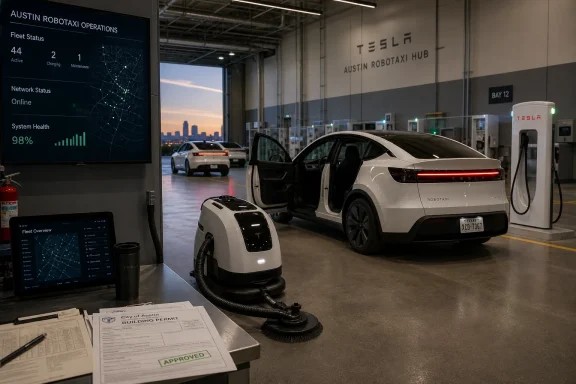 The Permit Turns a Sighting Into an Infrastructure Decision
The strongest new evidence is not the social-media video. It is the construction-permit reporting for Tesla’s Robotaxi Hub in Austin, which identifies a cleaning robot as part of the facility and, according to BASENOR’s July 11 update, marks the first documented appearance of the machine in official construction filings.That distinction matters because a video can show a prototype, a controlled demonstration, or a borrowed device without explaining whether it belongs in an operating plan. A construction filing places the robot in a different category: planned facility equipment. It suggests that somebody designing the Hub considered automated cleaning sufficiently concrete to include in the physical and operational environment.
The named account @TeslaNewswire summarized the discovery on July 11 by saying the Austin Hub “has a cleaning robot inside the facility” and that it could be the robot Tesla showed in an earlier video. The first half is tied to the permit; the second remains a possibility, not an identification. Keeping those two claims separate is essential, because the permit establishes the function while the available footage does not establish the manufacturer, hardware platform, or commercial status.
BASENOR senior writer Sarah Chen framed the filing as significant support for the idea that the machine is moving from internal demonstration toward real-world work. That is a reasonable interpretation, provided commercial rollout is understood here as deployment inside Tesla’s own operation rather than a product being offered to outside customers. The permit is evidence of institutional intent, not a sales announcement.
This is also why the official-announcement gap should not be treated as a trivial omission. Tesla did not announce the cleaning robot’s inclusion; it was identified through a construction permit. The public is therefore looking at the outlines of a system through operational paperwork and a short clip, not through a product page, technical specification, safety document, or launch presentation.
The result is unusually solid evidence of a narrow fact and unusually weak evidence for the larger claims already forming around it. Tesla appears to have a cleaning robot in its Robotaxi Hub plan. Almost everything beyond that sentence still requires careful qualification.
Tesla Is Automating the Depot, Not Unveiling a Roomba Rival
Sawyer Merritt posted video on July 11 suggesting that Tesla has at least one autonomous cleaning robot operational. The footage appears to depict internal use, and there has been no official Tesla announcement of a consumer vacuum robot product. Those facts point away from the most clickable interpretation: that Tesla is preparing to enter the household robot-vacuum market.A consumer appliance launch would require answers the clip does not even begin to provide. Buyers would need to know what the machine cleans, where it can navigate, how it maps a home, what maintenance it requires, how it handles privacy, how it is supported, and whether it is intended for floors, vehicle cabins, or both. None of that is established by the permit or the video.
An internal fleet robot has a much narrower job. It can operate in a known building, encounter a constrained set of surfaces, use infrastructure designed around it, and hand exceptions to staff. It does not have to survive every staircase, pet, cable, rug, doorway, toy, spilled drink, and household network that makes consumer robotics difficult.
The Austin Hub context further narrows the likely mission. A robotaxi facility exists to service vehicles and return them to operation; routine cleaning is not peripheral to that task. A driverless ride may eliminate the paid driver, but it does not eliminate dirt, discarded items, smudged screens, wet floors, or the need to inspect a cabin between passengers.
That makes the cleaning robot less like an unrelated gadget and more like depot equipment. Its value would not come from impressing a customer in a showroom. It would come from reducing repetitive work, standardizing part of the turnaround process, and allowing the facility to reserve human attention for exceptions the machine cannot resolve.
The important strategic shift is from autonomy as a feature of the vehicle to autonomy as a property of the operation. A robotaxi network is not merely a collection of cars that can drive themselves. It is a service system that must dispatch, charge, inspect, clean, stage, recover, and maintain those cars with as little friction as possible.
Seen in that light, the cleaning robot is not a side project. It is a missing piece of the same operating model. Tesla’s vehicle autonomy can only deliver its intended economics if the supposedly driverless fleet does not recreate a large manual workforce behind the depot doors.
Three Plausible Machines Sit Behind One Ambiguous Clip
The available evidence supports three potential identities, all explicitly left open in the source reporting. The device could be Tesla-built hardware, a third-party machine using Tesla software, or an early application related to the broader Optimus program. The clip alone does not decide among them.| Possible identity | What it would mean | What supports it | What remains unproven |
|---|---|---|---|
| Purpose-built Tesla cleaning robot | Tesla designed a specialized machine for facility or vehicle-cleaning work | The device appears in a Tesla operational context, and a cleaning robot is included in the Hub permit | Tesla has not identified the hardware, published specifications, or announced a product |
| Third-party unit running Tesla software | Tesla is integrating its autonomy or orchestration software with existing cleaning hardware | Internal deployment could favor fast integration over designing every component | The clip does not establish the hardware vendor or software stack |
| Early Optimus-adjacent application | Tesla is applying robotics work associated with Optimus to a narrower, non-humanoid task | Tesla has been accelerating its robotics roadmap during 2026 while Optimus production scales at Fremont | No evidence ties the machine directly to Optimus hardware, teams, or control systems |
The second possibility may be less dramatic but more practical. Tesla does not need to manufacture every wheel, brush, vacuum motor, or cleaning chassis to automate the workflow. A third-party platform connected to Tesla’s scheduling, perception, access-control, or fleet-management systems could produce most of the operational benefit while shortening the path to deployment.
The third possibility depends on what Optimus-adjacent means. It need not mean a humanoid body holding a vacuum. It could mean shared perception, planning, simulation, data tooling, remote-assistance processes, or organizational knowledge moving from one robotics effort into a task-specific machine.
That distinction goes to the heart of Tesla’s robotics thesis. A humanoid is attractive because it promises to work in spaces designed for humans, but a dedicated machine can be cheaper, safer, and more efficient when the task is repetitive and the environment can be redesigned. The presence of a non-humanoid cleaner would not contradict Optimus; it could show that Tesla is willing to choose the form factor that fits the job.
There is also a fourth interpretation that should be resisted because the evidence does not support it: that the machine is already a finished product category. An operating prototype can be useful without being manufacturable at scale. A permitted facility component can be real without becoming a retail business.
The correct status is therefore neither “just a rumor” nor “Tesla launches a vacuum.” This is evidence of internal deployment, not a consumer-product launch. It is a documented operational inclusion accompanied by video that reportedly suggests real use, with the device’s identity unresolved.
Robotaxi Autonomy Ends at the Depot Door Unless the Depot Is Autonomous Too
Tesla’s official Robotaxi presence in Austin gives the permit its strategic context. The company is not designing a generic showcase building; the Hub belongs to a service whose central promise is to move people with less direct human intervention. Every manual step surrounding the ride becomes more visible when the driver is removed.Cleaning is one of those steps because shared vehicles are public-facing machines with private-space expectations. Passengers expect a cabin to feel ready for them, even though the previous rider may have left behind dirt or damage. A conventional ride-hailing driver continuously performs low-level inspection and cleanup; a robotaxi service must replace that attention with sensors, depot processes, remote review, automation, or some combination of all four.
A cleaning robot can address only part of the problem. Vacuuming debris is different from identifying a lost wallet, detecting a spill, recognizing damaged upholstery, sanitizing a contact surface, or determining whether a vehicle is safe to return to service. The operational breakthrough would not be a robot that cleans perfectly, but a system that knows which cases the robot can handle and which require escalation.
That makes orchestration more important than spectacle. The cleaner has to receive a task, identify or be assigned the correct vehicle or zone, gain access, complete a defined procedure, report results, and avoid interfering with people, cars, charging equipment, and other robots. A machine that can navigate impressively but cannot participate reliably in that workflow is a demonstration, not infrastructure.
The permit’s significance is that Tesla appears to be accounting for this layer while designing the Hub. Facilities built around robots can provide predictable docking points, clear travel lanes, known charging locations, machine-readable zones, controlled lighting, and fewer awkward thresholds. Designing the environment and the robot together is often more realistic than demanding a robot solve every environmental problem through intelligence alone.
This is where the phrase “minimal human intervention” needs discipline. The source update suggests the Hub is being designed as a highly automated environment, but a cleaning robot does not prove a human-free facility. It indicates that Tesla is targeting at least one repetitive maintenance task; it says nothing conclusive about staffing levels, exception handling, repairs, supervision, or safety oversight.
Even limited automation, however, can matter at fleet scale. The business case is not necessarily eliminating every cleaner. It may be extending service hours, handling predictable debris, reducing turnaround variation, or allowing staff to focus on the messy edge cases that are expensive to automate.
The cleaning machine therefore belongs in the same analytical frame as charging and dispatch. It is part of the hidden system that determines whether autonomous vehicles spend their time earning revenue or waiting for human attention. The robotaxi may be the product passengers see, but the Hub is the product operation depends on.
The Least Glamorous Robot May Be the Most Credible One
Tesla has been accelerating its robotics roadmap throughout 2026, with Optimus production scaling at Fremont. Against that backdrop, a low-profile cleaning robot can look like a footnote. It may instead be the clearest sign that Tesla is beginning to separate robotics as an operating capability from robotics as a single humanoid product.Humanoid robots dominate attention because they package a broad technological ambition into a recognizable body. They also invite broad claims: one machine, many tasks, human spaces, general-purpose labor. A cleaner inside a controlled facility makes a narrower promise, but narrow promises are easier to test against daily work.
That is why mundane deployments deserve scrutiny. A robot that performs the same task repeatedly, reports failures, accepts maintenance, and fits into a production schedule creates operational data. It exposes battery limitations, navigation mistakes, dirty sensors, blocked paths, unreliable docks, software-update problems, and all the uncinematic details that determine whether robotics leaves the lab.
If the Austin machine is purpose-built by Tesla, it could indicate a portfolio approach in which specialized robots handle constrained jobs while Optimus develops toward broader capability. If it is third-party hardware, it could indicate that Tesla views the software and orchestration layer as more valuable than owning every chassis. If it is Optimus-adjacent, it could be a proving ground for components or workflows without forcing a humanoid form onto a task that does not need one.
All three interpretations lead to the same strategic observation: Tesla’s robotics future may be an ecosystem rather than a single hero machine. The company’s vehicles, facilities, specialized devices, humanoids, software services, and human supervisors could operate as one coordinated system even when the machines look nothing alike.
That possibility also changes how progress should be measured. Unit counts and stage demonstrations remain visible, but repeatable deployment, facility integration, exception rates, maintenance load, and the ability to run safely around people matter more. The cleaning robot is interesting precisely because it appears to have crossed from presentation into a planned operational setting.
Yet the evidence still does not tell us how autonomous it is. “Autonomous cleaning robot” can describe a wide range of capabilities, from route-following equipment in a controlled zone to a perception-rich machine that adapts to vehicle interiors. Without technical documentation, the responsible conclusion is functional, not architectural: it reportedly cleans autonomously enough to be shown operating and to be included in the Hub plan.
An Unannounced Robot Is Still an IT Endpoint
For Windows administrators and enterprise IT teams, the most useful way to view the Austin cleaner is not as an appliance but as an endpoint with physical consequences. Whatever logo is on the chassis, a production robot is likely to depend on software deployment, identity, connectivity, logging, permissions, and fleet management. When it fails, the incident can affect a building and a service queue, not merely a user’s desktop.The first issue is ownership. If the device is Tesla-built, responsibility may sit with an internal robotics platform team. If it is a third-party unit, patching and telemetry may cross vendor boundaries. If it uses shared Tesla software, the hardware supplier, software operator, facility owner, and security team may each control a different layer.
The second issue is privilege. A cleaner may need access to restricted facility zones, vehicle cabins, charging areas, elevators, doors, or scheduling systems. Those permissions should be treated as machine identities with defined scope, not as a permanent master key granted because the endpoint is physically small.
The third issue is data. Cameras and other sensors used for navigation can capture workers, passengers’ belongings, vehicle interiors, screens, badges, and facility layouts. The article and permit do not disclose the Austin robot’s sensor suite, so no specific surveillance claim is justified, but any enterprise deployment should decide what is collected, where it is processed, how long it is retained, and who can retrieve it.
The fourth issue is update control. A desktop patch can interrupt office work; a robot update can change movement, obstacle response, docking, or access behavior. IT change management therefore has to connect software versioning with operational safety, staged deployment, rollback procedures, and physical validation.
The fifth issue is exception handling. A robot does not become enterprise-ready merely because it succeeds in ideal conditions. Administrators need to know what happens when wireless coverage drops, a door stays closed, a route is blocked, a sensor becomes dirty, a task is interrupted, or the machine encounters something it cannot classify.
Action checklist for admins
- Inventory the robot as a managed endpoint, including hardware owner, software owner, vendor dependencies, network interfaces, and support path.
- Place the device on an appropriately segmented network and limit its access to the services, doors, vehicles, and facility zones required for its role.
- Assign unique machine credentials, rotate them, and log privileged actions rather than relying on shared service accounts.
- Define what sensor data is collected, where it is processed, how long it is retained, and how incident responders can preserve relevant logs.
- Stage firmware and software updates, validate physical behavior after changes, and maintain a tested rollback or safe-disable procedure.
- Document human escalation for spills, hazards, blocked routes, lost property, damaged interiors, and any condition the robot cannot safely resolve.
Windows-centric shops should recognize the pattern from every previous wave of “smart” equipment. The device may arrive through an operations budget rather than IT procurement, use a vendor cloud rather than a domain join, and be described as machinery rather than computing. It still creates credentials, logs, update obligations, network flows, and incident-response questions.
The difference is that a cleaning robot can act in the physical environment. A compromised account might expose telemetry; a bad update might strand the machine; an authorization error might send it into the wrong zone. Security architecture must therefore account for both information risk and kinetic risk without assuming that either one is dramatic enough to announce itself.
The Evidence Is Real, but the Product Story Is Not
The permit and video improve the evidence base, but they do not erase the gaps. The official filing reportedly confirms inclusion of a cleaning robot within the Austin facility. The video suggests at least one machine is operational. Neither source establishes a consumer launch, a Tesla-designed chassis, a connection to Optimus, or a timetable for wider deployment.The phrase “first documented evidence” should also be read precisely. It is the first documented appearance identified in official construction filings according to the July 11 article update. It is not necessarily the first time Tesla experimented with automated cleaning, the first time an employee used such a machine, or the first evidence of any cleaning automation anywhere in the company.
The earlier Tesla video mentioned by @TeslaNewswire creates a plausible continuity narrative: demonstration first, permit later, operational deployment next. But “may be the same robot” is not visual or documentary confirmation. Similar-looking machines can be revised prototypes, vendor units, or different devices performing the same task.
There is also an asymmetry in what permits can prove. A filing can demonstrate that equipment was planned or incorporated into a project’s design. It cannot, by itself, prove current utilization, performance, reliability, or whether the final installation matches every planning detail.
The Sawyer Merritt footage helps with the operation question but not the identity question. Video can show movement and apparent task performance, yet it rarely reveals who built the internals, what autonomy stack is running, whether a remote operator is involved, or how often the machine succeeds without intervention. Those are exactly the facts required to assess maturity.
Tesla’s silence leaves room for both overenthusiasm and excessive dismissal. Enthusiasts can mistake an internal tool for a new product line; skeptics can dismiss it as an ordinary floor cleaner. The more useful position is that internal deployment is strategically meaningful even when the hardware is conventional, because integration into a robotaxi workflow is itself a systems-engineering problem.
This is why the story deserves attention without hype. The novelty may not be a revolutionary vacuum motor or a dramatic new body. It may be the decision to make cleaning a machine-executable step inside an autonomous transport operation.
Austin’s Quiet Machine Leaves Six Facts Standing
Strip away the speculation and the story becomes narrower, but also more consequential. The permit provides a facility context, the video provides a reported operational clue, and Tesla’s lack of a consumer announcement defines the boundary around what can responsibly be claimed.- On July 11, 2026, reporting on construction permits identified a cleaning robot inside Tesla’s Robotaxi Hub plan in Austin.
- BASENOR describes this as the first documented appearance of the cleaning robot in official construction filings.
- @TeslaNewswire said the permitted machine may be the same robot shown in an earlier Tesla video, but that identity is not confirmed.
- Sawyer Merritt’s July 11 video reportedly suggests at least one autonomous cleaning robot is operational.
- Tesla has not announced a consumer vacuum robot, and the footage appears to show internal use.
- The device could be Tesla-built, third-party hardware using Tesla software, or an Optimus-adjacent application; the clip does not resolve which.
References
- Primary source: BASENOR - Tesla Accessories
Published: 2026-07-11T15:20:12.726624
Tesla's Vacuum Robot May Be Up and Running
📌 UPDATE — July 11, 2026 Construction permits for Tesla's Robotaxi Hub in Austin confirm that a cleaning robot is included within the facility — adding significant weight to the idea that Tesla's vacuum robot is already being deployed in real-world operations. The permit suggests the Hub... www.basenor.com
- Related coverage: tesla.com
- Related coverage: techcrunch.com
Tesla starts testing Cybercab without pedals or a steering wheel in Austin | TechCrunch
The company may finally be ready to try to deliver on Elon Musk's years-long promise of launching a robotaxi network of its own.techcrunch.com - Related coverage: ir.tesla.com
- Related coverage: houstonchronicle.com
- Related coverage: dps.texas.gov
