
The practical recommendation is narrow but meaningful. FSD Supervised may be worth a carefully controlled trial for a still-capable senior whose main difficulties involve fatigue, physical workload, or the effort of sustained vehicle operation. It is not an alternative to stopping driving when cognition, vision, awareness, judgment, or the ability to retake control is impaired. The technology may extend useful mobility for some seniors, but it cannot determine who remains capable of supervising it.
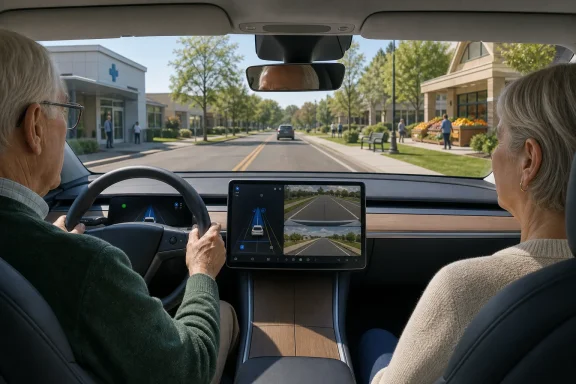 Tesla Has Found a Stronger Argument Than Convenience
Most consumer pitches for driver assistance revolve around convenience. The senior-mobility argument is fundamentally different. It presents FSD Supervised not merely as a premium software package but as a possible bridge between fully manual driving and the loss of personal transportation.
In communities where public transit is limited and other transportation options are unreliable, expensive, or difficult to arrange, that bridge can affect whether an older adult can reach medical appointments, buy groceries, visit friends, and participate in ordinary community life.
That is why Musk’s July 11 comment matters even though, as reported by Basenor’s Marcus Reed, it was brief. It connects Tesla’s best-known driver-assistance product to a problem that many families already face: deciding whether an older relative can continue driving and, if so, under what conditions.
The correct answer cannot be based on age alone. Some older adults remain attentive, careful, and fully capable of taking control. Others may experience changes that make driving unsafe, whether those changes involve vision, cognition, awareness, physical control, medication effects, or reaction ability. A software demonstration cannot resolve those medical and functional questions.
FSD Supervised may reduce some of the effort associated with a trip, but the person in the driver’s seat must remain capable of monitoring what is happening and taking over. That requirement creates a firm boundary around the senior-mobility argument: assistance can support retained driving ability, but it cannot replace abilities that have already been lost.
Aging Can Make Assistance More Valuable—and Supervision More Difficult
Older drivers are not a single risk category, and families should avoid treating a birthday as proof that someone can or cannot drive. Many seniors adapt responsibly by limiting night driving, avoiding unfamiliar routes, choosing quieter travel times, or asking for help in difficult conditions.
The strongest potential case for FSD Supervised is a driver who remains competent but finds driving more physically or mentally tiring than before. Continuous steering, pedal operation, route management, and sustained attention can become exhausting even when the person still understands the road and can respond appropriately.
Basenor reports that Tesla’s late-May rollout of FSD Supervised v14.3.3 included a rewritten AI compiler and an improved neural-network vision encoder. The same reporting says the release improved reaction time by 20 percent over earlier versions. That is a notable software claim, but it should not be turned into a complete inventory of what the system can safely do in every environment.
The relevant issue for families is the relationship between the reported software improvement and the individual driver’s remaining ability. Faster system response does not remove the need for human response. A trip may proceed smoothly for an extended period and still produce a situation in which the driver must recognize a problem, decide what to do, and take control.
A senior with mild physical limitations, reduced stamina, or discomfort during demanding trips may therefore be a reasonable trial candidate. A person who can still assess road conditions and take over but finds continuous vehicle operation exhausting may receive meaningful practical value.
A senior with significant cognitive impairment, severe vision limitations, unpredictable lapses of awareness, or unreliable takeover ability is a different case. Automation may make an uneventful trip look reassuring without proving that the driver can respond during an unusual or rapidly developing situation.
That is the central rule for evaluating the product: the prospective user must still be capable of driving safely without depending on the software to replace impaired cognition, perception, awareness, or control.
The Safety Number Is Not a Senior-Driver Study
Basenor reports Tesla-related data showing one major collision for every 5,300,676 miles driven with FSD Supervised engaged. The comparison presented in that reporting uses a U.S. average of one collision every 660,164 miles, producing an approximately eightfold difference.
| Safety measure | FSD Supervised | Cited U.S. average | Reported difference |
|---|---|---|---|
| Miles per major collision | 5,300,676 miles | 660,164 miles | Approximately 8 times |
| Operating model | Supervised driver assistance | General human driving baseline | Different operating populations |
| Population represented | Reported Tesla-related FSD mileage | Cited U.S. average | Not an age-matched comparison |
The first row is encouraging, but it must remain framed as Basenor-reported Tesla-related data rather than independent evidence that FSD Supervised makes every driver safer.
The other rows explain why the comparison cannot settle the senior-mobility question. It is not an age-controlled study of older motorists. It does not establish whether drivers in their 70s, 80s, or beyond receive the same relative benefit. It also does not isolate the effects of driver behavior, road selection, vehicle differences, operating conditions, or other variables that may separate the compared populations.
The reported statistic can support further investigation and justify a careful individual trial. It cannot prove that a particular older person should continue driving, nor can it substitute for medical advice, licensing requirements, or an honest assessment of the person’s actual performance.
Families should also distinguish between two different questions:
- Does FSD Supervised appear useful across the reported Tesla-related mileage?
- Can this specific driver supervise it reliably and take over when required?
The first question concerns a broad data comparison. The second determines whether the product is appropriate for an individual. A favorable answer to the first does not guarantee a favorable answer to the second.
For senior-driver suitability, the most important evidence will often come from direct observation: whether the person understands alerts, stays engaged, notices developing hazards, remembers how to disengage the system, and can resume manual control without confusion or delay.
The Demonstration Campaign Puts Families at the Center
Basenor reported that Tesla North America’s June 2026 campaign encouraged owners to show FSD Supervised to their parents or grandparents. The message invited existing users to introduce older relatives to the software through direct experience rather than abstract explanation.
That approach may make the technology easier to understand, but it also places substantial responsibility on families. A smooth ride is not the same as a suitability assessment, and an enthusiastic owner is not automatically qualified to determine whether an older relative remains medically or functionally fit to drive.
The concern is not unique to seniors. Any driver can become overly confident after repeated trips in which the software appears to handle routine situations without difficulty. For an older user whose attention, awareness, or reaction ability is already in question, however, that confidence could obscure the continuing need for rapid manual intervention.
A responsible trial therefore must evaluate the human participant, not merely showcase the car. The central question is not, “How much did the software do?” It is, “Did the driver remain aware, understand the system’s signals, and demonstrate reliable control throughout the test?”
Before the Test Drive
Families should use a short protocol before allowing a prospective senior user to try FSD Supervised:
- Confirm eligibility. Verify that the prospective driver holds a valid license and, where health changes or previous concerns make it appropriate, has been medically cleared to drive.
- Review the instructions first. Read the relevant in-car FSD Supervised warnings and vehicle manual before moving the car.
- Choose a controlled starting route. Begin during daylight on a familiar, low-complexity route in favorable conditions.
- Require active supervision. The prospective driver must keep hands ready, eyes on the driving environment, and attention on the road throughout the trial.
- Practice disengagement. Before attempting a longer trip, rehearse disengaging FSD Supervised and returning to complete manual control.
- Test alert recognition. Confirm that the driver can identify the system’s visual and audible alerts and explain what response is required.
- Set an immediate stop rule. End the trial if the driver cannot consistently recognize alerts, becomes confused about whether the system is engaged, loses awareness of the road, or cannot retake control reliably.
A family member should not present the trial as permission to continue driving regardless of health. The demonstration should be treated as one part of a wider decision that may include medical guidance, licensing considerations, and observation of ordinary manual driving.
WindowsForum’s Model 2 Accessibility Checklist
Basenor reports that Musk said in December 2025 that the proposed Model 2 was being designed with senior citizens as a core user group, with easier entry and exit and a simplified instrument layout among the reported priorities.
Those reported priorities should not be treated as independently verified production specifications. Nor do they establish what the final vehicle will include, when it will arrive, or how any proposed design choices would affect production.
Still, the senior-driver discussion raises useful design questions. The following items are WindowsForum’s accessibility checklist, not announced Tesla plans:
- Easy entry and exit for people with reduced hip, back, or leg mobility.
- Essential information presented in large, readable formats.
- Predictable controls that do not change location without clear notice.
- Clear confirmation of whether supervised assistance is engaged.
- Distinct warnings that are easy to see, hear, and understand.
- Straightforward manual takeover and emergency controls.
- Optional voice interaction that does not replace essential physical controls.
- A carefully permissioned way for trusted family members to provide assistance.
- Privacy protections that prevent family support features from becoming unnecessary surveillance.
- A simple fallback process when software-assisted functions are unavailable.
These items matter because accessibility involves more than reducing visual clutter. A clean interface can help, but excessive dependence on changing menus can also create confusion. A design intended for older drivers should remain understandable both during normal use and when the driver must respond quickly.
The same principle applies to family assistance. Some older owners may benefit from help learning controls or configuring settings, but assistance should not automatically give relatives unrestricted access to location, driving history, or personal information. Independence and safety should be supported together rather than treated as opposing goals.
A $99 Subscription Turns Mobility Into a Recurring Bill
Basenor’s reporting says Tesla moved FSD to a subscription-only model in February 2026 at $99 per month. That dated entry should be understood as part of the supplied reporting, not as a guarantee that pricing, eligibility, or terms remain unchanged for every customer.
For a current owner evaluating the system, a monthly subscription could lower the immediate cost of a trial. A family may be able to test the software for a limited period rather than make a larger long-term commitment before knowing whether the driver is comfortable with it.
For a senior who comes to depend on the assistance, however, a monthly charge becomes a recurring transportation expense. At the reported rate, the direct subscription cost would total $1,188 over 12 months.
That distinction matters. A person who treats the feature as optional convenience can cancel it. Someone who reorganizes medical appointments, shopping, and family visits around the assistance may experience cancellation as a loss of mobility.
The cost discussion should therefore be part of the test-drive decision rather than an afterthought. Families should ask:
- Is the monthly expense sustainable on the driver’s budget?
- Would the driver still be able to travel if the subscription ended?
- Is the family evaluating a useful supplement or creating a new dependency?
- Are alternative transportation options available if the driver later becomes unable to supervise the software?
- Has anyone checked the current price and terms rather than relying solely on the February 2026 report?
The senior-mobility case becomes weaker if a short trial creates long-term dependence without a realistic financial or transportation backup plan.
Eight Billion Miles Show Scale, Not Individual Readiness
According to Basenor’s reporting, cumulative FSD Supervised driving reached 8 billion miles in February 2026. That figure indicates substantial use of the software, but cumulative mileage should not be confused with proof that the system is suitable for every driver or every situation.
Aggregate performance cannot answer the individual human-factors question. Even if the software performs successfully for most of a trip, a single event may require the person behind the wheel to understand what is happening and retake control.
For a senior driver, successful use depends on the interaction between software performance and personal capability. A person may find the system helpful while still remaining fully able to drive. Another person may appear comfortable during routine operation but be unable to respond adequately when the situation changes.
The ideal trial candidate is therefore not someone who has already lost the ability to drive safely. It is someone who remains licensed and capable but may benefit from reduced fatigue or physical workload.
The least suitable candidate is someone whose family already believes manual driving is unsafe because of impaired vision, cognition, awareness, judgment, or vehicle control. FSD Supervised should not be used to reverse that conclusion without appropriate professional assessment and clear evidence that the person can still supervise and take over.
Tesla’s Reported Road Map Runs Through Demographics
The supplied Basenor reporting presents a sequence of events connecting Tesla’s software, marketing, and possible product planning with older users. The timeline is useful, but each entry should be read as attributed reporting rather than independently verified Tesla history.
Timeline
December 2025 — Basenor reports that Musk confirmed the proposed Model 2 was being designed with senior citizens as a core user group, with easier entry and exit and a simplified instrument layout among the stated priorities.
February 2026 — Basenor reports that Tesla moved FSD to a subscription-only model priced at $99 per month.
February 2026 — Basenor reports that cumulative FSD Supervised driving reached 8 billion miles.
Late May 2026 — Basenor reports that FSD Supervised v14.3.3 began rolling out with a rewritten AI compiler, an improved neural-network vision encoder, and a 20 percent improvement in reaction time over earlier versions.
June 2026 — Basenor reports that Tesla North America encouraged owners to demonstrate FSD Supervised to parents and grandparents.
July 11, 2026 — Basenor reports that Musk highlighted senior citizens as an important use case for Tesla’s self-driving technology.
Viewed together, the reported events indicate sustained attention to the senior-mobility use case. It is reasonable to analyze them as related, but they do not by themselves prove a formal or comprehensive corporate strategy.
The more important issue is what families do with the message. Senior mobility is not established by a marketing campaign, a cumulative mileage figure, a reported reaction-time improvement, or a proposed vehicle design. It is established one driver at a time through licensing, health, awareness, practical performance, and the ability to retake control.
What Families Should Carry Into the Test Drive
The available facts support cautious evaluation rather than blanket enthusiasm or rejection:
- Basenor reports one major collision every 5,300,676 miles for the cited FSD Supervised data, compared with one every 660,164 miles for the cited U.S. average.
- The approximately eightfold comparison is Tesla-related fleet reporting, not an independent study focused on senior drivers.
- Basenor reports that v14.3.3 included a rewritten AI compiler, an improved neural-network vision encoder, and a 20 percent reaction-time improvement.
- Those reported software changes do not establish that every driver can supervise the system safely.
- A still-capable senior experiencing fatigue or physical workload may be a reasonable candidate for a controlled trial.
- A person with impaired cognition, vision, awareness, judgment, or takeover ability is not an appropriate candidate merely because automation is available.
- The reported $99 monthly price lowers the initial barrier but may create an ongoing expense and dependency.
- A demonstration should measure the driver’s supervision and takeover performance, not simply how smoothly the vehicle completes a route.
Stop/Go Decision Framework
| Decision | Indicators |
|---|---|
| Go to a limited trial | Valid license; medical clearance when appropriate; understands the warnings; remains attentive; identifies alerts correctly; disengages without confusion; takes manual control promptly; performs safely on a familiar daytime route. |
| Pause and reassess | Uncertainty about health or medication effects; inconsistent understanding of controls; difficulty hearing or seeing alerts; excessive anxiety; delayed but potentially correctable takeover; family members disagree about current driving ability. |
| Stop the trial | Missed alerts; confusion about whether FSD is active; loss of road awareness; inability to take over reliably; significant vision or cognitive impairment; unsafe manual driving; reliance on the software as a substitute for lost driving capacity. |
A “pause” decision should lead to more assessment, not pressure to continue. That may mean consulting an appropriate medical professional, reviewing licensing requirements, obtaining a formal driving evaluation, or developing alternative transportation arrangements.
A “stop” decision should not be treated as punishment. Driving cessation can be emotionally and practically difficult, particularly where transportation alternatives are limited. Families should address that loss directly by identifying who can provide rides, which services are available, how appointments will be scheduled, and how the older adult can preserve independence and social contact.
The Real Test Is Human, Not Promotional
The senior-mobility argument gives FSD Supervised a purpose beyond novelty and convenience. For the right driver, reduced physical workload or fatigue could preserve access to ordinary life without pretending that age alone determines competence.
But the right driver remains the decisive qualification.
A reported safety comparison cannot clear an individual to drive. Billions of cumulative miles cannot show whether one person recognizes alerts. Faster software reaction cannot compensate for a driver who cannot understand the situation or resume control. A family demonstration cannot replace medical judgment when health changes are involved.
The most responsible conclusion is neither that seniors should avoid the technology nor that it can keep everyone driving longer. A capable older driver may benefit from a structured, supervised trial. A driver who can no longer see, understand, monitor, judge, or intervene reliably needs a transportation alternative—not more confidence in automation.
Tesla’s reported focus on senior users may become an important mobility story, especially if future vehicles and software are designed around genuine accessibility. Its value, however, will not be measured by how many families can be persuaded to try FSD Supervised. It will be measured by whether families can distinguish between assistance that supports remaining ability and automation that merely disguises its loss.
