

Tesla said on July 3, 2026, that its Robotaxi service was available in Miami, adding Florida to a rollout that already spans Austin, Dallas, Houston, and the San Francisco Bay Area with different levels of human supervision. The expansion is real, but the word expansion is doing more work than usual. Tesla is not simply turning on a national autonomous Uber competitor overnight; it is stitching together a regulatory, operational, and reputational experiment city by city. As Reuters reported on Friday and Tesla-focused outlets including Teslarati and Electrek have tracked, the company’s robotaxi story is now less about whether cars can drive themselves in a demo and more about whether Tesla can scale a service that regulators, riders, and skeptics will treat as transportation rather than theater.
The clean version of the story is irresistible: Tesla Robotaxi is now in five U.S. metro areas. Miami joins Austin, Dallas, Houston, and the Bay Area, giving Elon Musk’s company a multi-state autonomous ride-hailing footprint just as rivals are trying to prove that robotaxis can move from technical marvel to boring urban utility.
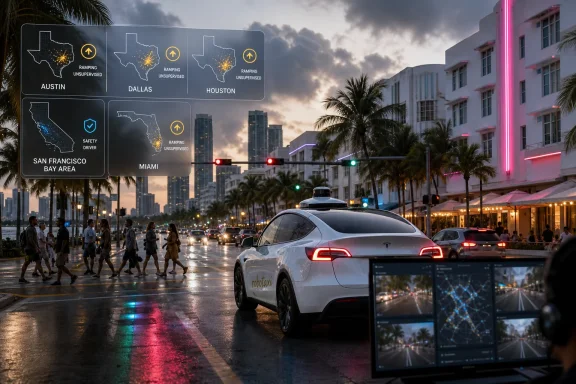
The messier version is more important. Tesla’s own materials earlier this year described a patchwork of statuses: Austin, Dallas, and Houston as “ramping unsupervised,” the Bay Area as operating with a safety driver, and Florida markets such as Miami as preparation targets before this week’s launch. That language matters because Tesla is not selling one uniform product across the country. It is selling the idea of a network while operating several different versions of autonomy under the same branding umbrella.
That makes this rollout both impressive and unusually difficult to parse. A rider in Houston may experience a different operational model from a rider in the Bay Area, even if both are being pulled into the same Tesla Robotaxi narrative. In one city, the absence of a human monitor is the headline; in another, the continued presence of one is the condition that makes the service politically and legally possible.
Sawyer Merritt’s social-media reporting, amplified by Blockchain.News, framed the July 3 development as a five-city expansion powered by Model Y vehicles and Tesla’s AI stack. Reuters narrowed the immediate news to Miami availability. Electrek, which has been consistently skeptical of Tesla’s deployment metrics, has emphasized the small fleet sizes and geofenced nature of earlier launches. Taken together, those accounts describe a company advancing quickly, but not yet operating at the scale implied by the most bullish version of the robotaxi pitch.
That is why the Miami launch is bigger than another dot on a map. South Florida is a useful stress test for any autonomous ride-hailing system: aggressive driving norms, dense pedestrian zones, heavy ride-hailing demand, sudden storms, airport traffic, and a large population of visitors unfamiliar with local roads. A robotaxi that works only in carefully selected neighborhoods at quiet hours is one thing. A robotaxi that becomes a reliable option in a sprawling, chaotic metro area is something else entirely.
Reuters reported that Tesla said the service was available in Miami on July 3, and that timing is strategically convenient. The company had previously outlined first-half 2026 ambitions for several additional cities, including Miami, Orlando, Tampa, Phoenix, and Las Vegas. By arriving just after June, Miami lets Tesla argue that the broader plan is still moving, even if the schedule has already become more elastic than the original target suggested.
The launch also lets Tesla reframe the debate around its autonomous driving program. For years, the company has been criticized for selling Full Self-Driving software that still required active driver supervision. A dedicated ride-hailing service, even with limits, gives Tesla a more concrete answer: judge the system by paid rides, not just owner-assist miles.
Tesla’s Texas operations are the centerpiece here. Company materials and subsequent reporting have described Austin as ramping unsupervised, with Dallas and Houston joining that category in April 2026. If the service is genuinely carrying members of the public without onboard human intervention in those markets, Tesla has crossed a threshold that many observers long doubted it could reach with its camera-first approach.
But even there, scale remains the hard question. Electrek has reported that some Texas deployments have involved small numbers of vehicles and limited geofences, arguing that Tesla’s city-count headlines can obscure the practical size of the service. That criticism is not nitpicking. In robotaxi economics, ten cars in a constrained zone and 1,000 cars covering a metro area are different businesses, not different phases of the same press release.
Tesla’s advantage is that it can plausibly expand without building a bespoke sensor-laden vehicle from scratch for each market. Its Model Y fleet, manufacturing base, over-the-air software pipeline, and existing owner data give it a scaling story that rivals envy. Its challenge is that autonomy does not scale like a streaming app. Every new city adds edge cases, emergency-response coordination, insurance exposure, and political risk.
California regulators have historically treated driverless passenger service as a separate and higher-stakes category than supervised testing or ride-hailing with a human behind the wheel. That posture is not accidental bureaucracy. It reflects a basic fact about urban autonomy: the public road is not a private beta environment.
For Tesla, the Bay Area therefore functions as both showcase and constraint. It can put riders in Tesla-operated vehicles, gather data, and build brand familiarity. But it cannot make the same unsupervised claim there that it can make in more permissive jurisdictions unless and until the regulatory posture changes.
That unevenness will frustrate Tesla bulls who want a single national story. Yet it may ultimately be useful for the company. A world in which Austin, Dallas, Houston, Miami, and the Bay Area all operate under identical conditions would be simpler to market, but less realistic. The actual market will be jurisdictional, negotiated, and uneven.
Waymo has built its public credibility around a highly instrumented stack, detailed mapping, and a methodical city-by-city rollout. Tesla has argued for a more generalized approach rooted in neural networks, cameras, fleet learning, and rapid software iteration. For years, that debate sounded abstract because Tesla’s public-facing autonomy remained tied to supervised consumer driving. Robotaxi changes the debate by putting Tesla’s approach into a commercial service context.
If Tesla can safely expand unsupervised operations across multiple cities using Model Y vehicles, it will strengthen the argument that its vertically integrated AI-and-manufacturing model has real leverage. The company can produce vehicles, update software, optimize routing, integrate charging, and eventually tune pricing inside one corporate system. That is not merely a technology stack; it is a business architecture.
But the same architecture raises the stakes when something goes wrong. A Waymo incident is a Waymo incident. A Tesla Robotaxi incident risks spilling into Tesla’s consumer FSD brand, insurance ambitions, regulatory relationships, and vehicle sales narrative. Tesla’s strength is integration. Its vulnerability is also integration.
The business case depends on utilization, uptime, maintenance cost, insurance cost, cleaning, charging logistics, remote support, customer acquisition, and regulatory compliance. A robotaxi service that dazzles early adopters but strands ordinary riders with long wait times is not a ride-hailing competitor. It is a rolling demo.
Tesla’s potential advantage is that it already understands fleet economics from manufacturing and service, even if ride-hailing operations are a different discipline. The company can theoretically use dynamic pricing, demand prediction, and centralized fleet management to improve margins over time. It can also use each ride to collect operational data that feeds back into future deployment decisions.
Still, autonomy removes one cost while adding others. There may be no human driver in an unsupervised ride, but there are remote operations teams, safety systems, local incident protocols, cleaning crews, charging coordination, customer support staff, and legal overhead. The driver is not simply deleted from the spreadsheet; the driver’s functions are redistributed across the company.
Robotaxi intensifies that debate. A privately owned Tesla using supervised FSD is one risk category: the human driver is supposed to remain responsible. A paid robotaxi ride without an onboard safety operator is another: the company has assumed the driving task. That shift is not semantic. It changes accountability.
The question for regulators will not be whether Tesla’s neural networks are elegant. It will be whether the company can show safe performance in defined operating domains, respond transparently to incidents, and avoid overclaiming what the system can do. The phrase unsupervised autonomy carries enormous commercial value, but it also invites a higher burden of proof.
Tesla’s critics are right to demand clarity on fleet size, disengagement-like events, remote assistance, crash reporting, and operating limits. Tesla’s supporters are right that public deployment cannot wait for a mythical zero-risk standard. The serious policy question sits between those positions: how much evidence is enough before a city lets software replace a paid human driver at scale?
That diversity is useful, but it complicates claims of simple expansion. Tesla can say it is in five areas, and that appears to be true under the broad ride-hailing umbrella. But investors, regulators, riders, and competitors will ask a more pointed question: in which of those places is Tesla offering a truly driverless commercial service, at meaningful scale, under normal urban conditions?
This is where Tesla’s communications discipline will matter. The company has often benefited from ambition outrunning formal proof, because its supporters buy the trajectory. Robotaxi will be less forgiving. If the product is good, riders will notice. If the service area is tiny, wait times are long, or safety interventions are frequent, riders will notice that too.
The most consequential number may not be cities. It may be rides per week, average wait time, paid autonomous miles, incident rates, and the percentage of trips completed without onboard or remote intervention. Those are the metrics that separate a transportation network from a map graphic.
That is the strategic asymmetry. Waymo’s approach is deliberate and capital-intensive. Tesla’s is potentially faster because the vehicle platform already exists in huge numbers and the software pipeline is core to the company’s identity. If Tesla’s system generalizes well enough, the company could compress the time between “preparing a city” and “selling rides” in a way that changes the competitive landscape.
Cruise’s earlier troubles showed how quickly public trust can evaporate after safety and transparency failures. That history shadows every robotaxi rollout, Tesla’s included. The lesson for the industry is not that autonomy should stop. It is that operational humility is not optional.
Tesla’s brand cuts both ways here. It has a loyal customer base willing to try new products early, but it also attracts intense scrutiny from regulators, short sellers, safety advocates, and media outlets. Every awkward maneuver will be clipped. Every smooth trip will be celebrated. The service will live in public before it is mature.
Every robotaxi is a mobile compute node with safety consequences. It depends on software update integrity, sensor calibration, encrypted communications, backend availability, abuse prevention, and rapid rollback capability. The more Tesla scales, the more the service resembles a distributed cyber-physical platform rather than a car company side project.
That should make sysadmins and security-minded readers cautious about simplistic narratives. The magic is not just the neural network deciding when to turn. The magic is the entire operational envelope: how the vehicle authenticates, how it receives updates, how telemetry is stored, how remote assistance is governed, how incidents are audited, and how the company proves that a given software version behaved as expected in a real event.
This is also where public accountability will mature. Cities will eventually want more than promises. They will want data-sharing arrangements, emergency-response interfaces, audit trails, and clear rules for service suspension. The robotaxi company that wins may not be the one with the flashiest demo, but the one that can make municipalities comfortable treating autonomy as dependable infrastructure.
 Tesla’s Robotaxi Map Is Growing Faster Than Its Definition Is Settling
The clean version of the story is irresistible: Tesla Robotaxi is now in five U.S. metro areas. Miami joins Austin, Dallas, Houston, and the Bay Area, giving Elon Musk’s company a multi-state autonomous ride-hailing footprint just as rivals are trying to prove that robotaxis can move from technical marvel to boring urban utility.The messier version is more important. Tesla’s own materials earlier this year described a patchwork of statuses: Austin, Dallas, and Houston as “ramping unsupervised,” the Bay Area as operating with a safety driver, and Florida markets such as Miami as preparation targets before this week’s launch. That language matters because Tesla is not selling one uniform product across the country. It is selling the idea of a network while operating several different versions of autonomy under the same branding umbrella.
That makes this rollout both impressive and unusually difficult to parse. A rider in Houston may experience a different operational model from a rider in the Bay Area, even if both are being pulled into the same Tesla Robotaxi narrative. In one city, the absence of a human monitor is the headline; in another, the continued presence of one is the condition that makes the service politically and legally possible.
Sawyer Merritt’s social-media reporting, amplified by Blockchain.News, framed the July 3 development as a five-city expansion powered by Model Y vehicles and Tesla’s AI stack. Reuters narrowed the immediate news to Miami availability. Electrek, which has been consistently skeptical of Tesla’s deployment metrics, has emphasized the small fleet sizes and geofenced nature of earlier launches. Taken together, those accounts describe a company advancing quickly, but not yet operating at the scale implied by the most bullish version of the robotaxi pitch.
Miami Is a Milestone Because Florida Changes the Story
Miami matters because it turns Tesla Robotaxi from a Texas-and-California experiment into a multi-region service. Texas gave Tesla a relatively friendly proving ground for unsupervised operations. California gave it a regulatory gauntlet, particularly in the Bay Area, where safety-driver requirements and local scrutiny blunt the optics of full autonomy. Florida gives Tesla a new urban test bed with different traffic rhythms, weather, tourism patterns, and political incentives.That is why the Miami launch is bigger than another dot on a map. South Florida is a useful stress test for any autonomous ride-hailing system: aggressive driving norms, dense pedestrian zones, heavy ride-hailing demand, sudden storms, airport traffic, and a large population of visitors unfamiliar with local roads. A robotaxi that works only in carefully selected neighborhoods at quiet hours is one thing. A robotaxi that becomes a reliable option in a sprawling, chaotic metro area is something else entirely.
Reuters reported that Tesla said the service was available in Miami on July 3, and that timing is strategically convenient. The company had previously outlined first-half 2026 ambitions for several additional cities, including Miami, Orlando, Tampa, Phoenix, and Las Vegas. By arriving just after June, Miami lets Tesla argue that the broader plan is still moving, even if the schedule has already become more elastic than the original target suggested.
The launch also lets Tesla reframe the debate around its autonomous driving program. For years, the company has been criticized for selling Full Self-Driving software that still required active driver supervision. A dedicated ride-hailing service, even with limits, gives Tesla a more concrete answer: judge the system by paid rides, not just owner-assist miles.
The Unsupervised Label Is the Whole Ballgame
The industry’s most important distinction is not whether a ride is branded Robotaxi. It is whether the vehicle is operating without a human safety driver or monitor in a position to intervene. That distinction separates an advanced demonstration from a commercial autonomy claim.Tesla’s Texas operations are the centerpiece here. Company materials and subsequent reporting have described Austin as ramping unsupervised, with Dallas and Houston joining that category in April 2026. If the service is genuinely carrying members of the public without onboard human intervention in those markets, Tesla has crossed a threshold that many observers long doubted it could reach with its camera-first approach.
But even there, scale remains the hard question. Electrek has reported that some Texas deployments have involved small numbers of vehicles and limited geofences, arguing that Tesla’s city-count headlines can obscure the practical size of the service. That criticism is not nitpicking. In robotaxi economics, ten cars in a constrained zone and 1,000 cars covering a metro area are different businesses, not different phases of the same press release.
Tesla’s advantage is that it can plausibly expand without building a bespoke sensor-laden vehicle from scratch for each market. Its Model Y fleet, manufacturing base, over-the-air software pipeline, and existing owner data give it a scaling story that rivals envy. Its challenge is that autonomy does not scale like a streaming app. Every new city adds edge cases, emergency-response coordination, insurance exposure, and political risk.
The Bay Area Shows Why Regulation Still Owns the Road
The San Francisco Bay Area is the counterweight to Tesla’s Texas narrative. It is one of the world’s most important technology markets, but it is also where autonomous vehicle companies face intense public scrutiny, detailed permitting regimes, and a political memory shaped by previous robotaxi disruptions. Tesla’s presence there matters, but the continued use of safety drivers or monitors changes what the deployment proves.California regulators have historically treated driverless passenger service as a separate and higher-stakes category than supervised testing or ride-hailing with a human behind the wheel. That posture is not accidental bureaucracy. It reflects a basic fact about urban autonomy: the public road is not a private beta environment.
For Tesla, the Bay Area therefore functions as both showcase and constraint. It can put riders in Tesla-operated vehicles, gather data, and build brand familiarity. But it cannot make the same unsupervised claim there that it can make in more permissive jurisdictions unless and until the regulatory posture changes.
That unevenness will frustrate Tesla bulls who want a single national story. Yet it may ultimately be useful for the company. A world in which Austin, Dallas, Houston, Miami, and the Bay Area all operate under identical conditions would be simpler to market, but less realistic. The actual market will be jurisdictional, negotiated, and uneven.
Tesla’s AI Bet Is Different From Waymo’s, and That Difference Is Now Commercial
The robotaxi race is not only a contest between companies. It is a contest between philosophies of machine perception, mapping, redundancy, and deployment.Waymo has built its public credibility around a highly instrumented stack, detailed mapping, and a methodical city-by-city rollout. Tesla has argued for a more generalized approach rooted in neural networks, cameras, fleet learning, and rapid software iteration. For years, that debate sounded abstract because Tesla’s public-facing autonomy remained tied to supervised consumer driving. Robotaxi changes the debate by putting Tesla’s approach into a commercial service context.
If Tesla can safely expand unsupervised operations across multiple cities using Model Y vehicles, it will strengthen the argument that its vertically integrated AI-and-manufacturing model has real leverage. The company can produce vehicles, update software, optimize routing, integrate charging, and eventually tune pricing inside one corporate system. That is not merely a technology stack; it is a business architecture.
But the same architecture raises the stakes when something goes wrong. A Waymo incident is a Waymo incident. A Tesla Robotaxi incident risks spilling into Tesla’s consumer FSD brand, insurance ambitions, regulatory relationships, and vehicle sales narrative. Tesla’s strength is integration. Its vulnerability is also integration.
The Business Case Depends on Boring Reliability, Not Viral Rides
The temptation is to judge robotaxis through clips: the smooth unprotected left turn, the awkward hesitation near construction, the rider filming an empty front seat. That is how autonomy enters public consciousness. It is not how autonomy becomes a business.The business case depends on utilization, uptime, maintenance cost, insurance cost, cleaning, charging logistics, remote support, customer acquisition, and regulatory compliance. A robotaxi service that dazzles early adopters but strands ordinary riders with long wait times is not a ride-hailing competitor. It is a rolling demo.
Tesla’s potential advantage is that it already understands fleet economics from manufacturing and service, even if ride-hailing operations are a different discipline. The company can theoretically use dynamic pricing, demand prediction, and centralized fleet management to improve margins over time. It can also use each ride to collect operational data that feeds back into future deployment decisions.
Still, autonomy removes one cost while adding others. There may be no human driver in an unsupervised ride, but there are remote operations teams, safety systems, local incident protocols, cleaning crews, charging coordination, customer support staff, and legal overhead. The driver is not simply deleted from the spreadsheet; the driver’s functions are redistributed across the company.
The Safety Argument Has to Survive Contact With Public Roads
Tesla’s autonomy story has long been shaped by a tension between statistical confidence and public trust. Musk and Tesla supporters often emphasize fleet learning and aggregate safety comparisons. Critics ask whether those comparisons are valid when operating domains, road types, driver behavior, and reporting standards differ.Robotaxi intensifies that debate. A privately owned Tesla using supervised FSD is one risk category: the human driver is supposed to remain responsible. A paid robotaxi ride without an onboard safety operator is another: the company has assumed the driving task. That shift is not semantic. It changes accountability.
The question for regulators will not be whether Tesla’s neural networks are elegant. It will be whether the company can show safe performance in defined operating domains, respond transparently to incidents, and avoid overclaiming what the system can do. The phrase unsupervised autonomy carries enormous commercial value, but it also invites a higher burden of proof.
Tesla’s critics are right to demand clarity on fleet size, disengagement-like events, remote assistance, crash reporting, and operating limits. Tesla’s supporters are right that public deployment cannot wait for a mythical zero-risk standard. The serious policy question sits between those positions: how much evidence is enough before a city lets software replace a paid human driver at scale?
The Five-City Headline Hides Five Different Deployment Problems
Each Tesla Robotaxi market presents a different technical and political problem. Austin is the credibility base: it must show that an early unsupervised market can grow beyond a novelty. Dallas and Houston test whether the Texas model can replicate across larger, more varied metros. Miami introduces Florida’s tourism-heavy, weather-sensitive urban environment. The Bay Area forces Tesla to operate under one of the most scrutinized regulatory climates in the country.That diversity is useful, but it complicates claims of simple expansion. Tesla can say it is in five areas, and that appears to be true under the broad ride-hailing umbrella. But investors, regulators, riders, and competitors will ask a more pointed question: in which of those places is Tesla offering a truly driverless commercial service, at meaningful scale, under normal urban conditions?
This is where Tesla’s communications discipline will matter. The company has often benefited from ambition outrunning formal proof, because its supporters buy the trajectory. Robotaxi will be less forgiving. If the product is good, riders will notice. If the service area is tiny, wait times are long, or safety interventions are frequent, riders will notice that too.
The most consequential number may not be cities. It may be rides per week, average wait time, paid autonomous miles, incident rates, and the percentage of trips completed without onboard or remote intervention. Those are the metrics that separate a transportation network from a map graphic.
Rivals Now Have to Answer Tesla’s Speed
Waymo remains the company to beat in public robotaxi credibility, particularly because it has already operated fully driverless commercial service in multiple markets with a more mature operational model. But Tesla’s expansion creates a different kind of pressure. Waymo can be safer, smoother, and more established in specific cities; Tesla can threaten to become ubiquitous if its technical assumptions hold.That is the strategic asymmetry. Waymo’s approach is deliberate and capital-intensive. Tesla’s is potentially faster because the vehicle platform already exists in huge numbers and the software pipeline is core to the company’s identity. If Tesla’s system generalizes well enough, the company could compress the time between “preparing a city” and “selling rides” in a way that changes the competitive landscape.
Cruise’s earlier troubles showed how quickly public trust can evaporate after safety and transparency failures. That history shadows every robotaxi rollout, Tesla’s included. The lesson for the industry is not that autonomy should stop. It is that operational humility is not optional.
Tesla’s brand cuts both ways here. It has a loyal customer base willing to try new products early, but it also attracts intense scrutiny from regulators, short sellers, safety advocates, and media outlets. Every awkward maneuver will be clipped. Every smooth trip will be celebrated. The service will live in public before it is mature.
IT Pros Should Watch This Like Infrastructure, Not Like Car News
For WindowsForum readers, the Tesla Robotaxi rollout may look at first like automotive news. It is really infrastructure news. Autonomous ride-hailing is a live example of edge AI, fleet telemetry, remote operations, cybersecurity, identity, payments, mapping, incident response, and regulatory compliance colliding in public space.Every robotaxi is a mobile compute node with safety consequences. It depends on software update integrity, sensor calibration, encrypted communications, backend availability, abuse prevention, and rapid rollback capability. The more Tesla scales, the more the service resembles a distributed cyber-physical platform rather than a car company side project.
That should make sysadmins and security-minded readers cautious about simplistic narratives. The magic is not just the neural network deciding when to turn. The magic is the entire operational envelope: how the vehicle authenticates, how it receives updates, how telemetry is stored, how remote assistance is governed, how incidents are audited, and how the company proves that a given software version behaved as expected in a real event.
This is also where public accountability will mature. Cities will eventually want more than promises. They will want data-sharing arrangements, emergency-response interfaces, audit trails, and clear rules for service suspension. The robotaxi company that wins may not be the one with the flashiest demo, but the one that can make municipalities comfortable treating autonomy as dependable infrastructure.
The Real Signal in Tesla’s Five-City Push Is Uneven Maturity
The July 3 Miami launch gives Tesla a stronger robotaxi story, but it also exposes the gap between presence and maturity. The company is no longer merely promising an autonomous ride-hailing future; it is operating pieces of one in public, under different rules, with different levels of supervision, and under a microscope that will only get stronger.- Tesla’s Robotaxi service now has a multi-state footprint, with Miami joining Texas and California markets in the company’s public rollout.
- The most important distinction is whether a market is truly unsupervised or still dependent on a safety driver or monitor.
- Texas remains the center of Tesla’s strongest autonomy claim because Austin, Dallas, and Houston have been described as ramping unsupervised operations.
- The Bay Area remains a regulatory proving ground where Tesla’s branding ambitions run into stricter oversight.
- Miami is strategically significant because it tests Tesla’s system in a new state with dense tourism, complex traffic, and weather-driven edge cases.
- The next proof point is not another city announcement, but transparent evidence of fleet size, ride volume, wait times, safety performance, and operational reliability.
References
- Primary source: blockchain.news
Published: 2026-07-03T17:00:55.038999
Tesla Robotaxi expands to 5 cities | AI News Detail
According to SawyerMerritt, Tesla launched Robotaxi in Miami, Dallas, Houston, Austin, and Bay Area with varying oversight levels, per his tweet.blockchain.news - Related coverage: investing.com
Tesla rolls out robotaxi service in Miami By Reuters
Tesla rolls out robotaxi service in Miamiwww.investing.com - Related coverage: learnmyev.com
Tesla Robotaxi Just Launched in Miami — City #4 Goes Live as National Expansion Accelerates | Learn My EV
Miami is now the fourth US city with active Tesla Robotaxi service as of July 3, 2026. Here's the full story: how we got here, where it's live today, and which cities are next.www.learnmyev.com - Related coverage: teslant.com
Tesla Expands Robotaxi Across All of Austin — but Only About 20 Cars Are Running — TeslAnt
Tesla expanded its unsupervised Robotaxi geofence to cover the entire Austin metro area (~245 sq mi) on 3 June 2026, and detailed how the cars hand control to first responders and can be geofenced around emergencies. The catch: the active driverless fleet is still only about 20 cars, a fraction... teslant.com
- Related coverage: marketscreener.com
- Related coverage: eletric-vehicles.com
Tesla Launches Robotaxi in Miami, Its First Market Beyond Texas and California | EV
Tesla launched its robotaxi service in Miami on Friday, extending the autonomous ride-hailing programme to a third state and opening the first of five cities whose rollout had slipped past the company's own first-half deadline.eletric-vehicles.com
- Related coverage: teslarati.com
Tesla expands Robotaxi to Florida, marking its third state for autonomy
Tesla has expanded its Robotaxi program to Miami, Florida, marking the third state the autonomous ride-hailing platform has made its way to since launching last Summer. Tesla announced today that the Robotaxi suite would now officially launch rides in a geofence in Miami: 🚨 Tesla’s “Long...www.teslarati.com - Related coverage: electrek.co
Tesla expands 'Robotaxi' to entire Austin metro — but still has only ~20 vehicles | Electrek
Tesla expanded its unsupervised 'Robotaxi' geofence to the entire Austin metro area, but its active fleet has shrunk to just 20 vehicles a year into the program.electrek.co - Related coverage: robotaxi-safety-tracker.com
Austin Robotaxi Safety: Tesla's Path to Monitor Removal
Austin is Tesla's only unsupervised Level 4 robotaxi deployment. Track safety monitor removal progress, fleet growth from 10 to 80 vehicles, and NHTSA safety data. robotaxi-safety-tracker.com
- Related coverage: tesorb.com
Tesla Robotaxi Operations Go Multi-City: Austin, Dallas, and Houston 'Ramping Unsupervised' as Phoenix and San Francisco Prepare - Tesorb
Tesla's Q1 2026 shareholder update, published April 22, included a city-by-city robotaxi status map the company has never released before. Austin:tesorb.com - Related coverage: ir.tesla.com
- Related coverage: techxplore.com
