

On June 27, 2026, a refreshed Tesla Semi was filmed on public roads near Tesla’s Fremont factory in California carrying roof-mounted validation equipment, suggesting Tesla is collecting data to adapt its Full Self-Driving (Supervised) system for heavy-duty freight operations next. The sighting does not prove a launch is imminent, and it certainly does not mean an 82,000-pound truck is about to drive itself without oversight. But it is a visible signal that Tesla’s autonomy ambitions are moving beyond consumer cars and robotaxi theater into the far less forgiving world of commercial logistics. If Tesla can make even supervised automation useful in a Class 8 truck, the business case for FSD changes from convenience to fleet economics.
The video posted by Tesla Owners Silicon Valley shows what appears to be a new Tesla Semi operating near Fremont with a prominent roof-mounted rig. The language around the sighting has been careful in some places and breathless in others, but the hardware itself is the important part: this is the kind of equipment automakers use when they want a more reliable reference point than the production camera suite alone can provide.
That distinction matters because Tesla has spent years arguing that camera-based perception is enough for autonomy at scale. Yet Tesla has also repeatedly used additional validation sensors on development vehicles, not necessarily because those sensors will ship to customers, but because engineers need a way to measure whether the production system is seeing the world correctly. The roof rack is less a confession than a calibration instrument.
For the Semi, the stakes are higher than they are for a Model Y drifting through a suburban left turn. A loaded Class 8 truck has a much longer stopping distance, a vastly different turning envelope, more severe blind spots, and a business duty cycle that punishes downtime. Even if Tesla’s FSD stack can reuse much of its passenger-vehicle intelligence, the Semi is not simply a scaled-up car.
That is why this sighting is significant without being definitive. It says Tesla is gathering the data it needs to answer the hard questions. It does not say regulators, insurers, fleet managers, or safety departments are ready to accept the answers.
Freight is different. Fleet operators do not buy mythology; they buy uptime, cost per mile, driver retention, safety performance, and predictable maintenance. If FSD on the Semi merely reduces driver workload on long highway runs, improves lane discipline, or smooths energy use through more consistent control, it could still be valuable long before any unsupervised autonomy arrives.
That is the underappreciated angle in this sighting. Tesla does not need the Semi to become a driverless robotruck overnight for autonomy to matter. A supervised system that handles monotony well, avoids harsh inputs, and reduces fatigue on repeatable freight corridors could become a fleet-management tool rather than a consumer gadget.
The more aggressive version of the story is obvious: autonomous electric trucks running predictable hub-to-hub routes with fewer labor constraints and lower energy costs. But the near-term version is more plausible and more commercially relevant. Tesla may be building toward autonomy in public, while selling incremental assistance to fleets in private.
The Tesla Semi’s production hardware reportedly includes a broad external camera suite and an internal cabin camera. Camera washers on a commercial truck are not a cosmetic detail; they are an acknowledgment that a working vehicle accumulates grime, spray, salt, dust, insects, and road film at a rate passenger-car owners rarely experience. Perception hardware that works in a clean showroom still has to work after hundreds of miles behind diesel traffic in rain.
Tesla’s challenge is therefore both technical and operational. The neural networks must understand truck-specific geometry, but the product team also has to make sure the sensors stay clean, aligned, powered, and diagnosable across real fleet use. A camera blocked on a personal vehicle is an annoyance. A camera blocked on a loaded truck in a distribution schedule is a safety and dispatch problem.
This is where the roof-mounted validation rig becomes more than a curiosity. Tesla needs ground-truth data not just for obvious driving scenes, but for the small degradations that define commercial life: faded lane lines, reflective trailer surfaces, oddly angled loading yards, low sun, dirty lenses, and long, repetitive highway stretches where driver attention naturally decays.
The published production specifications put the Semi in two broad configurations: a roughly 325-mile standard-range version and a roughly 500-mile long-range version, with energy consumption around 1.7 kWh per mile and support for megawatt-class charging. Those numbers matter because autonomy is not being developed for a science project. It is being attached to a truck Tesla wants fleets to buy, route, charge, maintain, and finance.
For fleet operators, the Semi’s electric drivetrain and charging strategy are already a major operational shift. Add supervised automation, and the deployment model becomes even more complicated. A fleet manager is not only asking whether the truck can make the route; they are asking whether the software stack is stable, whether drivers trust it, whether safety policies permit it, and whether the system behaves consistently across different loads and trailers.
That is where Tesla’s vertical integration becomes both advantage and liability. The company controls the vehicle, software, charging ecosystem, and data loop more tightly than most commercial-vehicle makers. But that also means customers will expect Tesla to solve the whole workflow, not merely deliver an impressive driver-assistance demo.
Tesla’s use of validation hardware should not be misread as evidence that production Semis will ship with lidar or radar-rich autonomy stacks. Automakers commonly test with sensors they do not intend to sell, using them to benchmark perception, verify distances, and improve labeling. Tesla can remain philosophically committed to camera-first autonomy while still using other instruments to train and validate it.
The Semi makes that validation burden heavier because mistakes have different consequences. A passenger car that hesitates at a four-way stop irritates traffic. A tractor-trailer that misjudges a turn can block an intersection, clip a curb, damage a trailer, or create a serious hazard. The edge cases are not just more numerous; they are more expensive.
This also explains why a public-road sighting near Fremont is meaningful. Tesla needs exposure to the messy, human, irregular road environment around its own facilities. Closed-course testing is essential, but freight autonomy has to learn from the world where trucks actually operate: industrial roads, mixed traffic, impatient commuters, construction detours, and awkward intersections designed long before electric autonomous trucks were imagined.
If Tesla eventually enables FSD (Supervised) on the Semi, the driver will still be central to the safety case. The system may steer, accelerate, brake, change lanes, or navigate certain roads, but the human operator remains responsible unless and until Tesla obtains approval for a genuinely driverless commercial service. That distinction cannot be a footnote in fleet training.
The commercial-trucking world already has a safety vocabulary built around compliance, inspection, duty cycles, and liability. Tesla’s consumer-software cadence, where features arrive through over-the-air updates and improve in public, will collide with that culture. Fleet buyers will want release notes, operational design limits, auditability, and predictable rollback procedures.
That may be one of the biggest obstacles Tesla faces. The technology can be impressive and still be difficult to operationalize. A driver-assistance system for a consumer car can tolerate some ambiguity in user expectations; a driver-assistance system for freight has to survive safety committees, insurers, regulators, unions, logistics customers, and courtroom discovery.
Autonomy systems fail in mundane ways. A blocked lens, a misaligned camera, condensation, mud, snow, or road salt can degrade perception long before the neural network faces a philosophical dilemma. Commercial vehicles compound those risks because they run longer hours, cover more miles, and operate in harsher conditions than most private cars.
A washer system does not solve autonomy, but it shows Tesla understands one of the unglamorous prerequisites. For a truck, sensor maintenance has to be built into the vehicle’s daily life. Drivers and fleet technicians cannot be expected to treat every camera as a fragile laboratory instrument.
This is why the refreshed Semi cabin and exterior changes are relevant to the autonomy story. Tesla reportedly reworked driver ergonomics, side-window usability, display placement, and other practical details based on operational feedback. That kind of iteration matters because autonomous features do not exist outside the cab. They are used by human drivers doing tiring work on strict schedules.
The autonomous trucking sector has already spent years moving away from vague “drive anywhere” promises toward constrained routes, mapped corridors, hub-to-hub models, and carefully monitored pilots. That approach lacks Tesla’s consumer-scale glamour, but it fits the way freight actually moves. Many trucks repeat the same lanes, serve the same depots, and operate under contracts where predictability matters more than generality.
Tesla’s generalized autonomy strategy could become a huge advantage if it works. A Semi that can eventually use the same learning architecture as millions of passenger vehicles would have a data advantage that specialized trucking startups cannot match. But freight is full of domain-specific problems, and Tesla will have to prove that general driving intelligence transfers to the commercial world without unacceptable surprises.
The economics are also unforgiving. A truck that saves energy and reduces fatigue is useful. A truck that creates new training burdens, insurance uncertainty, or service downtime is not. Tesla’s reputation for fast iteration may excite enthusiasts, but fleet operators often prefer boring maturity.
Those questions become sharper with a heavy truck. An 82,000-pound combination vehicle is not just another endpoint in Tesla’s software fleet. It is a regulated commercial machine operating in a sector where driver qualification, hours of service, inspection rules, and carrier liability already define daily life.
Tesla’s likely first step is supervised assistance rather than unsupervised freight autonomy. That path is easier to deploy, but it still requires careful communication. If a fleet adopts FSD (Supervised), it must train drivers not to overtrust the system during exactly the long, monotonous stretches where automation feels most capable.
This is the paradox of good driver assistance. The better it performs, the more it tempts the human to disengage. In a passenger car, that is already a serious issue. In a heavy truck, it becomes a central safety challenge.
That could push Tesla toward a more disciplined version of FSD. A truck should leave larger gaps, plan earlier, avoid marginal maneuvers, and treat uncertainty as a reason to slow down rather than improvise. Those behaviors may look timid in a viral video, but they are exactly what commercial operators tend to reward.
The upside is that freight routes may give Tesla cleaner deployment opportunities than consumer driving. Highway-heavy lanes, fixed depots, known charging sites, and repeat customers all create structure. If Tesla uses that structure well, the Semi could become a proving ground for autonomy that is less chaotic than the consumer fleet and more commercially measurable.
This is where the Semi’s electric platform intersects with software. Regenerative braking, torque control, stability systems, and route-aware energy management can all feed into smoother automated driving. Tesla’s Vehicle Dynamics Control work, especially around traction and jackknife prevention, is part of the same larger story: software is becoming the way the truck behaves, not just the way it entertains the driver.
Near-term expectations should be calibrated accordingly. Tesla has not announced a public release date for FSD on the Semi, and a test vehicle on public roads is not a product launch. The more responsible reading is that Tesla is actively building the data foundation for a future supervised system.
Still, the strategic direction is unmistakable. Tesla is not treating the Semi as merely an electric drivetrain wrapped in a futuristic cab. It is positioning the truck as another node in its autonomy network, and possibly one with more direct economic value than any consumer feature package.
That raises a provocative possibility: the Semi may become the product that forces Tesla to mature its autonomy messaging. In freight, vague promises are less useful than measurable capabilities. If Tesla wants logistics customers to trust FSD, it will have to translate Silicon Valley confidence into dispatch-office reliability.
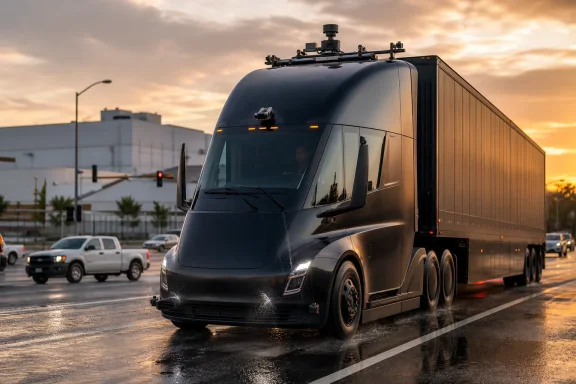 Tesla’s Freight Ambition Is Now Wearing Test Hardware
The video posted by Tesla Owners Silicon Valley shows what appears to be a new Tesla Semi operating near Fremont with a prominent roof-mounted rig. The language around the sighting has been careful in some places and breathless in others, but the hardware itself is the important part: this is the kind of equipment automakers use when they want a more reliable reference point than the production camera suite alone can provide.That distinction matters because Tesla has spent years arguing that camera-based perception is enough for autonomy at scale. Yet Tesla has also repeatedly used additional validation sensors on development vehicles, not necessarily because those sensors will ship to customers, but because engineers need a way to measure whether the production system is seeing the world correctly. The roof rack is less a confession than a calibration instrument.
For the Semi, the stakes are higher than they are for a Model Y drifting through a suburban left turn. A loaded Class 8 truck has a much longer stopping distance, a vastly different turning envelope, more severe blind spots, and a business duty cycle that punishes downtime. Even if Tesla’s FSD stack can reuse much of its passenger-vehicle intelligence, the Semi is not simply a scaled-up car.
That is why this sighting is significant without being definitive. It says Tesla is gathering the data it needs to answer the hard questions. It does not say regulators, insurers, fleet managers, or safety departments are ready to accept the answers.
The Semi Turns FSD From a Consumer Feature Into a Balance-Sheet Argument
Tesla’s Full Self-Driving branding has always lived in a strange gap between marketing aspiration and legal reality. In consumer vehicles, FSD (Supervised) is still a driver-assistance system that requires human attention, even when it performs impressively. The product is sold as a software option, but the appeal is emotional as much as practical: less fatigue, more novelty, a glimpse of the future.Freight is different. Fleet operators do not buy mythology; they buy uptime, cost per mile, driver retention, safety performance, and predictable maintenance. If FSD on the Semi merely reduces driver workload on long highway runs, improves lane discipline, or smooths energy use through more consistent control, it could still be valuable long before any unsupervised autonomy arrives.
That is the underappreciated angle in this sighting. Tesla does not need the Semi to become a driverless robotruck overnight for autonomy to matter. A supervised system that handles monotony well, avoids harsh inputs, and reduces fatigue on repeatable freight corridors could become a fleet-management tool rather than a consumer gadget.
The more aggressive version of the story is obvious: autonomous electric trucks running predictable hub-to-hub routes with fewer labor constraints and lower energy costs. But the near-term version is more plausible and more commercially relevant. Tesla may be building toward autonomy in public, while selling incremental assistance to fleets in private.
Freight Is the Hard Mode Tesla Can’t Demo Away
Passenger-car FSD videos tend to compress the problem into a few dramatic moments: an unprotected left turn, a narrow residential street, a surprise pedestrian, a tricky roundabout. Trucking autonomy is less cinematic but more brutal. The system has to be boringly competent for hours, in weather, around impatient drivers, loading docks, weigh stations, construction zones, and industrial roads that are often poorly marked.The Tesla Semi’s production hardware reportedly includes a broad external camera suite and an internal cabin camera. Camera washers on a commercial truck are not a cosmetic detail; they are an acknowledgment that a working vehicle accumulates grime, spray, salt, dust, insects, and road film at a rate passenger-car owners rarely experience. Perception hardware that works in a clean showroom still has to work after hundreds of miles behind diesel traffic in rain.
Tesla’s challenge is therefore both technical and operational. The neural networks must understand truck-specific geometry, but the product team also has to make sure the sensors stay clean, aligned, powered, and diagnosable across real fleet use. A camera blocked on a personal vehicle is an annoyance. A camera blocked on a loaded truck in a distribution schedule is a safety and dispatch problem.
This is where the roof-mounted validation rig becomes more than a curiosity. Tesla needs ground-truth data not just for obvious driving scenes, but for the small degradations that define commercial life: faded lane lines, reflective trailer surfaces, oddly angled loading yards, low sun, dirty lenses, and long, repetitive highway stretches where driver attention naturally decays.
The Nevada Factory Raises the Pressure
Tesla’s Semi program has been a long-running exercise in delayed inevitability. The truck was first unveiled years before meaningful volume production, and early deployments with customers such as PepsiCo functioned as both validation and public proof point. Now that Tesla is pushing the Semi toward broader production from its dedicated Nevada facility, the autonomy story becomes harder to keep separate from the vehicle story.The published production specifications put the Semi in two broad configurations: a roughly 325-mile standard-range version and a roughly 500-mile long-range version, with energy consumption around 1.7 kWh per mile and support for megawatt-class charging. Those numbers matter because autonomy is not being developed for a science project. It is being attached to a truck Tesla wants fleets to buy, route, charge, maintain, and finance.
For fleet operators, the Semi’s electric drivetrain and charging strategy are already a major operational shift. Add supervised automation, and the deployment model becomes even more complicated. A fleet manager is not only asking whether the truck can make the route; they are asking whether the software stack is stable, whether drivers trust it, whether safety policies permit it, and whether the system behaves consistently across different loads and trailers.
That is where Tesla’s vertical integration becomes both advantage and liability. The company controls the vehicle, software, charging ecosystem, and data loop more tightly than most commercial-vehicle makers. But that also means customers will expect Tesla to solve the whole workflow, not merely deliver an impressive driver-assistance demo.
Ground Truth Is Tesla’s Quiet Admission That Scale Still Needs Measurement
The phrase ground truth sounds like engineering jargon because it is, but it captures the central tension in Tesla’s autonomy strategy. A system trained on massive video data still needs reliable reference data to know when it is wrong. The better the production model gets, the more valuable those rare, ambiguous, high-consequence cases become.Tesla’s use of validation hardware should not be misread as evidence that production Semis will ship with lidar or radar-rich autonomy stacks. Automakers commonly test with sensors they do not intend to sell, using them to benchmark perception, verify distances, and improve labeling. Tesla can remain philosophically committed to camera-first autonomy while still using other instruments to train and validate it.
The Semi makes that validation burden heavier because mistakes have different consequences. A passenger car that hesitates at a four-way stop irritates traffic. A tractor-trailer that misjudges a turn can block an intersection, clip a curb, damage a trailer, or create a serious hazard. The edge cases are not just more numerous; they are more expensive.
This also explains why a public-road sighting near Fremont is meaningful. Tesla needs exposure to the messy, human, irregular road environment around its own facilities. Closed-course testing is essential, but freight autonomy has to learn from the world where trucks actually operate: industrial roads, mixed traffic, impatient commuters, construction detours, and awkward intersections designed long before electric autonomous trucks were imagined.
Tesla’s Naming Problem Gets Bigger With a Bigger Vehicle
Tesla’s FSD branding has always been controversial because the name implies more than the supervised product legally delivers. On a passenger vehicle, that mismatch has triggered regulatory scrutiny, consumer confusion, and endless online argument. On a heavy truck, the same naming issue becomes more serious because the public will not parse “Supervised” as carefully as lawyers do.If Tesla eventually enables FSD (Supervised) on the Semi, the driver will still be central to the safety case. The system may steer, accelerate, brake, change lanes, or navigate certain roads, but the human operator remains responsible unless and until Tesla obtains approval for a genuinely driverless commercial service. That distinction cannot be a footnote in fleet training.
The commercial-trucking world already has a safety vocabulary built around compliance, inspection, duty cycles, and liability. Tesla’s consumer-software cadence, where features arrive through over-the-air updates and improve in public, will collide with that culture. Fleet buyers will want release notes, operational design limits, auditability, and predictable rollback procedures.
That may be one of the biggest obstacles Tesla faces. The technology can be impressive and still be difficult to operationalize. A driver-assistance system for a consumer car can tolerate some ambiguity in user expectations; a driver-assistance system for freight has to survive safety committees, insurers, regulators, unions, logistics customers, and courtroom discovery.
The Camera Washers Tell a More Practical Story Than the Roof Rack
The roof-mounted validation equipment gets the attention because it looks like autonomy in progress. The camera washers may be the more revealing detail. They suggest Tesla is designing the Semi’s sensor suite around the realities of freight, where uptime depends on a vehicle’s ability to keep working without constant pampering.Autonomy systems fail in mundane ways. A blocked lens, a misaligned camera, condensation, mud, snow, or road salt can degrade perception long before the neural network faces a philosophical dilemma. Commercial vehicles compound those risks because they run longer hours, cover more miles, and operate in harsher conditions than most private cars.
A washer system does not solve autonomy, but it shows Tesla understands one of the unglamorous prerequisites. For a truck, sensor maintenance has to be built into the vehicle’s daily life. Drivers and fleet technicians cannot be expected to treat every camera as a fragile laboratory instrument.
This is why the refreshed Semi cabin and exterior changes are relevant to the autonomy story. Tesla reportedly reworked driver ergonomics, side-window usability, display placement, and other practical details based on operational feedback. That kind of iteration matters because autonomous features do not exist outside the cab. They are used by human drivers doing tiring work on strict schedules.
The Competition Will Not Wait for Tesla’s Perfect Autonomy
Tesla’s greatest advantage is that it can bring a large real-world autonomy data pipeline to a commercial truck platform. Its greatest risk is that trucking customers may not wait for the grand version of the plan. Freight operators are pragmatic; if a rival offers a narrower but certifiable autonomous or assisted-driving product on a defined route, that may be enough.The autonomous trucking sector has already spent years moving away from vague “drive anywhere” promises toward constrained routes, mapped corridors, hub-to-hub models, and carefully monitored pilots. That approach lacks Tesla’s consumer-scale glamour, but it fits the way freight actually moves. Many trucks repeat the same lanes, serve the same depots, and operate under contracts where predictability matters more than generality.
Tesla’s generalized autonomy strategy could become a huge advantage if it works. A Semi that can eventually use the same learning architecture as millions of passenger vehicles would have a data advantage that specialized trucking startups cannot match. But freight is full of domain-specific problems, and Tesla will have to prove that general driving intelligence transfers to the commercial world without unacceptable surprises.
The economics are also unforgiving. A truck that saves energy and reduces fatigue is useful. A truck that creates new training burdens, insurance uncertainty, or service downtime is not. Tesla’s reputation for fast iteration may excite enthusiasts, but fleet operators often prefer boring maturity.
Regulators Will See a Truck, Not a Software Update
The public tends to debate autonomous driving in terms of whether the car is smart enough. Regulators and safety agencies ask a different set of questions. What is the system designed to do, where is it allowed to do it, how does it fail, how is the human warned, and who is responsible when the chain breaks?Those questions become sharper with a heavy truck. An 82,000-pound combination vehicle is not just another endpoint in Tesla’s software fleet. It is a regulated commercial machine operating in a sector where driver qualification, hours of service, inspection rules, and carrier liability already define daily life.
Tesla’s likely first step is supervised assistance rather than unsupervised freight autonomy. That path is easier to deploy, but it still requires careful communication. If a fleet adopts FSD (Supervised), it must train drivers not to overtrust the system during exactly the long, monotonous stretches where automation feels most capable.
This is the paradox of good driver assistance. The better it performs, the more it tempts the human to disengage. In a passenger car, that is already a serious issue. In a heavy truck, it becomes a central safety challenge.
The Semi Could Make FSD More Conservative — And More Valuable
There is a version of Tesla autonomy that enthusiasts love: assertive, humanlike, surprisingly fluent in chaotic traffic. The Semi may demand a different personality. Commercial automation does not need to be flashy; it needs to be predictable, explainable, and conservative enough that drivers and fleet managers know what it will do next.That could push Tesla toward a more disciplined version of FSD. A truck should leave larger gaps, plan earlier, avoid marginal maneuvers, and treat uncertainty as a reason to slow down rather than improvise. Those behaviors may look timid in a viral video, but they are exactly what commercial operators tend to reward.
The upside is that freight routes may give Tesla cleaner deployment opportunities than consumer driving. Highway-heavy lanes, fixed depots, known charging sites, and repeat customers all create structure. If Tesla uses that structure well, the Semi could become a proving ground for autonomy that is less chaotic than the consumer fleet and more commercially measurable.
This is where the Semi’s electric platform intersects with software. Regenerative braking, torque control, stability systems, and route-aware energy management can all feed into smoother automated driving. Tesla’s Vehicle Dynamics Control work, especially around traction and jackknife prevention, is part of the same larger story: software is becoming the way the truck behaves, not just the way it entertains the driver.
The Freight Future Now Depends on the Boring Details
The Fremont sighting is a useful reminder that autonomy does not arrive as a single dramatic moment. It arrives through test rigs, sensor cleaning, fleet trials, cautious software flags, driver training, and regulatory paperwork. Tesla’s fans tend to see the roof rack and imagine the endpoint. Fleet buyers will see the same hardware and ask about validation.Near-term expectations should be calibrated accordingly. Tesla has not announced a public release date for FSD on the Semi, and a test vehicle on public roads is not a product launch. The more responsible reading is that Tesla is actively building the data foundation for a future supervised system.
Still, the strategic direction is unmistakable. Tesla is not treating the Semi as merely an electric drivetrain wrapped in a futuristic cab. It is positioning the truck as another node in its autonomy network, and possibly one with more direct economic value than any consumer feature package.
That raises a provocative possibility: the Semi may become the product that forces Tesla to mature its autonomy messaging. In freight, vague promises are less useful than measurable capabilities. If Tesla wants logistics customers to trust FSD, it will have to translate Silicon Valley confidence into dispatch-office reliability.
The Fremont Sighting Narrows the Debate
The practical lesson from this week’s video is not that driverless Tesla Semis are about to flood America’s highways. It is that Tesla appears to be doing the expensive, necessary work of adapting its autonomy system to a vehicle class where errors are larger, duty cycles are harsher, and customers are less forgiving.- Tesla’s refreshed Semi was spotted near Fremont with roof-mounted validation equipment consistent with autonomy data collection and system verification.
- The sighting suggests development work on FSD (Supervised) for the Semi, but it does not establish a launch date or imply unsupervised driverless operation.
- The production Semi’s camera suite, cabin camera, and camera-cleaning hardware point to a design increasingly shaped around software-assisted operation.
- Freight use cases could make supervised automation valuable before full autonomy, especially if it reduces fatigue, smooths driving, and improves route consistency.
- Tesla’s biggest challenge may be operational trust rather than raw technical capability, because fleets need predictable safety, training, service, and liability models.
- The Semi turns Tesla’s FSD story from a consumer convenience pitch into a commercial productivity argument, where claims will be judged by cost per mile and incident rates.
References
- Primary source: Not a Tesla App
Published: Sat, 27 Jun 2026 19:42:00 GMT
Tesla Semi Spotted With FSD Testing Equipment [VIDEO] - Not a Tesla App
Tesla appears to be making some serious moves behind the scenes to bring autonomous driving to the world of heavy freightwww.notateslaapp.com - Related coverage: tesla.com
- Related coverage: speedoscience.com
Tesla Semi 2026: 500-Mile Range, 1,072 hp & 1.2 MW Megacharging Specs | Speedo Science
Technical database for high-performance engineering. Aerospace, Defense, Marine, and Land velocity systems. Australian defence industry intelligence hub.www.speedoscience.com
- Related coverage: tesorb.com
Tesla Semi Enters Mass Production in 2026 | Tesorb
Tesla's Semi is no longer a concept truck. After eight years of delays, missed production targets, and a limited pilot program, the Class 8tesorb.com - Related coverage: techradar.com
The first Tesla Semi finally rolls off the production line — 7 years after Elon Musk unveiled the long-haul EVs | TechRadar
Better late than neverwww.techradar.com - Related coverage: driveteslacanada.ca
Tesla Semi spotted again with ground truthing hardware - Drive Tesla
A Tesla Semi equipped with roof-mounted ground truth sensors has been spotted again, renewing speculation that Full Self-Driving support for Tesla's Class 8 truck is getting closer.driveteslacanada.ca
- Related coverage: evwire.com
Tesla confirms HW3 can’t reach Unsupervised FSD, but V14 park-to-park still coming in June
Elon Musk confirms Tesla HW3 can't reach Unsupervised FSD, but V14 park-to-park features coming June.evwire.com - Related coverage: teslamagz.com
Tesla software build 2026.2.9.5 spotted with no FSD v14.3 inside - TeslaMagz
A Tesla software build labeled 2026.2.9.5 turned up on a third-party tracking service this week, briefly pushing speculationteslamagz.com - Related coverage: electricvehicles-now.com
Tesla Confirms Semi Specs: 800 kW Power, Up to 500 Miles of Range
Tesla has quietly updated the official specifications for its long-delayed all-electric Semi truck — and the numbers are now official. The Class 8 ...www.electricvehicles-now.com - Related coverage: teslanorth.com
Tesla Semi Hits 1.2 MW Charging: Final Specs Now Official
Tesla is finally lifting the curtain on the production-ready version of its redesigned electric Semi truck, with deliveries expected to start soonteslanorth.com - Related coverage: bike-ev.com
Tesla Semi 1.2 MW Charging: 500-Mile EV Truck Milestone
Tesla Semi hits 1.2 MW peak charge in official video, enabling 70% range in 30 min for long-haul trucking. Specs, analysis, and 2026 production details.www.bike-ev.com - Related coverage: wheelfront.com
Tesla Semi Gets FSD Sensors as Cybercab Army Grows | Wheel Front
Tesla Semi Gets FSD Sensors as Cybercab Army Grows .Read automotive and aftermarket news today on Wheel Frontwheelfront.com - Related coverage: techxplore.com
- Related coverage: ir.tesla.com
