

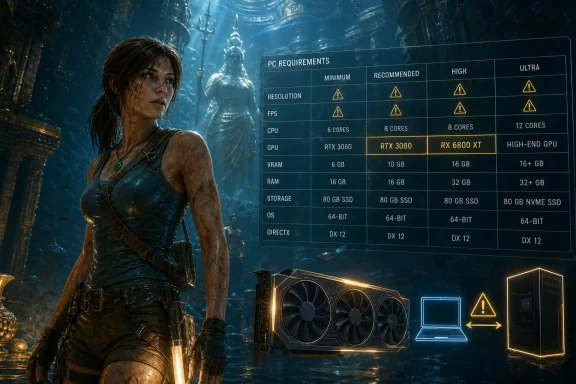
Crystal Dynamics and Amazon Game Studios have listed Tomb Raider: Legacy of Atlantis on Steam with Windows 10/11 support, 16GB of RAM, 80GB of storage, and a recommended GPU tier of Nvidia’s RTX 3080 or AMD’s RX 6800 XT ahead of its February 12, 2027 launch. That is an unusually muscular recommendation for a remake of a 1996 classic, even one rebuilt in Unreal Engine 5. The real issue is not that the spec sheet is high; it is that it is incomplete. Without target resolution, frame rate, graphics preset, ray tracing status, or upscaling assumptions, the requirements say just enough to worry PC players and not enough to let them plan.
The headline spec is the recommended graphics card. An RTX 3080 is not a new GPU anymore, but it is still a serious card: wide memory bus, substantial raster performance, and a class of power draw that places it well above the cards many players actually buy today. AMD’s RX 6800 XT tells the same story from the other side of the aisle.
That matters because “recommended” used to imply comfort. For years, it usually meant the developer’s intended mainstream experience: high-ish settings, acceptable frame rate, and no need to turn the options menu into a second game. Here, if that same convention holds, Legacy of Atlantis may be telling players that the comfortable experience starts at what was enthusiast hardware in the last console generation.
The Steam listing’s minimum tier is more forgiving on paper: a GTX 1070, RTX 2060 Super, or Radeon RX 5700. But that trio is doing a lot of work. The GTX 1070 lacks modern upscaling hardware and ray tracing acceleration, while the RTX 2060 Super has DLSS support but far less raw headroom than the recommended cards. The RX 5700 sits in a similar awkward middle ground: competent, but born before AMD’s current ray-tracing and frame-generation pitch.
The bigger problem is that the table floats in a vacuum. A GTX 1070 at 1080p low and 30 frames per second is one thing. A GTX 1070 asked to survive a dense Unreal Engine 5 environment with aggressive temporal upscaling, modern lighting, and shader-heavy materials is another. PC specs have become less a promise than a set of coordinates, and this one is missing the map.
Epic’s modern engine gives developers a seductive toolset: Nanite for high-detail geometry, Lumen for dynamic global illumination, virtual shadow maps, dense environments, and filmic rendering pipelines that scale beautifully in promotional trailers. The trouble is that these features do not arrive for free. They tend to push hard on GPU compute, memory bandwidth, shader compilation behavior, storage streaming, and CPU scheduling.
That is why Unreal Engine 5 games have become a kind of stress test for the PC market. The engine can produce spectacular results, but it has also become associated with stutter, uneven frame pacing, large shader caches, heavy reliance on upscaling, and system requirements that feel detached from what many Steam users own. The problem is not that UE5 is incapable of good performance. The problem is that a UE5 game’s spec sheet often raises more questions than it answers.
For Tomb Raider, that tension is especially sharp. This is not a new IP where visual extravagance is the whole sales pitch. It is Lara Croft’s first adventure rebuilt for a different era, which means the audience includes nostalgia players, mainstream action-adventure fans, and PC users who may not have upgraded since the pandemic GPU market punished everyone’s wallets.
The franchise’s older identity also creates an expectation of responsiveness. Classic Tomb Raider was about precision, spatial awareness, and environmental navigation. A remake can modernize the controls and camera, but if the PC version ships with traversal stutter, shader hitching, or inconsistent frame pacing, it will not just be a technical blemish. It will cut into the game’s central feel.
If the card targets 1440p at high settings and 60 frames per second without ray tracing, the requirement is assertive but understandable. If it targets 4K with upscaling, it is less alarming. If it targets 1080p high with upscaling enabled, then the PC audience has a much bigger problem. The same hardware line can mean three very different things depending on the test conditions.
Publishers know this, which is why modern PC requirement tables increasingly include separate columns for 1080p low, 1080p recommended, 1440p high, 4K ultra, ray tracing, and upscaling mode. Those tables can be messy, but they at least acknowledge the way PC games are actually played. A single minimum and recommended column now feels like a relic from a simpler rendering era.
The omission is particularly important because upscaling has changed the language of performance. When a listing says 1440p, does it mean native 1440p? Does it mean DLSS Quality? FSR Balanced? TSR at an internal resolution much lower than the monitor output? Does frame generation count toward the stated frame rate? Those are not pedantic questions anymore. They determine whether the game is honestly playable on a given machine.
This is where the spec sheet turns from information into marketing. The publisher can claim early transparency while withholding the details that would make the transparency useful. It tells PC players which products to compare, but not what experience those products are expected to deliver.
That creates a perception trap. A player sees a newer model number and assumes relevance. A spec sheet that calls for an RTX 3080 punctures that assumption, reminding everyone that generational naming does not equal performance class. A newer midrange card can be newer, cheaper, cooler, and still below the recommended bar.
The same is true for laptop GPUs, where the naming problem gets even messier. An RTX 3080 laptop GPU is not the same thing as a desktop RTX 3080. An RTX 4070 laptop GPU is not the same thing as a desktop RTX 4070. If Legacy of Atlantis is using desktop-class recommendations without spelling out the target experience, laptop buyers are left to guess whether their machine is comfortably above spec or merely adjacent to it.
This is not a niche concern. The PC gaming market is full of people on RTX 3060, RTX 4060, RX 6600, RX 7600, and similar cards. These are not bargain-bin machines. They are the practical middle of the market, the systems people built or bought when GPU prices finally began to normalize. If a big-budget action-adventure remake treats that class as compromise hardware, it says something about where AAA PC development is drifting.
The industry’s answer has been upscaling. DLSS, FSR, XeSS, TSR, and frame generation can all help, and in the best cases they are genuinely impressive. But relying on them to make the mainstream viable changes the default bargain between player and publisher. The PC is no longer being asked to render the image so much as reconstruct it convincingly after the fact.
Legacy of Atlantis is not trying to reproduce that technology. It is being sold as a full reimagining, one that can reshape old environments, expand set pieces, modernize combat, and make Lara’s first adventure look like a contemporary blockbuster. That is an understandable commercial move. A literal remake would risk feeling like a museum exhibit with better textures.
But the moment a remake becomes a showcase, it inherits showcase expectations. It must look expensive enough to justify itself, but perform well enough not to alienate the audience drawn in by nostalgia. That is a hard balance, and the Steam requirements suggest Crystal Dynamics is aiming visually high.
The danger is that the remake’s technical ambition overwhelms the simplicity that made the original endure. Tombs should feel vast because they are cleverly staged, not merely because the GPU is pushing millions of triangles through a cinematic fog volume. A Tomb Raider game can benefit from modern lighting and dense environments, but it cannot hide behind them.
That cuts both ways. Optimists can argue that the requirements will become clearer and perhaps more forgiving as optimization continues. Pessimists can argue that early requirements tend to be soft landings, and the final chart could add higher tiers for ray tracing, 4K, and ultra settings that make the RTX 3080 look like merely the middle rung.
The delay out of 2026 also places the game into a busier and more volatile release environment. Publishers are increasingly trying to avoid being crushed by tentpole launches, especially as the industry braces for blockbuster congestion around major open-world releases and fall-window competition. Moving into February may give Tomb Raider more oxygen, but it also means the game will be judged against whatever hardware expectations have hardened by then.
By early 2027, another round of GPUs will be in the market, and the conversation around AI-assisted rendering will be even louder. That may make today’s RTX 3080 recommendation seem less shocking. It may also make the PC community even less patient with vague requirements, because players will have lived through several more years of spec sheets that quietly assume reconstruction, interpolation, and post-processing wizardry.
But 16GB does not guarantee a smooth ride. Modern Windows gaming machines often have launchers, overlays, browsers, capture tools, RGB utilities, and background services running alongside the game. A nominal 16GB requirement can become tight if the game is heavy on streaming, decompression, shader compilation, or memory-hungry texture pools.
The 80GB storage requirement also deserves more than a shrug. It is not extreme by modern standards, but the performance question is not just capacity. It is whether the game expects an SSD, how aggressively it streams assets, and how well it behaves on slower drives. The Steam listing’s storage line does not specify SSD versus HDD in the supplied table, which is another missing detail in a world where traversal stutter and asset streaming can shape the feel of play.
For Windows users, this is where the technical stack becomes broader than the graphics card. DirectStorage support, shader precompilation, CPU decompression load, driver maturity, and background Windows behavior can all matter. A spec sheet that focuses on CPU and GPU brands may miss the very bottlenecks that players actually experience.
The PlayStation 5 and Xbox Series X/S era has pushed PC games toward higher assumptions around CPU threading, asset streaming, and background simulation. The Ryzen 5 3600 became a kind of unofficial comfort point for many PC gamers because it roughly belongs to the same architectural moment as the console generation’s CPU expectations. Seeing it as a minimum is not shocking, but it is another sign that older quad-core and early six-core machines are being left behind.
The Core i7-9700K recommendation is interesting because it offers strong gaming performance but lacks Hyper-Threading. The Ryzen 5 5600X, meanwhile, is a six-core, twelve-thread chip that has aged gracefully. Pairing those two suggests the developers are looking for solid per-core performance more than extreme thread counts, though that reading could change once more detailed specs appear.
For sysadmins and IT pros who also happen to be PC gamers, this is familiar territory. The Windows gaming experience is no longer just about whether the executable launches. It is about whether the whole platform can sustain a stable real-time workload while juggling security features, driver layers, overlays, storage calls, and increasingly complex engine pipelines.
Crystal Dynamics and Amazon should publish a fuller PC matrix well before launch. That matrix should separate native from upscaled rendering, list expected frame rates, identify presets, clarify ray tracing or Lumen modes, and specify whether frame generation is included in any claimed performance target. It should also say whether an SSD is required or merely recommended.
This is not just a courtesy to enthusiasts. It is basic consumer clarity. PC players make hardware decisions months in advance, especially for games tied to beloved franchises. If the publisher wants preorders from PC users, it should provide information that helps them decide whether the game fits their machine rather than forcing them to reverse-engineer the meaning of “recommended.”
The better publishers have already moved in this direction. Detailed spec charts may look intimidating, but they reduce ambiguity. They also build trust because they admit that PC gaming is not a single target. A player on 1080p medium, a player on 1440p ultrawide, and a player on 4K with ray tracing are not asking the same question.
The current Legacy of Atlantis table answers only the easiest version of the question. It says what hardware classes the developers are thinking about. It does not say what those classes are meant to deliver.
Still, the early signal is unmistakable. Tomb Raider: Legacy of Atlantis is being positioned as a premium modern remake, not a lightweight nostalgia project. That means PC players should expect a game that leans on current rendering techniques, modern GPU features, and probably some form of upscaling as part of the intended experience.
The most concrete lessons are already visible:
 The RTX 3080 Line Is a Warning, Not a Number
The headline spec is the recommended graphics card. An RTX 3080 is not a new GPU anymore, but it is still a serious card: wide memory bus, substantial raster performance, and a class of power draw that places it well above the cards many players actually buy today. AMD’s RX 6800 XT tells the same story from the other side of the aisle.That matters because “recommended” used to imply comfort. For years, it usually meant the developer’s intended mainstream experience: high-ish settings, acceptable frame rate, and no need to turn the options menu into a second game. Here, if that same convention holds, Legacy of Atlantis may be telling players that the comfortable experience starts at what was enthusiast hardware in the last console generation.
The Steam listing’s minimum tier is more forgiving on paper: a GTX 1070, RTX 2060 Super, or Radeon RX 5700. But that trio is doing a lot of work. The GTX 1070 lacks modern upscaling hardware and ray tracing acceleration, while the RTX 2060 Super has DLSS support but far less raw headroom than the recommended cards. The RX 5700 sits in a similar awkward middle ground: competent, but born before AMD’s current ray-tracing and frame-generation pitch.
The bigger problem is that the table floats in a vacuum. A GTX 1070 at 1080p low and 30 frames per second is one thing. A GTX 1070 asked to survive a dense Unreal Engine 5 environment with aggressive temporal upscaling, modern lighting, and shader-heavy materials is another. PC specs have become less a promise than a set of coordinates, and this one is missing the map.
Unreal Engine 5 Has Made the Spec Sheet Political
It is tempting to read the requirements as another example of PC optimization sliding downhill. Sometimes that complaint is fair. But with Unreal Engine 5, the story is more complicated and more structural.Epic’s modern engine gives developers a seductive toolset: Nanite for high-detail geometry, Lumen for dynamic global illumination, virtual shadow maps, dense environments, and filmic rendering pipelines that scale beautifully in promotional trailers. The trouble is that these features do not arrive for free. They tend to push hard on GPU compute, memory bandwidth, shader compilation behavior, storage streaming, and CPU scheduling.
That is why Unreal Engine 5 games have become a kind of stress test for the PC market. The engine can produce spectacular results, but it has also become associated with stutter, uneven frame pacing, large shader caches, heavy reliance on upscaling, and system requirements that feel detached from what many Steam users own. The problem is not that UE5 is incapable of good performance. The problem is that a UE5 game’s spec sheet often raises more questions than it answers.
For Tomb Raider, that tension is especially sharp. This is not a new IP where visual extravagance is the whole sales pitch. It is Lara Croft’s first adventure rebuilt for a different era, which means the audience includes nostalgia players, mainstream action-adventure fans, and PC users who may not have upgraded since the pandemic GPU market punished everyone’s wallets.
The franchise’s older identity also creates an expectation of responsiveness. Classic Tomb Raider was about precision, spatial awareness, and environmental navigation. A remake can modernize the controls and camera, but if the PC version ships with traversal stutter, shader hitching, or inconsistent frame pacing, it will not just be a technical blemish. It will cut into the game’s central feel.
The Missing Resolution Target Is the Real Red Flag
A recommended RTX 3080 is not automatically outrageous. It becomes worrying because the listing does not say what the recommendation buys.If the card targets 1440p at high settings and 60 frames per second without ray tracing, the requirement is assertive but understandable. If it targets 4K with upscaling, it is less alarming. If it targets 1080p high with upscaling enabled, then the PC audience has a much bigger problem. The same hardware line can mean three very different things depending on the test conditions.
Publishers know this, which is why modern PC requirement tables increasingly include separate columns for 1080p low, 1080p recommended, 1440p high, 4K ultra, ray tracing, and upscaling mode. Those tables can be messy, but they at least acknowledge the way PC games are actually played. A single minimum and recommended column now feels like a relic from a simpler rendering era.
The omission is particularly important because upscaling has changed the language of performance. When a listing says 1440p, does it mean native 1440p? Does it mean DLSS Quality? FSR Balanced? TSR at an internal resolution much lower than the monitor output? Does frame generation count toward the stated frame rate? Those are not pedantic questions anymore. They determine whether the game is honestly playable on a given machine.
This is where the spec sheet turns from information into marketing. The publisher can claim early transparency while withholding the details that would make the transparency useful. It tells PC players which products to compare, but not what experience those products are expected to deliver.
The Mainstream GPU Is Being Quietly Reclassified
The most uncomfortable implication is that current “mainstream” cards may not feel mainstream in Legacy of Atlantis. Nvidia’s RTX 4060 and likely midrange successors can offer newer features, better efficiency, and frame-generation marketing, but they do not automatically outrun an RTX 3080 in raw rendering. In many traditional workloads, the older high-end card remains faster.That creates a perception trap. A player sees a newer model number and assumes relevance. A spec sheet that calls for an RTX 3080 punctures that assumption, reminding everyone that generational naming does not equal performance class. A newer midrange card can be newer, cheaper, cooler, and still below the recommended bar.
The same is true for laptop GPUs, where the naming problem gets even messier. An RTX 3080 laptop GPU is not the same thing as a desktop RTX 3080. An RTX 4070 laptop GPU is not the same thing as a desktop RTX 4070. If Legacy of Atlantis is using desktop-class recommendations without spelling out the target experience, laptop buyers are left to guess whether their machine is comfortably above spec or merely adjacent to it.
This is not a niche concern. The PC gaming market is full of people on RTX 3060, RTX 4060, RX 6600, RX 7600, and similar cards. These are not bargain-bin machines. They are the practical middle of the market, the systems people built or bought when GPU prices finally began to normalize. If a big-budget action-adventure remake treats that class as compromise hardware, it says something about where AAA PC development is drifting.
The industry’s answer has been upscaling. DLSS, FSR, XeSS, TSR, and frame generation can all help, and in the best cases they are genuinely impressive. But relying on them to make the mainstream viable changes the default bargain between player and publisher. The PC is no longer being asked to render the image so much as reconstruct it convincingly after the fact.
A Remake Now Carries the Burden of a Showcase
There is a strange irony in a remake of the original Tomb Raider becoming a test case for high-end rendering expectations. The 1996 game was iconic not because it overwhelmed hardware with realism, but because it made a new kind of 3D space feel explorable. Its limitations were part of its grammar: angular rooms, readable geometry, deliberate movement, and a sense of isolation born partly from the technology of the time.Legacy of Atlantis is not trying to reproduce that technology. It is being sold as a full reimagining, one that can reshape old environments, expand set pieces, modernize combat, and make Lara’s first adventure look like a contemporary blockbuster. That is an understandable commercial move. A literal remake would risk feeling like a museum exhibit with better textures.
But the moment a remake becomes a showcase, it inherits showcase expectations. It must look expensive enough to justify itself, but perform well enough not to alienate the audience drawn in by nostalgia. That is a hard balance, and the Steam requirements suggest Crystal Dynamics is aiming visually high.
The danger is that the remake’s technical ambition overwhelms the simplicity that made the original endure. Tombs should feel vast because they are cleverly staged, not merely because the GPU is pushing millions of triangles through a cinematic fog volume. A Tomb Raider game can benefit from modern lighting and dense environments, but it cannot hide behind them.
February 2027 Is a Delay With a Message
The confirmed February 12, 2027 release date gives the PC version time, but it also changes the way the specs should be read. This is not a game launching next month with placeholder requirements rushed onto a storefront. It is still far enough out that the current table may be provisional, conservative, or simply incomplete.That cuts both ways. Optimists can argue that the requirements will become clearer and perhaps more forgiving as optimization continues. Pessimists can argue that early requirements tend to be soft landings, and the final chart could add higher tiers for ray tracing, 4K, and ultra settings that make the RTX 3080 look like merely the middle rung.
The delay out of 2026 also places the game into a busier and more volatile release environment. Publishers are increasingly trying to avoid being crushed by tentpole launches, especially as the industry braces for blockbuster congestion around major open-world releases and fall-window competition. Moving into February may give Tomb Raider more oxygen, but it also means the game will be judged against whatever hardware expectations have hardened by then.
By early 2027, another round of GPUs will be in the market, and the conversation around AI-assisted rendering will be even louder. That may make today’s RTX 3080 recommendation seem less shocking. It may also make the PC community even less patient with vague requirements, because players will have lived through several more years of spec sheets that quietly assume reconstruction, interpolation, and post-processing wizardry.
The 16GB RAM Line Is the Calm Before the Storage Question
The memory and storage requirements look ordinary at first glance: 16GB of RAM and 80GB of space. In 2026, that is not shocking for a large action-adventure game. If anything, some players may be relieved not to see 32GB as a recommended system memory target.But 16GB does not guarantee a smooth ride. Modern Windows gaming machines often have launchers, overlays, browsers, capture tools, RGB utilities, and background services running alongside the game. A nominal 16GB requirement can become tight if the game is heavy on streaming, decompression, shader compilation, or memory-hungry texture pools.
The 80GB storage requirement also deserves more than a shrug. It is not extreme by modern standards, but the performance question is not just capacity. It is whether the game expects an SSD, how aggressively it streams assets, and how well it behaves on slower drives. The Steam listing’s storage line does not specify SSD versus HDD in the supplied table, which is another missing detail in a world where traversal stutter and asset streaming can shape the feel of play.
For Windows users, this is where the technical stack becomes broader than the graphics card. DirectStorage support, shader precompilation, CPU decompression load, driver maturity, and background Windows behavior can all matter. A spec sheet that focuses on CPU and GPU brands may miss the very bottlenecks that players actually experience.
The CPU Requirement Suggests a Game Built for the Console Baseline
The CPU side is less dramatic but still revealing. The minimum calls for an Intel Core i5-8600 or Ryzen 5 3600, while the recommended tier lists a Core i7-9700K or Ryzen 5 5600X. That is a sensible spread for a modern cross-platform game, but it also hints at the current console baseline.The PlayStation 5 and Xbox Series X/S era has pushed PC games toward higher assumptions around CPU threading, asset streaming, and background simulation. The Ryzen 5 3600 became a kind of unofficial comfort point for many PC gamers because it roughly belongs to the same architectural moment as the console generation’s CPU expectations. Seeing it as a minimum is not shocking, but it is another sign that older quad-core and early six-core machines are being left behind.
The Core i7-9700K recommendation is interesting because it offers strong gaming performance but lacks Hyper-Threading. The Ryzen 5 5600X, meanwhile, is a six-core, twelve-thread chip that has aged gracefully. Pairing those two suggests the developers are looking for solid per-core performance more than extreme thread counts, though that reading could change once more detailed specs appear.
For sysadmins and IT pros who also happen to be PC gamers, this is familiar territory. The Windows gaming experience is no longer just about whether the executable launches. It is about whether the whole platform can sustain a stable real-time workload while juggling security features, driver layers, overlays, storage calls, and increasingly complex engine pipelines.
The Publisher Has Time to Fix the Message
The easiest fix is not necessarily lowering the requirements. It is explaining them.Crystal Dynamics and Amazon should publish a fuller PC matrix well before launch. That matrix should separate native from upscaled rendering, list expected frame rates, identify presets, clarify ray tracing or Lumen modes, and specify whether frame generation is included in any claimed performance target. It should also say whether an SSD is required or merely recommended.
This is not just a courtesy to enthusiasts. It is basic consumer clarity. PC players make hardware decisions months in advance, especially for games tied to beloved franchises. If the publisher wants preorders from PC users, it should provide information that helps them decide whether the game fits their machine rather than forcing them to reverse-engineer the meaning of “recommended.”
The better publishers have already moved in this direction. Detailed spec charts may look intimidating, but they reduce ambiguity. They also build trust because they admit that PC gaming is not a single target. A player on 1080p medium, a player on 1440p ultrawide, and a player on 4K with ray tracing are not asking the same question.
The current Legacy of Atlantis table answers only the easiest version of the question. It says what hardware classes the developers are thinking about. It does not say what those classes are meant to deliver.
Lara’s Next Raid Is Also a Test of PC Honesty
The practical read is not that everyone below an RTX 3080 should panic. It is that nobody should treat the current requirements as complete buying advice. The game is far from release, the listing may change, and Unreal Engine 5 performance can improve dramatically over a project’s final optimization stretch.Still, the early signal is unmistakable. Tomb Raider: Legacy of Atlantis is being positioned as a premium modern remake, not a lightweight nostalgia project. That means PC players should expect a game that leans on current rendering techniques, modern GPU features, and probably some form of upscaling as part of the intended experience.
The most concrete lessons are already visible:
- The recommended RTX 3080 and RX 6800 XT tier suggests the game is targeting a higher GPU class than many mainstream desktop PCs currently occupy.
- The absence of resolution and frame-rate targets makes the published requirements unsuitable for judging real-world performance.
- Unreal Engine 5 increases the importance of upscaling, shader behavior, storage performance, and frame pacing, not just raw average FPS.
- Newer midrange GPUs should not be assumed to beat older high-end cards simply because their model numbers are more recent.
- The February 12, 2027 launch date gives the developers time to optimize, but it also gives the publisher time to publish a much clearer PC specification matrix.
References
- Primary source: Wccftech
Published: 2026-06-04T16:20:36.122105
Tomb Raider: Legacy of Atlantis Recommends an NVIDIA RTX 3080/ 6800 XT — And the Real Specs Could Hit Harder
Tomb Raider: Legacy of Atlantis PC specs recommend an RTX 3080 GPU, but the real performance cost may hit harder.wccftech.com
- Related coverage: gamesradar.com
Tomb Raider: Legacy of Atlantis is still the OG game fans remember, but "reimagined in ways that weren't possible 30 years ago and with new surprises woven in" | GamesRadar+
It's the second full remake of the 1996 classicwww.gamesradar.com - Related coverage: blog.playstation.com
Tomb Raider: Legacy of Atlantis launches Feb 12, 2027 on PS5 – PlayStation.Blog
Launch editions detailed, new gameplay info shared and a returning character revealed.blog.playstation.com - Related coverage: blog.latam.playstation.com
Tomb Raider: Legacy of Atlantis se lanza el 12 de febrero de 2027 en PS5 – PlayStation.Blog LATAM
Descubre las ediciones de lanzamiento, nuevos detalles de la jugabilidad y el regreso de un personaje muy esperado.blog.latam.playstation.com - Related coverage: gmanetwork.com
'Tomb Raider: Legacy of Atlantis' launches on PlayStation in 2027 | GMA News Online
“Tomb Raider: Legacy of Atlantis” has been announced to launch on PlayStation 5 on February 12, 2027.www.gmanetwork.com - Related coverage: blog.it.playstation.com
Tomb Raider: Legacy of Atlantis in arrivo il 12 febbraio 2027 su PS5 – Il Blog Italiano di PlayStation
Svelati dettagli su edizioni di lancio, gameplay e un personaggio tornato in scena.blog.it.playstation.com
- Related coverage: playstation.com
Tomb Raider: Legacy of Atlantis - ألعاب PS5 | PlayStation (المملكة العربية السعودية)
اشترِ Tomb Raider: Legacy of Atlantis من PlayStation Store. تصور جديد مذهل لمغامرة Lara Croft الأولى التي وضعت معايير هذا النوع من الألعاب، مع رسومات محسّنة وتصميم لعبة عصري ومفاجآت جديدة.www.playstation.com
- Related coverage: store.steampowered.com
Bestellen Sie Tomb Raider: Legacy of Atlantis jetzt auf Steam vor
Erlebe eine atemberaubende Neuinterpretation von Lara Crofts erstem Abenteuer und entdecke die verlorenen Geheimnisse von Atlantis – mit umwerfender Grafik, modernem Gameplay und neuen Überraschungen, die dem Original treu bleiben.store.steampowered.com
- Related coverage: purexbox.com
- Related coverage: tombraider.fandom.com
Tomb Raider: Legacy of Atlantis | Lara Croft Wiki | Fandom
Tomb Raider: Legacy of Atlantis is the next game in the Tomb Raider game series developed by Crystal Dynamics and Flying Wild Hog on the Unreal Engine 5.[1] It is a retelling of the original Tomb Raider (1996) video game. This game continues the Unified Timeline which was introduced in...tombraider.fandom.com
- Related coverage: monstervine.com
Tomb Raider: Legacy of Atlantis launches February 12, 2027 on PS5 - MonsterVine
Tomb Raider: Legacy of Atlantis launches February 12, 2027 on PS5, reimagining Lara Croft’s original adventure with Unreal Engine 5 visuals.monstervine.com - Related coverage: games.gg
Tomb Raider: Legacy of Atlantis Gets a 2027 Release Date | GAMES.GG
Tomb Raider: Legacy of Atlantis is coming February 12, 2027. See what the new State of Play trailer revealed about editions, early access, and Lara's ne...games.gg - Related coverage: as.com
Tomb Raider impresiona con el remake de la primera aventura de Lara Croft, pero su lanzamiento se retrasa
Tomb Raider: Legacy of Atlantis es el regreso a lo grande de la primera aventura de Lara Croft en forma de remake.as.com
- Related coverage: embracer.com
