

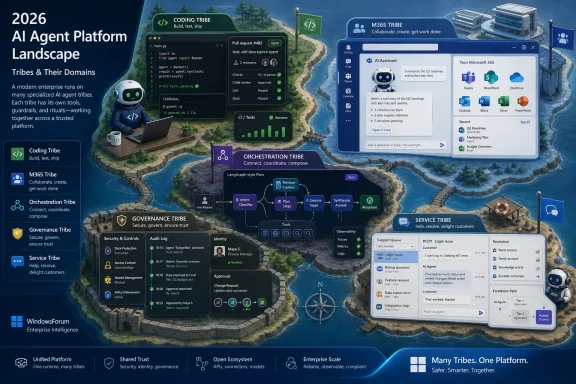
The 2026 AI-agent platform market is no longer a clean leaderboard of chatbots with tool access; it is a fragmented contest among coding agents, Microsoft 365 workflow builders, open-source orchestration frameworks, customer-service specialists, and governance-heavy enterprise platforms. That makes any “top 10” ranking useful only if readers understand what is being ranked. The real story is not that one vendor has won the agent era, but that agent platforms are splitting into tribes — and each tribe is making a different bet about where autonomous software should live.
The list circulating from NubiaPage captures the shape of the market reasonably well: OpenAI Codex at the coding-agent end, Microsoft Copilot Studio inside the enterprise-productivity stack, LangChain and LangGraph as the developer substrate, CrewAI for multi-agent teams, Sema4.ai and IBM watsonx.ai for controlled enterprise deployments, n8n for automation-first builders, and Sierra and Voiceflow for customer-facing conversational agents. But the ranking also shows why “best AI agent platform” has become a slippery phrase. A system that reviews pull requests, a low-code bot builder in Microsoft 365, and a customer-support agent for retail brands are not solving the same problem.
For WindowsForum readers, the important question is not whether Codex is “better” than Copilot Studio or whether LangGraph is “more powerful” than n8n. The question is where these platforms are likely to touch real work: inside Visual Studio and GitHub, inside Teams and SharePoint, inside support queues, inside regulated data environments, and inside the automation stacks that IT departments already maintain. The agent market is maturing, but it is not converging. It is specializing.
The first wave of generative AI in the workplace was easy to describe because it looked like a text box. Workers typed questions, models returned answers, and vendors sold the idea that knowledge work would be accelerated by a better assistant. Agents changed that bargain. Instead of merely answering, they are expected to plan, call tools, read files, update records, test code, ask for approvals, and continue working in the background.
That shift is why platform rankings are suddenly hard to compare. A chatbot can be judged by fluency, accuracy, latency, and price. An agent platform has to be judged by everything around the model: identity, permissions, audit logs, sandboxing, connector quality, retry behavior, human-in-the-loop controls, deployment options, and the boring but decisive question of who gets blamed when the agent does something expensive.
The phrase AI agent platform now covers at least four product categories. There are coding agents that live near repositories and IDEs. There are enterprise workflow agents that live inside productivity suites and line-of-business software. There are orchestration frameworks that developers use to build their own agentic systems. And there are specialized vertical agents aimed at customer service, document processing, sales operations, or regulated workflows.
That explains why a broad top-10 list can be directionally useful while still feeling internally inconsistent. OpenAI Codex and Voiceflow are both agent platforms, but they sit at opposite ends of the autonomy spectrum. Codex is judged by whether it can modify code safely and survive contact with a real build system. Voiceflow is judged by whether teams can design, test, and deploy customer conversations across channels without turning every bot update into an engineering project.
The market has stopped asking whether agents are technically possible. It is now asking where they can be trusted.
The newest Codex story is not merely autocomplete with a bigger model. It is delegation. The platform has expanded across the command line, IDE integrations, cloud tasks, and ChatGPT-linked workflows, with the practical goal of letting developers assign work rather than manually drive every edit. That changes the psychology of developer tooling. The IDE becomes less like a cockpit and more like a dispatch console.
The source ranking places Codex first and frames it as the leading autonomous coding system. That is plausible, though some of the surrounding claims should be treated carefully unless verified from primary disclosures. The important fact is less whether one valuation or deployment number is exactly right, and more that coding agents are moving from demo loops into corporate software pipelines. Once an agent can open a pull request, run tests, and respond to review feedback, it becomes part of the software-delivery chain rather than a sidecar.
That is also where the risk concentrates. A coding agent that writes poor code is annoying. A coding agent that misunderstands credentials, deletes state, mishandles licensing, or creates a subtle security flaw can become a governance incident. The better Codex gets, the more it must behave like a junior engineer with guardrails rather than a magic code fountain.
For Windows developers, the implications are immediate. The agentic coding fight will be fought inside the environments they already use: Visual Studio, VS Code, GitHub, terminals, CI systems, and corporate repositories. The winning platform will not be the one with the flashiest prompt demo. It will be the one that understands the developer’s context without requiring reckless permission grants.
That gives Copilot Studio a different kind of advantage from Codex. It does not need to convince a company to adopt a new workflow from scratch. It can promise to agent-enable workflows that already exist. For enterprise IT, that is a powerful pitch because it turns agent adoption into an extension of familiar governance, licensing, and administration patterns.
The 2026 Microsoft agent story is also tied to Model Context Protocol support, Power Platform governance, Microsoft Graph access, and the broader attempt to make agents manageable as enterprise objects. That sounds less exciting than a coding agent autonomously fixing a bug, but it may matter more to the average organization. A company’s first useful agent may not write code. It may triage HR requests, update a CRM record, summarize a SharePoint folder, or file a ticket after reading an email.
The catch is that Microsoft’s strength is also its constraint. Copilot Studio is most compelling for organizations already deep in the Microsoft ecosystem. Outside that world, it can look like another layer in a licensing maze, with costs, connectors, capacity, and governance controls that require serious administrative attention. The more Microsoft makes agents a natural part of Microsoft 365, the more buyers must ask whether they are choosing an agent platform or tightening their dependence on the Microsoft stack.
Still, distribution wins enterprise markets more often than elegance does. If agents become another managed workload in the Microsoft admin universe, Copilot Studio may not need to be the most flexible platform in the world. It may simply need to be good enough, secure enough, and already approved.
That distinction matters because the agent hype cycle has often blurred “can call a tool” with “can reliably operate as software.” LangGraph’s state-machine approach is a response to that confusion. Real workflows are not just a chat transcript plus a plugin. They have conditions, loops, failures, escalation paths, and checkpoints. A graph-based agent architecture gives engineers a way to define those paths explicitly rather than hoping the model improvises correctly every time.
This is why LangChain and LangGraph have become foundational even where they are invisible. Many companies do not want a boxed agent product. They want to embed agentic behavior into their own applications, with their own prompts, tools, memory, observability, and safety policies. For them, the platform is not a destination. It is scaffolding.
The downside is obvious: flexibility costs expertise. A LangGraph deployment is not a button inside Teams. It requires engineers who understand software architecture, model behavior, testing, data access, and operational monitoring. That makes it powerful for product companies and technical teams, but less accessible for departments that simply want a support bot or a document-processing assistant.
In the long run, open-source orchestration may be the quiet winner even if it never dominates glossy rankings. Frameworks become infrastructure. Infrastructure disappears into products. And once agent patterns stabilize, many organizations will not ask whether they are “using LangChain” any more than they ask whether a web app is “using an HTTP library.”
That role-based approach helped popularize the idea of agent teams. It also gave demos a narrative structure that single-agent systems often lack. A “researcher” handing work to an “analyst” and then to a “writer” feels more understandable than a monolithic model silently deciding which tool to call next.
But the org chart metaphor can hide complexity. Human teams work because they share context, negotiate ambiguity, and carry accountability. Agent teams can instead multiply errors if each agent inherits bad assumptions from the previous one. More agents do not automatically mean more reliability. Sometimes they mean more places for context to drift.
The best multi-agent systems are not theatrical casts of AI personalities. They are engineered workflows where specialization reduces risk or improves performance. One agent might retrieve documents, another might validate facts, another might generate a draft, and another might check policy compliance. The value comes from constrained responsibility, not from pretending the system is a digital office.
CrewAI’s position in the ranking reflects a real appetite for these patterns. Enterprises want agents that can coordinate complex work, not just answer isolated prompts. The next phase will test whether role-based orchestration can become boringly dependable enough for production use at scale.
Sema4.ai’s pitch around secure enterprise agents, VPC deployment patterns, Control Room-style management, and document intelligence speaks directly to that market. It is not trying to be the most popular developer toy. It is trying to make agents acceptable in places where data movement and compliance obligations are the first barriers to adoption.
IBM watsonx.ai plays an adjacent role with a familiar enterprise message: model governance, deployment flexibility, data controls, and support for organizations that cannot simply ship sensitive workloads into a consumer-facing AI service. IBM’s challenge is that the market often associates it with heavy enterprise sales cycles and complex implementation work. Its advantage is that some buyers actually want that seriousness.
These platforms remind us that the most important agent deployments may not be the most visible ones. A bank automating internal document review, a healthcare organization classifying records, or a government agency using agents against controlled data may never produce the viral demo that a coding agent does. But these are precisely the environments where agent platforms can become sticky.
The agent market will not mature until vendors can answer uncomfortable questions. What did the agent access? Which identity did it use? What did it change? Who approved the action? Can the organization reconstruct the sequence later? Platforms that treat those questions as central will have an advantage over platforms that treat them as procurement paperwork.
That gives n8n an interesting position. It is not the purest agent platform, and that may be its strength. A visual workflow tool with hundreds of integrations, self-hosting options, and custom code nodes can offer something many AI-native products lack: practical plumbing. For teams that care about data control and repeatable automations, that may matter more than whether the product uses the latest agent terminology.
The self-hosting angle is especially important for WindowsForum’s sysadmin audience. Many organizations want AI features but do not want every operational workflow routed through a black-box cloud service. A self-hostable automation platform with agent capabilities lets teams experiment while retaining more control over deployment and data exposure.
The limitation is that automation-first tools can struggle with the open-endedness that defines more advanced agent systems. A workflow builder is excellent when the process is known. An agent is valuable when the path is variable but bounded. The best products in this category will blend deterministic workflow design with model-driven flexibility, without letting either side undermine the other.
That hybrid future is likely. The fantasy of fully autonomous business agents will keep attracting headlines, but many production systems will be semi-agentic workflows: structured automations with language understanding, tool selection, exception handling, and human approvals woven in.
These platforms are narrower than Codex, Copilot Studio, or LangGraph, but narrowness can be a virtue. Customer service is a defined domain with recurring intents, measurable outcomes, escalation paths, and existing systems of record. A brand does not need an all-purpose autonomous employee. It needs an agent that can answer accurately, act safely, preserve tone, and know when to hand off.
Sierra’s emphasis on brand voice is not cosmetic. For consumer companies, support interactions are part of the product experience. A technically correct bot that sounds wrong can still damage trust. The platform challenge is to combine transaction execution with the softer constraints of customer communication.
Voiceflow, by contrast, is compelling because conversation design is collaborative by nature. Product managers, support leaders, designers, and developers all have stakes in how an automated interaction behaves. A low-code environment lets non-engineers shape flows directly while still leaving room for custom integrations.
The risk in this category is overpromising autonomy where reliability is what matters. Customers do not care whether a support agent is “agentic” in the architectural sense. They care whether it solves the problem without wasting their time. The best customer-service agent platforms will be judged less by model sophistication than by containment rates, escalation quality, integration reliability, and customer satisfaction.
If the workload is software engineering, OpenAI Codex, GitHub Copilot, Cursor-style environments, and other coding agents belong in the discussion. If the workload is Microsoft 365 process automation, Copilot Studio has a natural advantage. If the workload is custom application architecture, LangGraph and similar frameworks become more important. If the workload is governed document processing, Sema4.ai, IBM, and comparable enterprise AI platforms deserve attention. If the workload is customer interaction, Sierra, Voiceflow, and adjacent conversational platforms make more sense.
This is where many AI procurement efforts go wrong. Buyers start with the model brand or the product ranking, then hunt for a use case that justifies it. Mature agent adoption works in the opposite direction. It starts with a workflow that is repetitive, valuable, measurable, and bounded enough to automate safely.
The other missing dimension is operations. Agent platforms are easy to test and hard to run. A proof of concept can succeed with a friendly dataset, a permissive API key, and an enthusiastic internal champion. Production requires monitoring, incident response, access reviews, cost controls, rollback procedures, and user training. In other words, agents become another IT system.
That may be the least glamorous truth of the 2026 market. The winners will not simply be the platforms with the smartest models. They will be the platforms that fit into the messy machinery of real organizations.
A realistic organization may use Codex-like systems for engineering, Copilot Studio for Microsoft 365 workflows, LangGraph for custom product features, n8n for self-hosted automation, and a specialized vendor for customer service. That sounds messy, but it resembles how enterprise software normally evolves. Companies do not run on one application. They run on layers.
The challenge for IT leaders is to prevent that layered reality from becoming an unmanaged sprawl of bots with overlapping permissions. Agent governance cannot be postponed until after adoption. Once agents can act across systems, identity and auditability become foundational.
The real platform question, then, is not “which agent is best?” It is “which agent belongs where, under whose control, with what evidence that it is working?” That question is less exciting than a top-10 list, but it is the one that will decide whether agents become productive infrastructure or another expensive experiment.
The list circulating from NubiaPage captures the shape of the market reasonably well: OpenAI Codex at the coding-agent end, Microsoft Copilot Studio inside the enterprise-productivity stack, LangChain and LangGraph as the developer substrate, CrewAI for multi-agent teams, Sema4.ai and IBM watsonx.ai for controlled enterprise deployments, n8n for automation-first builders, and Sierra and Voiceflow for customer-facing conversational agents. But the ranking also shows why “best AI agent platform” has become a slippery phrase. A system that reviews pull requests, a low-code bot builder in Microsoft 365, and a customer-support agent for retail brands are not solving the same problem.
For WindowsForum readers, the important question is not whether Codex is “better” than Copilot Studio or whether LangGraph is “more powerful” than n8n. The question is where these platforms are likely to touch real work: inside Visual Studio and GitHub, inside Teams and SharePoint, inside support queues, inside regulated data environments, and inside the automation stacks that IT departments already maintain. The agent market is maturing, but it is not converging. It is specializing.
 The Agent Boom Has Outgrown the Chatbot Metaphor
The first wave of generative AI in the workplace was easy to describe because it looked like a text box. Workers typed questions, models returned answers, and vendors sold the idea that knowledge work would be accelerated by a better assistant. Agents changed that bargain. Instead of merely answering, they are expected to plan, call tools, read files, update records, test code, ask for approvals, and continue working in the background.That shift is why platform rankings are suddenly hard to compare. A chatbot can be judged by fluency, accuracy, latency, and price. An agent platform has to be judged by everything around the model: identity, permissions, audit logs, sandboxing, connector quality, retry behavior, human-in-the-loop controls, deployment options, and the boring but decisive question of who gets blamed when the agent does something expensive.
The phrase AI agent platform now covers at least four product categories. There are coding agents that live near repositories and IDEs. There are enterprise workflow agents that live inside productivity suites and line-of-business software. There are orchestration frameworks that developers use to build their own agentic systems. And there are specialized vertical agents aimed at customer service, document processing, sales operations, or regulated workflows.
That explains why a broad top-10 list can be directionally useful while still feeling internally inconsistent. OpenAI Codex and Voiceflow are both agent platforms, but they sit at opposite ends of the autonomy spectrum. Codex is judged by whether it can modify code safely and survive contact with a real build system. Voiceflow is judged by whether teams can design, test, and deploy customer conversations across channels without turning every bot update into an engineering project.
The market has stopped asking whether agents are technically possible. It is now asking where they can be trusted.
Codex Turns the IDE Into a Staging Area
OpenAI Codex deserves a high position in any 2026 ranking because coding remains the most measurable and commercially obvious agent workload. Software projects have repositories, tests, issue trackers, pull requests, CI pipelines, and logs. That gives coding agents a structured environment in which success and failure are easier to observe than in a general office workflow.The newest Codex story is not merely autocomplete with a bigger model. It is delegation. The platform has expanded across the command line, IDE integrations, cloud tasks, and ChatGPT-linked workflows, with the practical goal of letting developers assign work rather than manually drive every edit. That changes the psychology of developer tooling. The IDE becomes less like a cockpit and more like a dispatch console.
The source ranking places Codex first and frames it as the leading autonomous coding system. That is plausible, though some of the surrounding claims should be treated carefully unless verified from primary disclosures. The important fact is less whether one valuation or deployment number is exactly right, and more that coding agents are moving from demo loops into corporate software pipelines. Once an agent can open a pull request, run tests, and respond to review feedback, it becomes part of the software-delivery chain rather than a sidecar.
That is also where the risk concentrates. A coding agent that writes poor code is annoying. A coding agent that misunderstands credentials, deletes state, mishandles licensing, or creates a subtle security flaw can become a governance incident. The better Codex gets, the more it must behave like a junior engineer with guardrails rather than a magic code fountain.
For Windows developers, the implications are immediate. The agentic coding fight will be fought inside the environments they already use: Visual Studio, VS Code, GitHub, terminals, CI systems, and corporate repositories. The winning platform will not be the one with the flashiest prompt demo. It will be the one that understands the developer’s context without requiring reckless permission grants.
Microsoft’s Advantage Is Distribution, Not Romance
Microsoft Copilot Studio ranking near the top makes sense for a reason that has little to do with AI glamour. Microsoft owns the work surface. Teams, Outlook, SharePoint, Dynamics 365, Power Platform, Entra, and Azure are already where many organizations manage documents, approvals, identities, customer records, and internal processes.That gives Copilot Studio a different kind of advantage from Codex. It does not need to convince a company to adopt a new workflow from scratch. It can promise to agent-enable workflows that already exist. For enterprise IT, that is a powerful pitch because it turns agent adoption into an extension of familiar governance, licensing, and administration patterns.
The 2026 Microsoft agent story is also tied to Model Context Protocol support, Power Platform governance, Microsoft Graph access, and the broader attempt to make agents manageable as enterprise objects. That sounds less exciting than a coding agent autonomously fixing a bug, but it may matter more to the average organization. A company’s first useful agent may not write code. It may triage HR requests, update a CRM record, summarize a SharePoint folder, or file a ticket after reading an email.
The catch is that Microsoft’s strength is also its constraint. Copilot Studio is most compelling for organizations already deep in the Microsoft ecosystem. Outside that world, it can look like another layer in a licensing maze, with costs, connectors, capacity, and governance controls that require serious administrative attention. The more Microsoft makes agents a natural part of Microsoft 365, the more buyers must ask whether they are choosing an agent platform or tightening their dependence on the Microsoft stack.
Still, distribution wins enterprise markets more often than elegance does. If agents become another managed workload in the Microsoft admin universe, Copilot Studio may not need to be the most flexible platform in the world. It may simply need to be good enough, secure enough, and already approved.
Open-Source Frameworks Are Where Agent Ambition Gets Real
LangChain and LangGraph occupy a different layer of the market. They are not primarily products for a business user who wants to automate a department workflow by Friday. They are developer infrastructure for teams that want control over how agents reason, call tools, retain state, branch, retry, and hand off tasks.That distinction matters because the agent hype cycle has often blurred “can call a tool” with “can reliably operate as software.” LangGraph’s state-machine approach is a response to that confusion. Real workflows are not just a chat transcript plus a plugin. They have conditions, loops, failures, escalation paths, and checkpoints. A graph-based agent architecture gives engineers a way to define those paths explicitly rather than hoping the model improvises correctly every time.
This is why LangChain and LangGraph have become foundational even where they are invisible. Many companies do not want a boxed agent product. They want to embed agentic behavior into their own applications, with their own prompts, tools, memory, observability, and safety policies. For them, the platform is not a destination. It is scaffolding.
The downside is obvious: flexibility costs expertise. A LangGraph deployment is not a button inside Teams. It requires engineers who understand software architecture, model behavior, testing, data access, and operational monitoring. That makes it powerful for product companies and technical teams, but less accessible for departments that simply want a support bot or a document-processing assistant.
In the long run, open-source orchestration may be the quiet winner even if it never dominates glossy rankings. Frameworks become infrastructure. Infrastructure disappears into products. And once agent patterns stabilize, many organizations will not ask whether they are “using LangChain” any more than they ask whether a web app is “using an HTTP library.”
Multi-Agent Systems Are Useful, but the Org Chart Metaphor Can Mislead
CrewAI’s appeal is easy to understand: it makes agent collaboration intuitive by assigning roles. One agent researches, another writes, another reviews, another coordinates. This mirrors how people already describe work, and it gives developers a simple mental model for building multi-step systems.That role-based approach helped popularize the idea of agent teams. It also gave demos a narrative structure that single-agent systems often lack. A “researcher” handing work to an “analyst” and then to a “writer” feels more understandable than a monolithic model silently deciding which tool to call next.
But the org chart metaphor can hide complexity. Human teams work because they share context, negotiate ambiguity, and carry accountability. Agent teams can instead multiply errors if each agent inherits bad assumptions from the previous one. More agents do not automatically mean more reliability. Sometimes they mean more places for context to drift.
The best multi-agent systems are not theatrical casts of AI personalities. They are engineered workflows where specialization reduces risk or improves performance. One agent might retrieve documents, another might validate facts, another might generate a draft, and another might check policy compliance. The value comes from constrained responsibility, not from pretending the system is a digital office.
CrewAI’s position in the ranking reflects a real appetite for these patterns. Enterprises want agents that can coordinate complex work, not just answer isolated prompts. The next phase will test whether role-based orchestration can become boringly dependable enough for production use at scale.
Governance Is Becoming the Product
Sema4.ai and IBM watsonx.ai point to a less flashy but more durable trend: in enterprise AI, governance is no longer a feature bolted onto the side. It is the product. Regulated organizations do not wake up asking for “more autonomy.” They ask whether an agent can operate inside a network boundary, respect identity controls, produce audit trails, protect sensitive data, and survive legal review.Sema4.ai’s pitch around secure enterprise agents, VPC deployment patterns, Control Room-style management, and document intelligence speaks directly to that market. It is not trying to be the most popular developer toy. It is trying to make agents acceptable in places where data movement and compliance obligations are the first barriers to adoption.
IBM watsonx.ai plays an adjacent role with a familiar enterprise message: model governance, deployment flexibility, data controls, and support for organizations that cannot simply ship sensitive workloads into a consumer-facing AI service. IBM’s challenge is that the market often associates it with heavy enterprise sales cycles and complex implementation work. Its advantage is that some buyers actually want that seriousness.
These platforms remind us that the most important agent deployments may not be the most visible ones. A bank automating internal document review, a healthcare organization classifying records, or a government agency using agents against controlled data may never produce the viral demo that a coding agent does. But these are precisely the environments where agent platforms can become sticky.
The agent market will not mature until vendors can answer uncomfortable questions. What did the agent access? Which identity did it use? What did it change? Who approved the action? Can the organization reconstruct the sequence later? Platforms that treat those questions as central will have an advantage over platforms that treat them as procurement paperwork.
Automation Veterans Have a Second Life
n8n’s inclusion is a reminder that the agent boom did not erase workflow automation. It absorbed it. Before everyone was talking about autonomous agents, organizations were already connecting SaaS tools, triggering workflows from events, transforming data, and moving records between systems. Agents add reasoning and language interfaces, but much of the useful work still looks like automation.That gives n8n an interesting position. It is not the purest agent platform, and that may be its strength. A visual workflow tool with hundreds of integrations, self-hosting options, and custom code nodes can offer something many AI-native products lack: practical plumbing. For teams that care about data control and repeatable automations, that may matter more than whether the product uses the latest agent terminology.
The self-hosting angle is especially important for WindowsForum’s sysadmin audience. Many organizations want AI features but do not want every operational workflow routed through a black-box cloud service. A self-hostable automation platform with agent capabilities lets teams experiment while retaining more control over deployment and data exposure.
The limitation is that automation-first tools can struggle with the open-endedness that defines more advanced agent systems. A workflow builder is excellent when the process is known. An agent is valuable when the path is variable but bounded. The best products in this category will blend deterministic workflow design with model-driven flexibility, without letting either side undermine the other.
That hybrid future is likely. The fantasy of fully autonomous business agents will keep attracting headlines, but many production systems will be semi-agentic workflows: structured automations with language understanding, tool selection, exception handling, and human approvals woven in.
Customer-Service Agents Are Narrower, and That Is the Point
Sierra and Voiceflow represent the customer-facing side of the agent market, but they approach it differently. Sierra focuses on branded conversational agents that can handle customer-service tasks and take actions in connected systems. Voiceflow gives teams a collaborative low-code environment for designing voice and chat experiences across channels.These platforms are narrower than Codex, Copilot Studio, or LangGraph, but narrowness can be a virtue. Customer service is a defined domain with recurring intents, measurable outcomes, escalation paths, and existing systems of record. A brand does not need an all-purpose autonomous employee. It needs an agent that can answer accurately, act safely, preserve tone, and know when to hand off.
Sierra’s emphasis on brand voice is not cosmetic. For consumer companies, support interactions are part of the product experience. A technically correct bot that sounds wrong can still damage trust. The platform challenge is to combine transaction execution with the softer constraints of customer communication.
Voiceflow, by contrast, is compelling because conversation design is collaborative by nature. Product managers, support leaders, designers, and developers all have stakes in how an automated interaction behaves. A low-code environment lets non-engineers shape flows directly while still leaving room for custom integrations.
The risk in this category is overpromising autonomy where reliability is what matters. Customers do not care whether a support agent is “agentic” in the architectural sense. They care whether it solves the problem without wasting their time. The best customer-service agent platforms will be judged less by model sophistication than by containment rates, escalation quality, integration reliability, and customer satisfaction.
The Ranking Says More About Use Cases Than Winners
The NubiaPage ranking is useful as a snapshot of market breadth, but it should not be read like a sports table. A company choosing between Codex and Sierra has not narrowed its vendor list; it has failed to define the problem. The first decision is not vendor. It is workload.If the workload is software engineering, OpenAI Codex, GitHub Copilot, Cursor-style environments, and other coding agents belong in the discussion. If the workload is Microsoft 365 process automation, Copilot Studio has a natural advantage. If the workload is custom application architecture, LangGraph and similar frameworks become more important. If the workload is governed document processing, Sema4.ai, IBM, and comparable enterprise AI platforms deserve attention. If the workload is customer interaction, Sierra, Voiceflow, and adjacent conversational platforms make more sense.
This is where many AI procurement efforts go wrong. Buyers start with the model brand or the product ranking, then hunt for a use case that justifies it. Mature agent adoption works in the opposite direction. It starts with a workflow that is repetitive, valuable, measurable, and bounded enough to automate safely.
The other missing dimension is operations. Agent platforms are easy to test and hard to run. A proof of concept can succeed with a friendly dataset, a permissive API key, and an enthusiastic internal champion. Production requires monitoring, incident response, access reviews, cost controls, rollback procedures, and user training. In other words, agents become another IT system.
That may be the least glamorous truth of the 2026 market. The winners will not simply be the platforms with the smartest models. They will be the platforms that fit into the messy machinery of real organizations.
The Practical 2026 Agent Stack Is Being Assembled in Pieces
The most concrete lesson from this ranking is that enterprises should stop looking for a single agent platform to rule every workflow. The market is not consolidating around one universal interface. It is assembling a stack, with different products occupying different layers.A realistic organization may use Codex-like systems for engineering, Copilot Studio for Microsoft 365 workflows, LangGraph for custom product features, n8n for self-hosted automation, and a specialized vendor for customer service. That sounds messy, but it resembles how enterprise software normally evolves. Companies do not run on one application. They run on layers.
The challenge for IT leaders is to prevent that layered reality from becoming an unmanaged sprawl of bots with overlapping permissions. Agent governance cannot be postponed until after adoption. Once agents can act across systems, identity and auditability become foundational.
The real platform question, then, is not “which agent is best?” It is “which agent belongs where, under whose control, with what evidence that it is working?” That question is less exciting than a top-10 list, but it is the one that will decide whether agents become productive infrastructure or another expensive experiment.
The Agent Shortlist Should Start With the Job, Not the Logo
The most useful way to read the 2026 agent rankings is as a map of specialization rather than a declaration of supremacy.- OpenAI Codex is strongest when the job is software development, code review, repository navigation, and delegated engineering work.
- Microsoft Copilot Studio is strongest when the job lives inside Microsoft 365, Dynamics, Power Platform, Azure, and enterprise identity boundaries.
- LangChain and LangGraph are strongest when engineering teams need to build custom agent behavior rather than buy a finished workflow product.
- CrewAI is strongest when role-based multi-agent coordination maps cleanly to the work being automated.
- Sema4.ai and IBM watsonx.ai are strongest when governance, deployment control, document intelligence, and compliance matter as much as model capability.
- n8n, Sierra, and Voiceflow show that many successful agents will be extensions of automation and customer-experience platforms, not standalone AI showcases.
References
- Primary source: Nubia Magazine!
Published: 2026-06-10T10:50:11.911864
Top 10 Best AI Agent Platforms In The World 2026 | Nubia Magazine
The top 10 best AI agent platforms in the world 2026 reflect a market that has shifted from experimental tools to production systems used across coding,...nubiapage.com - Related coverage: effloow.com
OpenAI Codex GPT-5.5: Autonomous Coding Agent Guide 2026
A developer guide to OpenAI Codex powered by GPT-5.5 — CLI setup, AGENTS.md config, computer use, memory, scheduling, and GitHub integration.effloow.com
- Official source: microsoft.com
6 core capabilities to scale agent adoption in 2026 | Microsoft Copilot Blog
Learn how organizations are scaling Copilot Studio agent adoption in 2026 with six core capabilities, including governance, security, and operational readiness.www.microsoft.com
