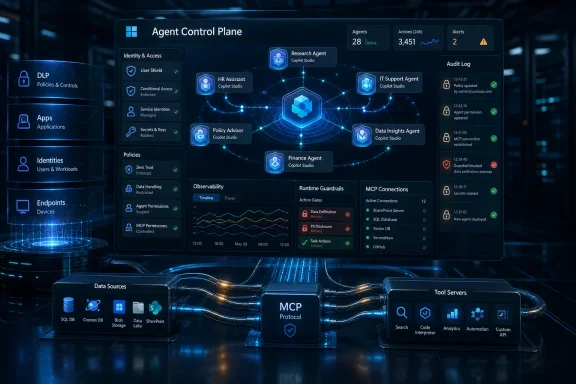
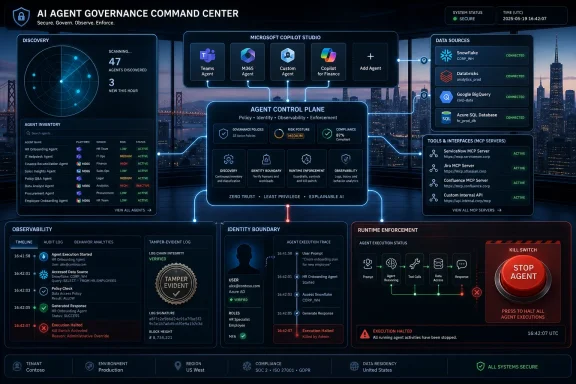
Trust3 AI announced on June 29, 2026, in San Francisco that its Agent Control Plane now integrates with Microsoft Copilot Studio, giving enterprise security teams discovery, observability, runtime guardrails, and incident controls for Copilot Studio agents, including agents built outside formal inventories. The launch is not just another vendor plug-in for Microsoft’s AI stack. It is a signal that agent governance is becoming its own market because the old controls around apps, identities, and data pipelines do not map cleanly onto software that can reason, delegate, and act. For Windows shops that have standardized on Microsoft 365, Power Platform, Entra ID, and Copilot Studio, the pitch lands in a familiar place: productivity arrived first, auditability is racing to catch up.
Copilot Studio has done exactly what Microsoft wanted it to do. It has lowered the bar for building AI agents that can answer questions, call tools, use enterprise data, and sit inside the collaboration surfaces where employees already work. That convenience is the point, and it is also the risk.
The security model for conventional business applications begins with a relatively stable inventory. Someone provisions an app, registers it, assigns permissions, reviews connectors, and gives it a lifecycle. Agentic systems blur that process because the useful thing is not merely the app object; it is the chain of prompts, tools, data sources, identities, and runtime decisions that appears when a user asks the agent to do work.
That is where Trust3 AI is aiming its integration. The company is not claiming to replace Copilot Studio, nor is it positioning itself as a rival builder environment. It is selling the missing oversight layer: a way to discover what agents exist, observe what they are doing, and intervene when their behavior crosses a policy line.
The distinction matters. Enterprises already have identity platforms, security information and event management systems, data loss prevention products, and compliance archives. What they often do not have is a coherent view of an agent’s behavior as a sequence of delegated actions. A chatbot transcript is not enough when the agent can also invoke tools, query databases, call APIs, and pass context into a Model Context Protocol server.
Copilot Studio raises the stakes because an agent is not just a form or workflow. It can blend natural-language instructions with connectors, organizational knowledge, and tool calls. A user does not need to think like a developer to create something that behaves like a lightweight application.
Trust3 AI’s use of the term “shadow agents” is therefore more than marketing. It captures a real governance problem: agents can be created outside official project intake, connected to data sources by enthusiastic departments, and shared before security teams have had a chance to classify their risk. In a Microsoft-heavy enterprise, that can happen inside tools that IT broadly trusts.
This is the uncomfortable part for administrators. The agent may live inside an approved tenant. It may authenticate through approved identity. It may use approved connectors. Yet the resulting behavior can still be under-reviewed because the composition of those pieces creates a new operational surface.
The classic enterprise answer is to restrict creation rights. That may still be necessary in regulated environments, but it will not be sufficient. If the business value of Copilot Studio lies in letting domain experts build task-specific agents, then governance must operate after creation as well as before it.
Discovery has long been a baseline discipline for endpoints, cloud workloads, identities, and data stores. Agent discovery is a newer problem because an agent’s risk is partly defined by what it can reach and partly by what it is instructed to do. An agent connected to a harmless FAQ has one profile; an agent with access to sales forecasts, support tickets, HR records, and an MCP tool that can update a system of record has another.
The practical question for administrators is not whether Copilot Studio can be governed. Microsoft has been building governance controls across Power Platform, Copilot Studio, Entra, Purview, connectors, environments, and admin tooling. The question is whether a security team can get a cross-cutting view quickly enough to manage real deployments at business speed.
That is the opening for a third-party control plane. Trust3 AI is betting that organizations will not want agent governance trapped inside each builder surface. If a company uses Copilot Studio, custom agents, data platforms, third-party MCP servers, and multiple AI development stacks, the security team will want a single policy and observation layer rather than a dozen dashboards.
This is also why the company emphasizes its Privacera lineage. Data governance is not a decorative feature in agent systems. If an agent is useful because it can reach enterprise data, then the policies around that data must survive the jump from human query to delegated agent action.
For traditional software, logs can show API calls, errors, transactions, and user actions. For agents, the evidence trail is stranger. Investigators may need to know what the user asked, what the agent inferred, which tools it considered, which tools it invoked, what those tools returned, what content influenced the next step, and whether the final answer or action was consistent with policy.
That chain is fragile. Prompts can contain sensitive data. Tool responses can include secrets or regulated records. Model reasoning may be opaque or unavailable. Connectors and MCP servers may be operated by different teams. A useful observability system must capture enough to reconstruct what happened without becoming a new privacy and security liability.
Trust3 AI says its integration captures prompts, tool calls, decisions, and execution history for replay and forensics. If implemented well, that could help close a gap that many enterprises are only beginning to appreciate. It is not enough to know that an agent accessed a document. Security teams need to know why it accessed the document, on whose behalf, under what instruction, and what happened next.
The investigative burden will grow as agents move from answering questions to taking action. A bad answer is one class of problem. An agent that changes a customer record, triggers a refund, emails a confidential file, or executes a workflow against the wrong data is another.
Microsoft has been pushing MCP support across its agent platforms, including Copilot Studio. That makes sense strategically. Enterprises do not want agents trapped inside narrow product silos; they want them to reach internal systems, SaaS platforms, development tools, analytics services, and operational workflows.
But MCP also changes the governance boundary. A Copilot Studio agent may be approved, but what about the MCP server it calls? What about the tool metadata the server exposes? What about prompt injection hidden in a response from a downstream system? What about credentials that are broader than the request requires?
Trust3 AI’s “MCP content firewall” language is aimed squarely at that anxiety. The company says it treats every MCP server as untrusted by default, limits credentials per request, and removes prompt-injection attempts embedded in tool descriptions or responses. That framing reflects an important shift: in agent systems, content is not just content. It can become instruction.
This is the nightmare scenario for defenders. A compromised or poorly designed tool does not need to exploit a memory corruption bug to cause harm. It may only need to persuade the agent to reinterpret its task, reveal context, overreach its permission, or call another tool in a way the user did not intend.
Trust3 AI says its integration provides identity-aware governance that preserves the originating user identity throughout agent delegation. This is the sort of feature that sounds procedural but determines whether agent deployments can survive compliance review. If an audit trail collapses into “the agent did it,” the enterprise has a problem.
Least privilege depends on this distinction. An agent should not become a magic identity blender that lets users reach data they could not otherwise access. Nor should every agent run with the maker’s broad credentials simply because that was easier to configure. The more powerful the agent, the more important it becomes to prove that the human initiator’s rights and responsibilities followed the request.
This is especially relevant in Microsoft environments because identity is already the center of gravity. Entra ID, Microsoft 365 permissions, Power Platform environments, connector policies, and Purview controls are supposed to give organizations a coherent governance fabric. If an agent breaks that chain, the organization has turned its trusted platform into a bypass route.
The market will punish ambiguity here. Security teams may tolerate some hallucination risk in low-stakes knowledge agents. They will not tolerate unclear attribution for agents that touch finance, HR, legal, customer data, source code, or production operations.
The phrase “kill switch” carries a certain theatrical quality, but administrators should not dismiss it. When software can act across systems, the ability to halt behavior quickly becomes as important as the ability to approve behavior slowly. The operational question is whether the stop mechanism is granular enough to be useful without becoming so blunt that it shuts down business-critical workflows.
A mature control plane should allow teams to stop a specific agent, tool, connector, MCP server, policy class, or action type. If the only available response is to disable an entire platform, organizations will hesitate until damage is already done. If the response can isolate a risky behavior quickly, security teams can act with less organizational drama.
The need for runtime enforcement also exposes the limits of pre-deployment review. A Copilot Studio agent may look safe in a design review and still become unsafe when a tool changes, a data source expands, a prompt is edited, a user group grows, or a downstream service returns hostile content. Governance has to be continuous because the system itself is dynamic.
This is where enterprise AI diverges from the demo stage. In a demo, the agent completes the happy path. In production, the agent meets stale credentials, overbroad data stores, conflicting policies, malicious inputs, poorly described tools, and users who ask it to do things nobody anticipated.
The deeper issue is that Microsoft is both the accelerant and the control vendor. It wants Copilot Studio adoption to grow, and it wants customers to trust the platform enough to let that growth continue. Those goals are not inherently contradictory, but they do create tension.
Third-party governance products thrive in that tension. They can say what platform vendors often imply more carefully: the native controls are necessary but may not be sufficient for organizations with heterogeneous data estates, multiple AI stacks, and security teams that want independent oversight. Trust3 AI is making that argument from the data governance side rather than from the traditional endpoint or network security side.
For WindowsForum.com readers, the practical takeaway is that Microsoft’s agent ecosystem is no longer just a productivity story. It is becoming part of the security architecture. Copilot Studio agents will need the same seriousness that administrators bring to conditional access, endpoint management, privileged identity, data classification, and logging pipelines.
That does not mean every organization needs Trust3 AI specifically. It does mean that every organization adopting Copilot Studio needs an answer to the category of problem Trust3 AI is describing. If your answer is “we trust users not to build risky agents,” you do not have an answer.
Privacera’s historical territory was governance across enterprise data platforms such as Snowflake, Databricks, BigQuery, and other large data environments. Trust3 AI is now applying that lineage to agents, MCP servers, and the data those agents touch. The company is effectively arguing that AI governance should be anchored where enterprise risk already lives: data, identity, policy, and audit.
This is a stronger story than treating agent governance as a narrow content-filtering problem. Content safety matters, but enterprise harm often comes from authorized systems doing authorized-looking things in the wrong context. A support agent that summarizes the wrong customer record, a finance agent that queries sensitive forecasts, or an operations agent that invokes the wrong tool can create real exposure without ever producing obviously toxic text.
The data governance angle also helps explain why Trust3 AI says it does not sit in the data path. Enterprises are wary of adding latency, failure points, and new chokepoints to already complex systems. A control plane that can observe and enforce policy without becoming the route through which all data must flow is easier to sell, provided the enforcement claims hold up under scrutiny.
The hard part will be proving coverage. Agent ecosystems are messy, and no control plane can govern what it cannot see. Trust3 AI’s value will depend on how completely it can discover Copilot Studio agents, how reliably it can map their connected systems, and how well it can enforce policy when the agent’s work crosses product and protocol boundaries.
Trust3 AI’s announcement is tailored to that expanded audience. The language is not about making agents smarter or easier to build. It is about discovery, observability, security, forensics, identity, policy, and incident response. That is the vocabulary of enterprise adoption after the pilot phase.
This is also why the timing matters. Trust3 AI is demonstrating the integration during AI Engineer World’s Fair 2026 in San Francisco, an event aimed at the builders and platform teams shaping the agent stack. The message to that crowd is clear: the next wave of agent infrastructure will not be judged only by capability, but by controllability.
There is a useful parallel with cloud computing. Early cloud adoption emphasized speed and elasticity. Then came cloud security posture management, workload identity, infrastructure-as-code scanning, cost governance, policy-as-code, and cloud-native detection. Agent infrastructure is likely to follow a compressed version of that arc.
The difference is that agents introduce an extra layer of uncertainty. Cloud workloads generally execute code that engineers wrote. Agents execute plans generated at runtime from user intent, system prompts, available tools, and model behavior. That makes governance less like checking a configuration file and more like supervising a decision-making process.
Enterprise customers should test that claim against their own reality. Does discovery cover agents across all environments? Does it see agents built through adjacent Microsoft 365 experiences? How quickly does inventory update? Can ownership be inferred when metadata is incomplete? Are tool calls captured consistently? What happens when an MCP server is custom-built, self-hosted, or proxied through a connector?
The same scrutiny applies to runtime guardrails. It is one thing to say policies can be enforced during execution. It is another to define which actions can be blocked, how fast enforcement occurs, what context the policy engine can evaluate, and how exceptions are handled. Security teams will also want to know whether enforcement decisions themselves are logged and reviewable.
The kill switch deserves similar testing. Incident responders need clear semantics: what stops, how quickly it stops, who can trigger it, whether approval workflows exist, and how restoration works afterward. A kill switch that creates uncertainty during an incident may become another risk.
None of this makes the announcement less important. It simply places it in the correct enterprise frame. The arrival of agent control planes is a sign that the market is maturing, but maturity will be measured in operational evidence rather than launch language.
The right mental model is not “someone built a bot.” The right model is “someone created a delegated software actor with access to enterprise context.” Once framed that way, the governance requirements become clearer. Inventory, identity, permissions, change management, monitoring, incident response, and data policy all apply.
This does not mean every agent needs the same review as a core banking system. Risk classification matters. A personal productivity agent summarizing public documentation does not deserve the same burden as an agent that can retrieve confidential records and call an external workflow. But the classification process itself must exist.
Administrators should also resist the temptation to separate “AI risk” from “normal IT risk.” The most serious failures will often be hybrids. A stale connector, a badly scoped credential, an over-permissive SharePoint site, a weak environment policy, and an agent instruction that encourages broad retrieval can combine into a problem that no single control would have caught alone.
That is why the control plane language resonates. Enterprises are not looking for one more dashboard for curiosity. They are looking for a way to connect policy intent to runtime behavior across systems that were not originally designed around autonomous delegation.
That accountability has several dimensions. The business needs to know who owns an agent. The security team needs to know what it can reach. The compliance team needs to know what it did. The data governance team needs to know whether access rules were honored. The incident response team needs to know how to stop it.
The hardest part is cultural rather than technical. Business units will want agent creation to feel lightweight. Security teams will want agent deployment to feel controlled. Platform teams will be asked to reconcile those demands without killing the productivity gains that justified the platform in the first place.
A credible control plane can help by moving governance away from blanket prohibition. Instead of saying “no agents,” organizations can say “agents are allowed when they are discoverable, attributable, observable, policy-bound, and stoppable.” That is a more sustainable bargain.
It also gives Microsoft customers a path between two bad extremes. One extreme is uncontrolled experimentation that turns into risk sprawl. The other is governance so heavy that users route around it with unsanctioned tools. The winning posture will be controlled enablement.
The next phase of enterprise AI will be decided less by who can build the flashiest agent and more by who can run agents safely at scale. Trust3 AI’s Copilot Studio integration is one more sign that the market has moved from wonder to control, from demos to audit trails, and from “can this agent do the task?” to “can we prove what happened when it did?” For Microsoft customers, that is the right question to ask now, before today’s productivity shortcut becomes tomorrow’s incident report.
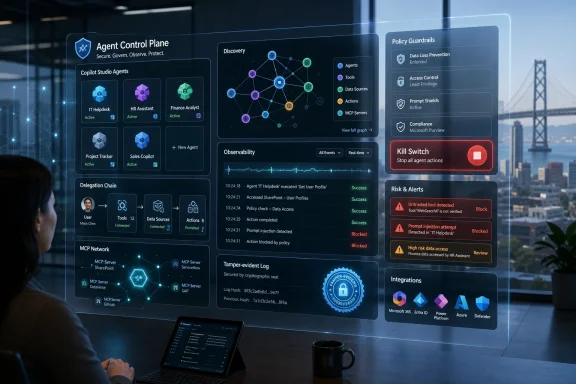 Microsoft’s Agent Factory Has Created a Control Problem
Copilot Studio has done exactly what Microsoft wanted it to do. It has lowered the bar for building AI agents that can answer questions, call tools, use enterprise data, and sit inside the collaboration surfaces where employees already work. That convenience is the point, and it is also the risk.The security model for conventional business applications begins with a relatively stable inventory. Someone provisions an app, registers it, assigns permissions, reviews connectors, and gives it a lifecycle. Agentic systems blur that process because the useful thing is not merely the app object; it is the chain of prompts, tools, data sources, identities, and runtime decisions that appears when a user asks the agent to do work.
That is where Trust3 AI is aiming its integration. The company is not claiming to replace Copilot Studio, nor is it positioning itself as a rival builder environment. It is selling the missing oversight layer: a way to discover what agents exist, observe what they are doing, and intervene when their behavior crosses a policy line.
The distinction matters. Enterprises already have identity platforms, security information and event management systems, data loss prevention products, and compliance archives. What they often do not have is a coherent view of an agent’s behavior as a sequence of delegated actions. A chatbot transcript is not enough when the agent can also invoke tools, query databases, call APIs, and pass context into a Model Context Protocol server.
Shadow Agents Are the New Shadow IT
Every generation of enterprise tooling creates its own form of shadow IT. Excel macros, Access databases, SaaS subscriptions, Zapier automations, unmanaged Power Apps, and Teams bots all followed the same pattern: a central platform gave users a fast way to solve local problems, and the central IT organization discovered the sprawl later.Copilot Studio raises the stakes because an agent is not just a form or workflow. It can blend natural-language instructions with connectors, organizational knowledge, and tool calls. A user does not need to think like a developer to create something that behaves like a lightweight application.
Trust3 AI’s use of the term “shadow agents” is therefore more than marketing. It captures a real governance problem: agents can be created outside official project intake, connected to data sources by enthusiastic departments, and shared before security teams have had a chance to classify their risk. In a Microsoft-heavy enterprise, that can happen inside tools that IT broadly trusts.
This is the uncomfortable part for administrators. The agent may live inside an approved tenant. It may authenticate through approved identity. It may use approved connectors. Yet the resulting behavior can still be under-reviewed because the composition of those pieces creates a new operational surface.
The classic enterprise answer is to restrict creation rights. That may still be necessary in regulated environments, but it will not be sufficient. If the business value of Copilot Studio lies in letting domain experts build task-specific agents, then governance must operate after creation as well as before it.
Discovery Is Becoming a Security Primitive
Trust3 AI’s first promise is continuous discovery of Copilot Studio agents, including ownership, connected data sources, and risk classification. That sounds mundane until you consider how many governance failures begin with a simpler sentence: we did not know it existed.Discovery has long been a baseline discipline for endpoints, cloud workloads, identities, and data stores. Agent discovery is a newer problem because an agent’s risk is partly defined by what it can reach and partly by what it is instructed to do. An agent connected to a harmless FAQ has one profile; an agent with access to sales forecasts, support tickets, HR records, and an MCP tool that can update a system of record has another.
The practical question for administrators is not whether Copilot Studio can be governed. Microsoft has been building governance controls across Power Platform, Copilot Studio, Entra, Purview, connectors, environments, and admin tooling. The question is whether a security team can get a cross-cutting view quickly enough to manage real deployments at business speed.
That is the opening for a third-party control plane. Trust3 AI is betting that organizations will not want agent governance trapped inside each builder surface. If a company uses Copilot Studio, custom agents, data platforms, third-party MCP servers, and multiple AI development stacks, the security team will want a single policy and observation layer rather than a dozen dashboards.
This is also why the company emphasizes its Privacera lineage. Data governance is not a decorative feature in agent systems. If an agent is useful because it can reach enterprise data, then the policies around that data must survive the jump from human query to delegated agent action.
Observability Has to Mean More Than Logs
The press release’s most important phrase may be “tamper-evident observability.” It suggests a world in which agent activity is not merely logged, but preserved in a way that supports replay, investigation, and accountability. That is the difference between watching a system and being able to explain it after an incident.For traditional software, logs can show API calls, errors, transactions, and user actions. For agents, the evidence trail is stranger. Investigators may need to know what the user asked, what the agent inferred, which tools it considered, which tools it invoked, what those tools returned, what content influenced the next step, and whether the final answer or action was consistent with policy.
That chain is fragile. Prompts can contain sensitive data. Tool responses can include secrets or regulated records. Model reasoning may be opaque or unavailable. Connectors and MCP servers may be operated by different teams. A useful observability system must capture enough to reconstruct what happened without becoming a new privacy and security liability.
Trust3 AI says its integration captures prompts, tool calls, decisions, and execution history for replay and forensics. If implemented well, that could help close a gap that many enterprises are only beginning to appreciate. It is not enough to know that an agent accessed a document. Security teams need to know why it accessed the document, on whose behalf, under what instruction, and what happened next.
The investigative burden will grow as agents move from answering questions to taking action. A bad answer is one class of problem. An agent that changes a customer record, triggers a refund, emails a confidential file, or executes a workflow against the wrong data is another.
The MCP Boom Makes the Boundary Messier
The Model Context Protocol has quickly become one of the most important plumbing standards in the agent ecosystem. Its appeal is obvious: give agents a standardized way to discover and use external tools and data. Its security implications are equally obvious once you view every tool description, server response, and delegated credential as part of the attack surface.Microsoft has been pushing MCP support across its agent platforms, including Copilot Studio. That makes sense strategically. Enterprises do not want agents trapped inside narrow product silos; they want them to reach internal systems, SaaS platforms, development tools, analytics services, and operational workflows.
But MCP also changes the governance boundary. A Copilot Studio agent may be approved, but what about the MCP server it calls? What about the tool metadata the server exposes? What about prompt injection hidden in a response from a downstream system? What about credentials that are broader than the request requires?
Trust3 AI’s “MCP content firewall” language is aimed squarely at that anxiety. The company says it treats every MCP server as untrusted by default, limits credentials per request, and removes prompt-injection attempts embedded in tool descriptions or responses. That framing reflects an important shift: in agent systems, content is not just content. It can become instruction.
This is the nightmare scenario for defenders. A compromised or poorly designed tool does not need to exploit a memory corruption bug to cause harm. It may only need to persuade the agent to reinterpret its task, reveal context, overreach its permission, or call another tool in a way the user did not intend.
Identity Must Survive Delegation
One of the harder problems in agent governance is preserving the identity of the person behind the request. Enterprises know how to audit a user. They know how to audit a service principal. They know how to audit an app registration. What becomes more complicated is the chain where a user asks an agent to ask a tool to retrieve or change something in another system.Trust3 AI says its integration provides identity-aware governance that preserves the originating user identity throughout agent delegation. This is the sort of feature that sounds procedural but determines whether agent deployments can survive compliance review. If an audit trail collapses into “the agent did it,” the enterprise has a problem.
Least privilege depends on this distinction. An agent should not become a magic identity blender that lets users reach data they could not otherwise access. Nor should every agent run with the maker’s broad credentials simply because that was easier to configure. The more powerful the agent, the more important it becomes to prove that the human initiator’s rights and responsibilities followed the request.
This is especially relevant in Microsoft environments because identity is already the center of gravity. Entra ID, Microsoft 365 permissions, Power Platform environments, connector policies, and Purview controls are supposed to give organizations a coherent governance fabric. If an agent breaks that chain, the organization has turned its trusted platform into a bypass route.
The market will punish ambiguity here. Security teams may tolerate some hallucination risk in low-stakes knowledge agents. They will not tolerate unclear attribution for agents that touch finance, HR, legal, customer data, source code, or production operations.
The Kill Switch Is a Governance Confession
Trust3 AI’s integration includes runtime guardrails and a kill switch that can stop agent activity during an incident. That is a sensible feature, but it is also an admission that preventive controls will not catch everything. In agentic systems, incident response has to become part of the product design.The phrase “kill switch” carries a certain theatrical quality, but administrators should not dismiss it. When software can act across systems, the ability to halt behavior quickly becomes as important as the ability to approve behavior slowly. The operational question is whether the stop mechanism is granular enough to be useful without becoming so blunt that it shuts down business-critical workflows.
A mature control plane should allow teams to stop a specific agent, tool, connector, MCP server, policy class, or action type. If the only available response is to disable an entire platform, organizations will hesitate until damage is already done. If the response can isolate a risky behavior quickly, security teams can act with less organizational drama.
The need for runtime enforcement also exposes the limits of pre-deployment review. A Copilot Studio agent may look safe in a design review and still become unsafe when a tool changes, a data source expands, a prompt is edited, a user group grows, or a downstream service returns hostile content. Governance has to be continuous because the system itself is dynamic.
This is where enterprise AI diverges from the demo stage. In a demo, the agent completes the happy path. In production, the agent meets stale credentials, overbroad data stores, conflicting policies, malicious inputs, poorly described tools, and users who ask it to do things nobody anticipated.
Microsoft Still Owns the Platform Risk
It would be easy to read Trust3 AI’s announcement as criticism of Microsoft’s governance posture, but that would be too simple. Microsoft has been adding controls around Copilot Studio, Power Platform, connectors, MCP onboarding, environment strategy, authentication, and agent security. The company knows that enterprise buyers will not scale agents without administrative guardrails.The deeper issue is that Microsoft is both the accelerant and the control vendor. It wants Copilot Studio adoption to grow, and it wants customers to trust the platform enough to let that growth continue. Those goals are not inherently contradictory, but they do create tension.
Third-party governance products thrive in that tension. They can say what platform vendors often imply more carefully: the native controls are necessary but may not be sufficient for organizations with heterogeneous data estates, multiple AI stacks, and security teams that want independent oversight. Trust3 AI is making that argument from the data governance side rather than from the traditional endpoint or network security side.
For WindowsForum.com readers, the practical takeaway is that Microsoft’s agent ecosystem is no longer just a productivity story. It is becoming part of the security architecture. Copilot Studio agents will need the same seriousness that administrators bring to conditional access, endpoint management, privileged identity, data classification, and logging pipelines.
That does not mean every organization needs Trust3 AI specifically. It does mean that every organization adopting Copilot Studio needs an answer to the category of problem Trust3 AI is describing. If your answer is “we trust users not to build risky agents,” you do not have an answer.
The Privacera Backstory Explains the Pitch
Trust3 AI’s announcement notes that the platform is built on the data governance foundation formerly known as Privacera. That matters because agent security is not just another branch of chatbot moderation. It is a data access and policy enforcement problem wearing a conversational interface.Privacera’s historical territory was governance across enterprise data platforms such as Snowflake, Databricks, BigQuery, and other large data environments. Trust3 AI is now applying that lineage to agents, MCP servers, and the data those agents touch. The company is effectively arguing that AI governance should be anchored where enterprise risk already lives: data, identity, policy, and audit.
This is a stronger story than treating agent governance as a narrow content-filtering problem. Content safety matters, but enterprise harm often comes from authorized systems doing authorized-looking things in the wrong context. A support agent that summarizes the wrong customer record, a finance agent that queries sensitive forecasts, or an operations agent that invokes the wrong tool can create real exposure without ever producing obviously toxic text.
The data governance angle also helps explain why Trust3 AI says it does not sit in the data path. Enterprises are wary of adding latency, failure points, and new chokepoints to already complex systems. A control plane that can observe and enforce policy without becoming the route through which all data must flow is easier to sell, provided the enforcement claims hold up under scrutiny.
The hard part will be proving coverage. Agent ecosystems are messy, and no control plane can govern what it cannot see. Trust3 AI’s value will depend on how completely it can discover Copilot Studio agents, how reliably it can map their connected systems, and how well it can enforce policy when the agent’s work crosses product and protocol boundaries.
The Enterprise Buyer Is Changing
The buyer for AI agents is no longer just the innovation team. In 2023 and 2024, many organizations treated generative AI as an experiment in productivity. By 2026, the conversation has moved toward workflows, delegated action, and operational integration. That shift brings security architects, compliance officers, data governance teams, and platform engineering into the room.Trust3 AI’s announcement is tailored to that expanded audience. The language is not about making agents smarter or easier to build. It is about discovery, observability, security, forensics, identity, policy, and incident response. That is the vocabulary of enterprise adoption after the pilot phase.
This is also why the timing matters. Trust3 AI is demonstrating the integration during AI Engineer World’s Fair 2026 in San Francisco, an event aimed at the builders and platform teams shaping the agent stack. The message to that crowd is clear: the next wave of agent infrastructure will not be judged only by capability, but by controllability.
There is a useful parallel with cloud computing. Early cloud adoption emphasized speed and elasticity. Then came cloud security posture management, workload identity, infrastructure-as-code scanning, cost governance, policy-as-code, and cloud-native detection. Agent infrastructure is likely to follow a compressed version of that arc.
The difference is that agents introduce an extra layer of uncertainty. Cloud workloads generally execute code that engineers wrote. Agents execute plans generated at runtime from user intent, system prompts, available tools, and model behavior. That makes governance less like checking a configuration file and more like supervising a decision-making process.
Vendor Claims Now Need Operational Proof
Press releases are naturally optimistic, and this one is no exception. Trust3 AI says security teams can discover, observe, and secure every Copilot Studio agent from a single control plane. The word “every” is doing a lot of work.Enterprise customers should test that claim against their own reality. Does discovery cover agents across all environments? Does it see agents built through adjacent Microsoft 365 experiences? How quickly does inventory update? Can ownership be inferred when metadata is incomplete? Are tool calls captured consistently? What happens when an MCP server is custom-built, self-hosted, or proxied through a connector?
The same scrutiny applies to runtime guardrails. It is one thing to say policies can be enforced during execution. It is another to define which actions can be blocked, how fast enforcement occurs, what context the policy engine can evaluate, and how exceptions are handled. Security teams will also want to know whether enforcement decisions themselves are logged and reviewable.
The kill switch deserves similar testing. Incident responders need clear semantics: what stops, how quickly it stops, who can trigger it, whether approval workflows exist, and how restoration works afterward. A kill switch that creates uncertainty during an incident may become another risk.
None of this makes the announcement less important. It simply places it in the correct enterprise frame. The arrival of agent control planes is a sign that the market is maturing, but maturity will be measured in operational evidence rather than launch language.
Windows Shops Should Treat Agents Like Production Systems
For many Windows-centric organizations, Copilot Studio will enter through familiar doors. It will be attached to Microsoft 365, Teams, SharePoint, Power Platform, Dynamics, or internal knowledge bases. That familiarity can breed dangerous comfort.The right mental model is not “someone built a bot.” The right model is “someone created a delegated software actor with access to enterprise context.” Once framed that way, the governance requirements become clearer. Inventory, identity, permissions, change management, monitoring, incident response, and data policy all apply.
This does not mean every agent needs the same review as a core banking system. Risk classification matters. A personal productivity agent summarizing public documentation does not deserve the same burden as an agent that can retrieve confidential records and call an external workflow. But the classification process itself must exist.
Administrators should also resist the temptation to separate “AI risk” from “normal IT risk.” The most serious failures will often be hybrids. A stale connector, a badly scoped credential, an over-permissive SharePoint site, a weak environment policy, and an agent instruction that encourages broad retrieval can combine into a problem that no single control would have caught alone.
That is why the control plane language resonates. Enterprises are not looking for one more dashboard for curiosity. They are looking for a way to connect policy intent to runtime behavior across systems that were not originally designed around autonomous delegation.
The Real Product Is Accountability
Trust3 AI’s Copilot Studio integration is not ultimately about Copilot Studio alone. It is about the accountability layer enterprises will need as agents become a normal interface for work. Microsoft may own the builder experience, but organizations still own the consequences of what their agents do.That accountability has several dimensions. The business needs to know who owns an agent. The security team needs to know what it can reach. The compliance team needs to know what it did. The data governance team needs to know whether access rules were honored. The incident response team needs to know how to stop it.
The hardest part is cultural rather than technical. Business units will want agent creation to feel lightweight. Security teams will want agent deployment to feel controlled. Platform teams will be asked to reconcile those demands without killing the productivity gains that justified the platform in the first place.
A credible control plane can help by moving governance away from blanket prohibition. Instead of saying “no agents,” organizations can say “agents are allowed when they are discoverable, attributable, observable, policy-bound, and stoppable.” That is a more sustainable bargain.
It also gives Microsoft customers a path between two bad extremes. One extreme is uncontrolled experimentation that turns into risk sprawl. The other is governance so heavy that users route around it with unsanctioned tools. The winning posture will be controlled enablement.
The Copilot Studio Era Needs a New Admin Checklist
Trust3 AI’s announcement should prompt IT teams to revisit their assumptions before agent sprawl becomes institutional muscle memory. The details will vary by tenant, industry, and risk appetite, but the direction of travel is now obvious.- Organizations should maintain a live inventory of Copilot Studio agents, including owner, environment, data sources, tools, users, and business purpose.
- Security teams should require runtime visibility into prompts, tool calls, execution history, policy decisions, and delegated identities.
- Administrators should treat MCP servers as untrusted integration points until ownership, authentication, tool scope, and content-handling risks are reviewed.
- Agent access should preserve the originating user identity wherever possible, rather than collapsing activity into broad maker or service credentials.
- Incident response plans should include procedures for disabling specific agents, tools, connectors, or MCP integrations without unnecessarily shutting down the entire platform.
- Governance teams should classify agents by consequence, not novelty, because a plain-looking internal assistant can become high risk the moment it touches sensitive data or operational systems.
The next phase of enterprise AI will be decided less by who can build the flashiest agent and more by who can run agents safely at scale. Trust3 AI’s Copilot Studio integration is one more sign that the market has moved from wonder to control, from demos to audit trails, and from “can this agent do the task?” to “can we prove what happened when it did?” For Microsoft customers, that is the right question to ask now, before today’s productivity shortcut becomes tomorrow’s incident report.
References
- Primary source: AD HOC NEWS
Published: Mon, 29 Jun 2026 10:05:22 GMT
- Related coverage: prnewswire.com
Trust3 AI Brings Its Agent Control Plane to Microsoft Copilot Studio
/PRNewswire/ -- Trust3 AI today announced that its Agent Control Plane, the operational core of the company's Agent DOS (Discovery, Observability, Security)... www.prnewswire.com
- Related coverage: boerse.de
EQS-News: Trust3 AI bringt seine Agent-Control-Plane in Microsoft Copilot Studio ein. - boerse.de
EQS-News: Trust3 AI / Schlagwort(e): Produkteinführung/Sonstiges Trust3 AI bringt seine Agent-Control-Plane in Microsoft...www.boerse.de - Related coverage: agentmarketcap.ai
Microsoft Copilot Studio MCP Server GA: 16M Enterprise Seats Meet the Universal Agent Protocol | AgentMarketCap
Microsoft's GA of MCP in Copilot Studio and federated connectors creates the largest single MCP client deployment, reshaping enterprise agent infrastructure.agentmarketcap.ai - Official source: microsoft.com
Model Context Protocol (MCP) is now generally available in Microsoft Copilot Studio | Microsoft Copilot Blog
MCP now includes a new set of features and enhancements that support more robust and scalable deployments: tool listing, enhanced tracing, and more.www.microsoft.com - Related coverage: trust3.ai
AI Agent Security & Data Governance Platform | Trust3 AI
Trust3 AI is the agent control plane for the enterprise: unify AI governance, agent security, and fine-grained data access control across any cloud or framework. Discover every agent, observe every decision, secure every action.trust3.ai
- Official source: learn.microsoft.com
Implement a zoned governance strategy - Microsoft Copilot Studio | Microsoft Learn
Establish a secure Copilot Studio environment strategy with tenant isolation, ALM processes, and advanced security features like Azure Private Link and MFA.learn.microsoft.com - Related coverage: powertricks.io
Copilot Studio Governance: The Complete Admin Reference (2026) | PowerTricks
This is the complete Copilot Studio governance reference for Power Platform admins and CoE teams. It covers monitoring, restrictions, maker management, and c... www.powertricks.io
- Related coverage: sougataroy.com
Copilot Studio April 2026 Releases Analytics Viewer Role, Agent Nodes in Workflows, and MCP Tools
Copilot Studio April 2026 separates analytics from control — while MCP connectivity quietly expands the permission boundary beyond the original governance scope.sougataroy.com - Related coverage: techradar.com
From code-first to intent-first: Microsoft Build 2026 could be the end of programming as we know it | TechRadar
Redefining what it means to be a developer with agentic AIwww.techradar.com - Related coverage: windowscentral.com
Build 2026 only makes sense if you remember Build 2025: a look back at the groundwork of the "age of AI agents" | Windows Central
Microsoft’s latest announcements build directly on the architecture it introduced a year ago.www.windowscentral.com - Related coverage: hkpcacademy.org
- Related coverage: privacera.com
- Official source: cdn-dynmedia-1.microsoft.com