

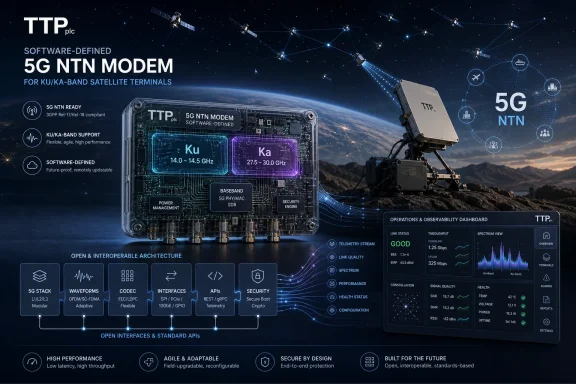
TTP plc disclosed on June 15, 2026, in Cambridge, UK, that it is developing a software-defined 5G Non-Terrestrial Networks modem module for future Ku- and Ka-band satellite terminals. The announcement is not just another component launch in the increasingly crowded satellite-connectivity market. It is a bet that the next phase of satcom competition will be won less by sealed proprietary boxes than by flexible, standards-aware platforms that can survive multiple network generations. For operators, defense integrators, and industrial users, the interesting question is whether “5G NTN” becomes a genuinely interoperable foundation or merely a new label on old vertical stacks.
Satellite communications has always had a replacement-cycle problem. Terminals are expensive, deployments are awkward, certification takes time, and many of the environments that need connectivity most — aircraft, vessels, remote energy sites, field hospitals, border infrastructure, military vehicles — are precisely the places where swapping hardware is least convenient. A modem architecture that can be updated in the field is therefore not a nice-to-have flourish. It is an attempt to change the economics of ownership.
TTP’s pitch is built around a software-defined, multi-band architecture intended to support future satellite terminals using Ku- and Ka-band links. That matters because these bands are central to high-throughput satellite services, and because the industry is shifting from bespoke satellite networks toward systems that borrow more heavily from cellular standards. The closer satellite networks move toward 5G-style interoperability, the more pressure there is on terminal hardware to keep up with evolving standards rather than freeze an operator into the assumptions of the year it was deployed.
The module is also being framed as a way to bridge old and new networks. That phrase can sound like press-release filler, but it speaks to a real operational constraint. Satellite operators do not get to shut off legacy infrastructure simply because a standards body has moved on, and customers do not rebuild field terminals on a telecom vendor’s preferred schedule. A transition layer that can speak to existing systems while preparing for 5G NTN is exactly the kind of unglamorous plumbing that determines whether a standards shift works in practice.
The more aggressive claim is that software definition can reduce the risk of technological obsolescence. That is plausible, but only up to a point. Software can extend the life of a platform, enable new waveform support, improve diagnostics, and adapt to protocol evolution. It cannot repeal physics, antenna constraints, thermal ceilings, power budgets, or silicon limits. TTP appears to understand that distinction, which is why the company is not promising a purely software fantasy.
The hybrid model is the more honest answer. Put the changeable logic in software where protocol flexibility, observability, and updateability matter; keep the hot paths accelerated where deterministic performance matters. That is the same broad compromise visible across modern networking, from SmartNICs to cellular baseband design to edge AI appliances. Flexibility wins headlines, but fixed-function acceleration often wins the battery-life and heat-dissipation arguments.
For UAVs and other size-, weight-, power-, and cost-constrained systems, this balance is especially important. A modem that is too flexible but too power-hungry will not survive the design review. A modem that is fast but rigid will age badly as NTN standards evolve. TTP is trying to occupy the middle ground: enough programmability to ride the standards curve, enough hardware discipline to remain deployable in harsh and mobile environments.
That positioning also gives the module a defense and aerospace flavor, even where the company discusses commercial use cases. Military tactical communications, unmanned surveillance platforms, maritime operations, and remote enterprise connectivity all share a familiar requirement: the network must work when terrestrial coverage is absent, degraded, jammed, overloaded, or politically unavailable. A modem module that can be adapted after deployment is attractive in those settings because the threat model and spectrum environment do not stand still.
An open architecture promises to separate the software stack from proprietary hardware assumptions. If that promise holds, operators could assemble systems from more diverse components, tune them for specific deployments, and avoid being trapped by a single vendor’s chipset or terminal roadmap. In a market where constellations, ground systems, user terminals, and spectrum strategies are all changing at once, that flexibility is commercially valuable.
The caveat is that openness is easy to declare and hard to prove. The satellite industry is full of “open” systems that become less open once certification, performance tuning, waveform support, or support contracts enter the room. True openness would mean credible interoperability across vendors and deployment scenarios, not merely a published interface around a proprietary core. TTP’s independence as a technology and product development services firm gives it a plausible story here, but the proof will come through integrations, trials, and customer deployments.
This is where 5G NTN raises the stakes. The promise of bringing satellite links into the broader 5G standards family is interoperability, scale, and a larger ecosystem of silicon, software, and network expertise. If the industry simply recreates closed satellite silos under a 5G banner, the standards effort will have delivered less than advertised. TTP’s module is interesting because it appears designed around the opposite assumption: that operators will want modularity precisely because the market is not settled.
This is important for WindowsForum readers because “satellite 5G” is often discussed in consumer terms: emergency messaging on phones, rural broadband, or direct-to-device coverage in dead zones. Those use cases matter, but they are only one layer of the NTN story. The more industrial version of the market is about terminals, gateways, aircraft, vehicles, ships, drones, and private networks that need resilient high-bandwidth connectivity beyond terrestrial infrastructure.
That market is more demanding than the phone-to-satellite narrative. It requires higher throughput, better observability, stronger integration with existing network operations, and a much longer service life. A rugged terminal on a UAV or a remote infrastructure site is not a smartphone accessory. It is part of an operational system that may need to remain supportable through multiple software releases, constellation changes, security updates, and mission profiles.
TTP’s module therefore lands in a competitive but credible niche. It is not trying to be the cheapest satellite messaging chipset. It is trying to be a foundation for terminals where flexibility, longevity, and integration matter more than consumer device glamour. That may be a smaller market in unit volume, but it is often a more valuable one in engineering terms.
Observability changes the modem’s role. It is no longer merely a device that pushes bits across a link; it becomes a source of operational intelligence. If the module can expose granular telemetry about signal quality, protocol behavior, interference, congestion, and performance bottlenecks, operators can diagnose problems faster and tune networks more precisely. In distributed satellite systems, that visibility may be the difference between a transient anomaly and an expensive field investigation.
The AI angle follows naturally, though it deserves careful handling. Feeding modem telemetry into AI-assisted reasoning and control systems could help operators detect degradation patterns, optimize spectrum use, or adapt routing and link behavior under changing conditions. But “AI-powered self-healing networks” should not be treated as magic. The value depends on data quality, operational safeguards, explainability, and the ability to distinguish a useful automated adjustment from a dangerous one.
Still, the direction is right. Future satellite networks will be too complex to run entirely by static configuration and human intuition. They will require feedback loops. A modem architecture designed to provide that feedback is more future-facing than one that treats diagnostics as an afterthought.
Defense communications have historically valued control, assurance, and mission-specific engineering. Commercial standards offer cost and ecosystem advantages, but they also require careful hardening. A 5G NTN terminal in a military context is not just a faster radio. It is a participant in a broader network architecture with authentication, slicing, orchestration, software updates, telemetry flows, and potentially cloud-connected management systems. Every one of those layers expands both capability and risk.
That does not make 5G NTN unsuitable for military use. It makes architecture more important. Open systems can reduce vendor dependency, but they also require disciplined integration and verification. Software-defined systems can adapt quickly, but they require secure update mechanisms and strong configuration control. Observability can improve diagnostics, but telemetry must be protected because it may reveal operational patterns.
The “friend or foe” framing is useful because the answer is not binary. 5G NTN can be a friend when it brings interoperability, resilience, and rapid evolution to satellite communications. It can become a foe if procurement treats standards compliance as a substitute for security engineering. TTP’s module sits directly in that debate.
For sysadmins and IT pros, the relevant shift is that satellite connectivity is becoming less of a standalone specialist network and more of an extension of IP infrastructure. Once satellite terminals start behaving more like standards-based 5G network elements, they enter the world of identity, monitoring, patching, endpoint policy, logging, and service assurance. That is familiar terrain for enterprise IT, but it is also terrain where assumptions from wired and cellular networks can fail.
Latency, coverage dynamics, antenna alignment, power constraints, weather effects, and spectrum conditions all complicate the management model. A Windows endpoint connected through a satellite NTN terminal may technically be “online,” but its link behavior can differ dramatically from fiber, Wi-Fi, or terrestrial 5G. Administrators will need tools that understand those differences rather than flattening every connection into a generic network icon.
This is where TTP’s observability emphasis becomes relevant beyond the satcom engineering team. Better modem telemetry can feed into broader fleet management, incident response, and performance analytics. If exposed through sane interfaces, it could help IT teams distinguish endpoint issues from link issues, policy problems from coverage problems, and application failures from radio-layer degradation. That is the difference between troubleshooting with a flashlight and troubleshooting with instrumentation.
But updateability brings governance responsibilities. A satellite terminal that can be updated in the field must have a secure update chain, rollback strategy, version inventory, vulnerability management process, and operational change window discipline. These are not glamorous concerns, but they are precisely the concerns that separate enterprise-grade infrastructure from experimental gear.
For defense and critical infrastructure users, the update channel becomes part of the security perimeter. Who signs the firmware? Who approves the update? How is compatibility tested with the rest of the terminal stack? What happens if a field update fails in a remote location? How are emergency patches balanced against mission stability? The more software-defined the system becomes, the more these questions matter.
This is not an argument against software-defined modems. It is an argument against pretending that software flexibility is free. TTP’s design may reduce hardware replacement costs, but customers will still need disciplined lifecycle management. The savings shift from metal to process.
Ku- and Ka-band terminals, in particular, involve hard physical realities. Higher-frequency links can support substantial throughput, but they are also sensitive to propagation conditions, pointing accuracy, hardware design, and power constraints. A standards-compliant modem is only one part of a terminal that must include RF front ends, antennas, thermal design, enclosure constraints, power management, and network software.
That is why TTP’s background matters. The company is leaning on decades of wireless and modem engineering heritage, including roots associated with TTPCom and experience in satellite communications such as BGAN-era systems. In a market full of generic “connectivity” claims, deep modem experience is not decorative. It is the difference between understanding a standard on paper and making it behave in the field.
The better way to read this announcement is not as a finished universal answer, but as an enabling architecture. TTP is offering a core around which operators and integrators can build terminals suited to specific missions. That is less flashy than a consumer gadget reveal, but more meaningful for the infrastructure layer.
From above, large network and satellite operators want systems that integrate with broader 5G and cloud-native management models. They will push for interoperability, automation, and standardized interfaces because those reduce operational friction across large deployments. From below, silicon vendors and software-defined radio specialists will push reusable modem IP and reference platforms that lower barriers to entry for terminal builders.
TTP’s differentiator is independence and architectural flexibility. It is not pitching a single locked chipset. It is presenting itself as a stack- and chipset-agnostic engineering partner capable of tailoring the modem architecture to operational requirements. That could appeal to customers who want more control than a shrink-wrapped subsystem provides but do not want to build a 5G NTN modem from scratch.
The risk is that the market may standardize faster than bespoke engineering services can scale. If a small number of modem IP blocks, chipsets, and terminal platforms become dominant, customers may accept some lock-in in exchange for availability, certification, and support. TTP’s challenge will be to show that flexibility delivers measurable value, not just architectural elegance.
They will also ask how open the open architecture really is. Can third-party components be swapped without rewriting the stack? Are telemetry outputs accessible through standard interfaces? How much of the acceleration path is fixed? What happens when 3GPP specifications evolve? How portable is the design across silicon? How much control does the operator retain over the software lifecycle?
These questions are boring in the best possible way. They are the questions that decide whether a promising modem architecture becomes operational infrastructure. In satellite communications, the gap between demonstration and deployment can be wide, and customers have long memories when equipment fails in expensive places.
TTP’s announcement gives the company a credible story, but not yet a verdict. The verdict will come from field trials, partner integrations, and the degree to which operators can actually extend terminal life without compromising performance. Until then, the module should be treated as an important marker of where the market is heading rather than proof that the transition is solved.
 TTP Is Selling an Escape Route From Satcom’s Hardware Trap
Satellite communications has always had a replacement-cycle problem. Terminals are expensive, deployments are awkward, certification takes time, and many of the environments that need connectivity most — aircraft, vessels, remote energy sites, field hospitals, border infrastructure, military vehicles — are precisely the places where swapping hardware is least convenient. A modem architecture that can be updated in the field is therefore not a nice-to-have flourish. It is an attempt to change the economics of ownership.TTP’s pitch is built around a software-defined, multi-band architecture intended to support future satellite terminals using Ku- and Ka-band links. That matters because these bands are central to high-throughput satellite services, and because the industry is shifting from bespoke satellite networks toward systems that borrow more heavily from cellular standards. The closer satellite networks move toward 5G-style interoperability, the more pressure there is on terminal hardware to keep up with evolving standards rather than freeze an operator into the assumptions of the year it was deployed.
The module is also being framed as a way to bridge old and new networks. That phrase can sound like press-release filler, but it speaks to a real operational constraint. Satellite operators do not get to shut off legacy infrastructure simply because a standards body has moved on, and customers do not rebuild field terminals on a telecom vendor’s preferred schedule. A transition layer that can speak to existing systems while preparing for 5G NTN is exactly the kind of unglamorous plumbing that determines whether a standards shift works in practice.
The more aggressive claim is that software definition can reduce the risk of technological obsolescence. That is plausible, but only up to a point. Software can extend the life of a platform, enable new waveform support, improve diagnostics, and adapt to protocol evolution. It cannot repeal physics, antenna constraints, thermal ceilings, power budgets, or silicon limits. TTP appears to understand that distinction, which is why the company is not promising a purely software fantasy.
The Hybrid Modem Is the Sensible Compromise
The most credible part of TTP’s architecture is not that it is software-defined. It is that the company is explicitly retaining hardware acceleration for computationally intensive tasks. In modem design, “software-defined” can sometimes become a marketing incantation, implying infinite flexibility without admitting the cost in power, latency, and throughput. Satellite links, especially high-bandwidth Ku- and Ka-band systems, do not leave much room for inefficient idealism.The hybrid model is the more honest answer. Put the changeable logic in software where protocol flexibility, observability, and updateability matter; keep the hot paths accelerated where deterministic performance matters. That is the same broad compromise visible across modern networking, from SmartNICs to cellular baseband design to edge AI appliances. Flexibility wins headlines, but fixed-function acceleration often wins the battery-life and heat-dissipation arguments.
For UAVs and other size-, weight-, power-, and cost-constrained systems, this balance is especially important. A modem that is too flexible but too power-hungry will not survive the design review. A modem that is fast but rigid will age badly as NTN standards evolve. TTP is trying to occupy the middle ground: enough programmability to ride the standards curve, enough hardware discipline to remain deployable in harsh and mobile environments.
That positioning also gives the module a defense and aerospace flavor, even where the company discusses commercial use cases. Military tactical communications, unmanned surveillance platforms, maritime operations, and remote enterprise connectivity all share a familiar requirement: the network must work when terrestrial coverage is absent, degraded, jammed, overloaded, or politically unavailable. A modem module that can be adapted after deployment is attractive in those settings because the threat model and spectrum environment do not stand still.
Open Architecture Is the Real Provocation
TTP’s insistence on an open architecture may be the most strategically important part of the announcement. Satellite communications has long been shaped by tightly integrated vendor ecosystems. That integration can produce reliable systems, but it also gives suppliers substantial control over roadmaps, component choices, maintenance contracts, and migration paths. For operators, vendor lock-in is not an abstract procurement complaint. It is a long-term operational dependency.An open architecture promises to separate the software stack from proprietary hardware assumptions. If that promise holds, operators could assemble systems from more diverse components, tune them for specific deployments, and avoid being trapped by a single vendor’s chipset or terminal roadmap. In a market where constellations, ground systems, user terminals, and spectrum strategies are all changing at once, that flexibility is commercially valuable.
The caveat is that openness is easy to declare and hard to prove. The satellite industry is full of “open” systems that become less open once certification, performance tuning, waveform support, or support contracts enter the room. True openness would mean credible interoperability across vendors and deployment scenarios, not merely a published interface around a proprietary core. TTP’s independence as a technology and product development services firm gives it a plausible story here, but the proof will come through integrations, trials, and customer deployments.
This is where 5G NTN raises the stakes. The promise of bringing satellite links into the broader 5G standards family is interoperability, scale, and a larger ecosystem of silicon, software, and network expertise. If the industry simply recreates closed satellite silos under a 5G banner, the standards effort will have delivered less than advertised. TTP’s module is interesting because it appears designed around the opposite assumption: that operators will want modularity precisely because the market is not settled.
5G NTN Is Becoming a Market, Not a Slide Deck
The timing of TTP’s announcement matters. Over the last several years, 5G NTN has moved from standards discussions and demonstrations into a more competitive product phase. Major silicon vendors, satellite specialists, research institutes, and network equipment companies are now showing modem IP, software-defined radio platforms, Ku- and Ka-band demonstrations, and end-to-end validation work over live satellite links. The field is still early, but it is no longer hypothetical.This is important for WindowsForum readers because “satellite 5G” is often discussed in consumer terms: emergency messaging on phones, rural broadband, or direct-to-device coverage in dead zones. Those use cases matter, but they are only one layer of the NTN story. The more industrial version of the market is about terminals, gateways, aircraft, vehicles, ships, drones, and private networks that need resilient high-bandwidth connectivity beyond terrestrial infrastructure.
That market is more demanding than the phone-to-satellite narrative. It requires higher throughput, better observability, stronger integration with existing network operations, and a much longer service life. A rugged terminal on a UAV or a remote infrastructure site is not a smartphone accessory. It is part of an operational system that may need to remain supportable through multiple software releases, constellation changes, security updates, and mission profiles.
TTP’s module therefore lands in a competitive but credible niche. It is not trying to be the cheapest satellite messaging chipset. It is trying to be a foundation for terminals where flexibility, longevity, and integration matter more than consumer device glamour. That may be a smaller market in unit volume, but it is often a more valuable one in engineering terms.
Observability Turns the Modem Into a Sensor
One of the more intriguing pieces of TTP’s announcement is the emphasis on observability across the physical layer and the network protocol stack. Traditional modems often behave like black boxes: they connect, fail, degrade, recover, or misbehave, while operators are left to infer what happened from limited logs and external measurements. That model is increasingly inadequate for satellite networks that must support dynamic links, multi-orbit architectures, contested spectrum, and service-level expectations borrowed from terrestrial networks.Observability changes the modem’s role. It is no longer merely a device that pushes bits across a link; it becomes a source of operational intelligence. If the module can expose granular telemetry about signal quality, protocol behavior, interference, congestion, and performance bottlenecks, operators can diagnose problems faster and tune networks more precisely. In distributed satellite systems, that visibility may be the difference between a transient anomaly and an expensive field investigation.
The AI angle follows naturally, though it deserves careful handling. Feeding modem telemetry into AI-assisted reasoning and control systems could help operators detect degradation patterns, optimize spectrum use, or adapt routing and link behavior under changing conditions. But “AI-powered self-healing networks” should not be treated as magic. The value depends on data quality, operational safeguards, explainability, and the ability to distinguish a useful automated adjustment from a dangerous one.
Still, the direction is right. Future satellite networks will be too complex to run entirely by static configuration and human intuition. They will require feedback loops. A modem architecture designed to provide that feedback is more future-facing than one that treats diagnostics as an afterthought.
Defense Interest Gives the Standard Both Momentum and Risk
Andy Walker, TTP’s Head of Satellite and Space, presented a briefing titled “5G NTN in Military Communications — Friend or Foe” at the IET Satcoms Conference on June 15. That title captures the tension around standardized satellite communications in defense environments. The same features that make 5G NTN attractive — interoperability, commercial ecosystem scale, software updateability, and shared standards — can also introduce new concerns around attack surface, supply-chain exposure, and dependence on civilian technology cycles.Defense communications have historically valued control, assurance, and mission-specific engineering. Commercial standards offer cost and ecosystem advantages, but they also require careful hardening. A 5G NTN terminal in a military context is not just a faster radio. It is a participant in a broader network architecture with authentication, slicing, orchestration, software updates, telemetry flows, and potentially cloud-connected management systems. Every one of those layers expands both capability and risk.
That does not make 5G NTN unsuitable for military use. It makes architecture more important. Open systems can reduce vendor dependency, but they also require disciplined integration and verification. Software-defined systems can adapt quickly, but they require secure update mechanisms and strong configuration control. Observability can improve diagnostics, but telemetry must be protected because it may reveal operational patterns.
The “friend or foe” framing is useful because the answer is not binary. 5G NTN can be a friend when it brings interoperability, resilience, and rapid evolution to satellite communications. It can become a foe if procurement treats standards compliance as a substitute for security engineering. TTP’s module sits directly in that debate.
The Windows Angle Is Not a Desktop Story
At first glance, a satellite modem module from a Cambridge engineering firm may seem far removed from Windows PCs. But the Windows ecosystem increasingly lives at the edge of operational technology. Ruggedized Windows tablets, field laptops, command-center workstations, Azure-connected management tools, Windows-based test benches, and industrial PCs all sit adjacent to the communications systems this kind of module is meant to serve.For sysadmins and IT pros, the relevant shift is that satellite connectivity is becoming less of a standalone specialist network and more of an extension of IP infrastructure. Once satellite terminals start behaving more like standards-based 5G network elements, they enter the world of identity, monitoring, patching, endpoint policy, logging, and service assurance. That is familiar terrain for enterprise IT, but it is also terrain where assumptions from wired and cellular networks can fail.
Latency, coverage dynamics, antenna alignment, power constraints, weather effects, and spectrum conditions all complicate the management model. A Windows endpoint connected through a satellite NTN terminal may technically be “online,” but its link behavior can differ dramatically from fiber, Wi-Fi, or terrestrial 5G. Administrators will need tools that understand those differences rather than flattening every connection into a generic network icon.
This is where TTP’s observability emphasis becomes relevant beyond the satcom engineering team. Better modem telemetry can feed into broader fleet management, incident response, and performance analytics. If exposed through sane interfaces, it could help IT teams distinguish endpoint issues from link issues, policy problems from coverage problems, and application failures from radio-layer degradation. That is the difference between troubleshooting with a flashlight and troubleshooting with instrumentation.
Software Updates Are a Feature and a Liability
The promise of field-updatable modem software is compelling. It lets operators respond to evolving standards, fix bugs, improve performance, and adapt to new satellite network behaviors without ripping out deployed equipment. In long-life terminals, that can dramatically change total cost of ownership. It also allows vendors and integrators to ship platforms that are not frozen at first deployment.But updateability brings governance responsibilities. A satellite terminal that can be updated in the field must have a secure update chain, rollback strategy, version inventory, vulnerability management process, and operational change window discipline. These are not glamorous concerns, but they are precisely the concerns that separate enterprise-grade infrastructure from experimental gear.
For defense and critical infrastructure users, the update channel becomes part of the security perimeter. Who signs the firmware? Who approves the update? How is compatibility tested with the rest of the terminal stack? What happens if a field update fails in a remote location? How are emergency patches balanced against mission stability? The more software-defined the system becomes, the more these questions matter.
This is not an argument against software-defined modems. It is an argument against pretending that software flexibility is free. TTP’s design may reduce hardware replacement costs, but customers will still need disciplined lifecycle management. The savings shift from metal to process.
Standards Will Not Eliminate Integration Work
One of the recurring myths around 5G NTN is that standards will make satellite integration simple. Standards help enormously, but they do not abolish engineering complexity. They define interfaces, behaviors, and compatibility targets; they do not automatically solve every antenna, RF, timing, mobility, authentication, orchestration, or service-assurance problem.Ku- and Ka-band terminals, in particular, involve hard physical realities. Higher-frequency links can support substantial throughput, but they are also sensitive to propagation conditions, pointing accuracy, hardware design, and power constraints. A standards-compliant modem is only one part of a terminal that must include RF front ends, antennas, thermal design, enclosure constraints, power management, and network software.
That is why TTP’s background matters. The company is leaning on decades of wireless and modem engineering heritage, including roots associated with TTPCom and experience in satellite communications such as BGAN-era systems. In a market full of generic “connectivity” claims, deep modem experience is not decorative. It is the difference between understanding a standard on paper and making it behave in the field.
The better way to read this announcement is not as a finished universal answer, but as an enabling architecture. TTP is offering a core around which operators and integrators can build terminals suited to specific missions. That is less flashy than a consumer gadget reveal, but more meaningful for the infrastructure layer.
The Competitive Pressure Is Coming From Both Above and Below
TTP is not alone in seeing 5G NTN as a modem opportunity. Silicon IP vendors are moving into satellite-native modem subsystems. Research organizations are demonstrating broadband NTN links over GEO satellites. Satellite ground-system companies are showing 5G NR-NTN access integrated into broader network platforms. The competitive map is forming quickly, and it is likely to squeeze bespoke terminal architectures from two directions.From above, large network and satellite operators want systems that integrate with broader 5G and cloud-native management models. They will push for interoperability, automation, and standardized interfaces because those reduce operational friction across large deployments. From below, silicon vendors and software-defined radio specialists will push reusable modem IP and reference platforms that lower barriers to entry for terminal builders.
TTP’s differentiator is independence and architectural flexibility. It is not pitching a single locked chipset. It is presenting itself as a stack- and chipset-agnostic engineering partner capable of tailoring the modem architecture to operational requirements. That could appeal to customers who want more control than a shrink-wrapped subsystem provides but do not want to build a 5G NTN modem from scratch.
The risk is that the market may standardize faster than bespoke engineering services can scale. If a small number of modem IP blocks, chipsets, and terminal platforms become dominant, customers may accept some lock-in in exchange for availability, certification, and support. TTP’s challenge will be to show that flexibility delivers measurable value, not just architectural elegance.
The Most Important Customers Will Ask Boring Questions
The first buyers and integrators for this kind of module are unlikely to be persuaded by buzzwords. They will ask about throughput, latency, supported releases, update procedures, environmental qualification, power draw, thermal behavior, RF integration, security boundaries, observability interfaces, and interoperability testing. They will want to know how the module behaves when links degrade, satellites hand off, traffic patterns shift, or software updates fail.They will also ask how open the open architecture really is. Can third-party components be swapped without rewriting the stack? Are telemetry outputs accessible through standard interfaces? How much of the acceleration path is fixed? What happens when 3GPP specifications evolve? How portable is the design across silicon? How much control does the operator retain over the software lifecycle?
These questions are boring in the best possible way. They are the questions that decide whether a promising modem architecture becomes operational infrastructure. In satellite communications, the gap between demonstration and deployment can be wide, and customers have long memories when equipment fails in expensive places.
TTP’s announcement gives the company a credible story, but not yet a verdict. The verdict will come from field trials, partner integrations, and the degree to which operators can actually extend terminal life without compromising performance. Until then, the module should be treated as an important marker of where the market is heading rather than proof that the transition is solved.
The Concrete Signals Hidden in TTP’s Modem Bet
TTP’s announcement is best read as a signpost for the 5G NTN market rather than as an isolated product note. The company is aligning with the industry’s move toward software-defined, standards-based, observable satellite communications, while acknowledging that performance still needs hardware acceleration.- TTP disclosed on June 15, 2026, that it is developing a flexible 5G NTN modem module intended for future satellite terminals, including Ku- and Ka-band systems.
- The architecture is designed to support field software updates, which could extend terminal life and reduce hardware replacement costs.
- The company’s open-architecture positioning is aimed at reducing vendor lock-in, though real-world interoperability will need to be proven through deployments.
- Hardware acceleration remains part of the design, which is essential for maintaining throughput and power efficiency in demanding satellite environments.
- The module’s observability features could make it useful not only for radio engineers but also for operators managing complex satellite-connected fleets.
- Defense and aerospace use cases may accelerate interest, but they will also raise the hardest questions about security, update control, and supply-chain trust.
References
- Primary source: Bisinfotech
Published: 2026-06-17T06:30:12.657839
TTP unveils 5G NTN modem module for satellite communications
TTP 5G NTN modem module supports Ku/Ka-band terminals, enabling flexible, long-lifespan satellite systems with legacy interoperability. www.bisinfotech.com
- Related coverage: radicalmoves.prowly.com
TTP satellite modem module targets smooth network transition to 5G NTN
Cambridge, UK, June 15, 2026: TTP plc, the leading independent technology and product development services company, is developing a novel and highly flexible 5G NTN (non-terrestrial networks) modem module. Designed to form the core of future satellite solutions, includin...radicalmoves.prowly.com - Related coverage: ceva-ip.com
Ceva Launches PentaG-NTN™ 5G Advanced Modem IP, Enabling Satellite-Native Innovators to Rapidly Deploy Differentiated LEO User Terminals - Ceva
Built on Ceva’s third-generation PentaG platform, PentaG-NTN accelerates the convergence of satellite and cellular networks BARCELONA, Spain, March...www.ceva-ip.com
- Related coverage: prnewswire.com
Ceva Launches PentaG-NTN™ 5G Advanced Modem IP, Enabling Satellite-Native Innovators to Rapidly Deploy Differentiated LEO User Terminals
/PRNewswire/ -- MWC26 – As satellite connectivity rapidly becomes the most strategically important and disruptive extension of the 5G network, Ceva, Inc.... www.prnewswire.com
- Related coverage: stocktitan.net
Ceva says new 5G satellite modem cuts dev time about 65%
Scalable from 10 Mbps to 2 Gbps for LEO/MEO use, PentaG-NTN helps satellite-native teams cut modem complexity, development time and program costs.www.stocktitan.net - Related coverage: satnow.com

ST Engineering iDirect to Demonstrate 5G NR-NTN Access at Satellite 2026
ST Engineering iDirect, a global leader in satellite communications, will showcase a live demonstration of native 5G NR-NTN (New Radio Non-Terrestrial Network) connectivity featuring a satellite-optimised 5G gNodeB integrated into its cloud-native Intuition ground system, at the Satellite 2026...
www.satnow.com
- Related coverage: connectivity.esa.int
- Related coverage: emagazine.bisinfotech.com
- Related coverage: 5gamericas.org
