

In early June 2026, the Vancouver School Board began providing Microsoft Copilot chatbot accounts to students aged 13 and older in Vancouver, British Columbia, framing the rollout as preparation for an AI-saturated world while parents and educators questioned the district’s process, safeguards, and pedagogical case. The move is not just another school-tech procurement story. It is a test of whether public education can distinguish between teaching students about AI and making AI a default participant in schoolwork. Right now, Vancouver appears to have answered the second question before it has convincingly explained the first.
The school board’s argument is familiar because it is now the default institutional defense of generative AI: students are already using these tools, so schools should bring them inside a managed environment. That logic has a surface-level sanity to it. Teenagers do not wait for curriculum committees before adopting technology, and pretending otherwise is how schools ended up years behind social media, smartphones, and messaging apps.
But there is a difference between acknowledging a technology and provisioning an account for it. A district-supported login does more than reduce risk; it confers legitimacy. It tells a thirteen-year-old that this is not merely a tool some people use, but an endorsed layer of the school environment.
That distinction matters because Copilot is not a calculator, not a search box, and not a spelling checker. A generative AI chatbot does not simply retrieve information or correct a typo. It can plan, draft, summarize, argue, imitate, and produce work that looks suspiciously like the thing students are being asked to learn how to create.
The Vancouver School Board’s stated goal — helping students prepare for a technology-rich world — is hard to dispute. The weakness is not the premise that AI literacy belongs in schools. The weakness is the leap from literacy to account rollout, especially when the public explanation has been thinner than the educational consequences demand.
That should make school districts more cautious, not less. A thirteen-year-old is often just beginning to write sustained arguments, manage sources, distinguish paraphrase from plagiarism, and build the internal discipline required to sit with a difficult assignment. These are precisely the moments when a chatbot can be most tempting and most distorting.
The issue is not that every student will type “write my essay” and submit the answer. The subtler problem is that students may never have to endure the useful friction of forming a first bad draft. When software offers structure, thesis language, topic sentences, transitions, and polished conclusions in seconds, it can quietly relocate the hard part of learning outside the student’s head.
Schools have always mediated tools. They decide when students may use calculators, when they must show work, when spellcheck is acceptable, and when outside help crosses a line. Generative AI demands the same kind of boundary-setting, except the boundary is harder to see because the tool can masquerade as brainstorming, tutoring, editing, and authorship all at once.
For a sysadmin, that argument lands. Managed accounts mean centralized policy, auditability, identity controls, and a cleaner compliance story. If students are going to use AI anyway, Microsoft would prefer they use it inside the tenant rather than through personal accounts on a patchwork of consumer services.
But safety is not the same as pedagogy. A filtered chatbot can still do too much of the work. A privacy-preserving chatbot can still weaken the assignment. A district-approved chatbot can still blur the line between assistance and substitution.
This is where the debate often goes sideways. Vendors and institutions talk about responsible AI as if the main dangers are data leakage, toxic output, and hallucinated facts. Those are real concerns, but in a classroom the central danger may be more ordinary: the tool can make it easier for students to avoid practice.
If the goal is to teach AI literacy, then the first question is not whether Copilot protects student data. The first question is what students are supposed to do with it, when they are supposed to avoid it, and how teachers will know the difference.
That is troubling, but it should be handled carefully. The study was limited, used adult participants rather than middle-school students, and was released as a preprint rather than a settled body of educational science. It does not prove that a child who uses Copilot in Grade 8 will suffer permanent cognitive decline.
Still, dismissing it would be just as lazy as overclaiming it. The study’s most important contribution is not a dramatic claim about brain damage. It is the empirical reinforcement of something teachers have long understood: when the tool performs the cognitive labor, the learner may not build the cognitive muscle.
That point does not require technophobia. We already understand it in other domains. A student who watches a math solution video may feel fluent without being able to solve the next problem. A student who copies a model paragraph may recognize good writing without being able to produce it. AI scales that illusion of competence with extraordinary efficiency.
The MIT work should not settle the policy debate, but it should raise the burden of proof. If a school district introduces AI accounts at scale, it should be able to explain why the deployment will increase thinking rather than outsource it.
To be fair, a teacher can design assignments that are harder to outsource. Oral defenses, in-class drafting, handwritten reflections, process journals, source annotations, and version histories all make a difference. But those mitigations require training, time, and consistency across classrooms.
A district rollout without a visible instructional framework risks placing the burden on individual teachers after the fact. One teacher may treat Copilot as a brainstorming partner. Another may ban it for essays. A third may allow it for editing but not drafting. Students will quickly learn that the rules are local, negotiable, and sometimes unenforceable.
That is not a recipe for AI literacy. It is a recipe for ambiguity, and ambiguity favors the student with the most confidence, the most outside support, or the least concern about academic integrity.
The core educational question is simple: when a student turns in a piece of writing, what part of that work must be theirs? Until a district can answer that in operational terms, the chatbot account is ahead of the policy.
That is right as far as it goes. Students should learn that chatbots can fabricate sources, flatten nuance, encode bias, leak sensitive information, and produce confident nonsense. They should learn how AI-generated text can violate academic integrity even when it is not copied from a traditional source. They should learn that “the computer said so” is not evidence.
But cyber-safety lessons do not require schools to create social media accounts for every child. Sex education does not require schools to simulate every adult relationship. Driver education, where it exists, does not begin by tossing keys to the youngest students and hoping guardrails will do the rest.
There are ways to teach AI without making the chatbot a standing personal assistant. Teachers can demonstrate prompts on a shared screen, compare AI answers with primary sources, show hallucinations in controlled exercises, and ask students to critique machine-generated drafts. Those activities can build skepticism and fluency without normalizing constant dependence.
The difference is subtle but important. A curriculum can make AI an object of study. An account makes AI an available actor in the student’s workflow.
The absence of a clear opt-out answer is especially important. In public education, default access carries institutional weight. Families who object may not know whether refusing the tool will disadvantage their child, complicate classroom participation, or mark them as difficult.
Districts often treat opt-out questions as administrative edge cases, but with AI they go to the legitimacy of the rollout. If Copilot is optional, what does optional mean in a classroom where assignments may assume access? If it is effectively required, what evidence justifies making it part of the student learning environment?
There is also a trust gap created by the speed of adoption. Generative AI has moved faster than curriculum standards, teacher professional development, assessment policy, and public consultation. Institutions are now trying to retrofit governance onto tools that vendors are improving, rebranding, and embedding across productivity suites at a pace schools do not control.
Parents do not need to win every policy argument. But they deserve more than reassurance that the platform has safeguards and the future is coming.
From Microsoft’s perspective, the strategy is coherent. If students learn with Copilot, educators teach with Copilot, and administrators manage with Copilot, the platform becomes infrastructure. The company can argue that it is providing secure, responsible AI for a world where unmanaged tools are already in use.
A school district’s duty is different. It is not to accelerate platform familiarity for its own sake. It is to decide when a tool advances learning, when it undermines learning, and when vendor convenience is being mistaken for educational necessity.
That distinction should be obvious, but it gets blurred whenever technology arrives under the banner of inevitability. Schools heard similar language about tablets, learning management systems, coding for all, one-to-one laptops, and remote learning platforms. Some of those tools proved useful; some were oversold; nearly all required more teacher support and policy clarity than their initial rollouts admitted.
AI is not just another app in that lineage. It is a general-purpose text generator in a system where text is still one of the primary ways students demonstrate thinking. That makes the stakes unusually high.
But the same system can become a substitute for effort. The difference is not always built into the product. It depends on the task, the prompt, the classroom norm, and the student’s intent.
The best use of AI in education may come after the student has attempted the work. A chatbot can be useful as a reviewer, opponent, quizzer, or explainer. It is far more dangerous as the first mover in a writing assignment, because the first move is where students clarify what they think.
This is where districts need rules that are pedagogical rather than merely technical. “Use AI responsibly” is not a rule. “You may use Copilot after completing a first draft, and you must submit the original draft, the prompts, and a reflection on what changed” is closer to one.
The uncomfortable truth is that responsible AI use is labor-intensive. It asks teachers to redesign assignments, students to document process, administrators to support enforcement, and parents to understand new norms. The easiest part is creating the accounts.
Generative AI is engineered to remove friction. That is why it is useful in professional settings, where the goal is often speed, synthesis, and reduction of repetitive work. Adults with developed judgment can use it to accelerate tasks they already understand.
Children are in a different position. They are still building the judgment that tells them whether the output is good, whether the source is real, whether the tone is appropriate, and whether the argument is theirs. Giving them a fluent assistant before they have fluency of their own risks reversing the order.
This does not mean schools should preserve difficulty for its own sake. It means they should distinguish between friction that is wasteful and friction that is formative. Looking up citation punctuation may be wasteful; deciding what evidence supports a claim is formative. Fixing a typo may be wasteful; wrestling with paragraph structure is formative.
AI policy in schools should begin with that distinction. Without it, the machine will happily smooth away both kinds.
That lag is not unique to Vancouver. Across North America, schools are caught between panic and adoption. Ban AI, and students use it anyway. Embrace it, and schools may launder corporate experimentation through children’s homework. Delay, and districts are accused of failing to prepare students for the future.
The answer is not paralysis. But the answer also cannot be a quiet rollout followed by vague assurances. Public institutions need to show their work, especially when the technology affects minors and the core skills schools exist to develop.
A credible rollout would include grade-by-grade use cases, prohibited uses, teacher training requirements, assessment redesign, parent notification, opt-out procedures, privacy documentation, and a plan for evaluating outcomes. It would also include a willingness to pause or narrow the deployment if evidence shows that students are substituting AI output for learning.
That is the governance standard AI deserves. Not because AI is uniquely evil, but because it is uniquely capable of looking like learning from the outside.
A cautious district would treat the first year as a controlled pilot, not a cultural reset. It would define the assignments where AI is allowed, the assignments where it is prohibited, and the evidence students must provide when they use it. It would publish the policy in language parents and students can understand.
It would also separate AI literacy from AI dependence. Students can learn how chatbots work, where they fail, how they hallucinate, how they affect authorship, and how they should be cited without being encouraged to run every assignment through a synthetic assistant.
The strongest argument for school-managed AI is that unmanaged AI is worse. That may be true. But “better than chaos” is not the same as good policy, and it is certainly not enough for a district-wide rollout to minors.
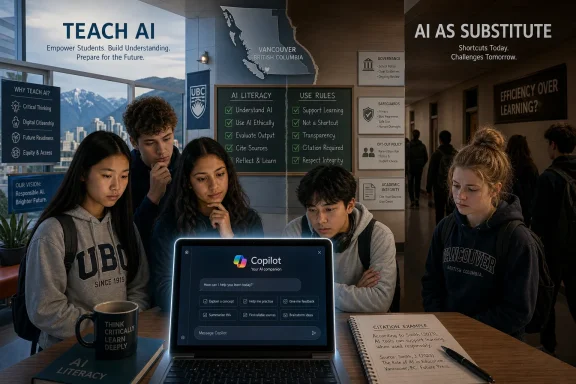 Vancouver Didn’t Ban the Future, It Pre-Installed It
The school board’s argument is familiar because it is now the default institutional defense of generative AI: students are already using these tools, so schools should bring them inside a managed environment. That logic has a surface-level sanity to it. Teenagers do not wait for curriculum committees before adopting technology, and pretending otherwise is how schools ended up years behind social media, smartphones, and messaging apps.But there is a difference between acknowledging a technology and provisioning an account for it. A district-supported login does more than reduce risk; it confers legitimacy. It tells a thirteen-year-old that this is not merely a tool some people use, but an endorsed layer of the school environment.
That distinction matters because Copilot is not a calculator, not a search box, and not a spelling checker. A generative AI chatbot does not simply retrieve information or correct a typo. It can plan, draft, summarize, argue, imitate, and produce work that looks suspiciously like the thing students are being asked to learn how to create.
The Vancouver School Board’s stated goal — helping students prepare for a technology-rich world — is hard to dispute. The weakness is not the premise that AI literacy belongs in schools. The weakness is the leap from literacy to account rollout, especially when the public explanation has been thinner than the educational consequences demand.
The Age of Thirteen Is Not a Technical Detail
Thirteen has become the magic number in platform policy because it sits at the intersection of children’s privacy law, commercial product design, and institutional convenience. It is not a developmental milestone at which students suddenly become capable of evaluating automated persuasion, synthetic authority, privacy tradeoffs, and academic shortcutting. It is mostly the age at which many online services become easier to administer.That should make school districts more cautious, not less. A thirteen-year-old is often just beginning to write sustained arguments, manage sources, distinguish paraphrase from plagiarism, and build the internal discipline required to sit with a difficult assignment. These are precisely the moments when a chatbot can be most tempting and most distorting.
The issue is not that every student will type “write my essay” and submit the answer. The subtler problem is that students may never have to endure the useful friction of forming a first bad draft. When software offers structure, thesis language, topic sentences, transitions, and polished conclusions in seconds, it can quietly relocate the hard part of learning outside the student’s head.
Schools have always mediated tools. They decide when students may use calculators, when they must show work, when spellcheck is acceptable, and when outside help crosses a line. Generative AI demands the same kind of boundary-setting, except the boundary is harder to see because the tool can masquerade as brainstorming, tutoring, editing, and authorship all at once.
Copilot’s Safety Case Is Stronger Than Its Learning Case
Microsoft’s education pitch is not reckless in the narrow privacy sense. The enterprise and education versions of Copilot are built around promises that matter to IT administrators: school-managed identities, commercial data protection, content filtering, and assurances that prompts and responses are not used to train the underlying foundation models. Compared with sending students to unmanaged consumer chatbots, a district-controlled deployment is plainly safer.For a sysadmin, that argument lands. Managed accounts mean centralized policy, auditability, identity controls, and a cleaner compliance story. If students are going to use AI anyway, Microsoft would prefer they use it inside the tenant rather than through personal accounts on a patchwork of consumer services.
But safety is not the same as pedagogy. A filtered chatbot can still do too much of the work. A privacy-preserving chatbot can still weaken the assignment. A district-approved chatbot can still blur the line between assistance and substitution.
This is where the debate often goes sideways. Vendors and institutions talk about responsible AI as if the main dangers are data leakage, toxic output, and hallucinated facts. Those are real concerns, but in a classroom the central danger may be more ordinary: the tool can make it easier for students to avoid practice.
If the goal is to teach AI literacy, then the first question is not whether Copilot protects student data. The first question is what students are supposed to do with it, when they are supposed to avoid it, and how teachers will know the difference.
The MIT Study Is a Warning, Not a Verdict
The recent MIT Media Lab work on ChatGPT-assisted essay writing has understandably become a banner for AI skeptics. The study found that participants using a large language model during essay tasks showed lower neural connectivity and weaker recall than those writing without tools, with search-engine users landing somewhere in between. It also suggested that some users retained less ownership over the work they had produced with AI help.That is troubling, but it should be handled carefully. The study was limited, used adult participants rather than middle-school students, and was released as a preprint rather than a settled body of educational science. It does not prove that a child who uses Copilot in Grade 8 will suffer permanent cognitive decline.
Still, dismissing it would be just as lazy as overclaiming it. The study’s most important contribution is not a dramatic claim about brain damage. It is the empirical reinforcement of something teachers have long understood: when the tool performs the cognitive labor, the learner may not build the cognitive muscle.
That point does not require technophobia. We already understand it in other domains. A student who watches a math solution video may feel fluent without being able to solve the next problem. A student who copies a model paragraph may recognize good writing without being able to produce it. AI scales that illusion of competence with extraordinary efficiency.
The MIT work should not settle the policy debate, but it should raise the burden of proof. If a school district introduces AI accounts at scale, it should be able to explain why the deployment will increase thinking rather than outsource it.
The Essay Is Where the Policy Becomes Real
The example raised by the student journalist at The Martlet cuts through the abstraction. Asked for help with an 800-word argumentative essay on the Black Death, Copilot reportedly generated a full essay even though the user had not explicitly asked it to do so. That is not a fringe misuse case. That is the obvious collision between a writing assignment and a writing machine.To be fair, a teacher can design assignments that are harder to outsource. Oral defenses, in-class drafting, handwritten reflections, process journals, source annotations, and version histories all make a difference. But those mitigations require training, time, and consistency across classrooms.
A district rollout without a visible instructional framework risks placing the burden on individual teachers after the fact. One teacher may treat Copilot as a brainstorming partner. Another may ban it for essays. A third may allow it for editing but not drafting. Students will quickly learn that the rules are local, negotiable, and sometimes unenforceable.
That is not a recipe for AI literacy. It is a recipe for ambiguity, and ambiguity favors the student with the most confidence, the most outside support, or the least concern about academic integrity.
The core educational question is simple: when a student turns in a piece of writing, what part of that work must be theirs? Until a district can answer that in operational terms, the chatbot account is ahead of the policy.
Teaching AI Safety Does Not Require Handing Over the Keys
The Vancouver argument also leans on a comparison to cyber-safety. Schools teach students about online risks, privacy, scams, and digital citizenship because those risks are part of life. By that logic, AI safety belongs in the curriculum too.That is right as far as it goes. Students should learn that chatbots can fabricate sources, flatten nuance, encode bias, leak sensitive information, and produce confident nonsense. They should learn how AI-generated text can violate academic integrity even when it is not copied from a traditional source. They should learn that “the computer said so” is not evidence.
But cyber-safety lessons do not require schools to create social media accounts for every child. Sex education does not require schools to simulate every adult relationship. Driver education, where it exists, does not begin by tossing keys to the youngest students and hoping guardrails will do the rest.
There are ways to teach AI without making the chatbot a standing personal assistant. Teachers can demonstrate prompts on a shared screen, compare AI answers with primary sources, show hallucinations in controlled exercises, and ask students to critique machine-generated drafts. Those activities can build skepticism and fluency without normalizing constant dependence.
The difference is subtle but important. A curriculum can make AI an object of study. An account makes AI an available actor in the student’s workflow.
Parents Are Being Asked to Trust a System They Cannot Yet See
The parental unease around the Vancouver rollout is not merely sentimental resistance to new technology. Parents are being asked to accept a change in the learning environment that may affect homework, privacy, assessment, and academic habits. If the district has a detailed instructional plan, a clear opt-out mechanism, and a robust teacher-training model, it should say so plainly.The absence of a clear opt-out answer is especially important. In public education, default access carries institutional weight. Families who object may not know whether refusing the tool will disadvantage their child, complicate classroom participation, or mark them as difficult.
Districts often treat opt-out questions as administrative edge cases, but with AI they go to the legitimacy of the rollout. If Copilot is optional, what does optional mean in a classroom where assignments may assume access? If it is effectively required, what evidence justifies making it part of the student learning environment?
There is also a trust gap created by the speed of adoption. Generative AI has moved faster than curriculum standards, teacher professional development, assessment policy, and public consultation. Institutions are now trying to retrofit governance onto tools that vendors are improving, rebranding, and embedding across productivity suites at a pace schools do not control.
Parents do not need to win every policy argument. But they deserve more than reassurance that the platform has safeguards and the future is coming.
Microsoft’s Education Strategy Is Not the Same as a School’s Duty
Microsoft has every reason to make Copilot feel inevitable in education. The company has spent years embedding cloud identity, Teams, OneNote, Intune, and Microsoft 365 into schools and universities. Copilot is the next layer in that stack: a conversational interface over productivity, search, reading, writing, and eventually classroom workflows.From Microsoft’s perspective, the strategy is coherent. If students learn with Copilot, educators teach with Copilot, and administrators manage with Copilot, the platform becomes infrastructure. The company can argue that it is providing secure, responsible AI for a world where unmanaged tools are already in use.
A school district’s duty is different. It is not to accelerate platform familiarity for its own sake. It is to decide when a tool advances learning, when it undermines learning, and when vendor convenience is being mistaken for educational necessity.
That distinction should be obvious, but it gets blurred whenever technology arrives under the banner of inevitability. Schools heard similar language about tablets, learning management systems, coding for all, one-to-one laptops, and remote learning platforms. Some of those tools proved useful; some were oversold; nearly all required more teacher support and policy clarity than their initial rollouts admitted.
AI is not just another app in that lineage. It is a general-purpose text generator in a system where text is still one of the primary ways students demonstrate thinking. That makes the stakes unusually high.
The Real Divide Is Between AI as Tutor and AI as Substitute
There is a plausible pro-AI case for schools, and critics should not pretend otherwise. A well-designed AI tutor could help a student practice vocabulary, get unstuck on a math concept, review a science process, or receive feedback when a teacher is unavailable. For students with disabilities, language barriers, or uneven access to adult help at home, AI could provide meaningful support.But the same system can become a substitute for effort. The difference is not always built into the product. It depends on the task, the prompt, the classroom norm, and the student’s intent.
The best use of AI in education may come after the student has attempted the work. A chatbot can be useful as a reviewer, opponent, quizzer, or explainer. It is far more dangerous as the first mover in a writing assignment, because the first move is where students clarify what they think.
This is where districts need rules that are pedagogical rather than merely technical. “Use AI responsibly” is not a rule. “You may use Copilot after completing a first draft, and you must submit the original draft, the prompts, and a reflection on what changed” is closer to one.
The uncomfortable truth is that responsible AI use is labor-intensive. It asks teachers to redesign assignments, students to document process, administrators to support enforcement, and parents to understand new norms. The easiest part is creating the accounts.
The Classroom Needs Friction by Design
Good schooling often depends on productive friction. Students need to struggle with a sentence, misread a source and correct themselves, discover that their thesis is too broad, and learn that an argument does not become persuasive merely because it sounds polished. These are not bugs in the learning process. They are the learning process.Generative AI is engineered to remove friction. That is why it is useful in professional settings, where the goal is often speed, synthesis, and reduction of repetitive work. Adults with developed judgment can use it to accelerate tasks they already understand.
Children are in a different position. They are still building the judgment that tells them whether the output is good, whether the source is real, whether the tone is appropriate, and whether the argument is theirs. Giving them a fluent assistant before they have fluency of their own risks reversing the order.
This does not mean schools should preserve difficulty for its own sake. It means they should distinguish between friction that is wasteful and friction that is formative. Looking up citation punctuation may be wasteful; deciding what evidence supports a claim is formative. Fixing a typo may be wasteful; wrestling with paragraph structure is formative.
AI policy in schools should begin with that distinction. Without it, the machine will happily smooth away both kinds.
Vancouver’s Rollout Exposes a Governance Lag
The Vancouver case is part of a broader institutional lag. AI products are being deployed through software agreements, identity systems, and admin consoles, while the public debate is still catching up to what those switches mean. A district can technically enable a feature long before it has socially earned the right to normalize it.That lag is not unique to Vancouver. Across North America, schools are caught between panic and adoption. Ban AI, and students use it anyway. Embrace it, and schools may launder corporate experimentation through children’s homework. Delay, and districts are accused of failing to prepare students for the future.
The answer is not paralysis. But the answer also cannot be a quiet rollout followed by vague assurances. Public institutions need to show their work, especially when the technology affects minors and the core skills schools exist to develop.
A credible rollout would include grade-by-grade use cases, prohibited uses, teacher training requirements, assessment redesign, parent notification, opt-out procedures, privacy documentation, and a plan for evaluating outcomes. It would also include a willingness to pause or narrow the deployment if evidence shows that students are substituting AI output for learning.
That is the governance standard AI deserves. Not because AI is uniquely evil, but because it is uniquely capable of looking like learning from the outside.
The Copilot Account Is the Smallest Part of the Decision
The Vancouver debate should not be reduced to whether Microsoft Copilot is safer than ChatGPT or Claude. In a managed school environment, it probably is. The larger question is whether schools are prepared to manage the educational consequences of making chatbot access ordinary.A cautious district would treat the first year as a controlled pilot, not a cultural reset. It would define the assignments where AI is allowed, the assignments where it is prohibited, and the evidence students must provide when they use it. It would publish the policy in language parents and students can understand.
It would also separate AI literacy from AI dependence. Students can learn how chatbots work, where they fail, how they hallucinate, how they affect authorship, and how they should be cited without being encouraged to run every assignment through a synthetic assistant.
The strongest argument for school-managed AI is that unmanaged AI is worse. That may be true. But “better than chaos” is not the same as good policy, and it is certainly not enough for a district-wide rollout to minors.
Vancouver’s AI Lesson Is Really About Institutional Restraint
The concrete facts matter more than the slogans here.- The Vancouver School Board has enabled Microsoft Copilot accounts for students aged 13 and older, making generative AI a district-supported tool rather than merely an outside technology students may encounter.
- Microsoft’s managed education environment can offer stronger privacy and safety controls than consumer chatbot accounts, but those controls do not answer whether the tool improves learning.
- The MIT essay-writing study should not be treated as final proof of cognitive harm, but it does support the concern that outsourcing writing can reduce engagement and recall.
- AI literacy can be taught through demonstrations, critique, controlled exercises, and academic-integrity instruction without making chatbot use a default part of student workflow.
- Any district deploying AI to minors should publish clear rules on permitted use, opt-outs, teacher training, assessment changes, and how the rollout will be evaluated.
References
- Primary source: martlet.ca
Published: 2026-06-25T18:52:32.592612
Does a thirteen-year-old really need an AI chatbot account in school?
Vancouver School Board rolled out Microsoft Copilot AI chatbot accounts for every student aged 13+. Why make such a bold step so quickly?martlet.ca - Related coverage: scientificamerican.com
Does Using ChatGPT Really Change Your Brain Activity? | Scientific American
Scientists warn against reading too much into a small experiment about ChatGPT and brain activity that is receiving a lot of buzzwww.scientificamerican.com - Related coverage: techlearning.com
Your Brain On ChatGPT: Everything Educators Need To Know About MIT’s AI Study | Tech & Learning
A recent study of ChatGPT’s use for writing essays does not paint a flattering picture of the tool. But some of the study’s findings have been misunderstood, says its lead author.www.techlearning.com
