

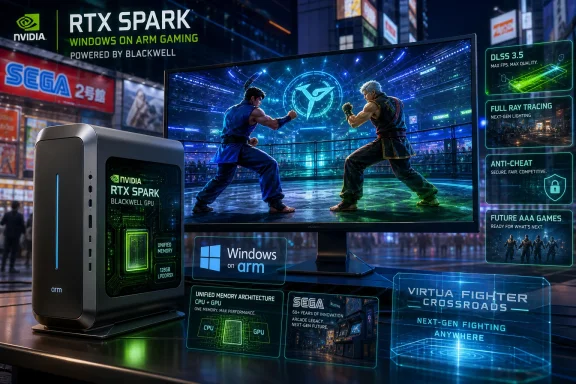
Nvidia and Sega are bringing Virtua Fighter Crossroads and future Sega games to RTX Spark, giving the forthcoming Arm-based Windows platform something it needs more than another hardware demonstration: a major publisher willing to support it. The 2027 fighting game is the first Sega release named for RTX Spark, although neither company has disclosed whether it will run as native Arm64 code or through Microsoft’s Prism translation layer.
Nvidia announced the commitment on July 15 at an event in Tokyo’s Akihabara district celebrating its 30-year relationship with Sega. Nvidia’s official blog says Sega will support RTX Spark across future titles, while GamesBeat reports Nvidia Vice President Deepu Talla described “all of Sega’s games” as coming to the platform. That broader language remains short on release names, technical details, and delivery dates, but it substantially raises the stakes for Windows gaming on Arm.
As detailed by Gizmodo, Nvidia is also working with Capcom, Konami, Riot Games, Remedy Entertainment, and Warhorse Studios. The company has presented RTX Spark as a gaming platform alongside its heavier emphasis on local AI, content creation, and high-performance Windows laptops.
A publisher commitment matters because Windows on Arm has never primarily suffered from a shortage of impressive silicon. Qualcomm’s Snapdragon X systems demonstrated that modern Arm laptops could deliver strong battery life and credible everyday Windows performance, but their gaming experience remained governed by translation compatibility, graphics drivers, copy protection, and anti-cheat software.
RTX Spark attacks the graphics portion of that problem with familiar Nvidia technology. The platform combines a 20-core Arm-based Grace CPU with a Blackwell RTX GPU offering up to 6,144 CUDA cores, up to 128GB of unified memory, and support for DLSS, Reflex, G-SYNC, ray tracing, and Nvidia’s wider software stack. Microsoft says RTX Spark machines will begin shipping in fall 2026 from Surface, Asus, Dell, HP, Lenovo, and MSI.
Those specifications make RTX Spark unlike the integrated graphics configurations associated with earlier Windows on Arm laptops. They do not, however, automatically make an x86 Windows game compatible with Arm.
Sega’s participation therefore represents a more valuable signal than another controlled demonstration. If Virtua Fighter Crossroads receives a properly tested Arm64 build—or even a carefully optimized release designed around Prism—it establishes a repeatable production route that Sega can use for subsequent games.
The distinction between native and translated code remains important. Nvidia’s announcement does not explain which approach Sega will take, and the phrase “coming to RTX Spark” could cover several technical arrangements. Until Nvidia or Sega confirms native Arm64 binaries, buyers should not assume that every promised game will bypass emulation.
That reach is visible in Nvidia’s initial partner list. Riot’s Valorant and League of Legends are particularly significant because competitive games depend on low-level anti-cheat components that cannot simply be translated like a conventional application. Remedy’s Alan Wake 2 and Control, meanwhile, provide demanding showcases for ray tracing and DLSS.
Capcom, Konami, and Warhorse bring different workloads and engines into the equation. A broad catalog is essential because a platform that runs selected Nvidia-sponsored demonstrations but fails unpredictably across a Steam library will not be considered a viable gaming PC by enthusiasts.
Nvidia has told Gizmodo that it intends to seek native support for more major AAA games. That is the correct target, but the company will still need Prism for the enormous back catalog of Windows software that publishers are unlikely to rebuild for Arm.
At Computex 2026, Gizmodo saw Pragmata running through Prism on a preproduction Microsoft Surface Laptop Ultra rather than as a native Arm release. Nvidia also demonstrated Alan Wake 2 at more than 90 frames per second using DLSS upscaling, ray reconstruction, and 2X Multi Frame Generation.
The result sounds playable, but it is not a clean measure of the underlying rendering performance. Upscaling reconstructs an image from a lower internal resolution, while frame generation inserts generated frames between conventionally rendered ones. Both can make a game look smoother, but neither resolves processor compatibility, driver behavior, input latency, or anti-cheat restrictions.
RTX Spark must work when the demo script ends. Reviewers will need to test untranslated games, obscure launchers, mods, peripherals, shader compilation, sleep and resume behavior, and titles that receive no special engineering attention from Nvidia.
Qualcomm has already spent years working on this issue. In November 2025, it announced that Fortnite and Easy Anti-Cheat support had reached Snapdragon X Series PCs, alongside work involving Tencent Anti-Cheat Expert, Denuvo, BattlEye, Roblox Hyperion, and other protection systems. That progress benefited Windows on Arm generally, even if it arrived too late to prevent the first Snapdragon X gaming experience from appearing incomplete.
Nvidia says RTX Spark will support major anti-cheat systems and is working with Riot and anti-cheat vendors. For prospective buyers, the useful test will not be the number of company logos presented at launch. It will be whether games such as Valorant, Fortnite, and other competitive releases install, update, and join protected matches without architecture-specific errors.
This is also where Nvidia’s involvement could improve Windows on Arm beyond RTX Spark. Native Arm64 middleware, better anti-cheat support, and engine-level changes can potentially help Qualcomm-powered PCs, provided developers do not limit their work to Nvidia-specific hardware checks or proprietary deployment paths.
The Sega agreement is explicitly not an exclusivity arrangement. Capcom and Remedy have already ported games to Apple silicon, while Qualcomm continues improving Snapdragon gaming support. Publishers therefore have an incentive to treat Arm as another PC deployment target rather than build isolated versions for individual chip vendors.
That launch will reveal whether RTX Spark has enough performance and compatibility to justify buying an Arm PC instead of an established Intel or AMD system with discrete GeForce graphics. Pricing, power limits, cooling, driver cadence, and actual battery life while gaming remain unknown for many announced models.
Sega’s support makes that proposition more credible, but one confirmed 2027 game does not establish a platform. Nvidia still needs a published compatibility picture showing which titles are native Arm64 releases, which are specifically optimized for Prism, and which merely happen to launch under translation.
The immediate change is nevertheless concrete: RTX Spark now has a named upcoming game and a publisher promising continued support, rather than only Nvidia and Microsoft assuring buyers that compatibility will arrive. If more studios convert those partnership announcements into shipping Arm builds before the first RTX Spark PCs reach stores this fall, Windows on Arm gaming may finally advance from an impressive demonstration to a platform players can reasonably choose.
Nvidia announced the commitment on July 15 at an event in Tokyo’s Akihabara district celebrating its 30-year relationship with Sega. Nvidia’s official blog says Sega will support RTX Spark across future titles, while GamesBeat reports Nvidia Vice President Deepu Talla described “all of Sega’s games” as coming to the platform. That broader language remains short on release names, technical details, and delivery dates, but it substantially raises the stakes for Windows gaming on Arm.
As detailed by Gizmodo, Nvidia is also working with Capcom, Konami, Riot Games, Remedy Entertainment, and Warhorse Studios. The company has presented RTX Spark as a gaming platform alongside its heavier emphasis on local AI, content creation, and high-performance Windows laptops.
 Sega Gives RTX Spark More Than a Showcase Demo
A publisher commitment matters because Windows on Arm has never primarily suffered from a shortage of impressive silicon. Qualcomm’s Snapdragon X systems demonstrated that modern Arm laptops could deliver strong battery life and credible everyday Windows performance, but their gaming experience remained governed by translation compatibility, graphics drivers, copy protection, and anti-cheat software.RTX Spark attacks the graphics portion of that problem with familiar Nvidia technology. The platform combines a 20-core Arm-based Grace CPU with a Blackwell RTX GPU offering up to 6,144 CUDA cores, up to 128GB of unified memory, and support for DLSS, Reflex, G-SYNC, ray tracing, and Nvidia’s wider software stack. Microsoft says RTX Spark machines will begin shipping in fall 2026 from Surface, Asus, Dell, HP, Lenovo, and MSI.
Those specifications make RTX Spark unlike the integrated graphics configurations associated with earlier Windows on Arm laptops. They do not, however, automatically make an x86 Windows game compatible with Arm.
Sega’s participation therefore represents a more valuable signal than another controlled demonstration. If Virtua Fighter Crossroads receives a properly tested Arm64 build—or even a carefully optimized release designed around Prism—it establishes a repeatable production route that Sega can use for subsequent games.
The distinction between native and translated code remains important. Nvidia’s announcement does not explain which approach Sega will take, and the phrase “coming to RTX Spark” could cover several technical arrangements. Until Nvidia or Sega confirms native Arm64 binaries, buyers should not assume that every promised game will bypass emulation.
Nvidia Is Building a Publisher Coalition
Nvidia already occupies a position in PC gaming that Qualcomm and Apple cannot easily reproduce. GeForce hardware, Game Ready drivers, DLSS integrations, and developer engineering relationships give the company direct access to studios already optimizing Windows games around its technology.That reach is visible in Nvidia’s initial partner list. Riot’s Valorant and League of Legends are particularly significant because competitive games depend on low-level anti-cheat components that cannot simply be translated like a conventional application. Remedy’s Alan Wake 2 and Control, meanwhile, provide demanding showcases for ray tracing and DLSS.
Capcom, Konami, and Warhorse bring different workloads and engines into the equation. A broad catalog is essential because a platform that runs selected Nvidia-sponsored demonstrations but fails unpredictably across a Steam library will not be considered a viable gaming PC by enthusiasts.
Nvidia has told Gizmodo that it intends to seek native support for more major AAA games. That is the correct target, but the company will still need Prism for the enormous back catalog of Windows software that publishers are unlikely to rebuild for Arm.
At Computex 2026, Gizmodo saw Pragmata running through Prism on a preproduction Microsoft Surface Laptop Ultra rather than as a native Arm release. Nvidia also demonstrated Alan Wake 2 at more than 90 frames per second using DLSS upscaling, ray reconstruction, and 2X Multi Frame Generation.
The result sounds playable, but it is not a clean measure of the underlying rendering performance. Upscaling reconstructs an image from a lower internal resolution, while frame generation inserts generated frames between conventionally rendered ones. Both can make a game look smoother, but neither resolves processor compatibility, driver behavior, input latency, or anti-cheat restrictions.
RTX Spark must work when the demo script ends. Reviewers will need to test untranslated games, obscure launchers, mods, peripherals, shader compilation, sleep and resume behavior, and titles that receive no special engineering attention from Nvidia.
Anti-Cheat Remains the Gatekeeper
Multiplayer compatibility may prove more important than peak frame rates. Kernel-level anti-cheat systems interact closely with Windows and the processor architecture, making them one of the hardest obstacles for translated games.Qualcomm has already spent years working on this issue. In November 2025, it announced that Fortnite and Easy Anti-Cheat support had reached Snapdragon X Series PCs, alongside work involving Tencent Anti-Cheat Expert, Denuvo, BattlEye, Roblox Hyperion, and other protection systems. That progress benefited Windows on Arm generally, even if it arrived too late to prevent the first Snapdragon X gaming experience from appearing incomplete.
Nvidia says RTX Spark will support major anti-cheat systems and is working with Riot and anti-cheat vendors. For prospective buyers, the useful test will not be the number of company logos presented at launch. It will be whether games such as Valorant, Fortnite, and other competitive releases install, update, and join protected matches without architecture-specific errors.
This is also where Nvidia’s involvement could improve Windows on Arm beyond RTX Spark. Native Arm64 middleware, better anti-cheat support, and engine-level changes can potentially help Qualcomm-powered PCs, provided developers do not limit their work to Nvidia-specific hardware checks or proprietary deployment paths.
The Sega agreement is explicitly not an exclusivity arrangement. Capcom and Remedy have already ported games to Apple silicon, while Qualcomm continues improving Snapdragon gaming support. Publishers therefore have an incentive to treat Arm as another PC deployment target rather than build isolated versions for individual chip vendors.
The Fall Hardware Launch Will Set Expectations
Microsoft and Nvidia are positioning RTX Spark systems as premium Windows machines spanning gaming, creation, development, and local AI. The first wave is expected in fall 2026, including Microsoft’s Surface Laptop Ultra and compact desktops from multiple OEMs.That launch will reveal whether RTX Spark has enough performance and compatibility to justify buying an Arm PC instead of an established Intel or AMD system with discrete GeForce graphics. Pricing, power limits, cooling, driver cadence, and actual battery life while gaming remain unknown for many announced models.
Sega’s support makes that proposition more credible, but one confirmed 2027 game does not establish a platform. Nvidia still needs a published compatibility picture showing which titles are native Arm64 releases, which are specifically optimized for Prism, and which merely happen to launch under translation.
The immediate change is nevertheless concrete: RTX Spark now has a named upcoming game and a publisher promising continued support, rather than only Nvidia and Microsoft assuring buyers that compatibility will arrive. If more studios convert those partnership announcements into shipping Arm builds before the first RTX Spark PCs reach stores this fall, Windows on Arm gaming may finally advance from an impressive demonstration to a platform players can reasonably choose.
References
- Primary source: Gizmodo
Published: 2026-07-15T15:00:51+00:00
Nvidia's Finally Making Gaming on ARM PCs Viable
Nvidia wants to be the Daddy Warbucks of ARM-based PC gaming. gizmodo.com
- Related coverage: tomshardware.com
Sega’s $5M investment saved Nvidia in 1996, now Jensen Huang is heading to Tokyo to mark 30 years of partnership — Akihabara event will include a GeForce RTX 5090 FE lottery, an RTX Spark presentation, and more | Tom's Hardware
In the mid-90s Sega provided a $5M lifeline to Nvidia before its first hit GPU.www.tomshardware.com
