

Microsoft plans to bring Viva Insights workplace metrics into Viva Glint survey reporting for Microsoft Viva customers in the worldwide standard cloud, with Roadmap ID 518289 listed as in development and targeted for general availability in October 2026. The feature sounds modest: a new tab, a few metrics, a bridge between two Viva products. But its real importance is larger than the user interface. Microsoft is trying to turn employee engagement from an episodic survey ritual into a continuously monitored management system.
That shift will be useful to some organizations and uncomfortable for others. It gives leaders a faster way to test whether changes in meeting culture, after-hours work, or collaboration patterns are actually moving in the right direction. It also pushes Microsoft 365 further into the sensitive territory where productivity telemetry, workplace analytics, and employee sentiment meet.
For years, employee engagement programs have operated on a rhythm that feels increasingly out of step with digital work. A company runs a survey, managers receive scores, HR pushes action plans, and everyone waits months to learn whether anything changed. By the time the next survey arrives, the team has reorganized, priorities have shifted, and the original diagnosis may already be stale.
Viva Glint was built for that survey-driven world. Viva Insights, by contrast, comes from the world of collaboration data: meetings, email, Teams activity, focus time, and after-hours work. Microsoft’s new integration matters because it collapses the distance between those two views of the workplace.
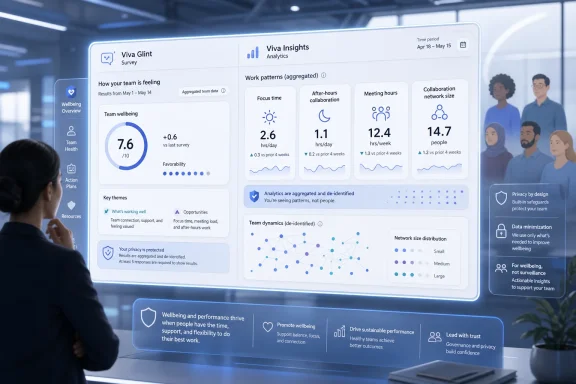
The company’s roadmap language is careful. Leaders and managers will see workplace metrics “alongside” survey results, with an initial emphasis on work-life balance and collaboration. Between survey cycles, they will be able to monitor continuous metrics to evaluate whether actions intended to improve engagement appear to be having the desired effect.
That is a very Microsoft 365 answer to a very modern management problem. If work happens inside Outlook, Teams, SharePoint, and the broader Microsoft cloud, then Microsoft can offer not just tools for doing the work, but instrumentation for interpreting how that work feels and functions.
If a team reports poor work-life balance, a manager may now see whether after-hours collaboration is high, focus time is scarce, or meeting load is climbing. If collaboration scores move, leaders may compare that against metrics such as collaboration hours, internal network size, and uninterrupted focus. The product is not just showing the survey result; it is trying to show the work pattern that may be sitting underneath it.
That is powerful because employee engagement surveys have always suffered from a gap between diagnosis and intervention. A score drops, managers are told to “take action,” and the actual action often becomes a vague blend of listening sessions, team norms, and calendar hygiene. Continuous workplace metrics give those actions something measurable to push against.
But the same feature also risks making engagement feel mechanical. A manager may be tempted to treat every survey score as a dashboard problem and every dashboard movement as evidence of cultural progress. The healthier interpretation is narrower: workplace metrics can contextualize survey results, not replace the messy human work of talking to employees.
Work-life balance is supported by metrics such as after-hours collaboration, uninterrupted focus, and meeting hours. Collaboration is supported by metrics including collaboration hours, after-hours collaboration, internal network size, and focus time. In plain English, Microsoft is giving managers a way to see whether a team is drowning in meetings, bleeding into evenings, losing deep work time, or operating in too narrow a network.
That aligns with the everyday complaints of knowledge workers. The problem is rarely just that people are “not engaged.” It is that the calendar is fragmented, the urgent has colonized the evening, and collaboration has become both the job and the obstacle to doing the job.
The feature therefore reflects a practical theory of workplace engagement. Microsoft is implying that employee sentiment is not separate from the operating system of work. If people have too little focus time, too much after-hours traffic, or collaboration patterns that reward constant availability, engagement programs will eventually collide with that reality.
Viva Glint already gives managers survey results to review and act on. By placing workplace metrics in the same experience, Microsoft is shortening the feedback loop from months to weeks. A manager who agrees to reduce recurring meetings or protect focus blocks can watch whether the team’s collaboration patterns change before the next engagement survey lands.
That is the optimistic version. The less comfortable version is that managers may now have a dashboard that appears to grade the working habits of their teams continuously. Even if the data is aggregated and privacy-protected, the cultural meaning of the dashboard depends on how it is used.
A healthy organization will treat these metrics as environmental indicators. A team with rising after-hours collaboration may need clearer priorities, better staffing, or fewer late-day escalations. An unhealthy organization may treat the same metric as a performance management proxy, asking why one manager’s team appears less “connected” or less “available” than another’s.
This is where Microsoft’s product design can only do so much. The tool can aggregate, mask, and scope data. It cannot guarantee managerial maturity.
The company’s model generally prevents managers from seeing individual-level activity in these experiences, especially for small groups. Admins can set minimum group sizes, and certain insights are hidden when thresholds are not met. In the Glint-and-Insights context, confidentiality thresholds matter because survey data and workplace telemetry become more sensitive when combined.
Still, privacy controls and employee trust are not the same thing. Workers do not experience a dashboard as a mathematical privacy guarantee. They experience it as a sign that management is watching the workplace in a new way.
That means IT and HR teams should not treat this integration as a simple roadmap feature to enable and announce. It needs a governance story. Employees should understand what data is used, what managers can and cannot see, how small groups are protected, and what the organization will not use the data for.
If that sounds like change management boilerplate, it is not. The difference between “we are using aggregate patterns to reduce burnout” and “your manager has a new productivity dashboard” is the difference between adoption and suspicion.
This integration is an example of Viva becoming more coherent. Rather than selling Glint as the survey system and Insights as the analytics system, Microsoft is trying to create a loop: ask employees how work feels, observe how work is structured, intervene, and monitor whether the structure changes.
That loop is strategically valuable for Microsoft. It gives Viva a reason to exist beyond being a bundle of HR-adjacent apps inside Microsoft 365. It also reinforces the broader Microsoft argument that the productivity cloud is not just a place where work happens, but a source of organizational intelligence.
The timing is notable as well. The roadmap item is in development, was created in November 2025, and was updated on June 22, 2026, with general availability planned for October 2026. Microsoft is not presenting this as a speculative research idea. It is on the product calendar for the worldwide standard multi-tenant cloud.
Viva integrations sit at the intersection of Microsoft 365 administration, Entra ID identity data, licensing, role assignments, privacy settings, and sometimes HR data imports. For Glint and Insights to produce meaningful, correctly scoped results, employee records must match across systems and reporting hierarchies must be accurate. Bad org data will not just create messy reports; it can create misleading management conclusions.
Admins will also need to think about licensing. Viva Insights capabilities, Viva Glint access, Microsoft 365 Copilot-related service plans in some contexts, and role-based access all complicate the practical rollout. The roadmap item says Microsoft Viva, web, worldwide standard cloud, general availability. That does not mean every tenant will automatically have a clean path to useful reports on day one.
The more subtle administrative burden is governance. Who is allowed to see manager-level breakdowns? What minimum group size should the organization set? Should access be granted broadly to all eligible managers or limited to a pilot group? These are not merely technical switches. They are policy decisions with technical consequences.
A chart showing after-hours collaboration next to a work-life balance score can look authoritative. It may even reveal a meaningful pattern. But correlation is not causation, and collaboration data is only a partial representation of work.
A customer support team, an incident response group, or a global engineering organization may show after-hours activity for reasons that are structural and unavoidable. A team with high internal network size may be collaborating effectively, or it may be drowning in coordination overhead. A team with more uninterrupted focus time may be healthier, or it may be isolated.
The best managers will use the metrics as prompts for better questions. The worst will use them as answers. Microsoft’s challenge is to design the experience so it nudges customers toward the former without pretending software can enforce judgment.
That makes Glint integration more valuable. If a company deploys Copilot, changes meeting practices, pushes asynchronous collaboration, or restructures teams, leaders will want to know whether employee sentiment and workplace patterns move together. Viva Glint plus Viva Insights offers a convenient way to tell that story.
It also makes the politics more fraught. Workers are already sensitive to AI being used to measure, benchmark, or reshape their jobs. Adding continuous engagement metrics into the same ecosystem can either reassure employees that leadership is watching for burnout, or confirm their fear that every digital trace is becoming management data.
Microsoft cannot avoid that tension because it is inherent in the product category. The more useful workplace analytics becomes, the more governance it requires. The more Microsoft sells organizational intelligence, the more customers must prove they can use that intelligence responsibly.
Preparation should start with data quality. Entra ID reporting lines, employee attributes, Glint user records, and Viva Insights configuration all shape what managers will see. If those foundations are wrong, the new integration may amplify organizational confusion rather than reduce it.
The next step is policy. HR, legal, compliance, IT, and employee representatives where applicable should agree on the acceptable use of workplace metrics. The organization should decide whether the feature is for wellbeing intervention, collaboration design, engagement follow-up, executive reporting, or all of the above.
Finally, communications matter. Employees should not learn about continuous workplace metrics through rumor or a screenshot in a manager meeting. If the stated purpose is improving engagement, the rollout itself has to model the transparency and trust the tool claims to support.
That shift will be useful to some organizations and uncomfortable for others. It gives leaders a faster way to test whether changes in meeting culture, after-hours work, or collaboration patterns are actually moving in the right direction. It also pushes Microsoft 365 further into the sensitive territory where productivity telemetry, workplace analytics, and employee sentiment meet.
 Microsoft Is Turning the Engagement Survey Into a Live Instrument Panel
For years, employee engagement programs have operated on a rhythm that feels increasingly out of step with digital work. A company runs a survey, managers receive scores, HR pushes action plans, and everyone waits months to learn whether anything changed. By the time the next survey arrives, the team has reorganized, priorities have shifted, and the original diagnosis may already be stale.Viva Glint was built for that survey-driven world. Viva Insights, by contrast, comes from the world of collaboration data: meetings, email, Teams activity, focus time, and after-hours work. Microsoft’s new integration matters because it collapses the distance between those two views of the workplace.
The company’s roadmap language is careful. Leaders and managers will see workplace metrics “alongside” survey results, with an initial emphasis on work-life balance and collaboration. Between survey cycles, they will be able to monitor continuous metrics to evaluate whether actions intended to improve engagement appear to be having the desired effect.
That is a very Microsoft 365 answer to a very modern management problem. If work happens inside Outlook, Teams, SharePoint, and the broader Microsoft cloud, then Microsoft can offer not just tools for doing the work, but instrumentation for interpreting how that work feels and functions.
The New Signal Is Not Sentiment, but Behavior Around Sentiment
The distinction matters. Viva Glint asks employees what they think and feel. Viva Insights infers patterns from how work is organized. Combining them does not magically reveal the truth of employee experience, but it does create a more useful managerial hypothesis engine.If a team reports poor work-life balance, a manager may now see whether after-hours collaboration is high, focus time is scarce, or meeting load is climbing. If collaboration scores move, leaders may compare that against metrics such as collaboration hours, internal network size, and uninterrupted focus. The product is not just showing the survey result; it is trying to show the work pattern that may be sitting underneath it.
That is powerful because employee engagement surveys have always suffered from a gap between diagnosis and intervention. A score drops, managers are told to “take action,” and the actual action often becomes a vague blend of listening sessions, team norms, and calendar hygiene. Continuous workplace metrics give those actions something measurable to push against.
But the same feature also risks making engagement feel mechanical. A manager may be tempted to treat every survey score as a dashboard problem and every dashboard movement as evidence of cultural progress. The healthier interpretation is narrower: workplace metrics can contextualize survey results, not replace the messy human work of talking to employees.
The First Metrics Reveal Microsoft’s Bet on Burnout and Meeting Culture
Microsoft’s initial scope is telling. The integration starts with work-life balance and collaboration, two areas where Microsoft 365 telemetry is strongest and where post-pandemic organizations remain most anxious. These are not abstract culture categories; they are visible in calendars, chats, meetings, and the spaces between them.Work-life balance is supported by metrics such as after-hours collaboration, uninterrupted focus, and meeting hours. Collaboration is supported by metrics including collaboration hours, after-hours collaboration, internal network size, and focus time. In plain English, Microsoft is giving managers a way to see whether a team is drowning in meetings, bleeding into evenings, losing deep work time, or operating in too narrow a network.
That aligns with the everyday complaints of knowledge workers. The problem is rarely just that people are “not engaged.” It is that the calendar is fragmented, the urgent has colonized the evening, and collaboration has become both the job and the obstacle to doing the job.
The feature therefore reflects a practical theory of workplace engagement. Microsoft is implying that employee sentiment is not separate from the operating system of work. If people have too little focus time, too much after-hours traffic, or collaboration patterns that reward constant availability, engagement programs will eventually collide with that reality.
The Manager Gets a Shorter Feedback Loop, and That Changes the Politics
The most consequential audience here is not the HR analyst. It is the line manager.Viva Glint already gives managers survey results to review and act on. By placing workplace metrics in the same experience, Microsoft is shortening the feedback loop from months to weeks. A manager who agrees to reduce recurring meetings or protect focus blocks can watch whether the team’s collaboration patterns change before the next engagement survey lands.
That is the optimistic version. The less comfortable version is that managers may now have a dashboard that appears to grade the working habits of their teams continuously. Even if the data is aggregated and privacy-protected, the cultural meaning of the dashboard depends on how it is used.
A healthy organization will treat these metrics as environmental indicators. A team with rising after-hours collaboration may need clearer priorities, better staffing, or fewer late-day escalations. An unhealthy organization may treat the same metric as a performance management proxy, asking why one manager’s team appears less “connected” or less “available” than another’s.
This is where Microsoft’s product design can only do so much. The tool can aggregate, mask, and scope data. It cannot guarantee managerial maturity.
Privacy Protections Are Necessary, but Trust Is the Real Deployment Requirement
Microsoft’s Viva Insights documentation emphasizes aggregation, de-identification, minimum group thresholds, distribution masking, and differential privacy for organization insights. Those safeguards are not cosmetic. They are essential for any product that turns collaboration behavior into management-facing analytics.The company’s model generally prevents managers from seeing individual-level activity in these experiences, especially for small groups. Admins can set minimum group sizes, and certain insights are hidden when thresholds are not met. In the Glint-and-Insights context, confidentiality thresholds matter because survey data and workplace telemetry become more sensitive when combined.
Still, privacy controls and employee trust are not the same thing. Workers do not experience a dashboard as a mathematical privacy guarantee. They experience it as a sign that management is watching the workplace in a new way.
That means IT and HR teams should not treat this integration as a simple roadmap feature to enable and announce. It needs a governance story. Employees should understand what data is used, what managers can and cannot see, how small groups are protected, and what the organization will not use the data for.
If that sounds like change management boilerplate, it is not. The difference between “we are using aggregate patterns to reduce burnout” and “your manager has a new productivity dashboard” is the difference between adoption and suspicion.
The Integration Makes Viva More Coherent After Years of Suite-Building
Microsoft Viva has sometimes felt like a suite assembled from adjacent but distinct bets: employee communications, learning, goals, insights, and feedback. Glint, acquired by LinkedIn before becoming part of Microsoft’s employee experience portfolio, added another layer of enterprise HR credibility. Viva Insights brought the Microsoft 365 data exhaust.This integration is an example of Viva becoming more coherent. Rather than selling Glint as the survey system and Insights as the analytics system, Microsoft is trying to create a loop: ask employees how work feels, observe how work is structured, intervene, and monitor whether the structure changes.
That loop is strategically valuable for Microsoft. It gives Viva a reason to exist beyond being a bundle of HR-adjacent apps inside Microsoft 365. It also reinforces the broader Microsoft argument that the productivity cloud is not just a place where work happens, but a source of organizational intelligence.
The timing is notable as well. The roadmap item is in development, was created in November 2025, and was updated on June 22, 2026, with general availability planned for October 2026. Microsoft is not presenting this as a speculative research idea. It is on the product calendar for the worldwide standard multi-tenant cloud.
IT Will Own the Plumbing, Even If HR Owns the Story
For WindowsForum.com readers, the operational question is straightforward: who gets dragged into this when the feature arrives? The answer is not just HR.Viva integrations sit at the intersection of Microsoft 365 administration, Entra ID identity data, licensing, role assignments, privacy settings, and sometimes HR data imports. For Glint and Insights to produce meaningful, correctly scoped results, employee records must match across systems and reporting hierarchies must be accurate. Bad org data will not just create messy reports; it can create misleading management conclusions.
Admins will also need to think about licensing. Viva Insights capabilities, Viva Glint access, Microsoft 365 Copilot-related service plans in some contexts, and role-based access all complicate the practical rollout. The roadmap item says Microsoft Viva, web, worldwide standard cloud, general availability. That does not mean every tenant will automatically have a clean path to useful reports on day one.
The more subtle administrative burden is governance. Who is allowed to see manager-level breakdowns? What minimum group size should the organization set? Should access be granted broadly to all eligible managers or limited to a pilot group? These are not merely technical switches. They are policy decisions with technical consequences.
The Risk Is Not Surveillance Alone, but False Precision
The common critique of workplace analytics is surveillance. That concern is valid, especially when employees are not told clearly what is collected or how it is used. But for this feature, the bigger day-to-day risk may be false precision.A chart showing after-hours collaboration next to a work-life balance score can look authoritative. It may even reveal a meaningful pattern. But correlation is not causation, and collaboration data is only a partial representation of work.
A customer support team, an incident response group, or a global engineering organization may show after-hours activity for reasons that are structural and unavoidable. A team with high internal network size may be collaborating effectively, or it may be drowning in coordination overhead. A team with more uninterrupted focus time may be healthier, or it may be isolated.
The best managers will use the metrics as prompts for better questions. The worst will use them as answers. Microsoft’s challenge is to design the experience so it nudges customers toward the former without pretending software can enforce judgment.
The Copilot Era Makes These Metrics More Valuable and More Fraught
This integration also lands in the shadow of Microsoft’s larger AI strategy. Microsoft 365 Copilot, Copilot Analytics, and Viva Insights are increasingly tied together by a common premise: the organization should be able to measure how digital work changes when new tools, especially AI tools, enter the workflow.That makes Glint integration more valuable. If a company deploys Copilot, changes meeting practices, pushes asynchronous collaboration, or restructures teams, leaders will want to know whether employee sentiment and workplace patterns move together. Viva Glint plus Viva Insights offers a convenient way to tell that story.
It also makes the politics more fraught. Workers are already sensitive to AI being used to measure, benchmark, or reshape their jobs. Adding continuous engagement metrics into the same ecosystem can either reassure employees that leadership is watching for burnout, or confirm their fear that every digital trace is becoming management data.
Microsoft cannot avoid that tension because it is inherent in the product category. The more useful workplace analytics becomes, the more governance it requires. The more Microsoft sells organizational intelligence, the more customers must prove they can use that intelligence responsibly.
The Calendar Says October, but the Real Rollout Starts Before Then
Because the roadmap lists general availability for October 2026, organizations have time to prepare. The mistake would be waiting until the feature appears in the tenant and then deciding what it means.Preparation should start with data quality. Entra ID reporting lines, employee attributes, Glint user records, and Viva Insights configuration all shape what managers will see. If those foundations are wrong, the new integration may amplify organizational confusion rather than reduce it.
The next step is policy. HR, legal, compliance, IT, and employee representatives where applicable should agree on the acceptable use of workplace metrics. The organization should decide whether the feature is for wellbeing intervention, collaboration design, engagement follow-up, executive reporting, or all of the above.
Finally, communications matter. Employees should not learn about continuous workplace metrics through rumor or a screenshot in a manager meeting. If the stated purpose is improving engagement, the rollout itself has to model the transparency and trust the tool claims to support.
The Glint Dashboard Is About to Become a Management Test
The most concrete lesson of Roadmap ID 518289 is that Microsoft is giving leaders a sharper instrument. Whether that instrument becomes a compass or a cudgel depends on the organization holding it.- Microsoft is targeting October 2026 general availability for bringing Viva Insights workplace metrics into Viva Glint for worldwide standard cloud customers.
- The first supported areas are work-life balance and collaboration, using metrics such as after-hours collaboration, meeting hours, focus time, collaboration hours, and internal network size.
- The feature is designed to help managers monitor trends between survey cycles rather than waiting months for the next engagement survey.
- The integration depends on careful configuration of identity data, reporting hierarchies, licensing, manager access, and confidentiality thresholds.
- The data should be treated as contextual evidence for better management conversations, not as a direct measure of individual effort or team quality.
- Organizations that do not explain privacy protections and acceptable use clearly should expect employee skepticism, even if the technical safeguards are strong.
References
- Primary source: Microsoft 365 Roadmap
Published: 2026-06-22T23:00:47.0315291Z
Microsoft 365 Roadmap | Microsoft 365
The Microsoft 365 Roadmap lists updates that are currently planned for applicable subscribers. Check here for more information on the status of new features and updates.www.microsoft.com
- Related coverage: m365admin.handsontek.net
Microsoft Viva: Viva Glint and Viva Insights Integration - Continuous employee engagement for leaders and managers with workplace metrics - M365 Admin
Stay connected to your team’s engagement with Viva Insights Workplace Metrics, available alongside your survey results in Viva Glint. Between survey cycles, leaders and managers can use these continuous, real-time metrics to see how their team is working and evaluate whether actions they are...m365admin.handsontek.net - Official source: directionsonmicrosoft.com
Viva Insights Roadmap 2025 - Directions on Microsoft
Viva Insights is a Teams-based application (originally based on Workspace Analytics and MyAnalytics) that provides employees with information to help improve work habits and work-life balance and managers with information about workgroup efficiency, trends, and engagement, commonly referred to...www.directionsonmicrosoft.com - Related coverage: windowscentral.com
Copilot’s new Benchmarks compares AI usage in your company | Windows Central
Your boss wants to know if you're getting the most out of Copilot's AI tools. Guess who's going to tell them?www.windowscentral.com
