Voxpopme announced on June 18, 2026, from Park City, Utah, that Voxpopme Insights for Microsoft Teams is now available through Microsoft Marketplace, letting Teams users query an organization’s Voxpopme research repository and receive summarized customer-backed answers inside Microsoft’s collaboration app. The pitch is simple enough to sound inevitable: if decisions happen in Teams, customer evidence should be callable from Teams. The larger story is not another app tile in Microsoft’s marketplace, but the continuing migration of specialized enterprise knowledge into the chat window where work increasingly gets negotiated, approved, and forgotten.
The classic customer-insights workflow has always contained a quiet bottleneck. Researchers collect interviews, videos, survey responses, transcripts, and project findings, then package them into decks or dashboards for business stakeholders who may or may not read them before the next planning meeting. The research exists, but its influence depends on timing, memory, and the political skill of the insights team.
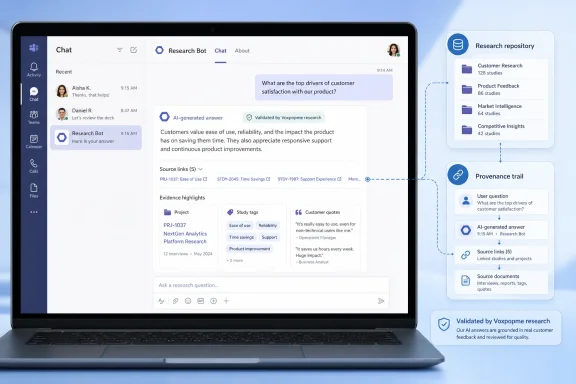
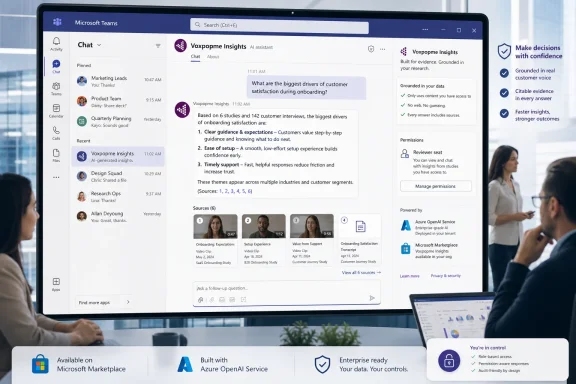
Voxpopme’s Teams integration attacks that weak point directly. Instead of asking a product manager, marketer, sales lead, or executive to log into a research platform and search for evidence, it lets the user ask a natural-language question in Microsoft Teams and receive an answer drawn from the company’s existing Voxpopme repository. In theory, the customer voice moves from being a scheduled presentation to an on-demand participant in the conversation.
That is a meaningful shift, but it is also a risky one. Research teams do more than retrieve quotes; they interpret context, qualify evidence, and prevent the organization from treating anecdote as certainty. The value of Voxpopme Insights will depend on whether it preserves that discipline while making the material easier to reach.
This is the central tension of the announcement. Voxpopme is not merely integrating with Teams; it is trying to turn customer intelligence into workplace infrastructure. If it works, customer evidence becomes less ceremonial and more operational. If it fails, it becomes another AI-flavored shortcut that lets business users mistake a plausible summary for a validated answer.
Voxpopme has chosen the latter path. Its new marketplace app effectively treats Teams as the interface layer for customer research. Users ask questions in everyday language, the integration searches relevant Voxpopme projects and underlying customer responses, and the answer comes back with source links so users can inspect the evidence behind the summary.
That matters because enterprise software adoption is often less about feature depth than about friction. A research platform may be powerful, but if the audience for its insights must remember another login, another dashboard, another taxonomy, and another search syntax, the tool becomes a place specialists go rather than a place decisions are shaped. Teams, by contrast, is already open.
This is also why Microsoft’s collaboration ecosystem keeps attracting these integrations. Teams has become a distribution channel for business context: CRM alerts, workflow approvals, analytics snippets, support escalations, meeting intelligence, and now customer research. The gravitational pull is obvious. The more work happens in the chat client, the more vendors want their systems to appear there at the moment a decision is being formed.
For WindowsForum readers, the significance is less about Voxpopme as a niche customer-intelligence vendor and more about the pattern. Microsoft 365 is turning into an operating layer for third-party enterprise knowledge, and Teams is one of the places where that strategy is most visible. The Windows desktop may still be the endpoint, but the workspace is increasingly an authenticated stream of apps, agents, summaries, and permissions inside Microsoft’s cloud.
The new app tries to solve that without turning the insights team into an internal help desk. Once the Teams app is added, users request a Reviewer seat from their Voxpopme administrator. After access is granted, questions are handled through the individual user’s Voxpopme credentials, and administrators retain control over rollout and access management.
That design choice is important. If the integration simply exposed a company’s full research archive to everyone with a Teams license, it would be a governance incident waiting to happen. Customer research can contain sensitive comments, product road map implications, competitive intelligence, personal data, and material that should be limited by geography, department, client, or role.
By tying requests to Voxpopme credentials and Microsoft sign-in, Voxpopme is signaling that it understands the enterprise buyer’s first objection. The app is not being pitched as a free-for-all chatbot over customer data. It is being positioned as a controlled extension of existing permissions into the collaboration layer.
Still, permissioning is only the first layer of governance. The harder questions come after deployment. Which employees should be allowed to ask broad strategic questions? What kinds of source material should be surfaced to non-researchers? How should the system handle conflicting findings across different studies? Who is accountable when a summarized answer influences a product decision that later proves wrong?
Those are not reasons to dismiss the product. They are reasons to treat the announcement as part of a broader enterprise AI maturation curve. The first wave of workplace AI asked whether a system could generate useful text. The next wave asks whether that text is anchored to approved evidence, constrained by permissions, and auditable after the fact.
That last part is crucial. Voxpopme says answers include insights and evidence, with source links back to the underlying research. This is not a cosmetic feature. In customer intelligence, the difference between “customers dislike the onboarding flow” and “three recent studies show enterprise admins struggled with provisioning steps during first-week setup” is the difference between vibe and evidence.
The danger with any summarized research assistant is compression. Qualitative research is valuable precisely because it captures nuance: hesitation, emotion, contradiction, context, and the messy gap between what customers say they want and what they actually do. A summary can make that material accessible, but it can also sand off the edges that make it useful.
For business users, the source links should not be treated as optional decoration. They are the accountability layer. A good Teams answer should be the beginning of investigation, not the end of it, especially when the decision involves pricing, positioning, product changes, or customer segmentation.
For IT and security teams, the trust question looks different. They will care less about whether the customer quote is emotionally compelling and more about whether the app respects identity boundaries, logs access appropriately, and behaves predictably inside the Microsoft 365 tenant. Marketplace availability lowers procurement friction, but it does not eliminate due diligence.
This is where Voxpopme’s Microsoft alignment helps. The company has previously positioned its AI capabilities around Microsoft’s ecosystem, including Azure OpenAI-related messaging, and the new Teams integration extends that story into the collaboration surface. For Microsoft-oriented enterprises, that is a more comfortable pitch than a standalone AI tool asking for broad access to research data with unclear identity plumbing.
Putting customer intelligence into Teams changes the cadence. It allows a stakeholder to ask, “What did customers say about pricing confusion?” or “Do buyers understand the new packaging?” while a discussion is still live. That does not guarantee better decisions, but it raises the cost of ignoring evidence.
The most interesting use case is not the formal research readout. It is the casual moment before a decision hardens. A product manager is drafting a requirements document. A campaign team is debating messaging. A regional sales lead is challenging headquarters’ assumptions. If the organization can summon customer-backed evidence in those moments, research becomes less of an artifact and more of a reflex.
This is also where the product could change the internal status of insights teams. Rather than being seen as a service bureau that answers requests, the research function can become the steward of a living evidence base. The work of designing good studies, tagging material, maintaining repositories, and governing access becomes more visible because more employees experience the output directly.
But there is a cultural catch. Democratized access does not automatically produce evidence-based decision-making. Some organizations will use tools like this to validate decisions they already wanted to make. Others will ask shallow questions and accept shallow answers. The technology can put customer evidence into the flow of work, but it cannot force intellectual honesty.
For existing Voxpopme customers, the path is straightforward: add the app to Teams, request the appropriate seat, and begin using the integration once access is granted. For organizations new to Voxpopme, the Teams app is likely less a standalone purchase trigger than a demonstration of how the platform’s research repository can be activated across the business.
That distinction matters. This is not a general-purpose survey bot for Teams. It is useful only if an organization already has, or is willing to build, a meaningful corpus of customer research inside Voxpopme. The app’s value depends on the quality, relevance, and coverage of the underlying data.
That makes the integration more defensible than a generic chatbot, but also narrower. Companies with mature research operations may see immediate value because they already have the evidence base. Companies with scattered interviews, inconsistent tagging, and little research governance may discover that a Teams interface simply exposes the disorder underneath.
In that sense, the Teams app is a mirror. It will make good research operations more accessible and weak research operations more visibly incomplete. The interface may be new, but the organizational discipline behind it still matters.
The app uses Microsoft secure sign-in and individual Voxpopme credentials, according to the announcement. Administrators also retain access management, which suggests a rollout model aligned with enterprise controls rather than consumer-style self-service. That is a necessary starting point, especially for organizations that tightly manage Teams apps through Microsoft 365 admin policies.
But IT teams will still need to ask what data leaves Teams, what is processed by Voxpopme, what logs are retained, and how source links behave when forwarded or copied into other chats. They will want to know whether answers are cached, whether prompts are stored, and whether the integration can be limited to specific users or departments. They will also need to understand how Reviewer seats are licensed and governed.
There is also a user-training issue hiding in plain sight. Employees need to understand that a summarized answer is not the same thing as a full research report. They need to know when to escalate to the insights team, when to inspect sources, and when a question is outside the scope of the available evidence.
For Windows administrators, this is the familiar shape of modern SaaS adoption. A business unit sees productivity value in a Teams app. IT sees a new integration touching identity, data, and compliance. The winning deployment is the one where those views are reconciled early rather than after the tool has already spread through informal channels.
That shift benefits Microsoft because it reinforces Teams as the work hub. It benefits vendors because they can meet users inside a tool that already has daily engagement. It benefits employees when the integration is well designed, because they do not have to navigate a maze of portals to answer a simple business question.
The cost is clutter and dependency. Teams already carries chats, meetings, channels, files, workflow notifications, apps, bots, and Copilot experiences. Every new integration claims to reduce context switching, but too many integrations can turn the hub into another noisy inbox.
The difference between useful embedded intelligence and enterprise confetti is relevance. Voxpopme has a plausible claim to relevance because customer evidence is often needed during cross-functional discussion. If the app returns grounded, concise answers with inspectable sources, it may earn its place. If it produces vague summaries that users cannot trust, it will become one more ignored sidebar.
This is the standard Microsoft ecosystem bargain. The platform makes distribution easier, but it also places vendors in a crowded arena where usefulness must be immediate. In Teams, an app does not merely compete with rival software. It competes with the user’s patience.
That is a form of organizational memory. Companies routinely spend significant money learning what customers think, only to bury that knowledge in decks, folders, project pages, and archived recordings. The promise of AI-assisted retrieval is that institutional knowledge can become callable rather than merely stored.
This is especially important in large organizations where employee turnover, reorgs, and product cycles cause evidence to disappear from active memory. A research study from eighteen months ago may still contain useful warnings, but only if someone remembers it exists. A Teams-based assistant can, at least in principle, reconnect current decisions to prior customer signals.
The challenge is that organizational memory is not neutral. What gets captured, how it is tagged, which customers are represented, and which studies are considered authoritative all shape the answers. An AI layer can surface buried evidence, but it can also amplify historical blind spots.
That is why insights teams remain central even as access expands. Their role may shift from gatekeeping every answer to curating the evidence base, defining standards, and teaching the business how to interpret what the system returns. The better the research function, the better the assistant. The reverse is also true.
Real users ask vague questions. They ask questions that blend markets, segments, and time periods. They ask leading questions. They ask for certainty where only directional evidence exists. They ask about subjects the research repository has never covered.
A strong system must handle those moments gracefully. It should say when evidence is thin. It should distinguish between recent and outdated studies. It should avoid implying that a handful of responses represent the whole market. It should push users toward source material when the stakes are high.
The announcement says answers are validated by research conducted by in-house insights teams, which is an important claim. The phrase suggests the system is not crawling random customer-facing material or improvising from unapproved data. It is drawing from a repository built through research work.
Still, “validated” will need practical meaning inside each customer deployment. Validation can mean approved studies, permissioned datasets, reviewed summaries, or simply source-backed retrieval. Enterprises evaluating the app should press for specifics, because this is where the difference between a research assistant and a corporate rumor engine becomes clear.
The Teams integration is built around that timing problem. It assumes the critical moment is not when the research report is published, but when a stakeholder is choosing a message, approving a feature, prioritizing a roadmap item, or challenging a strategic assumption. The closer evidence gets to that moment, the more likely it is to matter.
This is where the announcement should resonate with enterprise leaders beyond the market-research department. The same logic is reshaping BI, security operations, HR, finance, and support. Specialized systems are trying to surface relevant intelligence inside collaboration tools before decisions move on.
The risk is that every function now wants to be “in the flow of work,” and the flow is getting crowded. Customer intelligence earns its place only if it changes outcomes. That means fewer unsupported claims in meetings, faster access to prior learning, and more decisions that can be traced back to actual customer evidence.
For Voxpopme, the product’s success will likely be measured less by app installs than by whether non-researchers actually use it after the novelty fades. The first month may be curiosity. The sixth month will reveal whether it has become part of how teams think.
 Voxpopme Is Betting That Research Dies When It Leaves the Room
The classic customer-insights workflow has always contained a quiet bottleneck. Researchers collect interviews, videos, survey responses, transcripts, and project findings, then package them into decks or dashboards for business stakeholders who may or may not read them before the next planning meeting. The research exists, but its influence depends on timing, memory, and the political skill of the insights team.Voxpopme’s Teams integration attacks that weak point directly. Instead of asking a product manager, marketer, sales lead, or executive to log into a research platform and search for evidence, it lets the user ask a natural-language question in Microsoft Teams and receive an answer drawn from the company’s existing Voxpopme repository. In theory, the customer voice moves from being a scheduled presentation to an on-demand participant in the conversation.
That is a meaningful shift, but it is also a risky one. Research teams do more than retrieve quotes; they interpret context, qualify evidence, and prevent the organization from treating anecdote as certainty. The value of Voxpopme Insights will depend on whether it preserves that discipline while making the material easier to reach.
This is the central tension of the announcement. Voxpopme is not merely integrating with Teams; it is trying to turn customer intelligence into workplace infrastructure. If it works, customer evidence becomes less ceremonial and more operational. If it fails, it becomes another AI-flavored shortcut that lets business users mistake a plausible summary for a validated answer.
Microsoft Teams Has Become the Enterprise Front Door
The choice of Microsoft Teams is not incidental. Teams is where many organizations already conduct meetings, share files, route approvals, escalate problems, and perform the daily theater of hybrid work. Any vendor that wants to make enterprise data more visible now has to decide whether to compete with Teams or live inside it.Voxpopme has chosen the latter path. Its new marketplace app effectively treats Teams as the interface layer for customer research. Users ask questions in everyday language, the integration searches relevant Voxpopme projects and underlying customer responses, and the answer comes back with source links so users can inspect the evidence behind the summary.
That matters because enterprise software adoption is often less about feature depth than about friction. A research platform may be powerful, but if the audience for its insights must remember another login, another dashboard, another taxonomy, and another search syntax, the tool becomes a place specialists go rather than a place decisions are shaped. Teams, by contrast, is already open.
This is also why Microsoft’s collaboration ecosystem keeps attracting these integrations. Teams has become a distribution channel for business context: CRM alerts, workflow approvals, analytics snippets, support escalations, meeting intelligence, and now customer research. The gravitational pull is obvious. The more work happens in the chat client, the more vendors want their systems to appear there at the moment a decision is being formed.
For WindowsForum readers, the significance is less about Voxpopme as a niche customer-intelligence vendor and more about the pattern. Microsoft 365 is turning into an operating layer for third-party enterprise knowledge, and Teams is one of the places where that strategy is most visible. The Windows desktop may still be the endpoint, but the workspace is increasingly an authenticated stream of apps, agents, summaries, and permissions inside Microsoft’s cloud.
The Integration Promises Democratization, but Governance Will Decide Its Fate
Voxpopme’s announcement leans heavily on democratizing access to customer intelligence. That phrase has become a staple of enterprise AI marketing, but in this case it describes a real organizational problem. Insights teams often sit on valuable evidence that is too difficult for non-researchers to access without asking for help.The new app tries to solve that without turning the insights team into an internal help desk. Once the Teams app is added, users request a Reviewer seat from their Voxpopme administrator. After access is granted, questions are handled through the individual user’s Voxpopme credentials, and administrators retain control over rollout and access management.
That design choice is important. If the integration simply exposed a company’s full research archive to everyone with a Teams license, it would be a governance incident waiting to happen. Customer research can contain sensitive comments, product road map implications, competitive intelligence, personal data, and material that should be limited by geography, department, client, or role.
By tying requests to Voxpopme credentials and Microsoft sign-in, Voxpopme is signaling that it understands the enterprise buyer’s first objection. The app is not being pitched as a free-for-all chatbot over customer data. It is being positioned as a controlled extension of existing permissions into the collaboration layer.
Still, permissioning is only the first layer of governance. The harder questions come after deployment. Which employees should be allowed to ask broad strategic questions? What kinds of source material should be surfaced to non-researchers? How should the system handle conflicting findings across different studies? Who is accountable when a summarized answer influences a product decision that later proves wrong?
Those are not reasons to dismiss the product. They are reasons to treat the announcement as part of a broader enterprise AI maturation curve. The first wave of workplace AI asked whether a system could generate useful text. The next wave asks whether that text is anchored to approved evidence, constrained by permissions, and auditable after the fact.
Retrieval Is the Product, but Trust Is the Feature
The mechanics described by Voxpopme are familiar: natural-language question, repository search, summarized answer, source links. In enterprise AI terms, this is the practical center of gravity. Companies do not merely want a chatbot that speaks confidently; they want a system that can retrieve internal knowledge, synthesize it, and show its work.That last part is crucial. Voxpopme says answers include insights and evidence, with source links back to the underlying research. This is not a cosmetic feature. In customer intelligence, the difference between “customers dislike the onboarding flow” and “three recent studies show enterprise admins struggled with provisioning steps during first-week setup” is the difference between vibe and evidence.
The danger with any summarized research assistant is compression. Qualitative research is valuable precisely because it captures nuance: hesitation, emotion, contradiction, context, and the messy gap between what customers say they want and what they actually do. A summary can make that material accessible, but it can also sand off the edges that make it useful.
For business users, the source links should not be treated as optional decoration. They are the accountability layer. A good Teams answer should be the beginning of investigation, not the end of it, especially when the decision involves pricing, positioning, product changes, or customer segmentation.
For IT and security teams, the trust question looks different. They will care less about whether the customer quote is emotionally compelling and more about whether the app respects identity boundaries, logs access appropriately, and behaves predictably inside the Microsoft 365 tenant. Marketplace availability lowers procurement friction, but it does not eliminate due diligence.
This is where Voxpopme’s Microsoft alignment helps. The company has previously positioned its AI capabilities around Microsoft’s ecosystem, including Azure OpenAI-related messaging, and the new Teams integration extends that story into the collaboration surface. For Microsoft-oriented enterprises, that is a more comfortable pitch than a standalone AI tool asking for broad access to research data with unclear identity plumbing.
The Customer Voice Moves From Presentation Theater to Ambient Evidence
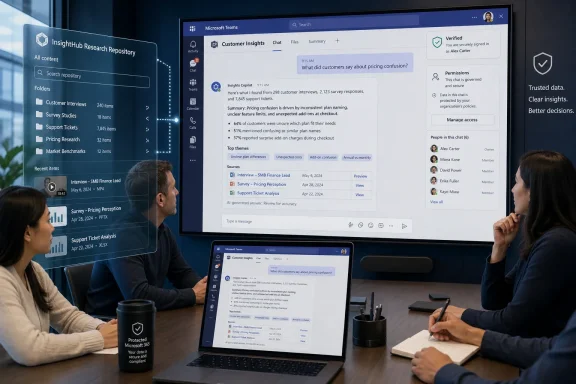
Anyone who has worked around product or marketing organizations knows the ritual. The insights team presents a carefully assembled deck, stakeholders nod at the customer clips, executives ask whether the sample size is enough, and then the organization drifts back toward deadline pressure, internal preference, and the loudest opinion in the room. The customer voice is respected, but often episodic.Putting customer intelligence into Teams changes the cadence. It allows a stakeholder to ask, “What did customers say about pricing confusion?” or “Do buyers understand the new packaging?” while a discussion is still live. That does not guarantee better decisions, but it raises the cost of ignoring evidence.
The most interesting use case is not the formal research readout. It is the casual moment before a decision hardens. A product manager is drafting a requirements document. A campaign team is debating messaging. A regional sales lead is challenging headquarters’ assumptions. If the organization can summon customer-backed evidence in those moments, research becomes less of an artifact and more of a reflex.
This is also where the product could change the internal status of insights teams. Rather than being seen as a service bureau that answers requests, the research function can become the steward of a living evidence base. The work of designing good studies, tagging material, maintaining repositories, and governing access becomes more visible because more employees experience the output directly.
But there is a cultural catch. Democratized access does not automatically produce evidence-based decision-making. Some organizations will use tools like this to validate decisions they already wanted to make. Others will ask shallow questions and accept shallow answers. The technology can put customer evidence into the flow of work, but it cannot force intellectual honesty.
The Marketplace Listing Is a Distribution Move, Not Just an Availability Note
The announcement says Voxpopme Insights is available now on Microsoft Marketplace, and that detail deserves more attention than it usually gets in product-launch coverage. Microsoft’s marketplace has become a procurement and discovery layer for cloud solutions, Teams apps, Microsoft 365 extensions, and AI agents. Being listed there helps a vendor meet customers where IT buyers already look.For existing Voxpopme customers, the path is straightforward: add the app to Teams, request the appropriate seat, and begin using the integration once access is granted. For organizations new to Voxpopme, the Teams app is likely less a standalone purchase trigger than a demonstration of how the platform’s research repository can be activated across the business.
That distinction matters. This is not a general-purpose survey bot for Teams. It is useful only if an organization already has, or is willing to build, a meaningful corpus of customer research inside Voxpopme. The app’s value depends on the quality, relevance, and coverage of the underlying data.
That makes the integration more defensible than a generic chatbot, but also narrower. Companies with mature research operations may see immediate value because they already have the evidence base. Companies with scattered interviews, inconsistent tagging, and little research governance may discover that a Teams interface simply exposes the disorder underneath.
In that sense, the Teams app is a mirror. It will make good research operations more accessible and weak research operations more visibly incomplete. The interface may be new, but the organizational discipline behind it still matters.
IT Will Ask the Boring Questions That Determine Whether This Gets Used
The press-release version of the story is about voice-of-customer access. The deployment version is about identity, licensing, app approval, data residency, auditability, and support boundaries. That is where many promising collaboration apps either become enterprise defaults or quietly stall.The app uses Microsoft secure sign-in and individual Voxpopme credentials, according to the announcement. Administrators also retain access management, which suggests a rollout model aligned with enterprise controls rather than consumer-style self-service. That is a necessary starting point, especially for organizations that tightly manage Teams apps through Microsoft 365 admin policies.
But IT teams will still need to ask what data leaves Teams, what is processed by Voxpopme, what logs are retained, and how source links behave when forwarded or copied into other chats. They will want to know whether answers are cached, whether prompts are stored, and whether the integration can be limited to specific users or departments. They will also need to understand how Reviewer seats are licensed and governed.
There is also a user-training issue hiding in plain sight. Employees need to understand that a summarized answer is not the same thing as a full research report. They need to know when to escalate to the insights team, when to inspect sources, and when a question is outside the scope of the available evidence.
For Windows administrators, this is the familiar shape of modern SaaS adoption. A business unit sees productivity value in a Teams app. IT sees a new integration touching identity, data, and compliance. The winning deployment is the one where those views are reconciled early rather than after the tool has already spread through informal channels.
Microsoft’s Platform Strategy Makes Niche Apps Feel Bigger Than They Are
On its own, a Voxpopme Teams app is a targeted product announcement for companies that care about customer intelligence. In Microsoft’s broader ecosystem, it is another small example of a much larger platform shift. Teams is becoming a place where specialized business systems surface just enough intelligence to keep employees from leaving the conversation.That shift benefits Microsoft because it reinforces Teams as the work hub. It benefits vendors because they can meet users inside a tool that already has daily engagement. It benefits employees when the integration is well designed, because they do not have to navigate a maze of portals to answer a simple business question.
The cost is clutter and dependency. Teams already carries chats, meetings, channels, files, workflow notifications, apps, bots, and Copilot experiences. Every new integration claims to reduce context switching, but too many integrations can turn the hub into another noisy inbox.
The difference between useful embedded intelligence and enterprise confetti is relevance. Voxpopme has a plausible claim to relevance because customer evidence is often needed during cross-functional discussion. If the app returns grounded, concise answers with inspectable sources, it may earn its place. If it produces vague summaries that users cannot trust, it will become one more ignored sidebar.
This is the standard Microsoft ecosystem bargain. The platform makes distribution easier, but it also places vendors in a crowded arena where usefulness must be immediate. In Teams, an app does not merely compete with rival software. It competes with the user’s patience.
The AI Story Is Really About Organizational Memory
Voxpopme’s announcement avoids some of the more overheated AI language that has infected enterprise software launches, but the AI subtext is obvious. The product takes a corpus of customer research and lets users ask questions in natural language. It searches, summarizes, and points back to source material.That is a form of organizational memory. Companies routinely spend significant money learning what customers think, only to bury that knowledge in decks, folders, project pages, and archived recordings. The promise of AI-assisted retrieval is that institutional knowledge can become callable rather than merely stored.
This is especially important in large organizations where employee turnover, reorgs, and product cycles cause evidence to disappear from active memory. A research study from eighteen months ago may still contain useful warnings, but only if someone remembers it exists. A Teams-based assistant can, at least in principle, reconnect current decisions to prior customer signals.
The challenge is that organizational memory is not neutral. What gets captured, how it is tagged, which customers are represented, and which studies are considered authoritative all shape the answers. An AI layer can surface buried evidence, but it can also amplify historical blind spots.
That is why insights teams remain central even as access expands. Their role may shift from gatekeeping every answer to curating the evidence base, defining standards, and teaching the business how to interpret what the system returns. The better the research function, the better the assistant. The reverse is also true.
The Real Test Comes After the First Impressive Demo
Tools like Voxpopme Insights often shine in controlled demonstrations. A user asks a clean question, the repository contains relevant evidence, and the answer returns with enough specificity to feel magical. The enterprise test is messier.Real users ask vague questions. They ask questions that blend markets, segments, and time periods. They ask leading questions. They ask for certainty where only directional evidence exists. They ask about subjects the research repository has never covered.
A strong system must handle those moments gracefully. It should say when evidence is thin. It should distinguish between recent and outdated studies. It should avoid implying that a handful of responses represent the whole market. It should push users toward source material when the stakes are high.
The announcement says answers are validated by research conducted by in-house insights teams, which is an important claim. The phrase suggests the system is not crawling random customer-facing material or improvising from unapproved data. It is drawing from a repository built through research work.
Still, “validated” will need practical meaning inside each customer deployment. Validation can mean approved studies, permissioned datasets, reviewed summaries, or simply source-backed retrieval. Enterprises evaluating the app should press for specifics, because this is where the difference between a research assistant and a corporate rumor engine becomes clear.
Customer Intelligence Joins the Race to Be Present at Decision Time
Voxpopme founder and CEO Andy Barraclough frames the problem as getting evidence to the person making the decision at the moment they are making it. That is a sharp diagnosis of why research often underperforms its potential. Good evidence delivered too late is still late.The Teams integration is built around that timing problem. It assumes the critical moment is not when the research report is published, but when a stakeholder is choosing a message, approving a feature, prioritizing a roadmap item, or challenging a strategic assumption. The closer evidence gets to that moment, the more likely it is to matter.
This is where the announcement should resonate with enterprise leaders beyond the market-research department. The same logic is reshaping BI, security operations, HR, finance, and support. Specialized systems are trying to surface relevant intelligence inside collaboration tools before decisions move on.
The risk is that every function now wants to be “in the flow of work,” and the flow is getting crowded. Customer intelligence earns its place only if it changes outcomes. That means fewer unsupported claims in meetings, faster access to prior learning, and more decisions that can be traced back to actual customer evidence.
For Voxpopme, the product’s success will likely be measured less by app installs than by whether non-researchers actually use it after the novelty fades. The first month may be curiosity. The sixth month will reveal whether it has become part of how teams think.
The Teams Chat Window Is Becoming a Boardroom Witness
The practical lesson from this launch is that customer research is no longer content to live in specialist systems. Voxpopme is pushing it into the everyday interface where organizations debate and decide, and that changes both the opportunity and the accountability around customer evidence.- Voxpopme Insights for Microsoft Teams is available through Microsoft Marketplace and is aimed at existing Voxpopme customers that want customer research accessible inside Teams.
- The app lets approved users ask natural-language questions and receive summarized answers drawn from the organization’s Voxpopme research repository.
- Access depends on Microsoft sign-in, Voxpopme credentials, administrator controls, and a requested Reviewer seat rather than unrestricted access for every Teams user.
- The value of the integration will depend heavily on the quality, coverage, and governance of the underlying research repository.
- Source links are essential because the summarized answer should function as a doorway into evidence, not as a replacement for research judgment.
- IT teams should evaluate the app as both a productivity tool and a data-access integration touching identity, permissions, logs, and customer-sensitive material.
References
- Primary source: ACCESS Newswire
Published: Thu, 18 Jun 2026 11:52:10 GMT
Voxpopme Brings Customer Intelligence Into Microsoft Teams
Voxpopme Insights for Microsoft Teams lets anyone ask a question in Teams and get an answer back from real customers, putting the customer's voice where decisions ...www.accessnewswire.com - Related coverage: voxpopme.com
Qualitative Research Platform for Video & AI Insights | Voxpopme
Voxpopme is the qualitative research platform trusted by McDonald's, Microsoft, and 300+ brands. Video surveys, live interviews, and AI-powered insights in minutes.www.voxpopme.com - Official source: learn.microsoft.com
Microsoft Marketplace overview - Marketplace customer documentation | Microsoft Learn
Microsoft Marketplace — Your trusted source for cloud solutions and AI agents. Learn how to find, try, buy, and deploy business software, solutions, and services.learn.microsoft.com - Official source: marketplace.microsoft.com
Microsoft Marketplace | cloud solutions, AI apps, and agents
Accelerate your AI transformation with Microsoft Marketplace—your trusted source to find, try, and buy cloud solutions, AI apps, and agents to meet your business needs.marketplace.microsoft.com
- Related coverage: insightplatforms.com
Voxpopme - Insight Platforms
The Voxpopme integrated insights platform uses AI to collect, centralise and analyse qualitative research data from videos.www.insightplatforms.com - Official source: microsoft.com
Microsoft Marketplace | Cloud Solutions, AI Apps, and Agents
Discover Microsoft Marketplace—your trusted source to find, try, and buy cloud solutions, AI apps, and agents from our comprehensive catalog.www.microsoft.com
- Related coverage: go.voxpopme.com

Voxpopme Compass
Introducing Voxpopme Compass, an autonomous research partner by Voxpopme. Compass analyzes past projects to identify gaps and launch new initiatives, providing strategic recommendations based on customer truth.
go.voxpopme.com
- Related coverage: similarlabs.com
Voxpopme - AI-powered qualitative research platform for customer insights | SimilarLabs
Voxpopme is the first qualitative research platform deeply integrated with ChatGPT and Azure OpenAI. It combines video surveys, live interviews, and AI-powered analysis in one centralized solution. Enterprises achieve insights 60x faster at just 3% of traditional costs. Trusted by Fortune 500...similarlabs.com - Official source: pulse.microsoft.com
AI Powered Customer Experiences Transform your sales marketing and service with Dynamics 365 Copilot komprimiert
PDF documentpulse.microsoft.com