

On July 2, 2026, Microsoft detailed how Waterbedrijf Groningen, the public drinking water utility for the Dutch province of Groningen, moved from an aging on-premises AX 2012 deployment to MECOMS 365 on Dynamics 365 Finance and Customer Service in 2023. The story is not really about a utility buying cloud software. It is about a public-service organization deciding that operational stability, customer history, field mobility, and analytics all had to become one system rather than a set of fragile workarounds. In a sector where success means citizens barely notice the machinery behind the tap, that is a more consequential modernization than the usual enterprise cloud victory lap.
Waterbedrijf Groningen’s most revealing benchmark is not a revenue target, a customer acquisition number, or a flashy AI metric. It is the idea that the customer should not notice the migration at all. For a water utility, the absence of drama is not a lack of ambition; it is the product.
That makes this Dynamics 365 migration a useful counterpoint to the way cloud transformation is often sold. Microsoft, partners, and enterprise vendors naturally want to talk about agility, intelligence, and innovation. Waterbedrijf Groningen’s framing is colder and more operational: billing must work, meter-to-cash must work, customer service must work, and nobody should be dragged into an escalation call because a release went sideways.
The utility’s starting point was familiar to many public-sector and regulated-industry IT teams. AX 2012 had done its job, but it had become the kind of system that survives through caution rather than momentum. Bespoke customizations made changes expensive, upgrades risky, and maintenance increasingly dependent on organizational memory.
That is the hidden tax of old enterprise software. The system may remain functional, but every new requirement becomes a negotiation with the past. Eventually, the question is no longer whether the old platform can run tomorrow morning, but whether it can support the next decade without turning every improvement into a controlled demolition.
That matters because every home and business in the region is tied to a meter, and every meter is tied to a chain of administrative and operational events. A reading becomes a bill. A bill becomes a payment status. A payment status becomes a customer interaction. A meter issue becomes a field visit. A leak, anomaly, or gap between produced and billed water becomes a question for operations, finance, and customer service at once.
Without a unified data model, those events are handled as fragments. Contact center agents answer questions without full history. Field staff call headquarters because they cannot see the account context on-site. Analysts prepare reports manually. Accountants and auditors wait on reconciliations that should have been routine.
This is why the phrase “drinking water intelligence” is less marketing fluff than it first appears. The intelligence does not come from sprinkling AI over a utility. It comes from giving the organization a shared operational memory.
That is a risky shape for a project, but it also avoids a common enterprise trap. Many organizations modernize around the edges, adding a CRM here, a dashboard there, and a mobile app somewhere else, while the core system remains a gravity well. The result is often more integration work, more duplicated data, and more places for process truth to diverge.
Ferranti’s standardized Water Template appears to have been central to avoiding that outcome. Instead of rebuilding every local customization, the utility aligned itself with a common platform used by multiple Dutch water companies. That is a cultural shift as much as a technical one: it means accepting that some processes should conform to a shared industry model rather than being preserved as local exceptions forever.
For IT pros, this is the uncomfortable lesson. Standardization is usually sold as efficiency, but its real value is survivability. The more a system resembles the platform everyone else is running, the easier it is to patch, update, test, document, staff, and extend.
In the old model, releases are events. They require coordination, defensive planning, and often a kind of institutional bracing. When upgrades are risky, organizations batch change, and when they batch change, each release gets larger and more dangerous. The result is a self-reinforcing loop: because change is painful, change becomes infrequent; because it is infrequent, it becomes bigger; because it is bigger, it becomes painful.
A faster cadence can break that loop, but only if the platform, partner, testing discipline, and governance are mature enough to absorb it. Microsoft’s cloud business has spent years trying to normalize this model across Windows, Azure, Microsoft 365, and Dynamics. The pitch is that smaller, more regular updates reduce risk. The counterargument from administrators is that constant change can become its own operational burden.
Waterbedrijf Groningen’s experience lands somewhere more practical. The utility reports stability and no major operational disruption from change failures, while also gaining the ability to implement improvements more quickly. That is the promise of cloud ERP and CRM when it works: not change for its own sake, but a safer route for necessary change.
Before the migration, there was no unified customer interaction history. That meant front-office employees could not easily see the full context of a caller’s issue, billing status, meter details, or previous contacts. In a call center handling up to 1,500 calls per day during peak periods, even small amounts of friction become operationally significant.
The Dynamics 365 Customer Service layer, surfaced through Power Apps, changes the work from information hunting to issue handling. Agents see customer details, meter information, billing status, and interaction history in one place. That does not merely shave seconds off calls. It changes the confidence level of the person answering the phone.
In public service, context is a form of respect. A customer should not have to reconstruct the organization’s own history back to it. When a utility can see the account, the meter, the bill, and the previous interaction together, the experience feels less like bureaucracy and more like competence.
With mobile access, field employees can look up accounts, process meter changes, and collect payments directly in the field. That is not merely a convenience feature. It collapses the distance between the physical water network and the administrative record.
This matters because utilities live in the gap between infrastructure and information. A meter is both a physical device and a billing object. A site visit is both a customer-service event and a data-quality opportunity. A payment or meter change processed on location is not just faster; it is less likely to be lost in a later handoff.
For WindowsForum readers who spend their days managing endpoints, identity, device policy, and line-of-business apps, this is the practical face of digital transformation. The cloud platform gets the headline, but the success of the workflow depends on whether the person in the field can authenticate, access the right data, update the record, and move on without calling the office.
The audit angle is important because it grounds the analytics story in governance rather than dashboard theater. Many organizations have dashboards. Fewer have dashboards that replace labor-intensive reporting processes, survive accountant scrutiny, and help departments reconcile around the same data.
The contact center forecasting use case is similarly practical. Waterbedrijf Groningen can predict call volumes based on historical patterns and meter-reading cycles, then translate expected calls and average handling time into required staffing hours. That is not AI in the cinematic sense. It is better math applied to better data.
The non-revenue water use case may be the most consequential. By comparing water produced with water billed, the utility can identify signs of leakage, meter errors, or uncontracted usage. In a world where water resilience and infrastructure efficiency are increasingly strategic concerns, finding loss is both a financial and environmental imperative.
That should be printed above the entrance to every enterprise AI steering committee. Organizations do not become AI-ready by buying a chatbot. They become AI-ready by cleaning up identity, process, data ownership, integration, permissions, telemetry, and governance. The chatbot is the visible layer; the foundation is the hard part.
Waterbedrijf Groningen’s migration matters because it did the unglamorous work first. It unified customer information, brought field workflows into the system, standardized around a utility template, and connected analytics to operational data. Only then does it make sense to talk about omnichannel service, predictive assistance, or Copilot-style augmentation.
For Microsoft, this is also a cleaner AI story than many of the noisier ones. The company does not need to claim that generative AI reinvented the water utility. It can argue that Dynamics 365, Power Platform, and Power BI create the governed substrate on which AI features can later be deployed with fewer illusions.
The old on-premises model had its own dependencies: aging software, custom code, scarce expertise, and slow releases. The new model swaps those risks for vendor cadence, cloud availability, licensing complexity, integration governance, and the need to keep pace with platform change. No serious enterprise migration eliminates risk. It changes its shape.
The question is whether the new risk profile is more manageable. In Waterbedrijf Groningen’s case, the answer appears to be yes, because the old platform was approaching end of life and lacked capabilities the organization increasingly needed. A stable but stagnant system is not truly low risk if it prevents the organization from seeing its customers, forecasting demand, or detecting water loss effectively.
The discipline comes from resisting customization sprawl the second time around. If Waterbedrijf Groningen and similar utilities use the cloud platform as a foundation for endless bespoke exceptions, they will eventually recreate the maintenance burden they escaped. The real test is not the first successful migration. It is whether the platform remains standard enough to keep updating safely five years from now.
That may sound boring, but boring is underrated. Public infrastructure does not need every new technology trend bolted onto it. It needs systems that can be patched, audited, updated, and understood by more than the three people who remember why a customization was written in 2014.
Waterbedrijf Groningen’s project is also a reminder that public service organizations can be ambitious without adopting private-sector language wholesale. The utility is not chasing growth in the conventional sense. Its ambition is continuity with more intelligence: fewer blind spots, faster service, better planning, and stronger control over the data that describes its network and customers.
For Microsoft, these are the kinds of customer stories that may matter more than splashier AI demos. Enterprise buyers already know they can generate text, summarize calls, and build dashboards. What they need to believe is that Microsoft’s business applications can handle regulated, mission-critical, unglamorous operations without turning every update into a crisis.
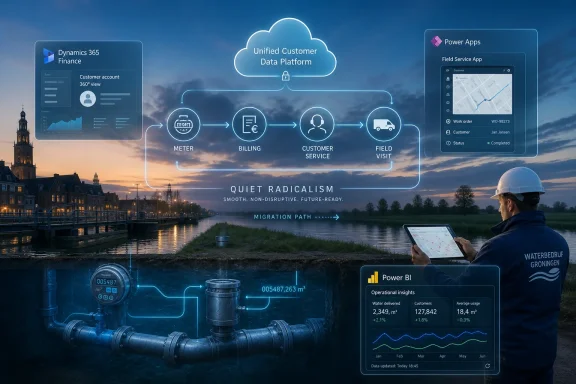 The Quiet Radicalism of Making Nothing Go Wrong
Waterbedrijf Groningen’s most revealing benchmark is not a revenue target, a customer acquisition number, or a flashy AI metric. It is the idea that the customer should not notice the migration at all. For a water utility, the absence of drama is not a lack of ambition; it is the product.That makes this Dynamics 365 migration a useful counterpoint to the way cloud transformation is often sold. Microsoft, partners, and enterprise vendors naturally want to talk about agility, intelligence, and innovation. Waterbedrijf Groningen’s framing is colder and more operational: billing must work, meter-to-cash must work, customer service must work, and nobody should be dragged into an escalation call because a release went sideways.
The utility’s starting point was familiar to many public-sector and regulated-industry IT teams. AX 2012 had done its job, but it had become the kind of system that survives through caution rather than momentum. Bespoke customizations made changes expensive, upgrades risky, and maintenance increasingly dependent on organizational memory.
That is the hidden tax of old enterprise software. The system may remain functional, but every new requirement becomes a negotiation with the past. Eventually, the question is no longer whether the old platform can run tomorrow morning, but whether it can support the next decade without turning every improvement into a controlled demolition.
A Water Utility Is a Data Company Whether It Likes It or Not
Waterbedrijf Groningen’s business is physical: pumps, pipes, meters, households, field visits, and billing cycles. But the Microsoft case study makes clear that the operational bottleneck had become informational. The utility lacked a single view of the customer, a proper CRM layer, mobile access for field staff, and reliable cross-departmental reporting.That matters because every home and business in the region is tied to a meter, and every meter is tied to a chain of administrative and operational events. A reading becomes a bill. A bill becomes a payment status. A payment status becomes a customer interaction. A meter issue becomes a field visit. A leak, anomaly, or gap between produced and billed water becomes a question for operations, finance, and customer service at once.
Without a unified data model, those events are handled as fragments. Contact center agents answer questions without full history. Field staff call headquarters because they cannot see the account context on-site. Analysts prepare reports manually. Accountants and auditors wait on reconciliations that should have been routine.
This is why the phrase “drinking water intelligence” is less marketing fluff than it first appears. The intelligence does not come from sprinkling AI over a utility. It comes from giving the organization a shared operational memory.
Microsoft’s Platform Play Meets the Utility Template
The technology stack is straightforward on paper: MECOMS 365, built on Dynamics 365 Finance and Dynamics 365 Customer Service, with Power Apps for front-office and field workflows and Power BI for analytics. Ferranti, the Belgian utility-software specialist behind MECOMS, provided the industry layer and implementation muscle. The more interesting decision was architectural: Waterbedrijf Groningen moved from on-premises AX 2012 to the cloud in one broad project rather than staging CRM, finance, field mobility, and analytics as separate modernization efforts.That is a risky shape for a project, but it also avoids a common enterprise trap. Many organizations modernize around the edges, adding a CRM here, a dashboard there, and a mobile app somewhere else, while the core system remains a gravity well. The result is often more integration work, more duplicated data, and more places for process truth to diverge.
Ferranti’s standardized Water Template appears to have been central to avoiding that outcome. Instead of rebuilding every local customization, the utility aligned itself with a common platform used by multiple Dutch water companies. That is a cultural shift as much as a technical one: it means accepting that some processes should conform to a shared industry model rather than being preserved as local exceptions forever.
For IT pros, this is the uncomfortable lesson. Standardization is usually sold as efficiency, but its real value is survivability. The more a system resembles the platform everyone else is running, the easier it is to patch, update, test, document, staff, and extend.
The Release Cadence Is the Real Cloud Migration
The most telling operational change may be Waterbedrijf Groningen’s move from roughly six releases per year to a release rhythm of every three to six weeks, aligned with Microsoft’s update cycle. That is not just a calendar adjustment. It changes the psychology of enterprise IT.In the old model, releases are events. They require coordination, defensive planning, and often a kind of institutional bracing. When upgrades are risky, organizations batch change, and when they batch change, each release gets larger and more dangerous. The result is a self-reinforcing loop: because change is painful, change becomes infrequent; because it is infrequent, it becomes bigger; because it is bigger, it becomes painful.
A faster cadence can break that loop, but only if the platform, partner, testing discipline, and governance are mature enough to absorb it. Microsoft’s cloud business has spent years trying to normalize this model across Windows, Azure, Microsoft 365, and Dynamics. The pitch is that smaller, more regular updates reduce risk. The counterargument from administrators is that constant change can become its own operational burden.
Waterbedrijf Groningen’s experience lands somewhere more practical. The utility reports stability and no major operational disruption from change failures, while also gaining the ability to implement improvements more quickly. That is the promise of cloud ERP and CRM when it works: not change for its own sake, but a safer route for necessary change.
CRM Was the Missing Infrastructure
It is easy to think of CRM as a sales tool, which is precisely why its absence in a public utility is so revealing. Waterbedrijf Groningen is not trying to sell more water to households. It needs to understand service relationships with citizens, businesses, and properties over time.Before the migration, there was no unified customer interaction history. That meant front-office employees could not easily see the full context of a caller’s issue, billing status, meter details, or previous contacts. In a call center handling up to 1,500 calls per day during peak periods, even small amounts of friction become operationally significant.
The Dynamics 365 Customer Service layer, surfaced through Power Apps, changes the work from information hunting to issue handling. Agents see customer details, meter information, billing status, and interaction history in one place. That does not merely shave seconds off calls. It changes the confidence level of the person answering the phone.
In public service, context is a form of respect. A customer should not have to reconstruct the organization’s own history back to it. When a utility can see the account, the meter, the bill, and the previous interaction together, the experience feels less like bureaucracy and more like competence.
Field Mobility Turns the Office Inside Out
The field-worker iPad app is another detail that looks modest until you consider the old workflow. Previously, field staff lacked mobile access to customer data. A question on-site meant calling headquarters, waiting for information, and depending on someone else to interpret the system.With mobile access, field employees can look up accounts, process meter changes, and collect payments directly in the field. That is not merely a convenience feature. It collapses the distance between the physical water network and the administrative record.
This matters because utilities live in the gap between infrastructure and information. A meter is both a physical device and a billing object. A site visit is both a customer-service event and a data-quality opportunity. A payment or meter change processed on location is not just faster; it is less likely to be lost in a later handoff.
For WindowsForum readers who spend their days managing endpoints, identity, device policy, and line-of-business apps, this is the practical face of digital transformation. The cloud platform gets the headline, but the success of the workflow depends on whether the person in the field can authenticate, access the right data, update the record, and move on without calling the office.
Power BI Makes the Audit Trail Operational
The migration also elevated reporting from manual preparation to operational intelligence. Power BI, connected through MECOMS Synapse, now supports audit preparation, contact center forecasting, and analysis of non-revenue water. Those are very different use cases, but they share a common requirement: trustworthy data that does not need to be reassembled by hand each time someone asks a serious question.The audit angle is important because it grounds the analytics story in governance rather than dashboard theater. Many organizations have dashboards. Fewer have dashboards that replace labor-intensive reporting processes, survive accountant scrutiny, and help departments reconcile around the same data.
The contact center forecasting use case is similarly practical. Waterbedrijf Groningen can predict call volumes based on historical patterns and meter-reading cycles, then translate expected calls and average handling time into required staffing hours. That is not AI in the cinematic sense. It is better math applied to better data.
The non-revenue water use case may be the most consequential. By comparing water produced with water billed, the utility can identify signs of leakage, meter errors, or uncontracted usage. In a world where water resilience and infrastructure efficiency are increasingly strategic concerns, finding loss is both a financial and environmental imperative.
AI Comes Last, Which Is Exactly the Point
The case study ends with Waterbedrijf Groningen looking toward AI, Copilot, and Microsoft Digital Contact Center Platform capabilities. That is predictable; no Microsoft customer story in 2026 can resist at least a glance toward AI. But the most credible line in the story is the observation that AI only works if the data foundation is solid.That should be printed above the entrance to every enterprise AI steering committee. Organizations do not become AI-ready by buying a chatbot. They become AI-ready by cleaning up identity, process, data ownership, integration, permissions, telemetry, and governance. The chatbot is the visible layer; the foundation is the hard part.
Waterbedrijf Groningen’s migration matters because it did the unglamorous work first. It unified customer information, brought field workflows into the system, standardized around a utility template, and connected analytics to operational data. Only then does it make sense to talk about omnichannel service, predictive assistance, or Copilot-style augmentation.
For Microsoft, this is also a cleaner AI story than many of the noisier ones. The company does not need to claim that generative AI reinvented the water utility. It can argue that Dynamics 365, Power Platform, and Power BI create the governed substrate on which AI features can later be deployed with fewer illusions.
The Risk Is Not Cloud; It Is Dependency Without Discipline
A skeptical reading is still necessary. Moving a public utility’s core customer, billing, and field-service workflows onto a cloud platform deepens dependence on Microsoft, Ferranti, and the MECOMS ecosystem. That dependency may be rational, but it is dependency all the same.The old on-premises model had its own dependencies: aging software, custom code, scarce expertise, and slow releases. The new model swaps those risks for vendor cadence, cloud availability, licensing complexity, integration governance, and the need to keep pace with platform change. No serious enterprise migration eliminates risk. It changes its shape.
The question is whether the new risk profile is more manageable. In Waterbedrijf Groningen’s case, the answer appears to be yes, because the old platform was approaching end of life and lacked capabilities the organization increasingly needed. A stable but stagnant system is not truly low risk if it prevents the organization from seeing its customers, forecasting demand, or detecting water loss effectively.
The discipline comes from resisting customization sprawl the second time around. If Waterbedrijf Groningen and similar utilities use the cloud platform as a foundation for endless bespoke exceptions, they will eventually recreate the maintenance burden they escaped. The real test is not the first successful migration. It is whether the platform remains standard enough to keep updating safely five years from now.
Public Infrastructure Modernization Has Entered Its Boring Era
There is a broader lesson here for public-sector IT. The next phase of modernization will often look less like moonshot innovation and more like disciplined consolidation. Replace unsupported systems. Standardize where possible. Give employees one view of the citizen or customer. Move field work into mobile workflows. Turn reporting into a live capability rather than a monthly archaeological dig.That may sound boring, but boring is underrated. Public infrastructure does not need every new technology trend bolted onto it. It needs systems that can be patched, audited, updated, and understood by more than the three people who remember why a customization was written in 2014.
Waterbedrijf Groningen’s project is also a reminder that public service organizations can be ambitious without adopting private-sector language wholesale. The utility is not chasing growth in the conventional sense. Its ambition is continuity with more intelligence: fewer blind spots, faster service, better planning, and stronger control over the data that describes its network and customers.
For Microsoft, these are the kinds of customer stories that may matter more than splashier AI demos. Enterprise buyers already know they can generate text, summarize calls, and build dashboards. What they need to believe is that Microsoft’s business applications can handle regulated, mission-critical, unglamorous operations without turning every update into a crisis.
The Groningen Lesson Is That Stability Now Requires Motion
The most concrete lesson from Waterbedrijf Groningen is that standing still had become the risky option. AX 2012 and bespoke customization had delivered years of service, but the organization needed a customer engagement layer, mobile field access, analytics, and a safer update model.- Waterbedrijf Groningen completed its move from AX 2012 to MECOMS 365 on Dynamics 365 Finance and Customer Service in 2023.
- The migration replaced an on-premises, heavily customized environment with a standardized utility platform implemented with Ferranti.
- Power Apps now gives front-office and field employees access to customer, meter, billing, and interaction data in workflows that previously required system-switching or calls to headquarters.
- Power BI and MECOMS Synapse have turned reporting into an operational capability, including audit support, contact center forecasting, and analysis of non-revenue water.
- The utility moved from about six annual releases to a three-to-six-week cadence aligned with Microsoft’s cloud update cycle, while reporting no major operational disruption from change failures.
- AI and Copilot are next on the roadmap, but the important prerequisite is already in place: a unified and governed data foundation.
References
- Primary source: Microsoft
Published: 2026-07-02T17:12:10.960542
Waterbedrijf Groningen turns data into drinking water intelligence with Dynamics 365 | Microsoft Customer Stories
Waterbedrijf Groningen transforms water utility operations with Dynamics 365, turning customer and operational data into actionable intelligencewww.microsoft.com
