

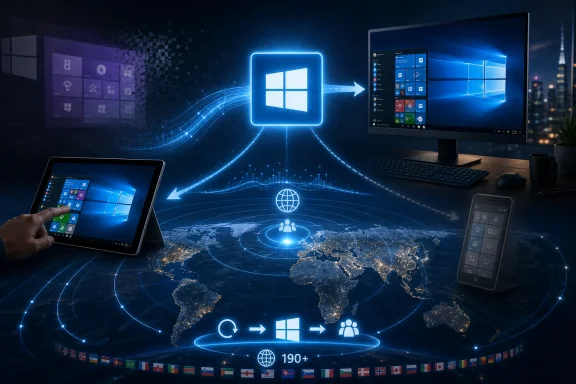
On July 29, 2015, Microsoft began rolling out Windows 10 in 190 countries as a free upgrade for eligible Windows 7 and Windows 8.1 PCs, using a staged release that gave Windows Insiders and validated systems priority before broader availability. The launch was not just another version bump. It was Microsoft’s attempt to turn Windows from a boxed product into a continuously updated platform spanning PCs, tablets, phones, Xbox, and new device categories. That ambition made Windows 10 both a repair job for Windows 8 and a wager on a future Microsoft had not yet earned.
The AOL piece captured the mood around Windows 10’s launch with a useful phrase: nearly impossible. That was not hyperbole in the summer of 2015. Microsoft was trying to solve three problems at once: calm desktop users alienated by Windows 8, make Windows credible on touch-first devices, and convince developers that one app platform could matter across screens.
Those goals pulled against each other. A desktop operating system rewards precision, density, multitasking, and backward compatibility. A tablet interface rewards direct manipulation and simplicity. A phone interface has even less room for compromise, and Microsoft was already fighting from behind against iOS and Android.
Windows 8 had tried to force the issue by making the new touch interface impossible to ignore. Windows 10 tried a more diplomatic strategy: bring back the Start menu, restore the desktop’s primacy, and let touch features exist without taking over the entire machine. The bet was that users would forgive Microsoft if the company stopped treating the mouse and keyboard as legacy accessories.
That was the emotional core of the launch. Windows 10 was not merely promising new features. It was promising that Microsoft had listened.
That approach became the operating model for Windows 10. The company had already been testing Windows 10 publicly through the Windows Insider Program, which gave millions of users pre-release builds and gave Microsoft an enormous stream of real-world data. The launch cadence simply extended that logic into general availability.
For traditional Windows users, this was a cultural shift. Windows releases used to feel like eras: Windows XP, Windows Vista, Windows 7, Windows 8. Windows 10 arrived with the language of continuity. Updates would keep coming, features would evolve, and the line between launch day and post-launch development would blur.
That was both sensible and unsettling. Sensible, because the diversity of Windows hardware made a cautious rollout almost mandatory. Unsettling, because it meant the user was no longer buying a static thing. Windows was becoming a service relationship, and service relationships require trust.
But Windows 8’s influence remained everywhere. Live tiles survived inside the Start menu. Touch gestures and tablet mode remained part of the design. Universal apps were still central to Microsoft’s developer pitch. The difference was not that Microsoft abandoned its earlier vision; it learned to stop making that vision compulsory.
That distinction mattered. Windows 8 was not wrong that computing was moving beyond the classic desktop. It was wrong in how abruptly it tried to drag desktop users into that future. Windows 10 was a retreat in interface politics, not in platform strategy.
The result was a product that could be praised as familiar and ambitious at the same time. For Microsoft, that was a rare balance. Familiarity kept Windows 7 users from fleeing. Ambition gave developers and OEMs a reason to believe Windows still had a roadmap beyond the PC refresh cycle.
On the PC, Windows was still dominant. On phones, Microsoft was an underdog with shrinking leverage. On tablets, Windows had credible hardware in devices like Surface but no guarantee that the broader market wanted desktop compatibility and touch in the same package. The same operating system strategy looked powerful from Redmond and uneven from the checkout counter.
Universal Windows apps were supposed to bridge that gap. Developers could target a platform that stretched from phone to PC to Xbox, with interfaces adapting to screen size and input method. The pitch was attractive: write once, refine for many devices, and reach a huge installed base.
But developer ecosystems are not built on technical possibility alone. They are built on users, revenue, habits, tooling, and confidence. Windows had the PC users. It did not have mobile momentum. That made the universal app strategy depend on a kind of circular optimism: developers would build because users would come, and users would come because developers would build.
As a concept, Continuum was persuasive because it recognized that device categories were becoming less rigid. Hybrids, detachables, convertibles, and large phones were already blurring the line between consumption and productivity machines. Microsoft had every reason to believe it understood that boundary better than rivals.
The trouble was that the dream depended on scale. A phone-as-PC experience required not only clever software but also compatible apps, strong hardware, user awareness, and a reason to choose Windows Phone in the first place. Without those, Continuum risked becoming a technology demo for a market that had already moved on.
Still, the idea should not be dismissed. Modern computing has kept drifting toward adaptive experiences: foldables, desktop-class tablets, cloud PCs, remote workstations, and mobile devices that can drive larger displays. Microsoft may not have won the phone version of the argument, but Windows 10 showed that the argument itself was real.
That generosity had a strategic edge. A fragmented Windows ecosystem is expensive for everyone. Developers have to support old APIs and behaviors. OEMs face inconsistent expectations. Microsoft must patch, secure, and explain too many generations at once. Moving users quickly to Windows 10 made the platform more coherent.
It also helped Microsoft reframe Windows around services. A user on Windows 10 was more likely to encounter Microsoft Edge, Cortana, OneDrive integration, the Windows Store, Xbox features, and Microsoft account hooks. The operating system was becoming a surface area for cloud services and subscription relationships.
That is why the free upgrade was not merely a customer-friendly promotion. It was a migration strategy. Microsoft was paying, in foregone upgrade revenue, to pull the ecosystem onto ground it could keep changing.
This was smart because Windows compatibility is too broad to validate entirely in a lab. Printers, graphics drivers, enterprise VPN clients, old accounting packages, obscure peripherals, firmware quirks, and regional configurations all shape the real Windows experience. Microsoft needed scale before launch, not after.
But the Insider model also changed expectations. Users who joined the program were not simply customers waiting for a finished product. They were participants in an ongoing build cycle. That gave Microsoft a faster feedback loop, but it also normalized the idea that Windows would always be in motion.
For power users, that was exciting. For administrators, it was more complicated. A platform that evolves continuously can close vulnerabilities and ship improvements faster, but it can also introduce regressions faster. Windows 10’s launch made that tradeoff visible before most organizations had fully adjusted their deployment practices.
Enterprises do not upgrade operating systems because a launch event is exciting. They upgrade when application compatibility, hardware readiness, compliance requirements, support timelines, and operational risk all line up. Windows 10’s staged consumer rollout did not remove those enterprise concerns; it simply showed Microsoft understood that uncontrolled deployment at Windows scale would be reckless.
The return of a more conventional desktop mattered enormously in business environments. Windows 8 had asked too much retraining for too little perceived benefit. Windows 10 restored enough muscle memory that IT departments could evaluate it as an upgrade rather than a workplace behavior experiment.
Still, the service model was the real debate. If Windows would receive regular feature updates, then enterprises needed rings, deferrals, validation processes, and clearer language from Microsoft about what was changing and when. Windows 10 was not just a new OS image. It was the beginning of a new patch management philosophy.
Yet the real PC world is never simple. Some machines had driver issues. Some users were wary of upgrade prompts. Some preferred the stability of Windows 7. Others wanted to escape Windows 8 as quickly as possible. The staged rollout helped Microsoft avoid a single catastrophic failure, but it could not eliminate the anxiety of replacing the operating system on a working machine.
The AOL article’s advice to wait was practical. Windows 10 would be available for a year under the free upgrade offer, and early adopters would inevitably discover edge cases. For users whose PCs were essential for work, school, or family logistics, patience was not cowardice. It was sound maintenance.
That remains one of the enduring lessons of Windows 10’s launch. The best upgrade strategy is not always the fastest one. It is the one that respects the value of a stable machine.
That does not make the praise illegitimate. Software is experienced in context. A feature that feels merely adequate in isolation can feel heroic if it fixes a daily irritation. The Start menu’s return was not revolutionary interface design, but it was emotionally important because it acknowledged that Microsoft had overreached.
The more cautious reviews were also right. Windows 10 felt good, but launch readiness was always going to be uneven. A modern operating system is too large, too hardware-dependent, and too tied to online services to arrive perfectly formed. The “could have used more time” critique was not an indictment so much as a statement of reality.
Microsoft’s answer was that Windows 10 would keep improving after launch. That was convenient, but also honest. The product was being released into a world where operating systems were no longer finished in the old sense.
That restraint was not glamorous, but it was mature. Windows runs on a staggering range of hardware, and even a tiny failure rate can become a very large number of broken PCs. A wave rollout gave Microsoft room to detect problems, pause, adjust, and continue.
It also subtly changed what launch meant. The date mattered for marketing, press coverage, and user anticipation. But operationally, launch became a ramp rather than a switch. That model now feels ordinary across software, games, cloud services, and mobile platforms. In 2015, for Windows, it was still a meaningful shift.
The irony is that this cautious mechanism served an audacious strategy. Microsoft was attempting to unify devices, modernize its app platform, and convert Windows into a service. The rollout was conservative because the ambition was not.
On traditional PCs, Windows 10 largely succeeded. It repaired the desktop experience, preserved compatibility, and created a platform that could keep evolving. On tablets and hybrids, it was more credible than Windows 8 because it stopped pretending every device should live full-time in the same interface mode.
On phones, the story was different. Windows 10 Mobile never overcame the structural disadvantages facing Microsoft’s mobile ecosystem. The universal platform did not magically create demand where carrier support, developer attention, and consumer momentum were lacking. One Windows could share code, but it could not manufacture market share.
That is the line between engineering success and ecosystem success. Microsoft built a more unified technical foundation. It did not turn every device category into a Windows stronghold.
It also helped Microsoft learn which parts of its platform vision were durable. The PC remained central. Touch mattered, but not at the expense of desktop productivity. Cross-device development mattered, but developers would not follow a platform simply because Microsoft drew a bigger map. User trust mattered more than interface novelty.
The launch also anticipated later Microsoft behavior. The company became more comfortable shipping public previews, using telemetry to guide deployment, and treating Windows as a living platform. Those practices brought benefits and controversies, but they became part of the modern Windows identity.
In that sense, Windows 10 was less the final form of Microsoft’s one-OS dream than the operating system that taught Microsoft which dreams could survive contact with users.
Windows 10’s launch was nearly impossible only if judged by the full sweep of Microsoft’s ambition: one platform, many devices, continuous updates, and a repaired relationship with desktop users. Judged more narrowly, it was the moment Microsoft rediscovered the value of pragmatism. The future of Windows would not be won by forcing every device into one interface, but by building a platform flexible enough to bend without breaking — and by remembering that, for most users, the best operating system is still the one that lets them get back to work.
Source: AOL.com Microsoft tries the nearly-impossible with Windows 10 launch - AOL
 Microsoft Was Not Shipping an Operating System So Much as a Reset Button
The AOL piece captured the mood around Windows 10’s launch with a useful phrase: nearly impossible. That was not hyperbole in the summer of 2015. Microsoft was trying to solve three problems at once: calm desktop users alienated by Windows 8, make Windows credible on touch-first devices, and convince developers that one app platform could matter across screens.Those goals pulled against each other. A desktop operating system rewards precision, density, multitasking, and backward compatibility. A tablet interface rewards direct manipulation and simplicity. A phone interface has even less room for compromise, and Microsoft was already fighting from behind against iOS and Android.
Windows 8 had tried to force the issue by making the new touch interface impossible to ignore. Windows 10 tried a more diplomatic strategy: bring back the Start menu, restore the desktop’s primacy, and let touch features exist without taking over the entire machine. The bet was that users would forgive Microsoft if the company stopped treating the mouse and keyboard as legacy accessories.
That was the emotional core of the launch. Windows 10 was not merely promising new features. It was promising that Microsoft had listened.
The Wave Rollout Was the First Sign of Windows as a Service
The staged release was easy to describe as bad news for impatient upgraders, but it was also the most revealing part of the launch. Microsoft was not throwing a single installer over the wall at midnight and hoping the world’s PC fleet survived. It was watching telemetry, compatibility signals, driver behavior, and early feedback as the rollout widened.That approach became the operating model for Windows 10. The company had already been testing Windows 10 publicly through the Windows Insider Program, which gave millions of users pre-release builds and gave Microsoft an enormous stream of real-world data. The launch cadence simply extended that logic into general availability.
For traditional Windows users, this was a cultural shift. Windows releases used to feel like eras: Windows XP, Windows Vista, Windows 7, Windows 8. Windows 10 arrived with the language of continuity. Updates would keep coming, features would evolve, and the line between launch day and post-launch development would blur.
That was both sensible and unsettling. Sensible, because the diversity of Windows hardware made a cautious rollout almost mandatory. Unsettling, because it meant the user was no longer buying a static thing. Windows was becoming a service relationship, and service relationships require trust.
The Ghost of Windows 8 Haunted Every Demo
Windows 10’s warm reception from beta testers and reviewers made sense because Microsoft had lowered the temperature of the user interface war. The Start menu returned, the desktop felt less like a neglected corner, and the operating system stopped insisting that every PC wanted to behave like a tablet.But Windows 8’s influence remained everywhere. Live tiles survived inside the Start menu. Touch gestures and tablet mode remained part of the design. Universal apps were still central to Microsoft’s developer pitch. The difference was not that Microsoft abandoned its earlier vision; it learned to stop making that vision compulsory.
That distinction mattered. Windows 8 was not wrong that computing was moving beyond the classic desktop. It was wrong in how abruptly it tried to drag desktop users into that future. Windows 10 was a retreat in interface politics, not in platform strategy.
The result was a product that could be praised as familiar and ambitious at the same time. For Microsoft, that was a rare balance. Familiarity kept Windows 7 users from fleeing. Ambition gave developers and OEMs a reason to believe Windows still had a roadmap beyond the PC refresh cycle.
One Windows Was a Brilliant Engineering Idea With a Brutal Market Problem
The central Windows 10 promise was unity. Microsoft wanted a shared core, a common app model, and interfaces that adapted across device families. In engineering terms, this was elegant. In market terms, it was treacherous.On the PC, Windows was still dominant. On phones, Microsoft was an underdog with shrinking leverage. On tablets, Windows had credible hardware in devices like Surface but no guarantee that the broader market wanted desktop compatibility and touch in the same package. The same operating system strategy looked powerful from Redmond and uneven from the checkout counter.
Universal Windows apps were supposed to bridge that gap. Developers could target a platform that stretched from phone to PC to Xbox, with interfaces adapting to screen size and input method. The pitch was attractive: write once, refine for many devices, and reach a huge installed base.
But developer ecosystems are not built on technical possibility alone. They are built on users, revenue, habits, tooling, and confidence. Windows had the PC users. It did not have mobile momentum. That made the universal app strategy depend on a kind of circular optimism: developers would build because users would come, and users would come because developers would build.
Continuum Was the Dream, Not the Business
Continuum was the purest expression of the Windows 10 idea. A device could change its interface depending on how it was being used. A tablet could behave more like a desktop when docked with a keyboard. A phone, in Microsoft’s most futuristic telling, could connect to a monitor and become something like a PC.As a concept, Continuum was persuasive because it recognized that device categories were becoming less rigid. Hybrids, detachables, convertibles, and large phones were already blurring the line between consumption and productivity machines. Microsoft had every reason to believe it understood that boundary better than rivals.
The trouble was that the dream depended on scale. A phone-as-PC experience required not only clever software but also compatible apps, strong hardware, user awareness, and a reason to choose Windows Phone in the first place. Without those, Continuum risked becoming a technology demo for a market that had already moved on.
Still, the idea should not be dismissed. Modern computing has kept drifting toward adaptive experiences: foldables, desktop-class tablets, cloud PCs, remote workstations, and mobile devices that can drive larger displays. Microsoft may not have won the phone version of the argument, but Windows 10 showed that the argument itself was real.
The Free Upgrade Was a Business Model Disguised as Generosity
Offering Windows 10 as a free upgrade for eligible Windows 7 and Windows 8.1 users was one of the most important decisions Microsoft made. It reduced friction, accelerated adoption, and signaled that Microsoft cared more about the installed base moving together than about extracting one more retail license fee from consumers.That generosity had a strategic edge. A fragmented Windows ecosystem is expensive for everyone. Developers have to support old APIs and behaviors. OEMs face inconsistent expectations. Microsoft must patch, secure, and explain too many generations at once. Moving users quickly to Windows 10 made the platform more coherent.
It also helped Microsoft reframe Windows around services. A user on Windows 10 was more likely to encounter Microsoft Edge, Cortana, OneDrive integration, the Windows Store, Xbox features, and Microsoft account hooks. The operating system was becoming a surface area for cloud services and subscription relationships.
That is why the free upgrade was not merely a customer-friendly promotion. It was a migration strategy. Microsoft was paying, in foregone upgrade revenue, to pull the ecosystem onto ground it could keep changing.
The Insider Program Turned Enthusiasts Into Infrastructure
The Windows Insider Program was one of Windows 10’s most consequential innovations, even if it looked like a beta channel. It turned enthusiasts, IT pros, and curious users into part of Microsoft’s development apparatus. Their machines became test beds. Their feedback became signal. Their tolerance for rough edges became launch insurance.This was smart because Windows compatibility is too broad to validate entirely in a lab. Printers, graphics drivers, enterprise VPN clients, old accounting packages, obscure peripherals, firmware quirks, and regional configurations all shape the real Windows experience. Microsoft needed scale before launch, not after.
But the Insider model also changed expectations. Users who joined the program were not simply customers waiting for a finished product. They were participants in an ongoing build cycle. That gave Microsoft a faster feedback loop, but it also normalized the idea that Windows would always be in motion.
For power users, that was exciting. For administrators, it was more complicated. A platform that evolves continuously can close vulnerabilities and ship improvements faster, but it can also introduce regressions faster. Windows 10’s launch made that tradeoff visible before most organizations had fully adjusted their deployment practices.
Enterprise IT Saw the Promise and the Blast Radius
For businesses, Windows 10 arrived with a familiar tension. The operating system promised better security features, broader device support, and a more modern management story. It also promised a new servicing model that could complicate change control.Enterprises do not upgrade operating systems because a launch event is exciting. They upgrade when application compatibility, hardware readiness, compliance requirements, support timelines, and operational risk all line up. Windows 10’s staged consumer rollout did not remove those enterprise concerns; it simply showed Microsoft understood that uncontrolled deployment at Windows scale would be reckless.
The return of a more conventional desktop mattered enormously in business environments. Windows 8 had asked too much retraining for too little perceived benefit. Windows 10 restored enough muscle memory that IT departments could evaluate it as an upgrade rather than a workplace behavior experiment.
Still, the service model was the real debate. If Windows would receive regular feature updates, then enterprises needed rings, deferrals, validation processes, and clearer language from Microsoft about what was changing and when. Windows 10 was not just a new OS image. It was the beginning of a new patch management philosophy.
The Consumer Upgrade Was Simple Until It Wasn’t
For home users, the Windows 10 pitch was refreshingly direct: if you had a qualifying Windows 7 or Windows 8.1 PC, you could upgrade for free during the first year. That simplicity mattered because Microsoft needed adoption at consumer scale.Yet the real PC world is never simple. Some machines had driver issues. Some users were wary of upgrade prompts. Some preferred the stability of Windows 7. Others wanted to escape Windows 8 as quickly as possible. The staged rollout helped Microsoft avoid a single catastrophic failure, but it could not eliminate the anxiety of replacing the operating system on a working machine.
The AOL article’s advice to wait was practical. Windows 10 would be available for a year under the free upgrade offer, and early adopters would inevitably discover edge cases. For users whose PCs were essential for work, school, or family logistics, patience was not cowardice. It was sound maintenance.
That remains one of the enduring lessons of Windows 10’s launch. The best upgrade strategy is not always the fastest one. It is the one that respects the value of a stable machine.
Reviewers Were Judging the Recovery as Much as the Product
The early praise for Windows 10 often sounded like relief. Reviewers liked the new gestures, the smoother desktop experience, the performance, and the sense that Microsoft had corrected course. But much of the enthusiasm was inseparable from the shadow of Windows 8.That does not make the praise illegitimate. Software is experienced in context. A feature that feels merely adequate in isolation can feel heroic if it fixes a daily irritation. The Start menu’s return was not revolutionary interface design, but it was emotionally important because it acknowledged that Microsoft had overreached.
The more cautious reviews were also right. Windows 10 felt good, but launch readiness was always going to be uneven. A modern operating system is too large, too hardware-dependent, and too tied to online services to arrive perfectly formed. The “could have used more time” critique was not an indictment so much as a statement of reality.
Microsoft’s answer was that Windows 10 would keep improving after launch. That was convenient, but also honest. The product was being released into a world where operating systems were no longer finished in the old sense.
The Launch Worked Because Microsoft Lowered the Drama
The remarkable thing about Windows 10’s launch strategy is how deliberately it avoided spectacle at the technical level. Microsoft could celebrate publicly while deploying cautiously. It could call July 29 launch day while acknowledging that not everyone would receive the upgrade at once.That restraint was not glamorous, but it was mature. Windows runs on a staggering range of hardware, and even a tiny failure rate can become a very large number of broken PCs. A wave rollout gave Microsoft room to detect problems, pause, adjust, and continue.
It also subtly changed what launch meant. The date mattered for marketing, press coverage, and user anticipation. But operationally, launch became a ramp rather than a switch. That model now feels ordinary across software, games, cloud services, and mobile platforms. In 2015, for Windows, it was still a meaningful shift.
The irony is that this cautious mechanism served an audacious strategy. Microsoft was attempting to unify devices, modernize its app platform, and convert Windows into a service. The rollout was conservative because the ambition was not.
The Impossible Part Was Never the Installer
Looking back, the hardest part of Windows 10 was not getting bits onto PCs. Microsoft could solve distribution with telemetry, staging, compatibility checks, and patience. The nearly impossible part was making one Windows feel natural in contexts that demanded different behaviors.On traditional PCs, Windows 10 largely succeeded. It repaired the desktop experience, preserved compatibility, and created a platform that could keep evolving. On tablets and hybrids, it was more credible than Windows 8 because it stopped pretending every device should live full-time in the same interface mode.
On phones, the story was different. Windows 10 Mobile never overcame the structural disadvantages facing Microsoft’s mobile ecosystem. The universal platform did not magically create demand where carrier support, developer attention, and consumer momentum were lacking. One Windows could share code, but it could not manufacture market share.
That is the line between engineering success and ecosystem success. Microsoft built a more unified technical foundation. It did not turn every device category into a Windows stronghold.
Windows 10 Became the Bridge Microsoft Needed
Even where Windows 10’s grandest claims fell short, the operating system became the bridge Microsoft needed. It moved the company away from the Windows 8 backlash and toward a world of continuous updates, cloud-connected services, and more flexible device assumptions.It also helped Microsoft learn which parts of its platform vision were durable. The PC remained central. Touch mattered, but not at the expense of desktop productivity. Cross-device development mattered, but developers would not follow a platform simply because Microsoft drew a bigger map. User trust mattered more than interface novelty.
The launch also anticipated later Microsoft behavior. The company became more comfortable shipping public previews, using telemetry to guide deployment, and treating Windows as a living platform. Those practices brought benefits and controversies, but they became part of the modern Windows identity.
In that sense, Windows 10 was less the final form of Microsoft’s one-OS dream than the operating system that taught Microsoft which dreams could survive contact with users.
The July 29 Bet Still Explains Modern Windows
The concrete lessons from the Windows 10 launch are clearer with distance. Microsoft’s strategy was ambitious, but its best decisions were often the least flashy ones: staged deployment, public testing, restored familiarity, and a free upgrade path that lowered resistance.- Microsoft used the July 29, 2015 launch to shift Windows from a traditional release cycle toward a continuously serviced platform.
- The staged rollout was a risk-control mechanism, not merely a queue for impatient users.
- Windows 10 succeeded on PCs because it restored familiar desktop conventions while keeping Microsoft’s broader platform ambitions alive.
- The universal Windows vision was technically coherent but commercially limited by Microsoft’s weak position in phones.
- The free upgrade was both a consumer-friendly offer and a strategic push to reduce fragmentation across the Windows base.
- The launch showed that Windows users will tolerate change when Microsoft preserves trust, compatibility, and control.
Windows 10’s launch was nearly impossible only if judged by the full sweep of Microsoft’s ambition: one platform, many devices, continuous updates, and a repaired relationship with desktop users. Judged more narrowly, it was the moment Microsoft rediscovered the value of pragmatism. The future of Windows would not be won by forcing every device into one interface, but by building a platform flexible enough to bend without breaking — and by remembering that, for most users, the best operating system is still the one that lets them get back to work.
Source: AOL.com Microsoft tries the nearly-impossible with Windows 10 launch - AOL
