Windows 11 26H1 Bromine: Snapdragon X2 Platform Release Explained

  • Thread Author
Microsoft’s clarification that Windows 11 version 26H1 is a device‑targeted, platform‑level release — and Microsoft’s visible example of that targeting being Qualcomm’s Snapdragon X2 — has reset expectations around what this release actually is, who will see it, and whether other Arm entrants such as NVIDIA’s N1/N1X are included. Microsoft’s own support documentation labels 26H1 as “available only on new devices with select new silicon,” and the company explicitly frames 26H1 as platform plumbing rather than a consumer feature update.

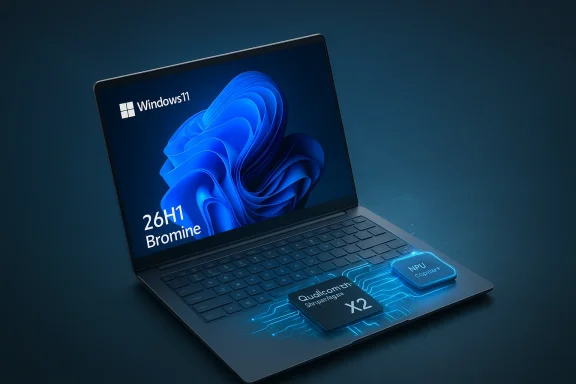
Windows 11 laptop with glowing Qualcomm Snapdragon X2 and NPU chips on the keyboard.Background / Overview​

Microsoft surfaced a Canary‑channel Windows 11 build with a visible version string of 26H1 (Build 28000) and followed up with support documentation clarifying the build’s role: it “only includes platform changes to support specific silicon” and “is not a feature update for version 25H2.” That language is decisive — Microsoft is not rolling out a second, general consumer feature update; it is issuing a factory/image‑level platform release so OEMs can ship new Arm‑based laptops with validated drivers, firmware, a the box.
Industry reporting and vendor briefings quickly associated 26H1 with Qualcomm’s Snapdragon X2 family — and OEM messaging (for example, certain ZenBook SKUs) has reinforced the idea that 26H1 will be the factory image for those X2 SKUs. At the same time, multiple outlets and community captures treated NVIDIA’s N1 / N1X as possible candidates for 26H1 support; the key caveat: those are still largeVIDIA or Microsoft issues an explicit statement.

What Microsoft actually said — and why wording matters​

The literal message: a platform release for specific silicon​

Microsoft’s KB entry for the February 10, 2026 cumulative lists Windows 11, version 26H1 (OS Build 28000.1575) and annotates that it’s intended for new devices with select new silicon arriving in early 2026. That is the authoritative baseline: 26H1 exists and is available only on qualifying hardware.

Why Microsoft framed it this way​

The company’s messaging — “not a feature update” and “only includes platform changes” — deliberately separates user‑facing feature work (the annual H2 cadence, 26H2 later in 2026) from device enablement work. That split reduces the risk of widespread regressions across the massive, heterogeneous Windows installed base by localizing deep kernel, scheduler, driver, firmware and NPU/runtime changes to factory images for a small set of SKUs. This approach mirrors prior moves where Microsoft coordinated platform images with OEMs to match silicon launch timing rather than force a universal servicing change.

Snapdragon X2: the clear front‑runner​

What Qualcomm announced​

Qualcomm’s Snapdragon X2 family (X2 Elite, X2 Elite Extreme and later X2 Plus variants) is positioned as a major generational step for Windows on Arm: new Oryon CPU cores, higher memory bandwidth, updated Adreno GPUs, and a substantially more capable NPU rated at around 80 TOPS (INT8) on many configurations. Qualcomm publicly framed those NPUs as a key enabler for Copilot+ and local, concurrent on‑device AI tasks — the exact workloads Microsoft’s platform changes target. Independent coverage from multiple outlets summarizing Qualcomm’s press materials corroborates those claims.

Why 26H1 lines up with X2 timing​

Qualcomm and multiple OEMs signalled early‑to‑mid 2026 shipping windows for X2 systems. Microsoft’s choice to make 26H1 a factory image allows OEMs to flash validated 26H1 builds at the factory, ensuring day‑one compatibility for X2’s novel power states, NPU attestation/runtimes, and firmware interactions — a coordination that would be difficult using the standard H2 servicing timetable. Industry coverage linking 26H1 to Snapdragon X2 is consistent across sources.

NVIDIA N1 / N1X: rumor, potential, and the current silence​

What’s being claimed about NVIDIA​

Over the last year outlets and community analysts have speculated that NVIDIA’s rumored Arm‑based laptop platforms — variously referred to as N1, N1X, or family members — could be candidates for Bromine/26H1 support. Those rumors point to NVIDIA positioning to enter the laptop Arm space with high‑NPU targets and server‑grade experience translated to client systems. But timelines, SKU definitions, and public productization remain fragmented and shifting.

What Microsoft’s messaging actually shows​

Microsoft’s public guidance and the KB page highlight Snapdragon X2 as a concrete example and do not enumerate NVIDIA N1/N1X as a guaranteed or explicit target. That omission matters: when Microsoft uses the phrase “select new silicon” and public vendor examples are limited, it leaves room for more chips to be supported later — but it does not constitute confirmation. Journalists and community sites have picked up on that omission to note that Microsoft named Snapdragon X2 and did not name NVIDIA N1, which motivated headlines such as the VideoCardz piece you flagged. Treat that omission as material but not definitive: absence of mention is not official exclusion.

Why NVIDIA silence is unsurprising (and consequential)​

  • NVIDIA’s Arm laptop plans (N1/N1X) have been reported with shifting timelines and occasional delays; silicon and firmware readiness are complex and can slip independently of Microsoft’s schedule.
  • Microsoft’s conservatism in naming partners in public docs is a deliberate risk‑minimizing move; until both silicon and OS plumbing are jointly validated, public confirmation is unlikely.
  • From a commercial standpoint, NVIDIA’s entry would be strategically significant — but Microsoft may prefer to keep launch coordination private until the end‑to‑end stack (drivers, runtimes, firmware attestation) is certified.
In short: N1/N1X remains possible for 26H1 support in the future, but it is not confirmed — and current Microsoft messaging implicitly prioritizes Snapdragon X2 as the immediate 26H1 anchor.

Technical anatomy: what 26H1 (Bromine) brings — at a high level​

26H1 is best understood as an OEM‑ship image that bundles platform changes necessary to operate reliably on new system architectures. Key engineering pieces likely included (and visible in community analysis and Microsoft’s KB metadata) are:
  • Kernel and scheduler adjustments to handle heterogeneous Arm core layouts and new power domains.
  • Power management and firmware handshake changes to support novel sleep/wake and power islands in X2‑class SoCs.
  • Native NPU/runtime hooks and attestation flows to ensure secure and performant on‑device AI acceleration.
  • Device driver bundles and validated firmware images signed for factory flashing to specific SKUs.
These are not shiny UI changes; they are the plumbing that must work before marketing content (Copilot+ experiences, semantic search, local AI features) can be shipped and reliably delivered to consumers.

Practical implications: consumers, OEMs, and IT teams​

For consumers and buyers​

  • If you’re buying an upcoming Snapdragon X2 Copilot+ laptop, expect it to ship with 26H1 preinstalled and to deliver the on‑device AI experiences vendors advertise — assuming hardware and driver stacks are validated. Confirm SKU‑level factory images with OEM spec sheets or retail listings before purchase.
  • If you own a current Intel or AMD laptop, do nothing. Microsoft has been explicit that 26H1 will not be pushed as an in‑place Windows Update to existing mainstream devices; your PC remains on the regular 25H2/26H2 cadence. ([support.microsoft.com](February 10, 2026—KB5077179 (OS Build 28000.1575) - Microsoft Support and procurement
  • Treat 26H1 devices as device‑specific images that may have a different servicing and update path than your existing fleet. Don’t assume Windows Update will behave the same for Bromine/26H1 devices.
  • Require OEM documentation on driver and firmware update channels, support windows, and whether management agents (MDM, endpoint protection, remote management) are supported at scale on 26H1 devices. Perform a pilot and validate all management tooling on the exact SKU you plan to deploy.

For developers and ISVs​

  • Arm64 CI builds and NPU‑aware testing should rise in priority. Device‑gated platform differences can cause subtle behavior changes in threading, power constraints, and hardware‑accelerated ML paths. Ensure graceful degradation when NPU acceleration is not present.

Risks, trade‑offs, and unanswered questions​

Fragmentation risk and testing complexity​

By introducing a device‑gated platform lane, Microsoft reduces day‑one risk for the new silicon but creates a short‑term fragmentation problem: image parity across enterprise images, testing matrices for ISVs, and update servicing logic will have to account for at least two contemporaneous platform baselines (Bromine/26H1 vs Germanium/25H2 and later 26H2). That fragmentation increases operational overhead for IT and independent software vendors.

Update path clarity​

Microsoft’s support documentation and industry reporting indicate that 26H1 devices will not receive the standard H2 feature update in the same way later in 2026, because 26H1 rests on a different Windows core. Microsoft has promised “a path to update in a future Windows release,” but the timing and mechanism remain unspecified. That ambiguity will matter to enterprises that need guarantees on upgrade windows, rollback options, and long‑term servicing expectations. Track Microsoft’s servicing matrix andosely.

Vendor readiness and driver maturity​

NPU and firmware ecosystems are nascent: validated drivers, runtime libraries, and security attestations are all required for reliable on‑device AI. Any gaps in vendor runtime maturity or delays in signed firmware updates could translate to poor battery life, instability, or disabled AI features at launch.

NVIDIA’s inclusion — a wildcard​

If NVIDIA’s N1/N1X enters the picture with certified drivers and a validated runtime stack, Microsoft could extend Bromine/26H1 support to those systems — but until NVIDIA or Microsoft explicitly confirms support, treat N1 inclusion as speculative. Headlines that emphasize a lack of mention of NVIDIA (for example, reporting that Microsoft “named Snapdragon X2 but didn’t name NVIDIA N1”) are accurate but incomplete: omission is not the same as exclusiotps://www.tomsguide.com/computing/cpus/nvidia-n1x-cpu-delayed-once-again-and-microsofts-next-gen-os-seems-to-be-at-fault)

How to evaluate claims and announce‑time statements (a short checklist)​

When you see headlines about 26H1 device eligibility, use this checklist to separate confirmation from rumor:
  • Look for Microsoft support or KB documentation naming the version/build string (authoritative).
  • Check OEM press releases or product pages for SKU‑level image strings (do ZenBook A14/X2 SKUs list 26H1?).
  • Verify vendor silicon specs from vendor press releases (Qualcomm’s X2 materials, NVIDIA’s public statements).
  • Treat community captures and early Canary notes as directional but not definitive — wait for Microsoft/OEM/NVIDIA joint confirmation for cross‑vendor support.
  • For enterprise purchases, demand written servicing and update guarantees from the OEM or reseller before procurement.

What to watch next (timeline and signals)​

  • Microsoft KB and release health updates: cumulative updates and KB pages remain the single most reliable place to verify which builds apply to which hardware. KB5077179 (Build 28000.1575) is the authoritative baseline for 26H1 as of February 10, 2026.
  • OEM product pages and retail stock: look for SKU pages that explicitly list the factory image version or platform build string — that’s how you confirm a shipped device uses 26H1.
  • NVIDIA statements: any blog post, developer note, or partner announcement from NVIDIA mentioning N1/N1X support for Microsoft’s Bromine/26H1 platform would materially change expectations — treat that as decisive.
  • Community telemetry and early device reports: after devices hit the market, community reports on in‑place applicability, device update channels, and driver behavior will surface edge cases that Microsoft’s KB may not fully enumerate.

Bottom line: a pragmatic, cautious engineering move — with cost​

Microsoft’s 26H1 decision is technically rational. Modern SoCs increasingly present heterogeneous compute (multiple CPU clusters, large NPUs, firmware attestation domains) that touch kernel, scheduler, power, and userland runtimes. Shipping a device‑targeted platform image lets Microsoft and OEMs validate the whole stack on a constrained set of SKUs and provide a dependable experience for buyers of those machines. That pragmatic choice reduces day‑one risk for Copilot+ marketing promises and on‑device AI features.
But there is a real cost. Short‑term fragmentation, uncertainty about update paths, and the potential operational burden for enterprises and ISVs are tangible consequences. NVIDIA’s N1/N1X remains a plausible candidate for inclusion in 26H1, but the vendor silence in Microsoft’s published guidance makes that an open question and the subject of reasonable skepticism until a vendor‑to‑vendor confirmation appears.
If you’re buying a new Copilot+ Arm laptop, do your homework: confirm the SKU’s factory image, require OEM servicing commitments, and pilot device management and security tooling. If you’re an IT manager, treat 26H1 SKUs as a separate device class and demand clarity on update paths before wide deployment. For the Windows ecosystem, the success of this approach will depend on Microsoft, OEMs and silicon partners communicating clearly and ensuring that the short‑term fragmentation resolves into a single, manageable servicing story later in 2026 with 26H2.
In the meantime, the most reliable facts are these: Windows 11 26H1 exists; Microsoft’s KB shows it as a narrowly targeted platform release; Qualcomm’s Snapdragon X2 is the concrete, named example; and NVIDIA’s inclusion remains possible but unconfirmed. Watch Microsoft’s support docs, OEM SKU pages, and any direct NVIDIA statements for the next, decisive signals.

Source: VideoCardz.com https://videocardz.com/newz/microso...is-for-snapdragon-x2-no-mention-of-nvidia-n1/
 

Microsoft's decision to ship Windows 11, version 26H1, as a narrowly scoped, device‑first platform image for new Arm‑based hardware — rather than as a broadly distributed feature update — marks a deliberate engineering move that will affect buyers, IT teams, OEMs and developers in materially different ways. The headline is simple: if your PC uses Intel or AMD, 26H1 is not for you; early Copilot+ and Snapdragon X2 systems will ship factory‑flashed with 26H1 (the Bromine platform), while the wider installed base remains on Windows 11 25H2 and awaits the general 26H2 consumer release later in the year.

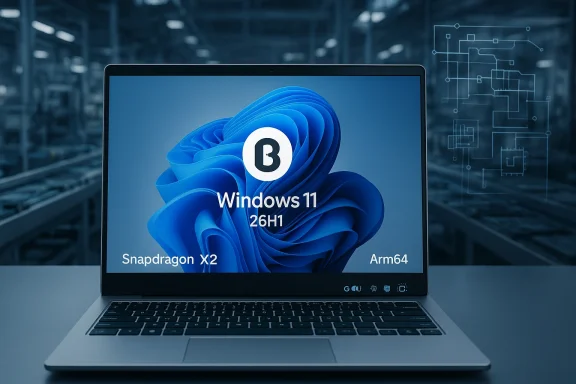
A laptop displays Windows 11 with Snapdragon X2 and Arm64 in a blue, industrial setting.Background / Overview​

Microsoft introduced the Canary preview labeled Build 28000, which surfaces in Settings and winver as Windows 11, version 26H1. The Windows Insider blog was explicit: “26H1 is not a feature update for version 25H2 and only includes platform changes to support specific silicon.” That phrasing frames 26H1 as a platform enablement lane rather than the next mass consumer feature drop.
Microsoft’s support documentation and release‑health pages confirm the manufacturing‑first intent: 26H1 will be available only on select new devices, starting with systems built on Qualcomm’s Snapdragon X2 series, and is not offered as an in‑place update from 24H2/25H2 on existing machines. Microsoft also notes that devices running 26H1 will follow their own servicing lane and will not automatically update to the annual H2 feature release in the typical way.
Industry reporting an captured in community reporting and OEM notes — tie 26H1 to a new internal platform codename, Bromine, and to factory images targeted at early 2026 Snapdragon X2 laptops. These corroborate Microsoft’s messaging and explain the release’s engineering rationale: to ship validated OS+driver+firmware bundles that match the new silicon’s expectations.

What Windows 11 26H1 actually is​

Platform baseline, not a consumer feature wave​

At its core, 26H1 is an engineering vehicle. It packages kernel, scheduler, power‑governor, driver and runtime changes needed to support new Arm rge NPUs, heterogeneous core topologies, and firmware/attestation behaviors that Windows must handle inside the OS. The release is intentionally lig UI features; its value is in enabling stable, day‑one hardware behavior for qualifying devices.

Key technical focuses​

  • Kernel and scheduler updates to manclusters and correct core affinity on big/mid/small arrangements typical in modern Arm designs.
  • Power and thermal governors tuned to new SoC envelopes so marketed battery life and sustained performance are realistic on launch devices.
  • NPU/runtime and attestation hooks to enable secure on‑device AI, model manifests and vendor‑specific acceleration paths.
  • Validated DCH driver bundles and firmware pairings for GPUs, ISPs and radios that OEMs will factory‑flash with the Bromine image.
These are low‑level, compatibility‑sensitive changes that, if merged wholesale into the mainstream servicing branch, risk regressions across a huge diversity of hardware. The device‑first approach isolates that complexity to a controlled hardware set.

Why Microsoft broke the cadence​

Microsoft historically ships a single, broad second half of the year (the H2 release). The decision to produce a mid‑cycle platform image responds to a simple operational tension: silicon roadmaps and OEM manufacturing deadlines don't always align with Microsoft’s H2 schedule. When new SoCs (notably Qualcomm’s X2 family) are ready to ship months before the next general feature wave, Microsodelay partner launches or provide a validated OS image for factories. Microsoft chose the latter.
That choice reduces day‑one regressions on new silicon and lets OEMs flash a tested image in production. It also protects the broad installed base from receiving deep platform plumbing changes before they're widely validated. But the trade‑off is a short‑term servicing divergence and the operational complexity that comes with it.

Who gets 26H1 — and who doesn’t​

Eligible initial recipients​

  • New Copilot+ Arm64 laptops shipped with Qualcomm Snapdragon X2 SKUs (examples reported in OEM briefings include certain Asus ZenBook A14/A16 variants). Those X2 SKUs are expected to come preinstalled with the Bromine image.

Explicitly not eligible​

  • Existing Intel‑ and AMD‑based Windows 11 PCs will not be offered 26H1 via Windows Update and remain on the mainstream 25H2 servicing baseline. Microsoft states unambiguously there is no forced migration for these systems.

Unconfirmed- Community and industry chatter points to other Arm vendors (for example, NVIDIA’s rumored N1/N1X families) as potential candidates for Bromine support, but those claims remain speculative until vendors or Microsoft publish formal compatibility statements. Treat such extensions as rumor until confiral effects — what different audiences should do​

Consumers and buyers​

For most consumers using Intel or AMD machines: *do nremains on 25H2 and continues to receive security and quality updates as before. If you’re shopping for a new Copilot+ laptop and evsk the retailer and OEM whether the model ships with 26H1**, and get written clarity on driver/firmware update channels and SLAs. Identical model names can hidages depending on the silicon option.

IT teams and procurement​

Enterprises must treat 26H1 systems as distinct platform SKUs with separate certification and servicing expectations. Recommended steps:
  • Source at least one pilot unit of each X2 SKU you plan to deploy and perform full image validation under your m. Demand OEM documentation on update channels, driver maintenance, and expected cadence (Windows Update vs OEM toolchains).
  • Verify endpoint protection, MDM behavior, and custom agents under Arm64 and test emulation fallbacks for legacy x86/x64 a mixed fleet, add Bromine/26H1 to your image matrix and plan for potential divergence in upgrade timing to the later mainstream 26H2 release.

Developers and ISVs​

Prioritize Arm64 CI builds and test NPUhs where feasible. Design apps to degrade gracefully when hardware acceleration or secure attestation paths are absent. Emulation remains a reality for many workloads, so maintain x86/x64 compatibmulation as well.

Strengths: clear engineering rationale and device readiness​

  • Day‑one hardware compatibility. OEMs can factory‑flash a validated image that bundles the exact driver/firmware mix the silicon expects, reducing launch‑week support calls.
  • Platform‑level optimizations where they matter. Scheduler and power changes tuned for specific SoC behavior should reduce the kind of battery and thermal surprises that plague early silicon launches.
  • Enables secure, local AI scenarios. NPU runtime and attestation plumbing insites for trustworthy on‑device AI and Copilot+ features Microsoft and OEMs are marketing.
These are defensible engineering wins when the goal is reliable hardware launches rather than immediate consumer feature propagation.

Risks and downsides: fragmentation, support complexity, and upgrade ambiguity​

Short‑term fragmentation​

Shipping a separate platform baseline creates a bifurcated ecosystem: Bromine/26H1 devices vs. the mainstream 25H2/26H2 lineage. That increases testing matrices for ISVs and complicates enterprise imaging strategies. Microsoft must provide clear guidance and timelines to keep fragmentation manageable.

Update and upgrade clarity​

Microsoft's support docs explicitly state 26H1 devices "will not be able to update to the next annual feature update in the second half of 2026" on a different Windows core. The promise is a path to update in a future release, but the lack of a precise, public upgrade timeline raises valid concerns for IT buyers and OEM warranties. Enterprises should insist on documented upgrade commitments from OEMs.

Compatibility gaps and vendor lock​

Third‑party kernel‑mode drivers, hardware management agents and older applications may behave differently on Bromine. Some device updates may rely on OEM toolchains rather than Windows Update, which increases operational overhead and raises support continuity questions if OEMs change policies. Require SLAs.

Marketing vs reality for on‑device AI claims​

Chip vendors and OEMs are marketing high NPU TOPS and core counts for Snapdragon X2 SKUs; those numbers are vendor claims and early benchmarks are directional. Real‑world gains in AI latency, power efficiency and app compatibility will depend on mature runtimes, model quantization and good integration across OS, drivers and apps. Treat vendor numbers as promotional until independent third‑party benchmarks are widely available.

Upgrade path — what we know and what remains unclear​

Microsoft’s documentation and the Caial picture: 26H1 devices will receive monthly quality and security updates on their own servicing lane, but they won’t follow the standard 25H2→26H2 in‑place update path in 2026. Microsoft states these device update in a future Windows release," but it does not yet publish exact timelines or technical migration steps for how Bromine devices converge with the broader Windows core. That uncertainty matters to IT and to users who expect a predictable multi‑year update story.
Actionable expectations for buyers and admins:
  • Treat 26H1 devices as having a separate servicing lane until OEMs and Micrl convergence schedule.
  • Require the vendor to state how and when 26H1 systems will be migrated to subsequent mainstream feature releases and whether that migration will preserve user data, provisioning, and enterprise profiles.

Comparing 26H1 to past platform splits​

Microsoft has previously made platform‑specific branches (for example, earlier ARM experiments and the 24H2 Germanium baseline reported during prior cycles). Those episodes show the model can work — enabling OEMs to out destabilizing the wider ecosystem — but also demonstrate the long tail of coordination required to unify branches : communicate upgrade paths early, publish HLK/WHCP/HLK playlists for certificati and tooling for testing.

Recommendations — checklist for stakeholders​

  • For consumers:
  • If you own Intel/AMD PCs: no action required. Stay on 25H2 and wait for the mainstate.
  • If you plan to buy an X2 Copilot+ ls factory OS image, get OEM update policy in writing, and expect a Bromine/26H1 image at purchase.
  • For IT and procurement:
  • Pilot early and validate management tooling on actual Bromine devices.
  • Demand OEM SLAs for driver and firmware servicing and a clear upgrade roadmap to mainstream Windows releases.
  • Treat Bromine images as separate SKUs in your asset and lifecycle plans.
  • For developers and ISVs:
  • Add Arm64 CI, test emulation fallbacks and validode paths carefully; expect divergence in runtime manifests and driver dependencies.
  • For OEMs and silicon vendors:
  • Publish clear firmware/driver update channels and document how Bromine images will be maintained and migrated in partnership with Microsoft and enterprise customers.

Final analysis — pragmatic engineering, conditional success​

Windows 11 26H1 is ultimately a pragmatic, engineering‑first response to the realities of modern silicon schedules. The approach has real benefits: controlled factory images, validated driver/firmware pairings and the ability to ship new Copilot+ experiences with less day‑one risk. In short, for the first wave of Snapdragon X2 systems, Bromine should make the devices behave more predictably out of the box.
That said, the model’s success depends on clear and timely communication from Microsoft and OEMs about servicing, upgrade paths, and SLAs. Without transparent upgrade timelines and robust tooling for ISVs and enterprises, the short‑term gains risk being undercut by the operational cost of managing a fragmented servicing landscape. The most important near‑term ask for customers and IT teams is simple: get commitments in writing and test early.

Windows 11 26H1 is not a mass consumer update; it is a specialized platform baseline built to make next‑generation Arm silicon ship with fewer surprises. For most users on Intel and AMD hardware the practical impact is zero — continue to run 25H2 and expect the mainline 26H2 feature release later in the year. For early adopters, enterprises and developers, the arrival of Bromine means planning, testing and a careful review of vendor commitments are now essential parts of any buying or deployment decision.

Source: TechPowerUp Windows 11 26H1 Limited to New Arm-based Processors, Other PCs Remain on 25H2 | TechPowerUp}
 

Microsoft’s decision to ship Windows 11, version 26H1, as a narrowly scoped, device‑first platform image — available at launch only on select Arm‑based PCs (notably those powered by Qualcomm’s Snapdragon X2 series) — marks a deliberate engineering pivot in how Microsoft delivers low‑level OS changes to new silicon, and it raises important questions about fragmentation, servicing, and the path forward for users, IT teams, OEMs and developers.

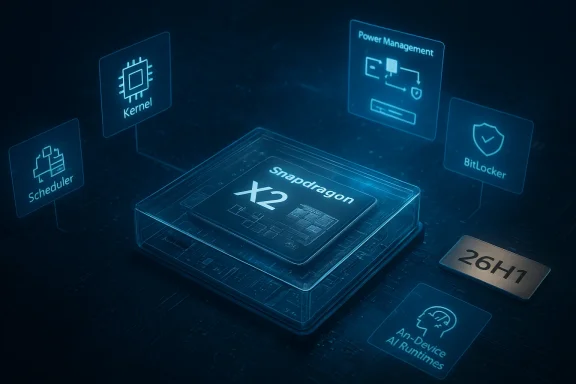
Snapdragon X2 chip shown with floating holographic icons for kernel, scheduler, power management, and security.Background / Overview​

Microsoft surfaced Windows 11, version 26H1 publicly in the Windows Insider Canary Channel as Build 28000, and it accompanied that build with unusually explicit wording: “26H1 is not a feature update for version 25H2 and only includes platform changes to support specific silicon.” That phrasing — combined with Microsoft’s product documentation — frames 26H1 as a platform enablement release designed to be factory‑flashed on new devices rather than a broadly distributed consumer feature update.
Microsoft’s official support pages confirm the intent and distribution model: 26H1 will be available only on new devices with select new silicon starting in early 2026 and will not be offered as an in‑place update to existing Windows 11 devices through Windows Update. The company explicitly states the first devices will use the Qualcomm Snapdragon® X2 Series processors.
Industry reporting and vendor briefings have tied 26H1 to an internal platform baseline commonly referred to in partner briefings as Bromine, and to the launch cadence for the Snapdragon X2 family. Independent coverage from outlets that tracked the Canary build and OEM confirmations reinforces Microsoft’s message that 26H1 is hardware‑gated: some new Copilot+ and Arm64 systems will ship with 26H1 preinstalled, while most existing Intel/AMD PCs will remain on the mainstream servicing track (25H2 → 26H2).

What exactly is Windows 11 26H1?​

A platform baseline, not a consumer feature wave​

At its core, 26H1 is an engineering vehicle: a Windows image that packages low‑level kernel, scheduler, driver, power‑management and NPU/runtime changes required by new Arm‑based SoCs. It intentionally carries minimal visible, consumer‑facing changes compared with the regular annual feature update cadence (the H2 releases). Microsoft’s own release notes make that distinction clear.
Key technical focus areas expected in 26H1 include:
  • Kernel and scheduler updates to handle heterogeneous CPU topologies typical in modern Arm SoCs.
  • Power and thermal policy changes to match new SoC power envelopes for consistent battery life and sustained performance.
  • Bundled, validated driver stacks (DCH) for GPUs, ISPs and connectivity tailored to specific silicon.
  • NPU/runtime and attestation hooks to enable secure on‑device AI and model execution.
  • Firmware/pre‑boot and attestation changes affecting BitLocker, WinRE and device identity flows.
These are not cosmetic or superficial tweaks. They touch deep OS surfaces and firmware interactions — which is precisely why Microsoft opted to contain them to a limited set of qualifying hardware rather than to push them into the broad servicing branch used by hundreds of millions of devices.

Distribution and servicing model​

  • Availability: Preinstalled by OEMs on qualifying new devices (factory image) beginning early 2026.
  • Upgrade path: Not offered as an in‑place Windows Update to existing devices running 24H2 or 25H2.
  • Servicing: Devices running 26H1 will receive monthly security and quality updates but will follow a different servicing baseline and will not automatically update to the 2026 H2 annual feature release (26H2) in the normal way. Microsoft documents the lifecycle differences for IT admins.

Why Arm‑only at launch? The engineering rationale​

Microsoft’s choice to gate 26H1 primarily for Snapdragon X2 devices is pragmatic rather than political: next‑generation Arm SoCs introduce architectural changes that reach far down the stack, and those changes create real risk if merged into the one‑size‑fits‑all servicing branch.
Reasons the device‑first approach makes engineering sense:
  • Modern Arm SoCs are heterogeneous: they mix big/mid/smae on‑die NPUs, differing cache/power characteristics and new firmware interfaces. The Windows kernel and scheduler require careful tuning to make those components behave predictably.
  • On‑device AI:w runtime and security* requirements (model manifests, attestation) that interact with the OS in complex ways.
  • OEM manufacturing timelines: silicon vendors and OEMs need a validated, RTM‑quality OS imagedevices can ship without day‑one driver or firmware mismatches.
  • Risk containment: isolating risky kernel and power‑management changes to a controlled hardware set reduces the potential for regressions on the broader Windows install base.
Microsoft has explicitly said 26H1’s purpose is to “enable the next generation of silicon and hardware innovation,” with the Snapdragon X2 family named as the first pipeline of qualifying chips. That makes sense when Qualcomm’s device timelines fall out of sync with Microsoft’s H2 feature cadence, and OEMs want a stable image to ship with.

What the major outlets reported (quick summary of coverage)​

Several outlets covered Microsoft’s Canary announcement and the launch plan. Their reporting converges on the same essentials, but each adds nuance and editorial perspective.
  • Tom’s Hardware emphasized Microsoft’s confirmation that 26H1 will be Arm‑focused at launch and tied the release to Snapdragon X2 devices shipping with factory‑flashed 26H1.
  • PCWorld framed the Canary release as confirmation that most users don’t need to worry — 26H1 is testing platform-level changes for new silicon and is not the next mainstream consumer update.
  • XDA Developers highlighted the blunt reality for current PC owners: 26H1 isn’t coming to your current PC as an in‑place update, and the practical implications for upgrade planning and expectations.
Each of these pieces underscores the same central message: 26H1 is about enabling new hardware, not about rolling out fresh consumer features to the installed base.

What this means for buyers and consumers​

If you’re shopping for a new laptop or evaluating a refresh, here’s what to expect and what to consider.

For consumers planning to buy an X2‑powered laptop​

  • Day‑one experience: Devices that ship with Snapdragon X2 + 26H1 may provide earlier access to validated, hardware‑gated on‑device AI experiences and tuned power profiles. Expect OEM SKUs to be labeled or documented with their factory image.
  • Feature parity: 26H1 is largely feature‑neutral relative to 25H2; visible UI or productivity features are not the selling point — the value is in stability and hardware integration.
  • Long term: Devices on 26H1 will follow a different update lane; they will still get security updates, but their path to the next annual H2 feature release differs and may require a future migration plan. Check the OEM’s support and update policy at purchase.

For users of existing Intel/AMD PCs​

  • No action required: Your PC will remain on the mainstream servicing track (25H2→26H2) and will not get 26H1 via Windows Update. This avoids surprising changes to behavior on existing machines.
  • Expect 26H2 later in the year for the broad consumer feature wave.

Enterprise and IT implications​

IT leaders should treat 26H1 as a hardware image baseline — not a new servicing ring to be broadly adopted.
Practical guidance for enterprises:
  • Pilot early: If evaluating Snapdragon X2 devices, run pilots in a controlled ring with device‑specific imaging.
  • Demand documentation: Require OEMs to publish clear image details, driver bundles and update SLAs for 26H1 devices.
  • Management tooling: Validate that your endpoint management, security agents, and kernel‑mode components are compatible with 26H1 images.
  • Update strategy: Continue to plan enterprise deployments around supported LTS/Pro baselines (24H2/25H2) unless you have a specific need to adopt 26H1 hardware early.
From a lifecycle perspective, Microsoft lists the servicing terms for 26H1, and IT pros should factor the different servicing lane into procurement and refresh timelines.

Developer and ISV considerations​

The rise of 26H1 as a platform baseline for Arm devices has immediate implications for software vendors.
  • Prioritize Arm64 builds: Native Arm64 binaries and installers reduce reliance on emulation and will deliver the best performance on X2 devices.
  • Test NPU paths: If your app uses on‑device AI, test accelerated paths (NPU inference) and graceful fallbacks to CPU/GPU paths for non‑X2 systems.
  • Validate drivers and agents: Security and endpoint agents that include kernel components must be validated against 26H1 images; exiy images.
  • Packaging & installers: Confirm installer behaviors on the Bromine/26H1 platform, as low‑level changes can expose differences in driver signing, attestation and secure runtime hooks.
Developers should treat 26H1 as an early harbinger of what next‑generation Arm laptops will demand: closer collaboration with silicon and OEM partners, and more investment in Arm‑native tooling and CI pipelines.

Strengths — Why Microsoft’s approach can work​

  • Better day‑one user experience: OEMs and silicon partners get an RTM‑quality image to factory‑flash, reducing the risk of day‑one driver mismatches and poor battery/thermal behavior.
  • Safer rollout of risky plumbing: Isolating kernel/scheduler changes to a limited hardware set reduces regressions on the broader Windows population.
  • Faster silicon enablement: Microsoft can synchronize OS work with partner timelines and ship hardware innovations without waiting for the H2 consumer release cadence.
  • Clear engineering rationale: The scale of modern SoC changes (large NPUs, heterogeneous cores) requires deep OS adjustments; a targeted baseline is a rational engineering response.

Risks and downsides — real concerns to watch​

Despite the engineering logic, there are tangible risks and trade‑offs.
  • Fragmentation anxiety: Multiple servicing baselines raise the specter of fragmentation — different devices on different Windows cores may cause confusion in support, app compatibility, and documentation.
  • Update and migration complexin’t follow the familiar automatic path to the H2 consumer release; enterprises and consumers must understand what that means for feature parity and long‑term updates.
  • Driver and ecosystem fragility: Relying on OEM‑bundled driver stacks and vendor‑signed firmware increases the importance of OEM support quality; a weak vendor support program could lead to poor post‑ship experiences.
  • Messaging & optics: Microsoft must communicate clearly to avoid perception issues where consumers think they’re being excluded or left behind; outlets like PCWorld and XDA already framed 26H1 as “not for you” for existing PCs, and poor messaging could exacerbate concern.
  • Test surface: ISVs, security vendors and IT teams must expand their testing matrices to include Bromine/26H1 images; that increases test overhead and could slow adoption if tooling lags.

Practical, actionable guidance​

Below are concise, practical steps for the major stakeholder groups.

If you’re buying a new laptop (consumer)​

  • Verify OEM image: Ask the retailer or OEM whether the device ships with Windows 11 version 26H1 factory‑installed.
  • Check support & updates: Confirm how the OEM will handle driver and firmware updates for the device across its lifecycle.
  • Expect hardware‑first benefits: If you need the earliest on‑device AI features or the best Arm power/thermal tuning, X2 + 26H1 may deliver those at purchase.

If you’re an enterprise IT leader​

  • Pilot a small set of X2 devices before broader adoption.
  • Validate endpoint manageme vendors on 26H1 images.
  • Demand written SLAs from OEMs for driver/firmware update behavior.
  • Keep mainstream deployments on 24H2/25H2 unless you have a targeted reason to adopt X2 hardware.

If you’re a developer or ISV​

  • Add Arm64 to your CI: Build and test native Arm64 packages on real hardware or validated images.
  • Test NPU paths and fallbacks: Validate on‑device AI code paths, including model attestation flows where relevant.
  • Engage OEMs/silicon partners where possible: If your app targets on‑device AI, early collaboration helps ensure runtime compatibility.

How Microsoft could reduce friction​

To minimize the risks of fragmentation and confusion, Microsoft should:
  • Publish clear, machine‑readable device catalog entries and OEM image manifests so IT and endpoint managers can quickly identify which SKU uses 26H1.
  • Provide a straightforward migration path and timeline for 26H1 devices to reach future mainstream feature releases, including documented upgrade scenarios and required tooling.
  • Work with OEMs to standardize support windows and update SLAs for 26H1 hardware to reduce variability in post‑ship update behavior.
  • Improve visibility into which hardware receives Bromine/26H1 at launch and provide searchable lists for IT procurement teams.

Critical analysis — balancing innovation with coherence​

Microsoft’s 26H1 approach is defensible from an engineering standpoint. Modern Arm silicon is diverging in ways that demand platform changes developers and OEMs cannot safely deliver through the single servicing stream that supports hundreds of millions of PCs. A factory‑flashed platform image gives OEMs the stability they need, and it lets Microsoft ship hardware‑validated experiences on day one. That’s a strength that matches the reality of heterogeneous silicon launches.
But the move also invites practical and perceptual costs. A world with multiple Windows cores in active use increases the burden on developers, security vendors and IT teams. It also creates a communications challenge: consumers must understand that being excluded from 26H ng choice — but that nuance is easy to lose in headlines that read “26H1 isn’t for you.” Microsoft and OEMs must therefore overcommunicate the reasons, benefits and lifecycle specifics to avoid unnecessary confusion.
From a product strategy angle, 26H1 also signals a broader reality: as on‑device AI and SoC complexity become central differentiators, OS vendors may need to run more parallel baselines to safely enable hardware innovation. That is manageable, but only if the industry invests in robust tooling, clear documentation and predictable support models.

Final verdict — what to expect next​

  • Expect early Snapdragon X2 laptops to ship with Windows 11, version 26H1 as their factory image in early 2026; Microsoft’s documentation and multiple outlets corroborate this timeline and distribution model.
  • Don’t expect 26H1 to appear as a Windows Update for your current Intel/AMD or prior Arm PC; the release is not an in‑place upgrade for most existing devices.
  • Anticipate the broader, consumer‑facing Windows 11 26H2 release to arrive on the usual H2 cadence later in 2026, carrying the mainstream feature set for the installed base. Microsoft has confirmed that feature development will continue on the H2 track for the wider population.
  • For enterprises and developers, treat 26H1 as a hardware image baseline: pilot, test, and insist on OEM/partner clarity about image contents and SLAs before broad adoption.

Conclusion​

Windows 11 version 26H1 is a clear, purposeful engineering answer to the reality of next‑generation Arm silicon: a targeted, OEM‑preinstalled platform image that enables new SoCs to ship with validated drivers, tuned power behavior, and on‑device AI runtimes without destabilizing the broader Windows ecosystem. That engineering-first approach reduces day‑one risk for OEMs and consumers buying qualifying hardware, and it gives Microsoft a safer path for deep OS changes.
At the same time, the approach raises legitimate concerns about fragmentation, support complexity, and communication. The success of 26H1 will hinge on Microsoft and OEMs delivering transparent documentation, reliable update and support practices, and clear guidance for IT administrators and developers. If they get that right, 26H1 can be a pragmatic bridge to richer, hardware‑accelerated experiences across the PC landscape; if they don’t, it risks creating a confusing fork in the Windows ecosystem at a time when clarity and cohesion matter most.

Source: Tom's Hardware Microsoft confirms Windows 11 26H1 will be for Arm devices only at launch — Snapdragon X2-powered devices officially shipping with 26H1
Source: PCWorld Microsoft releases exclusive Windows 11 update for certain PCs only
Source: XDA Microsoft's Windows 11 26H1 isn't coming to your current PC
 

Back
Top