

Microsoft is preparing Cloud-Initiated Driver Recovery for Windows Update, a Windows 11 recovery mechanism that will let Microsoft remotely roll back faulty drivers delivered through Windows Update beginning with validation work in 2026, according to recent reporting and Microsoft documentation. The feature sounds narrow, but it points at a larger shift in Windows servicing: Microsoft is admitting that the cloud cannot merely deliver change; it must also undo it. For users, that means fewer long afternoons in Device Manager. For IT departments, it means one more layer of automation to trust, audit, and occasionally fear.
Windows Update has always carried a strange bargain. Microsoft wants it to be invisible, automatic, and boring, while the Windows hardware ecosystem remains sprawling, vendor-driven, and frequently weird. Drivers sit directly at that fault line: they are distributed like software updates but fail like hardware incidents.
Cloud-Initiated Driver Recovery is Microsoft’s attempt to close the loop. If a driver pushed through Windows Update begins causing measurable failures, the recovery system can move affected machines back to a previously known-good driver through the same update infrastructure that delivered the bad one. The old model was largely preventive: test, sign, throttle, pause, and hope the telemetry catches problems before the blast radius gets too large. The new model adds a remedial step: if the blast happens anyway, reverse it.
That distinction matters. Windows already has driver rollback mechanisms, and Device Manager has long exposed a “Roll Back Driver” button for individual devices. But that is a local, user-initiated fix. It assumes the affected person can boot, diagnose the correct device, know which driver changed, and make the right call. Cloud-initiated recovery shifts that burden from the end user to Microsoft’s servicing machinery.
This is not Microsoft inventing rollback from scratch. It is Microsoft operationalizing rollback as a cloud-scale response tool. In a world where one bad kernel-mode driver can produce crashes, black screens, broken networking, or unusable peripherals, that is overdue.
For years, Microsoft’s public posture around Windows Update has emphasized safety through process. Driver packages are signed, tested, distributed gradually, and monitored with telemetry. That system is real and valuable, but it has never made driver updates risk-free. Anyone who has watched Windows replace a carefully installed GPU driver, downgrade an audio package, or revive a vendor driver that had been deliberately avoided knows the gap between theory and lived experience.
Cloud-Initiated Driver Recovery does not erase that history. Instead, it tacitly acknowledges it. The feature says: even with signing, flighting, gradual rollout, machine learning, and telemetry, bad drivers will still reach production machines. The question is no longer whether Windows Update can avoid every mistake. It is whether Windows Update can recover faster than users can lose confidence.
That is a healthier model. Modern software deployment is not made safe by pretending failure is rare; it is made safe by designing for failure from the start. Microsoft has spent years building the machinery to deploy Windows changes globally. Now it is adding machinery that treats reversal as a first-class operation.
This is why Windows users often have stronger feelings about driver updates than about ordinary cumulative patches. A driver can determine whether Wi-Fi works, whether sleep resumes properly, whether external displays behave, whether games stop crashing, whether BitLocker recovery gets triggered, or whether a machine boots at all. The update may be only a few megabytes, but the operational consequence can be a dead laptop in front of a user who has no idea what changed.
The Windows ecosystem makes the problem worse because “the right driver” is not always obvious. OEMs customize drivers for thermal behavior, power management, firmware quirks, laptop panels, keyboard hotkeys, docking stations, and bundled control software. Component vendors, meanwhile, often publish newer generic drivers. Windows Update may see one answer, the OEM support app another, and the enthusiast user a third.
That messy reality is why automated rollback must be conservative. The same system that can rescue a bad driver can also create confusion if it reverts something a user installed deliberately. Microsoft’s challenge is not merely technical. It must make the rollback smart enough to distinguish widespread harm from normal device churn and transparent enough that administrators can explain what happened after the fact.
Microsoft has since leaned harder into recovery messaging. Quick Machine Recovery in Windows 11, for example, is designed to help devices recover from critical boot failures by using a connected Windows Recovery Environment to look for cloud-based remediations. Cloud-Initiated Driver Recovery fits the same philosophy: if Windows can be injured at scale, Windows must also be recoverable at scale.
That does not mean every driver bug becomes a global crisis. Most do not. Many are limited to a model family, a chipset revision, a peripheral class, or a particular driver branch. But the operating principle is similar. Recovery must be deployable without asking every affected user to follow a 12-step workaround or every help desk to touch every machine.
The lesson for Microsoft is uncomfortable but obvious. Windows’ greatest strength is its breadth; its greatest operational liability is also its breadth. Recovery features are now part of the platform’s credibility.
In managed environments, the first question will be control. Administrators will want to know which devices were rolled back, which driver version was removed, which known-good version was restored, whether a reboot was required, and whether the action is visible in Intune, Windows Update for Business reports, event logs, or other telemetry channels. A rollback that quietly fixes a machine is good for the user. A rollback that leaves no audit trail is a problem for operations.
The second question is interaction with existing deployment rings. Microsoft’s own guidance has long pushed staged driver deployment: start small, monitor, expand, pause if problems appear. Cloud-Initiated Driver Recovery should complement that model, not replace it. If anything, it makes rings more important, because telemetry from early rings is what gives Microsoft and administrators the chance to stop a bad driver before it reaches everyone.
The third question is policy conflict. Some organizations exclude drivers from quality updates. Others rely on OEM tools. Some approve drivers manually. Some let Windows Autopatch or Intune handle the flow. A recovery system that works beautifully for unmanaged consumer PCs may be more complicated inside a locked-down fleet. Microsoft will need to document not only what the feature does, but how it behaves when update policies deliberately constrain driver delivery.
That is both the promise and the danger. Invisible recovery can preserve trust because the user never has to discover the cause of the problem. But invisible recovery can also erode trust if Windows appears to change drivers without explanation. Anyone who has fought Windows Update over GPU packages or audio drivers knows the feeling: the machine is yours, until the servicing stack decides otherwise.
Microsoft therefore has a communication problem. A notification saying “we rolled back a problematic driver to keep your device stable” would be helpful. A buried event log entry would not. The company does not need to turn every driver recovery into a modal drama, but users deserve a plain-English history of what changed and why.
That matters especially for enthusiasts. Many WindowsForum readers deliberately install specific AMD, Nvidia, Intel, Realtek, Qualcomm, or OEM driver versions for performance, latency, compatibility, or troubleshooting reasons. If Windows rolls something back, even for good cause, those users will want to know whether the rollback affects their tuning and whether the problematic driver will be blocked from reinstalling.
A bad driver and an unwanted driver are different categories. Cloud-Initiated Driver Recovery targets the former: a driver that is causing measurable harm. The GPU downgrade issue often belongs to the latter: a driver that Windows considers applicable but that the user or vendor software considers stale, inappropriate, or simply not preferred.
This distinction will matter in practice. If a new graphics driver crashes systems, rollback is a cure. If Windows Update replaces a newer driver with an older WHQL package that merely lacks a game optimization or control panel feature, rollback may not trigger at all. From Microsoft’s servicing perspective, the machine is healthy. From the user’s perspective, Windows just undid their work.
That is why this feature should be welcomed without being oversold. It is not a universal answer to Windows driver frustration. It is a safety mechanism for quality failures in the Windows Update distribution path. The broader dispute over who gets final say — Microsoft, the OEM, the component vendor, the administrator, or the user — remains unsettled.
This is where Microsoft has an advantage no OEM can easily replicate. Windows Update sees an enormous portion of the PC ecosystem. It can observe crash rates, install success, boot failures, device errors, and deployment patterns across hardware combinations that no single vendor lab could fully reproduce. The same breadth that creates Windows compatibility problems also gives Microsoft the data to spot them.
But telemetry-driven recovery is not infallible. Some failures are noisy and obvious, such as blue screens or boot loops. Others are subtle: degraded Wi-Fi performance, intermittent audio glitches, sleep battery drain, dropped Bluetooth devices, or reduced game performance. A rollback system will be better at catching the former than the latter.
That creates a future tension. Users may expect automatic rollback to fix every bad driver experience. Microsoft will likely define “bad” in terms that can be measured reliably and defended operationally. The difference between “this driver causes a kernel crash” and “this driver makes my machine worse” will remain a source of forum threads for years.
That makes accountability messy. When a driver from a hardware partner breaks machines through Windows Update, users blame Windows Update. They are not wrong, because Windows Update is the thing they experienced. Microsoft may not have written the code, but it provided the trust relationship, the signing path, and the distribution channel.
Cloud-Initiated Driver Recovery gives Microsoft a stronger operational lever over partner mistakes. It can pause distribution, cancel a problematic package, and now potentially initiate recovery to a known-good version. That is good for users, but it also changes the balance of power. A vendor that ships a poor driver through Windows Update may find Microsoft more willing to intervene directly when telemetry turns ugly.
In that sense, the feature is not merely user protection. It is ecosystem discipline. Microsoft is saying that the privilege of reaching PCs through Windows Update comes with the possibility of Microsoft-managed reversal.
Windows Update has been a recurring sore point since the Windows 10 era, when automatic updates became more assertive and driver delivery became part of the default servicing experience. Microsoft has added controls, pauses, safeguard holds, known issue rollbacks, deployment rings, and administrative reporting over the years. Yet the emotional reputation of Windows Update remains stubborn: necessary, powerful, and not always welcome.
Driver recovery is a credible attempt to improve that reputation because it addresses a concrete pain point. It does not ask users to appreciate a new design language or accept another cloud integration. It promises to reduce the time a machine spends broken because a driver update went sideways.
That is the kind of Windows improvement that rarely gets a keynote cheer but often matters more than a headline feature. A PC that recovers itself is more valuable than a PC with one more panel of recommendations.
The discipline still has to begin before deployment. Drivers need hardware lab testing, staged rollout, partner validation, and conservative targeting. Recovery should be the last line of defense after those systems fail, not the compensating control for a rushed pipeline.
This is especially important for firmware-adjacent updates and low-level system components. Some changes are harder to roll back safely than ordinary device drivers. Firmware updates may have anti-rollback security constraints. Storage, encryption, boot, and security drivers can leave machines in states where even reaching the recovery mechanism is difficult. Microsoft’s cloud recovery ambitions are strongest when the device can still communicate, boot into recovery, or accept servicing instructions.
So the right standard is not “Windows can always fix itself.” It is “Windows should fail less often, detect failures faster, and recover more consistently when recovery is technically possible.” That is less flashy, but it is honest.
That can be good. Cloud coordination is exactly what allows Microsoft to stop a bad rollout quickly, target affected hardware, and avoid asking users to become update engineers. The old standalone PC model could not solve a fleet-scale driver event with fleet-scale speed.
But it also makes transparency more important. If the cloud can decide that your PC should receive a driver, pause a driver, or roll back a driver, then the local interface needs to explain those decisions in a way that is not insulting. Windows users have tolerated a lot of “we’re getting things ready” vagueness. Driver recovery should not repeat that mistake.
For managed devices, the transparency bar is higher still. Administrators need reports, policy controls, and documentation that distinguishes Microsoft-initiated recovery from user action, help desk intervention, OEM software changes, and normal update supersedence. Otherwise, the recovery system becomes another mysterious actor in an already crowded servicing stack.
Source: PCMag UK Windows Updates Will Soon Be Able to Automatically Fix Botched Driver Updates
Source: PCMag Australia Windows Updates Will Soon Be Able to Automatically Fix Botched Driver Updates
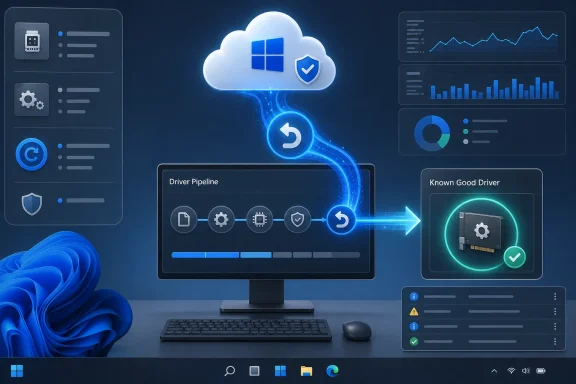 Microsoft Finally Builds an Undo Button for the Driver Pipeline
Windows Update has always carried a strange bargain. Microsoft wants it to be invisible, automatic, and boring, while the Windows hardware ecosystem remains sprawling, vendor-driven, and frequently weird. Drivers sit directly at that fault line: they are distributed like software updates but fail like hardware incidents.Cloud-Initiated Driver Recovery is Microsoft’s attempt to close the loop. If a driver pushed through Windows Update begins causing measurable failures, the recovery system can move affected machines back to a previously known-good driver through the same update infrastructure that delivered the bad one. The old model was largely preventive: test, sign, throttle, pause, and hope the telemetry catches problems before the blast radius gets too large. The new model adds a remedial step: if the blast happens anyway, reverse it.
That distinction matters. Windows already has driver rollback mechanisms, and Device Manager has long exposed a “Roll Back Driver” button for individual devices. But that is a local, user-initiated fix. It assumes the affected person can boot, diagnose the correct device, know which driver changed, and make the right call. Cloud-initiated recovery shifts that burden from the end user to Microsoft’s servicing machinery.
This is not Microsoft inventing rollback from scratch. It is Microsoft operationalizing rollback as a cloud-scale response tool. In a world where one bad kernel-mode driver can produce crashes, black screens, broken networking, or unusable peripherals, that is overdue.
The Real News Is Not Convenience, but Accountability
The tempting consumer framing is simple: Windows Update will fix bad drivers automatically. That is true, but it undersells the significance. The more important development is that Microsoft is treating driver rollback as part of the Windows Update contract rather than an afterthought left to OEM utilities, support articles, and forum archaeology.For years, Microsoft’s public posture around Windows Update has emphasized safety through process. Driver packages are signed, tested, distributed gradually, and monitored with telemetry. That system is real and valuable, but it has never made driver updates risk-free. Anyone who has watched Windows replace a carefully installed GPU driver, downgrade an audio package, or revive a vendor driver that had been deliberately avoided knows the gap between theory and lived experience.
Cloud-Initiated Driver Recovery does not erase that history. Instead, it tacitly acknowledges it. The feature says: even with signing, flighting, gradual rollout, machine learning, and telemetry, bad drivers will still reach production machines. The question is no longer whether Windows Update can avoid every mistake. It is whether Windows Update can recover faster than users can lose confidence.
That is a healthier model. Modern software deployment is not made safe by pretending failure is rare; it is made safe by designing for failure from the start. Microsoft has spent years building the machinery to deploy Windows changes globally. Now it is adding machinery that treats reversal as a first-class operation.
Drivers Are Small Files With System-Level Consequences
A faulty application update can be annoying. A faulty driver update can be existential. Drivers operate close to the kernel, the hardware, and the boot path, which means a bad one can take down the whole system rather than merely breaking a feature.This is why Windows users often have stronger feelings about driver updates than about ordinary cumulative patches. A driver can determine whether Wi-Fi works, whether sleep resumes properly, whether external displays behave, whether games stop crashing, whether BitLocker recovery gets triggered, or whether a machine boots at all. The update may be only a few megabytes, but the operational consequence can be a dead laptop in front of a user who has no idea what changed.
The Windows ecosystem makes the problem worse because “the right driver” is not always obvious. OEMs customize drivers for thermal behavior, power management, firmware quirks, laptop panels, keyboard hotkeys, docking stations, and bundled control software. Component vendors, meanwhile, often publish newer generic drivers. Windows Update may see one answer, the OEM support app another, and the enthusiast user a third.
That messy reality is why automated rollback must be conservative. The same system that can rescue a bad driver can also create confusion if it reverts something a user installed deliberately. Microsoft’s challenge is not merely technical. It must make the rollback smart enough to distinguish widespread harm from normal device churn and transparent enough that administrators can explain what happened after the fact.
The CrowdStrike Lesson Still Hangs Over Windows Servicing
Microsoft’s driver recovery push lands in the long shadow of the July 2024 CrowdStrike outage, even though that incident was not a Windows Update driver rollout. CrowdStrike’s faulty content update caused widespread Windows crashes across airlines, banks, hospitals, broadcasters, and governments. The lesson was brutal: when trusted software operates at kernel level and updates automatically, a bad release can become a global infrastructure event.Microsoft has since leaned harder into recovery messaging. Quick Machine Recovery in Windows 11, for example, is designed to help devices recover from critical boot failures by using a connected Windows Recovery Environment to look for cloud-based remediations. Cloud-Initiated Driver Recovery fits the same philosophy: if Windows can be injured at scale, Windows must also be recoverable at scale.
That does not mean every driver bug becomes a global crisis. Most do not. Many are limited to a model family, a chipset revision, a peripheral class, or a particular driver branch. But the operating principle is similar. Recovery must be deployable without asking every affected user to follow a 12-step workaround or every help desk to touch every machine.
The lesson for Microsoft is uncomfortable but obvious. Windows’ greatest strength is its breadth; its greatest operational liability is also its breadth. Recovery features are now part of the platform’s credibility.
Enterprise IT Gets a Safety Net, Not a Free Pass
For sysadmins, the appeal of cloud-initiated rollback is obvious. If Microsoft can identify a bad driver and reverse it before the service desk is buried, that is a win. But enterprise IT will not treat the feature as magic, because driver management is already wrapped in policy, rings, compliance baselines, hardware standards, and change windows.In managed environments, the first question will be control. Administrators will want to know which devices were rolled back, which driver version was removed, which known-good version was restored, whether a reboot was required, and whether the action is visible in Intune, Windows Update for Business reports, event logs, or other telemetry channels. A rollback that quietly fixes a machine is good for the user. A rollback that leaves no audit trail is a problem for operations.
The second question is interaction with existing deployment rings. Microsoft’s own guidance has long pushed staged driver deployment: start small, monitor, expand, pause if problems appear. Cloud-Initiated Driver Recovery should complement that model, not replace it. If anything, it makes rings more important, because telemetry from early rings is what gives Microsoft and administrators the chance to stop a bad driver before it reaches everyone.
The third question is policy conflict. Some organizations exclude drivers from quality updates. Others rely on OEM tools. Some approve drivers manually. Some let Windows Autopatch or Intune handle the flow. A recovery system that works beautifully for unmanaged consumer PCs may be more complicated inside a locked-down fleet. Microsoft will need to document not only what the feature does, but how it behaves when update policies deliberately constrain driver delivery.
Consumers Will Care Only If It Works Quietly
Most home users do not want to understand driver rollback. They want the keyboard to type, the display to wake, the GPU to accelerate, and the printer to stop pretending it is a state secret. For that audience, Cloud-Initiated Driver Recovery succeeds only if it feels like nothing happened.That is both the promise and the danger. Invisible recovery can preserve trust because the user never has to discover the cause of the problem. But invisible recovery can also erode trust if Windows appears to change drivers without explanation. Anyone who has fought Windows Update over GPU packages or audio drivers knows the feeling: the machine is yours, until the servicing stack decides otherwise.
Microsoft therefore has a communication problem. A notification saying “we rolled back a problematic driver to keep your device stable” would be helpful. A buried event log entry would not. The company does not need to turn every driver recovery into a modal drama, but users deserve a plain-English history of what changed and why.
That matters especially for enthusiasts. Many WindowsForum readers deliberately install specific AMD, Nvidia, Intel, Realtek, Qualcomm, or OEM driver versions for performance, latency, compatibility, or troubleshooting reasons. If Windows rolls something back, even for good cause, those users will want to know whether the rollback affects their tuning and whether the problematic driver will be blocked from reinstalling.
The GPU Downgrade Problem Shows the Limits of Automation
The driver rollback news also arrives alongside renewed attention to a familiar grievance: Windows Update sometimes installs older or less desirable graphics drivers over manually installed ones. Microsoft is reportedly working on policy changes to reduce those downgrades, particularly for newer devices and newer submitted drivers. That is related to the same trust problem, even if it is not identical.A bad driver and an unwanted driver are different categories. Cloud-Initiated Driver Recovery targets the former: a driver that is causing measurable harm. The GPU downgrade issue often belongs to the latter: a driver that Windows considers applicable but that the user or vendor software considers stale, inappropriate, or simply not preferred.
This distinction will matter in practice. If a new graphics driver crashes systems, rollback is a cure. If Windows Update replaces a newer driver with an older WHQL package that merely lacks a game optimization or control panel feature, rollback may not trigger at all. From Microsoft’s servicing perspective, the machine is healthy. From the user’s perspective, Windows just undid their work.
That is why this feature should be welcomed without being oversold. It is not a universal answer to Windows driver frustration. It is a safety mechanism for quality failures in the Windows Update distribution path. The broader dispute over who gets final say — Microsoft, the OEM, the component vendor, the administrator, or the user — remains unsettled.
Microsoft Is Turning Telemetry Into a Recovery System
The most important technical ingredient here is telemetry. Microsoft can roll back a driver at scale only if it can first detect that the driver is unhealthy, determine which systems are affected, identify a previous known-good version, and deliver the remediation through a trusted channel. That is a data problem as much as a Windows engineering problem.This is where Microsoft has an advantage no OEM can easily replicate. Windows Update sees an enormous portion of the PC ecosystem. It can observe crash rates, install success, boot failures, device errors, and deployment patterns across hardware combinations that no single vendor lab could fully reproduce. The same breadth that creates Windows compatibility problems also gives Microsoft the data to spot them.
But telemetry-driven recovery is not infallible. Some failures are noisy and obvious, such as blue screens or boot loops. Others are subtle: degraded Wi-Fi performance, intermittent audio glitches, sleep battery drain, dropped Bluetooth devices, or reduced game performance. A rollback system will be better at catching the former than the latter.
That creates a future tension. Users may expect automatic rollback to fix every bad driver experience. Microsoft will likely define “bad” in terms that can be measured reliably and defended operationally. The difference between “this driver causes a kernel crash” and “this driver makes my machine worse” will remain a source of forum threads for years.
The Feature Also Protects Microsoft From Its Partners
Windows driver quality is often discussed as if Microsoft is solely responsible, but the driver ecosystem is a partnership web. OEMs, independent hardware vendors, silicon companies, peripheral makers, and Microsoft all touch the process. Windows Update may be the delivery vehicle, but Microsoft does not author every driver it delivers.That makes accountability messy. When a driver from a hardware partner breaks machines through Windows Update, users blame Windows Update. They are not wrong, because Windows Update is the thing they experienced. Microsoft may not have written the code, but it provided the trust relationship, the signing path, and the distribution channel.
Cloud-Initiated Driver Recovery gives Microsoft a stronger operational lever over partner mistakes. It can pause distribution, cancel a problematic package, and now potentially initiate recovery to a known-good version. That is good for users, but it also changes the balance of power. A vendor that ships a poor driver through Windows Update may find Microsoft more willing to intervene directly when telemetry turns ugly.
In that sense, the feature is not merely user protection. It is ecosystem discipline. Microsoft is saying that the privilege of reaching PCs through Windows Update comes with the possibility of Microsoft-managed reversal.
The Timing Reflects a Broader Windows Reliability Campaign
This announcement also fits Microsoft’s 2026 Windows messaging. The company has been under pressure to make Windows 11 feel less chaotic, especially as AI features, security hardening, hardware requirements, and update cadence changes compete for attention. Reliability is not a glamorous platform story, but it is the one users notice when it fails.Windows Update has been a recurring sore point since the Windows 10 era, when automatic updates became more assertive and driver delivery became part of the default servicing experience. Microsoft has added controls, pauses, safeguard holds, known issue rollbacks, deployment rings, and administrative reporting over the years. Yet the emotional reputation of Windows Update remains stubborn: necessary, powerful, and not always welcome.
Driver recovery is a credible attempt to improve that reputation because it addresses a concrete pain point. It does not ask users to appreciate a new design language or accept another cloud integration. It promises to reduce the time a machine spends broken because a driver update went sideways.
That is the kind of Windows improvement that rarely gets a keynote cheer but often matters more than a headline feature. A PC that recovers itself is more valuable than a PC with one more panel of recommendations.
The Catch Is That Recovery Cannot Become an Excuse for Risk
There is a cynical interpretation of any rollback feature: if Microsoft can undo bad updates more easily, it may feel freer to ship risky ones. That would be the wrong lesson. Recovery is a seatbelt, not a license to crash.The discipline still has to begin before deployment. Drivers need hardware lab testing, staged rollout, partner validation, and conservative targeting. Recovery should be the last line of defense after those systems fail, not the compensating control for a rushed pipeline.
This is especially important for firmware-adjacent updates and low-level system components. Some changes are harder to roll back safely than ordinary device drivers. Firmware updates may have anti-rollback security constraints. Storage, encryption, boot, and security drivers can leave machines in states where even reaching the recovery mechanism is difficult. Microsoft’s cloud recovery ambitions are strongest when the device can still communicate, boot into recovery, or accept servicing instructions.
So the right standard is not “Windows can always fix itself.” It is “Windows should fail less often, detect failures faster, and recover more consistently when recovery is technically possible.” That is less flashy, but it is honest.
The PC Becomes More Cloud-Managed Even When It Is Sitting on Your Desk
Cloud-Initiated Driver Recovery also continues a deeper trend: Windows PCs are increasingly governed by cloud decision-making even when the device is personally owned and physically local. Updates, holds, feature rollouts, security reputation, driver targeting, and recovery logic all depend on Microsoft’s service-side view of the ecosystem.That can be good. Cloud coordination is exactly what allows Microsoft to stop a bad rollout quickly, target affected hardware, and avoid asking users to become update engineers. The old standalone PC model could not solve a fleet-scale driver event with fleet-scale speed.
But it also makes transparency more important. If the cloud can decide that your PC should receive a driver, pause a driver, or roll back a driver, then the local interface needs to explain those decisions in a way that is not insulting. Windows users have tolerated a lot of “we’re getting things ready” vagueness. Driver recovery should not repeat that mistake.
For managed devices, the transparency bar is higher still. Administrators need reports, policy controls, and documentation that distinguishes Microsoft-initiated recovery from user action, help desk intervention, OEM software changes, and normal update supersedence. Otherwise, the recovery system becomes another mysterious actor in an already crowded servicing stack.
The Practical Advice Is Boring, Which Means It Is Probably Right
For now, most users should not change their Windows habits because of this feature. It is a developing recovery capability, not a reason to abandon basic update hygiene. The best immediate response is to understand where it fits in the chain.The Driver Rollback Era Will Reward the Patient Admin
Cloud-Initiated Driver Recovery is useful because it gives Microsoft a way to respond after a driver has escaped into the wild, but it does not eliminate the value of cautious rollout, backups, or driver discipline. The concrete lessons are less dramatic than the headline, but they are the ones that will matter when a real incident hits.- Home users should still keep Windows Update enabled, because the same pipeline that sometimes causes driver pain is also the one Microsoft will use to deliver security fixes and recovery actions.
- Enthusiasts who manually install GPU, chipset, audio, or network drivers should keep notes on preferred versions, because automatic recovery may not align with a carefully tuned setup.
- IT departments should continue using deployment rings, because early telemetry remains the best way to keep a bad driver from becoming a fleet-wide incident.
- Administrators should watch for Microsoft documentation on logging, reporting, and policy interaction before assuming cloud-initiated rollback will behave the same in every managed environment.
- Hardware vendors should treat Windows Update distribution as an operational responsibility, because Microsoft now has more visible reasons to halt or reverse unhealthy driver packages.
- Users should distinguish between a driver that is objectively broken and a driver that is merely not the version they wanted, because the new recovery system is aimed primarily at the former.
Source: PCMag UK Windows Updates Will Soon Be Able to Automatically Fix Botched Driver Updates
Source: PCMag Australia Windows Updates Will Soon Be Able to Automatically Fix Botched Driver Updates
