

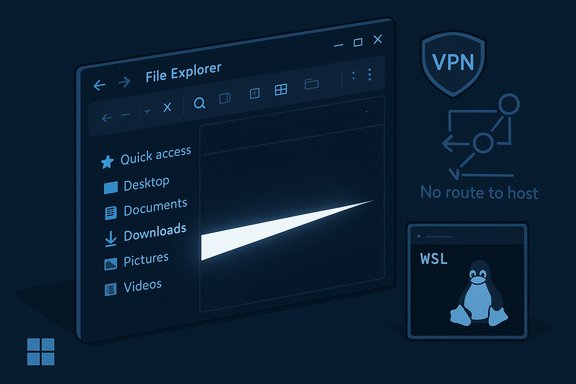
Microsoft has acknowledged that the December 9, 2025 cumulative update for Windows 11 (KB5072033, OS Builds 26200.7462 and 26100.7462) addresses a number of quality and security issues — and also that a separate, related regression continues to affect a narrow but important set of users, notably those using Windows Subsystem for Linux (WSL) in mirrored networking mode together with certain third‑party VPN clients.
Background
The December 2025 Patch Tuesday rollup — delivered as KB5072033 — consolidated fixes that followed the early‑December preview (KB5070311) and included both UI polishing and security hardening. Among the headline items in the release notes are improvements to File Explorer dark‑mode rendering, fixes to Copilot activation behavior, and several virtualization and networking bug fixes for enterprise scenarios.Shortly after the early December preview build (KB5070311) shipped, many users reported a regression in File Explorer: when File Explorer repainted (for example, when opening Home, Gallery, or creating a new tab) the window would briefly flash white before the dark UI finished rendering. That visual flash was widely reported as jarring, especially on OLED screens and when the system theme was set to dark. Microsoft listed the symptom in its known‑issues and then documented a fix for the flashing behavior in the cumulative KB5072033 release notes.
At the same time, Microsoft published a support advisory about an unrelated networking regression that surfaced after the October 28, 2025 non‑security update (KB5067036) and persisted through subsequent updates: when WSL is configured to use mirrored networking (
networkingMode=mirrored in %USERPROFILE%\.wslconfig) and a third‑party VPN is active, the WSL guest can lose connectivity to destinations that are reachable from the Windows host and show errors such as “No route to host.” Microsoft identified the root cause as the VPN client's virtual interface not responding to ARP (Address Resolution Protocol) requests from the mirrored WSL network, and called out Cisco Secure Client (formerly Cisco AnyConnect) and OpenVPN in user reports.What Microsoft documented (the official position)
Microsoft’s support documentation for KB5072033 lists the following, among other items:- File Explorer (known issue) — Fixed: the update addresses an issue where File Explorer briefly flashed white when navigating between pages.
- Mirrored networking on Windows Subsystem for Linux might fail: after the October 28, 2025 update (KB5067036) or later, mirrored networking in WSL may fail to work with some third‑party VPNs, producing “No route to host” inside WSL while the Windows host remains functional. Microsoft explains the observed cause as VPN virtual interfaces failing to answer ARP requests, and notes that the issue primarily affects enterprise VPN connectivity. The company states the issue is under investigation and will be addressed in a future update.
What users are seeing in the wild (verification and cross‑checks)
Independent reporting, user forum threads, and Microsoft’s community support pages corroborate several practical observations:- The white‑flash regression introduced in the early December preview was widely reported across multiple outlets and user communities. The cumulative KB5072033 release notes explicitly list a fix for the flashing, and many users confirm the most visible flashes (opening Home or Gallery) are gone after applying KB5072033.
- A residual visual artifact can remain for a very specific action: opening a new tab in File Explorer (Ctrl+T or clicking the + button) still triggers a brief re‑render that some users describe as a flash. That residual symptom is reported by several users and reproduced by some reviewers even after installing KB5072033, despite Microsoft’s description that the issue was addressed.
- The WSL mirrored‑networking regression is documented directly by Microsoft and echoed by enterprise administrators on tech forums. The symptom is deterministic in affected setups: the Windows host retains network access while the WSL guest, in
mirroredmode, reports ARP failures and cannot reach hosts through the VPN. - Several users have reported update installation failures or repeated install loops with KB5072033 on a subset of devices; community threads on Microsoft Q&A document error codes and troubleshooting attempts. Microsoft’s channels and community responses indicate that manual offline installation via the Microsoft Update Catalog or waiting for subsequent servicing updates are typical mitigation paths for installation anomalies.
Technical deep dive: why mirrored networking + VPN is brittle
WSL’s networking architecture historically used a NATed model where the Linux guest sits behind a virtual NAT, and outgoing traffic is translated through the Windows host. In late 2023 and through 2024–2025, Microsoft introduced mirrored networking as an alternative mode that attempts to mirror the host’s network interfaces into the WSL guest. That mode delivers benefits—IPv6 support, direct LAN IPs for WSL, improved compatibility in many complex networks, and the ability to bind to 127.0.0.1 for Windows services—because the guest is treated more like a first‑class participant on the same network.Mirrored networking depends on correct link‑layer behavior: the WSL guest needs the ability to resolve MAC addresses for gateway devices and to participate in ARP exchanges. Third‑party VPN clients commonly insert virtual network interfaces and modify routing and link behavior to steer traffic into encrypted tunnels. If a VPN client’s virtual adapter or stack does not respond to ARP probes in the way a mirrored guest expects, ARP resolution fails inside the guest and packets cannot be delivered to the gateway, even though Windows itself — handling traffic differently — continues to function normally.
Microsoft’s support notes explicitly say that the cause is that the VPN application’s virtual interface doesn’t respond to ARP requests. That is a precise network‑layer description and matches the symptoms (No route to host) reported by users.
Who is affected — scope and risk assessment
- Most home users are unlikely to be affected. Microsoft characterizes this as primarily an enterprise problem: it affects deployments where WSL has been intentionally configured to use mirrored networking and where third‑party enterprise VPN clients such as Cisco Secure Client or OpenVPN are in use.
- Developers and engineers who depend on WSL mirrored networking (for LAN‑facing servers, IPv6 testbeds, or to use 127.0.0.1 address behavior) are at the highest risk if they also require VPN access.
- Enterprise VPN, remote access, and security teams should treat this as a moderate‑to‑high operational risk when the combination of mirrored WSL + certain VPNs is in use in production or developer fleets.
- File Explorer white flashes are primarily a quality issue with accessibility implications (visual discomfort), especially on OLEDs and for users sensitive to bright flashes. While not a data‑integrity risk, it affects user experience and can be disruptive.
Practical mitigation steps (consumer and IT admin guidance)
The official guidance from Microsoft for the WSL mirrored networking issue is: the issue is under investigation and a resolution will be provided in a future update. That leaves administrators and developers to apply temporary mitigations.Recommended mitigations, ordered from least to most disruptive:
- Adjust WSL networking mode (fast, reversible)
- If you have
%USERPROFILE%\.wslconfigconfigured with[wsl2]andnetworkingMode=mirrored, change that setting back to NAT or remove thenetworkingModeline entirely to fall back to the default NAT behavior. - Steps:
- Open Notepad (or a text editor) and edit
%USERPROFILE%\.wslconfig. - Remove or change
networkingMode=mirroredunder the[wsl2]header. - Run
wsl --shutdownfrom an elevated PowerShell or Command Prompt to ensure WSL picks up the change. - Restart your WSL distro(s).
- Open Notepad (or a text editor) and edit
- Effect: WSL will revert to NATed networking; you lose the mirrored mode benefits (IPv6 direct addressing, 127.0.0.1 behavior), but connectivity through VPN should return for most setups.
- If you have
- Use Windows‑side tools instead of mirrored WSL networking
- Run test servers or VPN‑dependent tools on the Windows host or in a different VM where the VPN client is known to interoperate.
- For critical workflows (CI, deployment tests) consider using Hyper‑V virtual machines or cloud VMs until the fix arrives.
- Coordinate with VPN vendor / update client
- Check for updates to Cisco Secure Client, OpenVPN, or other enterprise VPN clients; vendors occasionally issue client updates to improve ARP/adapter behavior with modern Windows networking stacks.
- Work with corporate VPN teams to test alternative client versions or to temporarily switch to a different VPN implementation (including split‑tunneling where allowed).
- Avoid mirrored networking on managed developer workstations
- For enterprise fleets, make a conservative configuration decision: do not enable mirrored networking via standardized images or dotfiles until Microsoft issues a permanent fix.
- Use Known Issue Rollback (KIR) where applicable
- Microsoft provided group policy packages to temporarily disable problematic changes introduced by updates in some cases. Administrators able to deploy Group Policy or MDM configurations should review Microsoft’s guidance for Known Issue Rollback packages tied to the update family and apply the KIR only if it explicitly addresses a deployed change affecting their environment.
- For File Explorer white‑flash issues
- Ensure KB5072033 is installed. The cumulative release addresses the major white‑flash regression reported after the preview build. If you still see flashes on new tab creation, note this is a narrower residual symptom; there is not an alternate workaround other than temporarily switching system theme to Light mode if the visual artifact is unacceptable:
- Settings > Personalization > Colors > Choose your mode: Light.
- Report reproducible instances to Microsoft via the Feedback Hub so the telemetry can help prioritize a follow‑up correction.
- Ensure KB5072033 is installed. The cumulative release addresses the major white‑flash regression reported after the preview build. If you still see flashes on new tab creation, note this is a narrower residual symptom; there is not an alternate workaround other than temporarily switching system theme to Light mode if the visual artifact is unacceptable:
- Troubleshooting KB5072033 installation failures
- If Windows Update repeatedly fails to install KB5072033 on a device:
- Attempt manual installation using the offline MSU package from the Microsoft Update Catalog.
- Run standard servicing repairs:
DISM /Online /Cleanup-Image /RestoreHealthandsfc /scannow, then retry. - Use Windows Update troubleshooter and ensure device drivers (notably graphics drivers) are not blocking the update.
- As a last resort for problematic systems, pause cumulative updates until Microsoft publishes a servicing stack update or targeted fix.
- If Windows Update repeatedly fails to install KB5072033 on a device:
Enterprise deployment recommendations
- Test in your rings: Always validate cumulative updates like KB5072033 in a small pilot ring, focusing on systems that run WSL in mirrored mode, use corporate VPN clients, or are used for developer workstations and CI servers.
- Audit WSL usage: Inventory the fleet for machines with
%USERPROFILE%\.wslconfigcontainingnetworkingMode=mirrored. If mirrored networking is present and the device also uses an enterprise VPN, treat those systems as high priority for testing or remediation. - Coordinate with VPN vendors: Open support tickets with Cisco, OpenVPN, or other VPN suppliers. Provide vendor logs and Microsoft’s advisory details; vendors may already have or be preparing a client update.
- Use KIR selectively: If Microsoft supplies a Known Issue Rollback policy for the specific change causing pain in your environment, test and deploy it to affected devices rather than blocking the entire cumulative update rollout.
- Communicate with developers: Clearly inform developer teams about the risks of enabling mirrored networking in corporate laptops; provide a troubleshooting checklist and the steps to revert to NATed mode.
Analysis: strengths, gaps, and risk profile
- Strengths
- Microsoft moved quickly to both document the issues and ship a cumulative update (KB5072033) that addresses a high‑visibility UI regression. Publishing explicit, targeted support guidance and KIR artifacts shows an operational posture that prioritizes remediation while preserving deployment flexibility.
- The WSL mirrored networking model remains a strong architectural feature for developers who need direct network behavior—the underlying design intent (improved VPN compatibility, IPv6, and direct localhost semantics) is sound and valuable.
- Gaps and risks
- Mirrored networking interacts with third‑party VPN stacks in ways that expose brittle assumptions at the link layer; when multiple vendors modify low‑level networking, interactions can produce non‑obvious failures (ARP non‑responses) that are hard to diagnose remotely.
- Microsoft’s support advisory offers no immediate workaround beyond “under investigation,” which leaves some enterprise users without an official quick fix. While reverting WSL to NAT is possible, doing so reduces functionality and may break workflows that depend on mirrored mode semantics.
- Update installation anomalies reported by users (error codes and repeated failures) are a separate operational risk: incomplete or failed updates can leave machines in unstable states or delay security fixes. Administrators should watch update health and be ready to use offline installers or remediation commands.
- Broader implications
- This episode reinforces a recurring truth about modern desktop OS maintenance: changes intended to improve user experience (expanded dark mode coverage) or developer features (mirrored WSL networking) can have unintended side effects in complex environments. Enterprises that permit developer experimentation on managed devices increase the attack surface for update regressions.
What to watch next (timeline expectations and verification)
- Microsoft’s support materials indicate the mirrored networking bug is under active investigation. Historically, Microsoft schedules fixes for confirmed regressions in the next available Patch Tuesday (the second Tuesday of the month) when the change requires broader validation, but urgent out‑of‑band fixes are also possible for high‑impact issues. Organizations should expect telemetry and hotfix options to appear through Microsoft Update, Windows Server Update Services (WSUS), or as a Known Issue Rollback before a fully tested permanent change is deployed.
- For enterprises using mirrored networking at scale, follow both Microsoft’s release notes and vendor advisories from VPN manufacturers. If a definite fix date is required for planning, coordinate with Microsoft support channels and your VPN vendor contacts. Be cautious about assuming a particular Patch Tuesday date for the fix; do not schedule major rollouts until the update has been validated in your environment.
Final recommendations
- For individual developers affected by the WSL VPN issue: temporarily revert the
networkingModein%USERPROFILE%\.wslconfigto the default NAT networking andwsl --shutdown, or run the necessary services directly on Windows or a different VM until a fix is released. - For IT administrators: inventory mirrored networking usage, test KB5072033 in a controlled ring, and use Microsoft’s Known Issue Rollback or other configuration management tools if a specific change in the update causes unacceptable impact.
- For all users experiencing the File Explorer white flash: install KB5072033 to obtain the fix for the broad flashing regression; if you still see flashes when opening a new tab, report the exact reproduction steps via Feedback Hub to help Microsoft prioritize the residual symptom.
- Monitor official Microsoft support announcements and vendor advisories for a confirmed remediation timeline for the WSL mirrored networking bug, and prepare rollback or configuration changes as part of standard operational playbooks.
Microsoft’s December cumulative release shows both the benefits and fragility of continuous delivery: it patches high‑value user and security problems, but it also highlights how layered networking features like mirrored WSL can surface subtle interactions with third‑party networking stacks. For now, the practical path is visibility and containment: identify who is using mirrored networking, apply temporary mitigations (revert to NAT or use alternative environments), and keep a close watch on vendor updates and Microsoft’s follow‑up patches. The tradeoffs are clear — a small number of users lose a convenience feature for a short time while the engineering teams converge on a robust fix — but the operational impact can be meaningful for teams that depend on mirrored behavior. Careful testing and conservative deployment remain the best defense.
Source: Windows Latest Windows 11 KB5072033 issues: Microsoft confirms a bug affecting WSL and more
