

Windows Central tested Windows 11 on an 8GB RAM PC after Computex 2026 revived the argument over budget-premium laptops, finding that everyday browsing, writing, streaming, light editing, and multitasking remained usable despite the system’s constrained memory. The result does not prove that 8GB is suddenly generous. It does show that the old reflexive answer — “Windows 11 needs 16GB or don’t bother” — is becoming too blunt for the laptop market now forming around cheaper premium machines. The real story is not whether 8GB is good; it is whether PC makers can resist turning “good enough” into another excuse for bad configurations.
The argument over Windows 11 and 8GB of RAM is not new, but Computex 2026 gave it a new target. Dell’s revived XPS 13, pitched at $599 for students and $699 for everyone else, lands directly in the lane Apple opened with the MacBook Neo: affordable, polished, deliberately limited, and designed to make the cheap laptop feel less cheap.
That is where the fight starts. If Apple ships an 8GB MacBook, many buyers assume the company has balanced the hardware and software tightly enough to make the number work. If a Windows OEM ships an 8GB laptop, Windows veterans remember years of bargain-bin machines clogged with trialware, slow storage, anaemic processors, and update churn.
The Windows Central test matters because it challenges the lazy version of that criticism. Cale Hunt did not test an idealized flagship laptop with fast integrated memory. He used an older desktop with a Core i5-10400 and a single stick of DDR4-2666, a setup with far less memory bandwidth than the upcoming XPS 13’s integrated LPDDR5x design.
That makes the result more interesting, not less. If Windows 11 can feel tolerable on a worse memory subsystem while running the kind of workload a student or general user might actually use, then the blanket dismissal of 8GB Windows laptops needs revision. But revision is not absolution.
But idle memory readings are a poor proxy for user experience. Modern operating systems cache aggressively, browsers suspend tabs, and applications do not all demand peak memory at the same time. The number that matters is not whether Task Manager looks tidy; it is whether the machine starts paging itself into misery when ordinary work begins.
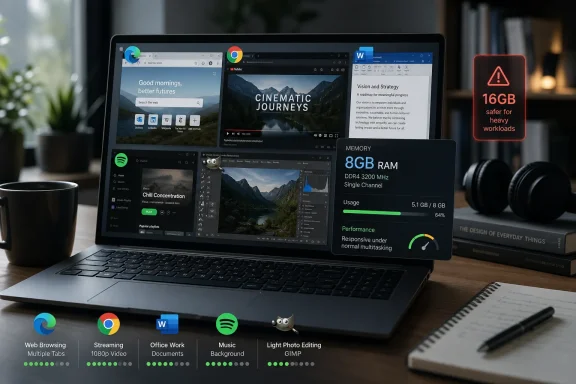
In Hunt’s browser test, Microsoft Edge with 10 tabs — including YouTube at 4K, Netflix, Gmail, Reddit, Airtable, a content management system, and general pages — pushed usage to about 6.6GB. Closing the 4K YouTube tab dropped memory use to around 5.7GB, and general poking around stayed in the 5.7GB to 6.0GB range.
That is not luxurious headroom. It is also not the catastrophe many people assume. For a student juggling research tabs, email, music, documents, and a learning platform, the difference between “full” and “unusable” is larger than raw RAM arithmetic implies.
The more revealing stage came when GIMP, Spotify, and Microsoft Word joined the browser load. Memory climbed to roughly 7.2GB, and the system reportedly stayed responsive. The 4K video stream became choppy, but the older CPU and integrated graphics were the more likely villains there than RAM alone.
That cuts both ways. On one hand, browser workloads are often more forgiving than old assumptions suggest. Tabs can sleep, web apps can reload, and cloud services can offload tasks that once required heavyweight local software.
On the other hand, the browser is also a memory monster wearing productivity software’s clothes. A “light” workload can become heavy quickly when a student opens 30 tabs, keeps a video call running, edits a group presentation, streams music, and leaves half a dozen Electron apps in the background.
The Windows Central test is persuasive because it reflects a sane mainstream workload, not because it proves 8GB is future-proof. It says Windows 11 is usable with 8GB when the PC is reasonably configured and the user’s needs stay within mainstream productivity. That is a narrower claim than the comment-section version, but it is a much more useful one.
It also gives Microsoft and OEMs less room to hide. If 8GB machines can be enjoyable, then the problem shifts from the Windows kernel to the full commercial stack installed around it. A clean 8GB laptop with fast memory and storage may be fine; an 8GB laptop with bloated background services, vendor telemetry, trial antivirus, RGB utilities, cloud sync agents, and aggressive update jobs may not be.
For years, Windows buyers had a choice that felt rigged. Spend real money and get something good, or save money and accept plastic, dim displays, noisy fans, weak batteries, poor trackpads, and configurations that aged badly almost on arrival. Apple exploited that opening by making the cheapest MacBook feel like part of the same family as the expensive ones.
Dell’s Computex pitch appears to understand that lesson. The XPS 13 is being positioned as a premium-feeling machine with an aggressive student price, long battery life ambitions, modern silicon, and a design meant to compete with the MacBook Neo rather than the bargain aisle.
That makes the baseline RAM decision more consequential. An 8GB XPS 13 is not a random budget laptop forgotten on a retailer shelf. It is a statement about what Dell believes is acceptable for a mainstream premium Windows experience in 2026.
The charitable reading is that Dell is right-sizing the entry model for students and general users who mostly write, browse, stream, call, and do light creative work. The cynical reading is that the industry has found a way to preserve low headline prices during a component-cost squeeze while upselling cautious buyers to 16GB.
Both readings can be true. That is what makes this moment uncomfortable.
The old rule of thumb was simple: 8GB was the floor, 16GB was the sensible buy, and anything below 8GB belonged in a landfill or a kiosk. Then Apple normalized a premium-feeling 8GB laptop again, and suddenly Windows OEMs had a comparison point that sounded less embarrassing.
But Apple’s memory story has always been different in ways that are both real and overmarketed. Unified memory, tight control over hardware, fewer OEM background utilities, and a narrower platform matrix can help Apple deliver a smoother experience at a given RAM capacity. That does not mean macOS bends physics. It does mean Apple usually owns more of the variables that determine how constrained memory feels.
Windows has the opposite problem. Its strength is breadth: many OEMs, many price points, many drivers, many peripherals, many enterprise agents, many weird workloads. That breadth also means a Windows 11 laptop with 8GB can be anything from pleasantly efficient to miserable depending on the vendor image and the user’s software stack.
So the correct comparison is not “macOS good, Windows bad.” It is that Apple sells a controlled appliance, while Windows OEMs sell a platform dressed as a product. If Dell wants the XPS 13 to compete with the MacBook Neo, it has to make the baseline model feel like an engineered configuration, not just the cheapest SKU that marketing could tolerate.
For Word, Edge, streaming, Spotify, light image editing, and ordinary multitasking, 8GB can work. For large creative projects, virtual machines, software development stacks, local AI tools, modern games, heavy Teams meetings, big spreadsheets, browser tab hoarding, and multi-monitor enterprise workflows, it can become tight fast.
The machine may not fail dramatically. Instead, it gets subtly worse. Apps reload more often. Switching tasks hesitates. Browser tabs wake slowly. Updates feel heavier. Storage wear increases if paging is constant. The PC still works, but the premium illusion thins.
That matters because laptops are not bought for a benchmark day. They are bought for three, four, or five years of accumulating updates, browser bloat, background agents, and user habits. An 8GB laptop that feels “not only viable but quite enjoyable” in June 2026 may feel less charming in late 2028 after several feature updates and a semester’s worth of installed utilities.
This is where buyers need honesty from reviewers and vendors. “Usable” is not the same as “recommended.” “Fine for students” is not the same as “fine for every student.” A first-year humanities major living in Edge and Word is not the same as an engineering student running IDEs, CAD viewers, WSL, Teams, and a dozen browser tabs tied to lab systems.
That history is why enthusiasts distrust 8GB. The number itself is not the whole indictment. It is a symbol of a broader pattern in which Windows PCs are sold by headline price first and lived experience second.
The new wave of 8GB premium-budget laptops can avoid that fate, but only if OEMs treat 8GB as a disciplined configuration. That means fast memory, fast storage, clean images, restrained startup apps, efficient firmware, and no shovelware. It also means clear upgrade paths where possible, or at least honest SKUs that do not hide the cost of choosing 16GB.
The XPS 13 has one advantage over many older cheap Windows laptops: it is being discussed as a complete product, not a parts-bin compromise. If Dell pairs 8GB with modern LPDDR5x memory and a competent SSD, the user experience can be far better than the number suggests.
But soldered memory changes the moral math. If the RAM cannot be upgraded later, the baseline model is not just a cheaper starting point. It is a permanent bet on what the buyer’s workload will look like for the life of the machine.
The company cannot simply point to minimum requirements and declare victory. The lived Windows experience includes updates, Defender, OneDrive, Edge, Widgets, Teams components, OEM services, drivers, and whatever retailers or vendors add before the box reaches the buyer.
If 8GB is returning to respectable laptops, Microsoft should treat it as a platform quality problem. Memory pressure should influence default behavior. Background tasks should be smarter on constrained systems. OEM preload policies should be stricter for machines marketed as streamlined student devices.
This is not about making Windows tiny. It is about making Windows adaptive. A system with 8GB should not behave like a 32GB developer workstation with more headroom than sense. The OS should know when it is in a constrained envelope and act accordingly.
There is also a Copilot-era tension here. Microsoft and its partners are pushing AI-branded experiences, richer background services, and more local intelligence. Those ambitions do not become free just because a laptop is affordable. If the next wave of Windows features assumes more memory while the next wave of affordable premium laptops ships with less, users will feel the contradiction before marketing does.
The next step is testing shipping 8GB laptops, not approximations. The new XPS 13 and Acer Swift Air 14 will need reviews that examine cold boot behavior, resume performance, browser pressure, Teams calls, Office apps, update installation, storage paging, battery life under memory pressure, and performance after OEM services settle in.
Reviewers should also test the baseline configuration, not only the 16GB or 32GB model vendors prefer to seed. The difference matters most exactly where review samples often avoid it: the cheapest version that produces the headline price.
There is a tendency in tech coverage to turn every spec dispute into a culture war. Mac versus PC. Enthusiast versus normie. “Real work” versus “just browsing.” The better frame is simpler: what does this configuration let a buyer do comfortably, for how long, and at what point does the vendor’s upsell become the wiser purchase?
For WindowsForum readers, that distinction is practical. Many of us are the people relatives, schools, small businesses, and departments ask before buying machines. The right answer will not always be “avoid 8GB.” It will often be “8GB is acceptable only if the rest of the machine is good and the workload is honest.”
A well-built 8GB laptop can be a good everyday computer. A poorly configured one can revive every bad memory of cheap Windows hardware. The buyer’s job is to distinguish the two before the return window closes.
 The 8GB Debate Is Really a Fight About Trust
The argument over Windows 11 and 8GB of RAM is not new, but Computex 2026 gave it a new target. Dell’s revived XPS 13, pitched at $599 for students and $699 for everyone else, lands directly in the lane Apple opened with the MacBook Neo: affordable, polished, deliberately limited, and designed to make the cheap laptop feel less cheap.That is where the fight starts. If Apple ships an 8GB MacBook, many buyers assume the company has balanced the hardware and software tightly enough to make the number work. If a Windows OEM ships an 8GB laptop, Windows veterans remember years of bargain-bin machines clogged with trialware, slow storage, anaemic processors, and update churn.
The Windows Central test matters because it challenges the lazy version of that criticism. Cale Hunt did not test an idealized flagship laptop with fast integrated memory. He used an older desktop with a Core i5-10400 and a single stick of DDR4-2666, a setup with far less memory bandwidth than the upcoming XPS 13’s integrated LPDDR5x design.
That makes the result more interesting, not less. If Windows 11 can feel tolerable on a worse memory subsystem while running the kind of workload a student or general user might actually use, then the blanket dismissal of 8GB Windows laptops needs revision. But revision is not absolution.
Windows 11 Did Not Magically Become Lightweight
The test begins from a familiar place: Windows 11 idling at around 3.8GB of RAM. That number is enough to make any sysadmin twitch, because it suggests almost half the available memory is gone before the user has done anything meaningful.But idle memory readings are a poor proxy for user experience. Modern operating systems cache aggressively, browsers suspend tabs, and applications do not all demand peak memory at the same time. The number that matters is not whether Task Manager looks tidy; it is whether the machine starts paging itself into misery when ordinary work begins.
In Hunt’s browser test, Microsoft Edge with 10 tabs — including YouTube at 4K, Netflix, Gmail, Reddit, Airtable, a content management system, and general pages — pushed usage to about 6.6GB. Closing the 4K YouTube tab dropped memory use to around 5.7GB, and general poking around stayed in the 5.7GB to 6.0GB range.
That is not luxurious headroom. It is also not the catastrophe many people assume. For a student juggling research tabs, email, music, documents, and a learning platform, the difference between “full” and “unusable” is larger than raw RAM arithmetic implies.
The more revealing stage came when GIMP, Spotify, and Microsoft Word joined the browser load. Memory climbed to roughly 7.2GB, and the system reportedly stayed responsive. The 4K video stream became choppy, but the older CPU and integrated graphics were the more likely villains there than RAM alone.
The Browser Is the Operating System Now
This is why the 8GB debate has become so slippery. For many mainstream buyers, the operating system is increasingly just a launcher for browser workloads. Edge, Chrome, Teams, Slack, Gmail, Canva, Office web apps, learning portals, and streaming sites are the real daily environment.That cuts both ways. On one hand, browser workloads are often more forgiving than old assumptions suggest. Tabs can sleep, web apps can reload, and cloud services can offload tasks that once required heavyweight local software.
On the other hand, the browser is also a memory monster wearing productivity software’s clothes. A “light” workload can become heavy quickly when a student opens 30 tabs, keeps a video call running, edits a group presentation, streams music, and leaves half a dozen Electron apps in the background.
The Windows Central test is persuasive because it reflects a sane mainstream workload, not because it proves 8GB is future-proof. It says Windows 11 is usable with 8GB when the PC is reasonably configured and the user’s needs stay within mainstream productivity. That is a narrower claim than the comment-section version, but it is a much more useful one.
It also gives Microsoft and OEMs less room to hide. If 8GB machines can be enjoyable, then the problem shifts from the Windows kernel to the full commercial stack installed around it. A clean 8GB laptop with fast memory and storage may be fine; an 8GB laptop with bloated background services, vendor telemetry, trial antivirus, RGB utilities, cloud sync agents, and aggressive update jobs may not be.
Dell Is Selling a Feeling, Not a Spec Sheet
The new XPS 13 is not important simply because it starts at 8GB. It is important because Dell is trying to make the entry-level Windows laptop aspirational again.For years, Windows buyers had a choice that felt rigged. Spend real money and get something good, or save money and accept plastic, dim displays, noisy fans, weak batteries, poor trackpads, and configurations that aged badly almost on arrival. Apple exploited that opening by making the cheapest MacBook feel like part of the same family as the expensive ones.
Dell’s Computex pitch appears to understand that lesson. The XPS 13 is being positioned as a premium-feeling machine with an aggressive student price, long battery life ambitions, modern silicon, and a design meant to compete with the MacBook Neo rather than the bargain aisle.
That makes the baseline RAM decision more consequential. An 8GB XPS 13 is not a random budget laptop forgotten on a retailer shelf. It is a statement about what Dell believes is acceptable for a mainstream premium Windows experience in 2026.
The charitable reading is that Dell is right-sizing the entry model for students and general users who mostly write, browse, stream, call, and do light creative work. The cynical reading is that the industry has found a way to preserve low headline prices during a component-cost squeeze while upselling cautious buyers to 16GB.
Both readings can be true. That is what makes this moment uncomfortable.
Apple Changed the Permission Structure
The MacBook Neo looms over this discussion even when the article is explicitly about Windows. Apple’s move gave the PC industry cover to return to 8GB configurations in machines that otherwise present themselves as modern and desirable.The old rule of thumb was simple: 8GB was the floor, 16GB was the sensible buy, and anything below 8GB belonged in a landfill or a kiosk. Then Apple normalized a premium-feeling 8GB laptop again, and suddenly Windows OEMs had a comparison point that sounded less embarrassing.
But Apple’s memory story has always been different in ways that are both real and overmarketed. Unified memory, tight control over hardware, fewer OEM background utilities, and a narrower platform matrix can help Apple deliver a smoother experience at a given RAM capacity. That does not mean macOS bends physics. It does mean Apple usually owns more of the variables that determine how constrained memory feels.
Windows has the opposite problem. Its strength is breadth: many OEMs, many price points, many drivers, many peripherals, many enterprise agents, many weird workloads. That breadth also means a Windows 11 laptop with 8GB can be anything from pleasantly efficient to miserable depending on the vendor image and the user’s software stack.
So the correct comparison is not “macOS good, Windows bad.” It is that Apple sells a controlled appliance, while Windows OEMs sell a platform dressed as a product. If Dell wants the XPS 13 to compete with the MacBook Neo, it has to make the baseline model feel like an engineered configuration, not just the cheapest SKU that marketing could tolerate.
8GB Is Enough Until It Suddenly Is Not
The most important caveat in Hunt’s experiment is that he avoided specialized software and demanding games. That is not a flaw in the test; it is the boundary of the conclusion.For Word, Edge, streaming, Spotify, light image editing, and ordinary multitasking, 8GB can work. For large creative projects, virtual machines, software development stacks, local AI tools, modern games, heavy Teams meetings, big spreadsheets, browser tab hoarding, and multi-monitor enterprise workflows, it can become tight fast.
The machine may not fail dramatically. Instead, it gets subtly worse. Apps reload more often. Switching tasks hesitates. Browser tabs wake slowly. Updates feel heavier. Storage wear increases if paging is constant. The PC still works, but the premium illusion thins.
That matters because laptops are not bought for a benchmark day. They are bought for three, four, or five years of accumulating updates, browser bloat, background agents, and user habits. An 8GB laptop that feels “not only viable but quite enjoyable” in June 2026 may feel less charming in late 2028 after several feature updates and a semester’s worth of installed utilities.
This is where buyers need honesty from reviewers and vendors. “Usable” is not the same as “recommended.” “Fine for students” is not the same as “fine for every student.” A first-year humanities major living in Edge and Word is not the same as an engineering student running IDEs, CAD viewers, WSL, Teams, and a dozen browser tabs tied to lab systems.
The Real Villain Is the Bad Baseline PC
The Windows ecosystem has a long habit of turning acceptable minimums into user-hostile products. Four gigabytes of RAM was once defensible for certain tasks, then lingered far too long in machines that had no business running a modern Windows workload. Slow eMMC storage did similar damage: it allowed OEMs to advertise usable-looking specs while shipping devices that collapsed under updates.That history is why enthusiasts distrust 8GB. The number itself is not the whole indictment. It is a symbol of a broader pattern in which Windows PCs are sold by headline price first and lived experience second.
The new wave of 8GB premium-budget laptops can avoid that fate, but only if OEMs treat 8GB as a disciplined configuration. That means fast memory, fast storage, clean images, restrained startup apps, efficient firmware, and no shovelware. It also means clear upgrade paths where possible, or at least honest SKUs that do not hide the cost of choosing 16GB.
The XPS 13 has one advantage over many older cheap Windows laptops: it is being discussed as a complete product, not a parts-bin compromise. If Dell pairs 8GB with modern LPDDR5x memory and a competent SSD, the user experience can be far better than the number suggests.
But soldered memory changes the moral math. If the RAM cannot be upgraded later, the baseline model is not just a cheaper starting point. It is a permanent bet on what the buyer’s workload will look like for the life of the machine.
Microsoft Has to Own the Low End Again
Microsoft’s role in this is awkward. Windows 11 can run on 8GB. Microsoft also benefits when OEMs produce attractive, affordable machines that can fight Apple in schools, dorm rooms, and coffee shops. But Windows’ reputation is damaged when those machines age poorly or ship with bad defaults.The company cannot simply point to minimum requirements and declare victory. The lived Windows experience includes updates, Defender, OneDrive, Edge, Widgets, Teams components, OEM services, drivers, and whatever retailers or vendors add before the box reaches the buyer.
If 8GB is returning to respectable laptops, Microsoft should treat it as a platform quality problem. Memory pressure should influence default behavior. Background tasks should be smarter on constrained systems. OEM preload policies should be stricter for machines marketed as streamlined student devices.
This is not about making Windows tiny. It is about making Windows adaptive. A system with 8GB should not behave like a 32GB developer workstation with more headroom than sense. The OS should know when it is in a constrained envelope and act accordingly.
There is also a Copilot-era tension here. Microsoft and its partners are pushing AI-branded experiences, richer background services, and more local intelligence. Those ambitions do not become free just because a laptop is affordable. If the next wave of Windows features assumes more memory while the next wave of affordable premium laptops ships with less, users will feel the contradiction before marketing does.
Reviewers Need to Test the Machines People Actually Buy
One useful thing about the Windows Central piece is its refusal to treat the 8GB question as purely theoretical. It took the kind of forum argument that usually dies in abstractions and put it against a visible workload.The next step is testing shipping 8GB laptops, not approximations. The new XPS 13 and Acer Swift Air 14 will need reviews that examine cold boot behavior, resume performance, browser pressure, Teams calls, Office apps, update installation, storage paging, battery life under memory pressure, and performance after OEM services settle in.
Reviewers should also test the baseline configuration, not only the 16GB or 32GB model vendors prefer to seed. The difference matters most exactly where review samples often avoid it: the cheapest version that produces the headline price.
There is a tendency in tech coverage to turn every spec dispute into a culture war. Mac versus PC. Enthusiast versus normie. “Real work” versus “just browsing.” The better frame is simpler: what does this configuration let a buyer do comfortably, for how long, and at what point does the vendor’s upsell become the wiser purchase?
For WindowsForum readers, that distinction is practical. Many of us are the people relatives, schools, small businesses, and departments ask before buying machines. The right answer will not always be “avoid 8GB.” It will often be “8GB is acceptable only if the rest of the machine is good and the workload is honest.”
The XPS 13 Argument Leaves a Paper Trail Buyers Can Use
The emerging lesson from this test is neither triumphalist nor alarmist. Windows 11 on 8GB is not doomed, but the margin for abuse is smaller than on a 16GB machine.A well-built 8GB laptop can be a good everyday computer. A poorly configured one can revive every bad memory of cheap Windows hardware. The buyer’s job is to distinguish the two before the return window closes.
- Windows 11 can remain responsive on 8GB of RAM for mainstream browsing, writing, streaming, music, and light image editing.
- The Windows Central test used older, slower desktop memory, which makes the positive result more notable but not a substitute for testing the actual 2026 XPS 13.
- An 8GB laptop is most defensible when paired with fast memory, fast storage, a clean software image, and a realistic workload.
- Buyers who expect gaming, development, virtual machines, heavy creative work, large spreadsheets, or years of demanding multitasking should still treat 16GB as the safer floor.
- OEMs that ship soldered 8GB memory are making a permanent decision for the buyer, so the baseline model deserves more scrutiny than a removable-memory budget PC.
- Microsoft and PC makers must keep background services and preload software under control if they want 8GB Windows laptops to feel premium rather than merely cheap.
References
- Primary source: Windows Central
Published: Thu, 11 Jun 2026 16:00:00 GMT
"Not only viable but quite enjoyable": I used Windows 11 with 8GB of RAM to see if it's as bad as everyone says | Windows Central
Windows 11 gets a lot of flak for its RAM appetite, but the reality probably isn't quite what you think.www.windowscentral.com - Related coverage: notebookcheck.com
Dell XPS 13: Besser als das MacBook Neo – doch Zweifel an Windows 11 mit 8 GB RAM - Notebookcheck News
Der Windows-Laptop-Markt erhält mit dem neuen Dell XPS 13 endlich einen Konkurrenten zum Apple MacBook Neo. Das neueste XPS 13 ist ab 699 US-Dollar/ca. 600 Euro (599 US-Dollar/rund 510 Euro für Studierende) erhältlich, besteht aus hochwertigen Materialien und ist besonders leicht. Allerdings... www.notebookcheck.com
- Related coverage: tomsguide.com
Windows laptops are entering their MacBook Neo era, but is Windows 11 actually ready for it? 8GB of RAM has me worried | Tom's Guide
Windows laptops are fighting back against the MacBook Neo, but Windows 11 needs to lose weight fast for 8GB of RAM!www.tomsguide.com - Related coverage: techradar.com
The MacBook Neo kickstarted an 8GB RAM trend — and seeing new Windows 11 laptops from Dell, Acer, and Microsoft following its lead has me worried | TechRadar
Bringing that question back under the spotlight: is 8GB still enough?www.techradar.com - Related coverage: pcworld.com
Dell copied Apple’s best MacBook Neo ideas. Windows may ruin it | PCWorld
Dell’s new XPS 13 borrows the MacBook Neo’s best ideas with premium hardware, long battery life, and a sharp OLED screen. But with only 8GB of RAM, Windows may still keep it from matching Apple’s budget laptop breakthrough.www.pcworld.com - Related coverage: computerbase.de
Dell XPS 13 im Hands-on: Hochwertiges Notebook, aber der RAM wird schnell knapp - ComputerBase
Das XPS 13 soll es mit dem MacBook Neo aufnehmen. Das Notebook ist hochwertig und fühlt sich schnell an, dennoch ist der RAM knapp bemessen.www.computerbase.de
- Related coverage: notebookcheck.net
"Dell made a better MacBook Neo" with new XPS 13 but users are concerned about Windows 11 on 8 GB RAM - Notebookcheck News
The Windows laptop space finally has a competitor to the Apple MacBook Neo with the new Dell XPS 13. The latest XPS 13 starts at $699 ($599 for students), is made from high-quality materials, and is super light. However, consumers are worried Windows 11 won't run well on just 8 GB of RAM. www.notebookcheck.net
- Official source: blogs.windows.com
Computex 2026: Empowering a billion users with Windows across the ecosystem
Computex has always been one of the most important moments of the year for the PC industry — a stage where our partners come together to show what is next for hardware, silicon and the experiences they unlock. This year our partner ecosystem is shablogs.windows.com
